


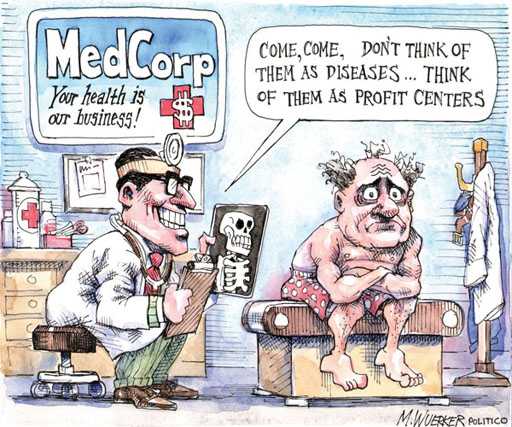
Cartoon – Skinny Health Plan Coverage
https://mailchi.mp/26f8e4c5cc02/the-weekly-gist-july-16-2021?e=d1e747d2d8

Senate Democrats announced a compromise budget framework to fund President Biden’s social spending plans to the tune of $3.5T, including substantial money for some of the administration’s key healthcare priorities. The framework sends instructions to several Senate committees, including the Budget and Finance panels, to craft legislative language around the central components of the deal, with the goal of passing a spending package before next month’s recess.
Many specifics remain to be ironed out in negotiations among the party’s progressive and moderate camps, but some of the main elements of the deal became clear this week. The plan includes extending the enhanced subsidies for purchasing individual coverage on the healthcare marketplaces, which were implemented earlier this year as part of the American Rescue Plan Act. It would also seek to close the so-called “Medicaid coverage gap”, by providing new coverage options for low-income adults in states that did not expand Medicaid under the Affordable Care Act (ACA).
New investments would be made in home- and community-based services for long-term care, along the lines of the $400B proposed in President Biden’s American Families Plan. And the budget deal envisions expanding benefits in the Medicare program to include dental, vision, and hearing services. Given the budgetary concerns of moderate Democratic lawmakers like Sen. Joe Manchin (WV), one critical question will be how the $3.5T deal will be paid for. One likely source of funding for the deal will be reforming the way Medicare purchases prescription drugs, making that long-time Democratic policy objective a probable part of any final package.
Notably absent from the healthcare spending proposals: lowering the eligibility age for Medicare from 65 to 60. No final decision has been reached on whether to incorporate such a move; rather, the question will be sent to the Senate Finance Committee for consideration. Given the urgency of passing as much of the Biden administration’s legislative agenda as possible before the midterm campaign season begins in earnest, we think it’s unlikely that Democrats will be willing to cross the Rubicon of Medicare expansion at this point.
The prospect of having to gain support from all 50 Democratic senators—as zero Republicans are expected to support the package—will likely temper any appetite for picking a fight with the influential hospital and physician industries, which have strongly opposed Medicare expansion.
One longer-term implication of the apparent decision to favor expansion of Medicare benefits over lowering the Medicare eligibility age now: a richer package of services in traditional Medicare might make Medicare Advantage (MA) a less attractive alternative for potential enrollees and could undermine any future efforts to create an “MA buy-in” for coverage expansion.
Expect lobbying and negotiations to reach a furious pace over the next several weeks, as lawmakers work out the final details of the $3.5T spending plan.
https://mailchi.mp/26f8e4c5cc02/the-weekly-gist-july-16-2021?e=d1e747d2d8
We’ve been working with a CEO and his strategy team around their health system’s five-year strategic plan. It’s still early in development, and they’re considering some bold moves. Given that some of the ideas are disruptive, he astutely observed they needed to bring a clinical leader into the process before the strategy is fully developed, but he’s having trouble identifying the right physician to be part of the very small executive working group.
We began listing the important attributes, creating a rough job description for a “clinician strategist”: the ability to consider clinical and operational implications but not get bogged down in details; bold, big-picture thinking and a willingness to take risks; strong communication and leadership skills.
As the list grew longer, we began to wonder if we were really telling the CEO to chase a unicorn. Some of the characteristics that typically make for an outstanding clinician—reliance on data and evidence, lower risk tolerance—might conflict with embracing disruptive change. Much of strategic decision making is about finding “80-20” compromises, while doctors often tend to get bogged down in detail (for good reason) and are quick to poke holes.
And our ideal physician strategist, out of a desire to safeguard patient care, might sometimes find that the strategy team isn’t adequately considering the ramifications for quality and safety. Finding a physician leader who also has the skills of a chief strategy officer is indeed a rare thing. It’s probably a better bet to identify early-career doctors who have the right mindset and an interest in strategy and help them develop their leadership skills over time.
Regardless, this CEO’s instinct was correct. Bringing doctors into the strategy-setting process early is crucial, even if the perfect clinician strategist might prove difficult to find.
https://mailchi.mp/26f8e4c5cc02/the-weekly-gist-july-16-2021?e=d1e747d2d8

One of the underappreciated ways in which health systems create value in our healthcare economy, as was recently the topic of discussion with the CEO of an organization we work with, is their role as a “safety net”. We weren’t talking about safety-net providers in the traditional sense—those which serve low-income populations. Rather, we were talking about the ability of larger health systems to acquire and invest in smaller hospitals that might otherwise risk going out of business entirely due to economic pressures.
When economic shocks hit, as was recently the case with COVID, we often see firms close; think of all the restaurant and hospitality businesses forced to shut down over the past year. As the economy rebounds, new business spring up to take their places—that kind of “creative destruction” is commonplace in the larger economy. But when a hospital is forced to shut its doors, it’s a different story, one that could be potentially disastrous for the community.
Often the most economically vulnerable hospitals are sole providers for their communities; without them, critical medical services could be much less accessible for patients. Enter multi-hospital health systems, which have often stepped in to acquire hospitals in jeopardy.
By providing access to capital, technology, and management infrastructure, systems have probably kept hundreds of such smaller hospitals in business over the past several decades. Policy analysts are quick to criticize health systems for value destruction: leveraging scale to raise prices, and so forth.
Often valid criticism, but it would be myopic to overlook the fact that systems have also allowed many vulnerable communities to retain access to a viable local hospital. The pushback is often to posit that we simply have too many hospitals to begin with—but try telling that to patients and communities who have lost access to their local source of care.
https://mailchi.mp/26f8e4c5cc02/the-weekly-gist-july-16-2021?e=d1e747d2d8

An estimate from the Partnership for America’s Healthcare Future predicts that nearly four out of five 60- to 64-year-olds would enroll in Medicare, with two-thirds transitioning from existing commercial plans, if “Medicare at 60” becomes a reality.
In the graphic above, we’ve modeled the financial impact this shift would have on a “typical” five-hospital health system, with $1B in revenue and an industry-average two percent operating margin.
If just over half of commercially insured 60- to 64-year-olds switch to Medicare, the health system would see a $61M loss in commercial revenue.
There would be some revenue gains, especially from patients who switch from Medicaid, but the net result of the payer mix shift among the 60 to 64 population would be a loss of $30M, or three percent of annual revenue, large enough to push operating margin into the red, assuming no changes in cost structure. (Our analysis assumed a conservative estimate for commercial payment rates at 240 percent of Medicare—systems with more generous commercial payment would take a larger hit.)
Coming out of the pandemic, hospitals face rising labor costs and unpredictable volume in a more competitive marketplace. While “Medicare at 60” could provide access to lower-cost coverage for a large segment of consumers, it would force a financial reckoning for many hospitals, especially standalone hospitals and smaller systems.


Legacy health brands are losing their significance as healthcare consumers place higher value on convenience than reputation. That’s the idea behind a July 1 tweet by Sachin Jain, MD, the CEO of Scan Group and Scan Health Plan.
“We are in an era of the declining significance of big healthcare brands,” he said.
To Dr. Jain, big healthcare brands are the ones commonly known for being the best in a specific specialty or renowned in their region. While many big healthcare brands have high quality performance metrics to hang their clout on, Dr. Jain believes reliance on name alone is problematic.
“There’s been an arrogance by a lot of healthcare organizations that have kind of sold on brand. There’s going to be a reckoning for some of those organizations. My personal view is that the next generation of healthcare consumers is going to be less aligned to think about brands in the same way,” Dr. Jain told Becker’s.
Today’s patients are paying more attention to convenience, digital access and price than reputation. Cost of care, ease of scheduling and accessibility are beating out recognition, Dr. Jain said.
At Scan, Dr. Jain said the Long Beach, Calif.-based Medicare Advantage insurer that serves more than 220,000 members is hyperfocused on staying as human as possible and fulfilling unmet needs for its community.
“Elite healthcare brands are entering this fun phase where they are becoming underdogs. They need to have a chip on their shoulders almost to thrive and perform in this next phase,” Dr. Jain said. “Because I’m not sure payers are necessarily going to continue to pay the same premiums per brand.”
 HENRY KOTULA