Just a month ago, even as signs of a fourth wave of COVID-19 infections in the U.S. were blossoming in the lower Midwest, the memory of a long, miserable winter kept us warm. Even places with burgeoning case rates were far below their catastrophic peaks over the holidays, when a combination of cold weather and defiant travelers contributed to a third wave in infections and deaths that drowned out the previous two spikes in April and July of 2020.
This is regrettably no longer the case. In four states—Hawaii, Louisiana, Mississippi and Florida—the current number of daily new COVID-19 infections, averaged across seven days, has surpassed that winter peak, even with a substantial percentage of the population having received a complete dosage of the COVID-19 vaccine (though not nearly as many as public officials would prefer).
Hawaii is something of an anomaly, as its winter peak was not nearly as high as in colder, more accessible regions. But several other states threaten to join this quartet in the near future. Oregon’s daily rate of new infections is at 36.5 per 100,000 residents, or 99% of the peak value on Dec. 3, 2020. Nationwide, the rate is 37.7, just under 50% of the winter peak of 76.5.
What is perhaps most sobering about this surge is that COVID-19-related deaths, which typically lag behind case surges by about two weeks, are starting to rise again. No state has yet surpassed the winter peak in deaths, but at 65%, Louisiana very well may. That figure is still 15% nationwide, well below the Jan. 13, 2021 peak of 1.04 fatalities per 100,000 people. It is currently at 0.16.
When it comes to the pandemic, no one wants to sound like Chicken Little. The sky might not be falling. But neither is the national case rate, or the number of people dying.
Dr. Jesse O’Shea, an infectious disease physician, posted this x-ray showing the difference between two of his patients; one with and one without the vaccination. Very telling and compelling visual, and we wanted to share.
To follow his page, please visit: https://www.instagram.com/jesseosheamd“A Story of Two Chest X-Rays. One patient with a vaccine and one patient without. Version 2—for the crowd that wants specifics without violating patient privacy (these are published cases).
The top picture is a 47-year-old man who received Pfizer vaccine (1) and developed COVID19 2 weeks after. He was overweight (BMI = 29), but without any known comorbidities. He had runny nose, mild body aches, mild cough. His chest X ray is relatively normal.
The bottom picture is a 50-year-old active female patient without obesity and not on medications. Her chest X-ray shows diffuse opacities, consolidations in both lungs with lung damage (all the fluffy white) and a pattern that looks like the worst feared complication of COVID19—acute respiratory distress syndrome (ARDS). She needed intubation, mechanical ventilation, and ECMO (extra-corporal membrane oxygenation) – the most life support we can offer.
The mRNA vaccines are effective at preventing severe disease and death— even with the Delta variant.
Our ICUs are starting to fill up with unvaccinated COVID19 patients again.
“To my fellow healthcare workers, keep your head up!”
40% of primary care clinicians worry that the field won’t exist in five years as many in the healthcare workforce experience burnout and plan to leave the field.
Clinician burnout, lay-offs, and other healthcare workforce challenges coming out of the COVID-19 pandemic are creating issues for primary care, according to a new survey.
About 40 percent of over 700 primary care clinicians recently surveyed by the Larry A. Green Center, Primary Care Collaborative (PCC), and 3rd Conversation worry that primary care won’t exist in five years’ time. Meanwhile, about a fifth say they expect to leave primary care within the next three years.
“Primary care is the front door to the healthcare system for most Americans, and the door is coming off its hinges,” Christine Bechtel, co-founder of 3rd Conversation, a community of patients and clinicians, said in a press release. “The fact that 40 [percent] of clinicians are worried about the future of primary care is of deep concern, and it’s time for new public policies that value primary care for the common good that it is.”
The threat to primary care comes as practices ramp up vaccination efforts. The survey found that more than half of respondents (52 percent) report receiving enough or more than enough vaccines for their patients, and 31 percent are partnering with local organizations or government to prioritize people for vaccination.
Stress levels at primary care practices are also decreasing compared to the height of the pandemic, according to survey results. However, over one in three, or 36 percent, of respondents say they are experiencing hardships, such as feeling constantly lethargic, having trouble finding joy in anything, and/or struggling to maintain clear thinking.
Clinician fatigue could spell trouble for the primary care workforce and the field itself, researchers indicated.
“The administration has now recognized the key role primary care is able to play in reaching vaccination goals,” Rebecca Etz, PhD, co-director of The Larry A. Green Center, said in the release. “While the pressure is now on primary care to convert the most vaccine-hesitant, little has been done to support primary care to date. Policymakers need to bear witness to the quiet heroism of primary care – a workforce that suffered five times more COVID-related deaths than any other medical discipline.”
Many primary care clinicians are hoping the federal government steps in to change policy and bolster primary care and the healthcare workforce. The government can start with how primary care is paid, respondents agreed.
About 46 percent of clinicians responding to the survey said policy should change how primary care is financed so that the field is not in direct competition with specialty care. The same percentage of clinicians also said policy to change how primary care is paid by shifting reimbursement from fee-for-service.
Over half of clinicians (56 percent) also agreed that policy should protect primary care as a common good and make it available to all regardless of ability to pay.
Alternative payment models helped providers during the COVID-19 pandemic, research from healthcare improvement company Premier, Inc. showed. Their study found that organizations in alternative payment models were more likely to leverage care management, remote patient monitoring, and population health data during the pandemic compared to organizations that relied on fee-for-service revenue.
“Many of the practices, especially in primary care, have been extremely cash strapped and have been struggling for many years,” Sanjay Doddamani, MD, toldRevCycleIntelligence last year.
“This has been a big moment for us to act in accelerating our performance-based incentive payments to our primary care doctors. We moved up our schedule of payments so that they could at least have some continued flow of funds,” added the chief physician executive and COO at Southwestern Health Resources, a clinically integrated network based in Texas.
Value-based contracting could be the key to primary care’s existence in the future, that is, if practices get on board with alternative payment models. A majority of respondents to the latest Value-Based Care Assessment from Insights said over 75 percent of their organization’s revenue is from fee-for-service contracts. This was especially true for respondents working in physician practices, of which 64 percent relied almost entirely on fee-for-service payments.
From the largest global meat producer to a major gas pipeline company, cyberattacks have been on the rise everywhere—and with copious amounts of valuable patient data, healthcare organizations have become a prime target.
The graphic above outlines the recent wave of data attacks plaguing the sector. Healthcare data breaches reached an all-time high in 2020, and hacking is now the most common type of breach, tripling from 2018 to 2020. This year is already on pace to break last year’s record, with nearly a third more data breaches during the first half of the year, compared to the same period last year.
Recovering from ransomware attacks is expensive for any business, but healthcare organizations have the highest average recovery costs, driven by the “life and death” nature of healthcare data, and need to quickly restore patient records. A single healthcare record can command up to $250 on the black market, 50 times as much as a credit card, the next highest-value record. Healthcare organizations are also slower to identify and contain data breaches, further driving up recovery costs.
A new report from Fitch Ratings finds cyberattacks may soon threaten hospitals’ bottom lines, especially if they affect a hospital’s ability to bill patients when systems become locked or financial records are compromised. The rise in healthcare hacking is shining a light on many health systems’ lax cybersecurity systems, and use of outdated technology.
And as virtual delivery solutions expand, health systems must double down on performing continuous risk assessments to keep valuable data assets safe and avoid disruptions to care delivery.
With vaccine mandates on the rise among healthcare organizations, including many of the health systems we work with, we’ve begun to hear a new argument in favor of getting staff vaccinated—one that weighs against the worry that mandates will drive scarce clinical workers away.
With staffing already stretched, some systems have been concerned that implementing mandates could worsen shortages and force an increase in the use of costly agency labor. But, some executives are now telling us, so could not vaccinating staff. As the highly contagious Delta variant continues to sweep through unvaccinated populations, clinical workers who haven’t gotten their shots are especially susceptible to contracting the virus.
That’s driven a sharp increase in unvaccinated nurses and other workers calling out sick with COVID symptoms, which has made a difficult staffing situation even worse.
Some of the high-profile reports of hospitals running out of beds in the face of the Delta variant are actually driven by running out of staff to keep those beds in use—making it even more critical to ensure that frontline workers are protected against the virus.
As a growing number of hospitals and other care facilities mandate that their workers get vaccinated, we’d hope this unwelcome pressure on an already stretched workforce begins to wane.
The Centers for Medicare & Medicaid Services (CMS) issued its final payment rule for inpatient hospitals for FY22 this week, giving providers a 2.5 percent pay increase, and implementing a number of other regulatory changes. Of particular note, the rule puts in place a requirement for hospitals and long-term care providers to report on COVID vaccination rates among their workers, amid growing calls for healthcare organizations to mandate vaccines.
The final rule will also extend additional payments to hospitals for delivering COVID care until the end of the public health emergency is declared.
On top of a number of changes to quality reporting programs aimed at reducing the adverse impact of the pandemic on hospital metrics, CMS also used the final inpatient rule to begin acting on the Biden administration’s stated desire of improving health equity by adding a maternal morbidity measure to hospital quality reporting requirements.
The measure will require hospitals to report whether they participate in initiatives to improve perinatal health, an area in which unequal treatment has led to disproportionately adverse outcomes for women of color. In what will surely be welcome news for hospitals, CMS will no longer require disclosure of the contract terms providers strike with Medicare Advantage insurers, which was a key provision of Trump-era transparency regulations.
Nevertheless, based on earlier proposed changes to physician and outpatient surgery payment rules, and the President’s recent executive order on competition policy, we’d anticipate the Biden administration will continue to boost efforts to increase transparency of provider pricing.
First things first, however: there’s a pandemic to get through, and this final inpatient payment rule should largely come as good news to hospitals who are increasingly feeling the strain of a fourth surge of COVID cases.
With US COVID case counts hitting levels not seen since February, hospitalizations climbing rapidly in many states—topping the number seen nationally during last summer’s surge—and mortality figures beginning to edge worrisomely upward, it’s increasingly clear that talk of a “hot vax summer” was premature at best.
While this week the nation crested President Biden’s July 4th goal of 70 percent of Americans getting at least one dose of the vaccine, attention has now turned in earnest to the need to dramatically accelerate vaccinations the face of the highly contagious Delta variant.
Of particular concern: a report from the Centers for Disease Control and Prevention (CDC) suggesting that vaccinated people who become infected with the variant may be able to spread the disease at a greater rate than previously thought.
Although it’s clear that we’re largely experiencing a “pandemic of the unvaccinated” at this point, it wasn’t reassuring to learn that the CDC has been citing pre-Delta data (from January to July) on hospitalizations to bolster its reassurances to vaccinated Americans about the low numbers of “breakthrough” cases in hospitals, nor to hear (as we have, anecdotally) from hospital leaders that vaccinated patients now account for 15 percent of COVID admissions.
Attention has rapidly turned to the need for booster shots, with the Food and Drug Administration (FDA) reported to be readying a plan for early September, focused on the over-65 population and those whose immune systems are compromised. Already, Zuckerberg San Francisco General Hospital has begun supplemental mRNA boosters for those who received the one-dose Johnson & Johnson shot earlier this year.
Meanwhile, in an attempt to reassure those still harboring concerns about getting an “experimental” vaccine, the FDA is fast-tracking its full approval process for Pfizer’s vaccine, which can’t come soon enough.
The ticking clock: students of all ages, vaccinated or otherwise, return to school in less than a month. Will we be ready?
Moderna said Thursday that it expects a third dose of its coronavirus vaccine will be necessary before the winter, citing that protection from the shot will fade over time, The Hill reports.
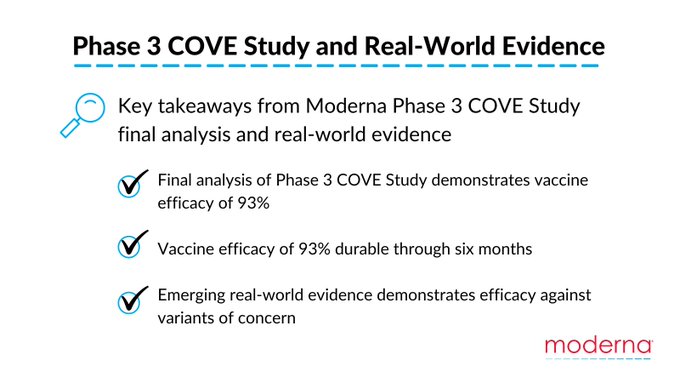
The biotech firm confirmed that its vaccine maintained 93% efficacy six months after the second dose but said that a booster shot will likely still be needed before the winter.
“We are pleased that our COVID-19 vaccine is showing durable efficacy of 93% through six months but recognize that the Delta variant is a significant new threat, so we must remain vigilant,” Moderna CEO Stephane Bancel said in a statement.
“Given this intersection, we believe dose 3 booster will likely be necessary prior to the winter season,” the company said.
The 93% efficacy after six months announced by Moderna is a promising sign and compares to the 84% efficacy reported by the Pfizer vaccine.
While there is strong data for six months, the company warned that the rise of the delta variant will cause an “increase of breakthrough infections in vaccinated individuals.”
Moderna: “you might need a booster sh—“ Me: signed in online, waiting outside the Rite Aid at 7am with my sleeve rolled up