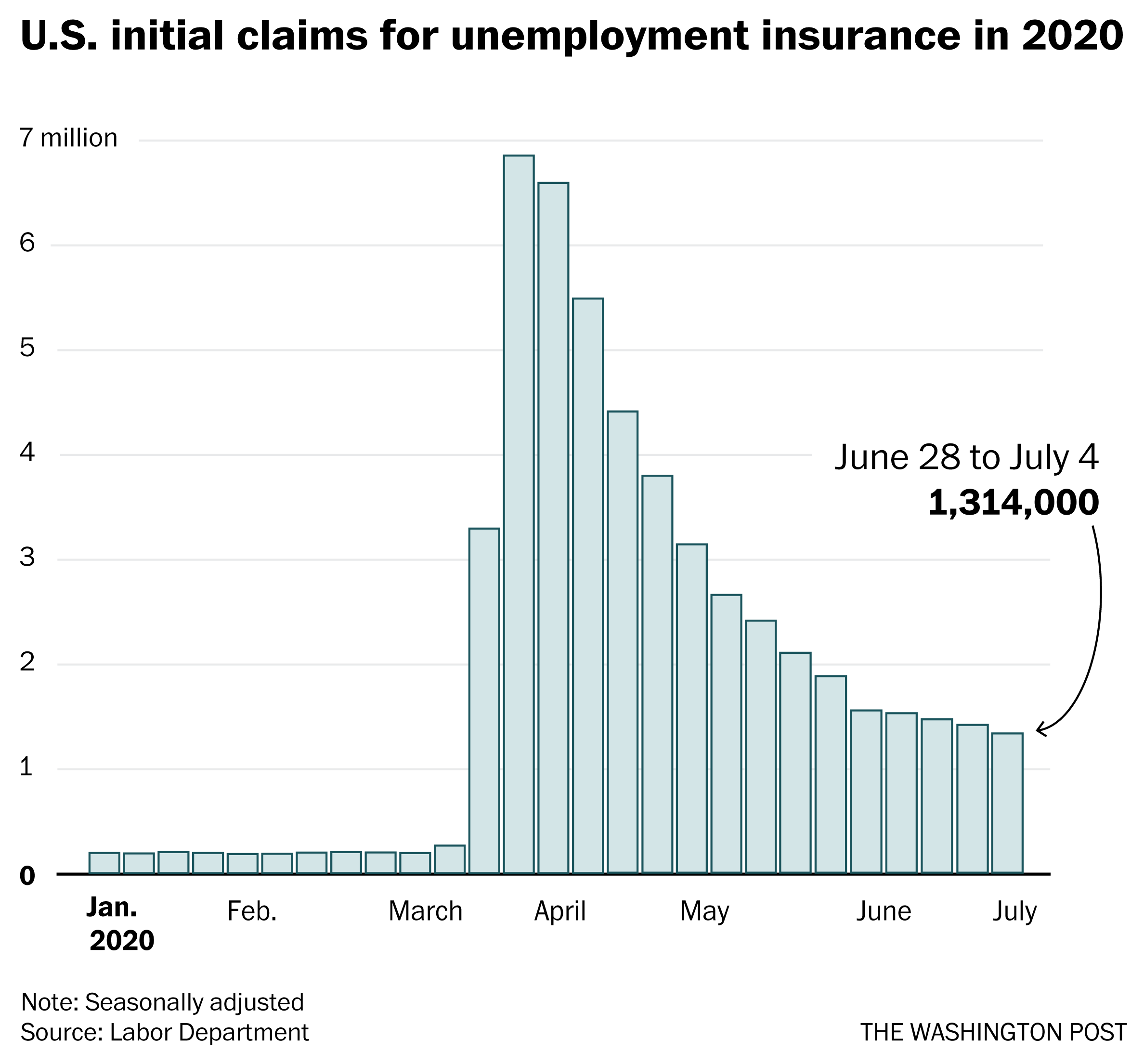
Another 1.3 million people applied for new jobless benefits last week as the pandemic’s toll on the economy continued

https://www.washingtonpost.com/business/2020/07/09/another-13-million-people-applied-new-jobless-benefits-last-week-pandemics-toll-economy-continued/?fbclid=IwAR0cDN8SNbJF-SoMktqUOPJyJQ5ZTwvqENXxZzkbXhcygOOrgVxVDotPlHI

Another 1.3 million people applied for new jobless benefits last ...

Another 1.3 million people filed for unemployment for the first time last week, a slight decrease from the week before, as novel coronavirus cases and closures surged around the country, according to data released Thursday by the Department of Labor.

The numbers of new unemployment filings have remained above a million each week since the pandemic began mid-March. That number has averaged about 1.4 million the past four weeks.

In addition, states reported that another 1 million claims were made under the Pandemic Unemployment Assistance program, which grants jobless benefits for gig workers, self-employed workers and contractors, the agency reported.

When combined, the two numbers for initial unemployment claims have ticked up the past three weeks, from 2.24 million in mid-June to 2.44 million last week.

The numbers for the first few days of July come as rising cases of coronavirus infections have hit states and counties nationwide, touching off a new round of closures and restrictions and sending some workers back to the unemployment insurance queue for the second time in just a few short months.

“The bad news is that initial claims are still historically very high and they suggest that damage is continuing to accumulate in the economy,” Adam Ozimek, chief economist at Upwork, said in an interview.

The unemployment rate, which is tabulated separately from the weekly jobless claims, has trended downward the past two months, to 11.1 percent last month, as many laid off or furloughed workers in industries like food service and retail were called back to work. Yet a rising number of workers have reported permanent layoffs.

And the jobless statistics don’t capture the damage from the new round of cases yet.

“All these factors look more like an economy that is riding into a recession than out of one,” Ozimek said. “At this stage in the game, when we’re this far from initial shock, it becomes less likely that new layoffs are the types of jobs that snap back.”

The numbers of people continuously receiving benefits at the end of June has also trended gradually downward. The last week of June saw 18.1 million people on unemployment insurance, down from 19.3 million people the week before that, as re-hirings have slightly outpaced new layoffs week by week.

But as hopes fade for a quick rebound from the pandemic — the United States reported more than 60,000 new cases on Wednesday, a new high — signs of longer term economic damage are emerging.

Levi Strauss & Co. said this week that it planned to cut about 15 percent of its nonretail and nonmanufacturing positions, or about 700 jobs this year. United Airlines warned it may need to furlough nearly 40 percent of its workforce this year, about 36,000 employees. Industrial and aerospace manufacturer the Barnes Group said it would layoff 400 workers; BAE Systems, a defense and aerospace company, said it planned to layoff 300 employees.

There are many workers like Samantha Hartman, 29, whose temporary layoff — she was furloughed in March from Rosen Hotels & Resorts, the hospitality company she works for in Orlando — became permanent this week.

Hartman said her supervisor called her this week to tell her that the company had tried to come up with a way to keep employees but found their hands tied with almost no business coming in.

“Everything is up in the air,” Hartman said. “I fully expect not to find another job in this industry.”

The company, which received a Paycheck Protection Program small business loan of more than $6 million according to the Orlando Sentinel, announced Wednesday that it would layoff a “substantial” amount of its workforce by July 31.

Hartman, who has a heart condition, said the company is letting her keep her health care through August. She moved to Orlando two years ago for the job. Now, she says she’ll probably move back with her family in California when her lease is up next year.

She said Florida’s challenges — including large delays in unemployment insurance processing, mishandling of the coronavirus response, a governor she doesn’t trust — make her less likely to stay in Florida. “If I’m going to struggle financially, I’d rather do that back home where I have a support system,” Hartman said.

Plunging consumer demand amid the virus’s surge and ensuing shutdowns have shuttered businesses across the country. Bed Bath & Beyond announced it would close 200 stores; Brooks Brothers, which filed for bankruptcy protection this week, said it would close 51 stores.

And there’s a grim waiting game for what are expected to be widespread layoffs in state and municipal governments, as budgets are drastically pared to meet declining tax revenue.

Initial weekly jobless claims remain well above the record before the pandemic, of 695,000 in 1982. They have dropped every week since the peak of 6.9 million, from a week in late March, but have plateaued for more than a month.



Intermountain, Stanford Children’s CEOs say hospitals need to get comfortable being a ‘frenemy’

https://www.fiercehealthcare.com/hospitals/intermountain-stanford-children-s-ceos-say-hospitals-need-to-get-comfortable-being-a?mkt_tok=eyJpIjoiTlRZNFpUa3hZbU0zWlRGaSIsInQiOiJjR0Y5WWdaZ1lxc2w3aHY0dlpFQ0w2czhrY0h3NVwvTkVnaVwvdStPYld1NzlIWFI1aFlRQUVLRjNmb25ETGNxR3Rza3czYjV2VzlpYVwvRmRqSnQ5a29Wc2tjeDhxcnl2VHZOSzg4OWx3WUp4eGR4ano2dURRYlhzamJHU3ZHTEdcL2YifQ%3D%3D&mrkid=959610

Intermountain, Stanford Children's CEOs say hospitals need to get ...

Health systems have had to adjust to a lot of change in a short amount of time since the COVID-19 pandemic began.

Among the biggest changes they need to get comfortable with?

Collaborations with their rivals, said Intermountain President and CEO Marc Harrison, M.D., at Fortune’s Brainstorm Health virtual event Wednesday.

“I think that the opportunity is to get comfortable with the whole ‘frenemy’ relationship,” Harrison said. “Other industries recognize that an organization is both going to compete and collaborate with another organization, often simultaneously.”

Intermountain and the other system have co-branded drive-thru testing sites to eliminate redundancies, they share personal protective equipment numbers and they load level patients between systems. They have also “harmonized” clinical trials to ensure consistent criteria for all patients admitted to them, he said.

“I think that’s fantastic,” Harrison said, speaking during a virtual panel called Reinventing the Hospital. “We will compete in the future in certain areas but I’d love to continue to see this.”

The increasing level of collaborations amid the pandemic is also among the biggest changes Paul King, CEO of Stanford Children’s Health, has noticed since COVID-19 began its spread across the U.S.

“That is one of the silver linings of what we’ve seen with this crisis, particularly in the children’s hospital space. We’ve seen a level of collaboration, heretofore unseen, with the amount of sharing of best practices real-time,” King said. “The other outcome of this crisis is the idea of speed. We’ve been able to really stand up some capabilities that we would’ve said weren’t possible just 12 weeks ago. That level of collaboration is part of the genie we don’t want to go back in the bottle.”


Merkel says pandemic reveals limits of ‘fact-denying populism’

Merkel says pandemic reveals limits of ‘fact-denying populism’

Covid-19 has exposed the limits of 'fact-denying populism', Merkel ...

German Chancellor Angela Merkel told European Union (EU) countries Wednesday that the coronavirus pandemic is showing the limits of “fact-denying populism” as she urged the bloc to reach an agreement on an economic recovery package.

Merkel said that the EU “must show that a return to nationalism means not more, but less control,” according to France 24.

Without naming any specific nations, Merkel said: “We are seeing at the moment that the pandemic can’t be fought with lies and disinformation, and neither can it be with hatred and agitation.”

“Fact-denying populism is being shown its limits,” she added. “In a democracy, facts and transparency are needed. That distinguishes Europe, and Germany will stand up for it during its presidency.”

The pandemic has killed more than 100,000 people in the 27 EU nations and sparked what is expected to be the largest recession the continent has experienced in decades.

On Tuesday the EU released a report predicting the bloc’s economy will contract more than initially expected due to coronavirus-related lockdowns.

Merkel on Wednesday joined EU Economy Commissioner Paolo Gentiloni in urging the commission to quickly reach an agreement on the 750 billion-euro stimulus package proposed earlier this year.

“The depth of the economic decline demands that we hurry,” Merkel told lawmakers, according to The Associated Press. “We must waste no time — only the weakest would suffer from that. I very much hope that we can reach an agreement this summer. That will require a lot of readiness to compromise from all sides — and from you too.”


Texas and Arizona ER doctors say they are losing hope as hospitals reach capacity

https://www.cnn.com/2020/07/08/us/emergency-room-doctors-coronavirus-capacity/index.html?utm_source=Sailthru&utm_medium=email&utm_campaign=Issue:%202020-07-08%20Healthcare%20Dive%20%5Bissue:28354%5D&utm_term=Healthcare%20Dive

Texas and Arizona ER doctors say they are losing hope as hospitals ...

As concerns over the capacity of hospitals resurface amid surging Covid-19 cases, two emergency room doctors say they worry about where the pandemic could take them next.

Dr. Mina Tran, an emergency room doctor in Texas, said 70 to 80% of her patients have been admitted with upper respiratory or coronavirus complaints.
In Arizona, which saw its lowest-ever number of available ICU beds Tuesday, Dr. Murtaza Akhter told Lemon so many patients are coming in that he is already having to make tough decisions over resources.
“I’m trying not to be an alarmist. I’m an emergency physician — we’re prepped for this. Dr. Tran and I both trained very hard for this. But we can’t just build beds overnight. We can’t just hire staff overnight. And like I said, our numbers are only increasing,” he said. “It’s only going to get worse and that’s the scary part.”
With a rise in hospitalization rates across the US, doctors like Akhter are reporting waiting lists for ICU beds and having to decide who will be admitted for treatment and who will not.
Surges in hospitalization and infection rates have followed larger crowds gathering in newly reopened public spaces. Every state has started their plan to reopen, and 35 are currently seeing more new cases reported compared to last week.
Tran applauded Texas Gov. Greg Abbott closing down bars once again but said she does think the state was too quick to open back up.
While many states have paused or rolled back reopening in light of a resurgence of cases, Akhter said seeing individuals continue disregard safe practices as his emergency room treats coronavirus patients makes him feel like he is “losing hope.”
“I’m going through shifts making some very tough decisions and then I’m driving home and seeing people who are clearly not distancing, having their Fourth of July celebrations, being in big congregate settings, and it feels like what I’m doing is futile,” Akhter said. “I don’t know what more people need to hear.”
And California and Florida are feeling the strain as well.
In Florida, where cases have surged, ICUs at 56 hospitals have reached capacity. And California’s hospitalizations were at an all-time high on Tuesday with nearly 6,000 coronavirus patients.


Providence, Humana back ad campaign urging patients to stop ‘medical distancing’

https://www.healthcaredive.com/news/providence-humana-back-ad-campaign-urging-patients-to-stop-medical-distan/581172/

Dive Brief:

  • A coalition of providers, payers and other healthcare organizations on Tuesday launched an ad campaign to encourage patients not to put off important care during the COVID-19 pandemic.
  • The announcement encourages people to continue social distancing but not “medical distancing” by putting off routine care or avoiding checking on concerning symptoms. That could be either through telemedicine or an in-person visit.
  • The campaign will be on TV, in print and across social media. The 11 organizations behind it include Providence, Humana, Baylor Scott & White, LabCorp and Walgreens.

Dive Insight:

While some hospitals in hotspots in Texas, Florida, California and Arizona have had to once again put off non-emergency procedures, providers in other areas of the country are trying to ramp up regular patient volumes as the number of positive cases eases.

Surveys show, however, that people are wary of returning to the doctor’s office, either because they worry about exposure to the novel coronavirus or have lost coverage to help pay for care.

The new ad campaign seeks to ease these concerns. No dollar figure was attached to the plan, which advertising agency MullenLowe U.S. took on pro bono. It follows an ad the American Hospital Association launched in May to ensure the public facilities are still available for non-COVID-19 care.

Since the pandemic’s onset in the United States, health officials have been concerned about the short- and long-term consequences of routine and preventive care being delayed or put off entirely. Chronic diseases that are caught early can be managed more easily and less expensively.

Also, research shows even some crucial services aren’t being sought even for issues such as strokes and heart attacks. In April, emergency room visits nationwide dropped more than 40%, according to the Centers for Disease Control and Prevention.

Public health experts are also beginning to fear vaccinations may be avoided, which could cause trouble with the upcoming flu season.

For providers the reduction in patient volumes has meant a major revenue loss. Some patient volume has been recaptured, but that rolled back again in recent weeks with hospitals in large states like Texas and Florida again reaching capacity with a COVID-19 surge.

At the end of June, hospital traffic in Arizona, New York and Texas was down week over week, according to an analysis from Jefferies.

Primary care has particularly suffered. Visits to medical offices were down nearly 60% in March and April, meaning losses to those practices could top $15 billion this year, according to a recent Health Affairs study.

The ad campaign stresses that providers have guidelines in place to keep patients safe, such as isolation of those suspected of having COVID-19 and increased virtual options.

“While we understand the fears that many people have around contracting the virus, our country’s medical facilities have adopted CDC guidelines and best practices and even telemedicine options to make your visit as safe as possible to prevent the spread of the virus,” Humana CMO William Shrank said in a statement. “The intent of the campaign is to let people know that protecting yourself against getting this virus does not need to come at the expense of your overall health.”


Walgreens invests $1B in primary care clinics with VillageMD deal

https://www.healthcaredive.com/news/walgreens-invests-1b-in-primary-care-clinics-with-villagemd-deal/581208/

Walgreens plans to open up to 700 primary care clinics as part of ...

Dive Brief:

  • Walgreens on Wednesday announced plans to open up to 700 primary care clinics across the country over the next five years in partnership with medical services provider VillageMD, and “hundreds more” after that.
  • As part of the agreement, Walgreens will invest $1 billion in equity and convertible debt in Chicago-based VillageMD over the next three years, including a $250 million equity investment Wednesday. VillageMD will use 80% of the funds to pay for opening the clinics, called Village Medical at Walgreens, and integrate digitally with Walgreens.
  • Walgreens, which saw its stock rise slightly in early morning trading on the news, anticipates owning 30% of VillageMD once the investment is done. More details on the partnership will be released in the first quarter next year.

Dive Insight:

Retail clinics, which can generate additional script-writing and drive front-of-store sales for their owners, have seen renewed interest in recent years from giants like pharmacy rival CVS Health and retail behemoth Walmart. But Walgreens is the first national pharmacy chain to work toward building out a primary care infrastructure in stores across the U.S.

The move represents a massive investment in the healthcare delivery space for the Illinois-based company, which began trialing the full-service doctor’s offices in its stores late last year with five clinics in Houston, Texas. The pilot was successful, Walgreens said, driving high patient satisfaction scores.

Additionally, the integrated pharmacy model is correlated with increased medication adherence and better patient outcomes, according to internal VillageMD data — important factors in managing chronic conditions, which drive roughly 85% of all U.S. healthcare spend.

As such, Walgreens plans to open 500 to 700 stores over the next five years, staffed by more than 3,600 primary care physicians recruited by VillageMD, along with nurses, social workers and therapists working alongside Walgreens’ pharmacists in 30 U.S. markets.

The two companies are still finalizing what those initial markets are going to be, but the very first will be in Texas and Arizona, Walgreens’ Director of Pharmacy and Healthcare Services Communications Kelli Teno told Healthcare Dive. More than half of the clinics will be located in government-designated medically underserved areas such as Houston, which have a large share of low-income populations, migrant workers and Medicaid beneficiaries.

The stores will accept a broad array of insurance options, according to the release. Many plans VillageMD works with have a zero dollar to $10 co-pay for primary care services, Teno said.

The clinics use a sliding scale payment model for patients who don’t have insurance to try to make care more affordable for the broad range of primary care services provided, like preventative visits, acute infection or minor trauma care or chronic condition management.

Telehealth will be available around the clock for consumers via Walgreens’ healthcare marketplace app, called Find Care, or via VillageMD’s internal capabilities. VillageMD doctors can also provide at-home doctor visits for vulnerable populations, such as senior citizens or the immunocompromised.

Walgreens already has 14 in-store primary care clinics operated by different partners like Partners in Primary Care, Southwest Medical — part of Optum’s physician group — and VillageMD. Late last year, Walgreens announced it was closing 160 of its internally staffed walk-in clinics, though it still has more than 400 clinics nationwide, most staffed or run by local health systems or physician groups.

Its outsourcing model flies against CVS, which built out its health-focused store network, called HealthHUBs, through acquisitions and builds. HealthHUBs designate at least a fifth of floor space to health and wellness focused products. CVS plans to have a chain of 1,500 locations by the end of 2021 as part of its enterprise growth strategy, adding to its almost 10,000 retail locations and more than 1,100 walk-in medical clinics.

For its part, Walgreens’ clinics will be between 3,300 and 9,000 square feet and use existing space within Walgreens’ locations. To make room, clinic-linked stores will offer fewer unhealthy front-end products like snacks and sodas. Tobacco products will not be sold in the first 200 Village Medical at Walgreens locations.

“Many of the stores that we’re initially looking at to build these clinics naturally sell more pharmacy and health and wellness products,” Teno said. “It will really depend on the needs of that local community.”

VillageMD, through its subsidiary Village Medical, includes more than 2,800 doctors across nine markets. The seven-year-old company, which competes with other primary care management companies like UnitedHealth-owned Optum has raised $216 million in total funding across three rounds from investors like Oak HC/FT and Town Hall Ventures, a firm founded by Andy Slavitt, former CMS administrator under President Barack Obama.