Cartoon – You want the Truth?



Here are eight health systems with strong operational metrics and solid financial positions, according to reports from Fitch Ratings, Moody’s Investors Service and S&P Global Ratings.
1. Minneapolis-based Allina Health has an “AA-” rating and stable outlook with Fitch. The health system has a strong financial profile and is the acute care leader in the broad Twin Cities metro area, Fitch said. The credit rating agency said Allina’s proven ability to rebound quickly from operating challenges supports the stable outlook.
2. Children’s Healthcare of Atlanta has an “Aa2” rating and stable outlook with Moody’s. The system has strong operating margins and is the leading pediatric provider in the Atlanta area, Moody’s said. The credit rating agency expects Children’s Healthcare of Atlanta to continue to generate robust margins and maintain exceptional liquidity while undergoing a new campus expansion project.
3. La Crosse, Wis.-based Gundersen Health System has an “AA-” rating and stable outlook with Fitch. The health system has consistently strong operating performance, strong balance sheet metrics and a low debt burden, Fitch said. The credit rating agency said Gundersen’s rating continues to be supported by its leading market position and expanding operating platform.
4. Houston Methodist has an “AA” rating and stable outlook with S&P. The system, which comprises an academic medical center and six community hospitals, has a strong enterprise profile and a history of excellent margins and cash flow, S&P said. The credit rating agency said Houston Methodist is well positioned to withstand the pressures from COVID-19.
5. Indianapolis-based Indiana University Health has an “AA” rating and stable outlook with Fitch. The health system has a solid balance sheet and strong operating cash flow despite short-term pressure from the COVID-19 pandemic. The credit rating agency expects IU Health’s EBITDA margins will range between 12 percent and 14 percent annually when margins recover from the pandemic.
6. Broomfield, Colo.-based SCL Health has an “AA-” rating and stable outlook with Fitch and an “Aa3” rating and stable outlook with Moody’s. The system has a track record of exceptional operations, consistent improvement in unrestricted liquidity levels and significant financial flexibility, Fitch said. The credit rating agency said SCL Health is well positioned to manage the pressures of COVID-19, having built up cash reserves.
7. San Diego-based Scripps Health has an “AA” rating and stable outlook with Fitch and an “Aa3” rating and stable outlook with Moody’s. The health system has a strong balance sheet, strong operations and has maintained a low leverage position, Fitch said. The credit rating agency expects Scripps will continue generating operating levels that are consistent with historical trends following recovery from the pandemic.
8. San Diego-based Sharp HealthCare has an “Aa3” rating and stable outlook with Moody’s and an “AA” rating and stable outlook with S&P. The health system has a healthy financial profile, an excellent balance sheet, a solid business position and is the leading provider in a competitive service area, S&P said. The credit rating agency said the system’s financial performance has remained stable despite COVID-19 and the recession.

In New York City, diners will be able to have a meal inside a restaurant at the end of the month, something that hasn’t happened there since the coronavirus pandemic began. In some parts of Florida, bars reopened Monday for the first time since late June.
One decision appears to be riskier than the other, according to an analysis of cellphone and coronavirus case data by The Washington Post.
States that have reopened bars experienced a doubling in the rate of coronavirus cases three weeks after the opening of doors, on average. The Post analysis — using data provided by SafeGraph, a company that aggregates cellphone location information — found a statistically significant national relationship between foot traffic to bars one week after they reopened and an increase in cases three weeks later.
The analysis of the cellphone data suggests there is not as strong a relationship between the reopening of restaurants and a rise in cases, nor with bar foot traffic and cases over time, except for a handful of states.
But like with so much in the pandemic, easy answers can prove elusive.
A study by the Centers for Disease Control and Prevention of nearly 300 adults who tested positive for the coronavirus found that they were more than twice as likely to have dined at a restaurant in the two weeks before getting sick than people who were uninfected. Those who tested positive and did not have close contact with anyone sick were also more likely to report going to a bar or coffee shop. The same effect was not seen in visits to salons, gyms and houses of worship, or in the use of public transportation.
“You’re sitting there for a long time, everyone’s talking,” said Linsey Marr, an environmental engineer at Virginia Tech. “And that’s just a recipe for spread.”
Few states make their contact-tracing data available, but in two that do — Colorado and Louisiana — bars and restaurants are responsible for about 20 percent of cases traced to a known source. San Diego traced nearly one-third of community outbreaks to restaurants and bars, more than any other setting.
But Louisiana’s experience suggests bar patrons contribute more to the spread of the virus than restaurant diners. There have been 41 outbreaks tied to restaurants and the same number of outbreaks associated with bars, but bar outbreaks appeared to result in more infections, with 480 cases traced to those establishments compared with 180 from restaurants.
Marr said indoor dining can be reasonably safe in a restaurant operating at 25 percent capacity and with a ventilation system that fully recirculates air every 10 minutes. New York City’s policy will allow for only 25 percent capacity at first, with a scheduled increase to 50 percent in November if transmission rates remain low.
Still, Marr said, she “will not eat inside a restaurant until the pandemic is over.” As one of the first scientists to begin emphasizing that the virus was spread primarily by air, she has been concerned about indoor drinking and dining since March.
“People go to restaurants to talk,” she said, “and we know that it’s talking that produces a lot — 10 to 100 times more — aerosols than just sitting.”
Other countries facing outbreaks imposed stricter and longer shutdowns on bars and restaurants. Ireland has yet to open its pubs. Countries that did reopen bars and restaurants have, like American states, scaled back in the face of fresh outbreaks.
Researchers at the Massachusetts Institute of Technology say that because U.S. policies vary by state and county, waves of closures and reopenings may have perversely led to more viral spread, as people traveled to enjoy freedoms not allowed closer to home.
The National Restaurant Association argues that restaurants are safe if they follow proper mitigation guidelines and that the industry has been unfairly maligned by the actions of an irresponsible few.
“Bars become particularly risky,” said Larry Lynch, who handles food science for the restaurant trade group. “Anybody who had been in bars knows that conversations get louder, people get closer.”
But, he said, “we haven’t seen … any kind of systemic outbreaks from people going into a restaurant that’s practicing what we ask them to practice.”
Lynch questioned the methodology of the CDC study, noting it covered only 295 people and did not identify the sources of transmission.
The American Nightlife Association, which represents the bar and nightclub industry, did not respond to a request for comment.
Kristen Ehresmann, director of the Infectious Disease Epidemiology, Prevention and Control Division at the Minnesota Department of Health, agreed that when restaurants and bars abide by guidelines designed to reduce transmission, few cases of the coronavirus have been traced to those establishments.
But there are more than a few bad actors, she said: 1,592 cases of covid-19, the disease caused by the coronavirus, have been tied to 66 bars and restaurants in Minnesota. And in 58 other establishments, cases were reported among only staff members, resulting in 240 illnesses. One bar in St. Cloud, Minn., the Pickled Loon, was the only place visited by 73 people who got sick and was one stop among several for 44 other people.
“The bottom line is, we’re seeing a big chunk of our cases associated with these venues, and those cases go on to get other cases in other settings,” Ehresmann said. “We can’t ignore the impact.”
Iowa’s first big spike in coronavirus cases originated in the meatpacking industry. Then, says University of Iowa epidemiologist Jorge Salinas, came bars in college towns such as Iowa City, where he is based.
“It was very clear,” Salinas said. “We reviewed records for patients, and they all shared that common exposure of having been to a bar in the previous five days or so. Usually, the same bars that tend to be very crowded and very loud, rather than a place you just sit down to go and have a beer.”
He said those bars began closing not because of government intervention, but because so many staff members fell ill. By that point, the young people who got infected at bars had begun spreading the virus to an older population through family and work.
After about two months, the outbreak in Iowa City started to burn out. But then college students started returning to campus.
“It’s just a different group of young people but similar exposures — going to bars, hanging out, going to large parties,” he said.
He said an order from Gov. Kim Reynolds (R) closing bars in Iowa City and five other hard-hit counties was welcome but overdue. In the past two weeks, more than 1,000 young people in the region have become infected.
“Unfortunately, it’s late in the game,” Salinas said. “It would have been better if it had been done to prevent this rather than as a reaction to this.”
Politicians who favor an aggressive approach to containing the coronavirus have been hesitant to shut down bars and restaurants. Expanded federal unemployment benefits lapsed more than a month ago. Loans to small businesses are forgiven only if they can keep workers on the payroll, which is usually impossible while running at reduced capacity.
According to the Bureau of Labor Statistics, 2.5 million jobs in bars and restaurants have been lost since February. Although that’s an improvement from the spring, many restaurant owners say they are barely hanging on.
“Winter is coming, and I’m staring down the barrel of the gun of what’s going to happen,” said Ivy Mix, owner of a restaurant called Leyenda in New York and author of the book “Spirits of Latin America.” Even when indoor dining reopens, Mix said she is not sure she and her staff would be comfortable serving enough people inside her Brooklyn restaurant to make a profit.
“This is almost like being thrown a deflated life-jacket — the action and the symbolism is there, but the actual aid is not,” she said.
That’s why she says the only solution is federal legislation introduced by Rep. Earl Blumenauer (D-Ore.) that would issue $120 billion in grants to independent bars and restaurants. A Senate version would cover some chains as well.
“Eleven million people work for these independent restaurants,” Blumenauer said. “If we don’t do something, the evidence suggests that 85 percent of them are not going to survive this year.”
His office estimates that the legislation would more than pay for itself, generating $186 billion in tax revenue and unemployment savings. He said President Trump was receptive in a meeting with supporters earlier this year, but that in recent weeks the administration “has basically shut down meaningful negotiations.”
Arizona reopened indoor restaurants and some bars at the end of August, after a hasty spring reopening and more than 5,000 deaths.
“We really kind of reaped the whirlwind,” said David Engelthaler, a former state epidemiologist now at the Translational Genomics Research Institute. “A lot of that was driven by people going into bars and nightclubs, typically the 20- to 30-year-old set, interacting, socializing like they did prepandemic. And that just supported a kind of wildfire of cases.”
He said he thinks it is probably feasible to reopen restaurants at reduced capacity, but bars are a different story.
“One thing that all bars have in common is that they create a lowering of inhibition, and I think more than anything, this will cause the spread of covid,” he said. “We get more complacent, more comfortable, covid starts spreading.”
With temperatures still regularly topping 100 degrees in Arizona, the appeal of outdoor food and drink is limited. After a rapid May reopening led to a spike in cases and deaths, the state has just begun trying a more cautious approach.
Under Arizona’s new, more deliberate reopening, businesses must apply to reopen and bars must serve food to qualify. But Saskia Popescu, an epidemiologist based in Phoenix, said it is unclear whether those requirements are sufficiently stringent.
“If you put out two items does that count?” she asked. “I just worry that we’re kind of all doing this at once.” She noted that more than 500 new cases a day continue to be reported in Arizona, about the same as during the first reopening: “We’ll see if we learn from our lessons.”

Americans became wealthier and more held jobs last year.
Yet at the very same time, one million people lost health insurance. And that number has steadily climbed this year under the pandemic.
A U.S. Census Bureau report released yesterday showed a continued slow erosion of the nation’s insured rate in 2019. The decline of coverage illustrates both the shortcomings of President Barack Obama’s 2010 health-care law and repeated attempts by President Trump and Republicans to undermine it.
“Though the reasons are sharply debated, the new data signifies that the first three years of President Trump’s tenure were a period of contracting health insurance coverage,” Amy Goldstein writes. “The decreases reversed gains that began near the end of the Great Recession and accelerated during early years of expanded access to health plans and Medicaid through the Affordable Care Act.”
The uninsured rate rose to 29.6 million people, totaling 9.2 percent of the population. It has slowly ticked upward since 2016, when 28.1 million people didn’t have a health plan. Between 2018 and 2019, the share of people without coverage increased in 19 states and decreased in just one.
The share of people on Medicare and with employer-sponsored coverage actually increased slightly. That was due to an aging population and last year’s booming economy, which meant more people had workplace plans — still the chief way Americans get their coverage.
Medicaid enrollment fell from 17.9 percent of Americans to 17.2 percent.
One reason for the decline is positive: As poverty rates fell for all major racial and ethnic groups, more people earned too much to qualify for the program. The poverty rate fell to 18.8 percent for Blacks, 15.7 percent for Hispanics and 9.1 percent for Whites.
But other factors were also at play. People no longer face a tax penalty for being uninsured, after Congress repealed it in 2017. Several GOP-led states expanded enrollment requirements. And wide disparities persisted in how states run their programs.

Missouri voters recently approved Medicaid expansion, making the state the seventh to do so under President Trump.
“There is huge variation state-to-state in the ease of enrollment, the administrative process, the mechanisms for verifying eligibility, how hard the state works to sign people up,” said Katherine Baicker, a health economist at the University of Chicago. “All those have big effects on net take-up rates.”
Before the coronavirus pandemic upended life, the United States was enjoying a record-long economic expansion. By the end of last year, the unemployment rate was at a 50-year low of 3.5 percent.
“Women outnumbered men in the workforce for only the second time, buoyed by a tight labor market and fast job growth in health care and education,” Amy writes. “Minimum-wage increases were also fueling faster wage growth for those at the bottom.”
But now millions of people have lost their jobs — and, in the process, their health insurance.
“Since March … job losses have disproportionately hit low-income workers and women, many of whom held service-sector jobs that were gutted by shutdown measures to help protect people from infection,” Amy writes. “Nearly 40 percent of households with income below $40,000 were laid off or furloughed by early April, according to the Federal Reserve.”
The Economic Policy Institute has estimated that 12 million people have lost health insurance received through their workplace or that of a family member. Some of those have been able to enroll in Medicaid — its rolls have risen by about 4 million during the pandemic — but others find it unaffordable.
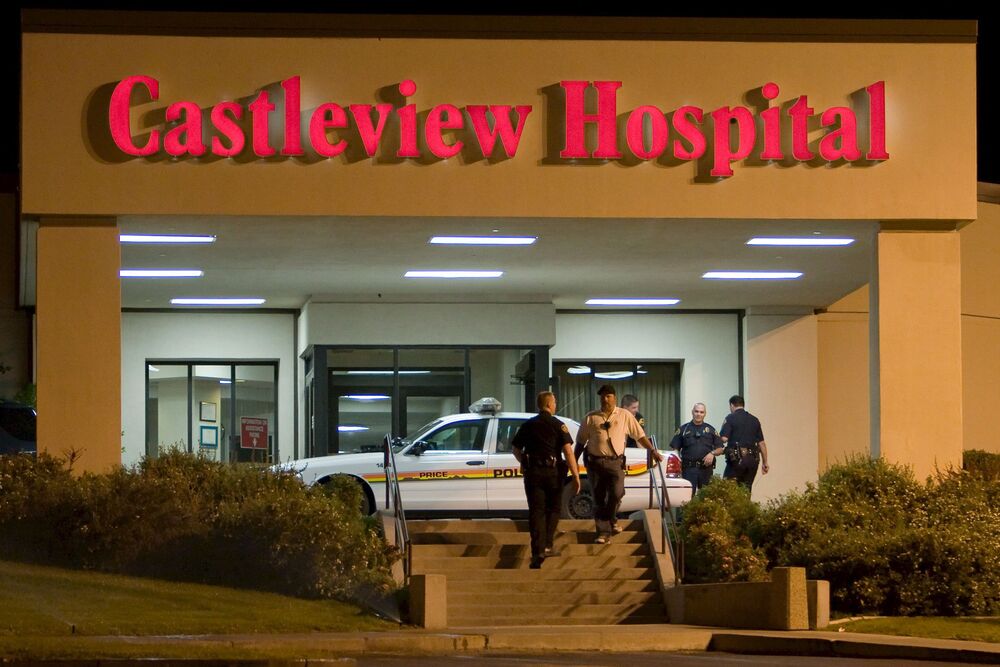
LifePoint’s Castleview Hospital in Price, Utah.
Private equity firm, flush with cash, sees ‘upside’ and more acquisitions.
Like hospital chains across the U.S., LifePoint Health tapped federal relief money to blunt the cost of the Covid-19 pandemic. It was a potent lifeline, a total of $1.5 billion.
But LifePoint is unusual in one respect, its owner: private equity firm Apollo Global Management, led by billionaire Leon Black.
LifePoint was certainly eligible for the money. But the extent of the federal assistance could contribute to concern in Washington over whether private equity-backed hospitals should have been. In July, the U.S. House passed a bill that would require health-care companies to disclose any private equity backing when seeking short-term loans from the federal Medicare program.
The reason for lawmakers’ concern: Private equity firms have ample access to cash. As recently as June, the Apollo fund that owns LifePoint had more than $2 billion to support its investments. Apollo, which manages $414 billion, recently told investors in an internal document that LifePoint was in such a strong market position that it was planning to make acquisitions of less fortunate hospitals.
The relief flowing to LifePoint illustrates a drawback of a government program designed to send out money quickly to every hospital, regardless of financial circumstances, according to Gerard Anderson, a health policy professor at Johns Hopkins University.
“This particular hospital system does not appear to need the money,” he said.
LifePoint and Apollo say they absolutely did. In their view, taxpayer money helped cover the soaring cost of treating Covid-19 patients and lost revenue because of the loss of fees from lucrative elective procedures. The assistance enabled the chain to retain all of its workers and provide essential service to its communities, they said.
“No health-care provider, including LifePoint, is immune to this, regardless of their ownership,” said LifePoint spokesperson Michelle Augusty.
Said an Apollo spokesperson: “Apollo is proud of LifePoint’s response to the Covid pandemic as they continue to provide vital care for both Covid and non-Covid patients.’’
LifePoint owns a far-flung collection of small-town hospitals, from Western Plains Medical Complex in Dodge City, Kansas, to Bourbon Community Hospital in Paris, Kentucky. For years, private equity has been pushing into every corner of American health care. Many medical professionals worry that these Wall Street-style investors will inevitably put profits before patients – something private equity denies.
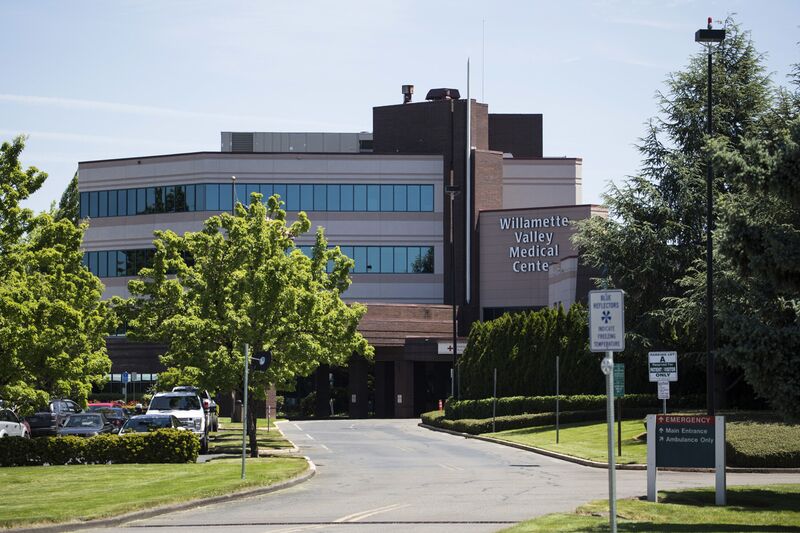
LifePoint’s Willamette Valley Medical Center in McMinnville, Oregon.
In April, LifePoint Chief Executive Officer David Dill and other hospital officials met with President Donald Trump. Dill urged Trump to keep helping hospitals, noting that LifePoint’s medical centers tend to be in the middle of the country, “smaller communities, which I know are communities very important to you,’’ according to a transcript of the meeting.
“Rural hospitals are a very important part of the infrastructure in this country and also treating the uninsured and the Medicaid population as well,’’ Dill said.
Trump pointed out that the hospitals didn’t appear to be in the “hot spots.” Dill acknowledged they were handling only “a couple hundred Covid patients.” (The company said it has now cared for almost 20,000.)
In April, the month the government started distributing assistance, LifePoint borrowed $680 million in the capital markets. It also had access to $900 million in cash and an $800 million credit line, according to Moody’s Investors Service.
By Apollo’s own account, LifePoint was doing just fine when the pandemic struck. In fact, it was thriving – and looking to expand. As of March 31, shortly before LifePoint got taxpayer dollars, Apollo’s investors were on track to double their money, internal documents show. On paper, they were sitting on a gain of more than $800 million.
“Independent hospital systems have greater difficulty weathering prolonged periods of financial stress,’’ Apollo wrote to its investors in May. “A consolidation strategy will provide meaningful upside for Apollo funds’ investment.’’
Apollo said the crisis represented an opportunity: “The coronavirus pandemic will serve as a catalyst for additional M&A opportunities given the attractive scale and overall position of the LifePoint platform.”

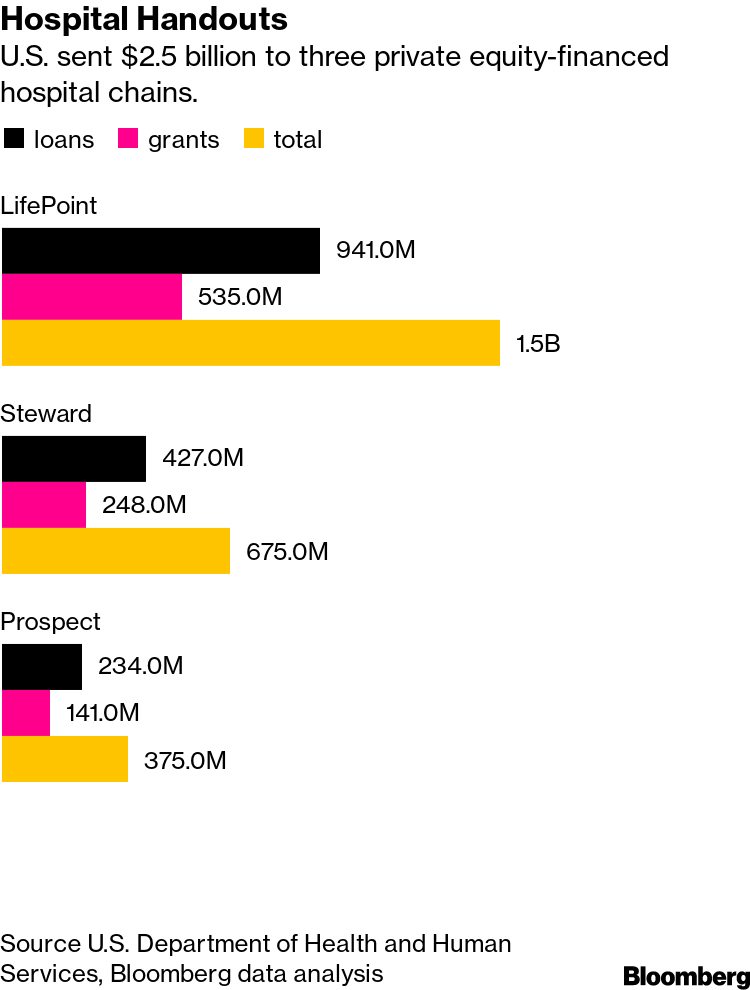
Apollo built its rural hospital empire through the acquisition of three regional hospital chains in 2015, 2016 and 2018. Apollo Investment Fund VIII LP owns 76% of LifePoint, which is based in Brentwood, Tennessee.
Even though many individual rural hospitals are struggling, Apollo says it can operate them more efficiently by merging them together. LifePoint now owns 88 hospitals in 29 states. It had almost $9 billion of annual revenue last year.
Apollo says that on its watch, the chain has improved its infrastructure and technology, recruited care providers and built new centers.
And for rural hospitals, Apollo argues, bigger is better.
“We continue to believe that rural hospitals can benefit from being part of a larger well-run system that enables access to greater resources and infrastructure for improved patient care,” the Apollo spokesperson said.
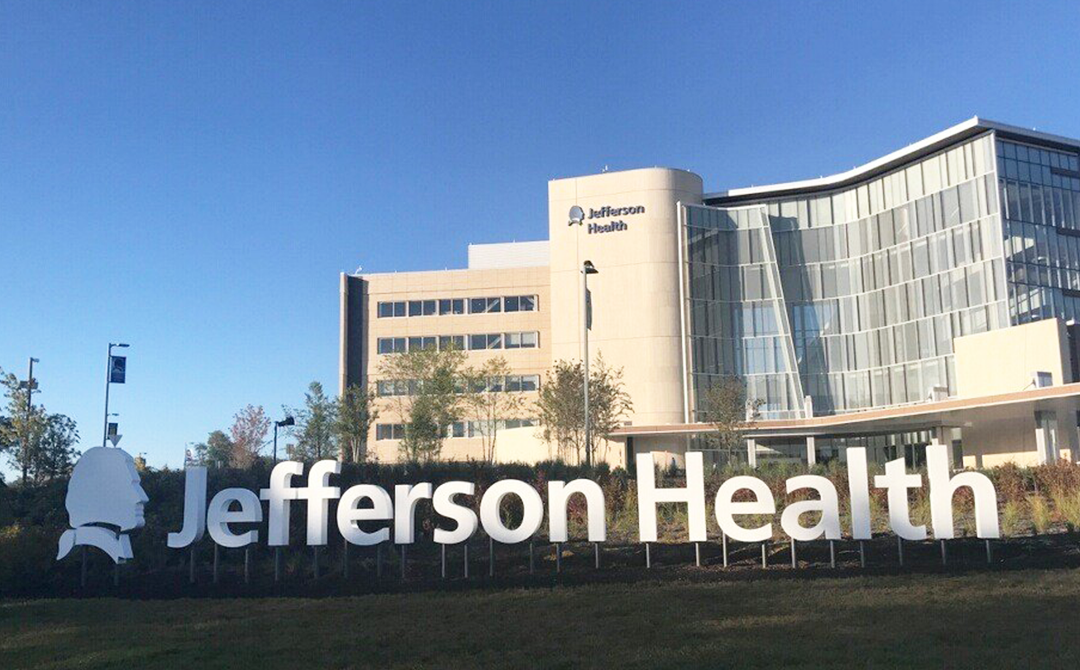
Jefferson Health walked back its stance that Einstein Health Network’s flagship hospital is at risk of financial failure without a merger during the first day of arguments at a trial, according to Law360.
The Federal Trade Commission’s legal challenge to block the proposed merger of Einstein Healthcare Network and Jefferson Health started in court Sept. 14. The FTC argues that combining the two Philadelphia-based systems would reduce competition in the Philadelphia region and Montgomery County.
In response to the legal challenge, Jefferson Health and Einstein argued that the merger is a matter of survival for Einstein’s flagship hospital.
The health systems argued that Einstein, which has only had annual operating profits twice since 2012, is on a path to financial failure without the deal and needs $500 million to invest in key capital projects and deferred maintenance. Further, the organizations said that without the infusion, Einstein will continue to weaken “as it is forced to cut services or close facilities.”
However, at day one of the trial, Jefferson Health CFO Peter DeAngelis conceded during arguments that Jefferson had no evidence that Einstein is in danger of insolvency, despite painting the finances as bleak, according to Law360.
The hearing on the preliminary injunction is expected to last the entire week, but a decision won’t happen by the end of the week. An additional round of filings must be submitted by the FTC and the two health systems by Sept. 28. The judge overseeing the case hopes to issue a decision before Jan. 1, according to The Philadelphia Inquirer.