Trump Unveils Healthcare Agenda

https://www.medpagetoday.com/washington-watch/electioncoverage/88250?xid=nl_mpt_DHE_2020-08-26&eun=g885344d0r&utm_source=Sailthru&utm_medium=email&utm_campaign=Daily%20Headlines%20Top%20Cat%20HeC%20%202020-08-26&utm_term=NL_Daily_DHE_dual-gmail-definition

What's in, and out, of Biden's health care plan

List of bullet points prompts debate over lack of detail, potential for actual achievement.

Health policy scholars critiqued the Trump campaign’s broad strokes healthcare agenda for his potential second term. While some found it overly vague, even dishonest, one suggested it was precisely what voters want.

Released Sunday night as a list of bullet points, the “Fighting for You” agenda will apparently serve as the Republican platform for the 2020 election. The GOP’s platform committee voted over the weekend to dispense with the customary detailed policy document for this cycle, in favor of simply backing President Trump’s agenda.

That agenda, which the Trump campaign promised would be fleshed out in future speeches and statements, included the following points relevant to healthcare:

Eradicate COVID-19

  • Develop a vaccine by the end of 2020
  • Return to normal in 2021
  • Make all critical medicines and supplies for healthcare workers
  • Refill stockpiles and prepare for future pandemics

Healthcare

  • Cut prescription drug prices
  • Put patients and doctors back in charge of our healthcare system
  • Lower healthcare insurance premiums
  • End surprise billing
  • Cover all pre-existing conditions
  • Protect Social Security and Medicare
  • Protect our veterans and provide world-class healthcare and services

Reliance on China

  • Allow 100% expensing deductions for essential industries like pharmaceuticals and robotics who bring back their manufacturing to the U.S.
  • No federal contracts for companies who outsource to China
  • Hold China fully accountable for allowing the virus to spread around the world

Joseph Antos, PhD, a resident scholar in healthcare and retirement policy at the American Enterprise Institute, characterized Trump’s strategy as “Don’t explain it. Just say what your goals are.”

He applauded the brevity of the document, 6 pages in total, covering 10 different policy areas from jobs to healthcare to immigration, as a “smart strategy.”

Voters don’t want to read lengthy policy briefs and gave the “Biden-Sanders Unity Task Force Recommendations” which were over 100 pages long and “unbelievably complicated stuff” as an example of how not to reach voters.

“I think [Trump] got it right. He’s not running a think tank…. He’s running for office. He does have a keen eye for what the average voter could stand to listen to.”

Gail Wilensky, PhD, an economist and senior fellow at Project Hope in Bethesda, Maryland, and CMS administrator under President George H.W. Bush, agreed that a platform packed with policy details doesn’t sway many voters.

This election, she said, is about one thing only: “Trump or not Trump.”

Whither the ACA?

Nevertheless, the Trump campaign’s goals merit attention, often for what they don’t include as well as what they do.

As for the substance of the agenda, the key difference between the Trump administration’s proposed agenda and that of the Democratic nominee, former Vice President Joe Biden, is that the latter aims to expand access to health insurance using the Affordable Care Act’s (ACA) framework, said Wilensky.

While Trump’s 2016 healthcare agenda centered around repealing the ACA, his second-term agenda doesn’t mention the law by name.

Wilensky said she’s glad that Trump did not include ACA repeal among his goals, given that “there’s no historical precedence” for eliminating the core benefits of such far-reaching legislation, now on the books for 10 years and fully implemented for 6.

Kavita Patel, MD, a primary care physician and Brookings Institution scholar in Washington, D.C., who was an advisor on the Democrats’ platform, said, “This is all just posturing and politics and almost a continuation of things [Trump’s] been saying without any real details behind it.”

Many of these items — such as ending surprise billing, lowering health insurance premiums, and cutting prescription drug prices — would have Democrats’ support “but they would get there in a different way,” Patel said.

One thing she was surprised not to see in the agenda were references to abortion or other reproductive health issues, she noted.

Insurance Coverage Neglected

Rosemarie Day, founder and CEO of Day Health Strategies and author of Marching Toward Coverage: How Women can Lead the Fight for Universal Healthcare, was dumbfounded by the overall lack of substance in the agenda, and particularly by the absence of a plan to deal with rising rates of uninsurance related to the pandemic.

Day thought the Trump campaign could have at least included a plan for returning to the “baseline” on the number of uninsured. Another administration might have chosen to promote Medicaid coverage or encourage unemployed workers to enroll on the health insurance exchanges, but not this administration, she said.

“So, they’re really just leaving people out in the cold,” Day said.

Wilensky, too, suggested it would have been “useful” for the Trump campaign to have “talked about how they envision getting more people covered.”

Paul Ginsburg, PhD, director of the USC-Brookings Schaeffer Initiative for Health Policy, said much of the agenda is “just aspirations.”

“‘Put patients and doctors in charge of our healthcare system’? … I don’t know what the policy is, [but] who’s going to quarrel with that?”

Lowering healthcare premiums also sounds “nice” but how that would be achieved is unclear, he said.

One agenda item in the document that really really irked Day was the Trump administration’s pledge to protect people who have pre-existing conditions.

“I consider the ‘covering all pre-existing conditions’ an outright lie,” she said. “I find it incredibly upsetting that [Trump] continues to say that” because he spent his first term attacking the ACA, which does protect pre-existing condition coverage.

Day also noted that the administration has repeatedly promised an ACA replacement without ever delivering an actual proposal.

Responding to the Pandemic

The Trump campaign agenda lists “eradicate COVID-19” on its bullet list, but Patel said it’s “probably not an achievable goal.” A more realistic target is to control it better.

“We have deaths every year and hospitalizations from influenza, but we have a vaccine and we have … strategies to protect people like seniors and young children,” Patel said. “That’s exactly the kind of attitude we have to take” with regard to COVID-19.

For both Patel and Ginsburg, “return to normal” is another aspiration that’s beyond the government’s power to deliver.

“So much depends on a vaccine and its acceptance and how quickly it can be produced,” Ginsburg said.

As for making all critical medicines and supplies for healthcare workers in the United States, Ginsburg acknowledged that it’s theoretically doable, but still unrealistic because it would be “way too expensive.”

“Brand name drugs are routinely produced in other countries as well as the U.S.; I wouldn’t want to upset that supply chain, especially for drugs that are in shortage,” he said.


The right to vote is not in the Constitution

https://theconversation.com/the-right-to-vote-is-not-in-the-constitution-144531?utm_medium=email&utm_campaign=Latest%20from%20The%20Conversation%20for%20August%2026%202020%20-%201713516549&utm_content=Latest%20from%20The%20Conversation%20for%20August%2026%202020%20-%201713516549+Version+A+CID_ca860340297de2ef2c2c85020b74576b&utm_source=campaign_monitor_us&utm_term=The%20right%20to%20vote%20is%20not%20in%20the%20Constitution

Why The Right To Vote Is Not Enshrined In The Constitution by Sean ...

If you’re looking for the right to vote, you won’t find it in the United States Constitution or the Bill of Rights.

The Bill of Rights recognizes the core rights of citizens in a democracy, including freedom of religion, speech, press and assembly. It then recognizes several insurance policies against an abusive government that would attempt to limit these liberties: weapons; the privacy of houses and personal informationprotections against false criminal prosecution or repressive civil trials; and limits on excessive punishments by the government.

But the framers of the Constitution never mentioned a right to vote. They didn’t forget – they intentionally left it out. To put it most simply, the founders didn’t trust ordinary citizens to endorse the rights of others.

They were creating a radical experiment in self-government paired with the protection of individual rights that are often resented by the majority. As a result, they did not lay out an inherent right to vote because they feared rule by the masses would mean the destruction of – not better protection for – all the other rights the Constitution and Bill of Rights uphold. Instead, they highlighted other core rights over the vote, creating a tension that remains today.

James Madison of Virginia. White House Historical Association/Wikimedia Commons

Relying on the elite to protect minority rights

Many of the rights the founders enumerated protect small groups from the power of the majority – for instance, those who would say or publish unpopular statements, or practice unpopular religions, or hold more property than others. James Madison, a principal architect of the U.S. Constitution and the drafter of the Bill of Rights, was an intellectual and landowner who saw the two as strongly linked.

At the Constitutional Convention in 1787, Madison expressed the prevailing view that “the freeholders of the country would be the safest depositories of republican liberty,” meaning only people who owned land debt-free, without mortgages, would be able to vote. The Constitution left voting rules to individual states, which had long-standing laws limiting the vote to those freeholders.

In the debates over the ratification of the Constitution, Madison trumpeted a benefit of the new system: the “total exclusion of the people in their collective capacity.” Even as the nation shifted toward broader inclusion in politics, Madison maintained his view that rights were fragile and ordinary people untrustworthy. In his 70s, he opposed the expansion of the franchise to nonlanded citizens when it was considered at Virginia’s Constitutional Convention in 1829, emphasizing that “the great danger is that the majority may not sufficiently respect the rights of the Minority.”

The founders believed that freedoms and rights would require the protection of an educated elite group of citizens, against an intolerant majority. They understood that protected rights and mass voting could be contradictory.

Scholarship in political science backs up many of the founders’ assessments. One of the field’s clear findings is that elites support the protection of minority rights far more than ordinary citizens do. Research has also shown that ordinary Americans are remarkably ignorant of public policies and politicians, lacking even basic political knowledge.

Is there a right to vote?

What Americans think of as the right to vote doesn’t reside in the Constitution, but results from broad shifts in American public beliefs during the early 1800s. The new states that entered the union after the original 13 – beginning with Vermont, Kentucky and Tennessee – did not limit voting to property owners. Many of the new state constitutions also explicitly recognized voting rights.

As the nation grew, the idea of universal white male suffrage – championed by the commoner-President Andrew Jackson – became an article of popular faith, if not a constitutional right.

After the Civil War, the 15th Amendment, ratified in 1870, guaranteed that the right to vote would not be denied on account of race: If some white people could vote, so could similarly qualified nonwhite people. But that still didn’t recognize a right to vote – only the right of equal treatment. Similarly, the 19th Amendment, now 100 years old, banned voting discrimination on the basis of sex, but did not recognize an inherent right to vote.

A painting of Andrew Jackson

Andrew Jackson of Tennessee. Ralph Eleaser Whiteside Earl/Wikimedia Commons

Debates about voting rights

Today, the country remains engaged in a long-running debate about what counts as voter suppression versus what are legitimate limits or regulations on voting – like requiring voters to provide identification, barring felons from voting or removing infrequent voters from the rolls.

These disputes often invoke an incorrect assumption – that voting is a constitutional right protected from the nation’s birth. The national debate over representation and rights is the product of a long-run movement toward mass voting paired with the longstanding fear of its results.

The nation has evolved from being led by an elitist set of beliefs toward a much more universal and inclusive set of assumptions. But the founders’ fears are still coming true: Levels of support for the rights of opposing parties or people of other religions are strikingly weak in the U.S. as well as around the world.

Many Americans support their own rights to free speech but want to suppress the speech of those with whom they disagree.

Americans may have come to believe in a universal vote, but that value does not come from the Constitution, which saw a different path to the protection of rights.


Fake vs genuine people: 10 ways to spot the difference

Fake vs genuine people: 14 ways to spot the difference

Check Out 10 Ways To Identify Fake People - EKSUOLOFOFO

Not sure who you’re dealing with?

Fake vs genuine people may look the same, but with a little bit of knowledge, you can spot the difference.

Fake people are ingenuine and often hypocritical. They do things for their own gain but hide behind altruism.

Genuine people are true to themselves. They do things because they want to, not because they have to. Plus, they enjoy helping people.

Fake people aren’t just frustrating—they can even be damaging to your health.

In this article, I’ll break down the key difference between fake and genuine people, explain how to tell if someone is a genuine person, and share some tips on standing up for yourself.

Let’s begin.

Fake vs genuine people

The key difference between fake and genuine people is honesty.

Fake people aren’t honest with themselves and the people around them. They do things based on lies and deceit.

Genuine people are honest with themselves and others. Their actions are aligned with what they believe.

The problem is that fake people often don’t know they’re being fake. They may be acting based on lies without knowing how hypocritical they are being.

Fake people don’t know they’re fake because of self-deception.

How can you recognize someone is being fake?

5 things fake people often do

1) Lead people on

Fake people often lead people on because they are trying to please everyone. They spend so much time trying to please everyone else that a lot of people get let down in the process.

2) Cancel plans

Whether they never invite you out to do things in the first place or they cancel at the last minute, they’re fake. They’re probably so busy trying to please the other people that they made plans with that they have to cancel yours.

3) Talk about you behind your back

This is what’s really annoying about fake people. To your face, you’re their best friend. But as soon as you’re away, you’re nothing. They sit and gossip about you to make themselves look better to whoever it is they’re trying to impress.

4) Never get mad

You know who gets mad? Real people! Those who claim that they hardly ever get mad or frustrated about things are fake. Everyone is passionate about something, and everyone gets mad.

5) Disappear when you need them

Need help moving? Going through a difficult breakup? Fake people disappear right when you need them. As soon as you ask them for help, they are gone.

How to tell if someone is genuine

It can be hard to tell if someone is a genuinely nice person or if they are only being nice to you because they need something from you.

Unfortunately, many people are only out to help themselves, but there are still lots of genuine people walking around on the planet.

Here’s how you can spot a genuine person from a fake person.

1) Have a few close friends

Those who are authentic to their selves know that they can’t do everything. They can’t commit to dozens of people, so they have a few close friends that they really commit to.

2) Show up

When a true, genuine person makes plans with you, they’re going to show up. They don’t cancel on you last minute, and they aren’t going to make you wait for a “date” that’s never going to happen. They enjoy your company.

3) Admire people

Genuine people don’t gossip. Instead, they admire the positive qualities that they find in people around them. They talk about the positive, not the negative, and like to share good things.

4) Get angry and feel hurt

Real people feel things. They aren’t going to sugarcoat and act as though nothing bothers them. When genuine people are passionate about something, they’re here to show it. They invest their time and energy into their passions, and they’ll make it known.

5) There for you

When you’re hurting, genuine people hurt with you. They aren’t going to make you feel like you have no one. You can rely on them, and when something happens or you need a helping hand, they’ll be there.

Standing up to fake people

If you have fake people in your life, it’s essential to build the courage to stand up for yourself.

It’s not just about not being pushed around by this particular fake person, though this is important.

It’s also important because it teaches you to set boundaries.

This will make a big difference the next time someone fake enters your life.

I learned the importance of boundary-setting in Rudá Iandê’s free masterclass on embracing your inner beast. It’s a brilliant masterclass and completely changed how I see myself.

I used to think it was a bad idea standing up for myself. I would worry so much about what other people think.

By the time I finished watching Rudá Iandê’s masterclass, my perspective had completely shifted.

Are fake people bad for you?

Fake people are annoying, but are they actually bad for your health? Well, yes, they can be.

It takes time and energy to invest in a relationship, and when that investment is in something fake, it’s hurtful. But it goes beyond that.

Plenty of studies have found that there is a link between our relationships and our well-being. When our social relationships are complicated or one-sided, we feel worse. The strength of our connection to people is what really matters.

So, what does this mean?

Basically, if you have 20 friends, but none of them would come and pick you up after you’ve blown a tire, then your relationships aren’t that great.

But if you had just one or two friends that you could count on, that would show up when needed, the strength of that connection is great. This helps you to feel whole and connected to others, which is beneficial to your health.

Why are there so many fake people?

In today’s world, it seems like there are a lot more fake people than ever before. And it may be true. Thanks to social media and the notoriety that a person can gain from it, it seems like everyone wants to be famous.

To be famous, at least some people have to like you. So, a lot of people will act fake in hopes of getting a following and more people to like them. There are a lot of people who use the internet as a means to stop their loneliness, but it can just make it worse for them.

Why do people act fake?

People act fake because:

  • They aren’t happy with who they truly are
  • They want to feel better about themselves
  • They want people to follow them
  • They want to control others
  • They don’t like their life

Everyone is fake sometimes

The truth is when it comes to fake vs genuine people, everyone is fake sometimes. Whether you’re fake to your coworkers or your so-called friends is up to you. But being fake isn’t something that is good for us.

The opposite, being authentic, is what makes us better people. And while I’m going to talk a bit more about authenticity in a moment, I just want to say that anyone who is fake and putting on a show, isn’t worth your time. You make strong connections with others, and those are the friendships to keep.

How do you really know you’re dealing with a fake person? Well, I’m glad you asked. There are 10 easy ways to test whether the person you’re dealing with is fake or genuine.

10 ways to know you’re dealing with a fake person

Every fake person has 10 tell-tale signs that they’re fake. No matter how hard they try to hide how unauthentic they are, these signs say otherwise:

1) Full of themselves

It probably doesn’t come as a surprise, but fake people are full of themselves. They think that they’re better than everyone around them, and they love to brag. If you find that you have that one friend who is always trying to brag about their own accomplishments, they’re not being genuine.

2) Are manipulative

Fake people have a sort of “mob mentality.” They manipulate others and want everyone to believe what they believe. To do this, they will appeal to others’ emotions. Sometimes, they’ll bandwagon behind a “hot issue” or something that will give them the most notoriety.

3) Jaded with emotions

Like I mentioned before, fake people don’t do emotions well. Most of the time, they think that they’re a waste of time. Since it doesn’t get them ahead, they don’t do them.

Sure, they can fake emotions here and there to get a rise out of people and hope for more people to follow them. But, that’s about as far as they get. Their emotions are jaded, and when you come to them for help, they’re going to be emotionally there for you.

4) Judge you

Do you have a friend that is always judging you? A lot of times, fake people are insecure about what they have. They think that if you don’t believe the same things they do, then you’re wrong. To counteract their own insecurity, they judge you.

It doesn’t feel good. They even use this judgment as a way to try and get back control. Since they want to build their own egos up, they think that by putting you down, it makes them look better. This is where all of their energy is focused.

5) Have hostile humor

Though they may plaster on a kind smile and say nice things, when their humor comes out, it’s clear to see that they’re fake. Many people use hostile humor to try and hide the shame that they feel with their own selves.

Since fake people aren’t happy with their true, authentic selves, they use hostile humor to make them feel better. By putting you down, it builds them up. Then when you get mad about their hostile humor, they blow you off or act like it isn’t a big deal. Remember, they don’t “do” emotions.

6) Aren’t consistent

It’s that friend who always has a new idea. One moment they’re investing in stocks, the next moment their opening up an online store, and finally, they’ve found their dream of being a realtor.

Sound familiar?

Those friends who lack consistency and can’t stay still aren’t true to themselves. They’re as fake as they come, and they don’t care if they leave a big mess behind them.

7) Don’t learn lessons

Fake people don’t get a free pass when it comes to their mistakes, but they think that they do. When they do make a mistake, they aren’t going to admit to it. Or even if they do admit to it, they aren’t going to learn from it.

Genuine people recognize their mistakes and learn from them. Fake people would rather act like it never happened in the first place.

8) Unrealistic expectations

Not only do they put you down and try to control you, but fake people also have unrealistic expectations. They expect people to drop everything for them last-minute, but they wouldn’t do the same for you.

On top of that, they expect to have the best of everything. Often times, fake people are constantly buying new things, especially expensive ones. They want to showcase the success that they have, and they believe that their belongings are how they can do that.

9) Always need the attention

Having your engagement party? Well, your fake friend is about to announce a huge promotion. If they have the chance to steal the spotlight, they will. These people want to be the star of the show, and they don’t care what show it is.

Attention always has to be focused on this person because they demand it. They want to be noticed, and they need that praise from others to feel good about themselves. Unfortunately, it leads to a lot of hurt people when they do something toxic like this.

10) Don’t respect your boundaries

Maybe the biggest sign of fake people? They don’t respect your boundaries.

Once you talk to them, they blow you off. This can be if you bring up hurt feelings or some time where they made a mistake. Boundaries are nonexistent to them unless they were the ones that set them.

Because of this, these friendships can be hard to sever, and they can lead to a lot of pain. But anyone who doesn’t respect your boundaries is not worth keeping around in your life.

Be authentic and attract authenticity

When it comes to fake vs genuine people, it can be hard to know which is which. However, the 10 ways I’ve outlined is a great start. Because fake people usually look for people who will follow them or people who are easily controlled, the best way to get rid of fake people is by being authentic yourself.

As Rudá Iandê says, “Our world is full of fake perfection and happiness, but craving for authenticity.” It is by being your authentic self that you will find deep, lasting connections that will help you to lead a happy and healthy life.

Our lives are too short to spend investing in fake people. Choose to be yourself and be authentic, and you’ll find genuine people to share your life with.


FDA chief apologizes for overstating plasma effect on virus

https://abcnews.go.com/Health/wireStory/fda-commissioner-overstated-effects-virus-therapy-72595122?fbclid=IwAR3Um3rVuom9rJNCOvccmmTBDOrrRePEu1BX1VgRvAzYbpL2NATGjY2-1IY

FDA chief apologizes for overstating plasma effect on virus

Food and Drug Administration Commissioner Stephen Hahn is apologizing for overstating the life-saving benefits of using convalescent plasma to treat COVID-19 patients.

Responding to an outcry from medical experts, Food and Drug Administration Commissioner Stephen Hahn on Tuesday apologized for overstating the life-saving benefits of treating COVID-19 patients with convalescent plasma.

Scientists and medical experts have been pushing back against the claims about the treatment since President Donald Trump’s announcement on Sunday that the FDA had decided to issue emergency authorization for convalescent plasma, taken from patients who have recovered from the coronavirus and rich in disease-fighting antibodies.

Trump hailed the decision as a historic breakthrough even though the treatment’s value has not been established. The announcement on the eve of Trump’s Republican National Convention raised suspicions that it was politically motivated to offset critics of the president’s handling of the pandemic.

Hahn had echoed Trump in saying that 35 more people out of 100 would survive the coronavirus if they were treated with the plasma. That claim vastly overstated preliminary findings of Mayo Clinic observations.

Hahn’s mea culpa comes at a critical moment for the FDA which, under intense pressure from the White House, is responsible for deciding whether upcoming vaccines are safe and effective in preventing COVID-19.

The 35% figure drew condemnation from other scientists and some former FDA officials, who called on Hahn to correct the record.

“I have been criticized for remarks I made Sunday night about the benefits of convalescent plasma. The criticism is entirely justified. What I should have said better is that the data show a relative risk reduction not an absolute risk reduction,” Hahn tweeted.

The FDA made the decision based on data the Mayo Clinic collected from hospitals around the country that were using plasma on patients in wildly varying ways — and there was no comparison group of untreated patients, meaning no conclusions can be drawn about overall survival. People who received plasma with the highest levels of antibodies fared better than those given plasma with fewer antibodies, and those treated sooner after diagnosis fared better than those treated later.

Hahn and other Trump administration officials presented the difference as an absolute survival benefit, rather than a relative difference between two treatment groups. Former FDA officials said the misstatement was inexcusable, particularly for a cancer specialist like Hahn.

“It’s extraordinary to me that a person involved in clinical trials could make that mistake,” said Dr. Peter Lurie, a former FDA official under the Obama administration who now leads the nonprofit Center for Science in the Public Interest. “It’s mind-boggling.”

The 35% benefit was repeated by Health and Human Services Secretary Alex Azar at Sunday’s briefing and promoted on Twitter by the FDA’s communication staff. The number did not appear in FDA’s official letter justifying the emergency authorization.

Hahn has been working to bolster confidence in the agency’s scientific process, stating in interviews and articles that the FDA will only approve a vaccine that meets preset standards for safety and efficacy.

Lawrence Gostin of Georgetown University said Hahn’s performance Sunday undermined those efforts.

“I think the integrity of the FDA took a hit, if I were Stephen Hahn I would not have appeared at such a political show,” said Gostin, a public health attorney.

Hahn pushed back Tuesday morning against suggestions that the plasma announcement was timed to boost Trump ahead of the Republican convention.

“The professionals and the scientists at FDA independently made this decision, and I completely support them,” Hahn said, appearing on “CBS This Morning.”

Trump has recently accused some FDA staff, without evidence, of deliberately holding up new treatments “for political reasons.” And Trump’s chief of staff, Mark Meadows, said over the weekend that FDA scientists “need to feel the heat.”

The administration has sunk vast resources into the race for a vaccine, and Trump aides have been hoping that swift progress could help the president ahead of November’s election.

At Sunday’s briefing Hahn did not correct Trump’s description of the regulatory move as a “breakthrough.” He also did not contradict Trump’s unsupported claim of a “deep state” effort at the agency working to slow down approvals.

Former FDA officials said the political pressure and attacks against the FDA carry enormous risk of undermining trust in the agency just when it’s needed most. A vaccine will only be effective against the virus if it is widely taken by the U.S. population.

“I think the constant pressure, the name-calling, the perception that decisions are made under pressure is damaging,” said Dr. Jesse Goodman of Georgetown University, who previously served as FDA’s chief scientist. “We need the American people to have full confidence that medicines and vaccines are safe.”

Convalescent plasma is a century-old approach to treating the flu, measles and other viruses. But the evidence so far has not been conclusive about whether it works, when to administer it and what dose is needed.

The FDA emergency authorization is expected to increase its availability to additional hospitals. But more than 70,000 Americans have already received the therapy under FDA’s “expanded access” program. That program tracks patients’ response, but cannot prove whether the plasma played a role in their recovery.

Some scientists worry the broadened FDA access to the treatment will make it harder to complete studies of whether the treatment actually works. Those studies require randomizing patients to either receive plasma or a dummy infusion.


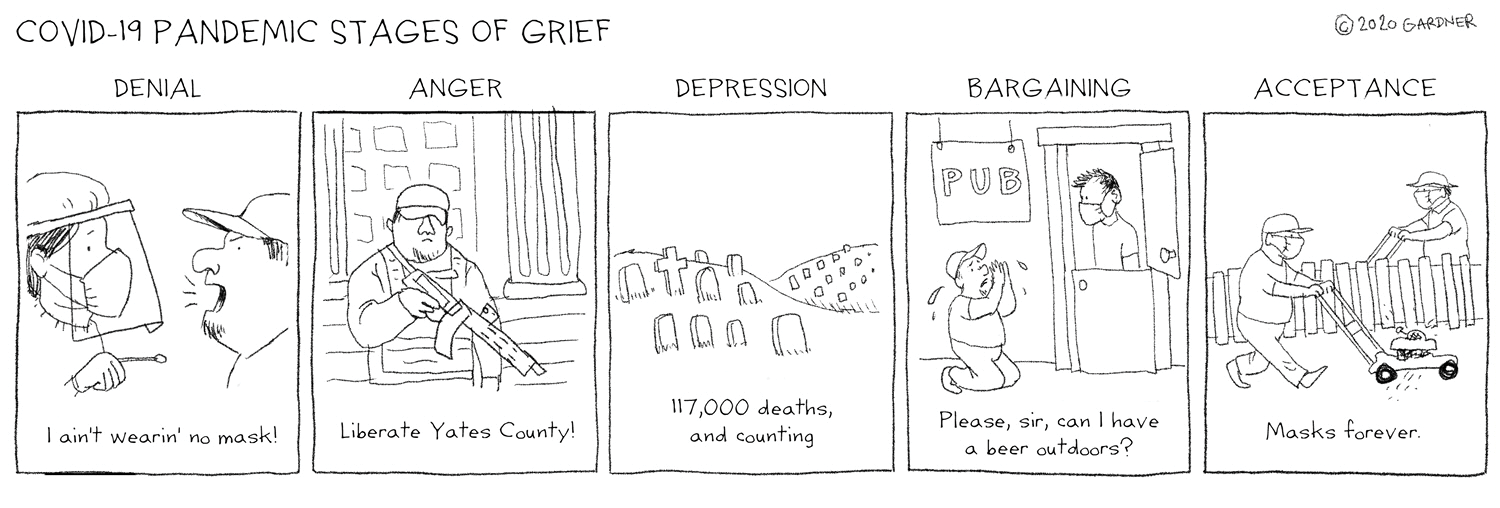
Cartoon – Pandemic Stages of Grief

Cartoon by Sally-Covid 19 Pandemic Stages of Grief |

The future of the ACA takes center stage yet again

https://mailchi.mp/0e13b5a09ec5/the-weekly-gist-august-21-2020?e=d1e747d2d8

The 2020 ACA Reporting & Regulation Landscape for US Employers ...

Across four nights of a national convention that was anything but conventional, with the nominating process, acceptance speeches, and traditional pomp and circumstance forced into a virtual format due to the coronavirus pandemic, Democrats returned to the healthcare playbook widely viewed as successful in the 2018 midterm elections.

In addition to promising a more robust and concerted response to the COVID crisis gripping the nation, party leaders vowed to protect and expand the Affordable Care Act (ACA), rather than aiming to replace it with the more aggressive “Medicare for All” (M4A) approach that dominated much of the discussion during the primary campaign.

In his acceptance speech on Thursday, Democratic nominee Joseph R. Biden, Jr. promised “a healthcare system that lowers premiums, deductibles, and drug prices by building on the Affordable Care Act he’s trying to rip away,” referring to President Trump’s continued support for the full repeal of the 2010 healthcare reform law.

Earlier, progressive runner-up and vocal M4A advocate Sen. Bernie Sanders signaled a closing of the party’s ranks around Biden’s more moderate approach: “While Joe and I disagree on the best path to get to universal coverage, he has a plan that will greatly expand healthcare and cut the cost of prescription drugs. Further, he will lower the eligibility age of Medicare from 65 to 60.”

Several other speakers highlighted the need to protect the ACA’s guarantee of affordable insurance to those with preexisting conditions, most powerfully the prominent M4A crusader Ady Barkan, who suffers from amyotrophic lateral sclerosis (ALS).

“Even during this terrible crisis,” Barkan said, “Donald Trump and Republican politicians are trying to take away millions of people’s health insurance.”


The kids are not all right

https://mailchi.mp/0e13b5a09ec5/the-weekly-gist-august-21-2020?e=d1e747d2d8

Many children heading back to school—in whichever form that that may take this fall—have skipped their annual visit to the pediatrician. The graphic above highlights the sluggish rebound in pediatric ambulatory volume. While adult primary care visits have mostly bounced back, pediatric visits are still 26 percent below pre-COVID levels.

The drop in visits early in the pandemic also impacted immunizations, with 2.5M regular childhood vaccinations missed in the US during the first quarter of 2020—and early data suggests those seem to be rebounding at a similarly anemic rate.

This lack of pediatric routine care is particularly worrisome as COVID-19 cases in children are climbing, with a 90 percent increase from July to August. Though most of the nation’s largest public school districts have opted to begin the school year with online learning, some districts have already returned to in-person classes, and, unsurprisingly, new cases are already being reported.

While COVID-19 is normally neither severe nor fatal in children, infections among school-age kids put others at risk. According to the Kaiser Family Foundation, nearly a quarter of teachers (1.5M) are considered high-risk and almost six percent of seniors (3.3M) live with school-aged children.

Without the traditional back-to-school push for well-child visits, sports physicals, and immunization updates, healthcare providers must think creatively about how to give children with the care they need, whether through personalized communication from pediatricians that assuages parental concerns about office safety, or through more innovative means such as drive-thru vaccination services.


Why Most Voters Oppose Schools Reopening

https://www.forbes.com/sites/williamhaseltine/2020/08/21/why-most-voters-oppose-schools-reopening/#2df43b5b1822

Why Most Voters Oppose Schools Reopening

Even as test rates hover around six to seven percent and tens of thousands of new Covid-19 cases are being reported daily, school districts across the country will continue with plans to resume operations in the coming weeks. The latest survey data shows, however, that most Americans oppose reopening K-12 education in their states.

Parents have reason to be concerned that sending their children to school could bring the virus into their homes, as well as spike positivity rates in their communities. From July 30th to August 13th, over 75,000 new child Covid-19 cases were reported, according to the American Academy of Pediatrics. The outcome would be disastrous were even one asymptomatic carrier to attend classes in the coming weeks.

A recent survey conducted by the Financial Times-Peterson Foundation US Economic Monitor revealed that six in ten voters oppose reopening K-12 schools in their states, while as many as 81 percent urge the prioritization of health among students and faculty over the economy. Were children to get sick at school, not only would their health be endangered, but so would the health of their families. There would be no economy without healthy parents, which is why the vast majority of Americans urge the safety of American students over the state of the economy.

One of the more prudent concerns about the resumption of K-12 education is the social nature of a student’s daily life. School districts are assuring parents that they have put preventative measures in place, such as social distancing and classroom hybridization. But to assume students will have no interaction at all seems ludicrous. Children and teens have been out of the traditional school setting for over five months and they will be ready to interact with others. 

Despite the urge shared by parents and children alike to return to normal, the average voter realizes that the pandemic in the United States is far from over. Parents want their children to stay healthy for many reasons—to ensure the physical health and wellbeing of the family, to ensure the economic livelihood of the family, and to avoid the unknown long term health risks associated with Covid-19. Around 65 percent of voters believe social distancing requirements and non essential business restrictions should be in place for at least another three months—a sacrifice many are willing to make for the sake of their families and children.

Such statistics also show that people recognize there will be several more months of abnormality and want decision makers to take action accordingly, even if it means deprioritizing the economy. Families and individuals have been economically crippled by the pandemic and the US government’s lack of public assistance. The official unemployment rate still hovers around ten percent according to the Bureau of Labor Statistics. Low income families are struggling and eviction rates are sure to spike as rent moratoriums expire. These families have enough to worry about without the added pressure of sending their children back to school at this time.

The reopening of K-12 school districts in the coming weeks presents medical and economic challenges for families in the pandemic era, especially those already disadvantaged or experiencing hardship. Societal immunity is a long way off; as thirty five percent of voters said they would not be likely to get a COVID-19 vaccine were one approved and available by the end of the year, meaning children of those thirty five percent would also be unlikely to get vaccinated. With the inability to ensure the health and safety of students and the unknown economic future to come, schools are better off staying online for the time being.


The Science Behind Campus Coronavirus Outbreaks

https://www.forbes.com/sites/johndrake/2020/08/21/the-science-of-campus-outbreaks/#4c5704ae6893

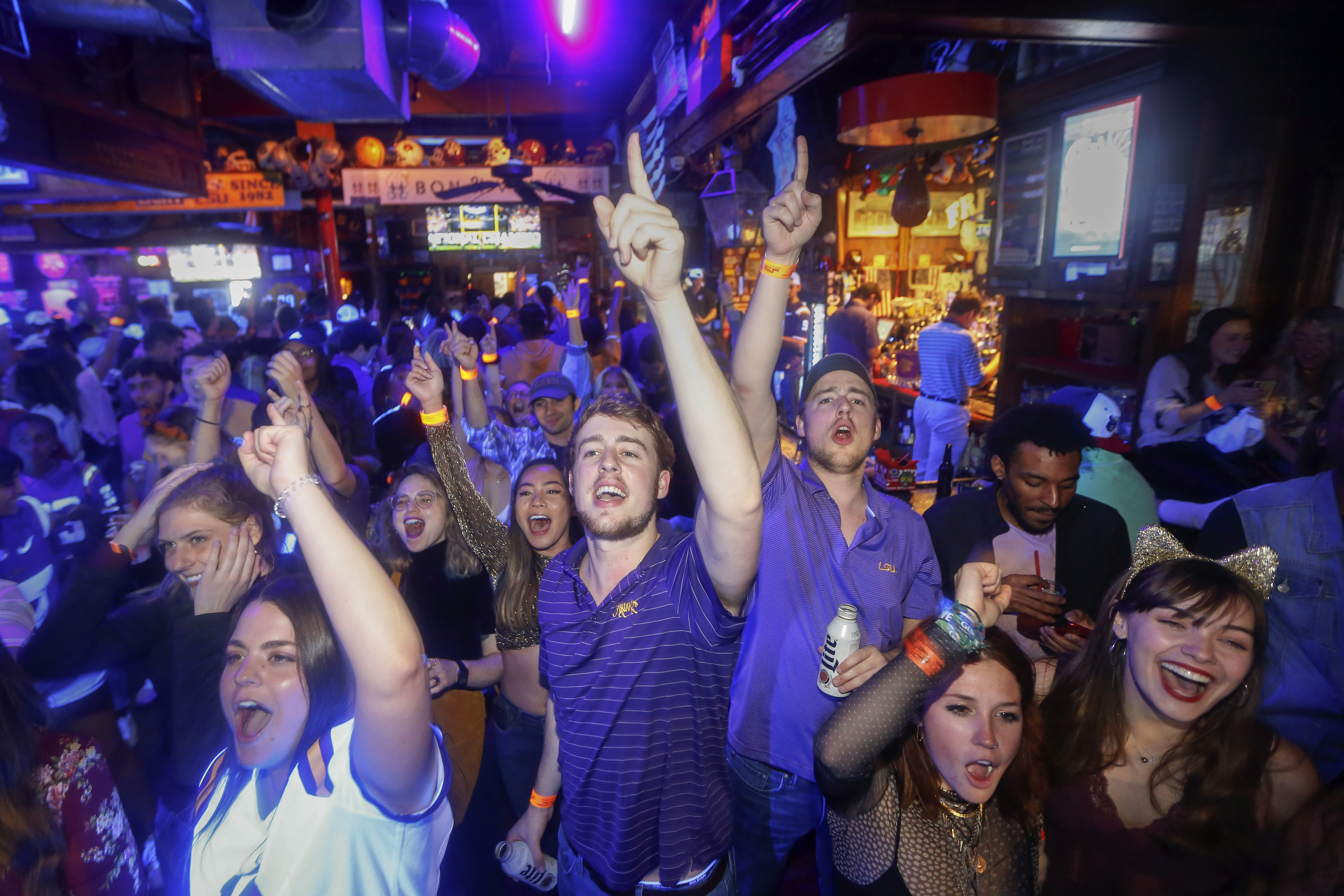
LSU frat parties become coronavirus 'superspreader events ...

Colleges And Universities Reverting To Online Instruction

On August 17, seven days after the start of in-person classes, the University of North Carolina at Chapel Hill announced that, due to a dramatic increase in Covid-19 on campus, all undergraduate classes would be held online for the remainder of the fall. Ithaca College and Michigan State pulled the plug on August 18. Two days later, N.C. State joined the club. More may follow. (The Chronicle of Higher Education maintains a live update feed.) In fact, only a minority of colleges and universities are still attempting fall instruction fully or primarily in person (about 25% at this writing).

Only time will tell if these rapid course changes were warranted and, of course, the answer may not be the same everywhere. Each institution is unique with respect to size, culture, infrastructure to provide online learning, and ability to cope with transmission.

What We Know About Infectious Diseases On College Campuses

In thinking about Covid-19 transmission on campus, it may be useful to know something about the science of epidemics among college students in general. There is a small scientific literature on disease outbreaks on campus. Campuses are special for several reasons. News photos of students lounging on green quads, engaged in late night study groups, or partying into the wee hours reminds us that if college is known for anything other than studying and college sports, it might be the unique gregariousness that attaches to what many people call the “college experience.”

Although outbreaks of infectious diseases on college campuses are routinely reported, there is little evidence that they are more explosive than in the general population. Outbreaks of directly transmitted diseases like measlesmumps, and whooping cough occur with some regularity and are typically contained through isolation and other public health measures. But, no study has been done to systematically examine how the campus environment differs from community-based transmission. 

Influenza is a particularly interesting case because, like Covid-19, it is a respiratory disease transmitted directly through close contact and also has a short incubation period. The basic reproduction number (R0) is a measure of the explosiveness of an epidemic, with anything over R0 = 1 indicating the possibility of sustained transmission.

In 2014, CDC and academic scientists compiled a list of all estimates of R0 for influenza. While most estimates for the 2009 pandemic were between 1 and 2, estimates from some schools (not necessarily colleges or universities) were noticeably higher (2.3 for a school in Japan and 3.3 for a school in the United States), although other cases (Iran and the United Kingdom) were similar to the rest of the population.

Perhaps more importantly, a study in Pullman, Washington (home to Washington State University) estimated R0 of the 2009 pandemic flu to be around 6, which is two to four times larger than most other estimates. So there is some evidence that campus contagions may be more prone to outbreak than other places.

Since Covid-19 is typically much less severe in young adults than in older adults, another question that seems particularly important now is whether transmission among students remains primarily within the student population or readily spreads to the rest of the community. 

In a measles outbreak at a university in China, the fraction of staff who were infected was not statistically different from the fraction of students. The total number of staff infected — three — was small, however, and it seems unlikely that this is the usual pattern.

A study of the 2009 influenza pandemic at the University of Delaware found that the risk of infection for people older than 30 was roughly half the risk of those that were 18 to 29.

An even more interesting aspect of the University of Delaware study is the association with student activities. Reports of influenza-like illness among students at a nearby emergency health center remained stable for almost a month after spring break. But cases increased almost five-fold following “Greek week”. In the final analysis, belonging to a fraternity or sorority doubled a student’s chances of being infected.

What’s Happening Now

This is concerning now as cases of Covid-19 are rising among college students nationwide. College leaders such as Penn State president Eric Barron, University of Kansas chancellor Douglas Girod, and University of Tennessee chancellor Donde Plowman have reproached students, especially fraternities and sororities, for ignoring guidance to avoid large gatherings.

Yesterday, J. Michael Haynie, Vice Chancellor for Strategic Initiatives and Innovation publicly excoriated students at Syracuse University for “selfishly jeopardizing” the possibility of in-person instruction this fall. “Make no mistake,” he wrote, “there was not a single student who gathered on the Quad last night who did not know and understand that it was wrong to do so.”

The science of Covid-19 tells us that students are vulnerable, just like everyone else. Although the evidence is somewhat thin, what there is points only in one direction: because of their specific social structure, college campuses are especially prone to outbreaks of infectious diseases. As in the rest of society, the only way to slow down the Covid-19 pandemic on college campuses is to reduce the rate of infectious contacts. There is too much value in the college experience to reduce it to partying, and it should not be squandered altogether for the sake of the party experience.