Trinity Health, one of the nation’s largest nonprofit health systems, said Monday it will take more measures to cut costs due to the downturn spurred by the novel coronavirus. The restructuring plan includes eliminating positions, extending furloughs, severances and reductions in schedules. The decisions are being “customized” across the system based on factors that include volume projections and the cost and revenue challenges in each market.
The Livonia, Michigan-based hospital operator said it continues to treat COVID-19 patients, however, it has “for now seen declining numbers of very sick patients with COVID-19.”
The system said it expects revenue to be depressed or “below historical levels” for the remainder of this fiscal year and much of the next. It projects revenue to drop by $2 billion to $17.3 billion for fiscal year 2021, which starts after its June 30 year end.
Dive Insight:
In May, Trinity said it planned to furlough nearly 12% of its workforce — or 15,000 employees out of the 125,000 nationally.
Trinity, one of the nation’s largest hospital operators with 92 facilities and operations across 22 states, is now broadening that restructuring, extending and adding new furloughs.
In a Monday bond filing, Trinity said its operations were “significantly” impacted by the effects of the pandemic as many operators saw depressed volumes due to shelter-in-place orders, which started in most of Trinity’s markets during the last two weeks of March.
“The effect of COVID-19 on the operating margins and financial results of Trinity Health is adverse and significant and, at this point, the duration of the pandemic and the length of time until Trinity Health returns to normal operations is unknown,” according to Monday’s bond filing.
The system said relief funds provided by the federal government have not been enough to cover its operating losses. Trinity has received $600 million in relief funds that do not have to be repaid and more in loans through the advanced Medicare payment program, according to a previous analysis by Healthcare Dive.
Still, the system said it has drawn on credit facilities totaling $1 billion to provide adequate liquidity during the pandemic. Trinity reported having 178 days cash on hand as of March 30.
Some nonprofits are faring better than Trinity and pulling back on earlier staffing cuts.
Mayo Clinic said last week it will call back its furloughed workers by the end of August and restore pay that had been cut due to the pandemic.
Mayo has some of the most cash on hand in terms of days when comparing other major nonprofit systems. Mayo had 252 days of cash on hand as of March 30, more than the other 20 largest nonprofits except Cleveland Clinic and New York-Presbyterian.
The United States has set a record for new covid-19 cases for the third time in three days, passing the 40,000 mark for the first time, according to tracking by The Washington Post.
Twelve states set their own records for the average number of new cases reported over the past seven days: Arizona, California, Florida, Georgia, Mississippi, Missouri, Oklahoma, South Carolina, Tennessee, Texas, Idaho and Utah.
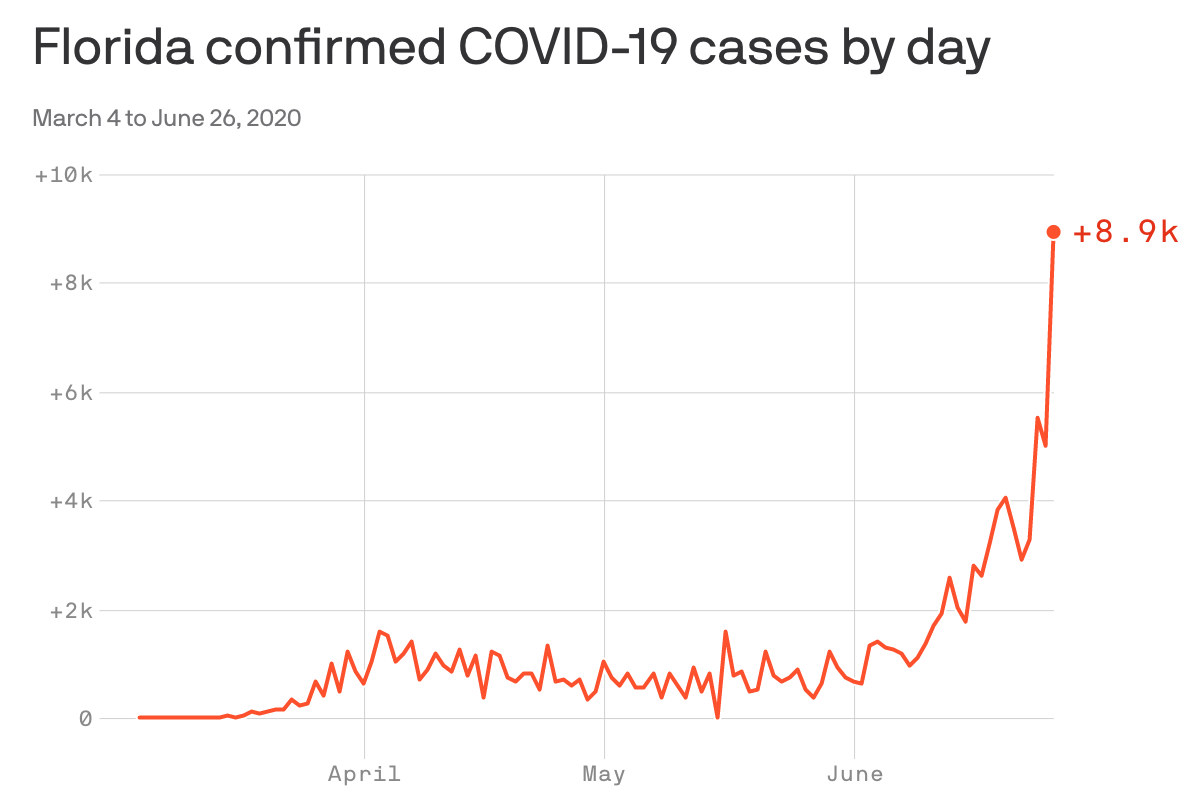
Six states set new single-day highs, led by Florida with 8,942 cases, more than 60 percent higher than its previous high set on Wednesday. Georgia, South Carolina, Tennessee, Idaho and Utah also set new single-day records.
Florida announced Friday morning that bars must close immediately, a move echoed by Texas, a state also dealing with a surge in cases and nearing its capacity to care for those suffering.
“The trajectory that we’re on right now has our hospitals being overwhelmed, probably about mid-July,” Austin Mayor Steve Adler (D) said during an appearance on CNN.
Texas Gov. Greg Abbott (R) issued an executive order that revives restrictions on bars, restaurants and certain types of outdoor recreation, one day after suggesting he would not.
Vice President Pence said during a White House coronavirus task force news briefing that it is “very encouraging news” that half of the increasing cases in Florida and Texas are among Americans under 35, because younger people tend to have less-serious outcomes.
The Trump administration official coordinating tests for the novel coronavirus did a partial pivot Friday, announcing that the government would briefly extend its management of five testing sites in Texas, a state with a recent spike of cases and hospitalizations.
Anthony S. Fauci, the nation’s leading infectious-disease doctor, urged Americans to see their role in taking safety precautions as a “societal responsibility.” He begged them not to let their guards down even if the risk to their own health is considered minimal, because they can still transport it.
In another sign that hopes of a swift economic recovery may be losing steam, the number of homeowners delaying their mortgage payments shot up by 79,000.
Portugal is reinstating lockdown measures for about 700,000 people in 19 civil parishes around Lisbon next week after a worrying rise in cases in communities in the capital’s outskirts.
Six states set record number of new cases
As the United States logged a record number of infections Friday, six states announced their own new single-day high case totals: Georgia, Utah, South Carolina, Tennessee, Idaho and Florida.
Georgia reported four straight days of more than 1,700 new infections and two days in a row of records. The 1,900 cases reported by state health officials Friday surpassed the previous record, 1,714 cases, announced Thursday.
The seven-day average of new infections also hit a new high — 1,569 — and has been rising steadily since late May. That figure is up about 77 percent from a week ago and nearly 115 percent since Memorial Day.
In Utah, the single-day case total hit 676 and set a record for the fourth day in a row. The rolling average has also been on a steady upward swing for 10 days.
Current hospitalizations of Utah’s confirmed covid-19 patients are rising quickly, from 149 a week ago to 174 on Friday. Hospitalizations were at 102 when the month began.
South Carolina’s 1,301 new cases and 1,094 rolling average also set records. The state started the month with an average of 281 daily cases.
Tennessee announced 1,410 new infections, surpassing its previous record number of single-day cases by more than 200.
Current hospitalizations are also rising in South Carolina and Tennessee.
In addition to the states that set records, Louisiana has joined the states with rapidly increasing case numbers. Health officials announced 1,354 new cases Friday, compared with 523 two weeks ago and none two weeks before that.
Despite the disparities, countries are reopening without a plan to redress these unequal harms and protect the broader community going forward. Our ethics research examines the potential for using virtues as a guide for a more moral coronavirus response.
Virtues are applied morals – actions that promote individual and collective well-being. Examples include generosity, compassion, honesty, solidarity, fortitude, justice and patience. While often embedded in religion, virtues are ultimately a secular concept. Because of their broad, longstanding relevance to human societies, these values tend to be held across cultures.
Compassion is a core virtue of all the world’s major religions and a bedrock moral principle in professions like health care and social work. The distinguishing characteristic of compassion is “shared suffering:” Compassionate people and policies recognize suffering and take actions to alleviate it.
As the French philosopher André Comte-Sponville said, compassion “means that one refuses to regard any suffering as a matter of indifference or any living being as a thing.”
Individual acts of compassion abound in the coronavirus crisis, like frontline health care professionals and neighbors who deliver food, among other examples.
Compassion and solidarity on display at New York’s Elmhurst Hospital, during the April peak of the city’s coronavirus outbreak.Noam Galai/Getty Images
A compassion-guided reopening aimed at preventing or reducing human suffering would require governments to continually monitor and alleviate the pain of their people. That includes addressing new forms of suffering that arise as circumstances change.
Public health measures like stay-at-home orders, social distancing and wearing masks reflect solidarity. While compliance in the United States has not been universal, data indicate broad approval for these measures. A new study found that 80% of Americans nationwide support staying home and social distancing and 74% support using face coverings in public.
To achieve these acts of solidarity, the leaders most praised in their countries and abroad – from U.S. National Institutes of Health director Dr. Anthony Fauci to New Zealand prime minister Jacinda Ardern – have relied primarily on moral persuasion, not threats of punishment.
By delivering clear information, giving simple and repeated behavioral guidance, and setting a good example, they’ve helped convince millions to take personal responsibility for protecting their community.
Justice focuses on the fair distribution of resources and the social structures that enable what the Dutch philosopher Patrick Loobuyck has called a “condition of equality.”
Justice-oriented policies are necessary for a moral reopening because of the pandemic’s disproportionate health and economic impacts. The evidence clearly shows that communities of color, low-income populations, people in nursing homes and those on the margins of society, such as homeless people and undocumented immigrants, are hardest hit.
Justice-oriented policies would aim for equitable balancing of necessary pandemic resources. That means directing testing and health equipment toward vulnerable communities – as identified by COVID-19 tracking data and risk factors like housing density and poverty – and ensuring free, widespread vaccine distribution when it becomes available.
In the U.S., economic justice will also require aggressively investing in minority-run businesses and poorer areas to guard against further harm to owners, employees and neighborhoods.
Similarly, all American school children have lost critical classroom hours, but lower-income children have been disproportionately damaged by remote learning in part due to the digital divide and loss of free lunch programs. Justice would demand channeling additional resources to the students and schools that need them most.
Note that it isn’t enough to apply just one virtue in a crisis of this magnitude. Policies built on compassion, solidarity and justice should be deployed in combination.
A compassionate post-pandemic response that does not address underlying inequalities, for example, ignores certain communities’ specific needs. Meanwhile, tackling specific injustices without engaging everyone in efforts like mask-wearing endangers the public health.
Bolstered by scientific evidence, virtue ethics can help nations reopen not just economically but morally, too.
“All countries successfully combatting this virus have robust public health systems, which provide for coordination of effort.”
A recent rise in cases of Covid-19 and the overt failure of the for-profit healthcare system throughout the pandemic in the U.S. are making the case for Medicare for All, advocacy groups and activists say, as countries with socialized systems see their infection rates decline.
“All countries successfully combatting this virus have robust public health systems, which provide for coordination of effort,” remarked a popular healthcare advocate who uses the @AllOnMedicare handle on Twitter.
Calls for the U.S. to adopt a single-payer heathcare system have increased as the pandemic has raged around the country. Cases and deaths in the U.S are now the highest in the world, a result critics blame on both the private healthcare system and the mismanagement of the crisis by President Donald Trump.
Public Citizen’s health care policy advocate Eagan Kemp told Common Dreams that the current for-profit healthcare system that has driven millions of Americans in to bankruptcy and leaves millions more without care will only continue to exacerbate the pain of the outbreak.
“While no health care system can completely protect a country from Covid-19, the U.S. has failed to respond for a number of reasons, not least of which is a for-profit health care system where Americans are too afraid to go to the doctors for fear of the cost,” said Kemp. “Far too many Americans will face medical debt and even bankruptcy if they are lucky enough to survive getting Covid-19, something unheard of in all other comparably wealth countries.”
As University of Massachusetts professor Dean E. Robinson wrote in a piece that appeared at Common Dreams earlier this month, the coronavirus is impacting people of color at a disproportionate rate in cities and communities nationwide—a dynamic that bolsters the call for a universal Medicare for All program to help close those gaps.
“The obvious and immediate need of Black and other working class populations caught in the teeth of the pandemic is the right to health care treatment without the burden of cost,” wrote Robinson. “Even before the pandemic, lower-income, Latino, and younger workers were more likely to be uninsured. Undocumented workers had the highest rates of uninsurance.”
On June 18, Ralph Nader in an opinion piece for Common Dreamsexpressed his hope that the ongoing pandemic would make essential workers in the health field “the force that can overcome decades of commercial obstruction to full Medicare for All.”
More than three months into the COVID-19 crisis in the U.S., countless Americans are still unemployed. According to the U.S. Labor Department, weekly initial jobless claims data showed yet another week of claims exceeding 1 million.
Another 1.48 million Americans filed for unemployment benefits in the week ending June 20, exceeding economists’ expectations for 1.32 million. The prior week’s figure was revised higher to 1.54 million from the previously reported 1.51 million claims. While this week’s report marked 12 consecutive weeks of deceleration, more than 47 million Americans have filed for unemployment insurance over the past 14 weeks.
“Jobless claims are not falling fast enough,” Renaissance Macro’s Neil Dutta said in an email Thursday. “Everything we have seen in the last week or two between rising case counts/hospitalizations, stalling economic progress in some important states, government job cuts, means one thing: the Phase 4 of fiscal stimulus must be bigger. Things should be better in 3-4 weeks, but the news will get worse before it gets better. Take some chips off the table and reload the chamber for August.”
Continuing claims, which lags initial jobless claims data by one week, totaled 19.52 million in the week ending June 13, down from 20.29 million in the week ending June 6. Consensus expectations were for 20 million continuing claims.
“Initial jobless claims continue to moderate only gradually,” Nomura economist Lewis Alexander wrote in a note Wednesday. “While the labor market remains exceptionally weak, signs of gradual improvement suggest another month of NFP gains during June.”
In the week ending June 20, California reported the highest number of jobless claims at an estimated 287,000 on an unadjusted basis, up from 241,000 in the previous week. Georgia had 124,000, down from 132,000, Florida reported 93,000, New York had roughly 90,000 and Texas reported 89,000 jobless claims.
Additionally, Pandemic Unemployment Assistance (PUA) program claims, which include those who were previously ineligible for unemployment insurance such as self-employed and contracted workers, was also closely monitored in Thursday’s report.
PUA claims totaled 728,120 on an unadjusted basis in the week ending June 20, down from the prior week’s 770,920.
As states reopen their economies, cases and hospitalization figures are back on the rise. As of Thursday morning, there were more than 9.4 million cases and 483,000 COVID-19 deaths around the world, according to Johns Hopkins University data. The U.S. had 2.3 million cases and 121,000 deaths.
The real number of U.S. coronavirus cases could be as high as 23 million — 10 times the 2.3 million currently confirmed cases — the Centers for Disease Control and Prevention told reporters yesterday, Axios’ Marisa Fernandez reports.
Between the lines: The new estimate is based on antibody testing, which indicates whether someone has previously been infected by the virus regardless of whether they had symptoms.
“This virus causes so much asymptomatic infection. The traditional approach of looking for symptomatic illness and diagnosing it obviously underestimates the total amount of infections,” CDC director Robert Redfield said.
The agency also expanded its warnings of which demographic groups are at risk, which now include younger people who are obese and who have underlying health problems.
The shift reflects what states and hospitals have been seeing since the pandemic began, which is that young people can get seriously ill from COVID-19.
The new guidance also categorizes medical conditions that can affect the severity of illness:
Conditions that increase risk: Chronic kidney disease; chronic obstructive pulmonary disease; obesity; weakened immune system from solid organ transplant; serious heart conditions, such as heart failure, coronary artery disease or cardiomyopathies; sickle cell disease; Type 2 diabetes.
Conditions that may increase risk: Chronic lung diseases, including moderate to severe asthma and cystic fibrosis; high blood pressure; a weakened immune system; neurologic conditions, such as dementia or history of stroke; liver disease; pregnancy.
The number of people who lost jobs and related health coverage and then signed up for Affordable Care Act health plans on the federal website was up 46% this year compared with 2019, representing an increase of 154,000 people, the federal government said in a new report.
The bottom line: The government said the rush of people going to HealthCare.gov was tied to “job losses due to COVID-19,” Bob writes.
Yes, but: Medicaid enrollment due to coronavirus-related job losses appears to be growing even faster than enrollment in ACA plans, according to the Georgetown University Health Policy Institute.










 HENRY KOTULA