More young people are getting — and spreading — the coronavirus

https://www.axios.com/coronavirus-young-people-spread-5a0cd9e0-1b25-4c42-9ef9-da9d9ebce367.html

More young people are getting — and spreading — the coronavirus ...

More young people are being infected with the coronavirus, and even though they’re less likely to die from it, experts warn the virus’ spread among young adults may further fuel outbreaks across the United States.

Why it matters: Some people in their 20s and 30s face serious health complications from COVID-19, and a surge in cases among young people gives the virus a bigger foothold, increasing the risk of infection for more vulnerable people.

  • We may see a pattern of younger people being affected initially, but then, in a number of weeks from now, we’re going to see a more deadly pandemic spreading to elderly people,” says Alison Galvani, an epidemiologist at Yale University.

People can transmit the virus without knowing they have it, and younger people, in particular, could be unknowingly spreading the disease.

  • A study in Italy, yet to be peer reviewed, found the probability of having symptoms increased with age and that among 20–39-year-olds only about 22% had a fever or respiratory symptoms (compared to about 35% of 60–79-year-olds).
  • About half of the clusters in a study in Japan were traced back to people ages 20–39 at karaoke bars, offices and restaurants — and 41% of them did not have symptoms at the time.
  • “Younger people are at lower risk for serious COVID outcomes but are disproportionately responsible for asymptomatic transmission,” says Galvani, who published a study earlier this week that found the majority of COVID-19 transmission is from silent carriers who are pre-symptomatic or asymptomatic.

By the numbers: From Arizona to Allegheny County, Pa., young people increasingly account for COVID-19 cases.

  • In the county of Los Angeles, nearly 50% of cases are now in people under 40 (compared to about 30% in April), per the LA Times.
  • In Harris County, Texas, home to Houston, 43% of the 40,000 cases are in people ages 20–39, as of yesterday.
  • In Florida, the median age of confirmed cases is hovering in the mid- to late-30s, compared to age 65 in March.

And the proportion of young people hospitalized for COVID-19 has also grown.

  • 40% of hospitalizations for COVID-19 at the end of June were for people 18–49-years-old, compared to 26% at the end of March, according to the COVID-NET database of hospitalizations in 14 states that represent about 10% of the U.S. population.

Between the lines: Yes, young people are going to bars and parties — but also to work.

  • 42% of people ages 18–39 said they had socialized without social distancing compared to 26% of people over 40, in a survey last month from the Democracy Fund + UCLA Nationscape.
  • 64% of frontline workers (grocery store clerks, health care workers, delivery drivers and other essential workers) are under 50.
  • There’s a need for better education so that young people choose to take steps to prevent infection, says Lauren Ancel Meyers, a mathematical epidemiologist at UT Austin.
  • “But it also might come down to policies or regulations that get employers to ensure they are providing a safe workplace or resources to protect 20, 30 and other age groups that are working for them.”

Where it stands: Young people are still much less likely to be hospitalized or die from the virus than people older than 60.

  • Yes, but: They can and do get very sick with the disease — from dangerous blood clots in their lungs to inflammation of the heart, lungs and even brain.
  • And the long-term consequences are unknown.
  • The risk is higher for young people of color: For example, the majority of coronavirus hospitalizations among Latino/Hispanic Americans are in people ages 18–49, my Axios colleague Caitlin Owens reported.

“The death rate among the young is not zero, and it is particularly not zero for people who have at least one co-morbid condition. This is not a completely benign disease of the young.”

— Joshua Schiffer, of the Fred Hutchinson Cancer Center

What to watch: “If hospitals are strained now dealing with younger cases, they are going to be all the more taxed when the age distribution of infections shifts to the elderly,” Galvani says.


Our new default coronavirus strategy: herd immunity

https://www.axios.com/newsletters/axios-vitals-8f089110-bdd3-440e-9f8a-d8e431e2e18e.html?utm_source=newsletter&utm_medium=email&utm_campaign=newsletter_axiosvitals&stream=top

The U.S.'s new default coronavirus strategy: herd immunity - Axios

By letting the coronavirus surge through the population with only minimal social distancing measures in place, the U.S. has accidentally become the world’s largest experiment in herd immunity.

Why it matters: Letting the virus spread while minimizing human loss is doable, in theory. But it requires very strict protections for vulnerable people, almost none of which the U.S. has established.

The big picture: Cases are skyrocketing, with hospitalizations and deaths following suit in hotspots. Not a single state has ordered another lockdown, even though per capita cases in Florida and Arizona have reached levels similar to New York and New Jersey’s in April.

  • Most states never built up the testing, contact tracing and isolation systems it would take to prevent the virus from spreading widely.
  • The Trump administration is generally ignoring or downplaying soaring caseloads across the South and West, and is pushing schools to fully reopen in the fall.
  • In Florida, where infections, hospitalizations and deaths are surging, Gov. Ron DeSantis “has repeatedly ruled out a sweeping mask mandate or taking the state back into a lockdown to stem the virus, although local governments have acted on their own,” per Bloomberg.

Between the lines: Separating older, sicker people from younger, healthier ones while the virus burns through the latter group could be a way to achieve herd immunity — assuming immunity exists — without hundreds of thousands of people dying.

  • But the U.S. hasn’t adopted such a strategy with any planning or foresight. Although younger people make up a larger portion of coronavirus cases now than they did earlier in the pandemic, vulnerable people still go to work or live with non-vulnerable people.

Yes, but: Some cities and states, particularly in the Northeast, are focused on containing the virus rather than living with it.


Another 1.3 million people applied for new jobless benefits last week as the pandemic’s toll on the economy continued

https://www.washingtonpost.com/business/2020/07/09/another-13-million-people-applied-new-jobless-benefits-last-week-pandemics-toll-economy-continued/?fbclid=IwAR0cDN8SNbJF-SoMktqUOPJyJQ5ZTwvqENXxZzkbXhcygOOrgVxVDotPlHI

Another 1.3 million people applied for new jobless benefits last ...

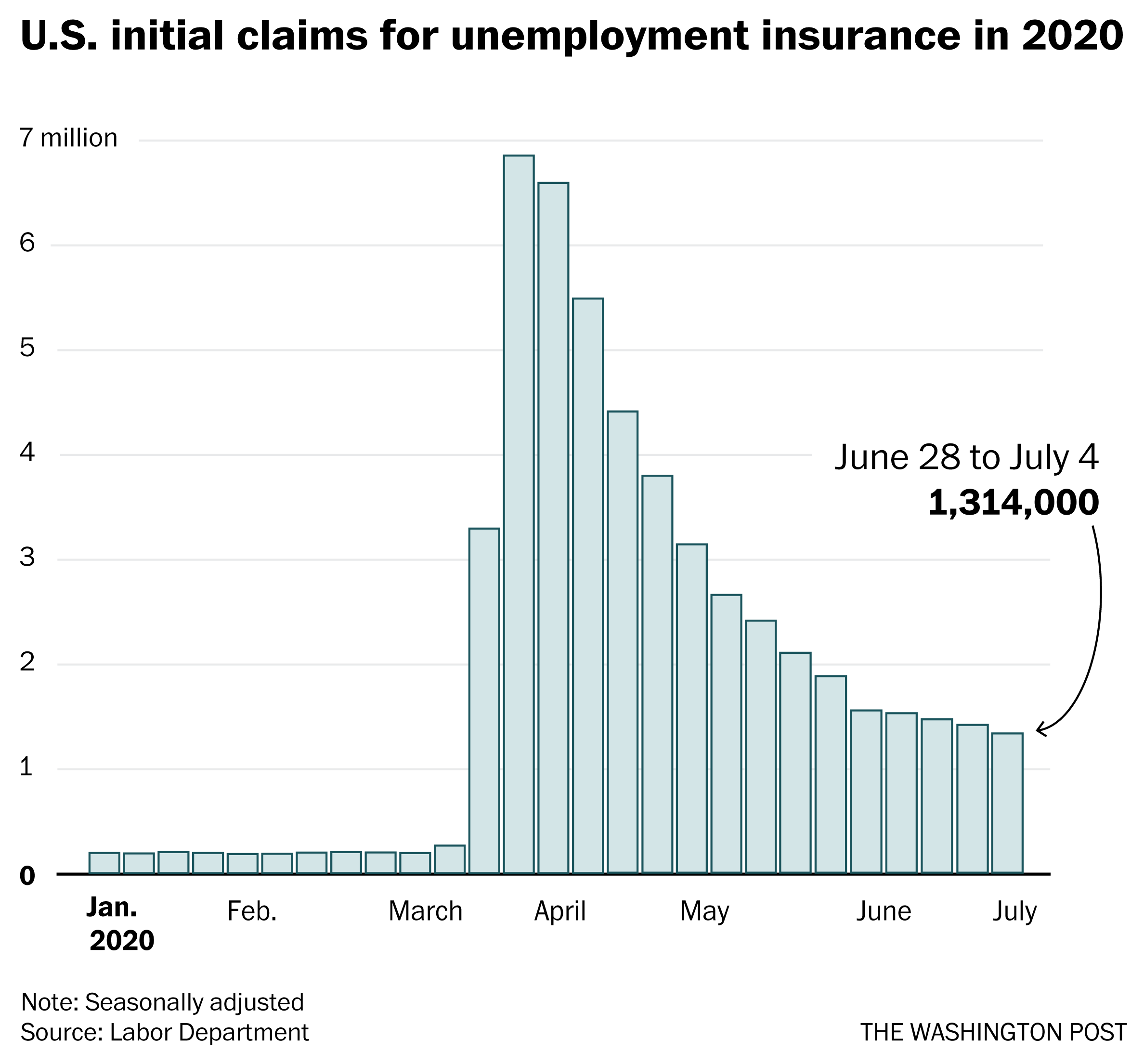
Another 1.3 million people filed for unemployment for the first time last week, a slight decrease from the week before, as novel coronavirus cases and closures surged around the country, according to data released Thursday by the Department of Labor.

The numbers of new unemployment filings have remained above a million each week since the pandemic began mid-March. That number has averaged about 1.4 million the past four weeks.

In addition, states reported that another 1 million claims were made under the Pandemic Unemployment Assistance program, which grants jobless benefits for gig workers, self-employed workers and contractors, the agency reported.

When combined, the two numbers for initial unemployment claims have ticked up the past three weeks, from 2.24 million in mid-June to 2.44 million last week.

The numbers for the first few days of July come as rising cases of coronavirus infections have hit states and counties nationwide, touching off a new round of closures and restrictions and sending some workers back to the unemployment insurance queue for the second time in just a few short months.

“The bad news is that initial claims are still historically very high and they suggest that damage is continuing to accumulate in the economy,” Adam Ozimek, chief economist at Upwork, said in an interview.

The unemployment rate, which is tabulated separately from the weekly jobless claims, has trended downward the past two months, to 11.1 percent last month, as many laid off or furloughed workers in industries like food service and retail were called back to work. Yet a rising number of workers have reported permanent layoffs.

And the jobless statistics don’t capture the damage from the new round of cases yet.

“All these factors look more like an economy that is riding into a recession than out of one,” Ozimek said. “At this stage in the game, when we’re this far from initial shock, it becomes less likely that new layoffs are the types of jobs that snap back.”

The numbers of people continuously receiving benefits at the end of June has also trended gradually downward. The last week of June saw 18.1 million people on unemployment insurance, down from 19.3 million people the week before that, as re-hirings have slightly outpaced new layoffs week by week.

But as hopes fade for a quick rebound from the pandemic — the United States reported more than 60,000 new cases on Wednesday, a new high — signs of longer term economic damage are emerging.

Levi Strauss & Co. said this week that it planned to cut about 15 percent of its nonretail and nonmanufacturing positions, or about 700 jobs this year. United Airlines warned it may need to furlough nearly 40 percent of its workforce this year, about 36,000 employees. Industrial and aerospace manufacturer the Barnes Group said it would layoff 400 workers; BAE Systems, a defense and aerospace company, said it planned to layoff 300 employees.

There are many workers like Samantha Hartman, 29, whose temporary layoff — she was furloughed in March from Rosen Hotels & Resorts, the hospitality company she works for in Orlando — became permanent this week.

Hartman said her supervisor called her this week to tell her that the company had tried to come up with a way to keep employees but found their hands tied with almost no business coming in.

“Everything is up in the air,” Hartman said. “I fully expect not to find another job in this industry.”

The company, which received a Paycheck Protection Program small business loan of more than $6 million according to the Orlando Sentinel, announced Wednesday that it would layoff a “substantial” amount of its workforce by July 31.

Hartman, who has a heart condition, said the company is letting her keep her health care through August. She moved to Orlando two years ago for the job. Now, she says she’ll probably move back with her family in California when her lease is up next year.

She said Florida’s challenges — including large delays in unemployment insurance processing, mishandling of the coronavirus response, a governor she doesn’t trust — make her less likely to stay in Florida. “If I’m going to struggle financially, I’d rather do that back home where I have a support system,” Hartman said.

Plunging consumer demand amid the virus’s surge and ensuing shutdowns have shuttered businesses across the country. Bed Bath & Beyond announced it would close 200 stores; Brooks Brotherswhich filed for bankruptcy protection this week, said it would close 51 stores.

And there’s a grim waiting game for what are expected to be widespread layoffs in state and municipal governments, as budgets are drastically pared to meet declining tax revenue.

Initial weekly jobless claims remain well above the record before the pandemic, of 695,000 in 1982. They have dropped every week since the peak of 6.9 million, from a week in late March, but have plateaued for more than a month.


Merkel says pandemic reveals limits of ‘fact-denying populism’

Merkel says pandemic reveals limits of ‘fact-denying populism’

Covid-19 has exposed the limits of 'fact-denying populism', Merkel ...

German Chancellor Angela Merkel told European Union (EU) countries Wednesday that the coronavirus pandemic is showing the limits of “fact-denying populism” as she urged the bloc to reach an agreement on an economic recovery package.

Merkel said that the EU “must show that a return to nationalism means not more, but less control,” according to France 24.

Without naming any specific nations, Merkel said: “We are seeing at the moment that the pandemic can’t be fought with lies and disinformation, and neither can it be with hatred and agitation.”

“Fact-denying populism is being shown its limits,” she added. “In a democracy, facts and transparency are needed. That distinguishes Europe, and Germany will stand up for it during its presidency.”

The pandemic has killed more than 100,000 people in the 27 EU nations and sparked what is expected to be the largest recession the continent has experienced in decades.

On Tuesday the EU released a report predicting the bloc’s economy will contract more than initially expected due to coronavirus-related lockdowns.

Merkel on Wednesday joined EU Economy Commissioner Paolo Gentiloni in urging the commission to quickly reach an agreement on the 750 billion-euro stimulus package proposed earlier this year.

“The depth of the economic decline demands that we hurry,” Merkel told lawmakers, according to The Associated Press. “We must waste no time — only the weakest would suffer from that. I very much hope that we can reach an agreement this summer. That will require a lot of readiness to compromise from all sides — and from you too.


Texas and Arizona ER doctors say they are losing hope as hospitals reach capacity

https://www.cnn.com/2020/07/08/us/emergency-room-doctors-coronavirus-capacity/index.html?utm_source=Sailthru&utm_medium=email&utm_campaign=Issue:%202020-07-08%20Healthcare%20Dive%20%5Bissue:28354%5D&utm_term=Healthcare%20Dive

Texas and Arizona ER doctors say they are losing hope as hospitals ...

As concerns over the capacity of hospitals resurface amid surging Covid-19 cases, two emergency room doctors say they worry about where the pandemic could take them next.

Dr. Mina Tran, an emergency room doctor in Texas, said 70 to 80% of her patients have been admitted with upper respiratory or coronavirus complaints.
In Arizona, which saw its lowest-ever number of available ICU beds Tuesday, Dr. Murtaza Akhter told Lemon so many patients are coming in that he is already having to make tough decisions over resources.
“I’m trying not to be an alarmist. I’m an emergency physician — we’re prepped for this. Dr. Tran and I both trained very hard for this. But we can’t just build beds overnight. We can’t just hire staff overnight. And like I said, our numbers are only increasing,” he said. “It’s only going to get worse and that’s the scary part.”
With a rise in hospitalization rates across the US, doctors like Akhter are reporting waiting lists for ICU beds and having to decide who will be admitted for treatment and who will not.
Surges in hospitalization and infection rates have followed larger crowds gathering in newly reopened public spaces. Every state has started their plan to reopen, and 35 are currently seeing more new cases reported compared to last week.
Tran applauded Texas Gov. Greg Abbott closing down bars once again but said she does think the state was too quick to open back up.
While many states have paused or rolled back reopening in light of a resurgence of cases, Akhter said seeing individuals continue disregard safe practices as his emergency room treats coronavirus patients makes him feel like he is “losing hope.”
“I’m going through shifts making some very tough decisions and then I’m driving home and seeing people who are clearly not distancing, having their Fourth of July celebrations, being in big congregate settings, and it feels like what I’m doing is futile,” Akhter said. “I don’t know what more people need to hear.”
And California and Florida are feeling the strain as well.
In Florida, where cases have surged, ICUs at 56 hospitals have reached capacity. And California’s hospitalizations were at an all-time high on Tuesday with nearly 6,000 coronavirus patients.


IHME Model Projects 208,255 U.S. Deaths By November, But Estimate Falls Sharply If Mask Use Increases

https://www.forbes.com/sites/mattperez/2020/07/07/imhe-model-projects-208255-us-deaths-by-november-but-estimate-falls-sharply-if-mask-use-increases/?utm_source=newsletter&utm_medium=email&utm_campaign=dailydozen&cdlcid=5d2c97df953109375e4d8b68#453db3d56f2e

IHME Model Projects 208,255 U.S. Deaths By November, But Estimate ...

TOPLINE

The University of Washington’s influential Covid-19 model, extended out to November 1 for the first time, estimates that 208,255 Americans will die from the virus by then, though, the death toll could be reduced by nearly 22% if mask use were to become widespread, researchers said.

KEY FACTS

The university’s Institute for Health Metrics and Evaluation (IHME) forecasts 162,808 deaths by November if at least 95% of people were to wear face coverings in public.

A Gallup poll released Monday found that 86% of adults wore masks in the past week.

Masks have become a political issue, with only 66% of Republicans reporting mask use in the poll, while President Trump continues to refuse to wear one in public and his campaign has declared them optional at recent public campaign events and rallies.

“Mask mandates delay the need for re-imposing closures of businesses and have huge economic benefits,” said IHME Director Dr. Christopher Murray.

The model anticipates a surge in deaths in September and October, with the IHME noting Tuesday that, “Current data show a strong statistical relationship between Covid-19 transmission and pneumonia seasonality, which is included as a covariate in the model.”

While many of the people infected during the current surge in cases worldwide have been on the younger side, and therefore at lower risk of death, the university warns its current projection could increase if the virus is spread to at-risk populations.

The U.S. is currently experiencing a surge in cases following the easing of social distancing policies, particularly in Southern and Western states, a situation that Dr. Anthony Fauci, the country’s top infectious disease official, characterized as “really not good” during an interview Monday.

CHIEF CRITIC

President Trump, who pushed back against Fauci’s comments on Tuesday. “Well, I think we are in a good place. I disagree with him,”Trump said, according to CNN. “Dr. Fauci said don’t wear masks and now he says wear them. And he said numerous things. Don’t close off China. Don’t ban China. I did it anyway. I didn’t listen to my experts and I banned China. We would have been in much worse shape.”

BIG NUMBER

57,718. That’s the new daily record for confirmed cases of Covid-19 in the U.S., reached on July 2, according to the CDC. The toll has been broken several times since June, the previous high coming in early April with 43,438. The U.S. leads the world in cases of the coronavirus with 2,981,602, as well as reported deaths with 131,248.

TANGENT

Both Fauci and Murry at the IHME agree that the U.S. is still deep into its first wave, as exemplified by Texas, which broke its records for cases, hospitalizations and deaths on Tuesday. Because of the situation, Houston Mayor Sylvester Turner urged Texas’ GOP on Monday to cancel its in-person convention set for next week.


U.S. Tops Three Million Known Infections as Coronavirus Surges

https://www.usnews.com/news/top-news/articles/2020-07-07/us-coronavirus-cases-hit-3-million-stoking-fears-of-overwhelmed-hospitals

U.S. tops three million known infections as coronavirus surges ...

 The U.S. coronavirus outbreak crossed a grim new milestone of over 3 million confirmed cases on Tuesday as more states reported record numbers of new infections, and Florida faced an impending shortage of intensive care unit hospital beds.

Authorities have reported alarming upswings of daily caseloads in roughly two dozen states over the past two weeks, a sign that efforts to control transmission of the novel coronavirus have failed in large swaths of the country.

California, Hawaii, Missouri, Montana, Oklahoma and Texas on Tuesday shattered their previous daily record highs for new cases. About 24 states have also reported disturbingly high infection rates as a percentage of diagnostic tests conducted over the past week.

In Texas alone, the number of hospitalized patients more than doubled in just two weeks.

The trend has driven many more Americans to seek out COVID-19 screenings. The U.S. Department of Health and Human Services said on Tuesday it was adding short-term “surge” testing sites in three metropolitan areas in Florida, Louisiana and Texas.

In Houston, a line of more than 200 cars snaked around the United Memorial Medical Center as people waited for hours in sweltering heat to get tested. Some had arrived the night before to secure a place in line at the drive-through site.

“I got tested because my younger brother got positive,” said Fred Robles, 32, who spent the night in his car. “There’s so many people that need to get tested, there’s nothing you can do about it.”

Dean Davis, 32, who lost his job due to the pandemic, said he arrived at the testing site at 3 a.m. on Tuesday after he waited for hours on Monday but failed to make the cutoff.

“I was like, let me get here at three, maybe nobody will be here,” Davis said. “I got here, there was a line already.”

In Florida, more than four dozen hospitals across 25 of 67 counties reported their intensive care units had reached full capacity, according to the state’s Agency for Health Care Administration. Only 17% of the total 6,010 adult ICU beds statewide were available on Tuesday, down from 20% three days earlier.

Additional hospitalizations could strain healthcare systems in many areas, leading to an uptick in deaths from the respiratory illness that has killed more than 131,000 Americans to date.

A widely cited mortality model from the University of Washington’s Institute for Health Metrics and Evaluation (IHME) projected on Tuesday that U.S. deaths would reach 208,000 by Nov. 1, with the outbreak expected to gain new momentum heading into the fall.

A hoped-for summertime decline in transmission of the virus never materialized as previously predicted, the IHME said.

“The U.S. didn’t experience a true end of the first wave of the pandemic,” IHME Director Dr. Christopher Murray said in a statement. “This will not spare us from a second surge in the fall, which will hit particularly hard in states currently seeing high levels of infections.”

‘PRESSURE ON GOVERNORS’

U.S. President Donald Trump, who has pushed for restarting the U.S. economy and urged Americans to return to their normal routines, said on Tuesday he would lean on state governors to open schools in the fall.

Speaking at the White House, Trump said some people wanted to keep schools closed for political reasons. “No way, so we’re very much going to put pressure on governors and everybody else to open the schools.”

New COVID-19 infections are rising in 42 states, based on a Reuters analysis of the past two weeks. By Tuesday afternoon, the number of confirmed U.S. cases had surpassed 3 million, affecting nearly one of every 100 Americans and a population roughly equal to Nevada’s.

In Arizona, another hot spot, the rate of coronavirus tests coming back positive rose to 26% for the week ended July 5, leading two dozen states with positivity rates exceeding 5%. The World Heath Organization considers a rate over 5% to be troubling.

The surge has forced authorities to backpedal on moves to reopen businesses, such as restaurants and bars, after mandatory lockdowns in March and April reduced economic activity to a virtual standstill and put millions of Americans out of work.

The Texas state fair, which had been scheduled to open on Sept. 25, has been canceled for the first time since World War Two, organizers announced on Tuesday.

In Ohio, Governor Mike DeWine said the state was ordering people in seven counties to wear face coverings in public starting on Wednesday evening.


Daily New Confirmed Covid-19 Cases per Million People

New cases per capita have risen sharply in the US, compared to Europe, Canada, and Japan.


Fauci warns U.S. is “knee-deep” in coronavirus first wave

https://www.cbsnews.com/news/fauci-warns-us-knee-deep-coronavirus-first-wave/


The United States is still “knee-deep” in its first wave of coronavirus infections and must act immediately to tackle the recent surge, the country’s top infectious diseases expert said Monday.

Anthony Fauci said the number of cases had never reached a satisfactory baseline before the current resurgence, which officials have warned risks overwhelming hospitals in the South and West.

“It’s a serious situation that we have to address immediately,” Fauci said in a web interview with National Institutes of Health director Francis Collins.

But Fauci added he didn’t strictly consider the ongoing rise in cases a “wave.”

“It was a surge or a resurgence of infections superimposed upon a baseline,” he said.

“If you look at the graphs from Europe, the European Union as an entity, it went up and then came down to the baseline. Now they’re having little blips, as you might expect, as they try to reopen. We went up, never came down to baseline, and now we’re surging back up.”

The death toll from the virus in the U.S. hit 130,000 Monday, according to a tally by Johns Hopkins University, and the number of infections is nearing three million.

A worrisome number of new cases are being reported amid a resurgence that’s forced several states to suspend phased economic reopenings.

Fauci, who heads the National Institute of Allergy and Infectious Diseases, is a leading member of President Trump’s Coronavirus Task Force and has become a trusted face in the administration’s battle against the epidemic.

The U.S. is the world’s hardest-hit nation from the virus and has been struggling to come to grips with a new normal of social distancing and mask-wearing.

Officials have warned that some of the country’s hospitals are in danger of being overwhelmed by the influx of COVID-19 patients.

Hospital beds are full in parts of Texas, while calls for fresh stay-at-home orders are growing.

Some mayors have said their cities reopened too early as Mr. Trump tries to downplay the severity of the crisis, prioritizing economic reopening instead.


Canada’s “national shame”: Covid-19 in nursing homes

https://www.vox.com/future-perfect/2020/7/7/21300521/canada-covid-19-nursing-homes-long-term-care

Why Canada's coronavirus cases are concentrated in nursing homes - Vox

Nursing homes account for 81 percent of Covid-19 deaths in the country. How did this happen?

Canada’s response to the coronavirus pandemic has generally been viewed as a success, with experts pointing to its political leadership and universal health care system as factors.

But there has been one glaring failure in Canada’s fight against the pandemic: its inability to protect the health of its senior citizens in nursing homes and long-term care facilities.

The situation for these seniors is so dire that the police — and even the military — have been called in to investigate why so many are dying.

In Quebec, some residents have been left for days in soiled diapers, going hungry and thirsty, and 31 residents were found dead at one home in less than a month, leading to accusations of gross negligence. In Ontario, the military found shocking conditions in five homes: cockroaches and rotten food, blatant disregard for infection control measures, and treatment of residents that was deemed “borderline abusive, if not abusive.”

“It’s a national shame,” said Nathan Stall, a geriatrician at Toronto’s Sinai Health System. “I don’t think we’ve done a good job at all in Canada.”

A whopping 81 percent of the country’s coronavirus deaths are linked to nursing homes and long-term care facilities. That means roughly 7,050 out of 8,700 deaths to date have been among residents and workers in these facilities.

In terms of raw numbers, that may not seem like very much. (For comparison, more than 40,000 US coronavirus deaths have been linked to nursing homes.) And, to be clear, Canada is hardly alone in watching tragedy unfold in these facilities. The US and Europe have seen startling numbers of fatalities among nursing home staffers and residents.

But 81 percent is a staggering statistic, especially for Canada, a country that prides itself on its progressive health policies. And it’s higher than the rate in any other country for which we have good data. In European countries, roughly 50 percent of coronavirus deaths are linked to these facilities. In the US, it’s 40 percent.

Experts say a number of factors are probably involved in Canada’s collapse on the nursing home front, like the fact that Canada has done well at controlling community spread outside these facilities (making nursing home deaths account for a greater share of overall deaths) and that residents in Canadian homes tend to be older and frailer than those in US homes (and thus more vulnerable to severe cases of Covid-19). But they say the high death rate in the homes is due, in large part, to egregious problems with the homes themselves.

“I think we have serious issues with long-term care,” said Vivian Stamatopoulos, a professor at Ontario Tech University who specializes in family caregiving. Experts have been warning political leaders about this for years, but, she said, “they’ve all been playing the game of pass the long-term care hot potato.”

Furious over how their elders are being treated, some Canadians have started petitions, protests, lawsuits, and even hunger strikes outside the homes. They say the government’s failure to respond reveals a deeper failure to care about seniors and people with disabilities, and to make that care concrete by sending facilities what they urgently need: more tests, more personal protective equipment (PPE), and more funding to pay staff members so they don’t have to work multiple jobs at different facilities.

Prime Minister Justin Trudeau has acknowledged that the situation in the facilities is “deeply disturbing.” He’s sent hundreds of military troops to help feed and care for the seniors in certain homes, where burnout and fear have prompted some staff members to flee their charges. But to some extent, Trudeau’s hands are tied because the facilities fall under provincial jurisdiction.

That leaves families terrified for their loved ones. They’re asking: Why have things gone so terribly wrong? How could this happen in Canada?


Canada’s crisis was a long time in the making

The first thing to understand is that Canada’s universal health care system does not cover nursing homes and long-term care facilities. That means these institutions are not insured by the federal system. Different provinces offer different levels of cost coverage, and even within a given province, you’ll find that some homes are publicly run, others are run by nonprofits, and still others are run by for-profit entities.

“This is the main problem — they don’t fall under the Canada Health Act,” said Stamatopoulos, adding that the same is not true of hospitals. “That’s why you see that the hospitals did so well. They had the resources.”

From the standpoint of someone in the US, where more than 132,000 people have died of Covid-19, Canada may seem to be doing well overall: The death toll there is around 8,700. Per capita, Canada’s coronavirus death rate is roughly half that of America’s. It’s clear that the northern neighbor has been doing better at keeping case numbers down, partly because it’s giving safer advice on easing social distancing.

Which makes the dire situation in nursing homes stand out even more. Longstanding problems with Canada’s nursing homes have clearly fueled the tragic situation unfolding there.

These homes are chronically understaffed. They tend to hire part-time workers, underpay them, and not offer them sick leave benefits. That means the workers have to take multiple jobs at different facilities, potentially spreading the virus between them. Many are immigrants or asylum seekers, and they fear putting their precarious employment at risk by, say, taking a sick day when they need it. (These problems aren’t unique to Canada, but as in other countries, they’ve been thrown into stark relief by the pandemic.)

A lot of Canadian homes also have poor infrastructure, built to the outdated design standards of the 1970s. Residents often live four to a room, share a bathroom, and congregate in crowded common spaces. That makes it very difficult to isolate those who get sick.

These problems are even worse in Canada’s for-profit nursing homes. Research shows that these private facilities provide inferior care for seniors compared to the public facilities, in large part because they hire fewer staff members and put fewer resources into upgrading or redesigning their buildings. The for-profit model incentivizes cost-cutting. (Similarly problematic profit motives and poor living conditions persist in US nursing homes, too.)

Canadian experts have been raising the alarm about these issues for more than a decade. So why haven’t they been addressed?

“Frankly, overall, it really reflects ageism in society. We choose not to invest in frail older adults,” Stall said. He added that early on in the pandemic, the public imagination latched onto stories of relatively young people on ventilators in hospitals. The hospitals and their staff got resources, free food, nightly applause. Homes for older people didn’t get the same attention.

“Nursing homes are not something we’re proud of societally. There’s a lot of shame around even having someone in a nursing home,” Stall said.

Stamatopoulos noted there are other forces at play, too. “I’d say it’s a trifecta of ageism, racism, and sexism,” she said. “When you look at this industry, it’s majority female older residents being cared for by majority racialized women.”

Ronnie Cahana, a 66-year-old rabbi who lives with paralysis at the Maimonides Geriatric Centre in Montreal, recently wrote a letter to Quebec’s premier. “I am not a statistic. I am a fully sentient, confident human being, who needs to have my humanity honored,” he wrote, adding that the premier should help the workers who take care of people like him. “Many of them are immigrants, newly beginning their lives in Quebec. … Please give them all the resources they require. Listen to their voices.”


How to make nursing homes safer — in Canada and beyond

If you want to keep nursing homes from becoming coronavirus hot spots, look to the strategies that have proven effective elsewhere. For months now, Canadian public health experts and advocates have been begging leaders to do just that.

All residents and workers in nursing homes should be tested regularly, whether they show symptoms or not. Anyone who gets sick should be isolated in a separate part of the building or taken to the hospital. Workers should be given adequate PPE, and universal masking among them should be mandatory. Working at multiple homes during the pandemic should be disallowed.

“Look at South Korea. They’ve had no deaths in long-term care because they treated it like SARS right from the get-go,” Stamatopoulos said. “They did aggressive testing. They were strict in terms of quarantining any infected residents and were quick to move them to hospitals. We’ve done the opposite.” Earlier in the pandemic, some Canadian hospitals sent recovering Covid-19 patients back to their nursing homes too soon; they inadvertently infected others.

“And look at New York state,” Stamatopoulos continued. “Gov. Cuomo signed an executive order on May 10 requiring all staff and residents to be tested twice a week. That aggressive testing helped halt the outbreaks in the homes.” Quebec and Ontario have yet to do this.

British Columbia, a Canadian standout at preventing deaths in nursing homes, adopted several wise measures early on. Way back on March 27, the western province made it illegal to work in more than one home — and topped up workers’ wages so they wouldn’t have to. It gave them full-time jobs and sick leave benefits.

It’s clear that so long as long-term care falls under provincial jurisdiction, nursing home residents will be better off in some provinces than in others. So some Canadian experts, including Stamatopoulos, are arguing that these facilities should be nationalized under the Canada Health Act. Others are not sure that’s the answer; Stall thinks it may make sense to target only for-profit homes, compelling them to improve their poor infrastructure. In the long term, any homes that do not meet modern standards should be redesigned.

Another lesson for the long term comes from Hong Kong, which has managed to totally avoid deaths in its nursing homes. Even before the coronavirus came along, all homes had a trained infection controller who put precautions in place to prevent the spread of infections. (US homes saw a similar system enacted under President Obama, but President Trump has proposed that it be rolled back.) Four times a year, Hong Kong’s homes underwent pandemic preparedness drills so that if an outbreak occurred, they’d be ready with best practices. It did, and they were.

Preparedness clearly saves lives. Hopefully, Canada and other countries will learn that lesson going forward so that no more lives are needlessly lost.

As Cahana, the resident in the Montreal home, said, “Each of us is crying to be heard. We say: More life! Please! We are not afraid of the future. We are afraid that society is forgetting us.”