COVID-19 pushes Mayo Clinic’s operating income into free fall

https://www.healthcaredive.com/news/covid-19-pushes-mayo-clinics-operating-income-into-free-fall/578191/

Farrugia calls 2019 'a year of remarkable growth' as Mayo reports ...

Dive Brief:

  • Prior to the onset of the novel coronavirus, Mayo Clinic was cruising along with a healthy operating margin of 6.7% during the first two months of the quarter. But by the close of the period, the operating margin was squeezed to just 0.9% while net operating income fell off a cliff, free falling 88% to $29 million compared to the first quarter of 2019.
  • Due to contracting services and the near closure of its outpatient business in response to the pandemic, revenues for the quarter declined nearly 4% while expenses rose 3% compared to the prior-year period.
  • The fluctuation in the financial markets caused a downturn in Mayo’s investment portfolio, leading to an overall net loss of $623 million for the Rochester, Minnesota-based nonprofit health system.

Dive Insight:

Mayo Clinic is the latest hospital operator to report it first quarter results have been battered by the pandemic.

The system, which took in more than $1 billion in operating income in 2019, joins other major hospital operators that reported a dip in volumes amid the public health crisis, including HCA and CommonSpirit.

The second quarter is not likely to look better, according to Fitch Ratings. The second quarter looks bleak as the ratings agency issued an ominous report predicting it would be the “worst on record” for most nonprofit hospitals.

Yet, some of the for-profit hospital operators see May as the beginning of the recovery. Both Tenet and CHS executives seemed upbeat about the prospects for this month, noting it was the start of resuming elective procedures that had been put off.

Despite the hospital sector as a whole taking a major hit from the pandemic, big wealthy systems like Mayo have significant rainy day funds. Mayo reported cash and investments of more than $10.6 billion as of March 30 with 252 days cash on hand.

In April, Mayo issued a voluntary notice about how the virus was taking on its business, noting reduced salaries for executives and physicians, furloughs and a hiring freeze, among other efforts.​

In its first quarter report, Mayo detailed the ways in which it’s tackling the novel coronavirus on the medical front, including leading a program, approved by the FDA, that gives severely sick COVID-19 patients plasma from those who were previously sickened but have since recovered from the virus.

Mayo said it’s preparing the program’s first safety report on the first 5,000 patients to receive the infusion. As of May 12, more than 9,300 patients have been infused, Mayo said.

The system also runs COVID-19 testing, and said it is now able to administer 8,500 molecular tests and 20,000 serologic tests, which look for antibodies to the virus in those that may have been previously infected, daily.


CommonSpirit posts $1.4B loss, says full COVID-19 impact unknown

https://www.healthcaredive.com/news/commonspirit-posts-14b-loss-too-soon-to-project-long-term-covid-19-impac/578100/

Locations | CommonSpirit Health

Dive Brief:

  • CommonSpirit Health, sprung from last year’s merger of California-based Dignity Health and Colorado-based Catholic Health Initiatives, reported a loss topping $1.4 billion in the fiscal third quarter ending March 31, although adjusted revenues were flat compared to the third quarter of 2019. The biggest proportion of losses were tied to investments, as its portfolio dropped in value by nearly $1.1 billion. Its total net assets are down nearly $2.5 billion from a year ago.
  • Like many other hospital systems, CommonSpirit reported a drop in patient volumes that began in mid-March as states began issuing lockdown orders. Acute admissions dropped more than 5% for the quarter compared to a year ago.
  • CommonSpirit did receive more than $700 million in Coronavirus Aid, Relief, and Economic Security Act funds, although since it was received on March 31 it will be booked into its fiscal fourth quarter financial statements. The system received another $2.6 billion in accelerated payments from CMS and anticipates receiving another $410 million in disaster relief funding and from the Paycheck Protection Program.​

Dive Insight:

The COVID-19 pandemic is continuing to ravage the bottom lines of providers, and the nation’s largest not-for-profit hospital system, CommonSpirit Health, is no exception.

Its first full year as a unified system is 2020, and the COVID-19 pandemic is challenging the 134-hospital organization in ways it likely never anticipated. Admissions are down for the foreseeable future, coupled with the need to spend tens of millions of dollars on personal protective equipment, respirators and to divert a significant amount of resources toward treating coronavirus patients.

Fitch Ratings said COVID-19 is to blame for the worst second quarter for most U.S. hospitals and systems.

For the third quarter of 2020, CommonSpirit reported an operating loss of $145 million, compared to a pro forma $124 million loss reported by Dignity and CHI for the first quarter of 2019.

CommonSpirit posted a net loss of $1.4 billion for the third quarter, compared to a pro forma net gain of $9.7 billion for the third quarter of 2019. However, $9.2 billion of that came from what CommonSpirit termed a “contribution from business combination,” the net assets received from both parties by merging with one another. For the first nine months of fiscal 2020, CommonSpirit lost $1.1 billion on revenue of $22.4 billion, compared to a net gain of $9.5 billion on revenue of $21.6 billion over the same period in fiscal 2019.

And despite receiving some $3.7 billion in federal assistance, CommonSpirit said in its quarterly financial disclosures that it remains too soon to tell what the impact of COVID-19 will be on the organization over the long-term.

Prior to the pandemic, CommonSpirit’s financial position was trending stronger compared to its pre-merger state. Seven of its 14 operating divisions reported a jump in revenue during the quarter compared to 2019.


COVID-19 shreds Sutter Health’s finances in matter of weeks

https://www.healthcaredive.com/news/covid-19-shreds-sutter-healths-finances-in-matter-of-weeks/578021/

Dive Brief:

  • Sutter Health, one of California’s largest and most powerful hospital networks, is getting pounded by losses related to the COVID-19 outbreak, according to a report issued to bondholders.
  • Sutter posted an operating loss of $236 million for the first quarter ending March 31, and a net loss of almost $1.1 billion. That’s even though California officials did not begin locking down activities in the state until the second part of March. Sutter saw an operating loss of $360 million in April alone, after the first quarter concluded, suggesting net losses for the second quarter could be even larger.
  • Much of the losses are attributed to the abrupt cutoff of patient flow to Sutter hospitals, clinics and medical offices. Only 5.7% of its intensive care unit beds are being used to treat COVID-19 patients, Sutter reported, and almost 32% of its ICU beds were unused as of May 11.

Dive Insight:

For decades, Sacramento-based Sutter Health has been considered the most powerful hospital operator in Northern California, with facilities throughout the Bay Area and even the more rural part of the state north of San Francisco. Critics allege its market dominance contributes to the long-term cost imbalance for hospital services between the northern and southern parts of the state.

Like many other chains and hospitals, it took only a few weeks of the COVID-19 outbreak and California’s statewide stay-at-home order to hamstring Sutter’s operations. Between March 17 and the end of April, inpatient bed days at Sutter hospitals declined by 23%, its ambulatory facilities have experienced volume declines of 73%, and emergency room visits were down 43%.

In the Wednesday note to bondholders, Sutter reported unaudited losses of $1.1 billion on revenue of $3.2 billion for the first quarter. It netted $394 million on revenue of $3.3 billion in the same period last year.

Sutter joins other large hospital networks such as the Mayo Clinic and Kaiser Permanente in reporting recent revenue losses related to COVID-19.

Yet the numbers for Sutter could get grimmer over the second quarter as revenue continues to sink. For April, it projects operating losses of $360 million and a negative operating margin of 50.5%, not counting congressional relief funds.

“Sutter anticipates in the near term at least a $300 million per month reduction in operating performance until containment of COVID-19,” it reported. It is also spending tens of millions of dollars to purchase equipment to confront a potential resurgence of COVID-19 this fall and winter — on top of some $57 million it has already spent to prepare for the pandemic.

As a result, Sutter says it has either cut the hours of about 5,000 of its employees, reassigned them or sent them for retraining.

While Sutter noted that California is slowly reopening the state after six weeks of shutdown, it remains to be seen whether patient flow will return to normal. Anthony Fauci, director of the National Institute of Allergy and Infectious Diseases, warned this week that reopening too soon could lead to a spike in new coronavirus cases.

The funds Sutter has received from the Coronavirus Aid, Relief, and Economic Security Act have alleviated the financial pain to some extent. It has received $205 million to date, plus another $1 billion in accelerated Medicare claims payments from CMS. Factoring that in, Sutter says April operating losses would be cut to $168 million.

Sutter is also sitting on about $6 billion in cash and liquid investments, but notes it has lost $500 million from its portfolio since the start of the year. It has also borrowed $400 million from a $500 million credit line so far this year and obtained another $100 million credit line last month.


For-profit, higher-margin hospitals at advantage when it comes to CARES funding

https://www.healthcaredive.com/news/for-profit-higher-margin-hospitals-at-advantage-when-it-comes-to-cares-fun/577941/

Understanding the CARES Act student loan relief | Sanford Center ...

Dive Brief:

  • Hospitals that tend to have a higher mix of private payer revenue are likely to receive more novel coronavirus federal grant money compared to hospitals that rely on government payers such as Medicare and Medicaid, a new analysis from the Kaiser Family Foundation found.
  • The study aims to analyze the implications of tying the latest round of $50 billion in federal bailout money to providers’ net patient service revenue. It examined hospital financial data and used the HHS’ grant formula to determine the amount of grant money hospitals were likely to receive.
  • KFF found that hospitals with the highest share of private insurance revenue, or those in the top 10%, received $44,321 per hospital bed, or more than double the hospitals in the bottom 10%.

Dive Insight:

This latest analysis reveals some hospitals may be at a disadvantage when it comes to receiving federal funding that is meant to serve as a lifeline for them during the COVID-19 pandemic.

The study found that hospitals with the highest share of private insurance revenue — and those set to receive more in bailout money — were less likely to be teaching hospitals and more likely to be for-profit. Also, they were more likely to have higher operating margins and provided less uncompensated care as a share of operating expenses.

In short, KFF explains that the funding package is skewed toward hospitals with higher revenue from private payers.

“These hospitals’ large share of private reimbursement may be due either to having more patients with private insurance or charging relatively high rates to private insurers or a combination of those two factors. All things being equal, hospitals with more market power can command higher reimbursement rates from private insurers and therefore received a larger share of the grant funds under the formula HHS used,” according to the analysis.

The study points out that a community health center that sees a small portion of patients with private pay would receive less funding than a private physician office that sees the same total number of patients but treats more with private pay.

“With HHS expected to release additional relief fund grants and Congress considering additional stimulus, this analysis demonstrates that the formula used to distribute funding has significant consequences for how funding is allocated among providers,” according to KFF.

Hospitals have been battered by the outbreak of the novel coronavirus. They’ve halted elective procedures and routine care in an effort to preserve needed medical supplies and in an attempt to snuff out the spreading virus.

That has caused hospital volumes and revenues to plummet as care is deferred, so the federal government has sent financial aid in response as part of the Coronavirus Aid, Relief, and Economic Security Act.

This latest round of funding was designed to be a more targeted approach than the initial wave. The first $30 billion released was distributed based on a facility’s share of Medicare fee-for-service. That put facilities with a small slice of Medicare fee-for service business, such as children’s hospitals, at a disadvantage. However, the first round was one way to get money out the door quickly, which officials have acknowledged, knowing a more targeted approach would follow.


Fitch Q2 outlook for nonprofit hospitals: ‘worst on record’

https://www.healthcaredive.com/news/fitch-analysts-hospital-worries-FY-2020/577875/

Nicklaus Children's Health System Receives A+ Rating from Fitch ...

From the Mayo Clinic to Kaiser Permanente, nonprofit hospitals are posting massive losses as the coronavirus pandemic upends their traditional way of doing business.

Fitch Ratings analysts predict a grimmer second quarter: “the worst on record for most,” Kevin Holloran, senior director for Fitch, said during a Tuesday webinar.​

Over the past month, Fitch has revised its nonprofit hospital sector outlook from stable to negative. It has yet to change its ratings outlook to negative, though the possibility wasn’t ruled out.

Some have already seen the effects. Mayo estimates up to $3 billion in revenue losses from the onset of the pandemic until late April — given the system is operating “well below” normal capacity. It also announced employee furloughs and pay cuts, as several other hospitals have done.

Data released Tuesday from health cost nonprofit FAIR Health show how steep declines have been for larger hospitals in particular. The report looked at process claims for private insurance plans submitted by more than 60 payers for both nonprofit and for-profit hospitals.

Facilities with more than 250 beds saw average per-facility revenues based on estimated in-network amounts decline from $4.5 million in the first quarter of 2019 to $4.2 million in the first quarter of 2020. The gap was less pronounced in hospitals with 101 to 250 beds and not evident at all in those with 100 beds or fewer.

Funding from federal relief packages has helped offset losses at those larger hospitals to some degree.

Analysts from the ratings agency said those grants could help fill in around 30% to 50% of lost revenues, but won’t solve the issue on their own.

They also warned another surge of COVID-19 cases could happen as hospitals attempt to recover from the steep losses they felt during the first half of the year.

Anthony Fauci, the nation’s top infectious disease expert, warned lawmakers this week that the U.S. doesn’t have the necessary testing and surveillance infrastructure in place to prep for a fall resurgence of the coronavirus, a second wave that’s “entirely conceivable and possible.”

“If some areas, cities, states or what have you, jump over these various checkpoints and prematurely open up … we will start to see little spikes that may turn into outbreaks,” he told a Senate panel.

That could again overwhelm the healthcare system and financially devastate some on the way to recovery.

“Another extended time period without elective procedures would be very difficult for the sector to absorb,” Holloran said, suggesting if another wave occurs, such procedures should be evaluated on a case-by-case basis, not a state-by-state basis.

Hospitals in certain states and markets are better positioned to return to somewhat normal volumes later this year, analysts said, such as those with high growth and other wealth or income indicators. College towns and state capitols will fare best, they said.

Early reports of patients rescheduling postponed elective procedures provide some hope for returning to normal volumes.

“Initial expectations in reopened states have been a bit more positive than expected due to pent up demand,” Holloran said. But he cautioned there’s still a “real, honest fear about returning to a hospital.”

Moody’s Investors Service said this week nonprofit hospitals should expect the see the financial effects of the pandemic into next year and assistance from the federal government is unlikely to fully compensate them.

How quickly facilities are able to ramp up elective procedures will depend on geography, access to rapid testing, supply chains and patient fears about returning to a hospital, among other factors, the ratings agency said.

“There is considerable uncertainty regarding the willingness of patients — especially older patients and those considered high risk — to return to the health system for elective services,” according to the report. “Testing could also play an important role in establishing trust that it is safe to seek medical care, especially for nonemergency and elective services, before a vaccine is widely available.”

Hospitals have avoided major cash flow difficulties thanks to financial aid from the federal government, but will begin to face those issues as they repay Medicare advances. And the overall U.S. economy will be a key factor for hospitals as well, as job losses weaken the payer mix and drive down patient volumes and increase bad debt, Moody’s said.

Like other businesses, hospitals will have to adapt new safety protocols that will further strain resources and slow productivity, according to the report.​

Another trend brought by the pandemic is a drop in ER volumes. Patients are still going to emergency rooms, FAIR Health data show, but most often for respiratory illnesses. Admissions for pelvic pain and head injuries, among others declined in March.

“Hospitals may also be losing revenue from a widespread decrease in the number of patients visiting emergency rooms for non-COVID-19 care,” according to the report. “Many patients who would have otherwise gone to the ER have stayed away, presumably out of fear of catching COVID-19.”


Treasury Has Hardly Spent Its $500 Billion Coronavirus Relief Fund

https://www.thefiscaltimes.com/newsletter/20200518-500-Billion-Coronavirus-Fund-Has-Barely-Been-Used

Hard News Cafe » Blog Archive » Water-faucet-shutterstock-june-2011

The Treasury Department has disbursed just $37.5 billion out of $500 billion in emergency coronavirus funds approved by Congress as part of the CARES Act passed in March, according to the first report of the congressional oversight commission monitoring the implementation of the law.

Airlines still waiting on billions from relief fund: Congress allocated $46 billion for aid to the air travel industry, but the Treasury Department has yet to disburse any of the money. The funds include $25 billion for airlines and $17 billion for related businesses that are critical to national security.

Lending programs not yet lending: The Federal Reserve and Treasury last month announced five lending facilities meant to help prop up various segments of the economy, including “Main Street” lending programs targeting small- and mid-sized businesses, a program for states and municipalities, and a corporate-bond buying facility. Only one of those programs is fully up and running. Treasury disbursed $37.5 billion to the corporate facility, called the Secondary Market Corporate Credit Facility (SMCCF), earlier this month.

“The Treasury and the Fed have announced these facilities but, with the exception of the SMCCF, the Treasury has not invested in them yet, nor has the Fed put them into operation,” the oversight report says. “Their size and scope may also grow as the Treasury has only pledged $185 billion of the $454 billion appropriated in the CARES Act for investments in Fed lending facilities.”

Changes to lending terms: “The report describes how even before any money from the Main Street program has been lent, the terms of the program already have evolved,” The Washington Post’s Erica Werner reports. “The changes include increasing the size of loans, eliminating a requirement that companies have to attest they need money ‘due to the exigent circumstances presented by’ the coronavirus, and modifying a requirement that companies make ‘reasonable efforts’ to maintain payroll and retain employees during the term of a loan. Instead, they will be required to make ‘commercially reasonable efforts’ to do so.”

The Fed and Treasury also expanded the $35 billion facility to buy debt from states, cities and counties, after criticism that the original guidelines left only a few dozen cities and counties eligible to participate. The facility will now buy notes from counties with a population of at least 500,000 residents (instead of the original floor of 2 million residents) and cities with a population of at least 250,000 residents (instead of a million residents). The program will also buy notes that mature within at least three years instead of two years.

The bottom line: Congress may have moved with unusual speed to provide money to address the pandemic, but while the Treasury Department quickly implemented other elements of the CARES Act, the report highlights how the lending programs have gotten off to a slow start and how many questions remain to be answered about how they will function. Roughly a third of the new report is filled with questions for the Treasury Department and the Federal Reserve about the programs.

Similar questions still hang over the oversight commission and broader oversight of the trillions in new spending approved by Congress. The five-member commission still doesn’t have a chairman, as House Speaker Nancy Pelosi and Senate Majority Leader Mitch McConnell have yet to agree on a person to fill that post. The Senate also has yet to confirm a special inspector general to oversee the $500 billion Treasury fund.

The commission’s next report is reportedly due in mid-June.


States brace for ‘nearly certain’ Medicaid budget shortfalls amid COVID-19

https://www.healthcaredive.com/news/states-brace-for-nearly-certain-medicaid-budget-shortfalls-amid-covid-19/578120/

Coronavirus updates: Virus reaches all 50 states, stock futures fall

Dive Brief:

  • Most states with budget projections expect Medicaid shortfalls due to rising spending as more people lose jobs and enroll into the safety net insurance for low-income Americans due to the COVID-19 pandemic, according to a new Kaiser Family Foundation survey.
  • Almost all states with enrollment projections and more than half with spending projections expect program growth to surpass pre-pandemic estimates. Nearly all states anticipate growth will accelerate even more in the 2021 fiscal year, KFF found. As a result of that growth, 17 of 19 states with budget projections report a shortfall is “nearly certain” or “likely” for the upcoming fiscal year.
  • The survey comes as Congress once again considers raising the federal match rate for Medicaid in the $3 trillion Health and Economic Recovery Omnibus Emergency Solutions Act, passed by the House of Representatives on Friday.​

Dive Insight:

Medicaid is often the top line spending item in state budgets, sending states scrambling for ways to reduce spend in the safety net health insurance program, including controversial block grants for funding.

At the start of the 2020 fiscal year, states anticipated modest Medicaid spending growth, and flat enrollment growth due to the strong economy. That forecast quickly shifted as the coronavirus spread in the U.S., which lost some 21 million jobs in April as businesses shutter their doors in compliance with stay-at-home orders, sending the unemployment rate to 15%.  

Because the U.S. generally couples coverage to employment, skyrocketing job loss could make an estimated 17 million people newly eligible for Medicaid and 6 million eligible for subsidies in the Affordable Care Act marketplaces by January 2021.

Medicaid officials from 38 states shared their budget projections with KFF for the survey. States that did not respond were still gathering data about the coronavirus or didn’t have updated enrollment or spending projections for the 2020 or 2021 fiscal years, KFF researchers Robin Rudowitz and Elizabeth Hinton said.

Thirty-two of 34 states with enrollment projections think enrollment will exceed initial projections in 2020, and 30 of 31 states anticipate that growth in 2021 will outpace the current fiscal year.

States are more mixed on spending projections. Over half of states with projections, 18 of 32, expect 2020 Medicaid spending to exceed pre-pandemic estimates. Eight states anticipate no change, and the remaining six project slightly lowered spending due to lower healthcare utilization as non-essential services have largely ground to a halt.

State Medicaid officials are more in lockstep when it comes to 2021 spending projections. Nearly all states with projections — 29 of 30 — think Medicaid spending rates in 2021 will increase over 2020.

Without greater support from the federal government, the survey hints states will face significant spending cuts for Medicaid for the upcoming fiscal year, which begins July 1 for most states. Multiple groups, including the National Governors Association and the National Association of State Medicaid Directors, have called for a higher federal match rate.

One of the first legislative packages designed to mitigate the fallout of COVID-19, the Families First Coronavirus Response Act passed March 18, authorized a 6.2 percentage point increase in the rate for Medicaid if states meet certain requirements. States can’t increase premiums or restrict eligibility standards and must cover COVID-19 testing and treatment without cost-sharing.

The HEROES Act passed by Democrats in the House on Friday would increase the match rate by 14 percentage points from July 1, 2020, through June 30, 2021, along with benchmarking an additional $100 billion for providers.

However, Senate Majority Leader Mitch McConnell, R-Ky., and President Donald Trump have said they’re in no rush to pass another round of legislation adding to the more than $3 trillion Congress has approved so far.


Jay Powell warns US recovery could take until end of 2021

https://www.ft.com/content/2ed602f1-ed11-4221-8d0b-ef85018c96ea

Fed Makes Second Emergency Rate Cut to Zero Due To Coronavirus ...

Fed chair says economy may not fully bounce back until virus vaccine is available.

Federal Reserve chair Jay Powell has warned that a full US economic recovery may take until the end of next year and require the development of a Covid-19 vaccine.

“For the economy to fully recover, people will have to be fully confident. And that may have to await the arrival of a vaccine,” Mr Powell told CBS News on Sunday. A full revival would happen, he said, but “it may take a while . . . it could stretch through the end of next year, we really don’t know”.

He added: “Assuming there is not a second wave of the coronavirus, I think you will see the economy recover steadily through the second half of this year.”

Mr Powell told CBS it was likely there would be a “couple more months” of net job losses, with the unemployment rate climbing to as high as 20-25 per cent. But he said it was “good news” that the “overwhelming” majority of those claiming unemployment benefits report themselves as having been laid off temporarily, meaning they are expecting to go back to their old jobs.

Oil prices and stocks in Asia rose on Monday despite the gloomy outlook. West Texas Intermediate, the US crude benchmark, climbed 4.4 per cent to take it above $30 a barrel for the first time in two months. Brent crude, the international benchmark, rose 3.6 per cent to $33.67 a barrel. Japan’s Topix was up 0.4 per cent and China’s CSI 300 index of Shanghai- and Shenzhen-listed stocks added 0.6 per cent.

Donald Trump, US president, said last week that he hoped to have a vaccine ready by the end of 2020. But public health experts, including Anthony Fauci, the head of the US National Institute of Allergy and Infectious Diseases, and Rick Bright, the recently ousted head of the US Biomedical Advanced Research and Development Authority, have warned that the process is likely to take longer.

Dr Fauci, a high-profile member of Mr Trump’s coronavirus task force, has said he expects the search for a vaccine to take at least a year to 18 months. But Dr Bright has said that was too optimistic.

Some world leaders have also raised doubts about the immediate prospects for a vaccine. Giuseppe Conte, prime minister of Italy, said at the weekend that his country could “not afford” to wait for a vaccine, while Boris Johnson, UK prime minister, warned that a vaccine “might not come to fruition” at all.

Mr Powell said that while lawmakers had “done a great deal and done it very quickly”, Congress and the Fed may need to do more “to avoid longer-run damage to the economy”.

The Fed chair said fiscal policies that “help businesses avoid avoidable insolvencies and that do the same for individuals” would position the US economy for a strong recovery post-crisis.

Mr Powell also reiterated his position against using negative interest rates, something Mr Trump has called for. The Fed chair told CBS that the Federal Open Market Committee had eschewed negative interest rates after the last financial crisis in favour of “other tools” such as forward guidance and quantitative easing.

The US Congress has already approved nearly $3tn of economic relief measures intended to support struggling businesses and individuals, but there is growing consensus in Washington that more fiscal stimulus will be needed — even if Democrats and Republicans are divided over how to dole out federal funds.

Late on Friday, the Democrat-controlled House of Representatives passed Nancy Pelosi’s plan for $3tn in new stimulus spending.

Mr Trump has repeatedly called for the next stimulus to include a cut to payroll taxes — deductions for entitlements such as social security and Medicare. Last week, Larry Kudlow, the top White House economic adviser, suggested that lower corporate taxes and looser business regulation should be part of any future relief package.

The Trump administration has taken a more bullish stance on the US economic recovery than Mr Powell, with White House officials repeatedly insisting that the economy will bounce back before the end of the year.

Mr Powell told CBS it was a “reasonable expectation that there will be growth in the second half of the year” but “we won’t get back to where we were by the end of the year”.


AFL-CIO sues feds over coronavirus workplace safety

https://www.axios.com/afl-cio-sues-feds-over-coronavirus-workplace-safety-6de76122-2c75-4f84-92e5-21048c08b44b.html

AFL-CIO sues feds over coronavirus workplace safety - Axios

With states reopening for business and millions of people heading back to work, the nation’s largest labor organization is demanding the federal government do more to protect workers from contracting the coronavirus on the job.

What’s happening: The AFL-CIO, a collection of 55 unions representing 12.5 million workers, says it is suing the federal agency in charge of workplace safety to compel them to create a set of emergency temporary standards for infectious diseases.

Driving the news: The lawsuit against the U.S. Labor Department’s Occupational Safety and Health Administration (OSHA) is expected to be filed on Monday in the U.S. Court of Appeals in Washington, D.C.

  • Citing an urgent threat to “essential” workers and those being called back to work as government-imposed lockdowns are lifted, the AFL-CIO is asking the court to force OSHA to act within 30 days.
  • It wants a rule that would require each employer to evaluate its workplace for the risk of airborne disease transmission and to develop a comprehensive infection control plan that could include social distancing measures, masks and other personal protective equipment and employee training.

The agency has issued guidance, in collaboration with the Centers for Disease Control and Prevention, to protect workers in multiple industries — including dentist offices, nursing homes, manufacturing, meat processing, airlines and retail.

  • But the unions complain these are only recommendations, not requirements, and that mandatory rules should be imposed.
  • OSHA has been considering an infectious disease standard for more than a decade, they note, and has drafted a proposed standard.

U.S. Labor Secretary Eugene Scalia, in a letter to AFL-CIO President Richard Trumka, said employers are already taking steps to protect workers, and that OSHA’s industry-tailored guidelines provide more flexibility than a formal rule for all employers.

Yes, but: OSHA has received more than 3,800 safety complaints related to COVID-19 as of May 4, but it had already close to about 2,200 of them without issuing a single citation, according to the AFL-CIO.

What they’re saying: “It’s truly a sad day in America when working people must sue the organization tasked with protecting our health and safety,” Trumka said.

  • “But we’ve been left no choice. Millions are infected and nearly 90,000 have died, so it’s beyond urgent that action is taken to protect workers who risk our lives daily to respond to this public health emergency.
  • “If the Trump administration refuses to act, we must compel them to.”
  • OSHA could not immediately be reached for comment on the lawsuit.


Most states still aren’t doing enough coronavirus testing

https://www.axios.com/coronavirus-testing-states-still-behind-629973cb-d8ad-4f36-a6fa-d59959fe84a3.html


Most states still aren't doing enough coronavirus testing - Axios


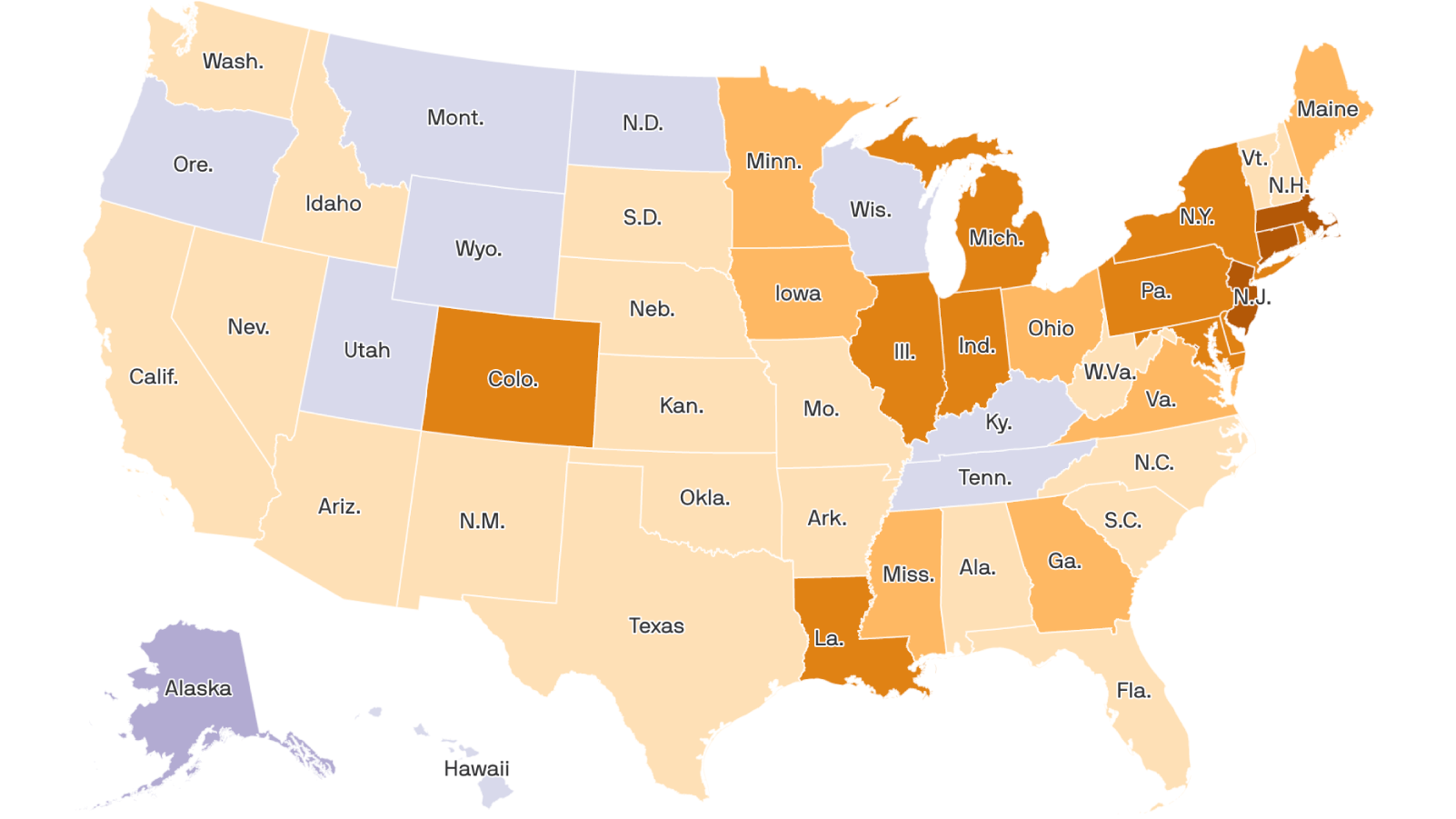
Most states still aren’t doing enough coronavirus testing, especially those that have suffered from larger outbreaks, according to recent testing targets calculated by the Harvard Global Health Institute.

Between the lines: It’s much harder to contain the virus once a lot of people have it — which is why we needed strong social distancing in the first place. But knowing who is infected is the foundation of containment going forward, and most states are still behind.

The big picture: Nationally, the U.S. needs to be doing about 900,000 tests a day, according to the Harvard estimate, which was released earlier this month.

  • But not all states need to be doing the same amount of tests. The goal Harvard suggested for each state — the number of tests they should have done on May 15  was calculated based on the size of its outbreak as of early May.
  • That means that New York needs to be doing a much larger number of tests each day than Wyoming, even after accounting for the states’ huge population discrepancy.

Why it matters: Most states have already begun reopening to some extent, even without key public health tools — like testing and contact tracing — fully built up.

  • That increases the chance that the virus will spread undetected as people begin interacting with one another again.
  • And these premature measures may just increase the number of tests a state needs, especially because the estimates were based on the assumption states would remain closed until May 15.
  • “The moment you relax, the number of cases will start climbing. And therefore, the number of tests you need to keep your society, your state from having large outbreaks will also start climbing,” Harvard’s Ashish Jha warned.