U.S. coronavirus cases rise by nearly 50,000 in biggest one-day spike of pandemic

https://www.yahoo.com/news/u-coronavirus-cases-rise-nearly-013221004.html

Dr Fauci warns US could see 100,000 new coronavirus cases PER DAY ...

New U.S. COVID-19 cases rose by nearly 50,000 on Wednesday, according to a Reuters tally, marking the biggest one-day spike since the start of the pandemic.

The record follows a warning by the government’s top infectious diseases expert that the number could soon double to 100,000 cases a day if Americans do not come together to take steps necessary to halt the virus’ resurgent spread, such as wearing masks when unable to practice social distancing.

In the first week of June, the United States added about 22,000 new coronavirus cases each day. But as the month progressed, hotspots began to emerge across the Sun Belt. In the last seven days of June, daily new infections almost doubled to 42,000 nationally.

Brazil is the only other country to report more than 50,000 new cases in one day. The United States reported at least 49,286 cases on Tuesday.

More than half of new U.S. cases each day come from Arizona, California, Florida and Texas, home to 30% of the country’s population. All four states plus 10 others saw new cases more than double in June.

The daily increase in new cases could reach 100,000 unless a nationwide push was made to tamp down the fast-spreading virus, Dr. Anthony Fauci, head of the National Institute of Allergy and Infectious Diseases, told a U.S. Senate committee on Tuesday.

“We can’t just focus on those areas that are having the surge. It puts the entire country at risk,” Fauci said.

The rise in cases is not just the result of more testing. Hospitalizations are also skyrocketing.

Nationally, 7% of coronavirus diagnostic tests came back positive last week, up from 5% the prior week, according to a Reuters analysis. Arizona’s positivity test rate was 24% last week, Florida’s was 16%. Nevada, South Carolina and Texas were all 15%, according to the analysis.

(Open https://tmsnrt.rs/2WTOZDR in an external browser for a Reuters interactive)

Some of the recent increase traces back to Memorial Day holiday celebrations in late May. Health experts are worried about Independence Day celebrations this weekend, when Americans traditionally flock to beaches and campgrounds to watch fireworks displays.


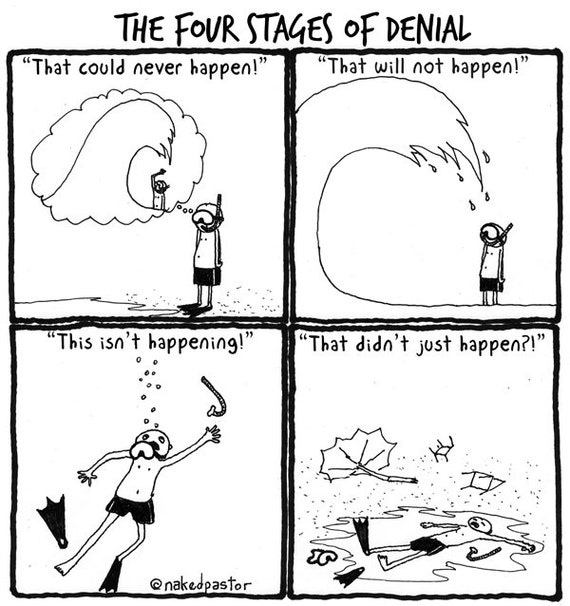
Cartoon – The Four Stages of Denial

The Four Stages of Denial CARTOON | Etsy

As the 1918 Flu Emerged, Cover-Up and Denial Helped It Spread

https://www.history.com/news/1918-pandemic-spanish-flu-censorship?cmpid=email-hist-inside-history-2020-0527-05272020&om_rid=5444b0eacc03f23065f305c9fea74958a7fc07af4357c4a980be55258fa8db43

As the 1918 Flu Emerged, Cover-Up and Denial Helped It Spread ...

Nations fighting in World War I were reluctant to report their flu outbreaks.

Spanish flu” has been used to describe the flu pandemic of 1918 and 1919 and the name suggests the outbreak started in Spain. But the term is actually a misnomer and points to a key fact: nations involved in World War I didn’t accurately report their flu outbreaks.

Spain remained neutral throughout World War I and its press freely reported its flu cases, including when the Spanish king Alfonso XIII contracted it in the spring of 1918. This led to the misperception that the flu had originated or was at its worst in Spain.

“Basically, it gets called the ‘Spanish flu’ because the Spanish media did their job,” says Lora Vogt, curator of education at the National WWI Museum and Memorial in Kansas City, Missouri. In Great Britain and the United States—which has a long history of blaming other countries for disease—the outbreak was also known as the “Spanish grip” or “Spanish Lady.”

Historians aren’t actually sure where the 1918 flu strain began, but the first recorded cases were at a U.S. Army camp in Kansas in March 1918. By the end of 1919, it had infected up to a third of the world’s population and killed some 50 million people. It was the worst flu pandemic in recorded history, and it was likely exacerbated by a combination of censorship, skepticism and denial among warring nations.

“The viruses don’t care where they come from, they just love taking advantage of wartime censorship,” says Carol R. Byerly, author of Fever of War: The Influenza Epidemic in the U.S. Army during World War I. “Censorship is very dangerous during a pandemic.”

The Flu in Europe

1918 Flu, U.S. Army Camp Hospital in France, WWI

Patients lie in an influenza ward at the U.S. Army Camp Hospital No. 45 in Aix-les-Baines, France, during World War I.

Corbis/Getty Images

When the flu broke out in 1918, wartime press censorship was more entrenched in European countries because Europe had been fighting since 1914, while the United States had only entered the war in 1917. It’s hard to know the scope of this censorship, since the most effective way to cover something up is to not leave publicly-accessible records of its suppression. Discovering the impact of censorship is also complicated by the fact that when governments pass censorship laws, people often censor themselves out of fear of breaking the law.

In Great Britain, which fought for the Allied Powers, “the Defense of the Realm Act was used to a certain extent to suppress…news stories that might be a threat to national morale,” says Catharine Arnold, author of Pandemic 1918: Eyewitness Accounts from the Greatest Medical Holocaust in Modern History. “The government can slam what’s called a D-Notice on [a news story]—‘D’ for Defense—and it means it can’t be published because it’s not in the national interest.”

Both newspapers and public officials claimed during the flu’s first wave in the spring and early summer of 1918 that it wasn’t a serious threat. The Illustrated London News wrote that the 1918 flu was “so mild as to show that the original virus is becoming attenuated by frequent transmission.” Sir Arthur Newsholme, chief medical officer of the British Local Government Board, suggested it was unpatriotic to be concerned with the flu rather than the war, Arnold says.

The flu’s second wave, which began in late summer and worsened that fall, was far deadlier. Even so, warring nations continued to try to hide it. In August, the interior minister of Italy—another Allied Power—denied reports of the flu’s spread. In September, British officials and newspaper barons suppressed news that the prime minister had caught the flu while on a morale-boosting trip to Manchester. Instead, the Manchester Guardian explained his extended stay in the city by claiming he’d caught a “severe chill” in a rainstorm.

Warring nations covered up the flu to protect morale among their own citizens and soldiers, but also because they didn’t want enemy nations to know they were suffering an outbreak. The flu devastated General Erich Ludendorff’s German troops so badly that he had to put off his last offensive. The general, whose empire fought for the Central Powers, was anxious to hide his troops’ flu outbreaks from the opposing Allied Powers.

“Ludendorff is famous for observing [flu outbreaks among soldiers] and saying, oh my god this is the end of the war,” Byerly says. “His soldiers are getting influenza and he doesn’t want anybody to know, because then the French could attack him.”

The Pandemic in the United States

Patients at U. S. Army Hospital No. 30 at a movie wear masks because of an influenza epidemic.

Patients at U. S. Army Hospital No. 30 at a movie wear masks because of an influenza epidemic.

The National Library of Medicine

The United States entered WWI as an Allied Power in April 1917. A little over a year later, it passed the 1918 Sedition Act, which made it a crime to say anything the government perceived as harming the country or the war effort. Again, it’s difficult to know the extent to which the government may have used this to silence reports of the flu, or the extent to which newspapers self-censored for fear of retribution. Whatever the motivation, some U.S. newspapers downplayed the risk of the flu or the extent of its spread.

In anticipation of Philadelphia’s “Liberty Loan March” in September, doctors tried to use the press to warn citizens that it was unsafe. Yet city newspaper editors refused to run articles or print doctors’ letters about their concerns. In addition to trying to warn the public through the press, doctors had also unsuccessfully tried to convince Philadelphia’s public health director to cancel the march.

The war bonds fundraiser drew several thousand people, creating the perfect place for the virus to spread. Over the next four weeks, the flu killed 12,191 people in Philadelphia.

Similarly, many U.S. military and government officials downplayed the flu or declined to implement health measures that would help slow its spread. Byerly says the Army’s medical department recognized the threat the flu posed to the troops and urged officials to stop troop transports, halt the draft and quarantine soldiers; but they faced resistance from the line command, the War Department and President Woodrow Wilson.

Wilson’s administration eventually responded to their pleas by suspending one draft and reducing the occupancy on troop ships by 15 percent, but other than that it didn’t take the extensive measures medical workers recommended. General Peyton March successfully convinced Wilson that the U.S. should not stop the transports, and as a result, soldiers continued to get sick. By the end of the year, about 45,000 U.S. Army soldiers had died from the flu.

The pandemic was so devastating among WWI nations that some historians have suggested the flu hastened the end of the war. The nations declared armistice on November 11 amid the pandemic’s worst wave. 

In April 1919, the flu even disrupted the Paris Peace Conference when President Wilson came down with a debilitating case. As when the British prime minister had contracted the flu back in September, Wilson’s administration hid the news from the public. His personal doctor instead told the press the president had caught a cold from the Paris rain.


Why We Should Be Reading Albert Camus During the Pandemic

https://www.governing.com/context/Why-We-Should-Be-Reading-Albert-Camus-During-the-Pandemic.html?utm_term=READ%20MORE&utm_campaign=Why%20We%20Should%20Be%20Reading%20Albert%20Camus%20During%20a%20Pandemic&utm_content=email&utm_source=Act-On+Software&utm_medium=email

Looking at Albert Camus's “The Plague” - The New York Times

The author’s masterpiece, The Plague, will make you think, ask all sorts of Socratic questions of yourself and form resolutions about how you intend to measure your life after getting through this global catastrophe.

It’s amazing how many pandemic books there are, and how thoroughly the idea of a global pandemic had crept into our popular culture well before the current situation. My daughter and I watched the Tom Hanks movie Inferno over the weekend, mostly because we wanted to gaze at the city of Florence. It’s not a great movie, but it is visually stunning in several ways. The plot is not something I gave much attention to when I first saw the film a couple of years ago: a rich Ted-talking eccentric decides to kill off most of the people of the world to save the Earth from over-population and the ravages 16 billion people would mean for other species and the health of the biosphere.

When I first saw the film in 2016, I regarded the plotline (will the vial of lethal germs be released or not?) as nothing but the usual “James Bond” setup for whatever else happened in the film. This time I watched it with greater alertness.

The fact is, of course, that COVID-19 is a serious global nuisance that has disrupted the lives of all Americans in a way that almost nobody could have predicted (well, there is Bill Gates, of course), but it is not the Black Plague, which swept away somewhere between one-fourth and one-half of all Europeans between 1348-1352, or the Yellow Fever epidemic in Philadelphia, which killed one in 10 inhabitants of America’s largest city in 1793, or the Spanish Flu, which killed somewhere between 57 and 100 million people worldwide in 1918.

If the coronavirus eventually kills 5 million people worldwide, and a couple of hundred thousand Americans before the vaccines gallop in to save the day a year or 18 months hence, it will have been a comparatively minor event in the history of global pandemics. The moment when it appeared that the hospital and medical infrastructure of New York might collapse has now passed. And though the death toll continues to climb towards perhaps 150,000 American dead by Aug. 1, 2020, the national dread that created a sustained will-we-survive and how-will-we-cope conversation in virtually every household in the United States is mostly over. The question now is when and how (and if) the country can return to what the late John McCain called regular order.

In the past two months I have read more than a dozen pandemic books, from Daniel Defoe’s A Journal of the Plague Year (1721), to Stephen King’s endless The Stand (1978). They are all interesting. If you outline the takeaway insights from these books, written over the span of many hundreds of years, they all make essentially the same points:

  1. Every government starts in denial, moves through some form of coverup, and eventually has to come to terms with the facts on the ground. 
  2. The rich flee to their country estates (or the Hamptons) and whine about all the inconvenience.
  3. The poor (as always) do most of the suffering, not merely because they are poor and have less access to the Maslovian necessities of life, but because they wind up putting themselves into harm’s way to help other people and even help the undeserving rich.
  4. The only sure methods of dealing with the epidemic (before the coming of vaccines) are social distancing, masks and the avoidance of direct body contact, and quarantining — and these do work.
  5. Economic activity grinds to a halt, but new forms of employment emerge, such as enforcing quarantines or monitoring the spread of the disease through contact tracing.
  6. People who have contracted the disease but who do not yet exhibit symptoms are the principal transmitters of the disease to others.
  7. Government has no choice but to subsidize the lives of people who have no savings and cannot work, because the alternative is food riots, looting, and perhaps revolution.
  8. Quacks, charlatans, and mountebanks abound, as always, to exploit exploitable people.
  9. Bad leaders and some portions of the population spend their time embracing and spreading conspiracy theories and searching for some group, some nation, some tribe to blame for the catastrophe.
  10. Social mores, including sexual codes, begin to break down as people slowly adopt an “eat, drink, and be merry, for tomorrow you shall certainly die” attitude.
  11. The natural sociability of humanity is such that we invariably rush back into the public square too soon, before the disease has been mastered, thus causing a second or a third wave of infection and death.


Cartoon – Are you Socially Distancing or in Denial?

Weekly Humorist

All 50 states have partially reopened; U.S. death toll surpasses 90,000

https://www.washingtonpost.com/nation/2020/05/20/coronavirus-update-us/?utm_campaign=wp_post_most&utm_medium=email&utm_source=newsletter&wpisrc=nl_most

NC coronavirus update May 18: Wake County leaders meet to discuss ...

Ready or not, the United States is reopening. All 50 states have started easing coronavirus-related restrictions — even though many of them do not meet federal benchmarks — leading public health experts to warn that a new surge of infections could be imminent.

As the U.S. death toll surpassed 90,000, White House officials continued to defend the push to reopen and optimistically predicted a swift economic recovery. As part of the focus on states’ efforts to revive their economies, Vice President Pence on Wednesday traveled to Florida while Trump was set to host the governors of Arkansas and Kansas at the White House.

Here are some significant developments:

  • Trump ramped up his rhetoric against China, claiming on Twitter that the nation’s “incompetence” was responsible for “this mass Worldwide killing!” Secretary of State Mike Pompeo also denounced China as a “brutal authoritarian regime” and described its relationship with the director of the World Health Organization as “troubling.”
  • A worker at a mink farm in the Netherlands may have contracted the novel coronavirus from an animal there, the country’s agricultural minister said. If confirmed, this is would be first recorded incident of animal-to-human transmission. 
  • A church in Houston and another in Georgia are closing for a second time after faith leaders and congregants tested positive for the virus shortly after the two churches reopened.
  • The president drew criticism for saying Tuesday it’s “a badge of honor” that America leads the world with more than 1.5 million confirmed cases of the novel coronavirus because “it means our testing is much better.” The United States has more than 30 percent of the world’s known coronavirus infections but accounts for less than 5 percent of the global population.
  • The Centers for Disease Control and Prevention laid out a detailed, delayed road map for reopening schools, child-care facilities, restaurants and mass transit, weeks after governors began opening states on their own terms.
  • The president privately expressed opposition to extending unemployment benefits for workers affected by the pandemic.


Rick Bright, ousted director of vaccine agency, warns that administration lacks ‘centralized, coordinated plan’

https://www.cnn.com/2020/05/14/politics/coronavirus-whistleblower-testimony/index.html?fbclid=IwAR0KfVp-njw8vqKFdaLbBC4r4NAx3KeS4rFg2vmFbSneW7PcqOwVYult9rc

Virus whistleblower tells lawmakers US lacks vaccine plan | Where ...

Rick Bright, the ousted director of a crucial federal office charged with developing countermeasures to infectious diseases, testified before Congress on Thursday that the US will face an even worse crisis without additional preparations to curb the coronavirus pandemic.

“Our window of opportunity is closing,” Bright said. “Without better planning, 2020 could be the darkest winter in modern history.”
Bright criticized the Trump administration for failing to implement a “standard, centralized, coordinated plan” to combat the virus and questioned its timeline for a vaccine. His testimony came a week after filing a whistleblower complaint alleging he was fired from his job leading the Biomedical Advanced Research and Development Authority for opposing the use of a drug frequently touted by President Donald Trump as a potential coronavirus treatment.
About an hour before Bright’s hearing, Trump tweeted that he had “never met” or “even heard of” Bright, but considers the NIH senior adviser a “disgruntled employee, not liked or respected by people I spoke to and who, with his attitude, should no longer be working for our government!”
Before the House Committee on Energy and Commerce’s health subcommittee, Bright urged the Trump administration to consider a number of actions, including increasing production of essential equipment and establishing both a national test strategy and a national standard of procurement of supplies. He calls on top officials to “lead” through example and wear face coverings and social distance.
Bright claimed that the administration missed “early warning signals” to prevent the spread of the virus. He said that he would “never forget” an email from Mike Bowen, the hearing’s other witness and the vice president of the medical supply company Prestige Ameritech, indicating that the US supply of N95, the respirator masks used by health care professionals, was at a perilous level.
“He said, ‘We’re in deep shit,'” testified Bright. “‘The world is.'”
Bright said he “pushed” that warning “to the highest levels” he could at Health and Human Services but received “no response.”
“From that moment, I knew that we were going to have a crisis for health care workers because we were not taking action,” said Bright. “We were already behind the ball.”
In his written statement, Bright blamed the leadership of HHS for being “dismissive” of his “dire predictions.” Bright wrote that he knew the US had a “critical shortage of necessary supplies” and personal protective equipment during the first three months of the year and prodded HHS to boost production of masks, respirators, syringes and swabs to no avail. He alleged that he faced “hostility and marginalization” from HHS officials after he briefed White House trade adviser Peter Navarro and members of Congress “who better understood the urgency to act.”
And he charged that he was removed from his post at BARDA and transferred to “a more limited and less impactful position” at NIH after he “resisted efforts to promote” the “unproven” drug chloroquine.
A Department of Health and Human Services spokesperson responded that it was “a personnel matter that is currently under review” but said it “strongly disagrees with the allegations and characterizations.”
Bright is seeking to be reinstated to his position as the head of BARDA. The Office of Special Counsel, which is reviewing Bright’s complaint, has determined that was a “substantial likelihood of wrongdoing” in removing him from his post, according to Bright’s attorneys.
Rep. Anna Eshoo, a California Democrat and the panel’s chairwoman, said Bright “was the right person, with the right judgment, at the right time.”
“We can’t have a system where the government fires those who get it right and reward those who get it completely wrong,” added Eshoo.
In his testimony, Bright also cast doubt on the Trump administration’s goal of manufacturing a vaccine in 12 to 18 months as overly optimistic, calling it “an aggressive schedule” and noting that it usually takes up to 10 years to make a vaccine.
“My concern is if we rush too quickly, and consider cutting out critical steps, we may not have a full assessment of the safety of that vaccine,” Bright said. “So, it’s still going to take some time.”
Some Republicans on the subcommittee said that the hearing shouldn’t have been held at all.
Rep. Michael Burgess of Texas, the top Republican on the panel, said “every whistleblower needs to be heard,” but added the hearing was “premature” and a “disservice” to the Special Counsel’s investigation since Bright’s complaint was filed only a week ago.
And Republican Rep. Richard Hudson of North Carolina claimed that the hearing was not about the whistleblower complaint but “undermining the Administration during a national and global crisis.”
Thursday’s subcommittee meeting comes two days after a blockbuster hearing in the Senate that featured Dr. Anthony Fauci, who leads the National Institute of Allergy and Infectious Diseases. Fauci said that access to a vaccine in time for the fall school year would be “a bit of a bridge too far” and warning against some schools opening too soon, which Trump later called “not an acceptable answer.”
Fauci testified from his modified quarantine at home since he had made contact with a White House staffer who tested positive. But Bright appeared masked and in-person for his hearing on Capitol Hill, as did the lawmakers who questioned him. Many members of the House have steered clear of Capitol Hill since the onset of the outbreak, although they are expected to return on Friday to vote on a multi-trillion dollar Democratic bill responding to the crisis.


Administration’s Handling of Coronavirus Threatens a Long Unemployment Crisis

https://www.americanprogress.org/issues/economy/news/2020/05/07/484795/trump-administrations-handling-coronavirus-threatens-long-unemployment-crisis/
The Trump Administration's Handling of Coronavirus Threatens a ...

On Friday, the Bureau of Labor Statistics will release employment numbers for April that are expected to show a tragic and historic increase in unemployment. Consensus estimates anticipate more than 20 million jobs lost and an unemployment rate of 16 percent—a figure that may well be an underestimate given that millions of people may not be looking for jobs, effectively exiting the labor force and reducing the labor force participation rate. Moreover, state-level unemployment claims data show that this economic pain is being felt across the country, with sharp rises in joblessness in every state. And Thursday’s jobless claims release suggests that job losses have continued at high levels since the April unemployment survey was taken.

While the immediate cause of this spike in joblessness is, of course, the necessary stay-at-home orders and social distancing measures taken to respond to the crisis, the rise in unemployment—and how long it lasts—cannot be separated from choices made by the Trump administration. In understanding the state of the economy, as well as what comes next, the following three elements of this crisis must be understood:

  1. The economic crisis we are facing—and the economic pain we expect in the months ahead—is the result of a failed public health response. The Trump administration ignored early warnings, misled the public, and made the coronavirus crisis worse. The fact that the administration bungled the testing regime early on in the crisis meant that the United States could never contain the virus, as other countries such as South Korea, New Zealand, and Taiwan have done. As a consequence of that failure, the United States has had to engage in social distancing that has meant economic shock in order to avoid significantly greater levels of infections and deaths. The depth and scope of the economic pain being felt is a consequence of the administration’s delayed response and complete failure take leadership during this crisis.
  2. The administration’s inability to put in place appropriate public health measures going forward—combined with its insistence that efforts to contain the virus should be lifted in the absence of those measures—is likely to not only prolong the public health crisis but also extend the economic pain. Rather than provide workers, businesses, and families the confidence that they can return to activity safely, the administration is taking steps that try to ignore the risk of infection, such as absolving employers of responsibility for worker safety through a liability shield or forcing workers to return to work even when they have concerns about their health. In this environment, we are likely to see decreased demand for some time to come because people will have little confidence in individual state reopening strategies disconnected from science—as we are already seeing across the country.
  3. By rejecting efforts that would support families, workers, and communities during this crisis, the administration and its allies in Congress are putting us on a path for continued double-digit unemployment even after the pandemic finally ends. Indeed, the Congressional Budget Office (CBO) projects that the unemployment rate—absent additional action—will be near 10 percent at the end of 2021, several months after they project social distancing as a result of the health crisis abates. By opposing efforts to provide sufficient aid to states and localities; relief to families and unemployed workers; and assistance to those struggling the most, President Donald Trump, Majority Leader Mitch McConnell (R-KY), and their allies are insisting on making this extended period of double-digit unemployment a reality.

There is an alternative path, however: Taking the necessary steps to address the public health crisis and ensure that people can go back to work safely and doing what is needed to address the immediate economic pain and avoid prolonged unemployment. As Congress and the administration consider an additional stimulus package, they should put in place necessary public health protections while providing robust aid to families, workers, and communities for as long as the crisis lasts. This will allow us to avoid double-digit unemployment from being a devastating reality for American families for the next year and a half or more.

Public health failures has driven unemployment up

The rise in unemployment over the past two months is a direct consequence of the public health crisis—one that could have taken a far less severe toll under an administration that had been better prepared for it and that had approached it more wisely. The Trump administration has failed to develop an evidence-based plan to end the coronavirus crisis. Instead, its mismanagement has resulted in widespread fear and uncertainty as to when it might be appropriate to reopen parts of the economy. President Trump did not take the pandemic seriously when cases first emerged in the United States; his administration failed to use the month of April—when the nation was largely shut down—to ramp up the testing, contact tracing, and other pieces necessary for the public health response. And now, Trump is pushing states to reopen too soon. Before people feel comfortable enough to once again venture out of their homes and reengage in work and other economic activities, we need to ensure the country has developed the necessary health infrastructure to allow us to gradually reopen our economy without sparking a second wave of infections.

The economic crisis cannot end until public health crisis is solved

The Trump administration and its allies are arguing that the way to solve the economic crisis is to open up the country, ending stay-at-home orders and engaging in aggressive efforts to force business to return to normal. But in the absence of public health measures that actually allow activity to return safely, the administration’s strategy appears to be one of “ignore and press on,” with potentially devastating results for workers and communities. This strategy includes:

  • Pushing communities to lift stay-at-home orders and other public health measures before sufficient testing, tracing, isolation and ongoing surveillance is in place
  • Forcing workers back on the job, even without sufficient personal protective equipment or workplace safety protections—whether by removing unemployment insurance for those who are recalled to unsafe situations or through executive actions such as those taken for the meatpacking industry
  • Proposing to absolve employers of the responsibility to keep workers and communities safe through blanket immunity from liability—a measure that would do nothing to keep workers safe or build confidence in economic reopening

These steps reflect an acceptance of elevated risks of transmission, and ultimately, death. And despite the president’s rhetoric, it will make it less likely that the economy can return faster.

First, it is clear that the public isn’t going to feel safe to return to normal economic activity absent additional public health measures. A recent Washington Post-University of Maryland poll found that “67 percent say they would be uncomfortable shopping at a retail clothing store, and 78 percent would be uncomfortable eating at a sit-down restaurant.” These results were similar both in states that had loosened restrictions and those that had not and is consistent with other data. As long as people are anxious that returning to normal activities could put them at risk of contracting the virus, the economy will be unable to recover.

Second, a strategy that fails to put in place the necessary protections against spreading the virus will increase transmission among the public, and especially workers, in ways that may force additional shutdowns and prolong the period of public health crisis. In sum, prolonged public health crisis equals a prolonged state of economic distress—extending the number of months with a job market like April’s. The best approach—an approach adopted by other countries who are faring better both with their health outcomes and their economic impacts—is a national plan to fight the virus that is based on testing, tracing, and isolation.

After the pandemic ends, double-digit unemployment will persist under the current course

The CARES act provided large, necessary relief to most Americans, including assistance for workers, families, and small businesses. But this assistance will run out before the economic emergency is behind us, forcing the economy into unnecessarily prolonged hardship.

Indeed, the measures in the CARES Act both leave important gaps and will expire long before the economy is expected to return to normal. States and localities are facing extreme budget shortfalls. If action is not taken before state budget deadlines on July 1, states are likely to begin implementing layoffs of teachers and first responders and service cuts in the coming months that will cause additional job loss. Expanded unemployment insurance benefits expire at the end of July, removing an important lifeline for those out of work. While the direct payments in the CARES Act provided important assistance to families, the $1,200 per person payment will not be enough to sustain households through a prolonged crisis. The initial Paycheck Protection Program (PPP) support for small businesses has run out, and a second round of funding may soon run out too. And in important areas such as housingfood assistancechild care, and health coverage, among others, the CARES Act failed to do enough to address the hardship being felt today, let alone over a prolonged crisis—even as it provided generous aid to corporations.

As a result, under baseline projections—those that assume no further action on the part of the government—double-digit unemployment is expected to be a feature of the economy for at least the next year and a half. As noted above, the CBO estimates that the unemployment rate will remain near 10 percent at the end of 2021—many months after they predict that social distancing due to the pandemic itself ends.

Yet the Trump administration and congressional Republicans have indicated that they are prepared to accept this reality, or at best, offer solutions that do nothing to shift it. White House economic adviser Kevin Hassett said that another round of coronavirus relief legislation might not be necessary, and chief economic adviser Larry Kudlow said on Sunday that nothing has been decided yet and that “there’s kind of a pause period right now” and that “we will wait and see.” Senator McConnell has dismissed state and local aid as a “blue state bailout,” despite pain being felt in all states.

To the extent the administration or its allies have signaled a desire to act, they have focused on measures that would be woefully insufficient to address the economic challenges we face. Aside from the liability shield, Trump has signaled a push for poorly targeted corporate tax cuts or a payroll tax cut that would fail to benefit those who are out of work. An illustrative example of Trump’s approach is his call for removing limits on corporate deductions for meals and entertainment—effectively allowing companies to deduct expenses for sports tickets, golf trips, or visits to casinos—which would provide a benefit to corporations and their wealthiest executives but do little to help put money in the hands of those who need it.

A better path: a response that meets the public health and economic challenge

As it considers another package to address this crisis, Congress has the opportunity to take a path that rejects double-digit unemployment as a lasting feature of this crisis. The approach Congress should take would allow economic activity to restart safely and ensure that, as the economy restarts, we are actually getting people back to work rather than accepting a recession that keeps millions unemployed.

First, that requires a sufficient public health response. The purpose of stay-at-home orders in the first place was to suppress transmission to low levels and buy time to put in place extensive testing and contact tracing programs, but we have yet to meet those goals. Nationally, we still need to increase our testing capacity and reach at least 500,000 tests a day; scale up contact tracing—both manually and by apps that meet privacy standards—in order to isolate people who test positive as well as their contacts; and have in place a far more robust disease surveillance system.

And second, it requires an economic response that offers relief that both addresses immediate pain that families, small businesses, and communities are facing and is sufficient to build back to a stronger economy.

In particular, the package must be:

  1. At a scale necessary to address the crisis. We need to pursue a fiscal response that is proportional to both the public health and economic threat posed by COVID-19. The economic consequences of this crisis are staggering. Children are going hungry; households are piling massive debts; millions of homeowners are delaying their mortgage payments; small businesses in hard hit states received fewer loans than others; minority small business owners are struggling to stay open; and state and local governments are preparing for significant layoffs of teachers and first responders in the absence of federal aid. Action needs to be sufficiently large to both address the immediate hardship that families are facing and get the economy back to work. This big push for aid has to be coordinated at the national, state, and local levels. An important lesson form the Great Recession was that austerity at the level of states and localities was a key factor in delaying economic recovery for years, since states were in austerity mode from 2008 until 2012, contributing to lower GDP growth. And, in contrast to concerns raised by some congressional Republicans—concerns that were absent during the passage of nearly $2 trillion in tax cuts in 2017—we have the fiscal capacity to respond robustly, especially with interest rates near zero. Indeed, evidence suggests that increased fiscal stimulus may increase fiscal sustainability.
  2. Sustained for the duration of the crisis. Relief must be sustained, automatic, and available with certainty for as long as it is needed. We should learn from the Great Recession, when stimulus was insufficient and removed too soon. During that crisis, unemployment insurance expired for many workers long before the crisis had passed; fiscal aid ended long before state and fiscal budget cuts ceased being a drag on the recovery. Key measures to support the economy, such as unemployment insurance, state and local aid, and direct relief to families, should automatically extend for the duration of the economic crisis—ensuring that we are providing sufficient relief and necessary stimulus as long as is needed to support a robust recovery.
  3. Targeted to all the areas where Americans are feeling economic hardship. There is no silver bullet that will bring the economy back. We need a multilayered attack that addresses the root cause of the problem—the spread of the virus—and ameliorates its symptoms in the form of hardship for families, workers, small businesses, and communities. Building off the CARES Act, additional aid needs to make sure it is reaching those who have been excluded. That requires ensuring that aid is more completely available—for example, ensuring that immigrant families can access needed relief or closing loopholes that prevent workers from having access to paid leave. It also means providing much needed assistance in areas such as food assistance, child care, housing, and for people with disabilities—areas that would both address concentrated harm and support the economy going forward. Finally, the package should be designed so that—rather than exacerbating structural problems in our economy that benefited corporations over workers—it puts us on a path for a stronger economy once the crisis ends.

The administration and its allies appear content to accept a prolonged period of public health and economic harm that is a result of the mismanagement of the COVID-19 crisis to date—essentially condemning the nation to a greater toll from the virus itself and a much longer period of economic distress. It must be clear that the harsh reality of the April jobs report—and the much broader pain that has been felt over recent weeks—was the result of both failed policy decisions and mismanagement. By the same token, we have the choice going forward as to whether we accept further pain or take steps that would both keep people healthy and get Americans back to work.


The White House said it was following health experts’ advice. Then we learned it isn’t approving a key CDC document.

https://www.washingtonpost.com/politics/2020/05/07/white-house-said-it-was-following-health-experts-advice-then-we-learned-it-isnt-approving-key-cdc-document/?fbclid=IwAR1TRmiDX4IF5WgkAEVT0BeV0qnYxHCZhF1YwfWrmM79FmS6UOivaFbNBA4&utm_campaign=wp_main&utm_medium=social&utm_source=facebook

Diseases & Conditions | CDC

White House press secretary Kayleigh McEnany made a point at the start of Wednesday’s news briefing to emphasize that President Trump is following health experts’ advice as we enter what Trump has labeled the “next stage” of the coronavirus response — reopening the economy.

“As you are well aware, President Trump has consistently sided with the experts and always prioritized the health and safety of the American people,” McEnany said.

Several hours later, we got another example of the White House resisting what those health experts are advising.

The Associated Press reported around midnight that the White House had shelved planned guidelines from the Centers for Disease Control and Prevention. The document, which was due nearly a week ago, was aimed at providing local authorities with step-by-step guidance on how to reopen:

The 17-page report by a Centers for Disease Control and Prevention team, titled “Guidance for Implementing the Opening Up America Again Framework,” was researched and written to help faith leaders, business owners, educators and state and local officials as they begin to reopen.
It was supposed to be published last Friday, but agency scientists were told the guidance “would never see the light of day,” according to a CDC official. The official was not authorized to talk to reporters and spoke to The Associated Press on the condition of anonymity.

A coronavirus task force official told The Washington Post that the document has not been completely shelved but was in the process of being revised because it was “overly specific.” The official also indicated that it was felt the document was too broad, as “guidance in rural Tennessee shouldn’t be the same guidance for urban New York City.”

The denial, though, reinforces that the White House is reluctant to submit to the CDC’s more detailed prescriptions for reopening the economy. And it’s difficult to divorce the delay in this document’s publication from Trump’s anxiety to reopen the economy — and the tension that has created with past guidelines.

The administration in mid-April issued phased advice on when areas should start to reopen places such as restaurants and other nonessential businesses. But many states have moved forward with certain elements of reopening without actually satisfying those guidelines. Most notably, they have begun to reopen without meeting the Phase One guideline that they should see a decrease in confirmed coronavirus cases over a 14-day period.

As The Post’s Philip Bump reported, some states that have pushed forward with reopening have also seen an increase in cases — which would prevent them from satisfying the requirement for moving into Phase Two. That requirement is that the decline should continue for another 14 days after Phase One begins.

Issuing a detailed document would seemingly complicate further reopenings, because it would again restrict what states and local authorities are supposed to do.

The Washington Post’s Lena H. Sun and Josh Dawsey previewed what the document was set to look like last week. And they also obtained a draft of the document. The new guidelines were to go beyond the initial ones in prescribing specific actions that could be taken in each phase of the reopening. Advocates for reopening have worried that strict guidance could make it difficult for businesses, churches, child-care centers and other facilities to actually function.

Trump, who has long signaled a desire to begin reopening that economy sooner rather than later, has doubled down on that rhetoric in recent days. Despite a steady national death rate that approached previous highs on Tuesday and Wednesday, and even though cases continue to increase outside the major U.S. hotbed of New York City, Trump on Tuesday signaled that we are entering the “next stage” of reopening the economy.

“Thanks to the profound commitment of our citizens, we’ve flattened the curve, and countless American lives have been saved,” Trump said. “Our country is now in the next stage of the battle: a very safe phased and gradual reopening. So, reopening of our country — who would have ever thought we were going to be saying that? A reopening. Reopening.”

Trump has been resistant to the advice of the health officials around him, from the early days of the outbreak when he continuously downplayed the severity of the situation. On several occasions, this tension has boiled over.

We’re also hearing from those officials less and less. The CDC long ago ceased holding briefings on the coronavirus outbreak, and the White House coronavirus task force briefings, which often featured health experts Anthony S. Fauci and Deborah Birx, have now been halted in favor of less-frequent and less-coronavirus-focused briefings from McEnany. Fauci has also been prevented from testifying to the Democratic-controlled House, although he is still slated to testify in the GOP-controlled Senate and has continued doing some interviews. The cumulative effect is that these health experts aren’t on the record as much as the effort to reopen the economy begins in earnest.

In the place of those public comments, the CDC guidelines were to provide firm and detailed advice from those officials for the new stage. But for reasons that seem pretty conspicuous, we still don’t have them.