COVID-19 to cost hospitals $323 billion, American Hospital Association says

https://www.beckershospitalreview.com/finance/covid-19-to-cost-hospitals-323-billion-american-hospital-association-says.html?utm_medium=email

Catastrophic financial impact of COVID-19 expected to top $323 ...

Hospitals will lose $323.1 billion this year because of the COVID-19 pandemic, according to a new report from the American Hospital Association. 

The total includes $120.5 billion in financial losses the association predicts hospitals will see from July through December on top of $202.6 billion in losses they estimated between March and June. The losses are in large part due to lower patient volumes.

“While potentially catastrophic, these projected losses still may underrepresent the full financial losses hospitals will face in 2020, as the analysis does not account for currently increasing case rates in certain states, or potential subsequent surges of the pandemic occurring later this year,” the AHA said.

Hospitals and health systems are reporting an average decline of 19.5 percent in inpatient volume and 34.5 percent in outpatient volume when compared to baseline levels from last year. Most hospitals don’t expect to return to last year’s levels in 2020.

Read the full report here.


Six months in, coronavirus failures outweigh successes

Six months in, coronavirus failures outweigh successes

Covid-19 news: UK deaths fall below five-year average | New Scientist

In the six months since the World Health Organization (WHO) detected a cluster of atypical pneumonia cases at a hospital in Wuhan, China, the coronavirus pandemic has touched every corner of the globe, carving a trail of death and despair as humankind races to catch up.

At least 10.4 million confirmed cases have been diagnosed worldwide, and the true toll is likely multiples of that figure. In the United States, health officials believe more than 20 million people have likely been infected.

A staggering 500,000 people around the globe have died in just six months. More people have succumbed to the virus in the U.S. — 126,000 — than the number of American troops who died in World War I.

But even after months of painful lockdowns worldwide, the virus is no closer to containment in many countries. Public health officials say the pandemic is getting worse, fueled by new victims in both nations that have robust medical systems and poorer developing countries.

“We all want this to be over. We all want to get on with our lives. But the hard reality is this is not even close to being over,” WHO Director-General Tedros Adhanom Ghebreyesus said Monday. “Globally, the pandemic is actually speeding up.”

In the U.S., the fierce urgency of March and April has given way to the complacency of summer, as bars and restaurants teem with young people who appear largely convinced the virus poses no threat to them. New outbreaks, especially among younger Americans, have forced 16 states to pause or roll back their reopening plans.

“This is a really challenging point in time. It’s challenging because people are tired of the restrictions on their activity, people are tired of not being able to socialize, not being able to go to work,” said Richard Besser, a former acting director of the Centers for Disease Control and Prevention (CDC) who now heads the Robert Wood Johnson Foundation.

“You have people who have reached that point of pandemic fatigue where they just don’t want to hear it anymore, they just want to go back to their life,” he added.

The number of new U.S. cases has risen sharply in recent weeks, led disproportionately by states in the South, the Midwest and the Sun Belt. More than a quarter-million people tested positive for the coronavirus last week, and more than 40,000 tested positive on three consecutive days over the weekend.

“We are now having 40-plus thousand new cases a day. I would not be surprised if we go up to 100,000 a day if this does not turn around. And so I am very concerned,” Anthony Fauci, director of the National Institute for Allergy and Infectious Diseases, told a Senate panel on Tuesday.

Public health experts now worry that a rising tide of death is about to crest across the United States. Officials in Alabama, Arizona, California, Mississippi and Texas are reporting a surging number of COVID-19 hospitalizations, leading to fears that health systems could soon be overrun.

“If you’re over the hospital capacity, people will start dying faster,” said Eric Feigl-Ding, an epidemiologist and health economist at the Harvard T.H. Chan School of Public Health and a senior fellow at the Federation of American Scientists.

Already, Arizona has reported more coronavirus deaths per million residents in the last week, at 4.77, than any nation on Earth except Chile and Peru.

The response to the coronavirus pandemic has varied widely, and in some parts of the world, both wealthy and developing nations have brought it under control. In the U.S., some states hit hard early on have wrangled transmission under control.

But even in states that have achieved some measure of success, the spikes in cases stand in stark contrast to countries that have bent the epidemiological curves to manageable levels.

Mass screenings in South Korea crushed the spread, and quick action to identify and isolate contacts in more recent hot spots have meant new outbreaks are quickly contained. South Korea, with a population of 51 million, has reported just 316 new cases in the past week, fewer than the number of new cases reported in Rhode Island, a state with slightly more than 1 million residents.

Germany raced to protect its elderly population and rapidly expanded its hospital capacity. It deployed the world’s most successful diagnostics test, developed at a Berlin hospital, on a massive scale. With a population of 83 million, the country has reported 78 coronavirus deaths in the past week; Mississippi, population 3 million, reported 96 coronavirus-related deaths during the same period.

Vietnam imposed mandatory quarantines on contacts, including international travelers, in government-run centers to stop the spread. Among its 95 million residents, Vietnam has confirmed 355 total cases since the outbreak began. Alabama, population 4.9 million, reported 358 cases on Sunday alone.

Those countries have begun loosening restrictions on their populations and their economies, with few signs of major flare-ups.

The United States has begun to open up too but without bending the curve downward, and the results have been disastrous. The number of daily confirmed cases has more than doubled in nine states over the past two weeks and has increased by more than half in 17 more.

“I have really grave concerns that viral transmission is going to get out of control,” Besser said.

In interviews, public health experts and epidemiologists confess to feelings of depression and disgust over the state of the nation’s response. Some remain exasperated that there is still no coordinated national response from the White House or federal agencies.

President Trump has rarely mentioned the virus in recent weeks, aside from using racial epithets and suggesting his administration would slow testing to reduce the number of confirmed cases. He later said he was joking.

“There should be some sort of federal leadership,” Feigl-Ding said. “Every state’s on its own, for the most part.”

Left to their own devices, some states are trending in the right direction. Connecticut, Maryland, New Hampshire, New York, North Dakota, Rhode Island, South Dakota and the District of Columbia have seen their case counts decline for two consecutive weeks or more. New York reported 4,591 new cases in the last week — a startlingly high figure but only a fraction of the 65,000 cases infecting the state during its worst week, in early April.

States with their numbers on the decline have benefited from fast action and strict measures. They’re also viewed as role models for states that are now experiencing surges.

“States who are now on the rapid upslope need to act quickly, take the advice and example of states that have already been through this,” said Abraar Karan, an internist at Brigham and Women’s Hospital and Harvard Medical School. “We know what needs to be done to win this in the short run, and we are working on what needs to happen for the longer term.”

If there is a silver lining, it is that the number of tests American states are conducting on a daily basis has grown to about 600,000, on its way toward the millions the nation likely needs to fully control the spread.

But that silver lining frames a darkening cloud: As the virus spreads, even the higher testing capacity has been strained, and state and local governments are hitting their limits and running low on supplies.

The greater number of tests does not account for the speed of the spread, as Trump has suggested. The share of tests that come back positive has averaged almost 7 percent over the last week, according to The Hill’s analysis of national figures; in the first week of June, just 4.6 percent of tests were coming back positive.

If greater testing were responsible for more cases, the percentage coming back positive should decrease rather than increase. The higher positive rates are an indication the virus is spreading more rapidly.

As with so much else in American life, the coronavirus has become a political battleground. The new front is over face masks, which studies show dramatically reduce transmission. States that have mandated wearing masks in public saw the number of new cases decline by a quarter between the first and third weeks of June; states that do not require masks in any setting saw the number of cases rise by 84 percent over that same span.

“From a public health perspective, it’s demoralizing, it’s tragic … because our public health leaders know what to do to get this under control, but we’re in a situation where the CDC is not out front in a leadership role. We’re not hearing from them every day. They’re not explaining and capturing people’s hearts and minds,” said Besser, the former CDC chief. “If we have a vaccine, that will be terrific if it’s safe and effective. But until that point, these are the only tools we have, these tools of public health, and they’re very crude tools.”


Cartoon – To Beach or not to Beach

Cartoons

Pre And Post Coronavirus Unemployment Rates By State, Industry, Age Group, And Race

https://www.forbes.com/sites/mikepatton/2020/06/28/pre-and-post-coronavirus-unemployment-rates-by-state-industry-age-group-and-race/#65c42c6555eb

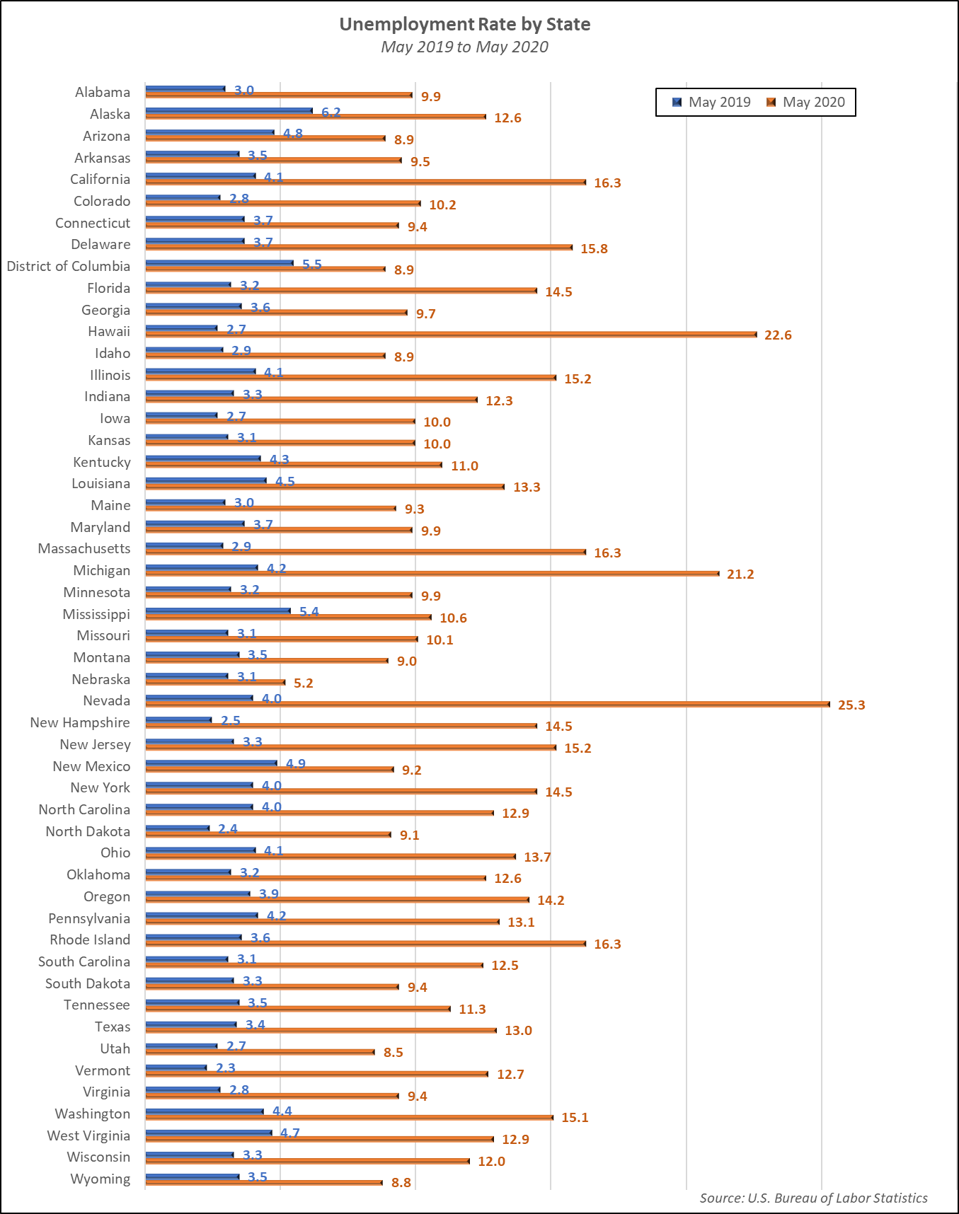
Unemployment by State-May 2019 to May 2020

The coronavirus has decimated the U.S. economy and benched nearly 40 million American workers. In the past several days, the U.S. has logged its highest number of new Covid-19 cases since the pandemic began. These combined with other factors, which we will discuss, is jeopardizing the future employment of millions of workers and the viability of thousands of businesses. Here’s how unemployment has increased for every state, industry, age group, and race, and why.

Unemployment by State

The coronavirus and subsequent stay at home orders hit the labor force especially hard. As states attempted to reopen, a resurgence in the virus is causing many businesses to close again, some by choice, others by government mandate.

Nevada has been hit the hardest as the unemployment rate in the Silver State rose from 4.0% in May 2019 to a whopping 25.3% in May 2020. Nevada’s economy is heavily reliant on leisure and hospitality, which had the brunt of the job losses. Hawaii, the second hardest hit state saw unemployment rise from 2.7% in May 2019 to 22.6% in May 2020. Which is the only other state with unemployment above 20% in May 2020? Michigan, where unemployment rose from 4.2% to 21.2% year over year. What state has fared best? Nebraska, which also has one of the most diverse economies of all states. Deriving nearly 50% of its total GDP from five different industries, unemployment in the Cornhusker State rose from 3.1% to a modest 5.2% from May 2019 to May 2020. Unemployment numbers for all states are shown in the following chart.

Unemployment by Industry

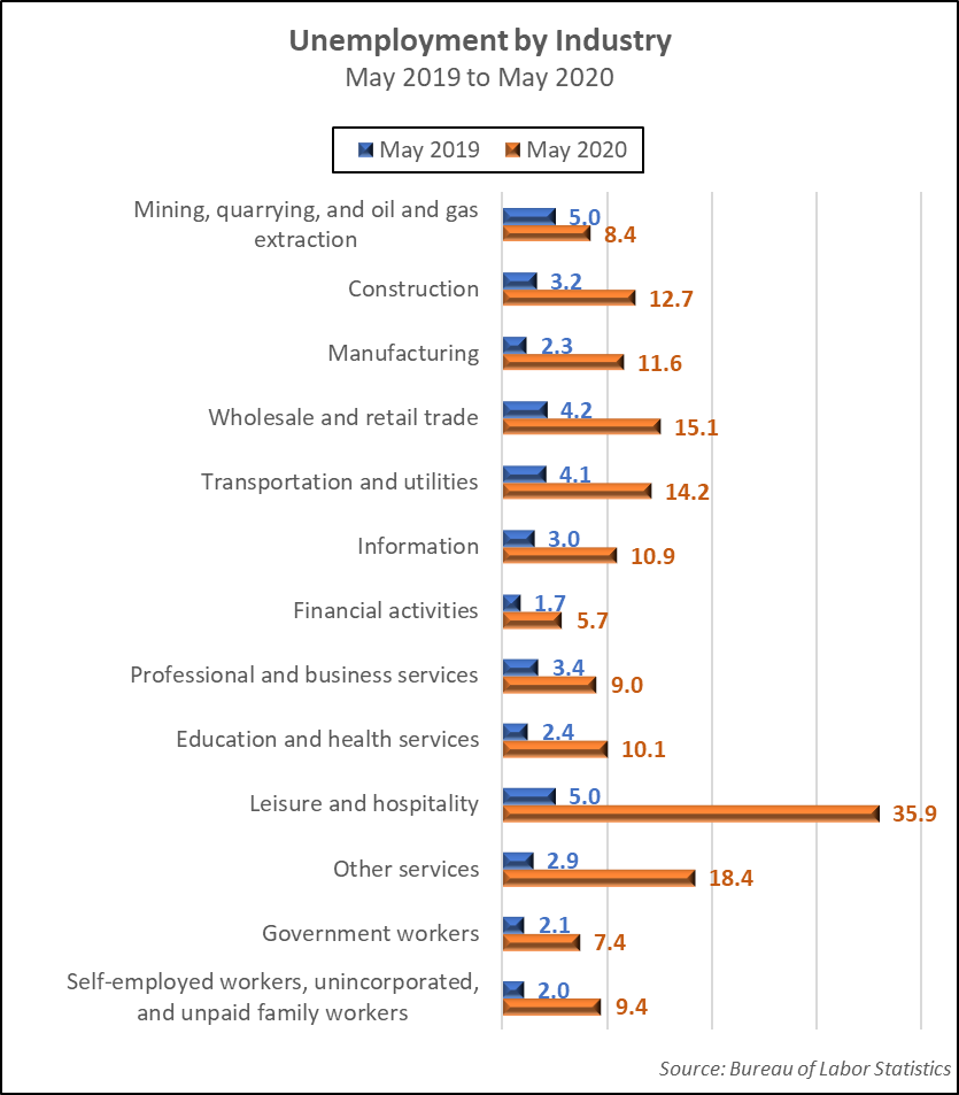
As mentioned in the previous section, the states that have fared best either have a more diverse economy or do not rely heavily on industries that have been hardest hit by the coronavirus. The most negatively affected is the leisure and hospitality industry where unemployment rose 618% from a low of 5.0% in May 2019 to a staggering 35.9% in May 2020. At a distant second, but still reeling, is the wholesale and retail trade industry, which saw unemployment rise from 4.2% to 15.1% during the same period. The rest of the industries are listed in the following chart.

Unemployment by Industry-May 2019 to May 2020

Unemployment by Age Group

Businesses need two things to exist: workers and customers. Without customers, there is no need for workers or the business for that matter. Some businesses require highly skilled workers while others operate well using unskilled labor. It is this unskilled labor group that has been hardest hit.

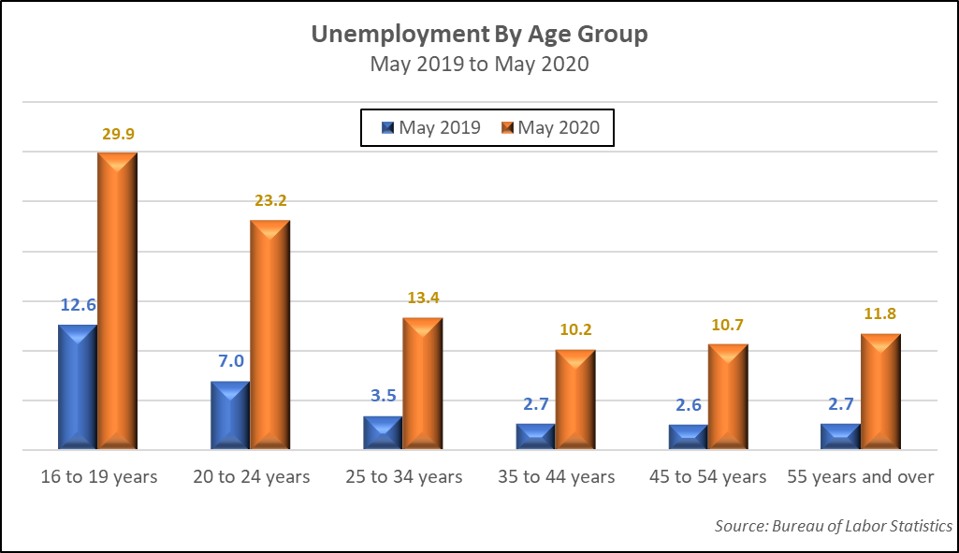
The greatest rise in unemployment is among workers under age 25. This is likely due to three factors. Younger workers typically have fewer marketable skills, less work experience, and less seniority. Many of these workers are in industries that have felt the greatest pain. Unemployment rates by age group are contained in the following chart.

Unemployment by Age Group-May 2019 to May 2020

Unemployment by Race/Ethnicity

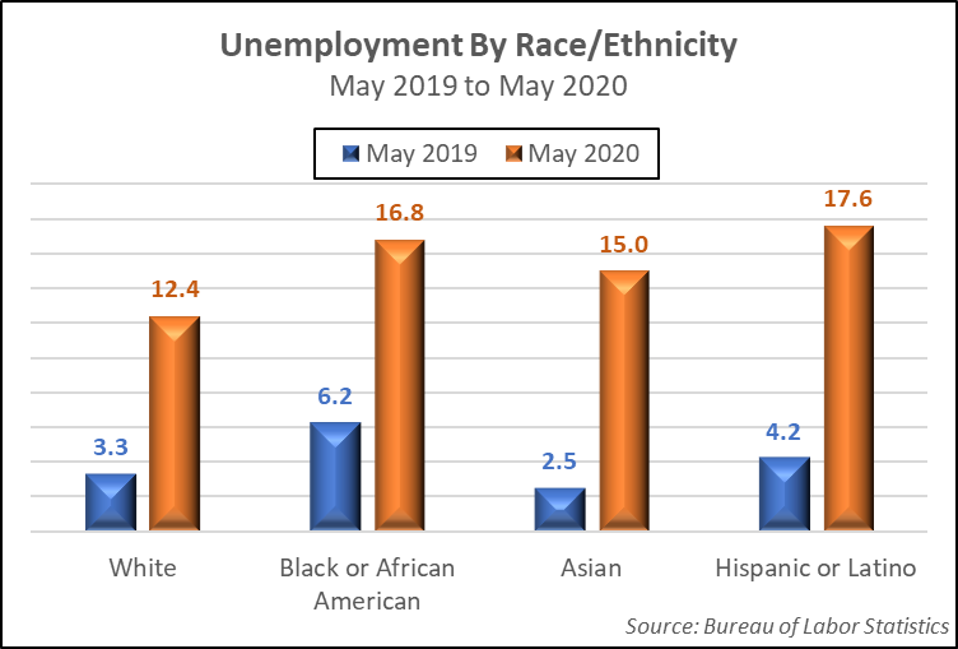
Question: Prior to Covid-19, was unemployment among blacks / African Americans at a record low as President Trump has claimed? Using the available data, which extends back to January 1972, the answer is yes. This new record low was achieved in October and November of 2019 when unemployment among black or African American workers fell to 5.1%. The previous record low was 5.2% in December 1973. The current rate is 16.8%, which is less than the highest rate of 20.7% logged in December 1982. The most recent high in unemployment for this group was 19.3% in March 2010. It has been steadily declining since then. Numbers for White, Asian, and Hispanic or Latino and black or African American workers are listed in the following chart.

Unemployment by Race or Ethnicity-May 2019 to May 2020

Businesses need workers, workers need businesses, and both depend on customers. Since the pandemic began, consumer demand has fallen sharply. With the probability that a vaccine will not be available until early 2021 at the soonest, plus a disregard for recommended safety protocols by many individuals, namely wearing masks and social distancing, it is highly unlikely that the economy will return to normal for several years.

Will the president continue to hold rallies? Will he set an example by wearing a mask? Will the protests and violence continue? Will other large gatherings continue? Unless Americans make a collective and conscious choice to mask up and social distance, we will be forced to live in a depressed economy for longer than necessary. The choice is up to us.


Trinity Health expects $2B revenue plunge as it cuts, furloughs more staff

https://www.healthcaredive.com/news/trinity-health-cutting-cost-cutting-2-billion-revenue-shortfall/580738/

The Dumbest Things You Can Do With Your Money | Work + Money

Dive Brief:

  • Trinity Health, one of the nation’s largest nonprofit health systems, said Monday it will take more measures to cut costs due to the downturn spurred by the novel coronavirus. The restructuring plan includes eliminating positions, extending furloughs, severances and reductions in schedules. The decisions are being “customized” across the system based on factors that include volume projections and the cost and revenue challenges in each market.
  • The Livonia, Michigan-based hospital operator said it continues to treat COVID-19 patients, however, it has “for now seen declining numbers of very sick patients with COVID-19.”
  • The system said it expects revenue to be depressed or “below historical levels” for the remainder of this fiscal year and much of the next. It projects revenue to drop by $2 billion to $17.3 billion for fiscal year 2021, which starts after its June 30 year end.

Dive Insight:

In May, Trinity said it planned to furlough nearly 12% of its workforce — or 15,000 employees out of the 125,000 nationally.  

Trinity, one of the nation’s largest hospital operators with 92 facilities and operations across 22 states, is now broadening that restructuring, extending and adding new furloughs.

In a Monday bond filing, Trinity said its operations were “significantly” impacted by the effects of the pandemic as many operators saw depressed volumes due to shelter-in-place orders, which started in most of Trinity’s markets during the last two weeks of March.

“The effect of COVID-19 on the operating margins and financial results of Trinity Health is adverse and significant and, at this point, the duration of the pandemic and the length of time until Trinity Health returns to normal operations is unknown,” according to Monday’s bond filing.

The system said relief funds provided by the federal government have not been enough to cover its operating losses. Trinity has received $600 million in relief funds that do not have to be repaid and more in loans through the advanced Medicare payment program, according to a previous analysis by Healthcare Dive.

Still, the system said it has drawn on credit facilities totaling $1 billion to provide adequate liquidity during the pandemic. Trinity reported having 178 days cash on hand as of March 30.

Some nonprofits are faring better than Trinity and pulling back on earlier staffing cuts.

Mayo Clinic said last week it will call back its furloughed workers by the end of August and restore pay that had been cut due to the pandemic.

Mayo has some of the most cash on hand in terms of days when comparing other major nonprofit systems. Mayo had 252 days of cash on hand as of March 30, more than the other 20 largest nonprofits except Cleveland Clinic and New York-Presbyterian.


Live updates: U.S. sets another single-day record for new coronavirus cases, surpassing 40,000 for first time

https://www.washingtonpost.com/nation/2020/06/26/coronavirus-live-updates-us/?fbclid=IwAR2rv7BC74tY4bLlGXlh70tcuv3V3vGz52MCFrCX2FYdMvhkOxd_XJoUsgM&utm_campaign=wp_main&utm_medium=social&utm_source=facebook

Coronavirus latest: Global coronavirus infections top 1 million ...

The United States has set a record for new covid-19 cases for the third time in three days, passing the 40,000 mark for the first time, according to tracking by The Washington Post.

Twelve states set their own records for the average number of new cases reported over the past seven days: Arizona, California, Florida, Georgia, Mississippi, Missouri, Oklahoma, South Carolina, Tennessee, Texas, Idaho and Utah.

Six states set new single-day highs, led by Florida with 8,942 cases, more than 60 percent higher than its previous high set on Wednesday. Georgia, South Carolina, Tennessee, Idaho and Utah also set new single-day records.

Florida announced Friday morning that bars must close immediately, a move echoed by Texas, a state also dealing with a surge in cases and nearing its capacity to care for those suffering.

“The trajectory that we’re on right now has our hospitals being overwhelmed, probably about mid-July,” Austin Mayor Steve Adler (D) said during an appearance on CNN.

Texas Gov. Greg Abbott (R) issued an executive order that revives restrictions on bars, restaurants and certain types of outdoor recreation, one day after suggesting he would not.

Here are some significant developments:

  • The Dow Jones industrial average slid 730.05 points, about 2.8 percent, as rising coronavirus infections roiled investors Friday.
  • Vice President Pence said during a White House coronavirus task force news briefing that it is “very encouraging news” that half of the increasing cases in Florida and Texas are among Americans under 35, because younger people tend to have less-serious outcomes.
  • The Trump administration official coordinating tests for the novel coronavirus did a partial pivot Friday, announcing that the government would briefly extend its management of five testing sites in Texas, a state with a recent spike of cases and hospitalizations.
  • Anthony S. Fauci, the nation’s leading infectious-disease doctor, urged Americans to see their role in taking safety precautions as a “societal responsibility.” He begged them not to let their guards down even if the risk to their own health is considered minimal, because they can still transport it.
  • In another sign that hopes of a swift economic recovery may be losing steam, the number of homeowners delaying their mortgage payments shot up by 79,000.
  • Portugal is reinstating lockdown measures for about 700,000 people in 19 civil parishes around Lisbon next week after a worrying rise in cases in communities in the capital’s outskirts.

Six states set record number of new cases

As the United States logged a record number of infections Friday, six states announced their own new single-day high case totals: Georgia, Utah, South Carolina, Tennessee, Idaho and Florida.

Georgia reported four straight days of more than 1,700 new infections and two days in a row of records. The 1,900 cases reported by state health officials Friday surpassed the previous record, 1,714 cases, announced Thursday.

The seven-day average of new infections also hit a new high — 1,569 — and has been rising steadily since late May. That figure is up about 77 percent from a week ago and nearly 115 percent since Memorial Day.

In Utah, the single-day case total hit 676 and set a record for the fourth day in a row. The rolling average has also been on a steady upward swing for 10 days.

Current hospitalizations of Utah’s confirmed covid-19 patients are rising quickly, from 149 a week ago to 174 on Friday. Hospitalizations were at 102 when the month began.

South Carolina’s 1,301 new cases and 1,094 rolling average also set records. The state started the month with an average of 281 daily cases.

Tennessee announced 1,410 new infections, surpassing its previous record number of single-day cases by more than 200.

Current hospitalizations are also rising in South Carolina and Tennessee.

In addition to the states that set records, Louisiana has joined the states with rapidly increasing case numbers. Health officials announced 1,354 new cases Friday, compared with 523 two weeks ago and none two weeks before that.


Jobless claims: Another 1.48 million Americans file for unemployment benefits

https://finance.yahoo.com/news/coronavirus-covid-weekly-initial-jobless-claims-june-20-195644738.html

More than three months into the COVID-19 crisis in the U.S., countless Americans are still unemployed. According to the U.S. Labor Department, weekly initial jobless claims data showed yet another week of claims exceeding 1 million.

Another 1.48 million Americans filed for unemployment benefits in the week ending June 20, exceeding economists’ expectations for 1.32 million. The prior week’s figure was revised higher to 1.54 million from the previously reported 1.51 million claims. While this week’s report marked 12 consecutive weeks of deceleration, more than 47 million Americans have filed for unemployment insurance over the past 14 weeks.

“Jobless claims are not falling fast enough,” Renaissance Macro’s Neil Dutta said in an email Thursday. “Everything we have seen in the last week or two between rising case counts/hospitalizations, stalling economic progress in some important states, government job cuts, means one thing: the Phase 4 of fiscal stimulus must be bigger. Things should be better in 3-4 weeks, but the news will get worse before it gets better. Take some chips off the table and reload the chamber for August.”

Continuing claims, which lags initial jobless claims data by one week, totaled 19.52 million in the week ending June 13, down from 20.29 million in the week ending June 6. Consensus expectations were for 20 million continuing claims.

“Initial jobless claims continue to moderate only gradually,” Nomura economist Lewis Alexander wrote in a note Wednesday. “While the labor market remains exceptionally weak, signs of gradual improvement suggest another month of NFP gains during June.”

In the week ending June 20, California reported the highest number of jobless claims at an estimated 287,000 on an unadjusted basis, up from 241,000 in the previous week. Georgia had 124,000, down from 132,000, Florida reported 93,000, New York had roughly 90,000 and Texas reported 89,000 jobless claims.

Additionally, Pandemic Unemployment Assistance (PUA) program claims, which include those who were previously ineligible for unemployment insurance such as self-employed and contracted workers, was also closely monitored in Thursday’s report.

PUA claims totaled 728,120 on an unadjusted basis in the week ending June 20, down from the prior week’s 770,920.

As states reopen their economies, cases and hospitalization figures are back on the rise. As of Thursday morning, there were more than 9.4 million cases and 483,000 COVID-19 deaths around the world, according to Johns Hopkins University data. The U.S. had 2.3 million cases and 121,000 deaths.


Credit downgrades aren’t attributable to COVID-19 but cash flow will be a challenge

https://www.healthcarefinancenews.com/news/credit-downgrades-arent-attributable-covid-19-cash-flow-will-be-ongoing-challenge?mkt_tok=eyJpIjoiTUdSbVptVmhaR0ZpT0RJMyIsInQiOiJ2TVwvb3g5VWF4R05DeWFScVJ4U0lXeW9xWG1cL0pVMWo1RE1cL24rd21ySEErbk9kZWNIXC9hdmZYYmJBcGU1RDQ5MDVDNXVyZ2RZSWo2djRRSXhSOVFVQk1yNjFWOTVoVjlkTXVxXC95QXU1SU8yMEhJcEtHZXJ3ZDhDc2RMb2RcLzlMcSJ9

Just How Bad Is My Bad Credit Score? | Credit.com

The coronavirus is mainly affecting the credit outlook for the rest of the year and beyond as hospitals adapt to new financial realities.

While the COVID-19 coronavirus is likely to cause cash flow and liquidity issues for hospitals through the end of the year and into 2021, the credit outlook for the healthcare industry isn’t as dire as some had feared. While there have been some downgrades this year, most of those are attributable to healthcare financial performance at the end of 2019.

At a virtual session of the Healthcare Financial Management Association on Wednesday, Lisa Goldstein, associate managing director at Moody’s Investors Service, said the agency is taking a measured approach to issuing credit ratings and will “triage” these ratings based on factors such as liquidity and cash flow.

“Changes are happening daily, and sometimes hourly with funding coming from the federal government,” said Goldstein, “so we’re taking a very measured approach.”

Healthcare is among the most volatile industries being affected by the coronavirus due to the fact that it operates like a business, with a general lack of government support to pay off debt.

Credit downgrades are on the rise, but there’s historical precedent at play. Looking at data beginning with the 2008 financial crisis, there were consistently more downgrades than upgrades in the healthcare industry, owing to its inherent volatility. It was and has generally been subject to public policy and competitive forces. In any given year, downgrades exceed upgrades.

After passage of the Affordable Care Act, however, the number of uninsured Americans hit an all-time low. Hospitals grew in occupancy and revenues improved. The situation started to worsen once more when it became clear that there was a national nursing shortage, as well as top-line revenue pressure from government and commercial payers lowering their rates, but credit downgrades didn’t truly explode until this year. There have been 24 downgrades so far this year, already exceeding the 13 downgrades in all of 2019.

The rub is that it’s not the coronavirus’s fault.

“Most downgrades were in the first quarter of the year,” said Goldstein. “We did have a lot of downgrades in March, which is when the pandemic really started – when it became a pandemic – but even though there were 11 downgrades in March, it was based on what we’d seen through the end of 2019. There were problems that were appearing that had nothing to do with the pandemic.”

Basic fundamental operating challenges were becoming more pronounced during that time. A decline in inpatient cases, a rapid rise in observation stays, a decline in outpatient cases to competing clinics and health centers, and staffing and productivity challenges all contributed to material increases in debt.

COVID-19’s effects on hospital credit ratings are in the outlook for the rest of the year and beyond. Interestingly, in March, Moody’s changed its outlook from negative to stable.

“We haven’t seen anything like this,” said Goldstein. “The industry has been through shocks, but something this long in duration has been something we think will have an impact on financial performance going forward.”

Moody’s anticipates cash flow will remain low into 2021, mostly from the suspension of elective surgeries, rising staffing expenses and uncertainty around securing enough personal protective equipment. Liquidity is still a concern, but is more of a side issue due to Medicare funding providing a Band-Aid of sorts. The CARES act will help to fill some of that gap, but not all of it, said Goldstein.

She added that the $175 billion in stimulus funding is favorable, but modestly so, since it is estimated to cover only about two months’ worth of spending. The good news is that the opportunity to apply for grant money, which doesn’t have to be repaid, can help to fill some of the gap.

Some hospital leaders are concerned that if they violate covenants – also known as a technical default – their credit outlook will be downgraded. Goldstein sought to assuage those concerns.

“Debt service covenants are expected to rise, but an expected covenant breach or violation won’t have an impact on credit quality because it’s driven by an unusual event happening,” she said. “It doesn’t speak to your fundamental history as an operating entity.”


Coronavirus live updates: New York activates quarantine for travelers from hotspots as Florida shatters daily record

https://www.cnbc.com/2020/06/24/coronavirus-live-updates.html?utm_source=&utm_medium=email&utm_campaign=30961

Chart of daily new coronavirus cases in the United States through June 23, 2020.

The coronavirus continues to surge in states around the country, mostly in the South and West. Testifying before members of Congress on Tuesday, White House health adviser Dr. Anthony Fauci said parts of the U.S. are beginning to see a “disturbing surge” and described the overall situation as a “mixed bag” across different regions and states.

  • Global cases: More than 9.29 million
  • Global deaths: At least 478,289
  • U.S. cases: More than 2.34 million
  • U.S. deaths: At least 121,279

The data above was compiled by Johns Hopkins University.

California reports more than 7,000 cases, biggest daily jump so far

3:30 p.m. ET — California reported an additional 7,149 Covid-19 cases since Tuesday, a 69% increase in two days, bringing the state’s total to 190,222 cases, according to the state’s health department.

While the daily case numbers are growing, Gov. Gavin Newsom said that the state performed a record number of tests in the last 24 hours. However, the percent of tests coming back positive has slightly increased in the last two weeks, sitting at 5.1% on a 14-day average, he said.

Hospitalizations from Covid-19 in California have also increased 29% in the last 14 days, totaling 4,095 as of Tuesday, Newsom said.

“We cannot continue to do what we have done over the last number of weeks. Many of us understandably developed a little cabin fever, some I would argue developed a little amnesia, others have frankly taken down their guard,” Newsom said at press briefing. —Noah Higgins-Dunn

The pandemic still hasn’t peaked in the Americas, WHO says

2:30 p.m. ET — Coronavirus outbreaks in the Americas, which include North, South and Central America, haven’t reached their peaks yet, the World Health Organization warned.

Over a third of the new cases reported Tuesday were from five countries in the Americas, according to WHO data. The U.S. reported the most cases and is the worst-hit country in the world with more than 2.3 million cases and at least 121,279 deaths as of Wednesday.

The comment by the WHO came a day after Dr. Anthony Fauci, the United States’ leading infectious disease expert, expressed concern a “disturbing surge” in coronavirus infections as states continue to reopen.

One WHO official said that parts of the Americas had not “reached a low enough level of transmission “with which we can achieve a successful exit of successful and social distancing measures.” —Berkeley Lovelace Jr.

The entrance to the Magic Kingdom at Disney World is seen on the first day of closure as theme parks in the Orlando area suspend operations for two weeks in an effort to curb the spread of the coronavirus (COVID-19). Paul Hennessy/SOPA Images/LightRocket via Getty Images)

1:04 p.m. ET — More than 7,000 people have signed an online petition urging Disney and local government officials to reconsider the reopening of Disney World next month.

The petition comes as coronavirus cases in the state are rapidly rising.

It is difficult to determine how many of the signees of the online petition are actually Walt Disney employees or if the petition is union-backed. There is no mention in the petition itself of any affiliation with an employee union.

“The safety and well being of our cast members and guests are at the forefront of our planning, and we are in active dialogue with our unions on the extensive health and safety protocols, following guidance from public health experts, which we plan to implement as we move toward our proposed, phased reopening,” Disney said in a statement to CNBC. —Sarah Whitten

Florida shatters record for new cases in a day

People wait for a health assessment check-in before entering Jackson Memorial Hospital, as Miami-Dade County eases some of the lockdown measures put in place during the coronavirus disease (COVID-19) outbreak, in Miami, Florida, U.S., June 18, 2020.

12:15 p.m. ET — The Florida Department of Health reported 5,508 new coronavirus cases, surpassing the previous record single-day increase of 4,049 new cases reported on Saturday.

Florida is among a handful of states that includes Arizona and Texas that are experiencing expanding outbreaks of the virus.

As cases continue to rise by the thousands every day in Florida, the percent of total tests coming back positive has also risen. On Wednesday, the state reported that 15.91% of all tests came back positive, up from 10.82%. That increase indicates that the surge in new cases is not due solely to ramped up testing. —Will Feuer

NY, NJ and CT impose quarantine on travelers from hotspot states

11:51 a.m. ET — The governors of New York, New Jersey and Connecticut jointly announced a 14-day quarantine for travelers entering the states from coronavirus hotspots.

The Northeastern bloc of states has successfully combated their own outbreaks, having brought peak infection rates down considerably, and are now worried about visitors reintroducing high transmission rates.

“We worked very hard to get the viral transmission rate down. We don’t want to see it go up because a lot of people come into this region and they can literally bring the infection with them,” New York Gov. Andrew Cuomo said at a press conference with New Jersey Gov. Phil Murphy and Connecticut Gov. Ned Lamont.

The hotspot states included in the advisory so far are: Alabama, Arizona, Arkansas, Florida, North Carolina, South Carolina, Texas, Utah and Washington. —Sara Salinas

New York City Marathon canceled

Lelisa Desisa of Ethiopia crosses the finish line to win the Men's Division during the 2018 TCS New York City Marathon in New York on November 4, 2018.

10:29 a.m. ET — The 2020 TCS New York City Marathon has been canceled amid the ongoing coronavirus pandemic, according to an announcement from the race’s organizers. Scheduled for Nov. 1, the event was supposed to commemorate the 50th running of the marathon.

New York Road Runners, which organizes the race, said the decision was made from a health perspective in partnership with the New York City Mayor’s Office.

“While the marathon is an iconic and beloved event in our city, I applaud New York Road Runners for putting the health and safety of both spectators and runners first,” said Mayor Bill de Blasio in a statement.

NYRR said runners will receive a full refund of their entry fee or complimentary entry for 2021, 2022 or 2023. They will also be invited to participate in a virtual marathon event taking place from Oct. 17 to Nov. 1.

The New York City race is the world’s largest marathon and counted 53,640 finishers in 2019, according to NYRR. —Hannah Miller

More states are reporting increases in new Covid-19 cases as U.S. 7-day average continues to grow

A patient is wheeled into Houston Methodist Hospital as storm clouds gather over the Texas Medical Center, amid the global outbreak of the coronavirus disease (COVID-19), in Houston, Texas, U.S., June 22, 2020.

0:11 a.m. ET — As of Tuesday, the seven-day average of daily new Covid-19 cases in the U.S. increased by more than 32% compared to one week ago, according to a CNBC analysis of data compiled by Johns Hopkins University.

Cases are growing by 5% or more in 30 states across the country, including Arizona, Texas, Montana and Idaho. Since Monday, four more states have seen growth in their 7-day average of daily new cases.

Texas health officials reported an all-time high of 5,489 new cases on Tuesday, surpassing 5,000 cases in a single day. The state has also been seeing record spikes in hospitalizations in recent weeks. As of Tuesday, there are 3,335 people currently hospitalized in Texas based on a 7-day moving average, which is a 49% increase compared with a week ago, according to Covid Tracking Project data.

California also broke its record for daily number of positive cases on Tuesday, adding 6,712 new cases, according to Johns Hopkins data. The state surpassed 6,000 new cases for the first time on Monday. —Jasmine Kim

IMF slashes forecasts for U.S. economy, GDP

9:47 a.m. ET — The International Monetary Fund slashed its economic estimates for global GDP and the U.S. economy amid the ongoing coronavirus pandemic, and warned that governments’ debt levels will continue to soar as they combat the crisis.

The IMF forecast a contraction of 4.9% in global GDP and estimated that the U.S. economy will contract by 8% in 2020, CNBC’s Silvia Amaro reports. The new estimates were downward revisions from what the IMF forecast in April.

The Washington-based institution said the new figures were due to expectations that social-distancing measures will likely remain in place during the second half of 2020, hurting productivity and supply chains.

The Fund also downgraded its 2020 estimates for the euro zone and its GDP forecast for 2021. —Hannah Miller

The U.S. will eclipse its first peak, Dr. Scott Gottlieb says

8:20 a.m. ET — Daily new cases of coronavirus will surpass the country’s first peak in April, former Food and Drug Administration Commissioner Dr. Scott Gottlieb told CNBC.

“We’re going to eclipse the totals in April, so we’ll eclipse 37,000 diagnosed infections a day,” he said on CNBC’s “Squawk Box.” “But in April we were only diagnosing 1 in 10 to 1 in 20 infections, so those 37,000 infections represented probably half a million infections at the peak.“

Since April, the U.S. has significantly ramped up the country’s capacity to test broadly for the virus, including among asymptomatic and pre-symptomatic patients. That means even though confirmed cases will likely peak again, the underlying outbreak probably isn’t as large as it was in April, Gottlieb said.

“The total number of deaths is falling because the total infection burden in the country is a lot lower now than it was in April,” he said. —Will Feuer

Most recent 1 million cases were reported in just a week, WHO says

Chart of global daily new coronavirus cases by region

8:08 am ET — The pandemic is still accelerating, with the most recent 1 million cases being reported in one week, World Health Organization Director-General Tedros Adhanom Ghebreyesus said, according to Reuters.

During a virtual conference on vaccine development and access across the continent, Tedros added that every country in Africa has now developed laboratory capacity to conduct diagnostic testing for the virus.

The virus has sickened more than 9.27 million people around the world and killed at least 477,807 people. There is still no U.S.-approved treatment or vaccine for the disease. —Will Feuer

India reports record single-day spike in cases

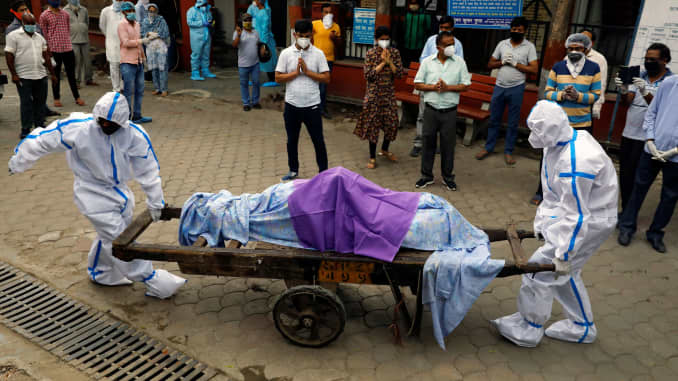
Health workers wearing Personal Protective Equipment (PPE) carry the body of a person who who died due to the coronavirus disease (COVID-19), at a crematorium in New Delhi, India, June 24, 2020.

7:12 a.m. ET — India has reported its highest spike of new cases of infections since the virus took hold in the country of more than 1.3 billion people, according to The Associated Press. 

In 24 hours, the country reported 15,968 new cases and 465 deaths, the AP reported. That means the virus has now infected more than 456,183 people in India, killing at least 14,476, according to data compiled by Johns Hopkins University.

Maharashtra, New Delhi and Tamil Nadu are the hardest-hit states, making up almost 60% of all confirmed cases in the country. New Delhi, in particular, is emerging as a cause for concern in the federal government, the AP reported, due to poor contact tracing infrastructure and limited hospital capacity.

India has the fourth worst coronavirus outbreak in the world, based on total number of confirmed cases, behind only the U.S., Brazil and Russia. —Will Feuer

The EU is discussing reopening its borders, but US citizens could remain barred

A general view of almost desert Pantheon square during Italy's lockdown due to Covid-19 pandemic.

6:51 a.m. ET — The European Union is discussing how to reopen its external borders as the region looks to revive its economies, but visitors from the U.S., and elsewhere, could be barred from entering the bloc for now.

Thirty European countries decided to close their external borders back in March to contain the spread of Covid-19, but that measure is due to be lifted on Tuesday. Representatives of the EU governments are discussing the criteria to lift the travel restrictions from abroad, and at the moment, the main requirement is the coronavirus infection rate in the country of origin.

This means that countries with high rates, such as the United States and Brazil, could remain barred from entering European nations, at least for some time. —Silvia Amaro


Coronavirus spike won’t end elective surgeries, Milwaukee hospital execs say

https://www.beckershospitalreview.com/hospital-management-administration/coronavirus-spike-won-t-end-elective-surgeries-milwaukee-hospital-execs-say.html?utm_medium=email

Medical Technology News - COVID-19 Risk in Elective Surgery Reboot

Healthcare executives in the Milwaukee area say they plan to continue offering elective care even if COVID-19 hospitalizations spike, according to the Milwaukee Business Journal

Many public health experts expect a second wave of COVID-19 infections to hit by the end of the year. But the healthcare executives said that hospitals won’t need to implement strict elective care cancellation procedures as they did in March and April because more is known about the virus.

“We know COVID now,” Jeff Bahr, MD, chief Aurora Medical Group officer for Advocate Aurora Health, told the Business Journal. “I accept that there might be another peak. The name of the game right now is to be able to continue to serve patients and continue despite another bump or spike.”

Dr. Bahr added that Advocate Aurora Health executives plan to continue “with minimal interruption” to elective surgical procedures. 

Spokespeople for ProHealth Care, Froedtert Health, the Medical College of Wisconsin and Children’s Wisconsin also told the Business Journal that their organizations plan to continue some or all elective surgeries even if there is a second surge in COVID-19 cases.

Medical College of Wisconsin President and CEO John Raymond Sr., MD, told the Business Journal that “Even with a second wave or surge of COVID-19 cases, I do not believe that we will need to return to the stringent restrictions that were imposed on elective procedures and routine clinical care in March and April of this year.”

ProHealth Care and Children’s Hospital of Wisconsin officials said that they plan to offer elective care amid  a spike, but the amount of that care will depend on several factors, including whether there’s enough protective gear for staff. 

Health systems across the U.S. canceled elective procedures in mid-March in an effort to prepare for a spike in COVID-19 cases. As a result of the cancellations of the more lucrative services, health systems saw steep revenue drops. Throughout the last month, hospitals have started to resume elective services.