Coronavirus’s painful side effect is deep budget cuts for state and local government services

https://theconversation.com/coronaviruss-painful-side-effect-is-deep-budget-cuts-for-state-and-local-government-services-141105

Coronavirus's painful side effect is deep budget cuts for state ...

Nationwide, state and local government leaders are warning of major budget cuts as a result of the pandemic. One state – New York – even referred to the magnitude of its cuts as having “no precedent in modern times.”

Declining revenue combined with unexpected expenditures and requirements to balance budgets means state and local governments need to cut spending and possibly raise taxes or dip into reserve funds to cover the hundreds of billions of dollars lost by state and local government over the next two to three years because of the pandemic.

Without more federal aid or access to other sources of money (like reserve funds or borrowing), government officials have made it clear: Budget cuts will be happening in the coming years.

And while specifics are not yet available in all cases, those cuts have already included reducing the number of state and local jobs – from firefighters to garbage collectors to librarians – and slashing spending for education, social services and roads and bridges.

In some states, agencies have been directed to cut their budget as much as 15% or 20% – a tough challenge as most states prepared budgets for a new fiscal year that began July 1.

As a scholar of public administration who researches how governments spend money, here are the ways state and local governments have reduced spending to close the budget gap.

Cutting jobs

State and local governments laid off or furloughed 1.5 million workers in April and May.

They are also reducing spending on employees. According to surveys, government workers are feeling personal financial strain as many state and local governments have cut merit raises and regular salary increases, frozen hiring, reduced salaries and cut seasonal employees.

Washington state, for example, cut both merit raises and instituted furloughs.

survey from the National League of Cities shows 32% of cities will have to furlough or lay off employees and 41% have hiring freezes in place or planned as a result of the pandemic.

Employment reductions have met some resistance. In Nevada, for example, a state worker union filed a complaint against the governor to the state’s labor relations board for violating a collective bargaining statute by not negotiating on furloughs and salary freezes.

Most of the employee cuts have been made in education. Teachers, classroom aids, administrators, staff, maintenance crews, bus drivers and other school employees have seen salary cuts and layoffs.

The job loss has hurt public employees beyond education, too: librarians, garbage collectors, counselors, social workers, police officers, firefighters, doctors, nurses, health aides, park rangers, maintenance crews, administrative assistants and others have been affected.

Residents also face the consequences of these cuts: They can’t get ahold of staff in the city’s water and sewer departments to talk about their bill; they can’t use the internet at the library to look for jobs; their children can’t get needed services in school.

Most of these cuts have been labeled temporary, but with the extensions to stay-at-home orders and a mostly closed economy, it will be some time before these employees are back to work.
Suspending road, bridges, building and water system projects

As another way to reduce costs quickly, a National League of Cities survey shows 65% of the municipalities surveyed are stopping temporarily, or completely, capital expenditure and infrastructure projects like roads, bridges, buildings, water systems or parking garages.

In New York City, there is a US$2.3 billion proposed cut to the capital budget, a fund that supports large, multiyear investments from sidewalk and road maintenance, school buildings, senior centers, fire trucks, sewers, playgrounds, to park upkeep. There are potentially serious consequences for residents. For example, New York housing advocates are concerned that these cuts will hurt plans for 21,000 affordable homes.

Suspending these big money projects will save the government money in the short term. But it will potentially harm the struggling economy, since both public and private sectors benefit from better roads, bridges, schools and water systems and the jobs these projects create.

Delaying maintenance also has consequences for the deteriorating infrastructure in the U.S. The costs of unaddressed repairs could increase future costs. It can cost more to replace a crumbling building than it does to fix one in better repair.

Cities and towns hit

In many states, the new budgets severely cut their aid to local governments, which will lead to large local cuts in education – both K-12 and higher education – as well as social programs, transportation, health care and other areas.

New York state’s budget proposes that part of its fiscal year 2021 budget shortfall will be balanced by $8.2 billion in reductions in aid to localities. This is the state where the cuts were referred to in the budget as “not seen in modern times.” This money is normally spent on many important services that residents need everyday –mass transit, adult and elderly care, mental health support, substance abuse programs, school programs like special education, children’s health insurance and more. Lacking any of these support services can be devastating to a person, especially in this difficult time.

Fewer workers, less money

As teachers and administrators figure out how to teach both online and in person, they and their schools will need more money – not less – to meet students’ needs.

Libraries, which provide services to many communities, from free computer use to after-school programs for children, will have to cut back. They may have fewer workers, be open for fewer hours and not offer as many programs to the public.

Parks may not be maintained, broken playground equipment may stay that way, and workers may not repave paths and mow lawns. Completely separate from activists’ calls to shift police funding to other priorities, police departments’ budgets may be slashed just for lack of cash to pay the officers. Similar cuts to firefighters and ambulance workers may mean poorly equipped responders take longer to arrive on a scene and have less training to deal with the emergency.

To keep with developing public safety standards, more maintenance staff and materials will be needed to clean and sanitize schools, courtrooms, auditoriums, correctional facilitiesmetro stations, buses and other public spaces. Strained budgets and employees will make it harder to complete these new essential tasks throughout the day.

To avoid deeper cuts, state and local government officials are trying a host of strategies including borrowing money, using rainy day funds, increasing revenue by raising tax rates or creating new taxes or fees, ending tax exemptions and using federal aid as legally allowed.

Colorado was able to hold its budget to only a 3% reduction, relying largely on one-time emergency reserve funds. Delaware managed to maintain its budget and avoided layoffs largely through using money set aside in a reserve account.

Nobody knows how long the pandemic, or its economic effects, will last.

In the worst-case scenario, budget officials are prepared to make steeper cuts in the coming months if more assistance does not come from the federal government or the economy does not recover quickly enough to restore the flow of money that governments need to operate.


14 hospitals bringing back furloughed workers

https://www.beckershospitalreview.com/workforce/9-hospitals-bringing-back-furloughed-employees.html?utm_medium=email

COVID-19 Return To Work Quiz! | Constangy, Brooks, Smith ...

Many U.S. hospitals and health systems have furloughed staff to help offset revenue losses from the COVID-19 pandemic. Now, some are starting to bring furloughed workers back as they resume nonemergency procedures and medical appointments. 

Here are 14 reported in July and June:

Editor’s Note: This webpage will be updated routinely. 

July

1. Elmeria, N.Y.-based Arnot Health said it brought back about half of the about 400 people it furloughed in mid-April, according to WETM-TV .

2. Guthrie said most furloughed staff have returned to the Sayre, Pa.-based health system, according to WETM-TV .

3. Charlottesville-based University of Virginia Health System will end some of its pandemic-related furloughs and pay cuts by the end of July and others in August.

4. Holyoke (Mass.) Medical Center brought back nearly 170 of 250 furloughed employees at the start of July, and another 80 to 90 are expected to return at month’s end, President and CEO Spiros Hatiras told BusinessWest.

5. Sarasota (Fla.) Memorial Health Care System brought back 640 furloughed workers.

June

6. MUSC Health, an eight-hospital system based in Charleston, S.C., called back nearly half of the employees who had been furloughed.

7. Lewiston-based Central Maine Healthcare has recalled about three-quarters of its 300 employees furloughed in April, spokesperson Kate Carlisle told the Sun Journal. The remaining furloughed employees are expected to return by mid-July.

8. Lewiston, Maine-based St. Mary’s Health System has recalled 80 percent to 85 percent of its 77 employees furloughed in April, spokesperson Steve Costello told the Sun Journal. Others are expected to return in July.

9. About 3,000 furloughed workers at hospitals in the Dayton, Ohio, region have been called back to work, according to the Springfield News-Sun. As of June 24, 2,606 workers remained on furlough, Sarah Hackenbracht, CEO of the Greater Dayton Area Hospital Association, told the newspaper. Initially, 5,648 hospital employees were furloughed in the 11-county region during the pandemic.

10. As of June 1, Claxton-Hepburn Medical Center in Ogdensburg, N.Y., brought back 34 employees, including nurses and staff for surgery, according to WWNY-TV. This is out of about 175 employees who were furloughed in April.

11. St. Lawrence Health System, a three-hospital system in Potsdam, N.Y., had called 80 furloughed employees back to work as of June 1, according to WWNY-TV. The health system furloughed about 400 workers.

12. St. Joseph’s Health in Syracuse, N.Y., had brought back 135 workers as of June 1, according to Syracuse.com. The organization, a member of Livonia, Mich.-based Trinity Health, furloughed 500 employees in April.

13. Crouse Health in Syracuse, N.Y., an affiliate of New Hyde Park, N.Y.-based Northwell Health, had brought back 63 of its 278 furloughed workers as of June 1, according to Syracuse.com.

14. Lewis County Health System CEO Gerald Cayer said June 12 that the Lowville, N.Y.-based organization soon will end the eight-week furlough that put 14 percent of its workforce on unpaid leave, according to nny360.com. Ten furloughed employees had returned to work as of June 12, and Mr. Cayer said other employees would return to work beginning June 21.


U.S. Coronavirus Pandemic Status: It’s about to get a lot worse

https://www.axios.com/coronavirus-pain-getting-worse-cd329f4c-9962-4f40-b401-7a7ac1a393cf.html

The pain of the coronavirus is about to get a lot worse - Axios

For months now, American workers, families and small businesses have been saying they can’t keep up their socially distanced lives for much longer. We’ve now arrived at “much longer” — and the pandemic isn’t going away anytime soon.

The big picture: The relief policies and stopgap measures that we cobbled together to get us through the toughest weeks worked for a while, but they’re starting to crumble just as cases are spiking in the majority of states.

Next week, the extra $600 per week in expanded unemployment benefits will expire. And there’s no indication that Congress has reached a consensus on extending this assistance or providing anything in its place.

  • But nearly half of the U.S. population is still jobless, and millions will remain jobless for the foreseeable future. There are 14 million more unemployed people than there are jobs, per the Economic Policy Institute.
  • Nearly a third of Americans missed a housing payment in July — and that was with the additional $600. Plus, most Americans have already spent the stimulus checks they received at the beginning of the pandemic.
  • “We should be very concerned about what’s going to happen in August and beyond” — starting with a spike in evictions, Mathieu Despard, who leads the Social Policy Institute at the Washington University in St. Louis, tells Axios.

Expect more furloughs and layoffs as more small businesses are pushed off the pandemic cliff.

  • By economists’ estimates, more than 100,000 small businesses have permanently closed since the pandemic began.
  • For those that are hanging on, loans from the Paycheck Protection Program (PPP) have not been enough, and the back and forth between re-opening and then closing again as states deal with new case waves has been devastating. In fact, rates of closure have started increasing, the New York Times reports, citing Yelp data.
  • The big firms aren’t immune either. Just last week, behemoths like United Airlines, Wells Fargo, Walgreens and Levi’s either cut jobs or told workers their jobs were at risk, Axios’ Dion Rabouin writes.

And the question of whether schools will reopen looms.

  • Since schools sent kids home in March, and most summer camps didn’t open their doors for the summer, working parents have been dealing with a child care crisis — attempting to do their jobs, care for their kids and homeschool all at once — and hoping that the stress will be temporary.
  • The situation is more dire for low-income families with kids who rely on school lunches or for single parents who are juggling work and parenting without any help.
  • Now the public heath crisis hasn’t abated, and school districts are running out of time to figure out what the fall will look like. Some, starting with Los Angeles, have already decided to go online.

The bottom line: “It’s the uncertainty that is anxiety-inducing,” says Despard. “If you give people a time horizon and say, ‘Look you have to get through these next 8 weeks of extreme shutdown,’ they’ll do it. Now it’s like, ‘How much longer?'”


1.3 million Americans filed first-time unemployment claims last week

https://www.cnn.com/2020/07/16/economy/unemployment-benefits-coronavirus/index.html

1.3 million people filed for first-time unemployment last week

It’s still not easy to remain employed in the US, nearly four months after the coronavirus pandemic began upending the economy.

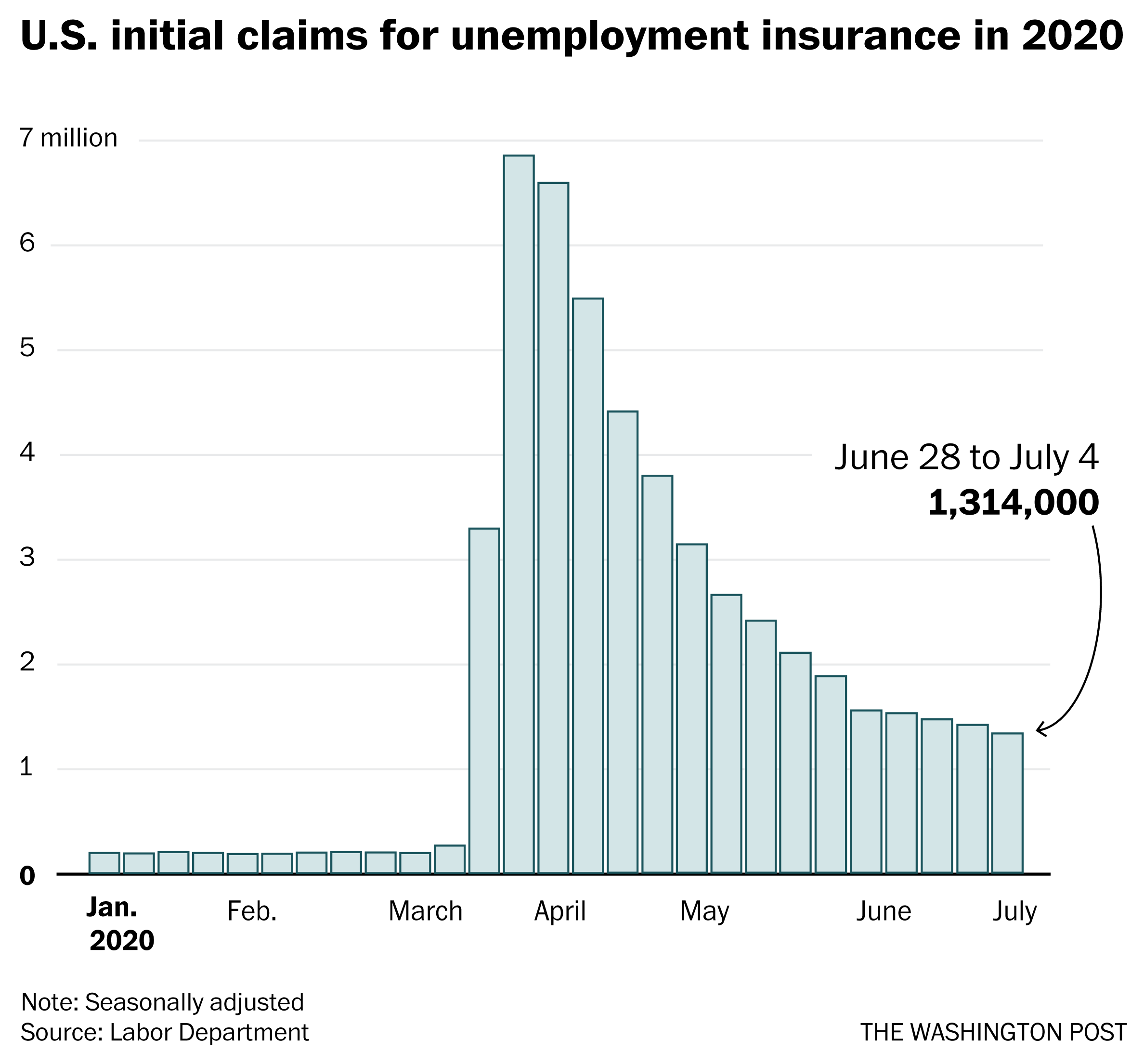
Another 1.3 million people filed first-time jobless claims on a seasonally adjusted basis for the week ending July 11, according to the Department of Labor. That’s down 10,000 from the prior week’s revised level.
On an unadjusted basis, more than 1.5 million people filed first-time claims, up almost 109,000 from the week before. The seasonal adjustments are traditionally used to smooth out the data, but that has tended to have the opposite effect during the pandemic.
Weekly first-time unemployment applications have been on the decline for more than three months since their peak in the last week of March. But last week’s drop was less than expected.
“Overall, filings remain high and are declining at a stubbornly slow pace,” said Rubeela Farooqi, chief US economist for High Frequency Economics, noting that the risk of mounting permanent job losses is high. “The pace could slow even further or reverse in coming weeks in response to a surge in virus cases and related closures of businesses.”
Continued claims, which count workers who have filed claims for at least two weeks in a row, stood at more than 17.3 million for the week ending July 4, down 422,000 from the prior week. These claims peaked in May at nearly 25 million.
In addition, about 928,500 million people in 47 states filed for first-time pandemic unemployment assistance last week, down almost 118,000 from the week before. And almost 14.3 million people claimed continued pandemic benefits across 48 states for the week ending June 27. That’s up nearly 406,000 from the prior week.
The pandemic program was created by Congress in March to respond to the coronavirus outbreak. It provides temporary benefits to workers who typically aren’t eligible for payments, including freelancers, independent contractors, the self-employed and certain people affected by the coronavirus. It expires at the end of the year.
Looking at all workers participating in an array of unemployment programs, just over 32 million Americans claimed jobless benefits the week ending June 27, down about 433,000 from the prior week.
That total includes those in the traditional and pandemic unemployment programs, as well as the pandemic emergency unemployment compensation program, which has nearly 936,500 filers. Lawmakers created it in March to provide those who have exhausted their benefits with an additional 13 weeks of payments. It also expires at the end of 2020.


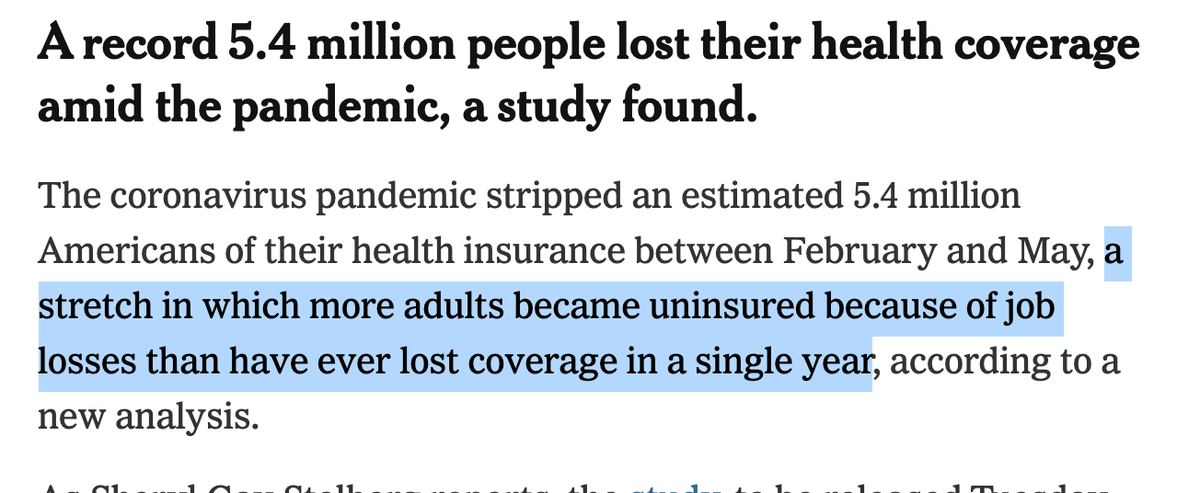
5.4 million Americans lost health insurance

https://www.axios.com/newsletters/axios-vitals-285240f4-9110-4c86-ad7e-e0c37085a957.html?utm_source=newsletter&utm_medium=email&utm_campaign=newsletter_axiosvitals&stream=top

Medicare for All (@AllOnMedicare) | Twitter

Roughly 5.4 million adults in the U.S. lost their health insurance from February to May after losing their jobs, according to a new estimate from Families USA, a group that favors the Affordable Care Act.

Why it matters: There are more adults under 65 without insurance in Southern states, which are the same states setting new records for single-day coronavirus infections along with rising hospitalizations, Axios’ Orion Rummler writes.

What they found: 3.9 million adults lost health insurance over one year during the Great Recession, per Families USA’s analysis. It only took four months in this current crisis for an estimated 5.4 million Americans to lose health insurance.

  • More than 20% of adults in Georgia, Florida, South Carolina, North Carolina, Mississippi, Oklahoma and Texas were without insurance as of May.
  • All of these states have set new records in the past two weeks for their highest number of coronavirus infections in a single day, per data from the COVID Tracking Project.
  • 46% of adults who lost coverage due to the pandemic came from five states: Florida, New York, Texas, California and North Carolina.

The backdrop: 21 million Americans were unemployed in May, according to the Bureau of Labor Statistics’ nonfarm payrolls report.


Pandemic spurs national union activity among hospital workers

https://www.healthcaredive.com/news/coronavirus-spurs-healthcare-union-activity/581397/

Pandemic spurs national union activity among hospital workers ...

When COVID-19 cases swelled in New York and other northern states this spring, Erik Andrews, a rapid response nurse at Riverside Community Hospital in southern California, thought his hospital should have enough time to prepare for the worst.

Instead, he said his hospital faced staffing cuts and a lack of adequate personal protective equipment that led around 600 of its nurses to strike for 10 days starting in late June, just before negotiating a new contract with the hospital and its owner, Nashville-based HCA Healthcare.

“To feel like you were just put out there on the front lines with as minimal support necessary was incredibly disheartening,” Andrews said. Two employees at RCH have died from COVID-19, according to SEIU Local 121RN, the union representing them.

A spokesperson for HCA told Healthcare Dive the “strike has very little to do with the best interest of their members and everything to do with contract negotiations.”

Across the country, the pandemic is exacerbating labor tensions with nurses and other healthcare workers, leading to a string of disputes around what health systems are doing to keep front-line staff safe. The workers’ main concerns are adequate staffing and PPE. Ongoing or upcoming contract negotiations could boost their leverage.

But many of the systems that employ these workers are themselves stressed in a number of ways, above all financially, after months of delayed elective procedures and depleted volumes. Many have instituted furloughs and layoffs or other workforce reduction measures.

Striking a balance between doing union action at hospitals and continuing care for patients could be an ongoing challenge, Patricia Campos-Medina, co-director of New York State AFL-CIO/Cornell Union Leadership Institute.

“The nurses association has been very active since the beginning of the crisis, demanding PPE and doing internal activities in their hospitals demanding proper procedures,” Campos-Medina said. “They are front-line workers, so they have to be thoughtful in how they continue to provide care but also protect themselves and their patients.”

At Prime Healthcare’s Encino Hospital Medical Center, just outside Los Angeles, medical staff voted to unionize July 5, a week after the hospital laid off about half of its staff, including its entire clinical lab team, according to SEIU Local 121RN, which now represents those workers.

One of the first things the newly formed union will fight is “the unjust layoffs of their colleagues,” it said in a statement.

A Prime Healthcare spokesperson told Healthcare Dive 25 positions were cut. “These Encino positions were not part of front-line care and involved departments such as HR, food services, and lab services,” the system said.

Hospital service workers elsewhere who already have bargaining rights are also bringing attention to what they deem as staffing and safety issues.

In Chicago, workers at Loretto Hospital voted to authorize a strike Thursday. Those workers include patient care technicians, emergency room technicians, mental health staff and dietary and housekeeping staff, according to SEIU Healthcare Illinois, the union that represents them. They’ve been bargaining with hospital management for a new contract since December and plan to go on strike July 20.

Loretto Hospital is a safety-net facility, catering primarily to “Black and Brown West Side communities plagued with disproportionate numbers of COVID illnesses and deaths in recent months,” the union said.

The “Strike For Black Lives” is in response to “management’s failure to bargain in good faith on critical issues impacting the safety and well-being of both workers and patients — including poverty level wages and short staffing,” according to the union.

A Loretto spokesperson told Healthcare Dive the system is hopeful that continuing negotiations will bring an agreement, though it’s “planning as if a strike is eminent and considering the best options to continue to provide healthcare services to our community.”

Meanwhile in Joliet, Illinois, more than 700 nurses at Amita St. Joseph Medical Center went on strike July 4.

The Illinois Nurses Association which represents Amita nurses, cited ongoing concerns about staff and patient safety during the pandemic, namely adequate PPE, nurse-to-patient ratios and sick pay, they want addressed in the next contract. They are currently bargaining for a new one, and said negotiations stalled. The duration of the strike is still unclear.

However, a hospital spokesperson told Healthcare Dive, “Negotiations have been ongoing with proposals and counter proposals exchanged.”

The hospital’s most recent proposal “was not accepted, but negotiations will continue,” the system said.

INA is also upset with Amita’s recruitment of out-of-state nurses to replace striking ones during the COVID-19 pandemic.

It sent a letter to the Illinois Department of Financial and Professional Regulation, asserting the hospital used “emergency permits that are intended only for responding to the pandemic for purposes of aiding the hospital in a labor dispute.”


Cartoon – Importance of Maintaining Employee Morale

Dilbert: Boosting Morale | Monar Consulting, Inc.

Another 1.3 million people applied for new jobless benefits last week as the pandemic’s toll on the economy continued

https://www.washingtonpost.com/business/2020/07/09/another-13-million-people-applied-new-jobless-benefits-last-week-pandemics-toll-economy-continued/?fbclid=IwAR0cDN8SNbJF-SoMktqUOPJyJQ5ZTwvqENXxZzkbXhcygOOrgVxVDotPlHI

Another 1.3 million people applied for new jobless benefits last ...

Another 1.3 million people filed for unemployment for the first time last week, a slight decrease from the week before, as novel coronavirus cases and closures surged around the country, according to data released Thursday by the Department of Labor.

The numbers of new unemployment filings have remained above a million each week since the pandemic began mid-March. That number has averaged about 1.4 million the past four weeks.

In addition, states reported that another 1 million claims were made under the Pandemic Unemployment Assistance program, which grants jobless benefits for gig workers, self-employed workers and contractors, the agency reported.

When combined, the two numbers for initial unemployment claims have ticked up the past three weeks, from 2.24 million in mid-June to 2.44 million last week.

The numbers for the first few days of July come as rising cases of coronavirus infections have hit states and counties nationwide, touching off a new round of closures and restrictions and sending some workers back to the unemployment insurance queue for the second time in just a few short months.

“The bad news is that initial claims are still historically very high and they suggest that damage is continuing to accumulate in the economy,” Adam Ozimek, chief economist at Upwork, said in an interview.

The unemployment rate, which is tabulated separately from the weekly jobless claims, has trended downward the past two months, to 11.1 percent last month, as many laid off or furloughed workers in industries like food service and retail were called back to work. Yet a rising number of workers have reported permanent layoffs.

And the jobless statistics don’t capture the damage from the new round of cases yet.

“All these factors look more like an economy that is riding into a recession than out of one,” Ozimek said. “At this stage in the game, when we’re this far from initial shock, it becomes less likely that new layoffs are the types of jobs that snap back.”

The numbers of people continuously receiving benefits at the end of June has also trended gradually downward. The last week of June saw 18.1 million people on unemployment insurance, down from 19.3 million people the week before that, as re-hirings have slightly outpaced new layoffs week by week.

But as hopes fade for a quick rebound from the pandemic — the United States reported more than 60,000 new cases on Wednesday, a new high — signs of longer term economic damage are emerging.

Levi Strauss & Co. said this week that it planned to cut about 15 percent of its nonretail and nonmanufacturing positions, or about 700 jobs this year. United Airlines warned it may need to furlough nearly 40 percent of its workforce this year, about 36,000 employees. Industrial and aerospace manufacturer the Barnes Group said it would layoff 400 workers; BAE Systems, a defense and aerospace company, said it planned to layoff 300 employees.

There are many workers like Samantha Hartman, 29, whose temporary layoff — she was furloughed in March from Rosen Hotels & Resorts, the hospitality company she works for in Orlando — became permanent this week.

Hartman said her supervisor called her this week to tell her that the company had tried to come up with a way to keep employees but found their hands tied with almost no business coming in.

“Everything is up in the air,” Hartman said. “I fully expect not to find another job in this industry.”

The company, which received a Paycheck Protection Program small business loan of more than $6 million according to the Orlando Sentinel, announced Wednesday that it would layoff a “substantial” amount of its workforce by July 31.

Hartman, who has a heart condition, said the company is letting her keep her health care through August. She moved to Orlando two years ago for the job. Now, she says she’ll probably move back with her family in California when her lease is up next year.

She said Florida’s challenges — including large delays in unemployment insurance processing, mishandling of the coronavirus response, a governor she doesn’t trust — make her less likely to stay in Florida. “If I’m going to struggle financially, I’d rather do that back home where I have a support system,” Hartman said.

Plunging consumer demand amid the virus’s surge and ensuing shutdowns have shuttered businesses across the country. Bed Bath & Beyond announced it would close 200 stores; Brooks Brotherswhich filed for bankruptcy protection this week, said it would close 51 stores.

And there’s a grim waiting game for what are expected to be widespread layoffs in state and municipal governments, as budgets are drastically pared to meet declining tax revenue.

Initial weekly jobless claims remain well above the record before the pandemic, of 695,000 in 1982. They have dropped every week since the peak of 6.9 million, from a week in late March, but have plateaued for more than a month.