Now Is the Time to Address Surprise Billing

https://www.medpagetoday.com/blogs/marty-makary/86455?xid=fb_o&trw=no&fbclid=IwAR1boFFgBZuSqJ9-1728UdSFeIK790TTXNeoJJ9mky9jCKbGyQ_G4jqwrfk

Tips to avoid surprise medical bills

The doctor-patient relationship is being undermined.

Private equity companies have spent millions in dark money to stall and effectively kill all versions of surprise billing reform. But this week, the issue will come before Congress again. Legislation was introduced Tuesday in the House that, among other things, would further assist hospitals with more relief funds. With this potential third disbursement of federal dollars comes an opportunity to finally address the embarrassing problem of surprise billing that has eroded the public trust in our great medical profession.

Physicians across the country are now signing a letter urging leaders of Congress to address surprise billing once and for all. I have already signed this letter and encourage you to consider doing so as well.

One reason the medical profession is the greatest profession in the world is that patients put their faith and trust in us. But 64% of Americans now say they have avoided or delayed medical care for fear of the bill. As more and more patients lose faith in the system, the doctor-patient relationship is being undermined by surprise billing and the modern-day business practices of price gouging and predatory billing. In fact, these egregious practices have become part of the business model of some private equity groups, which seek to replace physician autonomy with corporate medicine.

Our system today is unnecessarily complicated and works against patients’ interests by putting them in the middle of a finger-pointing blame game, which leaves them holding the bag. It doesn’t make sense for us to accept people with open arms, treat their ailment, and then ruin their lives financially. Medical science is a bastion of scientific and intellectual genius. We can fix this problem. Already, some efforts are advancing price transparency by creating a transparent marketplace for patients.

I’ve spent many years looking at the systematic cost issues that face our health system and patients. Simply put, the lack of fairness and transparency in pricing and billing practices has created financial toxicity and increased the general mistrust of the medical system for millions of Americans. No one designed it to be this bad. In fact, we have good people working in a bad system. When I explain details of pricing, billing, and collections with doctors and hospital leaders, they are invariably shocked and furious to learn how out of control their billing offices have gotten in overcharging patients and shaking people down for more than a reasonable amount for a service.

The current COVID-19 crisis is a stark reminder of the gaps in our health system that exacerbate the pressures facing providers and patients. Many Americans are getting crushed right now. Despite many years of debate in Washington and bipartisan agreement that something must be done, there is still no federal protection in place to safeguard consumers from an egregious surprise medical bill if they need emergency care or have limited options. The reality is that special interests — including the very private equity firms that stand to benefit financially from these exploitative business practices — continue to spend millions to maintain the status quo.

It’s time for a bipartisan compromise to end the non-transparent game of surprise medical billing. It’s time that Congress takes meaningful action to protect patients during this COVID-19 crisis and finally address this issue. Congress has solutions on the table that would bring much greater fairness and transparency to the healthcare system, protect patients from these predatory charges, and ensure that physicians are paid fairly for our services, as we deserve. It’s time we put an end to the cycle of financial toxicity and rebuild the great public trust in the medical profession.


Cartoon – U.S Healthcare Options

Cartoon – US Healthcare Options | HENRY KOTULA

Even health care jobs aren’t safe

https://www.axios.com/newsletters/axios-vitals-cacbbdf4-4694-4db3-9299-5a7e29ebee7e.html?utm_source=newsletter&utm_medium=email&utm_campaign=newsletter_axiosvitals&stream=top

Unemployment rate soars to 14.7% in April - Axios

The coronavirus pandemic is a health care crisis, but health care still isn’t immune from the rampant job losses the pandemic has wrought, Axios’ Bob Herman reports.

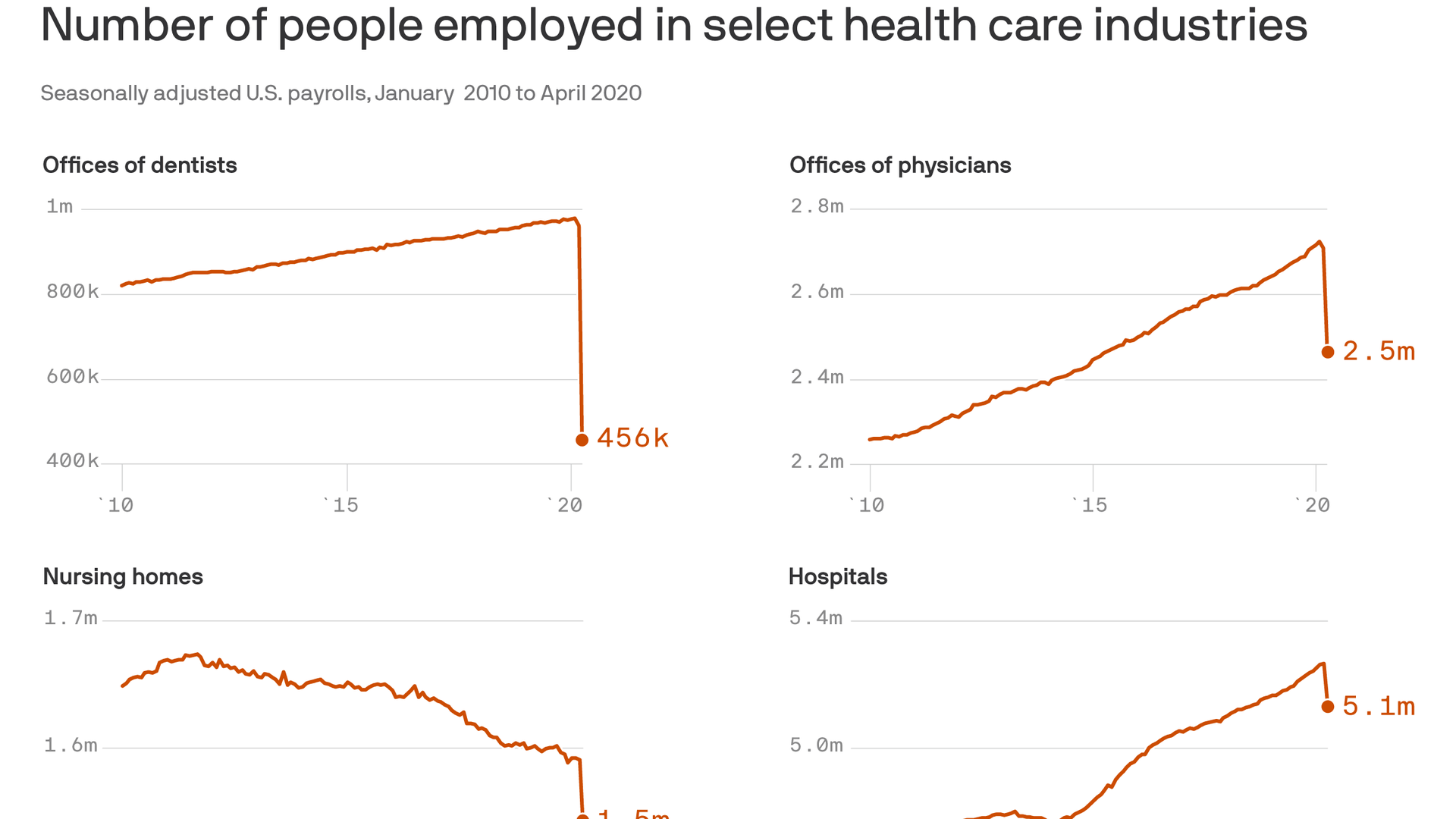
By the numbers: The health care industry lost more than 1.4 million jobs in April.

The reason: These jobs have gone away because outpatient care has dried up, as providers postponed elective procedures.

  • More than four out of five of those lost jobs were at dentists, doctors’ offices, chiropractors and other outpatient settings.
  • Technicians, billing clerks and medical assistants who work in outpatient settings — many of whom are not highly paid — have felt the brunt of the job losses.

What’s next: Don’t expect a quick return, even as elective procedures are able to come back online.

  • Patients who have lost their insurance or are worried about catching the coronavirus in a waiting room will likely stay away even from outpatient facilities.
  • “Of all the places people want to come back to quickly, a health care setting is probably not at the top of the list,” said Ani Turner, a health economist at Altarum.

What we’re watching: All of these delays in elective care a boon to insurers, who are saving a lot of money while outpatient procedures are on ice.

  • Some insurers will likely have to pay big rebates to their customers as a result. UnitedHealth Group is getting a jump start on that process, announcing $1.5 billion worth of voluntary premium credits and waived fees.


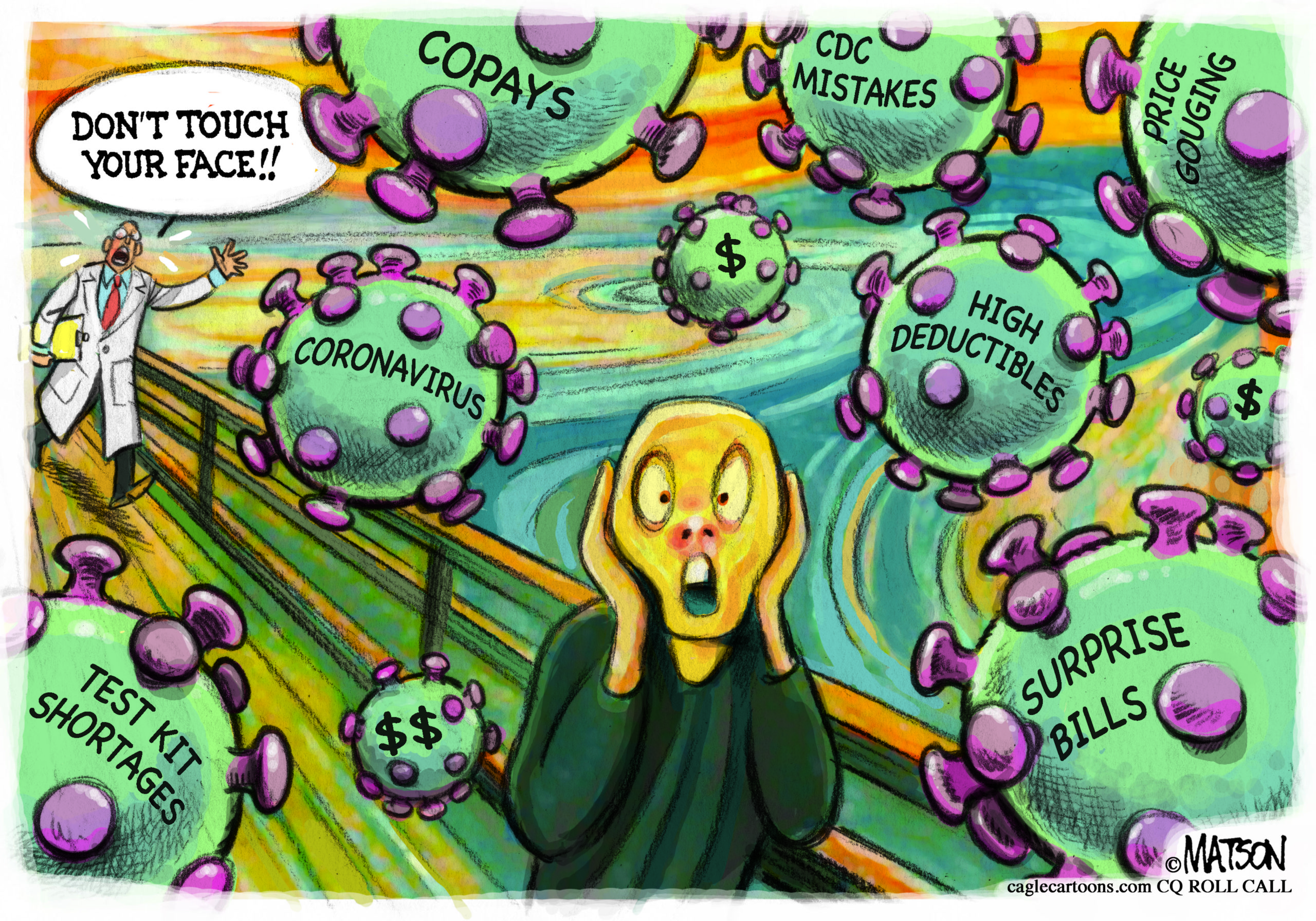
Cartoon – Sign of Coronavirus Times

The Coronavirus Scream - Truthdig: Expert Reporting, Current News ...

Most consumers nervous about returning to care settings

https://mailchi.mp/aa7806a422dd/the-weekly-gist-may-8-2020?e=d1e747d2d8

As non-essential businesses begin to reopen, there’s no guarantee that merely opening the doors will make customers return. A recent Morning Consult poll provides an assessment of the impact of COVID-19 on consumer confidence: fewer than one in five US adults are currently comfortable doing (formerly) everyday activities like eating at a restaurant or going to a shopping mall.

The graphic below provides similar data for healthcare. Consumers’ willingness to visit healthcare providers in person for non-COVID care is only slightly better, at 21 percent. Which providers might see patients return most quickly?

Consumers say they are about twice as likely to visit their primary care doctor’s office than other healthcare facilities, including hospitals, specialists, and walk-in clinics. And when it comes to scheduling a routine in-office visit, nearly half say they will wait two to six months, with almost one in ten not comfortable going to a doctor’s office in person for a year or more.

Healthcare facilities face an uphill battle in bringing back patients—many of whom have ongoing chronic diseases that necessitate care now. Reaching patients through telemedicine and providing concrete messages about how they can safely see their doctor will be critical to staving off a tide of disease exacerbations that will mount as fear delays much-needed care.


1.4 million healthcare jobs lost in April

https://www.beckershospitalreview.com/workforce/1-4-million-healthcare-jobs-lost-in-april.html?utm_medium=email

1.4 million health-care workers lost their jobs due to the ...

Healthcare lost 1.4 million jobs in April amid the COVID-19 pandemic, primarily in ambulatory healthcare services, according to the latest jobs report from the U.S. Bureau of Labor Statistics.

The April count compares to 43,000 healthcare jobs lost in March.

Within ambulatory healthcare services, April job losses included offices of dentists (503,300), offices of physicians (243,300), and offices of other healthcare practitioners (205,100).

Hospitals lost 134,900 jobs last month, compared to the 200 positions they added to the U.S. economy in March.

The April jobs report marks the second consecutive month that healthcare employment did not grow. In the 12 months prior to March — the month the World Health Organization declared the COVID-19 spread a pandemic — industry employment had grown by 374,000, according to the bureau.

Bloomberg reported the number of healthcare workers has doubled to 16 million in the last three decades, and until March, the industry has lost jobs in only four months during that period.

Overall, the U.S. lost 20.5 million jobs in April, and the unemployment rate reached 14.7 percent, the highest since the Great Depression, according to the bureau.

The unemployment rate does not reflect Americans still working who have had their hours or pay reduced, The New York Times noted.


States face economic death spiral from Coronavirus

https://www.axios.com/coronavirus-states-economy-295ac091-9dc2-4852-be67-d070ec268d8c.html

YEAR-OVER-YEAR CHANGE IN STATE TAX REVENUES

April 2020 vs. April 2019, select states

States face economic death spiral from coronavirus - Business Insider


Early numbers show how significantly the coronavirus is devastating states’ revenue streams — and could force choices between raising taxes or gutting services and laying off public employees.

Why it matters: Even as some states move toward reopening, the economic ramifications of having shut down will haunt them far into the future.

  • When states can reopen, and how quickly industries are able to bounce back, could either worsen or improve projections.

What to watch: Sens. Bob Menendez (D-N.J.) and Bill Cassidy (R-La.) plan to introduce bipartisan legislation as soon as next week that would create a $500 billion fund designed to help struggling state and municipality budgets in the wake of COVID-19.

  • “If there was another way to do this, I’d rather do it the other way,” Cassidy tells Axios. “But what I don’t want to happen is all this money spent for families and for employers to go to waste because cities cannot provide essential services.”
  • Menendez tells Axios: “This is the time to step up to the plate.”

By the numbers: The Urban Institute has been compiling lost revenue data as states make it publicly available. So far, there are figures for about one in four states that compare this April’s state income and sales tax revenue collections against those from April 2019.

  • The data shows collections dropping between 20% and more than 50%, depending on the state, senior researcher Lucy Dadayan tells Axios — and those figures could get worse as new data comes in.
  • South Dakota is an outlier in the states the Urban Institute has tracked so far, in that revenues actually appear up for April. That may be largely because it is one of very few states that did not issue a stay at home order. But experts expect to see revenue declines next month.
  • Although it has not yet released April sales tax numbers to enable a year-over-year comparison, California’s staggering tax revenue loss due to COVID-19 has led to an expected $54.3 billion budget shortfall through FY 2021 — including a $13.4 billion shortfall this fiscal year, the governor announced Thursday. That’s with a $21 billion surplus last year.
  • New York also has yet to release April tax revenue data, but its latest budget projection has the state short as much as $13.3 billion in FY 2021, according to Dadayan’s analysis of most recent state budget projections. Illinois is looking at a more than $4.6 billion shortfall for next fiscal year.
  • Arizona is projecting to be short more than half a billion dollars for this fiscal year.
  • The projected shortfalls for FY 2020, which ends at the end of June for most states, is arguably a bigger problem because there isn’t much time left to make changes, per Axios’ Dan Primack.

The big picture: Democratic-leaning cities have seen the highest case and death rates. But red and blue states alike are facing serious budget shortfalls.

  • That’s why some Republican senators are getting behind efforts to provide federal dollars to help states balance budgets.
  • Even after accounting for state emergency savings accounts — which in many states were at an all-time high — 33 states will likely need to fill budget gaps of 5% or more, according to a recent analysis by Moody’s Analytics.
  • 21 states would need to fill gaps of 10% or more.
  • “Anybody is going to be overwhelmed by this — even states who were well prepared,” Dan White, director of government consulting and fiscal policy research at Moody’s Analytics, tells Axios.

Between the lines: Much of the burden will likely be pushed on struggling local governments’ plates, White said.

  • Cities have also lost smaller revenue sources such as hotel occupancy fees, inspection fees and construction fees.
  • Some could be forced to lay off public workers needed to combat the virus and keep the public safe — such as firefighters, paramedics, public hospital workers.
  • It’s either that or raise taxes in the midst of high unemployment and financial insecurity. “That’s the death spiral,” said Menendez, who has been talking with mayors across his state.
  • New York City Mayor Bill de Blasio has already said he may have to start furloughing municipal employees if the city doesn’t receive federal funds to help fill budget gaps.

Some state and local governments will wait to make tough budget decisions in the hopes that they get needed funds from Congress, which is in heated negotiations around the fourth stimulus package.

Republican lawmakers have been hesitant to provide this much federal help to states, but they’ve been warming to the idea.

  • Menendez says he expects several Republican senators besides Cassidy to sign on to their proposal.


Trump will urge Supreme Court to strike down Obamacare

https://www.politico.com/news/2020/05/06/trump-supreme-court-obamacare-240366?utm_source=The+Fiscal+Times&utm_campaign=f343554e9c-EMAIL_CAMPAIGN_2020_05_06_09_42&utm_medium=email&utm_term=0_714147a9cf-f343554e9c-390702969

Trump will urge Supreme Court to strike down Obamacare - YouTube

Attorney General Bill Barr had urged the White House to soften its attack on the law during the pandemic.

President Donald Trump on Wednesday said his administration will urge the Supreme Court to overturn Obamacare, maintaining its all-out legal assault on the health care law amid a pandemic that will drive millions of more Americans to depend on its coverage.

The administration appears to be doubling down on its legal strategy, even after Attorney General William Barr this week warned top Trump officials about the political ramifications of undermining the health care safety net during the coronavirus emergency.

Democrats two years ago took back the House of Representatives and statehouses across the country by promising to defend Obamacare, in particular its insurance protections that prevent sick people from being denied coverage or charged more because of a health condition. The issue may prove to be even more salient in November amid the Covid-19 outbreak that health experts believe will persist through the fall.

The Justice Department had a Wednesday deadline to change its position in a case brought by Republican-led states, but Trump told reporters Wednesday afternoon his administration would stand firm. DOJ declined to comment.

“Obamacare is a disaster, but we’ve made it barely acceptable,” Trump said.

The Supreme Court later this fall will hear a lawsuit from the GOP-led states that argue the Affordable Care Act was rendered invalid after Congress eliminated its tax penalty for not having health insurance. A coalition of Democratic state attorneys general and the Democratic-led House of Representatives are defending the law in court.

The Trump administration had previously shifted its legal position in this case, but appears to have decided against doing so again. DOJ originally argued the courts should throw out just Obamacare’s preexisting condition protections, before last year urging that the entire law be struck down.

The Supreme Court is expected to hear the case during its next term starting in October, but it hasn’t scheduled arguments yet. A decision is unlikely before the Nov. 3 election. The court has previously upheld Obamacare in two major challenges that threatened the law’s survival.

About 20 million people have been covered by Obamacare, and the law is expected to provide a major safety net during the economic freefall brought on by the coronavirus. Millions more are expected to join the Medicaid rolls, especially in states that joined Obamacare’s expansion to poor adults. Others who lost workplace health insurance can sign up on the law’s health insurance marketplaces, though the Trump administration isn’t doing much to advertise coverage options.

House Democrats in a filing to the Supreme Court on Wednesday said the pandemic showcased why justices should preserve the law.

“Although Congress may not have enacted the ACA with the specific purpose of combatting a pandemic, the nation’s current public-health emergency has made it impossible to deny that broad access to affordable health care is not just a life-or death matter for millions of Americans, but an indispensable precondition to the social intercourse on which our security, welfare, and liberty ultimately depend,” their brief read.

Obamacare has grown more popular since the GOP’s failed repeal bid during Trump’s first year in office, though the law is still broadly disliked by Republicans. Many Democrats are eager to again run on their defense of Obamacare this fall. That includes presumptive presidential nominee Joe Biden, who has advocated for building on the health care law rather than pursuing a comprehensive progressive overhaul like “Medicare for All.”

Top Trump officials have long been split on the legal strategy in the Obamacare lawsuit. Barr and Alex Azar, the Health and Human Services secretary, both opposed a broader attack on the law, but White House officials have been more supportive, seeing it as a chance to fulfill Trump’s pledge to repeal Obamacare. Barr, in a Monday meeting with Vice President Mike Pence and other White House officials, made an eleventh-hour plea for the administration to soften its legal stance ahead of the Supreme Court’s briefing deadline.


Grim and getting worse: US set for historic unemployment surge

https://news.yahoo.com/grim-getting-worse-us-set-historic-unemployment-surge-015532438.html

Grim and getting worse: US set for historic unemployment surge

Like a global tsunami, the coronavirus pandemic has caused a huge loss of life and taken a massive economic toll.

In the US economy, skyrocketing unemployment is the most-visible sign of the devastation: almost overnight, at least 30 million workers lost their jobs.

The April employment report, due out Friday, is expected to show the jobless rate soaring into double digits, perhaps as high as 20 percent, far surpassing the worst of the global financial crisis and reaching levels not seen since the Great Depression last century.

The US government and central bank worked at a stunning pace to rush out aid and financing to workers and businesses to try to prevent a complete economic collapse, but there is a growing fear that the temporary shutdowns imposed to contain the spread of the virus will become permanent for many companies.

The coronavirus has infected nearly 1.2 million people in the United States and killed around 70,000, according to a count from Johns Hopkins University, and analysts fear some of the economic damage may be permanent.

“We took the elevator down, but we’re going to need to take the stairs back up,” Tom Barkin, president of the Federal Reserve Bank of Richmond, said in a recent speech.

Despite nearly $3 trillion in financial aid approved by Congress in March alone and trillions more in liquidity provided by the Federal Reserve, the US economy contracted by 4.8 percent in the first three months of the year — a period that included only a couple of weeks of the strict business shutdowns.

The second quarter could see the economy plunge by twice that amount.

– The worst is yet to come –

The data on the jobs market has become so bad so fast that there are no comparisons.

Statisticians in the Labor Department’s Bureau of Labor Statistics (BLS), which produces the monthly unemployment report, are using natural disasters as a point of reference.

“The closest that we have in terms of what was in our playbook has been usually hurricanes, because they tend to be large and impact significant periods of time, or areas,” BLS Associate Commissioner Julie Hatch Maxfield told AFP.

But even devastating events, like Hurricane Katrina in 2005, were regional — not national and certainly not global.

The job losses spread from airlines and hotels to restaurants and factories as states ordered lockdowns and then closed schools, sending initial claims for unemployment insurance surging from mid-March, with 20 million posted in the four weeks of April alone.

But those figures could underestimate the true size of the shock, since many people have not been able to file for benefits, and others do not qualify.

The official unemployment rate in March jumped from a historic low of 3.5 percent to 4.4 percent, with 701,000 jobs lost.

But the monthly data, which are separate from the jobless claims reports, are calculated only during the pay period that includes the 12th day of each month, so they too missed the real picture. BLS said the survey of households likely underestimated the jobless rate, which should have been 5.4 percent.

April will be far worse, with some economists projecting jobs losses at 28 million and a 17 percent unemployment rate. And as more businesses report their data, job losses in March are expected to be revised higher as well.

Employment in the private sector alone collapsed 20.2 million last month, US payroll services firm ADP said Wednesday. But ADP acknowledges the data do not present the complete picture.

“Job losses of this scale are unprecedented. The total number of job losses for the month of April alone was more than double the total jobs lost during the Great Recession,” said Ahu Yildirmaz, co-head of the ADP Research Institute.

– False rebound, slow comeback –

Job losses during the global financial crisis in 2008 and 2009 totaled 8.6 million and the unemployment rate peaked at 10 percent.

Even among workers who are still employed, many have seen their hours cut.

“It’s now clear the economy was in a downdraft much more rapidly than anyone expected,” Diane Swonk, chief economist at Grant Thornton, told AFP.

The expansive government aid programs mean the US might see a temporary pickup in hiring in May and June, Swonk said.

But if small businesses aren’t fully back to normal by July, which depends on consumers feeling safe enough to go back to restaurants and shops, “they’re going to have to lay them off again,” she said.