Despite provider claims, hospital M&A not associated with improved care, NEJM finds

https://www.healthcaredive.com/news/despite-provider-claims-hospital-ma-not-associated-with-improved-care-ne/569671/

Dive Brief:

  • Hospital consolidation is associated with poorer patient experiences and doesn’t improve care, according to a study published Thursday in the New England Journal of Medicine, refuting a common provider justification for rampant mergers and acquisitions.
  • The study funded by HHS’ health quality research division, the Agency for Healthcare Research and Quality, found that acquired hospitals saw moderately worse patient experience, along with no change in 30-day mortality or readmission rates. ​Acquired hospitals did improve slightly in clinical process, though that can’t be directly chalked up to the results of an acquisition, researchers found.
  • It’s further evidence that bigger isn’t always better when it comes to hospitals, and adds onto a heap of previous studies showing provider mergers lead to higher prices for commercially insured patients.

Dive Insight:

Hospitals continue to turn to M&A to navigate tricky industry headwinds, including lowering reimbursement and flatlining admissions as patients increasingly turn to alternate, cheaper sites of care. Provider trade associations maintain consolidation lowers costs and improves operations, which trickles down to better care for patients.

Though volume of deals has ebbed and flowed, hospital M&A overall has steadily increased over the past decade. The hospital sector in 2018 saw 90 deals, according to consultancy Kaufman Hall, up 80% from just 50 such transactions in 2009.

Thursday’s study analyzed CMS data on hospital quality and Medicare claims from 2007 through 2016 and data on hospital M&A from 2009 to 2013 to look at hospital performance before and after acquisition, compared with a control group that didn’t see a change in ownership.

American Hospital Association General Counsel Melinda Hatton took aim at the study’s methods to refute its findings, especially its reliance on a common measure of patient experience called HCAHPS.

“Using data collected from patients to make claims about quality fails to recognize that it is often incomplete, as patients are not required to and do not always respond comprehensively,” Hatton told Healthcare Dive in a statement. “The survey does not capture information on the critical aspects of care as it is delivered today.”

The results contradict a widely decried AHA-funded study last year conducted by Charles River Associates that found consolidation improves quality and lowers revenue per admission in the first year prior to integration. The research came quickly under fire by academics and patient advocates over potential cherrypicked results.

A spate of previous studies found hospital tie-ups raise the price tag of care on payers and patients. Congressional advisory group MedPAC found both vertical and horizontal provider consolidation are correlated with higher healthcare costs, the brunt of which is often borne by consumers in the form of higher premiums and out-of-pocket costs.

A 2018 study published in the Quarterly Journal of Economics found prices rose 6% after hospitals were acquired, partially due to limiting market competition. Groups like the left-leaning Center for American Progress have called for increased scrutiny from antitrust regulators as a result, but — despite snowballing M&A — there’s been little change in antitrust regulation since the 1980s. The Federal Trade Commission won several challenges to hospital consolidation in the 2010s, but the agency only contests 2% to 3% of mergers annually, according to MedPAC analysts.

Providers, like most actors across the healthcare ecosystem, are increasingly under fire for high prices and predatory billing practices. President Donald Trump’s administration finalized a rule late last year that would force hospitals to reveal secret negotiated rates with insurers, relying on the assumption that transparency would shame both actors into lowering prices.

A cadre of provider groups led by the AHA sued HHS over the regulation, arguing it violates the First Amendment and would place undue burden on hospitals, while potentially stifling competition. The lawsuit is currently being reviewed by the U.S. District Court for the District of Columbia.




Hospital M&A spurs rising healthcare costs, MedPAC finds

https://www.healthcaredive.com/news/hospital-ma-spurs-rising-healthcare-costs-medpac-finds/566858/

Dive Brief:

  • Both vertical and horizontal hospital consolidation is correlated with higher healthcare costs, according to a congressional advisory committee on Medicare, in yet another study finding rampant mergers and acquisitions drive up prices for consumers.
  • The Medicare Payment Advisory Commission found providers with greater market share see higher commercial profit margins, leading to higher costs per discharge, though the direct relationship between market share and cost per discharge was not statistically meaningful itself.
  • MedPAC also found vertical integration between health systems and physician practices increases prices and spending for consumers. The top-down consolidation leads to higher prices for commercial payers and Medicare alike, as hospitals have more bargaining heft and benefit from Medicare’s payment hikes for hospital outpatient departments.

Dive Insight:

Hospital consolidation has become a major point of concern for policymakers, antitrust regulators and patient advocacy groups.slew of prior studies have found unchecked provider M&A contributes to higher healthcare costs, with the brunt often borne by consumers in the form of higher premiums and out-of-pocket costs.

Since 2003, the number of “super-concentrated” markets has increased from 47% to 57%, according to the MedPAC analysis of CMS and American Hospital Association data. Those markets, with a high amount of consolidation, rarely see new providers enter, which stifles competition, and are rarely reviewed by the government.

There’s been little change in antitrust regulation since the 1980s and, though the Federal Trade Commission has won several challenges to hospital consolidation in the 2010s, the agency only challenges 2% to 3% of mergers annually.

MedPAC also found super-concentrated insurance markets actually led to lower costs per discharge compared to lower levels of payer concentration, deflating somewhat hospital lobbies’ arguments that payer consolidation is driving prices higher.

Committee members called for more analysis of how macro trends like an aging population and federal policy could be driving consolidation and impacting prices, leading some to call for a revamp of the hospital payment framework itself.

“We have to change the way hospitals are paid. I don’t see another solution,” said Brian DeBusk, CEO of Tennesse-based DeRoyal Industries, a medical manufacturer. “Are you going to undo a thousand hospital mergers? Are you going to enact rate setting? I don’t see another way.”

MedPAC also looked at vertical integration, where hospitals snap up physicians practices downstream. According to the Physician Advocacy Institute, only 26% of physician practices were owned by hospitals in 2012, but by last year that number had spiked to 44%.

Since 2012, billing has shifted from physician offices to hospital outpatient departments, especially in specialty practices. In chemotherapy administration, for example, physician offices saw almost 17% less volume between 2012 and 2018, while outpatient centers saw a 53% increase in volume, according to MedPAC.

Physicians in hospital-owned practices also refer more patients to the hospital’s facilities and, despite a common stumping point that integration improves quality through care coordination, its effect on quality is “ambiguous,” MedPAC analyst Dan Zabinski said Thursday at the committee’s November meeting.

Despite the mountain of evidence, the AHA published a widely-decried study in September claiming acquired hospitals see a reduction in operating expenses and a statistically significant drop in readmission and mortality rates. The study was criticized for not using actual claims data in its analysis among other methodological and conflict of interest concerns.

Republican leaders in the House Energy and Commerce Committee asked MedPAC to study provider consolidation in August, and the body’s full findings will be included in its March report to Congress.​


The biggest health care issues of the 2020 election

https://www.brookings.edu/podcast-episode/biggest-health-care-issues-of-2020-election/

Image result for brookings cafeteria

Polls show that health care is one of the top issues American voters care about, but ideas about controlling costs and expanding coverage are divided along partisan lines.

This episode features a deep dive into health care policy and what Democratic presidential candidates and Republican Party leaders are offering as their solutions. Guests are two of Brookings’s top health policy experts: Christen Linke Young is a fellow in the USC-Brookings Schaeffer Initiative for Health policy and, among her many roles in public service, served in the White House as a senior policy advisor for health.

Matthew Fiedler is also a fellow with the Schaeffer Initiative and was previously chief economist of the Council of Economic Advisers in the White House, where he oversaw the council’s work on health care policy. Both Young and Fiedler have contributed a few explainer pieces on health policy as part of the Policy 2020 project here at Brookings.

Also, meet Annelies Goger, a new David M. Rubenstein Fellow in the Metropolitan Policy program at Brookings.

Click to access BrookingsCafeteria_FiedlerLinkeYoung-TRANSCRIPT.pdf


2019 WAS A ROUGH YEAR FOR RURAL HOSPITALS

https://www.healthleadersmedia.com/clinical-care/2019-was-rough-year-rural-hospitals?spMailingID=16767558&spUserID=MTg2ODM1MDE3NTU1S0&spJobID=1781791709&spReportId=MTc4MTc5MTcwOQS2

Since 2005, 162 rural hospitals have shuttered, with 60% of the closures occurring in southern states that did not expand Medicaid enrollment.


KEY TAKEAWAYS

19 rural hospitals closed in 2019, up from 15 closures in 2018, and continuing a steady double-digit trend in closures since 2013.

Most hospitals closed because of financial problem, and 38% of rural hospitals are unprofitable.

Patients in communities affected by closure travel 12.5 miles on average for care. However, 43% of the closed hospitals are more than 15 miles to the nearest hospital, and 15% are more than 20 miles.

Despite a booming national economy, 2019 was the worst year for hospital closings since at least 2005.

The North Carolina Rural Health Research Program says that 19 rural hospitals closed this year, up from 15 closures in 2018, and continuing a steady double-digit trend in closures since 2013.

Since 2005, the North Carolina researchers tracked 162 hospital closings, with 60% of the closures occurring in southern states that did not expand Medicaid enrollment.

Texas led the way, with 23 hospital closures since 2005, followed by Tennessee with 13, and North Carolina with 11.

The closures have been blamed on a number of factors, including: the older, sicker, poorer, and less-concentrated rural demographic; bypassing by local residents seeking care at regional hospitals; hospital consolidation; value-based care; referral patterns of larger hospitals; the transition to outpatient services; and mismanagement.

Among the findings highlighted by the North Carolina Rural Health Research Program:

  • More than half of the rural hospitals that close cease to provide any type of health care, which were define as abandoned.
  • Most closures and “abandoned” rural hospitals are in South (60%), where poverty rates are higher, people are generally less healthy and less likely to have public or private health insurance.
  • Most hospitals closed because of financial problems. 38% of rural hospitals are unprofitable.
  • In 2016, 1,375 acute care hospitals out of 4,471 urban and rural acute care hospitals (31%) were unprofitable, including 847 rural hospitals (versus 528 unprofitable urban hospitals).
  • Patients in communities affected by closure travel 12.5 miles on average for care. However, 43% of the closed hospitals are more than 15 miles to the nearest hospital, and 15% are more than 20 miles.
  • The typical rural hospital employs about 300 people, serves a community of about 60,000. When the only hospital in a county closes, there is a decrease of about $1,400 in per capita income in the county.
  • University of Minnesota research shows that between 2004 and 2014, 179 rural counties lost all hospital-based OB services.
  • Over the last 15 years, the difference in mortality between rural and urban areas has tripled – from a 6% difference to an 18% difference in 2015.


EIGHT MORE HOSPITALS JOIN PA’S RURAL HEALTH MODEL

https://www.healthleadersmedia.com/innovation/eight-more-hospitals-join-pas-rural-health-model

Image result for PA'S RURAL HEALTH MODEL

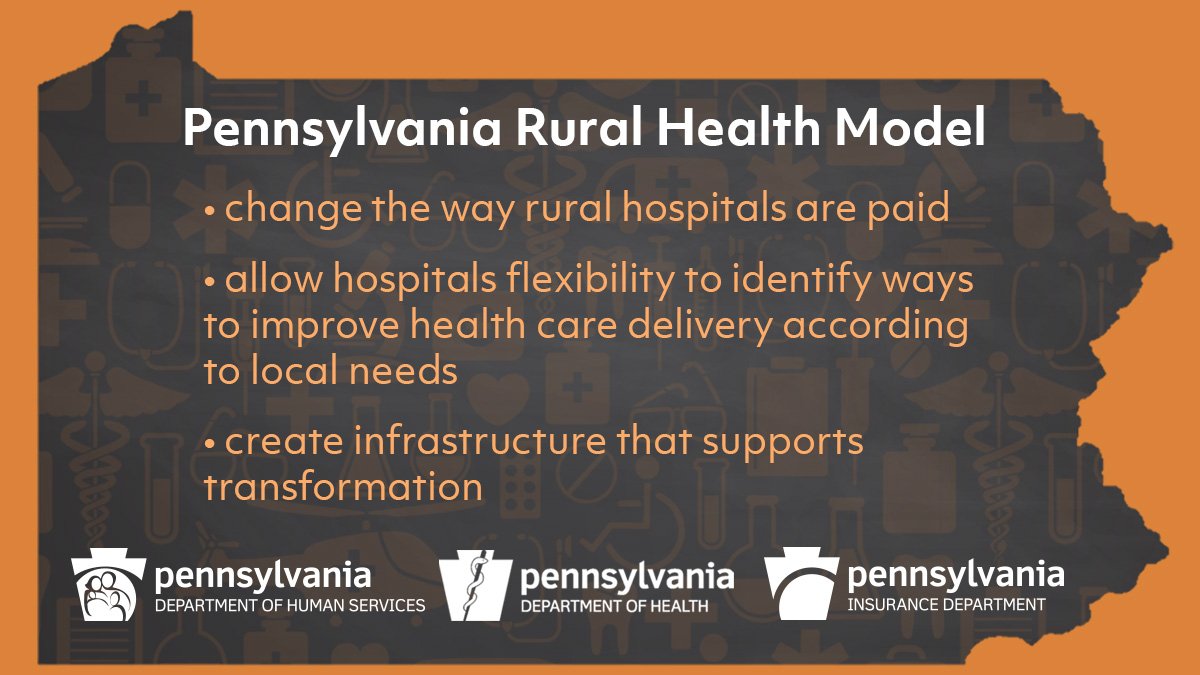
The Rural Health Model, the first of its kind, creates an alternative payment model that transitions hospitals from fee-for-service to global budget payments.


KEY TAKEAWAYS

The Rural Health Model creates an alternative payment model that transitions hospitals from fee-for-service to global budget payments.

Instead of getting paid for admissions, hospitals in the model will get a preset amount of money to provide services in the community.

State officials say the new payment model allows hospitals time to transform care to better meet the health needs of the community.

Eight more hospitals and one payer have joined a Pennsylvania initiative to shore up the financial footing of the state’s rural hospitals.

“I am especially pleased to see more hospitals joining this important initiative to improve their financial viability so that every Pennsylvanian has access to quality health care within a reasonable distance from home,” Gov. Tom Wolf said in a media release.

State officials the program is needed because nearly half of all rural hospitals in Pennsylvania are operating with negative margins and are at risk of closure. Four rural hospitals in Pennsylvania have shuttered since 2006, according to the North Carolina Rural Health Research Program.

So far this year, 19 rural hospitals across the nation have closed, making 2019 the worst year for rural hospital closures since at least 2005.

The Rural Health Model, the first of its kind, creates an alternative payment model that transitions hospitals from fee-for-service to global budget payments. Those global payments come from several payers, including private and public insurers.

Instead of getting paid for admissions, hospitals in the model will get a preset amount of money to provide services in the community.

State officials say the new payment model allows hospitals time to transform care to better meet the health needs of the community. This includes providing nontraditional roles, such as providing transportation and broadband internet access.

The eight hospitals are:

• Armstrong County Memorial Hospital in Kittanning.

• Chan Soon-Shiong Medical Center at Windber in Somerset County.

• Fulton County Medical Center in McConnellsburg.

• Greene Hospital in Waynesburg, Greene County.

• Monongahela Valley Hospital in Monongahela, Washington County.

• Punxsutawney Area Hospital in Punxsutawney, Jefferson County.

• Tyrone Hospital in Tyrone, Blair County.

• Washington Hospital in Washington, Washington County

A total of 67 hospitals are eligible for model based and nearly 20% of them will participate in in 2020, state officials said.

In addition, Aetna will join five other private payers  – Gateway, Geisinger, Highmark, Medicare and UPMC – which combine make up nearly half of the individual and small group market insurance population in the state.

The program is funded and administered by the newly created Rural Health Redesign Center Authority and the Pennsylvania Rural Health Redesign Center Fund.

In addition to providing access to care for rural communities, state officials say the model will ensure that, by remaining open, rural hospitals continue to be a vital economic driver for their communities.

“The Rural Health Model is a transformative step that changes the financial model for hospitals in rural areas,” said Pennsylvania Secretary of Health Rachel Levine, MD. “This is a step that will help achieve financial stability for these facilities and aims to improve the overall health of the community.”

“THIS IS A STEP THAT WILL HELP ACHIEVE FINANCIAL STABILITY FOR THESE FACILITIES AND AIMS TO IMPROVE THE OVERALL HEALTH OF THE COMMUNITY.”


5 trends and issues to watch in the insurance industry in 2020

https://www.fiercehealthcare.com/payer/top-5-trends-and-issues-to-watch-insurance-industry-2020

Image result for 5 trends and issues to watch in the insurance industry in 2020

The insurance industry appears likely to have another big year in 2020, as growth in government and commercial markets is expected to continue.

But a presidential election and new transparency initiatives could throw some major curveballs to payers.

Here are the top five issues and trends to watch out for in the next year:

Medicare Advantage diversifies

Enrollment growth in Medicare Advantage is likely to continue next year, as more than 22 million Medicare beneficiaries already have a plan. But what will be different is diversification into new populations, especially as insurers pursue dually eligible beneficiaries on both Medicare and Medicaid.

“This is being made possible because of strong support from government,” said Dan Mendelson, founder of consulting firm Avalere Health.

Support for Medicare Advantage “transcends partisanship and that has been true under Trump and Obama,” he added.

New benefit designs, such as paying for food or transportation to address social determinants of health, are also going to increase in popularity. The Centers for Medicare & Medicaid Services (CMS) has made it easier for plans to offer such supplemental benefits.

Get ready for transparency, whether you like it or not

This past year saw CMS release a major rule on transparency that forces hospitals to post payer-negotiated rates starting in 2021 for more than 300 “shoppable” hospital services.

The rule, which is being contested in court, could fundamentally change how insurers negotiate with hospitals on how to cover those services. The rule brings up questions about revealing “private information for the sake of transparency,” said Monica Hon, vice president for consulting firm Advis.

But it remains unclear how the court battle over the rule, which has garnered opposition from not just hospitals but also insurers, will play out. Hospital groups behind the lawsuit challenging the rule have had success getting favorable rulings that struck down payment cuts.

“I think there is going to be a lot of back and forth,” Hon said. “Whatever the result is that will impact how payers and providers negotiate rates with this transparency rule.”

Don’t expect major rules in 2020

2020 is a presidential and congressional election year, and traditionally few major initiatives get going in Congress. But experts say the same goes for regulations as administrations tend not to issue major regulations in the run-up to the vote in November, said Ben Isgur, leader of PwC’s Health Research Institute.

“What we will end up with is much more change on regulations on the state side,” Isgur said.

But new regulations on proposals that have been floated could be released. Chief among them could be a final rule to halt information blocking at hospitals and a new regulation on tying Medicare Part B prices for certain drugs to the prices paid in certain countries.

Congressional lawmakers are still hoping to reach a compromise on surprise billing, but they don’t have much time before campaigning for reelection in November.

A lot of the healthcare direction will be set after the presidential election in November. If a Democrat defeats President Donald Trump, then waivers for items like Medicaid work requirements and block grants will likely go by the wayside.

“Depending on who takes the White House and Congress, are we going to further repeal the Affordable Care Act and replace it or will we have Medicare for All,” Isgur said.

Insurers continue to go vertical in dealmaking

Insurers certainly weren’t shy about engaging in mergers and acquisitions in 2019, and that trend doesn’t appear likely to dissipate next year.

But the types of mergers might be different. Insurers and providers are increasingly looking at deals that would offer a vertical integration, such as acquiring more pharmacy services or a technology company to enhance the patient experience. Plenty of big-ticket vertical deals, such as CVS’ acquisition of Aetna and Cigna’s purchase of Express Scripts, have changed the industry landscape significantly.

“Deals in 2020 are going to be much more around the identity,” Isgur said. “Five years ago we had a lot of horizontal deals where health systems got bigger and regional payers got bigger.”

Payers continue to push patients away from hospitals

Insurers are going to try to find new ways to push patients toward outpatient services to avoid higher costs from going to a hospital.

For instance, “we are seeing a lot of payers not going to honor hospital imaging,” said Hon. “A lot of payers are saying we want you to go outside the hospital and that is a lot cheaper for us,” she said.

Instead, payers will try to steer patients toward imaging centers or physicians’ offices.

“We are seeing that with imaging and free-standing surgical centers now being able to do a lot more,” she added.

Insurers are also starting to use primary care more proactively to “ensure that they understand the needs of the patient, their needs are being addressed,” Mendelson said.


Sutter Health to pay $575M to settle antitrust case

https://www.beckershospitalreview.com/legal-regulatory-issues/sutter-health-to-pay-575m-to-settle-antitrust-case.html?origin=CFOE&utm_source=CFOE&utm_medium=email

Image result for Sutter Health to pay $575M to settle antitrust case

Sutter Health, a 24-hospital system based in Sacramento, Calif., has agreed to pay $575 million to settle an antitrust case brought by employers and California Attorney General Xavier Becerra.

The settlement resolves allegations that Sutter Health violated California’s antitrust laws by using its market power to overcharge patients and employer-funded health plans. The class members alleged Sutter Health’s inflated prices led to $756 million in overcharges, according to Bloomberg Law.

Under the terms of the settlement, Sutter will pay $575 million to employers, unions and others covered under the class action. The health system will also be required to make several other changes, including limiting what it charges patients for out-of-network services, halting measurers that deny patients access to lower-cost health plans, and improving access to pricing, quality and cost information, according to a Dec. 20 release from Mr. Becerra.

To ensure Sutter is complying with the terms of the settlement, the health system will be required to cooperate with a court-approved compliance monitor for at least 10 years.

Mr. Becerra said the settlement, which he called “a game changer for restoring competition,” is a warning to other organizations.

This first-in-the-nation comprehensive settlement should send a clear message to the markets: if you’re looking to consolidate for any reason other than efficiency that delivers better quality for a lower price, think again. The California Department of Justice is prepared to protect consumers and competition, especially when it comes to healthcare,” he said.

A Sutter spokesperson told The New York Times that the settlement did not acknowledge wrongdoing. “We were able to resolve this matter in a way that enables Sutter Health to maintain our integrated network and ability to provide patients with access to affordable, high-quality care,” said Flo Di Benedetto, Sutter’s senior vice president and general counsel, in a statement to The Times.

The settlement must be approved by the court. A hearing on the settlement is scheduled for Feb. 25, 2020.


In a Boston acute care matchup, home beats the hospital

https://mailchi.mp/f3434dd2ba5d/the-weekly-gist-december-20-2019?e=d1e747d2d8

Related image

Despite all of the recent hype, the idea of “hospital-at-home” is hardly a new concept. The first randomized, controlled study on the topic, published over 20 years ago, showed that the model was safe, finding that patients with five common conditions who would normally have been admitted to the hospital experienced similar outcomes when treated at home.

This week a new randomized, controlled trial from researchers at Boston-based Brigham and Women’s showed that hospital-at-home had better clinical outcomes and was a whopping 38 percent cheaper than equivalent management in an acute care hospital. Yes, the study was small (91 patients) and probably had some selection bias (just 37 percent of eligible patients chose home care).

Drilling into the data, length of stay for home-based patients was a little longer, but at-home patients received dramatically fewer lab tests, imaging studies and specialist consults—raising the question of whether all those daily chest x-rays, CBCs and curbside consults in traditional hospitals really provide value.

And 30-day readmissions and ED visit rates for home-based patients were less than half of the control group. Selection for clinical appropriateness and family support is critical, but experts estimate that up to a third of medical admissions could be managed in the home setting.

As growing evidence shows hospital-at-home to be safe, effective and lower cost, the lack of a reimbursement model to support investments in home-based acute care is now the greatest obstacle to widespread adoption.


Get ready for the “Yolds”

https://mailchi.mp/f3434dd2ba5d/the-weekly-gist-december-20-2019?e=d1e747d2d8

Image result for Yolds

In a recent discussion on consumer strategy, a health system executive relayed a surprising data point: the system’s most “digitally activated” market was a local retirement community. The residents of this over-55, master-planned community, designed for active seniors, had the system’s highest rates of patient portal activation and online appointment scheduling.

Growth of this cohort of “young old” consumers (YOLDS) —over 65 but still active—will explode as the peak of the Baby Boom joins their ranks. And with a median wealth of $210,000, they’ll have tremendous spending power, so much so that the Economist recently dubbed the next ten years “The Decade of the Yold”. Many “Yolds” will keep working well into their 70s, and those that do will experience slower rates of health and cognitive decline.

For health systems, the next few years are critical for deepening relationships as the Yolds transition into Medicare. What do they want today? Technology-enabled care, and access and communication that works right out of the box, as they have little patience for troubleshooting buggy software. Customized, high-touch services, like they’ve come to expect from everything they consume.

And a focus on helping them maintain their active, productive lifestyle for as long as possible. But they’re not brand switchers: once they join a Medicare Advantage plan, there’s a 90 percent chance they’ll stay. Building loyalty with the Yolds can be the found


A look at what lies under the (high) deductible

https://mailchi.mp/f3434dd2ba5d/the-weekly-gist-december-20-2019?e=d1e747d2d8


With the continued growth in high deductible health plans (HDHPs) in both employer- and exchange-based insurance markets, a larger number of services are falling “under the deductible”, leaving patients responsible for the full cost of care

The graphic above illustrates the national cost ranges of ten common outpatient services, based on data from a publicly-available commercial claims databaseIt’s not just minor services like lab tests or diagnostic imaging that are falling under the deductible—many consumers are now paying full freight for a growing list of outpatient procedures like cataract or carpal tunnel surgery, or even knee arthroscopy.

Shopping can pay off: for any service, the highest-priced provider can be over three times the lowest-priced, translating into thousands of dollars of savings for patients with high-deductible plans.

Outpatient services now account for over half the revenue of many health systems. As deductibles climb, more and more of the (profitable) health system services are becoming “shoppable” for consumers—creating an imperative for systems to both lower costs and pursue rational pricing as scrutiny becomes more intense.