Delta fears grip economy as cases jump across the country

Delta fears grip economy as cases jump across the country

Covid-19: Delta Variant Reported In 85 Countries; Expected To Become  Dominant Lineage, Says Who

The delta variant of the coronavirus is sweeping through the United States, raising the average number of cases to 30,000-per-day, crowding hospitals in areas with large number of unvaccinated people and spurring questions about the nation’s recovery from the pandemic.

Stocks tanked on Monday, with the Dow Jones Industrial average dropping 725 points after being down more than 900 points at one time.

It was the worst one-day performance in the Dow since last October, and followed losses in markets around the world as investor fears about how the delta virus might slow both the health and economic recovery took hold.

Health officials have described the latest stage of the coronavirus as a pandemic of the unvaccinated while emphasizing that those who have had their shots are relatively safe.

Yet Los Angeles County on Saturday reinstated a mask mandate for indoor public settings, a sign that local communities may decide to reimpose restrictions as a safety measure.

An Olympic gymnast and an Olympic women’s basketball player both announced they had tested positive as they prepared for the Games, which is being held in a state of emergency in Tokyo where the rate of vaccinations is behind the United States.

Canada had also been well behind the U.S. in its vaccination rate but surpassed its southern neighbor on Monday, a sign of how much more slowly the vaccination rate now is in the United States. A big reason is that many people who are unvaccinated do not want to get the vaccine, something the Biden administration has increasingly blamed on social media and some conservative media outlets.

While the 30,000 cases per day on average is more than double the 13,000 average at the end of June, that rate is still well below highs from last fall and earlier this year.

Still, deaths are also ticking back up, at around 240 per day. 

Because vaccinated people are still overwhelmingly protected, especially from severe outcomes, case and death numbers are likely to stay well below the worst of last winter’s surges, before vaccines were widely available. 

But unvaccinated people are at increasing risk, especially given the rise of the highly transmissible delta variant, and the vaccination campaign is hitting a wall, leaving more than 30 percent of adults without any shots and exposed to the full dangers of the virus.

States with lower vaccination rates are seeing the worst outbreaks. Arkansas, Missouri, Florida and Louisiana are the four states with the highest per capita new cases per day, according to data from the Covid Act Now tracking site. The percentage of the population with at least one shot in those states is 44 percent, 47 percent, 56 percent, and 40 percent, respectively. 

In contrast, Vermont and Massachusetts, where the vaccination rate is over 70 percent, are faring much better. 

Vaccine resistance among some leading conservative commentators and lawmakers is raising fears that many of the remaining unvaccinated may never get the shots.

Sten Vermund, a professor at the Yale School of Public Health, said he is “not particularly worried” about COVID-19 for himself, because he is fully vaccinated.

“What worries me is my fellow Americans who for a variety of reasons choose not to get vaccinated; they continue to be in harm’s way,” Vermund said.

In the rare instances where vaccinated people do get COVID-19 cases, symptoms are likely to be much milder.

CDC Director Rochelle Walensky said Friday that 97 percent of people entering the hospital with COVID-19 are unvaccinated, part of why she said it “is becoming a pandemic of the unvaccinated.”

Conservative resistance to vaccination is stiffening. A Washington Post-ABC News poll released earlier this month found that 47 percent of Republicans said they were unlikely to get vaccinated, compared to just six percent of Democrats. Among Republicans, 38 percent said they definitely would not get the shots.

Former President Trump has previously encouraged people to get vaccinated, though he has not made a forceful push, for example by recording a public service announcement or getting his own shots in public.

On Sunday, though, Trump appeared to justify people not taking the vaccine, blaming President Biden.

“He’s way behind schedule, and people are refusing to take the Vaccine because they don’t trust his Administration, they don’t trust the Election results, and they certainly don’t trust the Fake News, which is refusing to tell the Truth,” Trump said in a statement.

Asked if Biden would request Trump film a public service announcement on vaccination, White House press secretary Jen Psaki said “we don’t believe that requires an embroidered invitation to be a part of.”

“Certainly any role of anyone who has a platform where they can provide information to the public that the vaccine is safe, it is effective, we don’t see this as a political issue,” Psaki said. “We’d certainly welcome that engagement.”

She also emphasized, though, that the administration is focusing on local doctors and community leaders to try to boost vaccination rates, not national officials.

The effort is hitting its limits, though. The pace of vaccinations has fallen to around 500,000 per day, down from over 3 million at the peak in April, according to Our World in Data.

“I’m not that hopeful that we’re going to get to people who have refused to be vaccinated,” said Preeti Malani, an infectious disease expert at the University of Michigan.

Experts increasingly say the best remaining hopes of reaching the remaining unvaccinated are school and employer mandates for their workers or students to get vaccinated.

France is experiencing a surge in vaccinations after President Emmanuel Macron announced this month that proof of vaccination, or a negative test, would be required for everyday activities like going to restaurants. The Biden administration has repeatedly ruled out a national vaccine passport in the U.S., though, and Republicans have rebelled against the idea.

Full approval of the vaccines from the Food and Drug Administration, as opposed to the current emergency authorization, could also help assuage some people’s fears, and some experts have called on the FDA to move faster on issuing a full approval.

The Biden administration has stepped up its calls for Facebook and other technology companies to do more to fight vaccine misinformation on their platforms.

Biden on Friday said social media companies are “killing people” with misinformation. On Monday, though, he dialed the criticism back down, instead pointing to 12 people responsible for much of the disinformation.

“Facebook isn’t killing people, these 12 people are out there giving misinformation,” Biden said.

“My hope is that Facebook, instead of taking it personally, that somehow I’m saying Facebook is killing people, that they would do something about the misinformation, the outrageous misinformation about the vaccine,” Biden added. “That’s what I meant.”

For its part, Facebook said over the weekend, before Biden’s walk-back, that the administration was “finger pointing” and the company was not the reason the president’s goal of getting 70 percent of adults at least one shot by July 4 was missed.

Los Angeles County’s move to return to an an indoor mask mandate, even for vaccinated people,

got mixed reviews from experts, but either way, it is unlikely to be replicated in places that are the hardest hit, given that places that are resistant to vaccines tend to also be resistant to masks.

“Vaccines are really the only way out,” Malani said. “We can’t live in masks forever.”

S&P upgrades view on nonprofit health sector as COVID-19 cases drop

Dive Brief:

  • S&P Global Ratings on Wednesday upgraded its view on the nonprofit healthcare sector to stable. It had been at negative since March 2020, a view that was affirmed in January.
  • Analysts said the change results from coronavirus vaccination rates and decreasing COVID-19 cases as well as a drop in the unemployment rate that should reduce payer mix shakeup. They also pointed to generally healthy balance sheets across the sector.
  • Headwinds remain, most notably labor expenses as burnout among staff was heavily exacerbated by the pandemic. Increased salaries and benefit expenses will dampen margins going forward, according to the report.

Dive Insight:

The change is another sign for providers that their financial situation is on a rather swift recovery from the upheaval caused by the pandemic. Although some facilities, especially those that are smaller and in rural areas, are certainly still struggling, that was the case before COVID-19 as well.

Most nonprofit health systems reported first-quarter results that showed improved volumes and investment returns. Some are still sporting more than a year’s worth of cash on hand.

Many of them took advantage of federal coronavirus relief funds, most of which can now be used more flexibly. A few, like Kaiser Permanente, did fine without the aid and ended up returning it.

The S&P analysts warned, however, that potential COVID-19 outbreaks this fall would be a setback. That remains a concern with some parts of the country lagging in vaccination rates and the increasing prevalence of more contagious COVID-19 variants.

Other risks include the end of enhanced federal reimbursement and the return of the Medicare sequester cuts when the public health emergency ends, which is expected to be after the end of this year.

But the analysts said agile management teams should be able to combat these challenges.

“[T]o the extent that the pandemic has enabled faster decision making and allowed management teams to pivot and identify new opportunities for expense base restructuring and revenue enhancement, we believe these risks are manageable within our view of the stable sector view,” according to the report.

Rational Exuberance for Medicare Advantage Market Disrupters

Insurers Running Medicare Advantage Plans Overbill Taxpayers By Billions As  Feds Struggle To Stop It | Kaiser Health News

Medicare Advantage (MA) focused companies, like Oak Street
Health (14x revenues), Cano Health (11x revenues), and Iora
Health (announced sale to One Medical at 7x revenues), reflect
valuation multiples that appear irrational to many market observers. Multiples may be
exuberant, but they are not necessarily irrational.


One reason for high valuations across the healthcare sector is the large pools of capital
from institutional public investors, retail investors and private equity that are seeking
returns higher than the low single digit bond yields currently available. Private equity
alone has hundreds of billions in investable funds seeking opportunities in healthcare.
As a result of this abundance of capital chasing deals, there is a premium attached to the
scarcity of available companies with proven business models and strong growth
prospects.


Valuations of companies that rely on Medicare and Medicaid reimbursement have
traditionally been discounted for the risk associated with a change in government
reimbursement policy
. This “bop the mole” risk reflects the market’s assessment that
when a particular healthcare sector becomes “too profitable,” the risk increases that CMS
will adjust policy and reimbursement rates in that sector to drive down profitability.


However, there appears to be consensus among both political parties that MA is the right
policy to help manage the rise in overall Medicare costs and, thus, incentives for MA
growth can be expected to continue.
This factor combined with strong demographic
growth in the overall senior population means investors apply premiums to companies in
the MA space compared to traditional providers.


Large pools of available capital, scarcity value, lower perceived sector risk and overall
growth in the senior population are all factors that drive higher valuations for the MA
disrupters.
However, these factors pale in comparison the underlying economic driver
for these companies. Taking full risk for MA enrollees and dramatically reducing hospital
utilization, while improving health status, is core to their business model.
These
companies target and often achieve reduced hospital utilization by 30% or more for their
assigned MA enrollees.

In 2019, the average Medicare days per 1,000 in the U.S. was 1,190. With about
$14,700 per Medicare discharge and a 4.5 ALOS, the average cost per Medicare day is
approximately $3,200. At the U.S. average 1,190 Medicare hospital days per thousand,
if MA hospital utilization is decreased by 25%, the net hospital revenue per 1,000 MA

enrollees is reduced by about $960,000. If one of the MA disrupters has, for example, 50,000 MA lives in a market, the
decrease in hospital revenues for that MA population would be about $48 million. This does not include the associated
physician fees and other costs in the care continuum. That same $48 million + in the coffers of the risk-taking MA
disrupters allows them deliver comprehensive array of supportive services including addressing social determinants of health. These services then further reduce utilization and improves overall health status, creating a virtuous circle. This is very profitable.


MA is only the beginning. When successful MA businesses expand beyond MA, and they will, disruption across the
healthcare economy will be profound and painful for the incumbents. The market is rationally exuberant about that
prospect.

Hospitals saw gains in volume, revenue and margin in April, finds Kaufman Hall

https://www.healthcarefinancenews.com/news/hospitals-saw-gains-volume-revenue-and-margin-april-finds-kaufman-hall

Hospitals saw gains in volume, revenue and margin in April, finds Kaufman  Hall | Healthcare Finance News

The signs of progress are encouraging, but the metrics are still down slightly when compared to last month.

Slowly, the financial health of the nation’s healthcare institutions are improving. Hospitals and health systems continued to see performance improvements in April compared to the devastating losses experienced in the early months of the COVID-19 pandemic.

Hospital margins, volumes, and revenues were up across most performance metrics, both year-to-date and year-over-year, but were down compared to March, according to the latest issue of Kaufman Hall’s National Hospital Flash Report. There was no explicit reason given for the dip, but any number of factors small and large could play into the results. It’s possible that clearer trend lines will develop over time.

WHAT’S THE IMPACT?

While any signs of progress are encouraging, the April results draw a clear contrast to the severity of record-low performance seen during the first two months of the pandemic in 2020, rather than strong overall performance so far this year.

Operating margin, for example, rose 101.9% (or 8.6 percentage points) compared to January-April 2020, not including federal Coronavirus Aid, Relief, and Economic Security Act funding. With the funding, operating margin was up 90.6% year-to-date, or 6.9 percentage points. 

Operating margin was up 113.1% (39.3%) without CARES and 109.5% (21.4%) with CARES, compared to the first full month of the pandemic in April 2020, when nationwide shutdowns and broad restrictions on outpatient procedures caused operating margins to plummet 282% year-over-year.

April 2021 hospital margins, however, remained relatively thin. The median Kaufman Hall hospital operating margin index was 2.4% for the month, not including CARES. Even with the funding, it was 3.3%.

When it came to volumes, hospitals saw them increase across most metrics compared to 2020 levels, but decrease slightly compared to March. Adjusted discharges were up 5.9% year-to-date and jumped 66.4% year-over-year, while adjusted patient days rose 10% year-to-date and 64.8% year-over-year. Both metrics fell 1% month-over-month.

Emergency department visits were mixed, falling 7% compared to the first four months of 2020, but rising 57.2% year-over-year and 5.3% month-over-month. Operating room minutes were down 3.6% from March, but increased 26.1% year-to-date, and shot up 189.2% compared to April 2020, when COVID-19 abruptly halted most outpatient procedures.

Revenues followed a similar pattern, with gross operating revenue (not including CARES) up 16.7% year-to-date and 71.8% year-over-year, but down 2.5% compared to the prior month. Inpatient revenue rose 10.6% year-to-date and 37.1% year-over-year, but was down 1.9% month-over-month. Outpatient revenue rose 20.3% year-to-date, jumped 114.8% compared to April 2020, but fell 2% from March.

Total expenses continued to increase both year-to-date and year-over-year, but saw moderate decreases month-over-month. Total expense was up 6.6% year to date and 13.1% year over year. Total labor expense increased 6.1% year-to-date and 9.4% year-over-year, and total nonlabor expense rose 7% year-to-date and 16.3% year-over-year. 

Compared to March, though, all three metrics were down about 3%. Expense results were mixed when adjusted for the month’s volumes. Total expense per adjusted discharge, for example, increased 2% compared to January-April 2020, but fell 32.3% from April 2020 and 2% from March. 

THE LARGER TREND

Despite the ongoing pandemic, the 2021 financial outlook for the global healthcare sector is mostly positive, as strong demand for products and services – including those related to COVID-19 – will more than offset lingering pressures from the public health emergency, Moody’s Investors Service found in December.

The demand will remain strong, largely due to aging populations, the improvement in access and the introduction of new and innovative products. There is one caveat: steadily rising healthcare expenditures, which will cause payers to continue to restrict utilization and lower prices.

In October, Moody’s found that owning a public hospital during the COVID-19 pandemic carried operational risk, which will compound the fiscal and credit difficulties facing many large urban counties across the U.S.

Whether recovery from the coronavirus this year is relatively rapid or relatively slow, America’s hospitals will face another year of struggle to regain their financial health.
 

Non-operating income helps Providence claw back into black for 2020

https://www.healthcaredive.com/news/non-operating-income-helps-providence-claw-back-into-black-for-2020/596370/

Dive Brief:

  • Though the COVID-19 pandemic hampered Providence’s operational performance in 2020, the regional nonprofit powerhouse still ended the year in the black with net income of $1 billion, down about 9% from 2019.
  • Providence ended 2020 with an operating loss of $306 million, compared to an operating income of $214 million in 2019. However, healthy non-operating income recouped operating losses and offset reimbursement shortfalls from Medicaid and Medicare coverage, Providence said in full-year financial results released Monday.
  • The system, which operates 51 hospitals spanning seven states, posted drastic net losses in the first half of 2020 due to the pandemic, but seems to have closed out the year on more stable financial footing though volumes remain down.

Dive Insight:

Like other major systems, the pandemic railroaded Providence’s operational performance in 2020, as state and local lockdowns and orders to pause non-emergency procedures contributed to an unprecedented drop in patient volumes starting in March. As a result, the West Coast system reported a significant dip in patient revenue, along with skyrocketing expenses for personal protective equipment, pharmaceuticals and labor.

Volumes as measured by adjusted admissions were down 9% for the fiscal year ended Dec. 31, Providence said. Despite the lower volume, operating revenues were actually up 3% year over year to $25.7 billion, driven by growth in capitation, premium and diversified revenue streams — and supported by the recognition of $957 million in federal COVID-19 grants to providers from the Coronavirus Aid, Relief, and Economic Security Act passed a year ago.

However, operating expenses climbed 5% year over year to $26 billion, resulting in ​operating earnings before interest, depreciation and amortization of $1.1 billion, compared with $1.6 billion in 2019.

Overall, Providence’s financial results suggest the system was able to sidestep the worst of the pandemic’s financial effects, and mirrors 2020 reports from other major nonprofits.

Kaiser Permanente, which reported in early February, was also able to stay in the black despite COVID-19 deflating operating and net income, which fell about 19% and 15% respectively from 2019. Similarly, nonprofit Mayo Clinic reported a shrinking bottom line, with net income down almost 24% from 2019 though it remained profitable.

California-based nonprofit Sutter Health also squeaked to overall profitability in 2020 despite a operational loss of $321 million. The system, which said it expected to take several years to fully recover from COVID-19, launched a systemwide operational and financial review as a result of its weak operational performance.

For-profit operators weathered similar headwinds and were able to turn a profit in 2020, including Universal Health ServicesHCA HealthcareTenet and Community Health Systems.

A number of hospital executives have called out CARES grants and other federal aid as a key help in turning their finances around in 2020. However, despite the pandemic’s financial pressures, numerous major operators, including Kaiser Permanante, Mayo Clinic and HCA said they would return all or a portion of congressional aid, even as powerful hospital lobbies call on Washington for additional funds.

A recent Kaufman Hall report suggests providers could be overwhelmed by ongoing COVID-19 expenses following a surge in cases over the winter. Researchers estimate hospitals could lose anywhere from $53 billion to $122 billion in revenue in 2021 if pandemic pressures don’t abate, despite the glimmer of hope brought by ongoing vaccination efforts.

Despite increasing distribution of coronavirus vaccines, Moody’s Investors Service has placed a negative outlook on nonprofit hospitals in 2021.

Providence came together in 2016 with the merger of Washington-based Providence Health & Services and California-based St. Joseph Health to create the nation’s fourth-biggest Catholic hospital chain. Its full-year earnings come a week after California Attorney General and Biden nominee for HHS Secretary Xavier Becerra disclosed his office is investigating whether Providence violated legal commitments in applying religious restrictions to medical care at a hospital in Orange County.​

How hospital operators fared financially in 2020

“For the most part providers were dependent on that CARES funding. I think they would have been in the red or break even without it,” Suzie Desai, a senior director at S&P Global Ratings, said.

The pandemic weighed heavily on the financial performance of not-for-profit hospitals in 2020, but some of the larger health systems remained profitable despite the upheaval — in large part thanks to substantial federal funding earmarked to prop up providers during the global health crisis. 

Industry observers have been closely watching to see how health systems ultimately fared in 2020. Now, with the fiscal-year ended and accounted for, analysts say the $175 billion in federal funds was crucial for providers’ bottom lines.

Without the stimulus funding, it is very likely we would have seen more issuers [hospitals/health] systems experience either lower profitable margins, or outright losses from operations,” Kevin Holloran, senior director of U.S. public finance for Fitch Ratings, said.  

Still, the pandemic put a squeeze on nonprofit hospital margins last year, according to a recent Moody’s report that showed the median operating margin was 0.5% in 2020 compared to 2.4% in 2019.

The first half of the year hit providers especially hard as volumes fell drastically, seemingly overnight. Revenue plummeted alongside the volume declines as the nation paused lucrative elective procedures to preserve medical resources.

One estimate showed hospitals lost more than $20 billion as they halted surgeries in the early months of the outbreak in the U.S. 

But as the year wore on, the outlook improved as some volumes returned closer to pre-pandemic levels. At the same time, health systems worked to cut expenses to mitigate the financial strain.

Still, some health systems did post operational losses even with the federal funds meant to help them. Moody’s found that 42% of 130 hospitals surveyed posted an operating loss, an increase from 23% the year prior. Yet, the 2019 survey included more hospitals, a total of 282.

Sutter Health, the Northern California giant, reported an operating loss for 2020 and said it was launching a “sweeping review” of its finances as the pandemic exacerbated existing challenges for the provider. Washington-based Providence also reported an operating loss for 2020. However, both Sutter and Providence were able to post positive net income thanks in large part to investment gains.    

Investment income can aid nonprofit operators even when core operations are stunted like during 2020. Though, initially, the pandemic put stress on the stock market as uncertainty around the virus and its duration ballooned. The stock market took a dive and it was reflected in some six-month financials as both operations and investments took a hit. 

“COVID and the stimulus is (hopefully) a once in a lifetime disruption of operations,” Holloran said, who noted analysts have been trying to assess whether the top line losses can be placed squarely on COVID-19. If that’s the case, analysts are typically more apt to keep the provider’s existing rating. 

“For the most part providers were dependent on that CARES funding. I think they would have been in the red or break even without it,” Suzie Desai, a senior director at S&P Global Ratings, said.

For example, Arizona’s Banner Health would have posted an operating loss without federal relief, according to their financial reports. Banner Health was able to work its way back to black after it reported a loss through the first six months of the year. The same was true for Midwest behemoth Advocate Aurora. 

The providers that were able to weather the storm of the pandemic tended to be integrated systems that had a health plan under their umbrella. 

Kaiser Permanente ended the year with both positive operating and net income and returned relief funds it received.   

“The integrated providers, yeah, were one group that just had a natural hedge with the insurance premiums still coming in,” Desai said.  

Still, the hospital lobby is hoping to secure more funding for its members as the threat of the virus is still present even amid large scale efforts to vaccinate a majority of Americans to reach a blanket of protection from the novel coronavirus and its variants.

How many “lives” does a health plan need?

https://mailchi.mp/3e9af44fcab8/the-weekly-gist-march-26-2021?e=d1e747d2d8

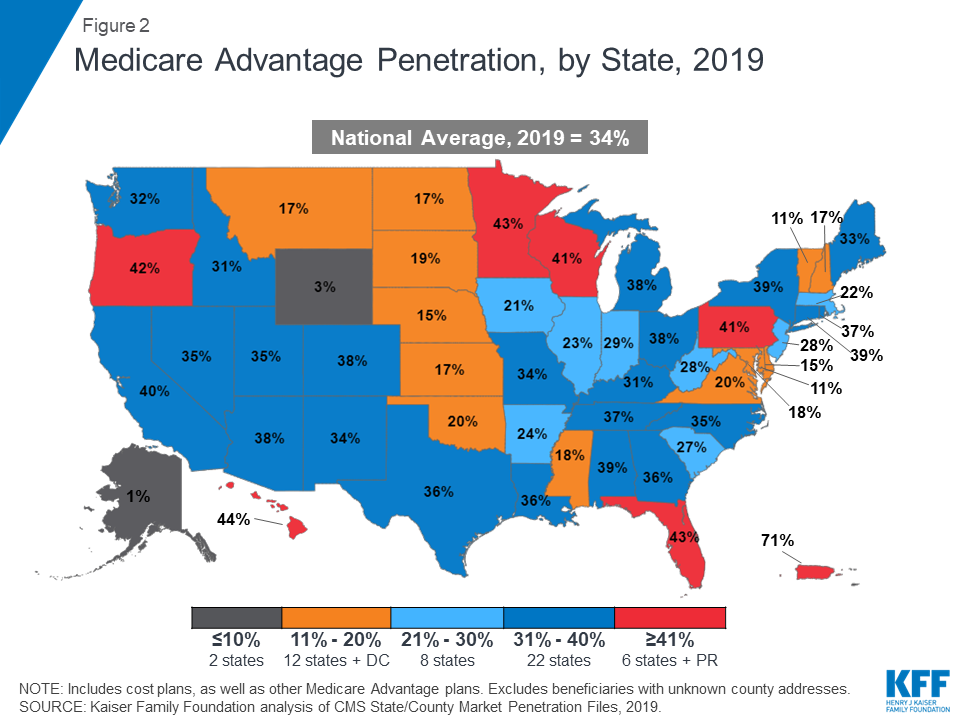
A Dozen Facts About Medicare Advantage in 2019 | KFF

Doctors and health systems with a significant portion of risk-based contracts weathered the pandemic better than their peers still fully tethered to fee-for-service payment. Lower healthcare utilization translated into record profits, just as it did for insurers.

We’re now seeing an increasing number of health systems asking again whether they should enter the health plan business—levels of interest we haven’t seen since the “rush to risk” in the immediate aftermath of the passage of the Affordable Care Act a decade ago.

The discussions feel appreciably different this time around (which is a good thing, since many systems who launched plans in the prior wave had trouble growing and sustaining them). First, systems are approaching the market this time with a focus on Medicare Advantage, having seen that growing a base of covered lives with their networks is much easier than starting with the commercial market, where large insurers, particularly incumbent Blues plans, dominate the market, and many employers are still reticent to limit choice.

But foremost, there is new appreciation for the scale needed for a health plan to compete. In 2010, many executives set a goal of 100K covered lives as a target for sustainability; today, a plan with three times that number is considered small. Now many leaders posit that regional insurers need a plan to get to half a million lives, or more. (Somehow this doesn’t seem to hold for insurance startups: see the recent public offerings of Clover Health and Alignment Health, who have just 57K and 82K lives, respectively, nationwide.)

We’re watching for a coming wave of health system consolidation to gain the financial footing and geographic footprint needed to compete in the Medicare Advantage market, and would expect traditional payers to respond with regional consolidation of their own.
 

Hedge fund unloads $133M of Tenet shares

Glenview Capital Receives ISS Support To Replace HMA Board

Glenview Capital Management, the hedge fund run by Larry Robbins, has a 12.9 percent stake in Tenet Healthcare after recently selling shares of the Dallas-based company, according to a Securities and Exchange Commission filing.

Glenview sold 2.5 million shares of Tenet, a 65-hospital system, on March 22 for $53.3 per share, bringing in a total of $133.25 million. 

Tenet shares closed March 24 at $50.03 per share, down from $50.49 a day earlier, according to Yahoo Finance

Tenet ended 2020 with net income of $399 million on revenue of $17.64 billion, compared to a net loss of $215 million on revenue of $18.48 billion a year earlier.