Eligibility for ACA Health Coverage Following Job Loss

Eligibility for ACA Health Coverage Following Job Loss

Eligibility for ACA Health Coverage Following Job Loss – Methods ...

The economic consequences of the coronavirus pandemic have led to historic level of job loss in the United States. Social distancing policies required to address the crisis have led many businesses to cut hours, cease operations, or close altogether. Between March 1st and May 2nd, 2020, more than 31 million people had filed for unemployment insurance. Actual loss of jobs and income are likely even higher, as some people may be only marginally employed or may not have filed for benefits. Some of these unemployed workers may go back to work as social distancing curbs are relaxed, though further job loss is also possible if the economic downturn continues or deepens.

In addition to loss of income, job loss carries the risk of loss of health insurance for people who were receiving health coverage as a benefit through their employer. People who lose employer-sponsored insurance (ESI) often can elect to continue it for a period by paying the full premium (called COBRA continuation) or may become eligible for Medicaid or subsidized coverage through the Affordable Care Act (ACA) marketplaces. Over time, as unemployment benefits end, some may fall into the “coverage gap” that exists in states that have not expanded Medicaid under the ACA.

In this analysis, we examine the potential loss of ESI among people in families where someone lost employment between March 1st, 2020 and May 2nd, 2020 and estimate their eligibility for ACA coverage, including Medicaid and marketplace subsidies, as well as private coverage as a dependent (see detailed Methods at the end of this brief). To illustrate eligibility as their state and federal unemployment insurance (UI) benefits cease, we show eligibility for this population as of May 2020 and January 2021, when most will have exhausted their UI benefits.

What are coverage options for people losing ESI?

Eligibility for health coverage for people who lose ESI depends on many factors, including income while working and family income while unemployed, state of residence, and family status. Some people may be ineligible for coverage options, and others may be eligible but opt not to enroll. Some employers may temporarily continue coverage after job loss (for example, through the end of the month), but such extensions of coverage are typically limited to short periods.

Medicaid: Some people who lose their jobs and health coverage—especially those who live in states that expanded Medicaid under the ACA— may become newly eligible1 for Medicaid if their income falls below state eligibility limits (138% of poverty in states that expanded under the ACA). For Medicaid eligibility, income is calculated based on other income in the family plus any state unemployment benefit received (though the $600 per week federal supplemental payment available through the end of July is excluded). Income is determined on a current basis, so prior wages for workers recently unemployed are not relevant. In states that have not expanded Medicaid under the ACA, eligibility is generally limited to parents with very low incomes (typically below 50% of poverty and in some states quite a bit less); thus many adults may fall into the “coverage gap” that exists for those with incomes above Medicaid limits but below poverty (which is the minimum eligibility threshold for marketplace subsidies under the ACA). Undocumented immigrants are ineligible for Medicaid, and recent immigrants (those here for fewer than five years) are ineligible in most cases.

Marketplace: ACA marketplace coverage is available to legal residents who are not eligible for Medicaid and do not have an affordable offer of ESI; subsidies for marketplace coverage are available to people with family income between 100% and 400% of poverty. Some people who lose ESI may be newly-eligible for income-based subsidies, based on other family income plus any state and new federal unemployment benefit received (including the $600 per week federal supplement, unlike for Medicaid).2 While current income is used for Medicaid eligibility, annual income for the calendar year is used for marketplace subsidy eligibility. Advance subsidies are available based on estimated annual income, but the subsidies are reconciled based on actual income on the tax return filed the following year. People who lose ESI due to job loss qualify for a special enrollment period (SEP) for marketplace coverage.3 As with Medicaid, undocumented immigrants are ineligible for marketplace coverage or subsidies. However, recent immigrants, including those whose income makes them otherwise eligible for Medicaid, can receive marketplace subsidies.

ESI Dependent Coverage: People who lose jobs may be eligible for ESI as a dependent under a spouse or parent’s job-based coverage. Some people may have been covered as a dependent prior to job loss, and some may switch from their own coverage to coverage as a dependent.

COBRA: Many people who lose their job-based insurance can continue that coverage through COBRA, although it is typically quite expensive since unemployed workers generally have to pay the entire premium – employer premiums average $7,188 for a single person and $20,576 for a family of four – plus an additional 2%. People who are eligible for subsidized coverage through Medicaid or the marketplaces are likely to opt for that coverage over COBRA, though COBRA may be the only option available to some people who are income-ineligible for ACA coverage.

Short-term plans: Short-term plans, which can be offered for up to a year and can sometimes be renewed under revised rules from the Trump administration, are also a potential option for people losing their employer-sponsored insurance. These plans generally carry lower premiums than COBRA or ACA-compliant coverage, as they often provider more limited benefits and usually deny coverage to people with pre-existing conditions. Even when coverage is issued, insurers generally may challenge benefit claims that they believe resulted from pre-existing medical problems; given the long latency between initial infection and sickness with COVID-19, these plans are riskier than usual during the current pandemic. People cannot use ACA subsidies toward short-term plan premiums.

Our analysis examines eligibility for Medicaid, marketplace subsidies, and dependent ESI coverage. We do not estimate enrollment in COBRA, short-term plans, or temporary continuation of ESI. See Methods for more details.

How does coverage and eligibility change following job loss?

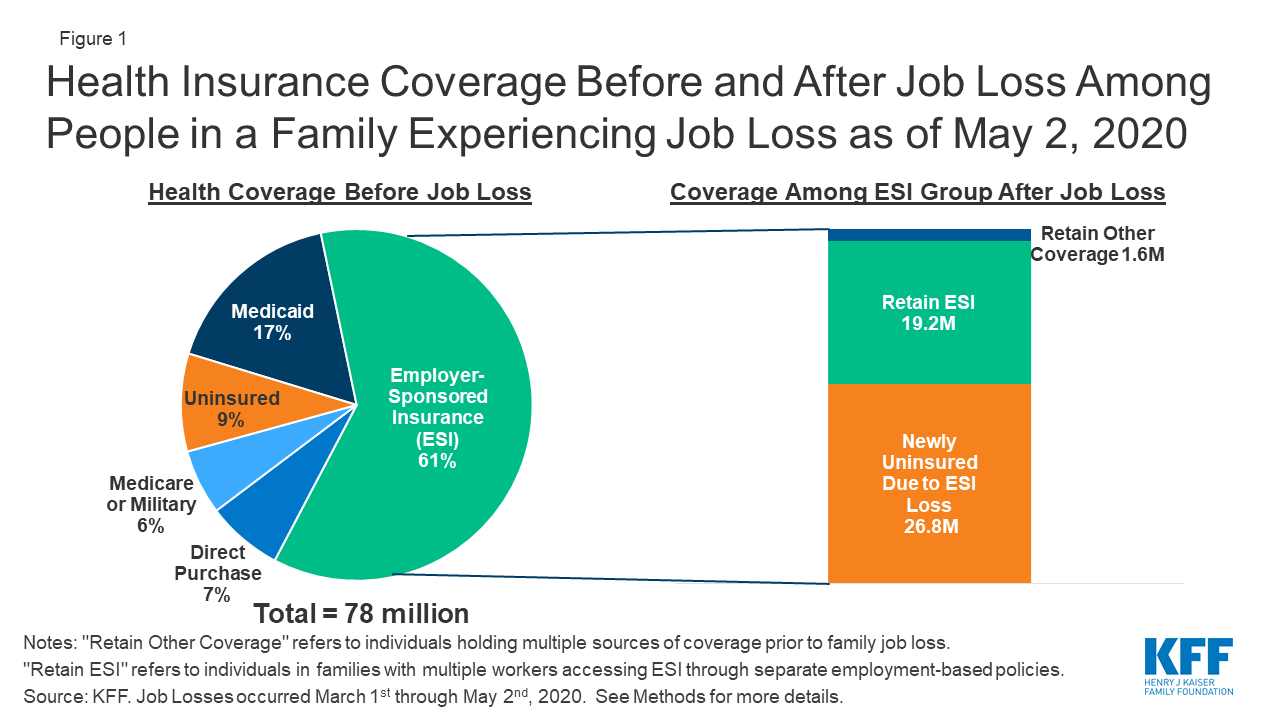
Between March 1st, 2020 and May 2nd, 2020, we estimate that nearly 78 million people lived in a family in which someone lost a job. Most people in these families (61%, or 47.5 million) were covered by ESI prior to job loss. Nearly one in five (17%) had Medicaid, and close to one in ten (9%) were uninsured. The remaining share either had direct purchase (marketplace) coverage (7%) or had other coverage such as Medicare or military coverage (6%) (Figure 1).
Eligibility for ACA Health Coverage Following Job Loss | The Henry ...

We estimate that, as of May 2nd, 2020, nearly 27 million people could potentially lose ESI and become uninsured following job loss (Figure 1). This total includes people who lost their own ESI and those who lost dependent coverage when a family member lost a job and ESI. Additionally, some people who otherwise would lose ESI are able to retain job-based coverage by switching to a plan offered to a family member: we estimate that 19 million people switch to coverage offered by the employer of a working spouse or parent. A very small number of people who lose ESI (1.6 million) also had another source of coverage at the same time (such as Medicare) and retain that other coverage. These coverage loss estimates are based on our assumptions about who likely filed for UI as of May 2nd, 2020 and the availability of other ESI options in their family (see Methods for more detail).

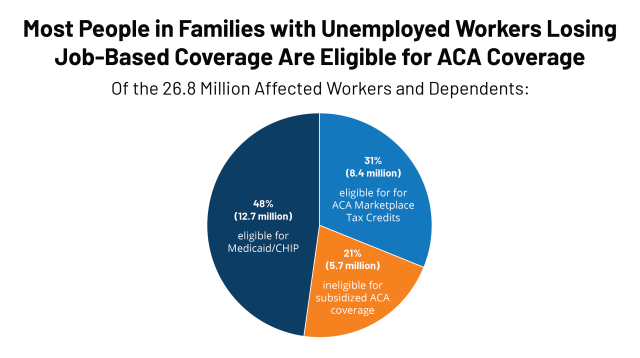
Among people who become uninsured after job loss, we estimate that nearly half (12.7 million) are eligible for Medicaid, and an additional 8.4 million are eligible for marketplace subsidies, as of May 2020 (Figure 2). In total, 79% of those losing ESI and becoming uninsured are eligible for publicly-subsidized coverage in May. Approximately 5.7 million people who lose ESI due to job loss are not eligible for subsidized coverage, including almost 150,000 people who fall into the coverage gap, 3.7 million people ineligible due to family income being above eligibility limits, 1.3 million people who we estimate have an affordable offer of ESI through another working family member, and about 530,000 people who do not meet citizenship or immigration requirements. We project that very few people fall into the coverage gap immediately after job loss (as of May 2020) because wages before job loss plus unemployment benefits (including the temporary $600 per week federal supplement added by Congress) push annual income for many unemployed workers in non-expansion states above the poverty level, making them eligibility for ACA marketplace subsidies for the rest of the calendar year.
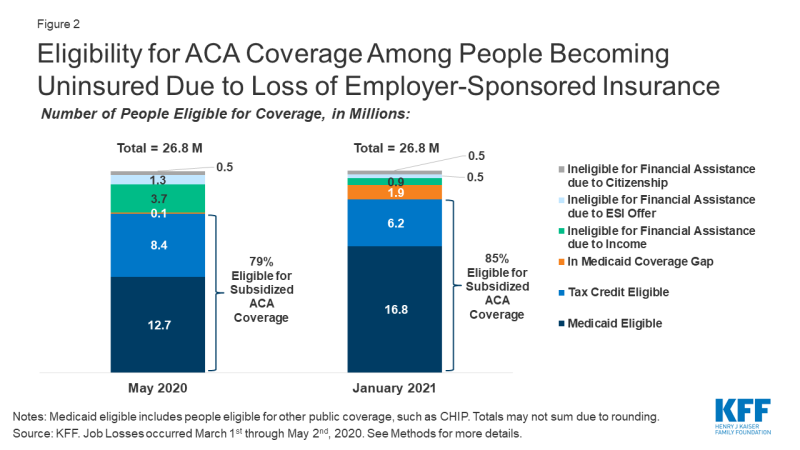
By January 2021, when UI benefits cease for most people, we estimate that eligibility shifts to nearly 17 million being eligible for Medicaid and about 6 million being eligible for marketplace subsidies (Figure 2), assuming those who are recently unemployed have not found work. Many unemployed workers who are eligible for ACA marketplace subsidies during 2020 would instead be eligible for Medicaid or fall into the coverage gap during 2021. The number in the coverage gap grows to 1.9 million (an increase of more than 80% of its previous size), and the number ineligible for coverage due to income shrinks to 0.9 million.

Estimates of coverage loss and eligibility vary by state, depending largely on underlying state employment by industry and Medicaid expansion status. Not surprisingly, states in which the largest number of people are estimated to lose ESI are large states with many people working in affected industries (Appendix Table 1). Eight states (California, Texas, Pennsylvania, New York, Georgia, Florida, Michigan, and Ohio) account for just under half (49%) of all people who lose ESI. Five of the top eight states have expanded Medicaid, and people eligible for Medicaid among the potentially newly uninsured as of May 2020 in these five states account for 40% of all people in that group nationally. Overall, patterns by state Medicaid expansion status show that people in expansion states are much more likely to be eligible for Medicaid, while those in non-expansion states are more likely to qualify for marketplace subsidies (Figure 3). However, the number of people qualifying for marketplace subsidies is similar across the two sets of states, as more people live in expansion states. Three states that have not expanded Medicaid, including Texas, Georgia, and Florida, account for 30% of people who become marketplace tax credit eligible nationally in May 2020. Assuming unemployment extends into 2021 when UI benefits would likely expire for most families, the proportion eligible for Medicaid would increase in expansion states while non-expansion states may see more nonelderly adults moving into the Medicaid coverage gap (Figure 4; Appendix Table 2).
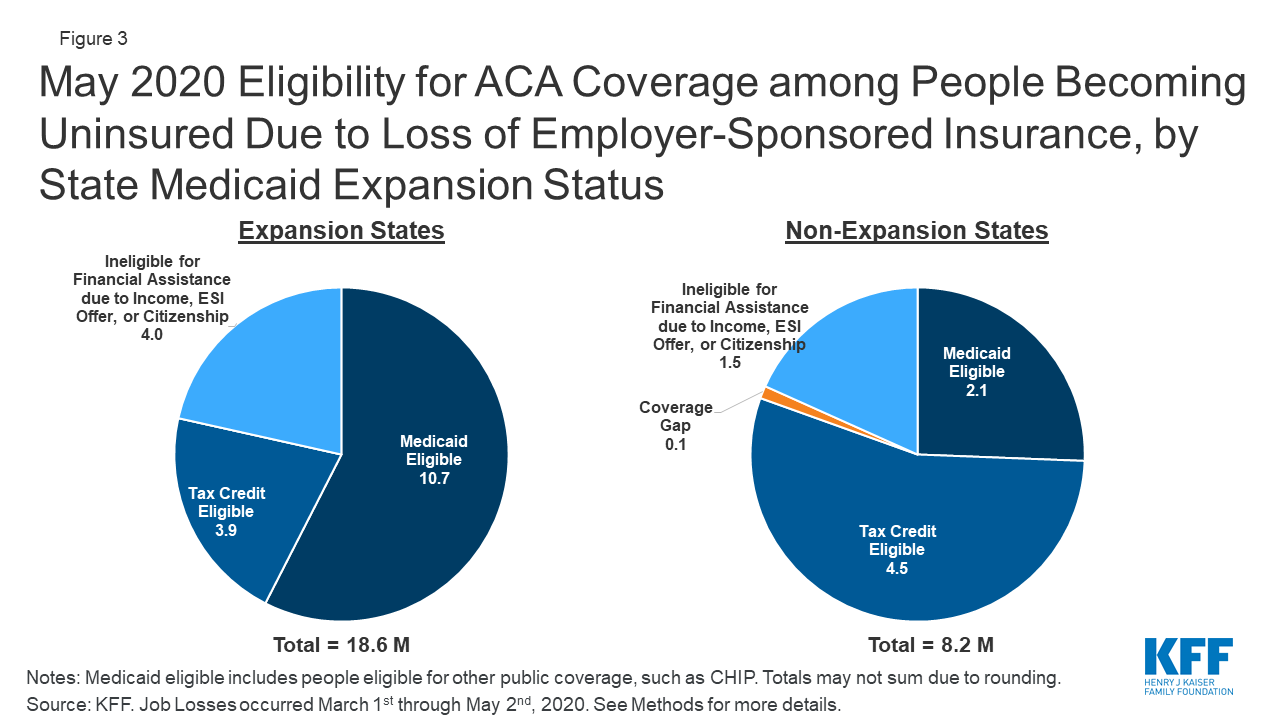
Figure 3: May 2020 Eligibility for ACA Coverage among People Becoming Uninsured Due to Loss of Employer-Sponsored Insurance, by State Medicaid Expansion Status
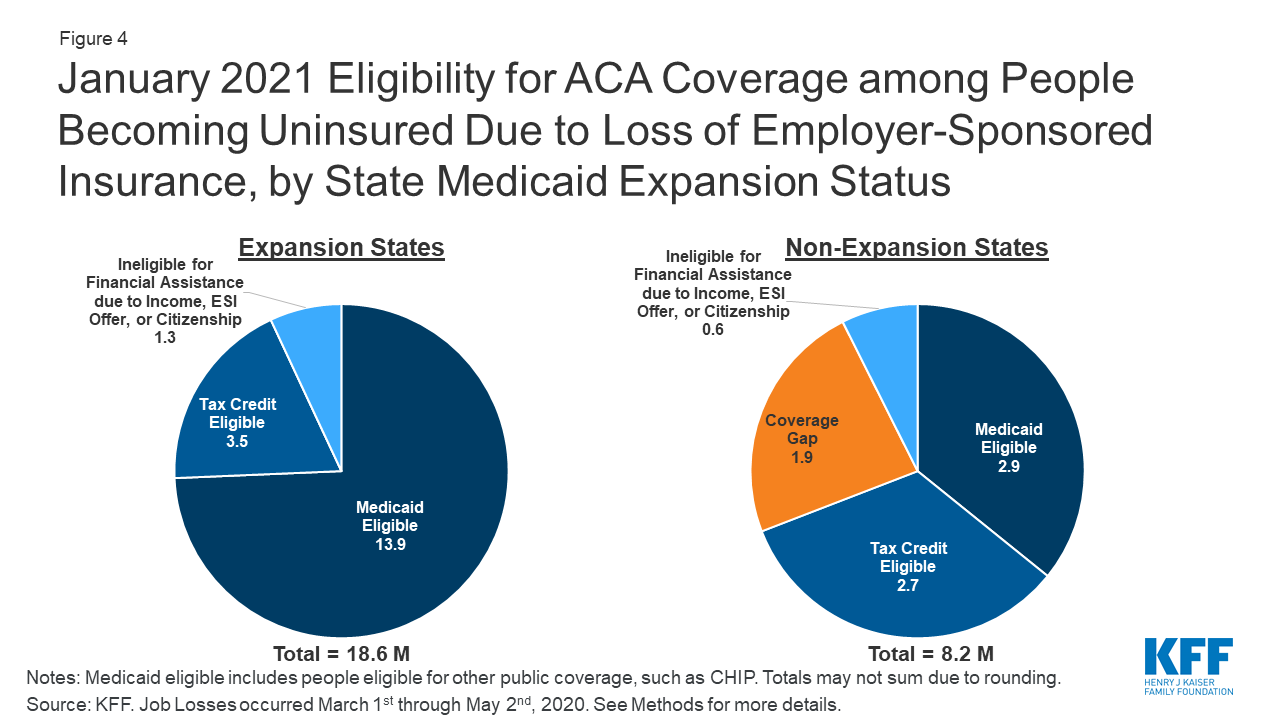
Figure 4: January 2021 Eligibility for ACA Coverage among People Becoming Uninsured Due to Loss of Employer-Sponsored Insurance, by State Medicaid Expansion Status

Nearly 7 million people losing ESI and becoming uninsured are children, and the vast majority of them are eligible for coverage through Medicaid or CHIP. Within the 26.8 million people losing ESI and becoming uninsured in May 2020, 6.1 million are children. Because Medicaid/CHIP income eligibility limits for children are generally higher than they are for adults, the vast majority of these children are eligible for Medicaid/CHIP in May 2020 (5.5 million, or 89%) or January 2021 (5.8 million, or 95%).

Discussion

Given the health risks facing all Americans right now, access to health coverage after loss of employment provides important protection against catastrophic health costs and facilitates access to needed care. Unemployment Insurance filings continue to climb each week, and it is likely that people will continue to lose employment and accompanying ESI for some time, though some of them will return to work as social distancing curbs are loosened. The ACA expanded coverage options available to people, and we estimate that the vast majority of people who lose ESI due to job loss will be eligible for ACA assistance either through Medicaid or subsidized marketplace coverage. However, some people will fall outside the reach of the ACA, particularly in January 2021 when UI benefits cease for many and some adults fall into the Medicaid coverage gap due to state decisions not to expand coverage under the ACA.

Both ACA marketplace subsidies and Medicaid are counter-cyclical programs, expanding during economic downturns as people’s incomes fall. In return for additional federal funding to help states finance their share of Medicaid cost during the public health crisis, states must maintain eligibility standards and procedures that were in effect on January 1, 2020 and must provide continuous eligibility through the end of the public health emergency, among other requirements. These provisions may help eligible individuals enroll in and maintain Medicaid, particularly in light of state and federal actions prior to the crisis to increase eligibility verification requirements or transition people off Medicaid.

Our estimates only examine eligibility among people who lost ESI due to job loss and potentially became uninsured. Additional uninsured individuals—including some of the 9% of the 78 million individuals in families where someone lost employment—may also be eligible for Medicaid or subsidized coverage. It is possible that contact with state UI systems may lead them to seek and enroll in coverage, even if they were eligible for financial assistance before job loss but uninsured.

It is unclear whether people losing ESI and becoming uninsured will enroll in new coverage. We did not estimate take-up or enrollment in coverage options but rather only looked at eligibility for coverage. Even before the coronavirus crisis, there were millions of people eligible for Medicaid or marketplace subsidies who were uninsured. Eligible people may not know about coverage options and may not seek coverage; others may apply for coverage but face challenges in navigating the application and enrollment process. Still others may find marketplace coverage, in particular, unaffordable even with subsidies. As policymakers consider additional efforts to aid people, expanding outreach and enrollment assistance, which have been reduced dramatically by the Trump Administration, could help people maintain coverage as they lose jobs.

This is the first economic downturn during which the ACA will be in place as a safety net for people losing their jobs and health insurance. The Trump Administration is arguing in case before the Supreme Court that the ACA should be overturned; a decision is expected by next Spring. The ACA has gaps, and for many the coverage may be unaffordable. However, without it, many more people would likely end up uninsured as the U.S. heads into a recession.


States face economic death spiral from Coronavirus

https://www.axios.com/coronavirus-states-economy-295ac091-9dc2-4852-be67-d070ec268d8c.html

YEAR-OVER-YEAR CHANGE IN STATE TAX REVENUES

April 2020 vs. April 2019, select states

States face economic death spiral from coronavirus - Business Insider


Early numbers show how significantly the coronavirus is devastating states’ revenue streams — and could force choices between raising taxes or gutting services and laying off public employees.

Why it matters: Even as some states move toward reopening, the economic ramifications of having shut down will haunt them far into the future.

  • When states can reopen, and how quickly industries are able to bounce back, could either worsen or improve projections.

What to watch: Sens. Bob Menendez (D-N.J.) and Bill Cassidy (R-La.) plan to introduce bipartisan legislation as soon as next week that would create a $500 billion fund designed to help struggling state and municipality budgets in the wake of COVID-19.

  • “If there was another way to do this, I’d rather do it the other way,” Cassidy tells Axios. “But what I don’t want to happen is all this money spent for families and for employers to go to waste because cities cannot provide essential services.”
  • Menendez tells Axios: “This is the time to step up to the plate.”

By the numbers: The Urban Institute has been compiling lost revenue data as states make it publicly available. So far, there are figures for about one in four states that compare this April’s state income and sales tax revenue collections against those from April 2019.

  • The data shows collections dropping between 20% and more than 50%, depending on the state, senior researcher Lucy Dadayan tells Axios — and those figures could get worse as new data comes in.
  • South Dakota is an outlier in the states the Urban Institute has tracked so far, in that revenues actually appear up for April. That may be largely because it is one of very few states that did not issue a stay at home order. But experts expect to see revenue declines next month.
  • Although it has not yet released April sales tax numbers to enable a year-over-year comparison, California’s staggering tax revenue loss due to COVID-19 has led to an expected $54.3 billion budget shortfall through FY 2021 — including a $13.4 billion shortfall this fiscal year, the governor announced Thursday. That’s with a $21 billion surplus last year.
  • New York also has yet to release April tax revenue data, but its latest budget projection has the state short as much as $13.3 billion in FY 2021, according to Dadayan’s analysis of most recent state budget projections. Illinois is looking at a more than $4.6 billion shortfall for next fiscal year.
  • Arizona is projecting to be short more than half a billion dollars for this fiscal year.
  • The projected shortfalls for FY 2020, which ends at the end of June for most states, is arguably a bigger problem because there isn’t much time left to make changes, per Axios’ Dan Primack.

The big picture: Democratic-leaning cities have seen the highest case and death rates. But red and blue states alike are facing serious budget shortfalls.

  • That’s why some Republican senators are getting behind efforts to provide federal dollars to help states balance budgets.
  • Even after accounting for state emergency savings accounts — which in many states were at an all-time high — 33 states will likely need to fill budget gaps of 5% or more, according to a recent analysis by Moody’s Analytics.
  • 21 states would need to fill gaps of 10% or more.
  • “Anybody is going to be overwhelmed by this — even states who were well prepared,” Dan White, director of government consulting and fiscal policy research at Moody’s Analytics, tells Axios.

Between the lines: Much of the burden will likely be pushed on struggling local governments’ plates, White said.

  • Cities have also lost smaller revenue sources such as hotel occupancy fees, inspection fees and construction fees.
  • Some could be forced to lay off public workers needed to combat the virus and keep the public safe — such as firefighters, paramedics, public hospital workers.
  • It’s either that or raise taxes in the midst of high unemployment and financial insecurity. “That’s the death spiral,” said Menendez, who has been talking with mayors across his state.
  • New York City Mayor Bill de Blasio has already said he may have to start furloughing municipal employees if the city doesn’t receive federal funds to help fill budget gaps.

Some state and local governments will wait to make tough budget decisions in the hopes that they get needed funds from Congress, which is in heated negotiations around the fourth stimulus package.

Republican lawmakers have been hesitant to provide this much federal help to states, but they’ve been warming to the idea.

  • Menendez says he expects several Republican senators besides Cassidy to sign on to their proposal.


Trump will urge Supreme Court to strike down Obamacare

https://www.politico.com/news/2020/05/06/trump-supreme-court-obamacare-240366?utm_source=The+Fiscal+Times&utm_campaign=f343554e9c-EMAIL_CAMPAIGN_2020_05_06_09_42&utm_medium=email&utm_term=0_714147a9cf-f343554e9c-390702969

Trump will urge Supreme Court to strike down Obamacare - YouTube

Attorney General Bill Barr had urged the White House to soften its attack on the law during the pandemic.

President Donald Trump on Wednesday said his administration will urge the Supreme Court to overturn Obamacare, maintaining its all-out legal assault on the health care law amid a pandemic that will drive millions of more Americans to depend on its coverage.

The administration appears to be doubling down on its legal strategy, even after Attorney General William Barr this week warned top Trump officials about the political ramifications of undermining the health care safety net during the coronavirus emergency.

Democrats two years ago took back the House of Representatives and statehouses across the country by promising to defend Obamacare, in particular its insurance protections that prevent sick people from being denied coverage or charged more because of a health condition. The issue may prove to be even more salient in November amid the Covid-19 outbreak that health experts believe will persist through the fall.

The Justice Department had a Wednesday deadline to change its position in a case brought by Republican-led states, but Trump told reporters Wednesday afternoon his administration would stand firm. DOJ declined to comment.

“Obamacare is a disaster, but we’ve made it barely acceptable,” Trump said.

The Supreme Court later this fall will hear a lawsuit from the GOP-led states that argue the Affordable Care Act was rendered invalid after Congress eliminated its tax penalty for not having health insurance. A coalition of Democratic state attorneys general and the Democratic-led House of Representatives are defending the law in court.

The Trump administration had previously shifted its legal position in this case, but appears to have decided against doing so again. DOJ originally argued the courts should throw out just Obamacare’s preexisting condition protections, before last year urging that the entire law be struck down.

The Supreme Court is expected to hear the case during its next term starting in October, but it hasn’t scheduled arguments yet. A decision is unlikely before the Nov. 3 election. The court has previously upheld Obamacare in two major challenges that threatened the law’s survival.

About 20 million people have been covered by Obamacare, and the law is expected to provide a major safety net during the economic freefall brought on by the coronavirus. Millions more are expected to join the Medicaid rolls, especially in states that joined Obamacare’s expansion to poor adults. Others who lost workplace health insurance can sign up on the law’s health insurance marketplaces, though the Trump administration isn’t doing much to advertise coverage options.

House Democrats in a filing to the Supreme Court on Wednesday said the pandemic showcased why justices should preserve the law.

“Although Congress may not have enacted the ACA with the specific purpose of combatting a pandemic, the nation’s current public-health emergency has made it impossible to deny that broad access to affordable health care is not just a life-or death matter for millions of Americans, but an indispensable precondition to the social intercourse on which our security, welfare, and liberty ultimately depend,” their brief read.

Obamacare has grown more popular since the GOP’s failed repeal bid during Trump’s first year in office, though the law is still broadly disliked by Republicans. Many Democrats are eager to again run on their defense of Obamacare this fall. That includes presumptive presidential nominee Joe Biden, who has advocated for building on the health care law rather than pursuing a comprehensive progressive overhaul like “Medicare for All.”

Top Trump officials have long been split on the legal strategy in the Obamacare lawsuit. Barr and Alex Azar, the Health and Human Services secretary, both opposed a broader attack on the law, but White House officials have been more supportive, seeing it as a chance to fulfill Trump’s pledge to repeal Obamacare. Barr, in a Monday meeting with Vice President Mike Pence and other White House officials, made an eleventh-hour plea for the administration to soften its legal stance ahead of the Supreme Court’s briefing deadline.


States cut Medicaid as millions of jobless workers look to safety net

https://www.politico.com/amp/news/2020/05/05/states-cut-medicaid-programs-239208?utm_source=The+Fiscal+Times&utm_campaign=f343554e9c-EMAIL_CAMPAIGN_2020_05_06_09_42&utm_medium=email&utm_term=0_714147a9cf-f343554e9c-390702969

Medicaid Cuts Could Hurt Seniors Most | Muskegon Tribune

Three states have cut back state spending on the program since the pandemic hit, and more are warning of painful cuts to benefits and services.

States facing sudden drops in tax revenue amid the pandemic are announcing deep cuts to their Medicaid programs just as millions of newly jobless Americans are surging onto the rolls.

And state officials are worried that they’ll have to slash benefits for patients and payments to health providers in the safety net insurance program for the poor unless they get more federal aid.

State Medicaid programs in the previous economic crisis cut everything from dental services to podiatry care — and reduced payments to hospitals and doctors in order to balance out spending on other needs like roads, schools and prisons. Medicaid officials warn the gutting could be far worse this time, because program enrollment has swelled in recent years largely because of Obamacare’s expansion.

The looming crisis facing Medicaid programs “is going to be the ’09 recession on steroids,” said Matt Salo, head of the National Association of Medicaid Directors. “It’s going to hit hard, and it’s going to hit fast.”

Medicaid programs, among the largest budget items in most states, provide health insurance to roughly 70 million poor adults, children, the disabled and pregnant women. The federal government on average pays roughly 60 percent of program costs, with poorer states receiving a higher share. States have the latitude to adjust benefits, payments to health care providers and eligibility requirements with oversight by the federal government.

Now, governors are turning to Congress for help as it weighs a new package to rescue state budgets battered by the pandemic. They’re asking lawmakers to provide a bigger boost to Medicaid payments and provide hundreds of billions of dollars in aid to shore up state budgets.

Medicaid naturally faces heightened demand as economic conditions worsen. But that leaves states facing more need at the same time that they have less money.

“The cruel nature of the economic downturn is that at a time when you need a social safety net is also the time when government revenues shrink,” Ohio Gov. Mike DeWine, a Republican, said Tuesday as he announced $210 million in cuts to his state’s Medicaid program in the next two months.

The vast majority of a $229 million spending cut made by Colorado Democratic Gov. Jared Polis last week came from Medicaid, though new federal funds will forestall an immediate reduction in benefits or payments to health providers. State legislative committee staff have warned Medicaid enrollment there could spike by 500,000 by the end of the year.

In Georgia, where Medicaid enrollment is projected to rise by as much as 567,000, Republican Gov. Brian Kemp and legislative leaders have instructed every state agency to prepare for 14 percent reductions across the board.

House Democrats are pushing to deliver a $1 trillion-plus package in aid to state and local governments and to support safety net programs, which could alleviate pressure on states to make deep cuts to health care during a pandemic. Some Republican lawmakers have questioned the need for more aid, after Congress has shoveled out trillions of dollars in rescue funding.

Congress already gave states a temporary 6 percent increase in the federal portion of Medicaid spending in an earlier coronavirus package. That prompted Alaska Gov. Mike Dunleavy, a Republican, to cut state Medicaid spending $31 million last month, saying the temporary federal boost would make up the difference.

State officials largely agreed the increase was helpful but said it likely will be washed out by an expected enrollment surge. The nation’s governors say Congress — in addition to providing at least $500 billion in direct support to states — must double the Medicaid funding boost to 12 percent as it did in the previous recession. At least one Republican senator facing a tough reelection fight, Cory Gardner of Colorado, said his state sorely needs extra Medicaid funding to avoid “harmful budget cuts.”

Anywhere from 11 million to 23 million more people could sign up for Medicaid over the next several months. The demand will be even greater in roughly three-quarters of states that expanded Medicaid enrollment to poor adults under the Affordable Care Act.

The portion of state budgets devoted to Medicaid spending has grown quickly since the previous recession, making it a riper target for cuts. Medicaid spending on average accounted for 15.7 percent of state budgets in fiscal 2009, a number that jumped to 19.7 percent in fiscal 2019.

Medicaid enrollment data in some states often lags, making it difficult to determine how much national sign-ups have climbed since jobless claims began surging two months ago. Some states have begun to report notable surges, however, and larger increases are expected in the coming months.

Arizona in the past two months saw 78,000 people enroll in Medicaid and the Children’s Health Insurance Program, which receives more generous funding from the federal government. Virginia has seen a 20 percent increase in enrollment applications since mid-March.

In New Mexico, where 42 percent of the population was already enrolled in Medicaid, sign-ups in the first two weeks of April surged by about 10,000 more people than were expected before the pandemic.

New Mexico’s top Medicaid official said the budget is a significant concern for a state heavily reliant on oil and natural gas. She worries a prolonged economic downturn could force the state to roll back pay increases to Medicaid providers enacted last year, and another planned pay raise for next year is almost certainly off the table.

States that accepted the temporary Medicaid payment increase from Congress are barred from cutting back enrollment while they’re receiving the enhanced funds. That leaves states with the option of cutting benefits or provider payments to find Medicaid savings, which could ignite fierce brawls in state capitals.

Michigan state Rep. Mary Whiteford, the Republican chairwoman of a health care appropriations panel, said the state’s Medicaid enrollment could increase from 2.4 million to 2.8 million by the end of the year.

“We are just planning for major cuts moving forward,” Whiteford said.

Before the pandemic, states had socked away $72 billion in rainy day funds — an all-time high, said Brian Sigritz of the National Association of State Budget Officers. But that figure was easily dwarfed by the $150 billion Congress provided to state and local governments in an earlier package, and it’s far short of what states are demanding.

“Now, we’re looking at greater declines than what we saw during the Great Recession and increased spending,” Sigritz said. “If there aren’t more federal funds, states will have to look at cutting funding for key services: public safety, education, health care. That’s where the money is.”


9 states seek $36B in federal advances for unemployment claims

https://www.politico.com/states/california/story/2020/05/05/9-states-seek-36b-in-federal-advances-for-unemployment-claims-1282530?utm_source=The+Fiscal+Times&utm_campaign=f343554e9c-EMAIL_CAMPAIGN_2020_05_06_09_42&utm_medium=email&utm_term=0_714147a9cf-f343554e9c-390702969

9 states seek $36B in federal advances for unemployment claims

Nine states have told the Department of Labor they plan to ask for $36 billion in federal advances to cover the astronomical cost of unemployment payouts amid the coronavirus pandemic, according to new information provided to POLITICO Tuesday night by federal officials.

Illinois, which had fiscal problems before the coronavirus, tops the list with an $11 billion request in May and June.

California, the first state to borrow, plans to seek the next-highest amount over the same two months: $8 billion.

Texas will ask for advances totaling $6.4 billion in May, June and July and New York will ask for $4.4 billion in the same three months.

Connecticut, Hawaii, Massachusetts, Ohio and West Virginia have also signaled an intent to borrow between May and July to fund their unemployment systems. Some of the states, like Illinois and California, only requested advances for May and June.

There is no approval process for the advances, a department spokesperson said. States notify the Departments of Labor and Treasury of their needs, the spokesperson said, and the Department of Labor certifies those amounts to the Treasury Department.

States are able to draw down advances as they need them, but won’t necessarily end up using the full amounts.

California took out its first $348 million unemployment insurance loan last week, slipping into the red just two years after repaying the $65 billion it borrowed from the federal government during and after the Great Recession. It was one of about three dozen states that took out federal loans to weather the last downturn, a scenario likely to repeat itself in the coming weeks and months as unemployment numbers soar nationwide.

The latest national figures last week showed that more than 30 million had filed jobless claims since mid-March.

California’s unemployment insurance system, funded by payroll taxes, was barely solvent before the pandemic blindsided the economy, with less of a cushion than any other state or territory except for the U.S. Virgin Islands, according to the Department of Labor’s Trust Fund Solvency Report.

Besides Hawaii, all of the states requesting advances also fell well below the department’s recommended solvency level.

Since mid-March, California Gov. Gavin Newsom said Monday, the state has issued $7.8 billion in unemployment relief, and more than 4.1 million people have filed claims — about 21 percent of the state’s pre-pandemic workforce.

Newsom stressed that the state was “good for our word,” but called for direct federal aid. “This pandemic is bigger than even the state of California,” he said. “The economic consequences of this pandemic are such that we can balance our budgets without substantial cuts, unless we get additional federal support.”

States won’t accrue interest on these federal loans through Dec. 31, under the federal Families First Coronavirus Response Act. But the last round of unemployment fund borrowing cost California $1.4 billion in interest payments, according to the state’s Department of Finance.


Cartoon – The Things Medical Science Can’t Explain

Cartoon – Limitations of Medical Science | HENRY KOTULA

Molina readies for ‘significant’ Medicaid member bump as more lose jobs

https://www.healthcaredive.com/news/molina-readies-for-significant-medicaid-member-bump-as-more-lose-jobs/577191/

Molina Healthcare's purchase of Medicaid managed care provider ...

Dive Brief:

  • Molina executives said it will likely experience a “significant” increase of Medicaid and exchange members as the pandemic continues to wash over the country and forces more out of work and job-based coverage, according to comments made during Friday’s first quarter earnings call.   
  • The company reaffirmed its 2020 earnings outlook with “enhanced confidence” given the “net-positive” effects likely to stem from the impact of novel coronavirus, as executives noted a steep decline in elective procedures and utilization very late in March and the limited impact COVID-19 has had on costs so far.
  • Overall for the first quarter, Molina beat Wall Street expectations on earnings per share and revenue which increased to $4.5 billion. Yet, it was only one of two managed care organizations to miss on medical loss ratio targets, which increased to 86.3% due to higher costs in its marketplace business. 

Dive Insight:

Another 3.8 million Americans filed for unemployment last week, bringing the total of out-of-work Americans to more than 30 million since the outbreak unfolded.

That presents an opportunity for insurers like Molina that are primarily positioned in Medicaid and Affordable Care Act exchange lines of business. Medicaid coverage is based on income and reserved for low-income Americans and the marketplace, or exchanges, tie coverage to income and financial help for those with incomes below a certain threshold.

Although its membership is likely to swell due to current economic conditions, Molina CEO Joe Zubretsky cautioned investors Friday by saying, “by how much we do not yet know.”

Zubretsky said Medicaid has proven it’s a stress-tested model that works in both robust economies and those in a recession.

So far, through April 27, 950 of Molina’s members have been hospitalized with COVID-19, a small fraction of Molina’s 3.4 million membership base. The average length of stay was about 10 days for these members, but they have not been able to assess the costs per episode yet, executives said Friday.

Its plans in Washington, California and Michigan were most affected. However, its Michigan plans have experienced the highest number of cases. 

By business line, Medicare members have experienced the highest percentage of COVID-19 diagnoses followed by Medicaid and marketplace members, in line with reports of the disease disproportionately affecting older Americans.

Molina also said it had entered into a definitive agreement to acquire Magellan Complete Care for $820 million in cash. The deal is expected to close in the first quarter of 2021. The deal gives Molina about 155,000 more members. Last year, Magellan generated more than $2.7 billion in revenue, according to Molina.

Magellan operates in six states, three of which would be new for Molina, including Arizona, Virginia and Massachusetts. 


COVID-19 cases are rising in rural America, and its hospitals may be unprepared

https://www.healthcaredive.com/news/covid-19-cases-are-rising-in-rural-america-and-its-hospitals-may-be-unprep/577161/

CMS announces Rural Health Strategy | SDAHO

Dive Brief:

  • Though metro and rural areas have had different infection rates since the outbreak began, the mortality rate from the virus is mostly the same in the U.S. But in recent weeks, the infection rate in rural counties has been outpacing urban counties, according to a new analysis of COVID-19 data by the Kaiser Family Foundation.
  • According to KFF, counties with large metro areas have had nearly three times as many coronavirus cases and deaths as rural counties (327.5 cases per 100,000 versus 114.9 per 100,000, even adjusting for population size). Metro counties have also experienced nearly four times as many deaths as of last Monday (17 per 100,000 versus 4.4 per 100,000).
  • Nevertheless, the COVID-19 mortality rate is 4.2% for metro populations, versus 3.8% for rural populations. And the county with the most deaths per capita is in a non-metro area. 

Dive Insight:

The divide between rural and urban America was highlighted during the first several weeks of the COVID-19 pandemic in the U.S., as major metropolitan areas were hit much harder than their rural counterparts, suggesting lower population density could spare rural America the brunt of the outbreak.

However, this week’s KFF analysis suggests COVID-19 is now spreading in rural America, whose older population and smaller, often sparsely equipped hospitals may be ill-prepared to bear up against the coronavirus. That rural hospitals have been in dire financial straits for years suggests that they may not be able to marshal the resources to properly respond if they become inundated with coronavirus patients.

A recent letter from the Medicaid and CHIP Payment and Access Commission to Health and Human Services Secretary Alex Azar also suggests that hospitals with a high proportion of Medicaid and low-income patients are not getting enough emergency federal funding in response to COVID-19, a trend that could also hurt some rural hospitals.

According to the KFF analysis, there was a 45% uptick in COVID-19 cases in non-metro counties over the past week, versus 26% in metro counties. Over two weeks, cases increased 125% in non-metro counties versus 68% among their urban counterparts. And deaths are up 169% over the past two weeks in non-metro counties, versus a 113% increase in metro counties.

Meanwhile, the easing of lockdowns in states with large rural areas foretells more problems in the near-term. “Georgia has started to reopen certain businesses and allow limited dine-in at restaurants, despite some of its counties rising toward the top of this list of U.S. metro and non-metro counties with the highest numbers of COVID-19 deaths per capita,” the KFF analysis observed.

The county with the most deaths per capita in the U.S. is Randolph County, with 278 deaths per 100,000 people. Randolph is a rural county in Georgia.


CMS rolls back more Medicare, telehealth regs for providers working through pandemic

https://www.healthcaredive.com/news/CMS-second-round-COVID-rollbacks/577199/


How Telemedicine Is Changing Healthcare

Dive Brief:

  • CMS issued a another round of sweeping regulatory rollbacks Thursday that will temporarily change how some providers care for patients and get compensated during the ongoing pandemic.
  • Practitioners such as therapists previously restricted from providing telehealth services for reimbursement can now do so, and CMS is also upping payments for telephone-only telehealth visits. Accountable care organizations also scored a major win in the Thursday rule drop, with CMS pledging they wouldn’t be dinged financially for lower-than-expected health outcomes in their patient populations from COVID-19.​
  • Other major changes are related to COVID-19 testing for Medicare and Medicaid beneficiaries. A written practitioner’s order is no longer needed for diagnostic testing for Medicare payment purposes. The agency also said it will cover serology, or antibody testing, including certain FDA-authorized tests that patients self-collect at home.

Dive Insight:

The new rules come out of the recent public health emergency declaration, building on others announced in late March and early April. This round of changes, which take effect immediately, focuses on expanding testing capacity to help reopen the U.S. economy, according to CMS, along with delivering expanded care to seniors.

Major provider lobbies the American Hospital Association and American Medical Association praised the changes, noting that Medicare patients have been canceling needed medical appointments because of physical distancing and transportation challenges.

The Trump administration, which allowed traditional Medicare to temporarily cover telehealth in March, continues to expand virtual care access. CMS is expanding the types of specialists allowed to provide telehealth services for reimbursement to include physical therapists, occupational therapists, speech language pathologists and others. In the past, only doctors, nurse practitioners, physician assistants and certain others could do so.

Earlier changes included waiving the video requirement for telehealth patients without access to interactive audio-video technology – particularly those in rural areas. CMS is increasing payments for telephone visits from a range of about $14-$41 to about $46-$110, according to the release.

The rollbacks are a “major victory for medicine that will enable physicians to care for their patients, especially their elderly patients with chronic conditions who may not have access to audio-visual technology or high-speed Internet,” the AMA said.

Michael Abrams, managing partner of Numerof & Associates, a healthcare consulting firm, said the current, rapid adoption of telehealth is an experiment, and depending on the results, waivers could eventually become permanent.

“Once you increase pricing, you almost never roll it back,” Abrams said. “If this new pricing on telehealth visits makes it more attractive, attractive enough to substitute telehealth for in-office visits, that not only lowers the cost of care, but makes it very much more accessible, particularly for those whose ability to see a physician is limited.”

In a victory for ACOs, CMS said the value-based organizations wouldn’t incur any financial penalties because of COVID-19 testing and treatment for their patient populations. Roughly 60% of ACOs said previously they were likely to drop out of their risk-based model to avoid potential losses, according to the National Association of ACOs.

CMS is also allowing ACOs to remain at the same level of risk for another year, instead of bumping them up to the next risk level. NAACOs said it was “appreciative” of the changes in a statement, though they asked for additional relief for providers in two-sided risk arrangements.

Other loosened restrictions include those on who can administer COVID-19 diagnostic tests for payment to include any healthcare professional authorized to do so under state law, including pharmacists. Medicare and Medicaid recipients can now get tested at parking lot sites operated by pharmacies and other entities for reimbursement.

Outpatient hospital services such as wound care, drug administration, and behavioral health services can now be delivered in temporary expansion locations, including parking lot tents, converted hotels or patients’ homes for reimbursement, so long as they’re temporarily designated as part of a hospital.

Hospital outpatient departments that relocate off-campus are paid at lower rates under current law, but CMS is making a temporary exception to continue paying those physicians at their standard rates.

The agency will also pay for certain partial hospitalization services – that is, individual psychotherapy, patient education, and group psychotherapy – that are delivered in temporary expansion locations, including patient homes.

CMS is also now requiring nursing homes to inform residents, their families, and representatives of COVID-19 outbreaks in their facilities.


Newly uninsured can turn to stable ACA market

https://www.axios.com/newsletters/axios-vitals-fb6b1c68-afc1-4b2b-9096-de20fd0b10a7.html?utm_source=newsletter&utm_medium=email&utm_campaign=newsletter_axiosvitals&stream=top

Stable costs but more uninsured as 'Obamacare' sign-ups open

People losing their employer-based health insurance in the coronavirus economy would find a pretty stable Affordable Care Act market if they need it — not that the Trump administration is advertising that fact, Bob writes.

Why it matters: ACA plans will be an important backstop for some newly uninsured people, many of whom could likely find affordable coverage on the law’s insurance marketplaces.

Where it stands: The average monthly premium for ACA coverage was down 3% in this year’s enrollment period, compared with 2019, according to a federal report that was released earlier this month but not publicly promoted.

  • That average monthly premium is $595, but the overwhelming majority of enrollees get a subsidy to help cover those costs — and people who have just lost a job could be eligible for those.
  • Some people “could get paid to buy ACA plans” right now because of looming insurance company rebates, according to Duke University health insurance researcher David Anderson.

Yes, but: You won’t hear much about those options from the Trump administration, which has been consistently hostile to the ACA and has declined to open up a special enrollment window that would let anyone who has been disrupted by the economic shutdown to buy coverage.