Henry Ford Health to furlough 2,800 workers

https://www.beckershospitalreview.com/finance/henry-ford-health-to-furlough-2-800-workers.html?utm_medium=email

Henry Ford furloughing 2,800 employees due to COVD-19 financial ...

Financial damage from the COVID-19 pandemic is forcing Detroit-based Henry Ford Health System to furlough 2,800 workers, the health system announced April 22. 

The six-hospital system decided to furlough employees who are not directly involved in patient care after recording a $43 million loss in operating income in March due to the cancellation of elective procedures, temporary site closures, and expenses related to personal protective equipment and other supplies needed to care for COVID-19 patients. The health system expects more significant losses in April and May.

“I know that news concerning furloughs is painful — especially for an organization like ours, whose greatest strength has always been our people,” Henry Ford President and CEO Wright Lassiter III wrote in an email to employees. “We value each team member’s unique contribution and this decision does not change that. But, we must face these realities head on.”

In addition to the furloughs, the health system’s executives and senior leaders will begin contributing 10 percent to 25 percent of their salaries to funds created to support employees.

Henry Ford Health reported a net operating loss of $36.2 million for the first three months of this year, compared to operating income of $39.4 million in the same period of 2019. 


Mayo Clinic furloughs, cuts hours of 30,000 employees to help offset $3B in pandemic losses

https://www.beckershospitalreview.com/finance/mayo-clinic-furloughs-cuts-hours-of-30-000-employees-to-help-offset-3b-in-pandemic-losses.html?utm_medium=email

Information for Orlando Residents - Orlando - Mayo Clinic

Rochester, Minn.-based Mayo Clinic said it will furlough or cut the hours of about 30,000 staff members to help offset about $3 billion in losses incurred by the COVID-19 pandemic, according to The Post Bulletin.

Mayo Clinic announced that it would need to take several cost cutting measures, including furloughs, earlier in April. However, the system didn’t disclose the number of employees that would be affected.

The temporary reduction in workforce is one of the ways the system is working to offset a $3 billion loss from the pandemic. Even with the cost-cutting measures, Mayo anticipates a $900 million shortfall this year.

The furloughs or reduced hours affect about 42 percent of Mayo Clinic’s 70,000 employees across its campuses in Arizona, Florida and Minnesota. 

Affected employees will still receive healthcare benefits.

The furloughs will begin in May and be spread throughout the rest of the year, Mayo Clinic spokesperson Ginger Plumbo told the publication. The duration of the furlough will vary depending on the hospital unit, she added.

The furloughs will not affect physicians at the system, but physicians will receive a 10 percent wage reduction. In addition, senior managers will receive pay cuts of 15 percent and top executives will take a 20 percent reduction.

The furloughs, cut hours and wage reductions are expected to save $1.4 billion.

Mayo Clinic also has been taking other cost-cutting measures, including a hiring freeze and halting major construction projects.

Mayo Clinic is also tapping into its reserves to bring $900 million in cash to the system.


Operating margins plummet at US hospitals, Kaufman Hall says

https://www.healthcaredive.com/news/Kaufman-hospitals-operating-margin-decline/576491/

Third Quarter Investment Report: Moving Into Choppy Waters « CPEA ...

Dive Brief:

  • Operating margins at the nation’s hospitals have plummeted due to large-scale volume and revenue declines coupled with flat to rising expenses, according to a new report from Kaufman Hall.
  • Based on March data from more than 800 U.S. hospitals, average operating margins dropped 150% year over year, plunging non-profit hospitals, which historically operate on already thin margins, into troublesome territory.
  • The data paint a dire picture for U.S. hospitals. “These initial numbers only reflect the first two weeks of the COVID-19 response and likely indicate more negative results in the future,” Jim Blake, managing director at Kaufman Hall, said in a statement.

Dive Insight:

Hospitals depend heavily on elective surgeries for revenue, but had to cancel or postpone many of them starting last month in order to preserve coveted COVID-19 resources such as personal protective equipment, beds and staff.

Those measures have upended the financial health of the entire industry in a matter of just weeks, according to new data and analysis from Kaufman Hall.

“We anticipate April will be significantly worse, and at this point, no one knows how long hospitals will continue on their current path,” Blake said.

Despite the ongoing pandemic, patient volumes overall have plunged. During March, the median hospital occupancy rate was 53%, with operating room minutes down 20% year-over-year and emergency room visits down 15% year over year, according to the report.

At the same time, hospitals’ labor expenses were up 3% year over year, and non-labor expenses were up 1%. In order to rein in operating costs, some health systems have begun to furlough or lay off workers.

While non-profit systems are especially vulnerable given their razor-thin margins, major for-profit systems are also struggling financially.

HCA Healthcare, Community Health Systems and Tenet Healthcare have all pulled their 2020 guidance in response to the pandemic. In its first quarter report Tuesday, HCA attributed a steep decrease in volumes and 45% drop in profit to the pandemic.

And Jefferies analyst wrote in a note Tuesday they are reducing their volume and earnings expectations for those companies for this year and 2021 based on the pandemic. “Our belief is that high unemployment translates to reduced commercial insurance coverage and disposable income to fund co-pays/deductibles, which results in fewer physician visits and procedures,” they wrote.

Under these circumstances, the federal government has attempted to financially support struggling hospitals through ongoing coronavirus relief legislation.

First came accelerated Medicare payments based on reimbursement data, in the form of loans that providers will have to pay back.

Separately, the Coronavirus Aid, Relief, and Economic Security Act passed by Congress in March benchmarked $100 billion in funding to provide financial support to struggling hospitals.

$30 billion first round was announced April 8 and given to providers based on historic Medicare payments. A second round of CARES act funding for systems in hot spots is next, although the timing is unclear.

On Tuesday the Senate approved a separate $484 billion aid package, the Paycheck Protection Program and Health Care Enhancement Act, that would send an additional $75 billion in emergency funds to hospitals. It also allocates $25 billion to expand testing for the virus across the country.

The White House expressed support for the package. It still needs House approval, which could happen as soon as this week.

The latest package comes in response to depleted funding for the Small Business Administration’s Paycheck Protection Program. Upon replenishing those funds, smaller health systems may be eligible for forgivable PPP loans used to meet payroll and other operating costs, but only if they have 500 or fewer employees.


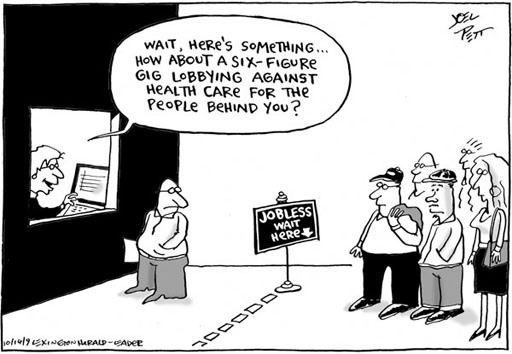
Cartoon – Job Opportunity

Political Cartoon: “Overheard In The Unemployment Line” by Joel ...

Beginning the long, winding journey back from coronavirus

https://mailchi.mp/39947afa50d2/the-weekly-gist-april-17-2020?e=d1e747d2d8

45cat - The Beatles - The Long And Winding Road / For You Blue ...

It was another brutal week in the coronavirus pandemic, with more than 2.1M cases and nearly 150,000 deaths worldwide. The US continued to be the hardest-hit country, reaching a daily record 4,591 deaths from COVID-19 on Thursday. The national death toll is now more than 35,000, though there are signs that the number of new cases in the US has begun to plateau, raising hopes that the worst days may be drawing to a close. Meanwhile, with strict stay-at-home measures continuing in most places across the country, the economic toll of the virus mounted. New unemployment claims rose by another 5.2M, bringing the estimated number of American jobs claimed by the virus to 22M, eliminating a decade’s worth of job growth, and raising the unemployment rate to an estimated 17 percent.

As the growth in new cases flattened, attention turned this week to plans to “reopen” the American economy. Despite insisting early in the week that he alone would decide when and how to reopen the country, President Trump yesterday unveiled a set of non-binding, “Opening Up America Again” guidelines for state and local officials to use in judging when to loosen restrictions. The guidelines suggest a three-stage, gated approach, gradually allowing individuals and employers to return to normal activities based on criteria including disease trends, hospital capacity, and the availability of robust testing. Progressing from one stage to the next is predicated on maintaining a downward trajectory in new cases—with any signs of a resurgence indicating a need to reimpose restrictions.

Missing from the White House plan are specific details about how states, cities, and healthcare providers are to procure and pay for the many millions of tests and extensive contact tracing that will need to be available to allow businesses, public transport systems, and other essential services to resume activity. By week’s end, about 3.5M coronavirus tests had been conducted nationally, but the daily number of tests conducted has plateaued, and the test-positivity rate is still troublingly high. Public health experts continue to warn that testing must ramp up significantly before any steps toward reopening can be considered, a difficult challenge given widespread reports of shortages of testing supplies and trained lab technicians. To bolster testing capacity, the Centers for Medicare and Medicaid Services (CMS) this week nearly doubled the amount it will pay laboratories to analyze tests using high-throughput equipment.

Three coalitions of states—in the Northeast, Midwest, and West Coast—were formed this week to coordinate regional efforts to reopen the economy. Among the issues they’ll need to address: interstate travel restrictions, coordinated purchasing of critical supplies, investments in contact tracing capabilities, and ongoing surveillance of the virus’ spread. With federal agencies taking a back seat to states (“You are going to call your own shots,” the President told governors on a call this week), it became clear that the road back from the coronavirus pandemic will be circuitous, with a patchwork of different timelines and approaches in different locations based on local conditions and resources.

In the words of William Gibson, “The future is here—it’s just not very evenly distributed.”


Whole Foods staff protest against conditions as coronavirus cases rise

https://www.theguardian.com/business/2020/apr/15/whole-food-protests-coronavirus-working-conditions-sickout

Coronavirus workplace conditions spur protests at Whole Foods, Amazon

Workers say too little is being done to enforce social distancing in stores, and some are not given masks or training on cleaning.

Whole Foods workers across the US are planning to hold another sickout protest on 1 May, as the number of confirmed cases of coronavirus infections at the supermarket chain continues to rise and workers charge the Amazon-owned company is doing too little to help them.

Workers complain too little is being done to enforce social distancing in stores; it is difficult, and sometimes impossible, to qualify for sick pay; and some are not given masks or training on cleaning. In the meantime, Whole Foods is reportedly recording record sales.

Dan Steinbrook, an employee at Whole Foods in Boston, said: “The bottom line is we don’t think Whole Foods or Amazon is doing nearly enough as they could be to protect both employees and customers at the store in terms of personal safety and public health.”

Steinbrook, who also participated in a sickout protest on 31 March organized by Whole Worker, a worker activism group said: “Grocery stores are one of the only places open to the public so they’ve become a significant public health concern in terms of stopping the spread of this disease. Any transmission we can stop at the grocery stores is extremely important for saving a lot of lives.”

Whole Foods workers have become increasingly concerned over the confirmed cases of coronavirus at Whole Foods stores. Employees have tested positive for coronavirus at Whole Foods locations across the country including West Orange, New JerseySudbury, MassachusettsBrookline, MassachusettsArlington, MassachusettsHingham, MassachusettsCambridge, MassachusettsSan Francisco, CaliforniaNew York City, New YorkFort Lauderdale, FloridaNew Orleans, Louisiana; and Allentown, Pennsylvania.

The Guardian spoke to several Whole Foods workers across the US about working conditions and the company’s policies. The workers requested to remain anonymous for fear of retaliation.

“I haven’t felt safe going into work because Whole Foods hasn’t really done anything to combat the amount of Amazon shoppers in the stores,” said a Whole Foods employee at Bowery Place in New York City, the center of the coronavirus pandemic in the US. “The store has been closing earlier, but they still want us to stay until 11pm to clean, and we aren’t trained to clean or given masks or anything.”

Whole Foods workers have noted some stores where a worker has tested positive for coronavirus have yet to be publicly reported in the media.

“Team members are being told there was a deep clean overnight and not to worry,” said a Whole Foods worker in West Bloomfield, Michigan. “I’m scared to work. I have three immune sensitive people living in my house and I don’t want to get them sick, but I can’t lose my only income.”

A worker at Whole Foods in Chapel Hill, North Carolina, said there have been two positive cases at their store. “It has been almost impossible to maintain basic social distancing practices. We’ve seen huge sales ever since the outbreak and it’s been all hands on deck. As of 1 April, there were no limits on the number of customers allowed in at a given time,” said the employee.

In Minnesota, a Whole Foods employee is currently on unpaid leave after experiencing coronavirus symptoms when their roommate was advised by their doctor to self-quarantine.

“When I talked to my HR department they told me I would need to take a two week leave as well, but unless I test positive for Covid-19, I do not qualify for the ‘guaranteed two weeks paid time off’ corporate is saying they are offering,” said the worker. “Everyone knows tests are limited and unavailable to most people unless they are showing severe symptoms, and as retail workers, many of us cannot afford to go to the doctor unless we’re in desperate need of medical attention.”

A Whole Foods employee in Massachusetts is also currently taking unpaid leave after experiencing coronavirus symptoms.

“I’m in a situation where I can’t get tested or afford a doctor. At first I was told I wouldn’t be eligible for sick pay without a positive test. Later I was told that I might qualify, that pay was being disbursed on a case by case basis. My case has been pending for over a week with no response and I ran out of paid time off,” said the worker.

“My parents lent me money, so I’ll be able to finish quarantine and still afford groceries. Money was tight before bills were due, and those fears kept me from reaching out to a doctor. My symptoms were mild, but I don’t know what I would have done if they got serious.”

A Whole Foods spokesperson told the Guardian: “The safety of our team members and customers is our top priority and we are diligently following all guidance from local health and food safety authorities. We’ve been working closely with our store Team Members, and are supporting the diagnosed Team Members, who are in quarantine.

“Out of an abundance of caution, each of these stores performed an additional deep cleaning and disinfection, on top of our current enhanced sanitation measures. As we prioritize the health and safety of our customers and Team Members, we will continue to do the following to help contain the spread of Covid-19.”


Cartoon – Unemployment Today

Social distancing in the unemployment line: Political Cartoons ...

Another 5.2 million jobless claims filed last week amid coronavirus crisis

https://www.axios.com/coronavirus-unemployment-filings-caded026-fce4-43cc-8dc0-5f0037747b69.html?stream=top&utm_source=alert&utm_medium=email&utm_campaign=alerts_all

Arrow

Another 5.2 million Americans filed for unemployment last week, the Labor Department announced Thursday.

Why it matters: With the more than 16 million jobless claims filed over the past three weeks, more jobs have now been lost in the last month than were gained since the Great Recession.

The big picture: The weekly unemployment filings report has become a must-watch for Wall Street and economists. It offers the timeliest glimpse into how efforts to contain the coronavirus outbreak are ravaging the job market.

  • And economists say that as bad as these weekly numbers look on the surface, they’re likely even higher. There are widespread complaints that state labor departments are having trouble processing the never-before-seen wave of jobless filings.

The bottom line: In just one month, the coronavirus economic shutdown has caused a staggering 22 million Americans to lose their jobs.


Newly uninsured can turn to stable ACA market

https://www.axios.com/newsletters/axios-vitals-fb6b1c68-afc1-4b2b-9096-de20fd0b10a7.html?utm_source=newsletter&utm_medium=email&utm_campaign=newsletter_axiosvitals&stream=top

Stable costs but more uninsured as 'Obamacare' sign-ups open

People losing their employer-based health insurance in the coronavirus economy would find a pretty stable Affordable Care Act market if they need it — not that the Trump administration is advertising that fact, Bob writes.

Why it matters: ACA plans will be an important backstop for some newly uninsured people, many of whom could likely find affordable coverage on the law’s insurance marketplaces.

Where it stands: The average monthly premium for ACA coverage was down 3% in this year’s enrollment period, compared with 2019, according to a federal report that was released earlier this month but not publicly promoted.

  • That average monthly premium is $595, but the overwhelming majority of enrollees get a subsidy to help cover those costs — and people who have just lost a job could be eligible for those.
  • Some people “could get paid to buy ACA plans” right now because of looming insurance company rebates, according to Duke University health insurance researcher David Anderson.

Yes, but: You won’t hear much about those options from the Trump administration, which has been consistently hostile to the ACA and has declined to open up a special enrollment window that would let anyone who has been disrupted by the economic shutdown to buy coverage.


We can’t just flip the switch on the coronavirus

https://www.axios.com/coronavirus-slow-recovery-econony-deaths-27e8d258-754e-4883-bebe-a2e95564e3b6.html

The end of the coronavirus lockdown won't be like flipping a ...

It feels like some big, terrible switch got flipped when the coronavirus upended our lives — so it’s natural to want to simply flip it back. But that is not how the return to normalcy will go.

The big picture: Even as the number of illnesses and deaths in the U.S. start to fall, and we start to think about leaving the house again, the way forward will likely be slow and uneven. This may feel like it all happened suddenly, but it won’t end that way.

What’s next: Nationally, the number of coronavirus deaths in the U.S. is projected to hit its peak within the next few days. But many big cities will see their own peaks significantly later — for them, the worst is yet to come.

  • The White House is eyeing May 1 as the time to begin gradually reopening the economy. But that also will not be a single nationwide undertaking, and it will be a halting process even in the places where it can start to happen soon.
  • “In principle it sounds very nice, and everyone wants to return to normalcy. I think in reality it has to be incredibly carefully managed,” said Claire Standley, an infectious-disease expert at Georgetown University.

The future will come in waves — waves of recovery, waves of more bad news, and waves of returning to some semblance of normal life.

  • “It’s going to be a gradual evolution back to something that approximates our normal lives,” former Food and Drug Administration Commissioner Scott Gottlieb said.

What the post-lockdown world will look like:

  • Some types of businesses will likely be able to open before others, and only at partial capacity.
  • Stores may continue to only allow a certain number of customers through the door at once, or restaurants may be able to reopen but with far fewer tables available at once.
  • Some workplaces will likely bring employees back into the office only a few days a week and will stagger shifts to segregate groups of workers from each other, so that one new infection won’t get the whole company sick.
  • Large gatherings may need to stay on ice.

And there will be more waves of infection, even in areas that have passed their peaks.

  • “Everything doesn’t just go down to zero” once a city or region gets through its initial crush of cases, said Janet Baseman, a professor of epidemiology at the University of Washington.
  • This is happening now in Singapore, which controlled its initial outbreak more effectively than almost any other country in the world but is now seeing the daily number of new cases climb back up.

This is all but inevitable in the U.S., too, especially as travel begins to pick back up. Some places may need to shut down again, or at least tighten back up, if these new flare-ups are bad enough.

  • Part of the reason to lock down schools, businesses and workplaces is to prevent an outbreak from overwhelming the local health care system. If new cases start to pile up too quickly, leaders may need to pump the brakes.
  • “If you go back to normal too fast, then cases start to go up quickly, and then we end up back where we started,” Baseman said.
  • The good news, though, is that hospitals should have far more supplies by the fall, thanks to the coming surge in manufacturing for items like masks and ventilators.

What we’re watching: We’ll still need a lot more diagnostic testing to make this process work. Public health officials need to be able to identify people who might be spreading the virus before they begin to feel sick, and then identify the people they may have infected.

  • Most of the U.S. does not seem prepared for that undertaking, at least on any significant scale.
  • Another kind of test — serology tests, which identify people who have already had the virus and may be immune to it — will also help. We can’t test everyone, but identifying potential immunity could be important in knowing who can safely return to work in high-risk fields like health care.

The real turning point won’t come until there’s a proven, widely available treatment or, even better, a widely available vaccine.

  • A vaccine is still about a year away, even at a breakneck pace and if everything goes right. A treatment isn’t likely to be available until the fall, at the earliest.
  • In the meantime, all we can do is try to manage a slow recovery, using a less aggressive version of the same tools that are in place today.

The bottom line: “I’m not going back to Disneyland, I’m not going to take a cruise again, until we have a very aggressive testing system or we have very effective therapeutics or a vaccine,” Gottlieb said.