Identifying “triple-threat” counties at higher risk of COVID outbreaks

https://mailchi.mp/9f24c0f1da9a/the-weekly-gist-june-5-2020?e=d1e747d2d8

“Superspreader facilities”—nursing homes, correctional facilities, and meatpacking plants—have become major COVID hotspots across the US. Many counties are dealing with a large outbreak in one type of tightly-packed facility or another.

Case in point: the outbreak at Cook County Jail in Chicago, which now accounts for a whopping 15.7 percent of all COVID cases in the state of Illinois. Some places, like Colorado’s Weld County, are managing outbreaks across all three types of superspreader facilities.

The graphic above highlights the nearly 260 counties that we’ve termed “triple-threat counties”: those which have all three types of superspreader facilities. The counties are mapped using our Gist Healthcare COVID-19 Risk Factor Index, which identifies particularly vulnerable populations using chronic disease, demographic, and acute care access variables.

The top 10 “triple-threat counties” by risk index score are all in more rural areas of the country with limited acute care access and more vulnerable populations—places where a COVID outbreak is likely to be particularly devastating. Seven of the 10 have a high percentage of African-American or Hispanic/Latino residents, groups with a an outsized burden of COVID-19 illness and death. These risk factors are intersectional; for example, food processing plants employ twice as many Hispanic workers as the national average, and a disproportionate share of long-term care workers are black.

[Click here for more information and interactive data from our analysis of the risk impact of these superspreader facilities.]


A Third of Unemployment Benefits Haven’t Been Paid Out: Report

https://www.thefiscaltimes.com/2020/06/02/Third-Unemployment-Benefits-Haven-t-Been-Paid-Out-Report

A Third of Unemployment Benefits Haven't Been Paid Out: Report

The U.S. Treasury paid out $146 billion in jobless benefits in the three months ending in May as tens of millions of Americans lost their jobs due to the coronavirus pandemic. Although the number is massive – larger than all of the unemployment benefits provided during the depths of the Great Recession in 2009 – it’s smaller than it should have been, according to a new analysis by Bloomberg News. Crunching the numbers on weekly unemployment filings and average claim size, Bloomberg found that total jobless benefits should have come to roughly $214 billion during that time.

“The estimated gap of some $67 billion shows how emergency efforts to boost payments, and deliver them via creaking state-level systems, are lagging the needs of a jobs crisis that’s seen more than 40 million people file for unemployment as the economy shut down,” Bloomberg’s Shawn Donnan and Catarina Saraiva wrote Tuesday.

A tough calculation: Although it’s hard to put a precise number on the shortfall – the Labor Department pushed back against the method used by Bloomberg to develop its estimate – there is general agreement that there are many people who still haven’t received the unemployment assistance they are entitled to. “There’s a lot more money that should have gone out that has not gone out,” said Jay Shambaugh, an economist at the Brookings Institution who has been studying the issue.

And Bloomberg says its analysis likely provides a conservative estimate of the shortfall. Some states are still working through backlogs of unemployment claims – Texas alone is waiting to verify nearly 650,000 cases – and more than 7 million people are still owed retroactive benefits under the Pandemic Unemployment Assistance program for independent contractors.

Why it matters: In addition to the unnecessary suffering the delays are causing, the shortfall is reducing the positive economic effect that unemployment benefits are intended to provide. “On paper the U.S. strategy is very generous,” Ernie Tedeschi, a former U.S. Treasury economist now at Evercore ISI, told Bloomberg. “But that generosity on paper is meaningless if it doesn’t translate into actual money in people’s pockets when they need it.”

Diane Swonk, chief economist at the accounting firm Grant Thornton, said she is worried that lawmakers are experiencing “fiscal fatigue” as the crisis wears on, risking a falloff in aid that could prolong the recession. “We’re really talking about an economy that is going to be operating at a fraction of its capacity for a long period of time,” she told Bloomberg.


The Value of Home Health Care

https://morningconsult.com/opinions/the-value-of-home-health-care/?utm_source=ActiveCampaign&utm_medium=email&utm_content=Does+the+US+Spend+Too+Much+on+Police%3F&utm_campaign=TFT+Newsletter+06042020

5 Truths About Home Health Care

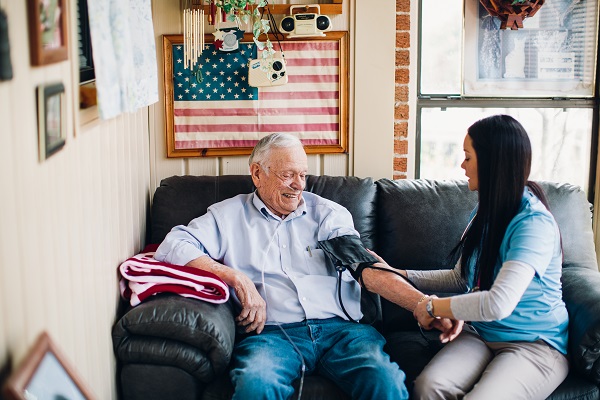
For the first time in our modern history, staying at home has become a “new” normal. And with more than 1.5 million Americans now infected with COVID-19, never before in our lifetime has accessing care in a person’s home been so important.

Smartly, our federal and state policymakers quickly expanded reimbursement for telehealth and removed barriers that have now allowed more providers to care for patients virtually via video and phone, eliminating the risk of COVID-19 exposure during provider visits. But not all care can be provided through telehealth – and we would be shortsighted to not also address the growing need for home-based care.

Long before the COVID-19 emergency, health care policy experts have increasingly recognized the value of home-based health care. A recent AARP survey found that three in four adults 50 years and older would prefer to age in their homes and communities. And a growing body of evidence suggests it is less expensive to deliver care in the home. Indeed, for years we’ve seen hospitalized patients more quickly returning to their homes and communities to heal and recover safely, reducing costs for themselves and the health care system.

Home-based care addresses some of the negative health effects of social isolation and loneliness, which drive poorer health outcomes that annually cost billions of excess health care dollars. According to one study, those experiencing loneliness and social isolation had a more than 60 percent higher risk of developing dementia and a fourfold increase in hospital readmission rates within a year of discharge.

Despite its demonstrated value, our country has yet to fully integrate the support needed for home-based care. Instead, we have a collage of different reimbursement frameworks across state, federal, and private payers.

Traditionally, Medicare has paid only for home caregivers in very limited circumstances. But we’re now seeing small and promising changes. The Medicare Advantage program, for example, now allows plans to offer non-medical care services in the home as supplemental benefits. These benefits can include day care services, in-home support services including meals and support for caregivers.

We have also seen a surge of technologies to enable home-based care. From those receiving home infusion therapies, to home dialysis, to remote patient monitoring, the private sector has stepped up to meet the needs of those wanting to or needing to receive care at home.

Now is the time to expand on these promising changes with a more comprehensive approach to paying for home-based care delivery. With more thoughtful integration of caregiving services and improved care coordination across care settings, including the home, such models can drive down health care costs for patients and the system overall.

Whether caring for those impacted by our current public health crisis, or those who are medically homebound, or those who simply choose to age in place, policymakers should think beyond essential medical services and consider the non-medical drivers of health that are often as essential to good health outcomes. For example, many individuals needing to stay at home are ill-equipped to carry out their own basic needs. Daily tasks — such as getting in and out of a chair or bed, moving about the house, shopping and preparing meals, taking medications properly, bathing and dressing, and cleaning and laundry — can be a struggle for the elderly and those with serious health conditions.

Fortunately, we have millions of home health nurses and caregivers working on the front lines to care for vulnerable adults who should safely remain in their homes during this pandemic and beyond.

These workers are the foot soldiers who perform tasks such as shopping, meal preparation and assisting with mobility and personal care. Well-trained caregivers and nurses, sensitive to the time and place where patients actually live, can more readily identify and address issues that can exacerbate a person’s chronic, complex illness that may not otherwise be visible in a single visit to a traditional health care setting.

As we face record unemployment, federal, state and local policymakers should consider how best to utilize this untapped resource both now and in the future. With the appropriate testing, training, and reimbursement, individuals can have a choice in where they age and receive care.

While keeping people safe and healthy in their homes has always been appealing, now it is imperative. For our most vulnerable individuals — the elderly and those with chronic health conditions – home-based care can save their lives.


CDC director: US needs up to 100,000 contact tracers by September to fight coronavirus

https://thehill.com/policy/healthcare/501157-cdc-director-us-needs-30-to-100-thousand-contact-tracers-by-september-to?utm_source=ActiveCampaign&utm_medium=email&utm_content=Does+the+US+Spend+Too+Much+on+Police%3F&utm_campaign=TFT+Newsletter+06042020

CDC director: US needs up to 100,000 contact tracers by September to fight coronavirus

Centers for Disease Control and Prevention (CDC) Director Robert Redfield told Congress on Thursday that the country needs between 30,000 and 100,000 people working on contact tracing in order to help contain the next wave of the coronavirus.

The estimate shows the daunting challenge of hiring an army of people to interview those infected with coronavirus to identify who they have been in contact with so that those people can quarantine and help prevent the spread of the virus.

“I’ve estimated between 30 and 100,000” contact tracers are needed,” Redfield told the House Appropriations Committee during a hearing Thursday. He acknowledged the figure is “sizable,” though it is actually less than the 300,000 people former CDC director Tom Frieden has estimated the U.S. will need.

He said it is crucial to get the contact tracing system in place by September to try to keep the virus in check ahead of an expected surge in the fall and winter. That could help prevent the type of blunt stay-at-home orders that the U.S. had to implement this spring after missing the window to contain the virus earlier this year.

“We really have to get this built and we have to get it built between now and September,” Redfield said.

Redfield said his agency has met with all 50 states to discuss hiring contact tracers and is pleased that some states have already started to do so. New York City, for example, has hired 1,700 contact tracers. 

He said the CDC Foundation is working to hire personnel to augment state efforts and the CDC has distributed funding to states provided by Congress for the purpose. He added he hopes AmeriCorps is a source of additional staff.

“It is fundamental that we have a fully operational contact tracing workforce that every single case, every single cluster, can do comprehensive contact tracing within 24 to 36 hours, 48 hours at the latest, get it completed, get it isolated, so that we can stay in containment mode as we get into the fall and winter of 2020,” he said.


ICUs become a ‘delirium factory’ for Covid-19 patients

https://www.cnn.com/2020/06/01/health/brain-coronavirus-delirium-kaiser/index.html

ICUs Become A 'Delirium Factory' For COVID-19 Patients | Health ...

Doctors are fighting not only to save lives from Covid-19, but also to protect patients’ brains.

Although Covid-19 is best known for damaging the lungs, it also increases the risk of life-threatening brain injuries — from mental confusion to hallucinations, seizures, coma, stroke and paralysis. The virus may invade the brain, and it can starve the brain of oxygen by damaging the lungs. To fight the infection, the immune system sometimes overreacts, battering the brain and other organs it normally protects.
Yet the pandemic has severely limited the ability of doctors and nurses to prevent and treat neurological complications. The severity of the disease and the heightened risk of infection have forced medical teams to abandon many of the practices that help them protect patients from delirium, a common side effect of mechanical ventilators and intensive care.
And while Covid-19 increases the risk of strokes, the pandemic has made it harder to diagnose them.
When doctors suspect a stroke, they usually order a brain MRI — a sophisticated type of scan. But many patients hospitalized with Covid-19 are too sick or unstable to be wheeled across the hospital to a scanner, said Dr. Kevin Sheth, a professor of neurology and neurosurgery at the Yale School of Medicine.
Many doctors also hesitate to request MRIs for fear that patients will contaminate the scanner and infect other patients and staff members.
“Our hands are much more tied right now than before the pandemic,” said Dr. Sherry Chou, an associate professor of critical care medicine, neurology and neurosurgery at the University of Pittsburgh School of Medicine.
In many cases, doctors can’t even examine patients’ reflexes and coordination because patients are so heavily sedated.
“We may not know if they’ve had a stroke,” Sheth said.
study from Wuhan, China — where the first Covid-19 cases were detected — found 36% of patients had neurological symptoms, including headaches, changes in consciousness, strokes and lack of muscle coordination.
“Our hands are much more tied right now than before the pandemic,” said Dr. Sherry Chou, an associate professor of critical care medicine, neurology and neurosurgery at the University of Pittsburgh School of Medicine.
In many cases, doctors can’t even examine patients’ reflexes and coordination because patients are so heavily sedated.
“We may not know if they’ve had a stroke,” Sheth said.
smaller, French study observed such symptoms in 84% of patients, many of which persisted after people left the hospital.
Some hospitals are trying to get around these problems by using new technology to monitor and image the brain.
New York’s Northwell Health is using a mobile MRI machine for Covid patients, said Dr. Richard Temes, the health system’s director of neurocritical care. The scanner uses a low-field magnet, so it can be wheeled into hospital rooms and take pictures of the brain while patients are in bed.
Staffers at Northwell were also concerned about the infection risk from performing EEGs, tests that measure the brain’s electrical activity and help diagnose seizures, Temes said. Typically, technicians spend 30 to 40 minutes in close contact with patients in order to place electrodes around their skulls.
“Right now, we actually don’t know enough to say definitely how Covid-19 affects the brain and nervous system,” said Chou, who is leading an international study of neurological effects of the virus. “Until we can answer some of the most fundamental questions, it would be too early to speculate on treatments.”
To reduce the risk of infection, Northwell is using a headband covered in electrodes, which can be placed on patients in just a couple of minutes, he said.

The brain under attack

Answering those questions is complicated by the limited data from patient autopsies, said Lena Al-Harthi, a professor and the chair of the microbial pathogens and immunity department at Rush Medical College in Chicago.
But many neuropathologists are unwilling or unable to perform brain autopsies, Al-Harthi said.
That’s because performing autopsies on patients who died of Covid-19 carries special risks, such as the aerosolization of the virus during brain removal. Pathologists need specialized facilities and equipment to conduct an autopsy safely.
Some of the best-known symptoms of Covid-19 might be caused by the virus invading the brain, said Dr. Robert Stevens, an associate professor of anesthesiology and critical care medicine at Johns Hopkins University.
Authors of a recent study from Germany found the novel coronavirus in patients’ brains.
Research shows that the coronavirus may enter a cell through a molecular gateway known as the ACE-2 receptor. These receptors are found not only in the lung, but also other organs, including many parts of the brain.
In a recent study, Japanese researchers reported finding the novel coronavirus in the cerebrospinal fluid that surrounds the brain and spinal cord.
Some of the most surprising symptoms of Covid-19 ― the loss of the senses of smell and taste ― remain incompletely understood, but may be related to the brain, Stevens said.
A study from Europe published in May found that 87% of patients with mild or moderate Covid-19 lost their sense of smell. Patients’ loss of smell couldn’t be explained by inflammation or nasal congestion, the researchers said. Stevens said it’s possible that the coronavirus interacts with nerve pathways from the nose to the brain, potentially affecting systems involved with processing scent.
new study in JAMA provides additional evidence that the coronavirus invades the brain. Italian researchers found abnormalities in an MRI of the brain of a Covid-19 patient who lost her sense of smell.
Many coronavirus patients also develop “silent hypoxia,” in which they are unaware that their oxygen levels have plummeted dangerously low, Stevens added.
When hypoxia occurs, regulatory centers in the brain stem — which control respiration — signal to the diaphragm and the muscles of the chest wall to work harder and faster to get more oxygen into the body and force out more carbon dioxide, Stevens said. The lack of this response in some patients with Covid-19 could indicate the brain stem is impaired.
Scientists suspect the virus is infecting the brain stem, preventing it from sending these signals, Temes said.

Collateral damage

Well-intentioned efforts to save lives can also cause serious complications.
Many doctors put patients who are on mechanical ventilators into a deep sleep to prevent them from pulling out their breathing tubes, which would kill them, said Dr. Pratik Pandharipande, chief of anesthesiology and critical care medicine at Vanderbilt University School of Medicine in Nashville, Tennessee.
Both the disease itself and the use of sedatives can cause hallucinations, delirium and memory problems, said Dr. Jaspal Singh, a pulmonologist and critical care specialist at Atrium Health in Charlotte, North Carolina.
Many sedated patients experience terrifying hallucinations, which may return in recovery as nightmares and post-traumatic stress disorder.
Research shows 70% to 75% of patients on ventilators traditionally develop delirium. Delirious patients often “don’t realize they’re in the hospital,” Singh said. “They don’t recognize their family.”
In the French study in the New England Journal of Medicine, one-third of discharged Covid-19 patients suffered from “dysexecutive syndrome,” characterized by inattention, disorientation or poorly organized movements in response to commands.
Research shows that patients who develop delirium — which can be an early sign of brain injury — are more likely to die than others. Those who survive often endure lengthy hospitalizations and are more likely to develop a long-term disability.
Under normal circumstances, hospitals would invite family members into the ICU to reassure patients and keep them grounded, said Dr. Carla Sevin, director of the ICU Recovery Center, also at Vanderbilt.
Simply allowing a family member to hold a patient’s hand can help, according to Dr. Lee Fleisher, chair of an American Society of Anesthesiologists committee on brain health. Nurses normally spend considerable time each day orienting patients by talking to them, reminding them where they are and why they’re in the hospital.
“You can decrease the need for some of these drugs just by talking to patients and providing light touch and comfort,” Fleisher said.
These and certain innovative practices — such as helping patients to move around and get off a ventilator as soon as possible — can reduce the rate of delirium to 50%.
Hospitals have banned visitors, however, to avoid spreading the virus. That leaves Covid-19 patients to suffer alone, even though it’s well known that isolation increases the risk of delirium, Fleisher said.
Although many hospitals offer patients tablets or smartphones to allow them to videoconference with family, these devices provide limited comfort and companionship.
Doctors are also positioning patients with Covid-19 on their stomachs, rather than their backs, because a prone position seems to help clear the lungs and let patients breathe more comfortably.
But a prone position also can be uncomfortable, so that patients need more medication, Pandharipande said.
All of these factors make coronavirus patients extremely vulnerable to delirium. In a recent article in Critical Care, researchers said the intensive care unit has become a “delirium factory.”
“The way we’re having to care for patients right now is probably contributing to more mortality and bad outcomes than the virus itself,” said Dr. Sharon Inouye, a geriatrician at Harvard Medical School and Hebrew SeniorLife, a long-term care facility in Boston. “A lot of the things we’d like to do are just very difficult.”

Americans’ deepening financial stress will make the coronavirus a lot harder to contain

https://theconversation.com/americans-deepening-financial-stress-will-make-the-coronavirus-a-lot-harder-to-contain-139741

Americans' deepening financial stress will make the coronavirus a ...

Preventing deaths from COVID-19 depends on people who get it seeking treatment – which also allows authorities to track down whom they came in contact with to reduce spread.

But, as the economic pain and joblessness caused by the statewide lockdowns continue to grow, more Americans are experiencing severe strains on their personal finances. This threatens our ability to contain the pandemic because those feeling the most financial stress are much less likely to seek medical care if they experience coronavirus symptoms, according to my analysis of a recent Federal Reserve survey.

As an economist who studies how individuals make health care choices, I worry that in the coming months even more people will consider forgoing vital treatment to pay rent or some other bill – especially as the extended unemployment benefits, rent moratoriums and other relief are set to expire soon.

‘Just getting by’

The Fed conducts a survey of the economic health of U.S. households every quarter, most recently near the end of 2019. In April, it conducted a supplementary but similar survey to quickly gauge how people were handling the coronavirus crisis. Results of both surveys were released on May 14.

The Fed tries to measure financial stress in three key ways. Its surveys ask respondents if they are unable to pay all their monthly bills, couldn’t cover a US$400 emergency expense, or are “just getting by” or worse.

Even before the pandemic hit, the picture wasn’t pretty. In October, when the fourth-quarter survey was conducted, 42% of employed respondents reported fitting at least one of these descriptions, while over 8% said they fit all three. Those figures jumped to 72% and 20% for low-income workers.

But by April, tens of millions of people who had jobs in October lost them as most nonessential businesses across the U.S. either closed or reduced their services. The unemployment rate shot up to 14.7% that month – the highest since the Great Depression – and is expected to climb further when the May data are released on June 5.

The Fed’s April survey, however, paints an even broader picture of the economic impact of the pandemic. In that survey, about 28% of the previously employed respondents said they either lost their job, were being furloughed, had their hours cut or were taking unpaid leave. This has been financially devastating to many, with 68% of this group reporting one of the stresses listed above and 28% saying they were experiencing all three, regardless of income level.

Forgoing medical care

Separate questions in the surveys demonstrate just how strong the link is between financial and physical health.

The October survey also asks those respondents if they had skipped a doctor’s visit during the previous 12 months because of the cost. More than 20% of those who reported one of these financial stresses said they had, while almost 46% of those with all three said so.

In April, the Fed asked a more timely question: “If you got sick with symptoms of the coronavirus, would you try to contact a doctor?”

A third of those respondents who also said they’re experiencing all three financial stresses said “no.” This is especially significant because, unlike the October question, it describes a current, known threat, rather than referring to a previous medical issue of unknown severity. And the widely reported urgency and seriousness of the coronavirus suggests someone wouldn’t treat the decision to seek a doctor’s care or advice lightly.

Relieving the stress

That was back in April, less than a month into the coronavirus lockdowns. If the same questions were asked today, I believe the numbers would look a lot worse.

In the middle of a serious pandemic, we don’t want sick people avoiding treatment because they’re worried they won’t be able to put food on the table. This would likely worsen the spread of the coronavirus and make it a whole lot harder to contain.

As Congress debates additional measures to mitigate the economic and financial effects of the pandemic, it would be wise to keep in mind the connection between financial stress and individual decisions to seek medical care.


Nearly 30,000 nursing home residents died during coronavirus pandemic, government report shows

https://www.washingtonpost.com/business/2020/06/01/coronavirus-nursing-home-deaths/?pwapi_token=eyJ0eXAiOiJKV1QiLCJhbGciOiJIUzI1NiJ9.eyJjb29raWVuYW1lIjoid3BfY3J0aWQiLCJpc3MiOiJDYXJ0YSIsImNvb2tpZXZhbHVlIjoiNWI2M2EzNDJhZGU0ZTI3Nzk1NTBjYTFiIiwidGFnIjoid3BfbmV3c19hbGVydF9yZXZlcmUiLCJ1cmwiOiJodHRwczovL3d3dy53YXNoaW5ndG9ucG9zdC5jb20vYnVzaW5lc3MvMjAyMC8wNi8wMS9jb3JvbmF2aXJ1cy1udXJzaW5nLWhvbWUtZGVhdGhzLz93cG1rPTEmd3Bpc3JjPWFsX25ld3NfX2FsZXJ0LWhzZS0tYWxlcnQtbmF0aW9uYWwmdXRtX3NvdXJjZT1hbGVydCZ1dG1fbWVkaXVtPWVtYWlsJnV0bV9jYW1wYWlnbj13cF9uZXdzX2FsZXJ0X3JldmVyZSJ9.y8RVJLZebL0pp382hoWXZKNybZzPCGaPXQJE5N60CqU&utm_campaign=wp_news_alert_revere&utm_medium=email&utm_source=alert&wpisrc=al_news__alert-hse–alert-national&wpmk=1

Coronavirus Claims at Least 6,900 Nursing Home Deaths in U.S. ...

About one in five homes reported a death but about 20 percent of nursing homes have not yet reported case counts.

At least 26,000 residents died and more than 60,000 were sickened as the novel coronavirus continued its unrelenting assault on America’s nursing homes, sweeping through facilities in every corner of the country.

The numbers, released late Monday, represent the first official national accounting of fatalities in the 15,000 nursing homes certified by the Centers for Medicare and Medicaid Services.

The tally, however, is incomplete. About 20 percent of the nation’s nursing homes did not report data to the federal government. The Centers for Medicare and Medicaid Services on Monday said early analysis shows homes with a history of infection-control and other health deficiencies were more likely to have covid-19 outbreaks.

Early analysis shows that facilities with a one-star quality rating were more likely to have large numbers of COVID-19 cases than facilities with a five-star quality rating. CMS will take enforcement action against the nursing homes that have not reported data into the CDC as required under CMS participation requirements.


The Essence of Big Pharma


Few U.S. adults say they’ve been diagnosed with coronavirus, but more than a quarter know someone who has

https://www.pewresearch.org/fact-tank/2020/05/26/few-u-s-adults-say-theyve-been-diagnosed-with-coronavirus-but-more-than-a-quarter-know-someone-who-has/?utm_source=Pew+Research+Center&utm_campaign=ef5ba73bf3-EMAIL_CAMPAIGN_2020_05_29_05_11&utm_medium=email&utm_term=0_3e953b9b70-ef5ba73bf3-400197657

28% of U.S. adults say they know someone diagnosed with COVID-19 ...

Relatively few Americans say they have been diagnosed with COVID-19 or tested positive for coronavirus antibodies, but many more believe they may have been infected or say they personally know someone who has been diagnosed.

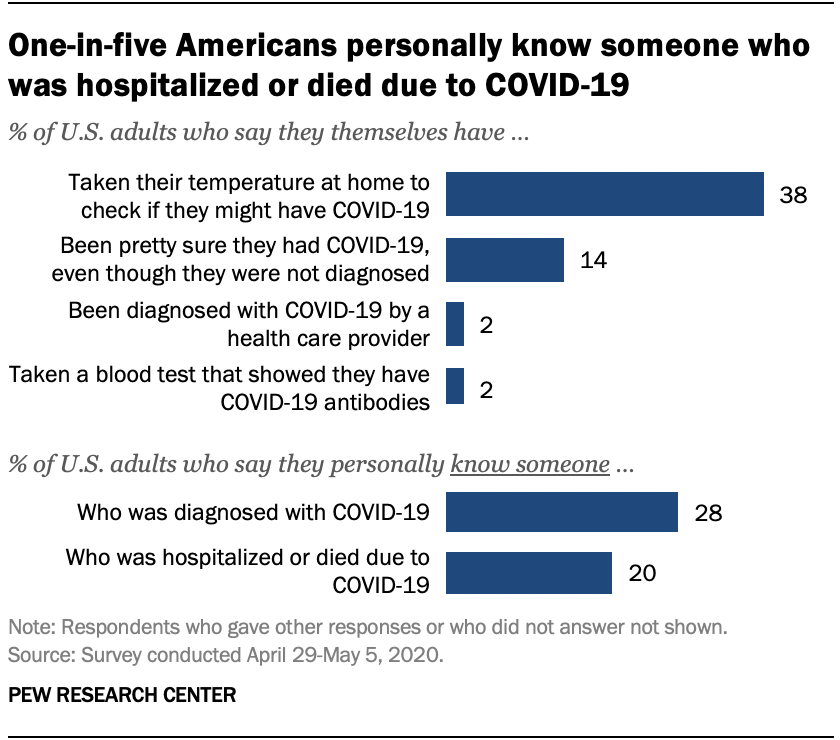
Only 2% of U.S. adults say they have been officially diagnosed with COVID-19 by a health care provider, according to a new Pew Research Center survey. And 2% say they have taken a blood test that showed they have COVID-19 antibodies, an indication that they previously had the coronavirus. But many more Americans (14%) say they are “pretty sure” they had COVID-19, despite not getting an official diagnosis. And nearly four-in-ten (38%) say they’ve taken their temperature to check if they might have the disease.

Although few Americans have been diagnosed with COVID-19 themselves, many more say they know someone with a positive diagnosis. More than one-in-four U.S. adults (28%) say they personally know someone who has been diagnosed by a health care provider as having COVID-19. A smaller share of Americans (20%) say they know someone who has been hospitalized or who has died as a result of having the coronavirus.

Some groups are more likely than others to report personal experiences with COVID-19. For instance, black adults are the most likely to personally know someone who has been hospitalized or died as a result of the disease. One-third of black Americans (34%) know someone who has been hospitalized or died, compared with 19% of Hispanics and 18% of white adults. Black Americans (32%) are also slightly more likely than Hispanic adults (26%) to know someone diagnosed with COVID-19. Public health studies have found black Americans are disproportionately dying or requiring hospitalization as a result of the coronavirus.

28% of U.S. adults say they know someone diagnosed with COVID-19 ...

Areas in the northeastern United States have recorded some of the highest rates of coronavirus cases and fatalities, and this is reflected in the Center’s survey. About four-in-ten adults living in the Northeast (42%) say they personally know someone diagnosed with COVID-19, significantly more than among adults living in any other region. People living in the Northeast (31%) are also the most likely to know someone who has been hospitalized or died as a result of the disease.

One aspect of personal risk for exposure to the coronavirus is whether someone is employed in a setting where they must have frequent contact with other people, such as at a grocery store, hospital or construction site. Given the potential for the spread of the coronavirus within households, risk to individuals is also higher if other members of the household are employed in similar settings. Among people who are currently employed full-time, 35% are working in a job with frequent public contact. Among those working part-time, almost half work (48%) in such a setting. For those living in a household with other adults, 35% report that at least one of those individuals is working in a job that requires frequent contact with other people.

Taken together, nearly four-in-ten Americans (38%) have this type of exposure – either currently working in a job that requires contact with others, living in a household with others whose jobs require contact, or both.

Hispanics (at 48%) are more likely than either blacks (38%) or whites (35%) to have this type of personal or household exposure. An earlier Center analysis of government data found Hispanic adults were slightly more likely to work in service-sector jobs that require customer interaction, and that are at higher risk of layoffs as a result of the virus. In fact, the current Center survey found Hispanics were among the most likely to have experienced pay cuts or job losses due to the coronavirus outbreak.

28% of U.S. adults say they know someone diagnosed with COVID-19 ...

Interpersonal exposure in the workplace is also more widespread among younger adults. And there is a 10 percentage point difference between upper- and lower-income Americans in exposure, with lower-income adults more likely to work in situations where they have to interact with the public, or to live with people who do.

Health experts warn that COVID-19 is particularly dangerous to people who have underlying medical conditions. In the survey, one-third of adults say they have such a condition. Among this group, nearly six-in-ten (58%) say that the coronavirus outbreak is a major threat to their personal health. Among those who do not report having an underlying medical condition, just 28% see the outbreak as a major threat to their health. Americans who have an underlying health condition are also more likely than those who do not to say they’ve taken their temperature to check if they might have COVID-19 (47% vs. 33% of those without a health condition).

Self-reports of an underlying health condition vary greatly by age. Among those ages 18 to 29, just 16% say they have a condition; this rises steadily with age to 56% among those 65 and older. Whites are a little more likely than blacks and Hispanics to report having a health condition, but both blacks (at 54%) and Hispanics (52%) are far more likely than whites (32%) to say that the coronavirus outbreak is “a major threat” to their health.


U.S. adults still afraid to go to a hospital over Covid-19 fears

http://secondscount.org/heart-resources/covid-19-facts?utm_source=STAT+Newsletters&utm_campaign=3d6599c5c4-MR_COPY_01&utm_medium=email&utm_term=0_8cab1d7961-3d6599c5c4-149578673#.XtKpcDpKgdX

Fear Can Spread From Person to Person Faster Than the Coronavirus ...

Seconds Count Survey Highlights
New research shows fear of COVID-19 is stopping people from seeking care during medical emergencies, like heart attacks or strokes.

  • As States start to re-open, more than one-third of Americans (36 percent) consider going to the hospital to be one of the riskiest behaviors to take part in compared to going to a hair salon (27 percent) or going to the beach (16 percent)
  • 61 percent of respondents think they are either somewhat likely or very likely to acquire COVID-19 in a hospital
  • Half of respondents are more afraid of contracting COVID-19 than experiencing a heart attack or stroke
  • Nearly 60 percent of respondents are more afraid of a family member or loved one contracting COVID-19 than experiencing a heart attack or stroke
  • When asked which are you more afraid of, contracting COVID-19, experiencing a heart attack or experiencing a stroke – twice as many people over the age of 60 are more afraid of contracting COVID-19 (52 percent) than they are of experiencing a heart attack (23 percent) or stroke (25 percent)