Protests essential despite risk of coronavirus spread, healthcare workers say

https://www.beckershospitalreview.com/public-health/protests-essential-despite-risk-of-coronavirus-spread-healthcare-workers-say.html?utm_medium=email

After months of pleading for social distancing, health officials ...

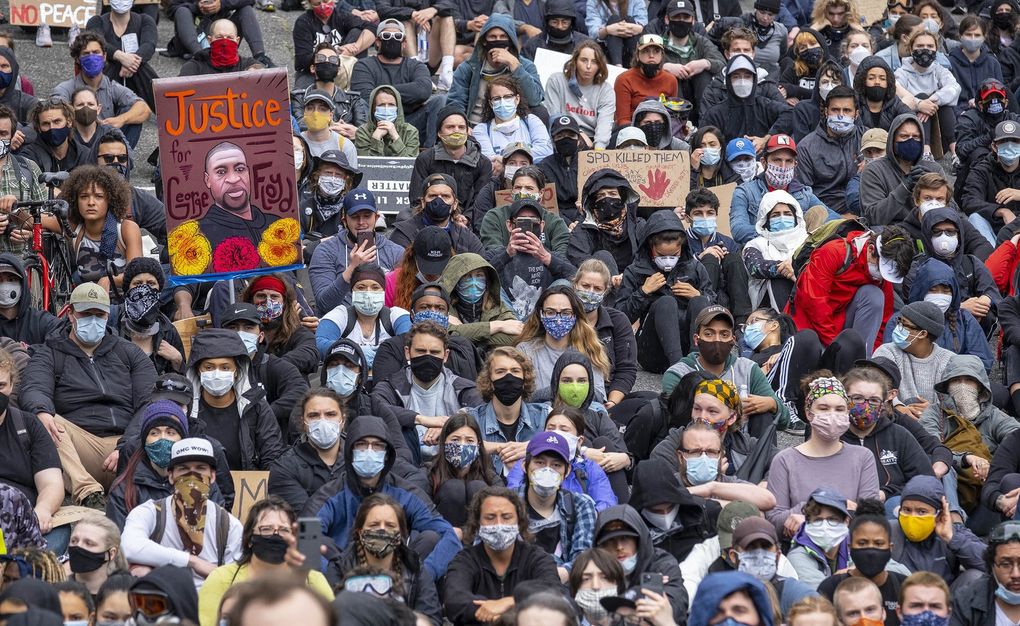
Though the protests that erupted after a black man died in police custody might result in spikes of COVID-19, some healthcare workers say that they are important, as racial disparities in healthcare is also a public health issue, according to The Wall Street Journal.

Public health experts and healthcare workers across the country are joining in the protests that began after George Floyd died at the hand of police in Minneapolis in late May. He is the most recent example of police brutality against black people and joins a long list of deaths of African Americans in police custody.

Healthcare experts and workers are saying though the protests may result in a new wave of coronavirus cases, the issue at hand is more important and the potential benefits outweigh the risks, especially since the risk of transmission is lower outside than inside when precautions are taken.

Darrell Gray, MD, a black gastroenterologist at the Ohio State University Wexner Medical Center in Columbus, has been attending protests, telling the Journal, “I prioritize being at protests and peaceful demonstrations because I strongly believe that they can be leveraged to produce change.” He said that he is taking precautions, wearing a face mask and distancing himself as much as possible.

Dr. Gray also said that the pandemic has disproportionately affected black communities, as the underlying conditions that are linked to more severe COVID-19 illness, such as diabetes and high blood pressure, are more rampant in those communities.

Jennifer Nuzzo, DrPH, an epidemiologist and senior scholar at the Johns Hopkins Center for Health Security in Baltimore, also supports the protests, though she has not been able to attend one in person as yet due to time constraints.

She told the Journal although she is worried about virus transmission, “there are some categories of risk that are, for me, completely worth it.” These protests are in those categories, she said.

Dr. Nuzzo and other health experts have also said protesters can reduce the risk of transmission by wearing masks, trying to maintain 6 feet of social distance when possible and making sure they are washing their hands often or using hand sanitizer.

More than 1,000 public health and infectious disease experts and community stakeholders signed an open letter last week saying that demonstrations were important for combating race-based health inequities, largely a result of racism, the Journal reports.


Cartoon – Pillars of Democracy

Exhibit highlights cartoonists' focus on First Amendment | WTOP

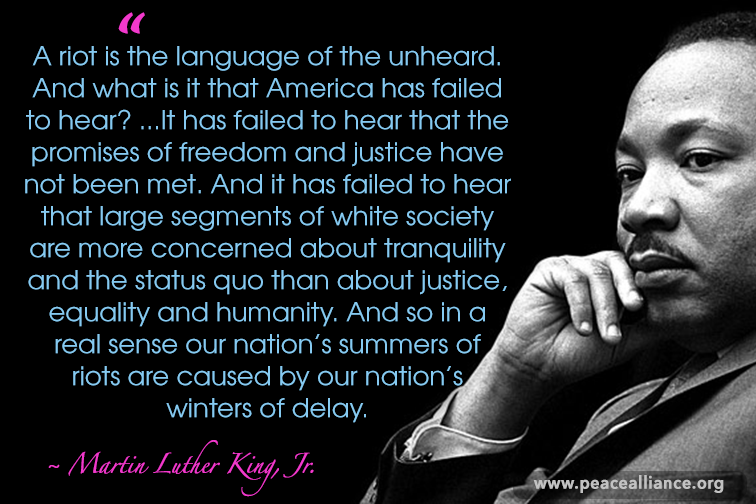
“What is it that America has failed to hear?”

https://mailchi.mp/9f24c0f1da9a/the-weekly-gist-june-5-2020?e=d1e747d2d8

The Peace Alliance's tweet - ""A riot is the language of the ...

“What is it that America has failed to hear?” asked Dr. Martin Luther King, Jr. in March of 1968, calling riots the “language of the unheard”. “It has failed to hear that the promises of freedom and justice have not been met.” Stubbornly, shamefully, we continue to turn a deaf ear: to structural racism; to institutionalized inequality; to a pandemic of police brutality and bigotry that chokes off the breath of black Americans as surely as a virus in the lungs or a boot on the neck. But the sound in the streets is thunderous.

We in healthcare must listen. We must hear that what killed George Floyd, and Breonna Taylor, and Eric Garner, and Tamir Rice, and Philando Castile, and Trayvon Martin, and Ahmaud Arbery, and countless others, as surely as the terrible actions of any single person, was the pervasive, insidious virus of racism, long since grown endemic in our country.

This week’s protests are a kind of ventilator, providing emergency breath for a national body in crisis. We must work—urgently—on the therapeutics of structural change and the vaccines of education and understanding.

At Gist Healthcare we are listening, and learning. As a team, we’ve committed to each other to be attentive, invested, empathetic allies, and to dedicate our individual and collective time, talents and treasure to antiracist work, in healthcare and beyond. Our contribution may not be large, and it will never be enough, but at least we hope it will be positive. We’d like to hear your thoughts and suggestions as well. For the moment, and for our colleagues, friends, and families, we stand with the protestors.

Black Lives Matter.


Providers show support amid unrest: #WhiteCoatsForBlackLives

https://www.healthcaredive.com/news/providers-show-support-amid-unrest-whitecoatsforblacklives/579020/

Dive Brief:

  • The American Hospital Association on Monday condemned what they called the “senseless killing of an unarmed black man in Minneapolis,” referring to George Floyd, who died more than a week ago after a police officer held his knee on Floyd’s neck for more than eight minutes. AHA said the group’s vision is a “society of healthy communities, where ALL individuals reach their highest potential for health.”
  • Medical societies, providers and other healthcare organizations weighed in to support peaceful protests, especially as the COVID-19 pandemic shines a light on racial inequities in access to healthcare and job security in America.
  • Health officials also expressed worry that the protest gatherings could further spread of the novel coronavirus. Minnesota Gov. Tim Walz said hospitals in the state could be overwhelmed. And some COVID-19 testing sites have been shut down for safety reasons, further exacerbating concerns.

Dive Insight:

Since protests and occasionally violent police confrontations in recent days were sparked by Floyd’s death, providers have taken to social media with notes of support and pictures of themselves taking a knee in their scrubs under the hashtag #WhiteCoatsForBlackLives.

The American Medical Association responded to ongoing unrest Friday, saying the harm of police violence is “elevated amidst the remarkable stress people are facing amidst the COVID-19 pandemic.”

Board Chair Jesse Ehrenfeld and Patrice Harris, AMA’s first African American woman to be president, continued: “This violence not only contributes to the distrust of law enforcement by marginalized communities but distrust in the larger structure of government including for our critically important public health infrastructure. The disparate racial impact of police violence against Black and Brown people and their communities is insidiously viral-like in its frequency, and also deeply demoralizing, irrespective of race/ethnicity, age, LGBTQ or gender.”

Other organizations weighed in, including CommonSpirit Health, the American Psychiatric Association, the American College of Physicians and several medical colleges.

The nascent research and data from the pandemic in the U.S. have shown people of color are more likely to die from COVID-19 than white people. The reasons behind that are myriad and complex, but many can be traced back to systemic inequality in social services and the healthcare system.

Payers, providers and other healthcare organizations have attempted to address these issues through programs targeting social determinants of health like stable housing, food security and access to transportation.

But despite these efforts over several years to recognize and document the disparities, they have persisted and in some cases widened, Samantha Artiga, director of the Disparities Policy Project at the Kaiser Family Foundation, noted in a blog post Monday.

Health disparities, including disparities related to COVID-19, are symptoms of broader underlying social and economic inequities that reflect structural and systemic barriers and biases across sectors,” she wrote.

Providers have waded into political issues affecting them before, including gun violence. Several organizations also objected to the Trump administration’s decision to cut ties with the World Health Organization in the midst of the pandemic.

The American Public Health Association in late 2018 called law enforcement violence a public health issue.


Guns in Michigan Capitol: Defense of liberty or intimidation?

https://www.csmonitor.com/USA/Politics/2020/0504/Guns-in-Michigan-Capitol-Defense-of-liberty-or-intimidation

Guns in coronavirus protests: Defense of liberty or intimidation ...

WHY WE WROTE THIS

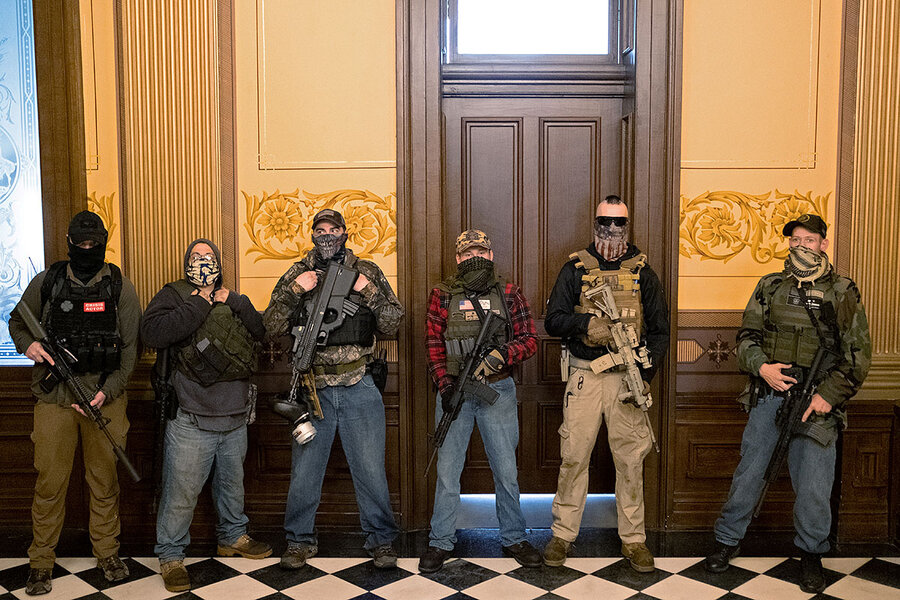
Bringing assault weapons to the Michigan Legislature for a protest against coronavirus restrictions? To one group, it’s why the Second Amendment exists. To many others, it’s unfathomable.

It was a first for Michigan state Sen. Sylvia Santana. Before heading to the statehouse in Lansing last Thursday, she slipped into a bulletproof vest.

Ms. Santana’s husband, a sheriff’s deputy, warned her about potential trouble at a rally to protest the decision to extend a coronavirus lockdown.

A group of armed white men entered the Capitol and shouted at lawmakers. To Ms. Santana, some were dressed like they were “going to war.” Several Confederate flags, a swastika, and a misogynistic sign aimed at Gov. Gretchen Whitmer could be seen outside.

“I thought that was very scary,” says Ms. Santana, an African American who represents parts of Detroit and all of neighboring Dearborn. “We’re there to do a job, and it’s not to dodge bullets as we try to do our jobs in a bipartisan fashion to make sure we’re keeping all Michiganders safe.”

Four days on from the protest, her concern lingers. The pandemic has intensified many societal fault lines – from health care inequities to political polarization – and gun control is no exception. Feeling that state officials are overreaching, a tiny minority of protesters are flexing their Second Amendment rights in Michigan and beyond.

But at a time of crisis, their crusade against the perceived tyranny of government is seen by many as tyrannical in its own right – recklessly using their liberties to intimidate others.

The core question is: Where should the line be drawn? For protesters, guns in statehouses is one of the purest expressions of the power the Second Amendment invests in citizens. But no constitutional right is absolute.

“Where do people who see no problem with guns downtown or near a hospital or in the legislature, where do they draw the line?” Sanford Levinson, co-author of “Fault Lines in the Constitution.” “That’s an interesting question both politically and legally, because courts are really receptive to line drawing. I don’t think you’d find any judge who says, ‘Yeah, I welcome guns in my courtroom.’”

In that way, the struggle over whether to allow firearms in legislatures “is part of the culture war,” he adds.

Are hard-line tactics effective?

Today, 21 state capitols allow guns in some form, according to a Wall Street Journal report. But only a few, including Michigan, allow citizens to openly carry under the rotunda. Many Republican-led states balk at open carry in the people’s hall for personal safety reasons, and courts have upheld bans in places like legislatures and polling places, holding that guns can chill other people’s rights.

Elements of race have long played a role. The modern gun control movement is linked to the signing of the Mulford Act in 1967, which banned open carry in California. The bill gained momentum after two dozen Black Panthers legally brought firearms to the state capitol to protest against it. The National Rifle Association backed the bill.

Incidents like the one in Michigan, however, could do more to damage gun rights than advance them. “It’s really now an open question to what extent hard-line pro-gun policies are politically advantageous,” says Mr. Levinson, also a visiting professor at Harvard Law School in Cambridge, Massachusetts.

Ms. Santana was certainly not persuaded. “I, as a state lawmaker, want to hear your concerns and your position on the issue. But I don’t feel that bringing assault weapons to the capitol and using symbols of hatred will make me understand your issue better.”

The scenes in Michigan, which has been hit hard by COVID-19, only make it harder to have already difficult conversations, others say. Part of self-defense is respecting the preferences other people have for their own security, which might mean leaving guns at home when overtones of intimidation are possible.

“When your eyes look at these pictures of groups of people … in a public building that is supposed to be a center of democratic exchange and debate, and you see a group of people carrying military weapons, that is not a vision of democracy,” says Hannah Friedman, a staff attorney at Giffords Law Center to Prevent Gun Violence in San Francisco. “That’s a vision of intimidation by a minority of people.”

Such concerns were heightened further this weekend, when employees at businesses in Stillwater, Oklahoma, faced a threat of violence with a gun while trying to force customers to wear masks, as mandated by the local government.

“I think we were heard”

But Ashley Phibbs has a different view.

Ms. Phibbs, a project manager and mother who helped organize the Michigan rally, acknowledged with regret that many in attendance didn’t abide by social distancing rules. She also confirmed the display of hate symbols. But she insisted those were agitators and not part of her group, Michigan United for Liberty, which has sprung up to oppose what members see as repressive COVID-19 restrictions.

“I know how it can seem to people who aren’t active in rallies and who are looking at it from the outside in, and I try to be very understanding of that,” says Ms. Phibbs. “But … I don’t think that anyone was there to really make anyone fearful. I didn’t see anything that would have really caused fear, aside from loud noises from the people yelling. But a lot of people are also sometimes afraid of guns in general.”

In the end, she says, “I think we were heard. I think overall [the rally] was positive.”

Knowing your audience

Other gun-rights advocates saw problems with the optics.

As he watched news from Michigan Thursday, Caleb Q. Dyer saw some familiar faces. The New Hampshire barista and former state legislator had been a keynote speaker at a Michigan Libertarian Party event last year.

But he worried that his friends in Michigan were sending “mixed messages” by failing to abide by public health rules.

In fact, he usually brings witty protest gear – such as a sign that says “arm the homeless” – to disarm fear. It’s a fine line, he says, between free speech and armed intimidation.

“People aren’t ready to have the discussion that a lot of these gun-carrying protesters want to have, which is that none of these laws are even remotely effective or just,” says Mr. Dyer. “But they’re not going to have that discussion if they cannot carry themselves in such a way that the opposition won’t think … that they’re murderous and violent.”


U.S. coronavirus updates

https://www.axios.com/coronavirus-west-virginia-first-case-ac32ce6d-5523-4310-a219-7d1d1dcb6b44.html

Coronavirus outbreak is level of public pain we haven't seen in ...


The pandemic is a long way from over, and its impact on our daily lives, information ecosystem, politics, cities and health care will last even longer.

The big picture: The novel coronavirus has infected more than 939,000 people and killed over 54,000 in the U.S., Johns Hopkins data shows. More than 105,000 Americans have recovered from the virus as of Sunday.

Lockdown measures: Demonstrators gathered in Florida, Texas and Louisiana Saturday to protest stay-at-home orders designed to protect against the spread of COVID-19, following a week of similar rallies across the U.S.

  • 16 states have released formal reopening plans, Vice President Mike Pence said at Thursday’s White House briefing. Several Southern states including South Carolina have already begun reopening their economies.
  • Alaska, Oklahoma and Georgia reopened some non-essential businesses Friday. President Trump said Wednesday he “strongly” disagrees with Georgia Gov. Brian Kemp on the move.
  • California’s stay-at-home orders and business restrictions will remain in place, Gov. Gavin Newsom made clear at a Wednesday news briefing. But some local authorities reopened beaches in Southern California Saturday.
  • New York recorded its third-straight day of fewer coronavirus deaths Friday. Still, Gov. Andrew Cuomo said he’s not willing to reopen the state, citing CDC guidance that states need two weeks of flat or declining numbers.

Catch up quick: Deborah Birx said Sunday that it “bothers” her that the news cycle is still focused on Trump’s comments about disinfectants possibly treating coronavirus, arguing that “we’re missing the bigger pieces” about how Americans can defeat the virus.

  • Anthony Fauci said Saturday the U.S. is testing roughly 1.5 million to 2 million people a week. “We probably should get up to twice that as we get into the next several weeks, and I think we will,” he said.
  • The number of sailors aboard the USS Kidd to test positive for the coronavirus has risen from 18 Friday to 33, the U.S. Navy said Saturday. It’s the second major COVID-19 outbreak on a U.S. naval vessel, after the USS Theodore Roosevelt, where a total of 833 crew members tested positive, per the Navy’s latest statement.
  • The first person known to have the coronavirus when they died was killed by a heart attack “due to COVID-19 infection” on Feb. 6, autopsy results obtained by the San Francisco Chronicle on Saturday show.
  • Some young coronavirus patients are having severe strokes.
  • Trump tweeted Saturday that White House press conferences are “not worth the time & effort.” As first reported by Axios, Trump plans to pare back his coronavirus briefings.
  • The South is at risk of being devastated by the coronavirus, as states tend to have at-risk populations and weak health care systems.
  • New York Gov. Andrew Cuomo said Friday Trump was right to criticize the World Health Organization’s handling of the global outbreak.
  • Trump signed legislation Friday for $484 billion in more aid to small businesses and hospitals.
  • The House voted along party lines on Thursday to establish a select committee to oversee the federal government’s response to the crisis.
  • Unemployment: Another 4.4 million Americans filed last week. More than 26 million jobless filings have been made in five weeks due to the pandemic.


A D.C. protest without people: Activists demand PPE for health care workers on front line of coronavirus pandemic

https://www.washingtonpost.com/local/a-dc-protest-without-people-activists-demand-ppe-for-health-care-workers-on-front-line-of-coronavirus-pandemic/2020/04/17/e4a915b4-80d6-11ea-a3ee-13e1ae0a3571_story.html?fbclid=IwAR25nXMi24JerZwm0uFL47exQtEkyWEPh5-tFp1eFO2O4zfzUmdltOfpd3A&utm_campaign=wp_main&utm_medium=social&utm_source=facebook


Activists in D.C. demand PPE for healthcare workers on frontline ...

Spaced six feet apart on the West Lawn of the Capitol, the faces of front-line health-care workers looked out over the nation’s capital. Some wore masks. Others held signs imploring lawmakers for more personal protective equipment.

But these workers were not there in the flesh. Friday’s protest was peopleless.

With mandatory social distancing guidelines and stay-at-home orders in effect throughout the region, and given the grueling demands of their jobs as the deadly coronavirus continues to spread, it would have been nearly impossible to assemble 1,000 health-care workers outside Congress this week.

Instead, volunteers put up 1,000 signs to stand on the lawn in their absence.

Activists who are used to relying on people power to amplify messages and picket lawmakers have been forced to use alternative protest tactics amid the pandemic.

Half a dozen volunteers with liberal activist group MoveOn pressed lawn signs into the grass outside the Capitol as the sun peaked over the Statue of Freedom.

On each sign was a message.

Some, bearing the blue Star of Life seen on the uniforms of doctors, first responders and emergency medical technicians, reiterated a hashtag that has made the rounds on social media for weeks, accompanying posts from desperate front-line workers who say they are running out of necessary protective equipment: #GetUsPPE.

Others showed photos of medical workers in scrubs and hair nets and baseball caps. Some wore face shields and plastic visors. Others donned gloves.

One barefaced doctor in a white lab coat held up a hand-drawn sign. “Trump,” it said. “Where’s my mask?”

Health-care providers in hospitals, clinics, nursing homes, assisted-living facilities and rehabilitation centers have for weeks begged for more PPE to protect themselves and their vulnerable patients.

States and hospitals have been running out of supplies and struggling to find more. The national stockpile is nearly out of N95 respirator masks, face shields, gowns and other critical equipment, the Department of Health and Human Services announced last week.

“Health-care workers are on the front lines of this crisis, and they’re risking their lives to save ours every day, and our government, from the very top of this administration on down, has not used the full force of what they have with the Defense Production Act to ensure [workers] have the PPE they need and deserve,” said Rahna Epting, the executive director of MoveOn. “We wanted to show that these are real people who are demanding that this government protect them.”

Unlike protests that have erupted from Michigan to Ohio to Virginia demanding that states flout social distancing practices and reopen the economy immediately, organizers with MoveOn said they wanted to adhere to health guidelines that instruct people not to gather in large groups.

“Normally, we’d want everyone down here,” said MoveOn volunteer Robby Diesu, 32, as he looked out over the rows of signs. “We wanted to find a way to show the breadth of this problem without putting anyone in harm’s way.”

A large white sign propped at the back of the display announced in bold letters: “Social distancing in effect. Please do not congregate.”

The volunteers who put up the signs live in the same house and have been quarantining under the same roof for weeks. Still, as they worked, several wore masks over their face to protect passersby — even though there were few.

A handful of joggers stopped to take pictures as the sun rose.

One man, who spoke on the condition of anonymity because he is a government employee, said he supported the idea.

“I’m so used to seeing protests out here by the Capitol that it really is bizarre to see how empty it is,” he said. “But this is really impressive to me.”

By sharing images and video on social media of front-line workers telling their stories, MoveOn organizers said they hope to galvanize people in the same way as a traditional rally with a lineup of speakers.

Activists planned to deliver a petition to Sen. Chris Murphy (D-Conn.) with more than 2 million signatures urging Congress to require the delivery of more PPE to front-line workers. Murphy has been a vocal critic of the Trump administration’s coronavirus task force and its reliance on private companies to deliver an adequate amount of critical gear, such as N95 respirator masks, medical gowns, gloves and face shields, to health-care workers.

“In this critical hour, FEMA should make organized, data-informed decisions about where, when, and in what quantities supplies should be delivered to states — not defer to the private sector to allow them to profit off this pandemic,” the senator wrote last week in a letter to Vice President Pence, co-signed by 44 Democratic and two independent senators.

Organizers said the signs would remain on the Capitol lawn all day, but that the demonstration was only the beginning of a spate of atypical ones the group expects to launch this month.

Epting described activists’ energy as “more intense” than usual as the pandemic drags on.

“The energy is very high, the intensity is very high,” she said. “That’s forcing us to be creative and ingenuitive in order to figure out how to protest in a social distancing posture and keep one another safe at the same time.”