WHO Reports Largest Single-Day Spike In Coronavirus Cases

https://talkingpointsmemo.com/news/who-reports-largest-single-day-spike-in-coronavirus-cases

WHO reports largest single-day increase in coronavirus cases

The World Health Organization on Sunday reported the largest single-day increase in coronavirus cases by its count, at more than 183,000 new cases in the latest 24 hours.

The UN health agency said Brazil led the way with 54,771 cases tallied and the U.S. next at 36,617. Over 15,400 came in in India.

Experts said rising case counts can reflect multiple factors including more widespread testing as well as broader infection.

Overall in the pandemic, WHO reported 8,708,008 cases — 183,020 in the last 24 hours — with 461,715 deaths worldwide, with a daily increase of 4,743.

More than two-thirds of those new deaths were reported in the Americas.

In Spain, officials ended a national state of emergency after three months of lockdown, allowing its 47 million residents to freely travel around the country for the first time since March 14. The country also dropped a 14-day quarantine for visitors from Britain and the 26 European countries that allow visa-free travel.

But there was only a trickle of travelers at Madrid-Barajas Airport, which on a normal June day would be bustling.

“This freedom that we now have, not having to justify our journey to see our family and friends, this was something that we were really looking forward to,” Pedro Delgado, 23, said after arriving from Spain’s Canary Islands.

Spanish Prime Minister Pedro Sánchez urged people to take maximum precautions: “The virus can return and it can hit us again in a second wave, and we have to do whatever we can to avoid that at all cost.”

At a campaign rally in Tulsa, Oklahoma, Trump said Saturday the U.S. has tested 25 million people, but the “bad part” is that it found more cases.

“When you do testing to that extent, you’re going to find more people, you’re going to find more cases,” Trump said. “So I said to my people, ‘Slow the testing down, please.’″

White House trade adviser Peter Navarro said on CNN that Trump was being “tongue-in-cheek” and made the comment in a “light mood.”

Democratic rival Joe Biden’s campaign accused Trump of “putting politics ahead of the safety and economic well-being of the American people.”

The U.S. has the world’s highest number of reported infections, over 2.2 million, and the highest death toll, at about 120,000, according to Johns Hopkins. Health officials say robust testing is vital for tracking outbreaks and keeping the virus in check.

In England, lockdown restrictions prevented druids, pagans and party-goers on Sunday from watching the sun rise at the ancient circle of Stonehenge to mark the summer solstice, the longest day of the year in the Northern Hemisphere. English Heritage, which runs the site, livestreamed it instead. A few people gathered outside the fence.

“You can’t cancel the sunrise,” druid Arthur Pendragon told the BBC.

The number of confirmed virus cases is still growing rapidly not only in the U.S. but in Brazil, South Africa and other countries, especially in Latin America.

Brazil’s Health Ministry said the total number of cases had risen by more than 50,000 in a day. President Jair Bolsonaro has been downplaying the risks even as his country has seen nearly 50,000 fatalities, the second-highest death toll in the world.

South Africa reported a one-day high of almost 5,000 new cases on Saturday and 46 deaths. Despite the increase, President Cyril Ramaphosa announced a further loosening of one of the world’s strictest lockdowns. Casinos, beauty salons and sit-down restaurant service will reopen.

In the United States, the virus appears to be spreading across the West and South. Arizona reported over 3,100 new infections, just short of Friday’s record, and 26 deaths. Nevada also reported a new high of 445 cases.

In Europe, a single meatpacking plant in Germany has had over 1,000 cases, so the regional government issued a quarantine for all 6,500 workers, managers and family members.

In Asia, China and South Korea reported new coronavirus cases Sunday in outbreaks that threatened to set back their recoveries.

Chinese authorities recorded 25 new confirmed cases — 22 in Beijing. In the past week, Beijing tightened travel controls by requiring anyone who wants to leave the Chinese capital, a city of 20 million people, to show proof they tested negative for the virus.

In South Korea, nearly 200 infections have been traced to employees at a door-to-door sales company in Seoul, and at least 70 other infections are tied to a table tennis club there. But South Korean officials are reluctant to enforce stronger social distancing to avoid hurting the economy.


Nebraska governor says he’ll withhold federal money from counties that require masks

https://www.latimes.com/world-nation/story/2020-06-18/nebraska-governor-mask-requirement-will-cost-counties-money

Nebraska governor: Mask rules will cost counties money meant to ...

Nebraska’s governor told local governments they will not receive any federal money to help fight the effects of the coronavirus pandemic if they require people to wear masks in public buildings.

The mandate from Republican Gov. Pete Ricketts seems at odds with his usual message, often delivered at his regular news conferences to address the COVID-19 outbreak, encouraging people to wear masks to slow the spread of the virus, the Omaha World-Herald reported.

Ricketts stands by that advice, his spokesman Taylor Gage said. Local governments can encourage mask-wearing in courthouses and other county government buildings, he said, but the governor “does not believe that failure to wear a mask should be the basis for denying taxpayers’ services.”

“Counties are not prohibited from requiring masks, but if they want CARES Act money, they have to be fully open, and that means they cannot deny service for not wearing a mask,” Gage said.

The mandate is drawing objections from county officials, who say it runs counter to Nebraska’s long-held bent toward local control and the advice of public health officials.

In Lincoln, officials planned to require all visitors to wear masks when entering the City-County Building, but those rules were dropped when officials learned that doing so would cost Lancaster County any chance at the $100 million that has been allotted to Nebraska counties as part of the federal economic rescue law.

“We’d like to have a little bit more ability to call the shots in our courthouse, but we realize that he has the right to set the rules,” said Deb Schorr, a longtime Lancaster County Board member.

Dakota County Assessor Jeff Curry said the order could have dire consequences in his county, which is home to a Tyson Foods meatpacking plant and has been one of the hardest-hit counties in the nation for the virus.

Curry said he was hoping that a mask requirement could be in place for the courthouse through July 1.

Nebraska continues to pull back on restrictions meant to slow the spread of the virus, even as more cases are recorded. On Wednesday, the state saw nearly 200 news cases of the virus reported, bringing Nebraska’s total to 17,226, according to the state’s online virus tracker. Nebraska has seen a total to 234 deaths related to the COVID-19 virus.


This Single Factor Could Force Another Coronavirus Shutdown, Goldman Sachs Says

https://www.forbes.com/sites/sarahhansen/2020/06/23/this-single-factor-could-force-another-coronavirus-shutdown-goldman-sachs-says/?utm_source=newsletter&utm_medium=email&utm_campaign=news&utm_campaign=news&cdlcid=#4a09f8fb3f92

This Single Factor Could Force Another Coronavirus Shutdown ...

TOPLINE

With new coronavirus cases rising in 26 states, according to data from Johns Hopkins, and the national conversation turning to whether those states rushed to reopen their economies too quickly, new analysis from Goldman Sachs suggests that in the coming weeks, hospital capacity (rather than case numbers) is the factor most likely to prompt another lockdown.

KEY FACTS

Goldman’s experts say hospital data is a more reliable picture of the spread of the virus nationwide than positive test results, which fluctuate with changes in testing trends. 

The analysts noted, however, that “there is probably a high hurdle for states to reinstate lockdowns.”

As new cases continue to rise across the country, Goldman’s analysts also tracked which states currently meet federal reopening criteria based on four factors: symptoms, cases, testing and hospitalizations and fatalities. 

Only Arizona and Alabama fail in all four categories, the analysts say; symptoms and cases are on the rise, positive test rates are high, and hospitals are nearing their maximum capacities. 

On the other hand, 19 states meet all four criteria for reopening, including several former hot spots like New York and New Jersey, and the vast majority of states meet at least three out of the four criteria.

KEY BACKGROUND

Along with Alabama and Arizona, California, Texas, and Florida have also seen sharp upticks in infections in recent days. Florida reported a record increase in new cases on four out of the six days between June 15 and 20, for instance. The number of confirmed cases since the pandemic started has now swelled to over 100,000, and Gov. Ron DeSantis said the uptick is “clearly” the result of a failure to follow social distancing guidelines. With cases on the rise, some places—like Arizona—are forging ahead with reopening plans while others—in MaineOregon, and Kansas, for instance—are tightening up restrictions again. 


Fauci: US seeing ‘disturbing’ new surge of infections

https://thehill.com/policy/healthcare/504087-fauci-country-seeing-disturbing-new-urge-of-infections?userid=12325

Fauci: US seeing 'disturbing' new surge of infections | TheHill

Anthony Fauci, the administration’s top infectious disease doctor, told a House panel on Tuesday that the country’s response to the COVID-19 pandemic has been a “mixed bag,” adding that a new increase in cases is “disturbing.”

“In some respects, we’ve done very well,” Fauci said during an Energy and Commerce Committee hearing, specifically praising the way New York has been containing the worst outbreak in the country to date.

“However, in other areas of the country, we are now seeing a disturbing surge of infections that looks like it’s a combination, but one of the things is an increase in community spread. And that’s something I’m really quite concerned about,” Fauci said.

There are now about 30,000 new cases per day in the United States. The number of new cases had leveled off at about 20,000, and stayed there for weeks before rising this past weekend.

The rise in the U.S. comes as the Trump administration has sought to paint a rosier picture of the U.S. outlook. Both President Trump and Vice President Pence have inaccurately tried to attribute the increase in cases to more tests being performed.

The new spike in the U.S. is being driven in part by worsening outbreaks across the South and Southwest, including in Arizona, Texas, Florida and the Carolinas, even as the situation has greatly improved in once hard-hit states in the Northeast like New York and Massachusetts.

Many of the states now being hit hard were on the more aggressive side in reopening their economies.  

“Right now, the next couple of weeks are going to be critical in our ability to address those surgings in Florida, in Texas, in Arizona, and in other states,” Fauci said on Tuesday.


Moody’s: Patient volume recovered a bit in May, but providers face long road to recovery

https://www.fiercehealthcare.com/hospitals/moody-s-patient-volume-recovering-may-but-providers-face-long-road-to-recovery?mkt_tok=eyJpIjoiWmpjeVlXVTRZV0l5T1RndyIsInQiOiJLWWxjamNKK2lkZmNjcXV4dm0rdjZNS2lOanZtYTFoenViQjMzWnF0RGNlY1pkcjVGcFwvZFY4VjFaUUlZaFRBT1NRMGE5eWhGK1ZmR01ZSWVZWGMxOHRzTkptZVZXZmc5UnNvM3pVM2VIWDh6VllldFc3OGNZTTMxTDJrXC8wbzN1In0%3D&mrkid=959610

Moody's: Patient volume recovered a bit in May, but providers face ...

Patient volumes at hospitals, doctors’ and dentists’ offices recovered slightly in May but lagged well behind pre-pandemic levels, according to a new analysis from Moody’s Investors Service.

In all, the ratings agency estimated total surgeries at rated for-profit hospitals declined by 55% to 70% in April compared with the same period in 2019. States required hospitals to cancel or delay elective procedures, which are vital to hospitals’ bottom lines.

“Patients that had been under the care of physicians before the pandemic will return first in order to address known health needs,” officials from the ratings agency said in a statement. “Physicians and surgeons will be motivated to extend office or surgical hours in order to accommodate these patients.”

Those declines narrowed to 20% to 40% in May when compared to 2019.

Emergency room and urgent care volumes were still down 35% to 50% in May.

“This could reflect the prevalence of working-from-home arrangements and people generally staying home, which is leading to a decrease in automobile and other accidents outside the home,” the analysis said. “Weak ER volumes also suggest that many people remain apprehensive to enter a hospital, particularly for lower acuity care.”

The good news:  The analysis estimated it is unlikely there will be a return to the nationwide decline of volume experienced in late March and April because healthcare facilities are more prepared for COVID-19.

For instance, hospitals have enough personal protective equipment for staff and have expanded testing, the analysis said.

For-profit hospitals also have “unusually strong liquidity to help them weather the effects of the revenue loss associated with canceled or postponed procedures,” Moody’s added. “That is largely due to the CARES Act and other government financial relief programs that have caused hospital cash balances to swell.”

However, the bill for one of those sources of relief is coming due soon.

Hospitals and other providers will have to start repaying Medicare for advance payments starting this summer. The Centers for Medicare & Medicaid Services doled out more than $100 billion in advance payments to providers before suspending the program in late April.

Hospital group Federation of American Hospitals asked Congress to change the repayment terms for such advance payments, including giving providers at least a year to start repaying the loans.

Another risk for providers is the change in payer mix as people lose jobs and commercial coverage, shifting them onto Medicaid or the Affordable Care Act’s (ACA’s) insurance exchanges.

“This will lead to rising bad debt expense and a higher percentage of revenue generated from Medicaid or [ACA] insurance exchange products, which typically pay considerably lower rates than commercial insurance,” Moody’s said.


Coronavirus Doesn’t Recognize Man-Made Borders

Coronavirus Doesn’t Recognize Man-Made Borders

Coronavirus Doesn't Recognize Man-Made Borders - California Health ...

From El Centro Regional Medical Center, the largest hospital in California’s Imperial County, it takes just 30 minutes to drive to Mexicali, the capital of the Mexican state of Baja California. The international boundary that separates Mexicali from Imperial County is a bridge between nations. Every day, thousands of people cross that border for work or school. An estimated 275,000 US citizens and green card holders live in Baja California. El Centro Regional Medical Center has 60 employees who reside in Mexicali and commute across the border, CEO Adolphe Edward told Julie Small of KQED.

Now these inextricably linked places have become two of the most concerning COVID-19 hot spots in the US and Mexico. While Imperial County is one of California’s most sparsely populated counties, it has the state’s highest per capita infection rate — 836 per 100,000according to the California Department of Public Health. This rate is more than four times greater than Los Angeles County’s, which is second-highest on that list. Imperial County has 4,800 confirmed positive cases and 64 deaths, and its southern neighbor Mexicali has 4,245 infections and 717 deaths.

The COVID-19 crisis on the border is straining the local health care system. El Centro Regional Medical Center has 161 beds, including 20 in its intensive care unit (ICU). About half of all its inpatients have COVID-19, Gustavo Solis reported in the Los Angeles Times, and the facility no longer has any available ventilators.

When Mexicali’s hospitals reached capacity in late May, administrators alerted El Centro that they would be diverting American patients to the medical center. “They said, ‘Hey, our hospitals are full, you’re about to get the surge,’” Judy Cruz, director of El Centro’s emergency department, recounted to Rebecca Plevin in the Palm Springs Desert Sun.

By the first week of June, El Centro was so overburdened that “a patient was being transferred from the hospital in El Centro every two to three hours, compared to 17 in an entire month before the COVID-19 pandemic,” Miriam Jordan reported in the New York Times.

Border Hospitals Filled to Capacity

Since April, hospitals in neighboring San Diego and Riverside Counties have been accepting patient transfers to alleviate the caseload at the lone hospital in El Centro, but the health emergency has escalated and now those counties need relief. “We froze all transfers from Imperial County [on June 9] just to make sure that we have enough room if we do have more cases here in San Diego County,” Chris Van Gorder, CEO of Scripps Health, told Paul Sisson in the San Diego Union-Tribune. El Centro patients are now being airlifted as far as San Francisco and Sacramento.

According to the US Census Bureau, nearly 85% of Imperial County residents are Latino, and statewide, Latinos bear a disproportionate burden of COVID-19. The California Department of Public Health reports that Latinos make up 39% of California’s population but 57% of confirmed COVID-19 cases.

Nonessential travel between the US and Mexico has been restricted since March 21, with the measure recently extended until July 21. However, jobs in Southern California, such as in agricultural fields and packing houses, require regular movement between the two countries. “I’m always afraid that people are imagining this rush on the border,” Andrea Bowers, a spokesperson for the Imperial County Public Health Department, told Small. “It’s just folks living their everyday life.”

These jobs, some of which are considered essential because of their role in the food supply chain, may have contributed to the COVID-19 crisis on the border. Agricultural workers often lack access to adequate personal protective equipment and are unable to practice physical distancing. They also are exposed to air pollution, pesticides, heat, and more — long-term exposures that can cause the underlying health conditions that raise the risk of death for COVID-19 patients.

Comite Civico del Valle, a nonprofit focused on environmental health and civic engagement in Imperial Valley, set up 40 air pollution monitors throughout the county and found that levels of tiny, dangerous particulates violated federal limits, Solis reported.

“I can tell you there’s hypertension, there’s poor air pollution, there’s cancers, there’s asthma, there’s diabetes, there’s countless things people here are exposed to,” David Olmedo, an environmental health activist with Comite Civico del Valle, told Solis.

Fear of New Surges

With summer socializing in full swing, health experts worry that COVID-19 spikes will follow. Imperial County saw surges after Mother’s Day and Memorial Day, probably because of lapsed physical distancing and mask use at social events.

Latinos in California are adhering to recommended public health behaviors to slow the spread of the virus. CHCF’s recent COVID-19 tracking poll with Ipsos asked Californians about their compliance with recommended behaviors. Eighty-four percent of Californians, including 87% of Latinos, say they routinely wear a mask in public spaces all or most of the time. Seventy-two percent of Californians, including 73% of Latinos, say they avoid unnecessary trips out of the home most or all of the time, and 90% of Californians, including 91% of Latinos, say they stay at least six feet away from others in public spaces all or most of the time.

A Push to Reopen Anyway

Most counties in California have met the state’s readiness criteria for entering the “Expanded Stage 2” phase of reopening. Imperial County has not. In the past two weeks, more than 20% of all COVID-19 tests in the county came back positive, the Sacramento Bee reported. The state requires counties to have a seven-day testing positivity rate of no more than 8% to enter Expanded Stage 2.

Still, the Imperial County Board of Supervisors is pushing Governor Gavin Newsom for local control over its reopening timetable. The county has a high poverty rate — 24% compared with the statewide average of 13% — and “bills are stacking up,” Luis Pancarte, chairman of the board, said on a recent press call.

He worries that because neighboring areas like Riverside and San Diego have opened some businesses with physical distancing measures in place, Imperial County residents will travel to patronize restaurants and stores. This movement could increase transmission of the new coronavirus, just as reopening Imperial County too soon could as well.

More than 1,350 residents have signed a petition asking Newsom to ignore the Board of Supervisor’s request, Solis reported. The residents called on the supervisors to focus instead on getting the infection rate down and expanding economic relief for workers and businesses.

Cruz, who has been working around the clock to handle the county’s COVID-19 crisis, agrees with the petitioners. The surges after Mother’s Day and Memorial Day made her “really concerned about unlocking and letting people go back to normal,” she told Plevin. “It’s going to be just like those little gatherings that happened [on holidays], but on a bigger scale.”


Two Trump campaign staffers who attended rally test positive for coronavirus

https://www.axios.com/trump-campaign-rally-tulsa-coronavirus-d3b09725-129c-4aa4-ba2a-1ea868a6ecdd.html?stream=health-care&utm_source=alert&utm_medium=email&utm_campaign=alerts_healthcare

How TikTok Teens Taking Tickets Lowered Trump's Tulsa Rally Crowd ...

Two members of the Trump campaign staff who attended the president’s rally in Tulsa on Saturday have tested positive for the coronavirus, according to the campaign’s communications director Tim Murtaugh.

The big picture: The campaign says the two staffers wore face masks during the entire event, which drew thousands of supporters. Health officials, including several in Tulsa, had urged the campaign to delay the rally, warning of the risk of spreading the virus. Six campaign staffers for the president were quarantined after testing positive before the rally last week.

What he’s saying:

“After another round of testing for campaign staff in Tulsa, two additional members of the advance team tested positive for the coronavirus. These staff members attended the rally but were wearing masks during the entire event. Upon the positive tests, the campaign immediately activated established quarantine and contact tracing protocols.”

— Tim Murtaugh

Worth noting: The White House said on Monday it is “scaling back” coronavirus temperature checks for visitors who enter the complex.


Comparing COVID-19 to past pandemics

https://mailchi.mp/d594e7a0c816/the-weekly-gist-june-19-2020?e=d1e747d2d8


Although the coronavirus is easily the most disruptive disease event of our lifetimes, pandemics have ravaged humanity over history, leaving devastating death tolls in their tracks. This graphic compares lives lost in some of the worst worldwide pandemics on record. While a staggering 450,000 people have died from COVID-19 worldwide, the current pandemic represents a mere 0.2 percent of the deadliest plague in recorded human history, the Black Death.

Caused by the bubonic plague, the Black Death took an estimated 200 million lives over just a five-year span during the Middle Ages, killing an estimated 30 to 50 percent of Europe’s population. Arguably, the entire course of history was altered by the Black Death—will the same be true for COVID-19?

The 1918 Spanish Flu, the deadliest pandemic in modern history, claimed 40-50 million lives worldwide across 15 months. Unlike COVID-19, the Spanish Flu—caused by the H1N1 virus—was notable for being atypically fatal in otherwise healthy people, including in children younger than five and especially in adults between the ages of 20 and 40.

The Spanish Flu ebbed and flowed over three very distinct waves across two years, killing 675,000 Americans in total. That’s more than five-and-a-half times the current US COVID-19 death toll, but today we’re less than six months into the coronavirus pandemic.

The vast majority of Spanish Flu deaths occurred in the illness’s second wave, beginning in the fall of 1918—if history repeats itself, the worst of our current pandemic could still be in front of us. 

One stark difference between 1918 and today: the advancement of medical science in the last century has allowed a swift, global effort to create a COVID-19 vaccine—over 125 vaccines are currently in development and 18 have progressed to human trials.


Cartoon – Flattening the I.Q. Curve

Editorial cartoons

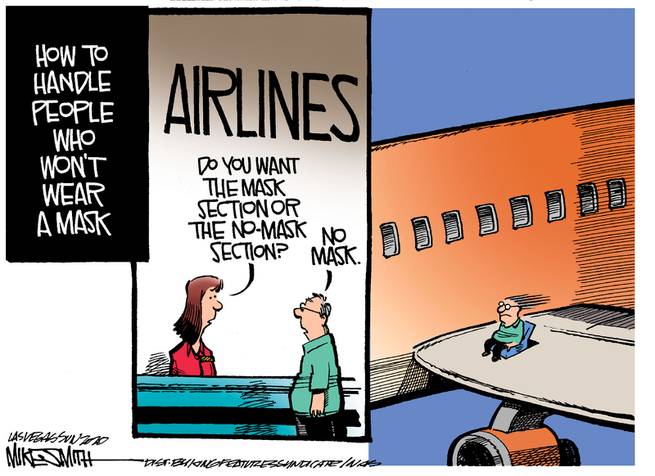
Cartoon – How to handle people who won’t wear a mask

Mike Smith Cartoon: 051420 smith cartoon masks -