National Hospital Flash Report: May 2023

Hospital finances showed signs of stabilizing in May amid slightly improving operating margins, declining expenses and notable increases in outpatient visits.

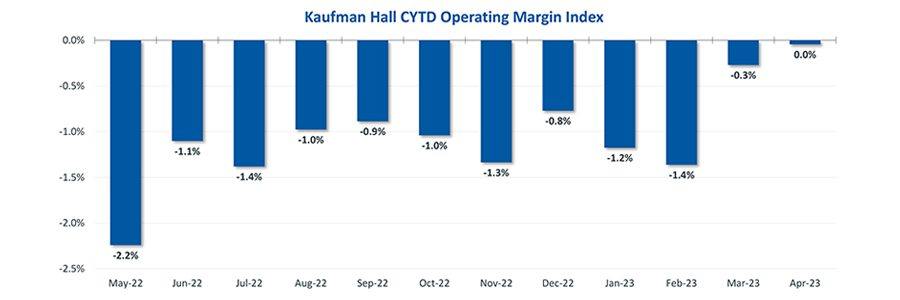
The median Kaufman Hall Year-To-Date Operating Margin Index reflecting actual margins was 0.3% in May.

The June issue of the National Hospital Flash Report covers these and other key performance metrics.

About the Data


The National Hospital Flash Report uses both actual and budget
data over the last three years, sampled from more than 900 hospitals
on a recurring monthly basis from Syntellis Performance Solutions.


The sample of hospitals for this report is representative of all hospitals in
the United States both geographically and by bed size. Additionally,
hospitals of all types are represented, from large academic to small
critical access. Advanced statistical techniques are used to standardize
data, identify and handle outliers, and ensure statistical soundness prior
to inclusion in the report.


While this report presents data in the aggregate, Syntellis Performance
Solutions also has real-time data down to individual department,
jobcode, paytype, and account levels, which can be customized into peer
groups for unparalleled comparisons to drive operational decisions and
performance improvement initiatives.

Key Takeaways

  1. Hospitals broke even in April.
    The median operating margin for hospitals was 0% in April, leaving most hospitals with little to no
    financial wiggle room.
  2. Volumes dropped while lengths of stay increased.
    Hospital volumes dropped across the board—including inpatient and outpatient. Emergency department
    volumes were the least affected.
  3. Effects of Medicaid disenrollment could be materializing.
    Hospitals experienced increases in bad debt and charity care in April. Combined with anemic patient
    volumes, experts note this data could illustrate the effects of the start of widespread disenrollment from
    Medicaid following the end of the COVID-19 public health emergency.
  4. Inflation continued to throttle hospital finances.
    Labor costs jumped in April and the costs of goods and services continued to be well above pre-pandemic
    levels. Though expenses generally fell in April, revenues declined at a faster rate.

National Non-Operating Results

Key Observations

At their May meeting, the Federal Open Market Committee (FOMC) raised the
benchmark borrowing rate another 25 basis points, setting the range to 5.00-5.25%
and marking the 10th consecutive hike in the cycle as well as a 16-year high

  • Fed officials acknowledged discussion of a potential pause in tightening while
    leaving wiggle room, saying “rates are going to come down” over a long period of
    time while also warning inflation “continues to run high”
    and the Fed will be taking
    a “data-dependent approach”
  • The consumer price index (CPI) rose 0.4% in April, a 4.9% increase year-over-year,
    an annual pace of inflation below 5% for the first time in two years
  • The labor market continued to show resilience in April as U.S. nonfarm payrolls
    grew by 253,000 and unemployment fell back to a 53-year low of 3.4%
  • Strong inflation, a robust labor market, continued banking sector woes, and a debt
    ceiling standoff further complicates credit conditions and may challenge
    the Fed to stabilize financial markets
  • Equities in April, as measured by the S&P 500, were up 1.5% in April and
    8.6% YTD despite downbeat economic data, reoccurring banking sector fears,
    and mixed earnings

United, Humana flag rising outpatient volumes in Q2

https://mailchi.mp/edda78bd2a5a/the-weekly-gist-june-23-2023?e=d1e747d2d8

Last week, the nation’s two largest Medicare Advantage insurers revealed that second quarter outpatient volumes were higher than anticipated, prompting a selloff of insurance stocks. 

Minnetonka, MN-based UnitedHealth Group (UHG) executives said at a Goldman Sachs investor conference that increased outpatient utilization was driving up its medical loss ratio (MLR) to the high end of its annual target, surmising that a new wave of seniors were finally accessing elective procedures like joint replacements postponed throughout COVID.

Then, in an investor filling, Louisville, KY-based Humana noted that both outpatient and inpatient utilization levels were elevated, though it did not point to any specific causes. But not all insurers have experienced higher-than-expected utilization: Indianapolis, IN-based Elevance Health reported that its medical spending this year so far was in line with expectations, and it did not expect a surge in procedure demand.

The Gist: Health systems will find this news, especially Humana’s reports of elevated inpatient and emergency department volumes, as encouraging as the insurers consider it alarming. But the bulk of this outpatient volume isn’t necessarily returning to health systems, as the proliferation of insurer- and investor-backed ambulatory surgery centers has resulted in not only more, but also lower-cost, competition. 

Health systems with significant ambulatory surgery center footprints, including Tenet and HCA, should be well-positioned to capture the volume return.  

UnitedHealth expects higher medical costs in Q2 as delayed care makes comeback

Dive Brief:

  • Pent-up demand for delayed healthcare during the COVID-19 pandemic is pressuring medical costs for health insurers that had a financial windfall during the pandemic amid low utilization.
  • UnitedHealth, the parent company of the largest private payer in the U.S., expects its medical loss ratio — the share of premiums spent on member’s healthcare costs — to be higher than previously expected in the second quarter of 2023, due to a surge in outpatient care utilization among seniors, CFO John Rex said Tuesday during Goldman Sachs’ investor conference.
  • The news sent UnitedHealth’s stock down 7% in morning trade Wednesday, and affected other Medicare-focused health insurers as well. Humana, CVS and Centene — the three largest MA insurers by enrollee after UnitedHealth — dropped 13%, 6% and 8%, respectively.

Dive Insight:

The early days of COVID saw widespread halts in nonessential services, causing visits to plunge with an estimated one-third of U.S. adults delaying or foregoing medical care in the pandemic’s first year. By 2022, the sizable rebound in deferred care that many predicted had yet to materialize.

Instead, patient volumes increased, but didn’t return to normal levels, threatening the financial health of hospitals, which rely on utilization for revenue. However, the trend helped payers, which reaped some of their highest profits in history during the pandemic on low medical spend.

Now, early signs suggest utilization may again be increasing, with the cost of rebounding care coming around to hit payers. UnitedHealth now expects its MLR for the second quarter to reach or exceed its full-year target of 82.1% to 83.1%.

“As you look at a Q2, you would expect Q2 medical care ratio to be somewhere in the zone of probably the upper bound or moderately above the upper bound of our full-year outlook,” Rex said. “I would expect at this distance that the full year would probably settle in in the upper half of the existing range we set up.”

In comparison, the insurer reported an MLR of 82.2% in the first quarter of 2023. UnitedHealth’s MLR was 82% in 2022.

UnitedHealth said the MLR increase is because medical activity is normalizing after COVID kept seniors away from non-essential care.

“We’re seeing as behaviors kind of normalize across the country in a lot of different ways and mask mandates are dropped, especially in physician offices, we’re seeing that more seniors are just more comfortable accessing services for things that they might have pushed off a bit like knees and hips,” said Tim Noel, UnitedHealth’s chief executive for Medicare and retirement.

The Minnetonka, Minnesota-based insurer has seen strong outpatient demand through April, May and June, particularly in hips and knees with high volumes at its owned ambulatory surgical centers and within its Medicare business, executives said.

Inpatient volumes have remained consistent, and while outpatient utilization has increased, patient acuity has remained the same. Optum Health’s behavioral businesses are also seeing higher utilization in the second quarter, said Patrick Conway, CEO of Care Solutions at Optum, UnitedHealth’s health services division.

UnitedHealth doesn’t expect this higher activity to let up anytime soon. As a result, the payer incorporated higher outpatient utilization into its Medicare Advantage plan bids for 2024, which were placed in early June. The move attests to the longer duration of the trend, SVB Securities analyst Whit Mayo wrote in a note.

“Assuming it is going to end quickly wouldn’t be prudent on our part,” Rex said. “We’ll see how this progresses here.” 

Reviewing post-pandemic changes to hospital volumes 

https://mailchi.mp/3ed7bdd7f54b/the-weekly-gist-june-2-2023?e=d1e747d2d8

In the graphic above, we use the most recent data from software and analytics firm Strata Decision Technology to compare 2023 year-to-date (YTD) hospital volumes by admission type to both 2019 and 2022 volumes. 

Compared to 2019, outpatient volumes in 2023 have increased by 14 percent, while inpatient, observation, and emergency (ED) admissions are all down. However, compared to 2022, the reverse trend is true, with inpatient, observation, and ED volumes up from last year while outpatient volumes have dropped slightly. 

This suggests that the net increase in outpatient volume and net loss in inpatient and ED volume over the past few years appears to be locked in. While the COVID-accelerated outpatient shift is here to stay, hospitals can take solace in the recent uptick in inpatient, observation, and ED volumes, which helps those still struggling to return to positive operating margins.

Importantly, there is significant regional variability among these volume data, suggesting that health system recovery will not be uniform.

For hospitals, ‘difficult decisions’ loom after 9 months of negative margins

The third quarter brought little relief to hospitals in what is shaping up to be one of their worst financial years. 

Kaufman Hall’s October National Hospital Flash Report — based on data from more than 900 hospitals — found slightly lower hospital expenses in September did not outweigh lower revenue across the board, with decreases in discharges, inpatient minutes and operating minutes.

The median year-to-date operating margin index for hospitals was -0.1 percent in September, marking a ninth straight month of negative operating margins and a dimmer outlook for their climb back into the black by year’s end. 

Kaufman Hall noted that expense pressures and volume and revenue declines could force hospitals to make “difficult decisions” about service reductions and cuts. 

“Health systems are starting to get a clear picture of what service lines have a positive effect on their margins and which ones are weighing them down,” said Matthew Bates, managing director and Physician Enterprise service line lead with Kaufman Hall. “Without a positive margin there is no mission. Health systems must think carefully and strategically about what areas of care they invest in for the future.”

US COVID-19 admissions tick up: 10 CDC findings

COVID-19 hospitalizations increased slightly this week after nearly two months of decline, while omicron subvariants BQ.1 and BQ.1.1 — dubbed ‘escape variants’ for their immune evasiveness — continued to gain prevalence nationwide, according to the CDC’s COVID-19 data tracker weekly review published Oct. 28.

Ten findings:

Hospitalizations

1. The seven-day hospitalization average for Oct. 19-25 was 3,249, a 1 percent increase from the previous week’s average. New hospital admissions had been falling since early August, CDC data shows.

Cases

2. As of Oct. 26, the nation’s seven-day case average was 37,683, a 25.1 percent decrease from the previous week’s average. This marks the 14th week of decline and the lowest daily case rate seen since late April, CDC data shows.

Variants

3. Based on projections for the week ending Oct. 29, the CDC estimates that BQ.1 accounts for 14 percent of cases, while BQ.1.1 accounts for 13.1 percent.

4. BA. 5 remains the nation’s dominant strain, accounting for 49.6 percent of infections. BF.7, another omicron subvariant experts are closely monitoring, makes up 7.5 percent of cases. Other omicron subvariants make up the rest. 

Community levels 

5. As of Oct. 27, 2.3 percent of counties, districts or territories had high COVID-19 community levels, 21.9 percent had medium community levels and 75.8 percent had low community levels. 

Deaths

6. The current seven-day death average is 373, down 13.7 percent from the previous week’s average. Some historical deaths have been excluded from these counts, the CDC said. 

Vaccinations

7. As of Oct. 26, about 266 million people — 80.1 percent of the U.S. population — have received at least one dose of the COVID-19 vaccine, and more than 226.9 million people, or 68.4 percent of the population, have received both doses. 

8. About 111.8 million people have received a booster dose, and more than 22.9 million people have received an updated omicron booster. However, 49.3 percent of people eligible for a booster dose have not yet gotten one, the CDC said.

Wastewater surveillance 

9. About 34 percent of the U.S. is reporting moderate to high virus levels in wastewater. Of these surveillance sites, 10 percent are seeing some of the highest levels since Dec. 1, 2021. 

10. About 50 percent of sites are reporting an increase in virus levels, and 44 percent of sites are seeing a decrease.

Inpatient volumes poised to grow 2% over next 10 years

https://www.beckershospitalreview.com/patient-experience/inpatient-volumes-poised-to-grow-2-over-next-10-years.html

Adult inpatient volumes will recover to pre-pandemic numbers but grow only 2 percent over the next decade, a new report from Sg2 forecasts.

At the same time, adult inpatient days are expected to increase 8 percent and tertiary inpatient days are poised to increase 17 percent, fueled by an increase in chronic conditions

“While case mix varies by hospital, it is likely this combination of increased inpatient volume, patient complexity and length of stay may require healthcare organizations to rethink service line prioritization, service distribution and investment in care at-home initiatives,” Maddie McDowell, MD, senior principal and medical director of quality and strategy for Sg2, said in a June 7 news release for the report. 

Five other key takeaways from Sg2’s forecasts: 

1. Outpatient volumes are projected to return to pre-pandemic levels in 2022 and then grow 16 percent through 2032, three percentage points above estimated population growth.

2. Surgical volumes are projected to grow 25 percent at ambulatory surgery centers and 18 percent at hospital outpatient departments and physician offices over the next decade. 

3. The pandemic-driven decline in emergency department visits is expected to plateau with a decline in demand projected at -2 percent over the next 10 years.

4. Over the next five years, home care is expected to gain traction, with home evaluation and management visits seeing 19 percent growth, home hospice at 13 percent growth and home physical and occupational therapy at 10 percent growth.

5. Telehealth is expected to resume its climb and by 2032 account for 27 percent of all evaluation and management visits.

Hospital volume return remains uneven, while virtual care holds

https://mailchi.mp/df8b77a765df/the-weekly-gist-may-6-2022?e=d1e747d2d8

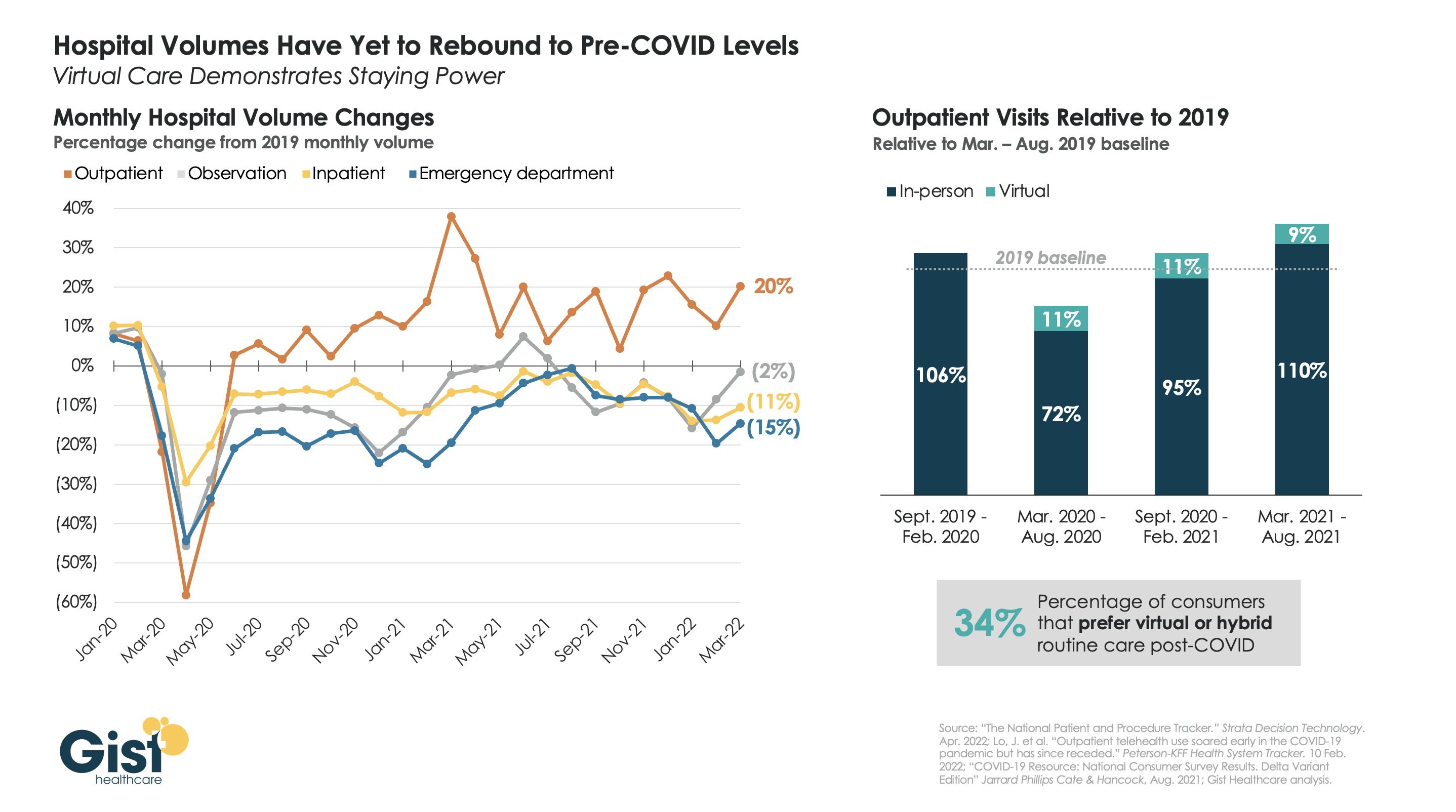
More than two years after the pandemic’s onset, some types of hospital volume still haven’t returned to pre-pandemic levels. The graphic above uses recent data from analytics firm Strata Decision Technology to track monthly hospital volume across various care settings. 

While outpatient volume continues to exceed pre-COVID levels, inpatient, emergency department (ED), and observation volume is still below the 2019 baseline. The unpredictability of volume trends is likely to continue, as COVID continues to ebb and flow regionally, and care continues to shift outpatient.

By contrast, the volume of virtual care visits has remained consistent, even as consumers return to in-person outpatient visits, driving up the overall level above the pre-pandemic baseline. Some of this increase in outpatient visit volume has been driven by consumers turning to urgent care clinics or doctors’ offices—either in-person or virtually—for their lower-acuity care needs.

While temporary reimbursement and licensing policies for telehealth have been the main stumbling blocks for many organizations’ longer-term planning for virtual visits, about half of states have now implemented permanent payment parity for telemedicine. As such, provider organizations that are still taking a “wait and see approach” must develop an economically sustainable virtual care model to reduce costs and meet evolving consumer demands.

Rational Exuberance for Medicare Advantage Market Disrupters

Insurers Running Medicare Advantage Plans Overbill Taxpayers By Billions As  Feds Struggle To Stop It | Kaiser Health News

Medicare Advantage (MA) focused companies, like Oak Street
Health (14x revenues), Cano Health (11x revenues), and Iora
Health (announced sale to One Medical at 7x revenues), reflect
valuation multiples that appear irrational to many market observers. Multiples may be
exuberant, but they are not necessarily irrational.


One reason for high valuations across the healthcare sector is the large pools of capital
from institutional public investors, retail investors and private equity that are seeking
returns higher than the low single digit bond yields currently available. Private equity
alone has hundreds of billions in investable funds seeking opportunities in healthcare.
As a result of this abundance of capital chasing deals, there is a premium attached to the
scarcity of available companies with proven business models and strong growth
prospects.


Valuations of companies that rely on Medicare and Medicaid reimbursement have
traditionally been discounted for the risk associated with a change in government
reimbursement policy
. This “bop the mole” risk reflects the market’s assessment that
when a particular healthcare sector becomes “too profitable,” the risk increases that CMS
will adjust policy and reimbursement rates in that sector to drive down profitability.


However, there appears to be consensus among both political parties that MA is the right
policy to help manage the rise in overall Medicare costs and, thus, incentives for MA
growth can be expected to continue.
This factor combined with strong demographic
growth in the overall senior population means investors apply premiums to companies in
the MA space compared to traditional providers.


Large pools of available capital, scarcity value, lower perceived sector risk and overall
growth in the senior population are all factors that drive higher valuations for the MA
disrupters.
However, these factors pale in comparison the underlying economic driver
for these companies. Taking full risk for MA enrollees and dramatically reducing hospital
utilization, while improving health status, is core to their business model.
These
companies target and often achieve reduced hospital utilization by 30% or more for their
assigned MA enrollees.

In 2019, the average Medicare days per 1,000 in the U.S. was 1,190. With about
$14,700 per Medicare discharge and a 4.5 ALOS, the average cost per Medicare day is
approximately $3,200. At the U.S. average 1,190 Medicare hospital days per thousand,
if MA hospital utilization is decreased by 25%, the net hospital revenue per 1,000 MA

enrollees is reduced by about $960,000. If one of the MA disrupters has, for example, 50,000 MA lives in a market, the
decrease in hospital revenues for that MA population would be about $48 million. This does not include the associated
physician fees and other costs in the care continuum. That same $48 million + in the coffers of the risk-taking MA
disrupters allows them deliver comprehensive array of supportive services including addressing social determinants of health. These services then further reduce utilization and improves overall health status, creating a virtuous circle. This is very profitable.


MA is only the beginning. When successful MA businesses expand beyond MA, and they will, disruption across the
healthcare economy will be profound and painful for the incumbents. The market is rationally exuberant about that
prospect.

ED volume remains persistently down, but at higher acuity

https://mailchi.mp/f42a034b349e/the-weekly-gist-may-28-2021?e=d1e747d2d8

As we shared recently, post-pandemic healthcare volume is not returning evenly. While outpatient volume is rebounding quickly, other settings remain sluggish, especially the emergency department. We partnered with healthcare data analytics company Stratasan to take a closer look at ED volume decline. As shown in the graphic above, nationally, ED visits were down 27 percent in 2020, compared to 2019. ED-only volume (cases that started and ended in the ED) took a large hit across last year, down nearly a third from 2019. We expect that a portion of this ED-only volume will never fully recover to pre-COVID levels, with patient demand permanently shifting to lower-acuity care settings, including virtual, and some patients avoiding care altogether for minor ailments as they learn to “live with” problems like back pain.
 
ED-to-observation volume saw the greatest decline in 2020, likely as a result both of patients avoiding the ED, and presenting in the ED sicker, meeting the criteria for inpatient admission. However, ED-to-inpatient volume, which fell only seven percent in 2020, has been returning. In the second half of 2020, the ED-to-inpatient admission rate was 20 to 30 percent higher than the pre-COVID baseline. Across all three categories of ED volume, pediatrics saw steeper declines compared to adult cases. While some further ED volume rebound is anticipated, health systems should expect that fewer, but sicker, patients will be the new normal for hospital emergency departments. 

Fewer low-acuity patients utilizing high-cost emergency care is good news from a public health perspective, but health systems must bolster other access channels like urgent care and telemedicine to ensure patients have convenient access for emergent care needs.