2019 WAS A ROUGH YEAR FOR RURAL HOSPITALS

https://www.healthleadersmedia.com/clinical-care/2019-was-rough-year-rural-hospitals?spMailingID=16767558&spUserID=MTg2ODM1MDE3NTU1S0&spJobID=1781791709&spReportId=MTc4MTc5MTcwOQS2

Since 2005, 162 rural hospitals have shuttered, with 60% of the closures occurring in southern states that did not expand Medicaid enrollment.


KEY TAKEAWAYS

19 rural hospitals closed in 2019, up from 15 closures in 2018, and continuing a steady double-digit trend in closures since 2013.

Most hospitals closed because of financial problem, and 38% of rural hospitals are unprofitable.

Patients in communities affected by closure travel 12.5 miles on average for care. However, 43% of the closed hospitals are more than 15 miles to the nearest hospital, and 15% are more than 20 miles.

Despite a booming national economy, 2019 was the worst year for hospital closings since at least 2005.

The North Carolina Rural Health Research Program says that 19 rural hospitals closed this year, up from 15 closures in 2018, and continuing a steady double-digit trend in closures since 2013.

Since 2005, the North Carolina researchers tracked 162 hospital closings, with 60% of the closures occurring in southern states that did not expand Medicaid enrollment.

Texas led the way, with 23 hospital closures since 2005, followed by Tennessee with 13, and North Carolina with 11.

The closures have been blamed on a number of factors, including: the older, sicker, poorer, and less-concentrated rural demographic; bypassing by local residents seeking care at regional hospitals; hospital consolidation; value-based care; referral patterns of larger hospitals; the transition to outpatient services; and mismanagement.

Among the findings highlighted by the North Carolina Rural Health Research Program:

  • More than half of the rural hospitals that close cease to provide any type of health care, which were define as abandoned.
  • Most closures and “abandoned” rural hospitals are in South (60%), where poverty rates are higher, people are generally less healthy and less likely to have public or private health insurance.
  • Most hospitals closed because of financial problems. 38% of rural hospitals are unprofitable.
  • In 2016, 1,375 acute care hospitals out of 4,471 urban and rural acute care hospitals (31%) were unprofitable, including 847 rural hospitals (versus 528 unprofitable urban hospitals).
  • Patients in communities affected by closure travel 12.5 miles on average for care. However, 43% of the closed hospitals are more than 15 miles to the nearest hospital, and 15% are more than 20 miles.
  • The typical rural hospital employs about 300 people, serves a community of about 60,000. When the only hospital in a county closes, there is a decrease of about $1,400 in per capita income in the county.
  • University of Minnesota research shows that between 2004 and 2014, 179 rural counties lost all hospital-based OB services.
  • Over the last 15 years, the difference in mortality between rural and urban areas has tripled – from a 6% difference to an 18% difference in 2015.


EIGHT MORE HOSPITALS JOIN PA’S RURAL HEALTH MODEL

https://www.healthleadersmedia.com/innovation/eight-more-hospitals-join-pas-rural-health-model

Image result for PA'S RURAL HEALTH MODEL

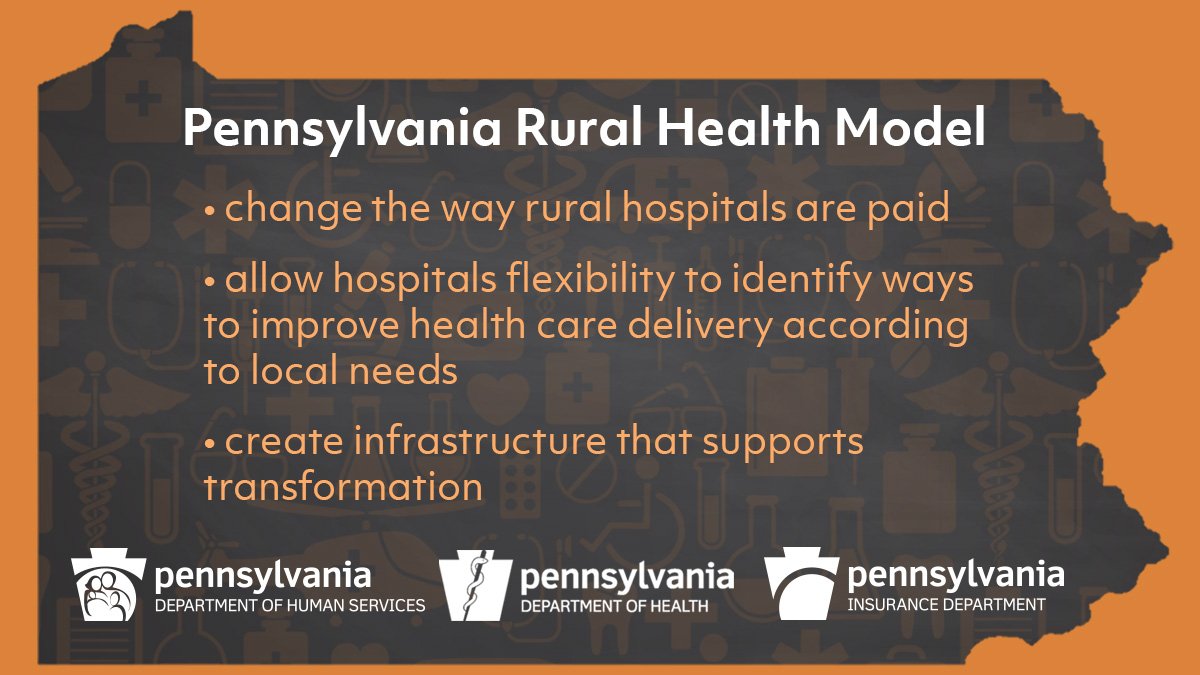
The Rural Health Model, the first of its kind, creates an alternative payment model that transitions hospitals from fee-for-service to global budget payments.


KEY TAKEAWAYS

The Rural Health Model creates an alternative payment model that transitions hospitals from fee-for-service to global budget payments.

Instead of getting paid for admissions, hospitals in the model will get a preset amount of money to provide services in the community.

State officials say the new payment model allows hospitals time to transform care to better meet the health needs of the community.

Eight more hospitals and one payer have joined a Pennsylvania initiative to shore up the financial footing of the state’s rural hospitals.

“I am especially pleased to see more hospitals joining this important initiative to improve their financial viability so that every Pennsylvanian has access to quality health care within a reasonable distance from home,” Gov. Tom Wolf said in a media release.

State officials the program is needed because nearly half of all rural hospitals in Pennsylvania are operating with negative margins and are at risk of closure. Four rural hospitals in Pennsylvania have shuttered since 2006, according to the North Carolina Rural Health Research Program.

So far this year, 19 rural hospitals across the nation have closed, making 2019 the worst year for rural hospital closures since at least 2005.

The Rural Health Model, the first of its kind, creates an alternative payment model that transitions hospitals from fee-for-service to global budget payments. Those global payments come from several payers, including private and public insurers.

Instead of getting paid for admissions, hospitals in the model will get a preset amount of money to provide services in the community.

State officials say the new payment model allows hospitals time to transform care to better meet the health needs of the community. This includes providing nontraditional roles, such as providing transportation and broadband internet access.

The eight hospitals are:

• Armstrong County Memorial Hospital in Kittanning.

• Chan Soon-Shiong Medical Center at Windber in Somerset County.

• Fulton County Medical Center in McConnellsburg.

• Greene Hospital in Waynesburg, Greene County.

• Monongahela Valley Hospital in Monongahela, Washington County.

• Punxsutawney Area Hospital in Punxsutawney, Jefferson County.

• Tyrone Hospital in Tyrone, Blair County.

• Washington Hospital in Washington, Washington County

A total of 67 hospitals are eligible for model based and nearly 20% of them will participate in in 2020, state officials said.

In addition, Aetna will join five other private payers  – Gateway, Geisinger, Highmark, Medicare and UPMC – which combine make up nearly half of the individual and small group market insurance population in the state.

The program is funded and administered by the newly created Rural Health Redesign Center Authority and the Pennsylvania Rural Health Redesign Center Fund.

In addition to providing access to care for rural communities, state officials say the model will ensure that, by remaining open, rural hospitals continue to be a vital economic driver for their communities.

“The Rural Health Model is a transformative step that changes the financial model for hospitals in rural areas,” said Pennsylvania Secretary of Health Rachel Levine, MD. “This is a step that will help achieve financial stability for these facilities and aims to improve the overall health of the community.”

“THIS IS A STEP THAT WILL HELP ACHIEVE FINANCIAL STABILITY FOR THESE FACILITIES AND AIMS TO IMPROVE THE OVERALL HEALTH OF THE COMMUNITY.”


The Chart that Could Undo the US Healthcare System

https://fee.org/articles/the-chart-that-could-undo-the-us-healthcare-system/

Image result for The Chart that Could Undo the US Healthcare System

Skyrocketing costs are being driven by bureaucracy.

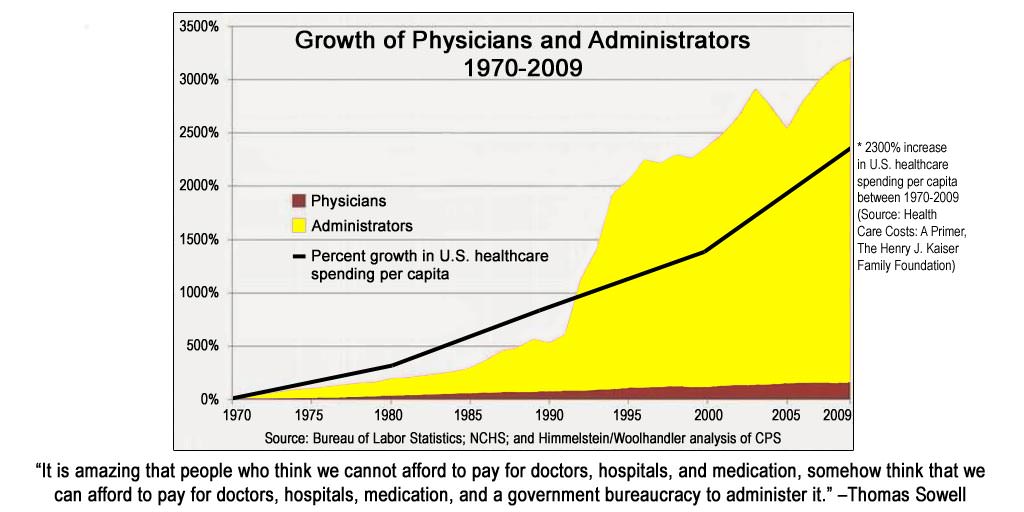
This chart looks remarkably similar to a chart that tracks the growth of the administrative class in higher education. And that’s no accident. As the physician who shared the chart writes:

[The chart] outlines the growth of administrators in healthcare compared to physicians over the last forty years. And, it includes an overlay of America’s healthcare spending over that same time. Take a look at the yellow color. A picture is worth a thousand words, isn’t it?

You see, when you have that much administration, what you really have is a bunch of meetings. Lots of folks carrying their coffee from place to place. They are meeting about more policies, more protocols to satisfy government-created nonsense. But, this type of thing in healthcare isn’t fixing things. It’s not moving the needle.

What moves things is innovation.

Innovation, indeed. But it’s not easy to innovate in stagnant, hyper-regulated, captured sectors.

In Tyler Cowen’s 2011 book the Great Stagnation, he argued that the areas that were stagnating the most are education, healthcare, and government. Writing about Cowen’s book in his Wall Street Journal blog, Kelly Evans says:

A particular challenge we confront is that our progress as a society — chiefly, in extending and improving lives — is now at a point in which it appears to be undercutting our potential for further advancement. Part of this, Mr. Cowen observes, stems from well-meaning efforts to do more with education, government, and health care that instead seem to have backfired and left us with noncompetitive institutions closer to failing us than to serving us well.

With respect to healthcare, this chart gives us an indication of why these efforts are backfiring: The more an industry becomes like a regulated utility, the more administrators are required to enforce the regulations and administer the programs. And they, as well as the programs they administer, are expensive. All manner of distortions follow, and the costs of healthcare go up proportionally.

There also seems to be perverse incentives associated with subsidy: The more resources you dump in, the more expensive that industry becomes. You might shift the costs around on unsuspecting groups (like taxpayers), but in almost every case we see premium hikes and tuition increases in both of these industries, despite (or rather because of) the truckloads of federal largesse.

But they will have to stop at some point — one way or the other.

The US healthcare system has become something of a Frankenstein monster, with pieces stitched together ad hoc by regulators and special interests. The ACA seems to have ignored most of what really needed fixing and doubled down on the worst aspects of our system. Price transparency, affordability, innovation and competitive entrepreneurship have all gotten worse, not better. And the beast has grown to take over more than 17 percent of GDP.

(And if you think 17 percent is about right, consider that in Singapore healthcare takes up less than 3 percent of GDP.)

The trouble with any further healthcare reform is that a massive coalition of special interests in multiple sectors has formed as a husk around the entire industry — a care-tel, if you will — and they will be very difficult to dislodge.


When a chart speaks a thousand words…

https://suneeldhand.com/2017/11/28/when-a-chart-speaks-a-thousand-words/

Image result for When a chart speaks a thousand words…

I happened to stumble across the above chart online the other day. It’s not new data, and was actually quoted in this major publication. I can write articles and parse the challenges we face till the cows come home, but nothing can really sum up what’s wrong with American healthcare more than this chart. It says everything and is quite obnoxious. What’s worse, it’s from 2009—and the curve has probably considerably diverged since then.

So that’s it, my blog post for the week. Just stare at this chart and take it all in. Feel free to comment below. I was going to write a long article on what these curves mean for healthcare. Then I thought to myself: absolutely nothing I write can possibly say more than the chart itself. It speaks not just a thousand words, but a million…..


Health Care in 2019: Year in Review

https://www.commonwealthfund.org/blog/2019/health-care-2019-year-review

Health care was front and center for policymakers and the American public in 2019. An appeals court delivered a decision on the Affordable Care Act’s (ACA’s) individual mandate. In the Democratic primaries, almost all the presidential candidates talked about health reform — some seeking to build on the ACA, others proposing to radically transform the health system. While the ACA remains the law of the land, the current administration continues to take executive actions that erode coverage and other gains. In Congress, we witnessed much legislative activity around surprise bills and drug costs. Meanwhile, far from Washington, D.C., the tech giants in Silicon Valley are crashing the health care party with promised digital transformations. If you missed any of these big developments, here’s a short overview.


1. A decision from appeals court on the future of the ACA: On December 18, an appeals court struck down the ACA’s individual mandate in Texas v. United States, a suit brought by Texas and 17 other states. The court did not rule on the constitutionality of the ACA in its entirety, but sent it back to a lower court. Last December, that court ruled the ACA unconstitutional based on Congress repealing the financial penalty associated with the mandate. The case will be appealed to the U.S. Supreme Court, but the timing of the SCOTUS ruling is uncertain, leaving the future of the ACA hanging in the balance once again.


2. Democratic candidates propose health reform options: From a set of incremental improvements to the ACA to a single-payer plan like Medicare for All, every Democratic candidate who is serious about running for president has something to say about health care. Although these plans vary widely, they all expand the number of Americans with health insurance, and some manage to reduce health spending at the same time.


3. Rise in uninsured: Gains in coverage under the ACA appear to be stalling. In 2018, an estimated 30.4 million people were uninsured, up from a low of 28.6 million in 2016, according to a recent Commonwealth Fund survey. Nearly half of uninsured adults may have been eligible for subsidized insurance through ACA marketplaces or their state’s expanded Medicaid programs.


4. Changes to Medicaid: States continue to look for ways to alter their Medicaid programs, some seeking to impose requirements for people to work or participate in other qualifying activities to receive coverage. In Arkansas, the only state to implement work requirements, more than 17,000 people lost their Medicaid coverage in just three months. A federal judge has halted the program in Arkansas. Other states are still applying for waivers; none are currently implementing work requirements.


5. Public charge rule: The administration’s public charge rule, which deems legal immigrants who are not yet citizens as “public charges” if they receive government assistance, is discouraging some legal immigrants from using public services like Medicaid. The rule impacts not only immigrants, but their children or other family members who may be citizens. DHS estimated that 77,000 could lose Medicaid or choose not to enroll. The public charge rule may be contributing to a dramatic recent increase in the number of uninsured children in the U.S.


6. Open enrollment numbers: As of the seventh week of open enrollment, 8.3 million people bought health insurance for 2020 on HealthCare.gov, the federal marketplace. Taking into account that Nevada transitioned to a state-based exchange, and Maine and Virginia expanded Medicaid, this is roughly equivalent to 2019 enrollment. In spite of the Trump administration’s support of alternative health plans, like short-term plans with limited coverage, more new people signed up for coverage in 2020 than in the previous year. As we await final numbers — which will be released in March — it is also worth noting that enrollment was extended until December 18 because consumers experienced issues on the website. In addition, state-based marketplaces have not yet reported; many have longer enrollment periods than the federal marketplace.


7. Outrage over surprise bills: Public outrage swelled this year over unexpected medical bills, which may occur when a patient is treated by an out-of-network provider at an in-network facility. These bills can run into tens of thousands of dollars, causing crippling financial problems. Congress is searching for a bipartisan solution but negotiations have been complicated by fierce lobbying from stakeholders, including private equity companies. These firms have bought up undersupplied specialty physician practices and come to rely on surprise bills to swell their revenues.


8. Employer health care coverage becomes more expensive: Roughly half the U.S. population gets health coverage through their employers. While employers and employees share the cost of this coverage, the average annual growth in the combined cost of employees’ contributions to premiums and their deductibles outpaced growth in U.S. median income between 2008 and 2018 in every state. This is because employers are passing along a larger proportion to employees, which means that people are incurring higher out-of-pocket expenses. Sluggish wage growth has also exacerbated the problem.


9. Tech companies continue inroads into health care: We are at the dawn of a new era in which technology companies may become critical players in the health care system. The management and use of health data to add value to common health care services is a prime example. Recently, Ascension, a huge national health system, reached an agreement with Google to store clinical data on 50 million patients in the tech giant’s cloud. But the devil is in the details, and tech companies and their provider clients are finding themselves enmeshed in a fierce debate over privacy, ownership, and control of health data.


10. House passes drug-cost legislation: For the first time, the U.S. House of Representatives passed comprehensive drug-cost-control legislation, H.R. 3. Reflecting the public’s distress over high drug prices, the legislation would require that the government negotiate the price of up to 250 prescription drugs in Medicare, limit drug manufacturers’ ability to annually hike prices in Medicare, and place the first-ever cap on out-of-pocket drug costs for Medicare beneficiaries. This development is historic but unlikely to result in immediate change. Its prospects in the Republican–controlled Senate are dim.


5 trends and issues to watch in the insurance industry in 2020

https://www.fiercehealthcare.com/payer/top-5-trends-and-issues-to-watch-insurance-industry-2020

Image result for 5 trends and issues to watch in the insurance industry in 2020

The insurance industry appears likely to have another big year in 2020, as growth in government and commercial markets is expected to continue.

But a presidential election and new transparency initiatives could throw some major curveballs to payers.

Here are the top five issues and trends to watch out for in the next year:

Medicare Advantage diversifies

Enrollment growth in Medicare Advantage is likely to continue next year, as more than 22 million Medicare beneficiaries already have a plan. But what will be different is diversification into new populations, especially as insurers pursue dually eligible beneficiaries on both Medicare and Medicaid.

“This is being made possible because of strong support from government,” said Dan Mendelson, founder of consulting firm Avalere Health.

Support for Medicare Advantage “transcends partisanship and that has been true under Trump and Obama,” he added.

New benefit designs, such as paying for food or transportation to address social determinants of health, are also going to increase in popularity. The Centers for Medicare & Medicaid Services (CMS) has made it easier for plans to offer such supplemental benefits.

Get ready for transparency, whether you like it or not

This past year saw CMS release a major rule on transparency that forces hospitals to post payer-negotiated rates starting in 2021 for more than 300 “shoppable” hospital services.

The rule, which is being contested in court, could fundamentally change how insurers negotiate with hospitals on how to cover those services. The rule brings up questions about revealing “private information for the sake of transparency,” said Monica Hon, vice president for consulting firm Advis.

But it remains unclear how the court battle over the rule, which has garnered opposition from not just hospitals but also insurers, will play out. Hospital groups behind the lawsuit challenging the rule have had success getting favorable rulings that struck down payment cuts.

“I think there is going to be a lot of back and forth,” Hon said. “Whatever the result is that will impact how payers and providers negotiate rates with this transparency rule.”

Don’t expect major rules in 2020

2020 is a presidential and congressional election year, and traditionally few major initiatives get going in Congress. But experts say the same goes for regulations as administrations tend not to issue major regulations in the run-up to the vote in November, said Ben Isgur, leader of PwC’s Health Research Institute.

“What we will end up with is much more change on regulations on the state side,” Isgur said.

But new regulations on proposals that have been floated could be released. Chief among them could be a final rule to halt information blocking at hospitals and a new regulation on tying Medicare Part B prices for certain drugs to the prices paid in certain countries.

Congressional lawmakers are still hoping to reach a compromise on surprise billing, but they don’t have much time before campaigning for reelection in November.

A lot of the healthcare direction will be set after the presidential election in November. If a Democrat defeats President Donald Trump, then waivers for items like Medicaid work requirements and block grants will likely go by the wayside.

“Depending on who takes the White House and Congress, are we going to further repeal the Affordable Care Act and replace it or will we have Medicare for All,” Isgur said.

Insurers continue to go vertical in dealmaking

Insurers certainly weren’t shy about engaging in mergers and acquisitions in 2019, and that trend doesn’t appear likely to dissipate next year.

But the types of mergers might be different. Insurers and providers are increasingly looking at deals that would offer a vertical integration, such as acquiring more pharmacy services or a technology company to enhance the patient experience. Plenty of big-ticket vertical deals, such as CVS’ acquisition of Aetna and Cigna’s purchase of Express Scripts, have changed the industry landscape significantly.

“Deals in 2020 are going to be much more around the identity,” Isgur said. “Five years ago we had a lot of horizontal deals where health systems got bigger and regional payers got bigger.”

Payers continue to push patients away from hospitals

Insurers are going to try to find new ways to push patients toward outpatient services to avoid higher costs from going to a hospital.

For instance, “we are seeing a lot of payers not going to honor hospital imaging,” said Hon. “A lot of payers are saying we want you to go outside the hospital and that is a lot cheaper for us,” she said.

Instead, payers will try to steer patients toward imaging centers or physicians’ offices.

“We are seeing that with imaging and free-standing surgical centers now being able to do a lot more,” she added.

Insurers are also starting to use primary care more proactively to “ensure that they understand the needs of the patient, their needs are being addressed,” Mendelson said.