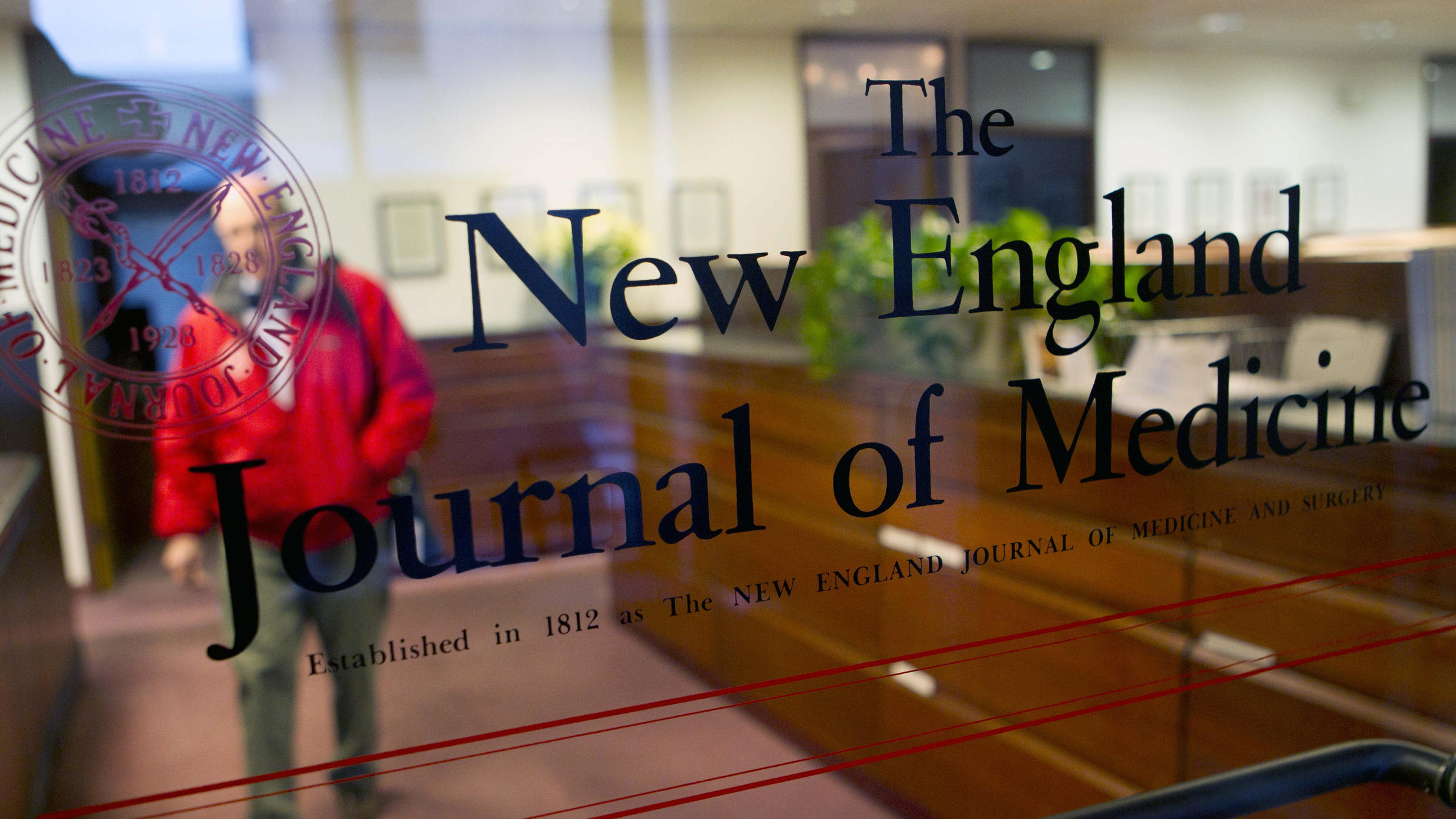
For its first 208 years, the New England Journal of Medicine has never endorsed a political candidate. But this week the journal published an editorial outlining its political position in the upcoming Presidential election, signed unanimously by all editors who are US citizens.
The editors did not explicitly endorse former Vice President Biden, but rather offered a scathing condemnation of the current administration’s performance during the COVID pandemic:“Reasonable people will certainly disagree about the many political positions taken by candidates.
But truth is neither liberal nor conservative. When it comes to the response to the largest public health crisis of our time, our current political leaders have demonstrated that they are dangerously incompetent. We should not abet them and enable the deaths of thousands more Americans by allowing them to keep their jobs.” (Formally endorsing Biden last month, Scientific American also made the first political endorsement in its 175-year history.)
Much of the media coverage of the NEJM statement has centered on the question of whether medicine should involve itself in politics, or “live above it”.
Medicine has been drawn into political disputes before, but now the nature of the involvement has changed. In the past, debates largely centered around regulation, payment or policy—but now the science itself has become a fundamentally political issue.
The very nature of the coronavirus has become a matter of political belief, not just an indisputable scientific fact.
Public trust in both scientific institutions and the government, and their ability to work together, has been damaged. We fear this will lead to poorer health outcomes regardless of who wins the upcoming election.
Along with the many political and public health questions raised by President Trump’s recent and very public bout with COVID-19 is the issue of when the public might have access to the same monoclonal antibody therapy that he received from doctors last week.
Having seen the President tout the benefits of Regeneron’s experimental antibody cocktail, COVID patients have reportedly been asking physicians about participating in clinical trials of the therapy, which is only available on a “compassionate use” basis outside of ongoing studies.
On Wednesday, Regeneronannounced it had submitted a request to the US Food and Drug Administration (FDA) for an Emergency Use Authorization (EUA) for the treatment, claiming that early data from ongoing trials showed promise in moderating coronavirus symptoms.
Eli Lilly, which is developing a similar antibody therapy, also announced plans to apply for an EUA, saying its drug has shown the ability to reduce hospitalizations among those infected with the virus.
The US government has already paid Regeneron $450M to access up to 300,000 doses of the therapy, and on Friday a spokesman for the Department of Health and Human Services (HHS) said the government would acquire up to a million doses from Regeneron and Eli Lilly by the end of the year, which it will allocate to hospitals in a similar approach to the way it has distributed Gilead Science’s antiviral drug remdesivir, which the President was also given last week.
News on the availability of potentially effective therapies to mitigate the impact of COVID-19 is welcome, particularly as thetimeline for COVID vaccines appears to be lengthening.
In guidance released this week, the FDA said it would require pharmaceutical companies to submit two months’ worth of data on vaccine safety and efficacy after patients received their final dose, as part of the EUA application process. The data requirement effectively means that, despite repeated promises from the White House, none of the vaccine candidates being developed will be available before the November 3rd Presidential election.
The head of the government’s vaccine program said separately this week that he expects data on vaccines being developed by Pfizer and Moderna to be available by December. As many have predicted, it will take months beyond that for a safe and effective vaccine to be distributed and administered to a majority of Americans.
Challenges will abound: ensuring sufficient manufacturing capacity, managing a complex supply chain, setting up specialized distribution and vaccination centers, and tracking those vaccinated (especially if two shots will be required). A massive public education campaign will also be needed to overcome vaccine hesitancy and ensure widespread immunization. And all of that will take time, and money.
President Trump’s recent and unfortunate illness underscores the importance of paying equal attention to the development of therapies and treatments—which are essentially a holding maneuver to get us through the coming winter and spring, and eventually to the promise of immunity that lies beyond.
The COVID-19 pandemic is rife with scientific and medical uncertainty, including debates about the ethics of using experimental treatments.
The big picture: As the global pandemic continues, the tension between providing the best available care for patients and performing trials to determine whether that care is effective risks complicating the medical response.
The big question: Is it unethical to withhold a possible treatment from someone who instead receives a placebo, or to continue to administer that treatment without having collected data on whether it works?
Driving the news: President Trump received an experimental monoclonal antibody cocktail via expanded access or “compassionate use,” which allows someone to access a treatment outside of a clinical trial before it is approved, provided their doctor, the drug company and the FDA agree.
Experts say his subsequent claims of the treatment being a cure risks reducing enrollment in clinical trials, flooding companies with requests for access to a limited number of doses andcreating false hope for patients.
“It’s important that we not say the president got access to a beneficial experimental intervention because we don’t know if it is beneficial or if there are adverse events associated with it,“ says Alex John London, director of the Center for Ethics and Policy at Carnegie Mellon University.
He and other ethicists say the president’s treatment highlights a broader question about the ethical obligation doctors have to the science needed to determine if those treatments are effective.
Between the lines: Offering patients experimental COVID-19 drugs via emergency use authorizations, expanded access programs and compassionate use can slow needed clinical trials.
Researchers have struggled to enroll people in clinical trials in which they may receive a placebo if patients can access a drug directly.
One example: “There’s been some hiccups with the expanded access use for convalescent plasma, because it was something that precluded people from enrolling in a randomized control trial, so it took longer, and we still don’t quite know how well convalescent plasma works,” says Amesh Adalja, an infectious disease physician and senior scholar at the Johns Hopkins Center for Health Security.
More than 100,000 COVID-19 patients at almost 2,800 U.S. hospitals received convalescent plasma from people who survived the virus and developed antibodies to it.
“It’s easy for people to say you enrolled 100,000 people, there should have been a trial. But a small number of those 2,800 hospitals would have been capable of doing those trials,” says the Mayo Clinic’s Michael Joyner, who leads the program.
There are now smaller trials taking place to answer questions about the effectiveness of plasma in treating the disease in different stages.
But if this happens again, Joyner says programs at academic medical centers should be peeled off earlier to form clinical trials run in parallel.
The gold standard for determining whether a treatment works is through randomized controlled trials in which people are randomly assigned to receive a treatment or to be in a control group.
In the uncertainty and urgency of a pandemic, some physicians argue randomizing people to receive a placebo goes against physicians’ ethics and that it is better to do something to help patients than do nothing.
“That’s a false dichotomy because the question is, what should we do?” says London.
From a doctor’s perspective, it’s important to weigh the collective value of theearly drug data and the individual needs of the patient, Adalja says.
“I do think you have to be extra careful when you’re thinking about drugs that you don’t have strong randomized control trial data for, or the data is incomplete or inconclusive,” he adds.
“What people have to ask themselves is what constitutes evidence or proof and where do you want to make the bets in a pandemic?” says Joyner.
“There is a moral, legal and public health obligation to do those trials before people use those products,” says Alison Bateman-House, a professor of medical ethics at NYU’s Grossman School of Medicine who co-chairs an international working group on pre-approval access to treatments.
She says she understands the emotional pull on doctors to help patients whose health is quickly deteriorating, “but it is not evidence-based medicine.”
“There is no ethical obligation to give anyone an unproven substance.”
— Alison Bateman-House, NYU Grossman School of Medicine
In a forthcoming paper, London argues that when medical professionals don’t have the knowledge they need to treat patients, it is their responsibility “to band together and run studies to get evidence to discharge [their] very ancient medical obligation.”
Medical ethics should be updated to include a responsibility to learn in the face of uncertainty, says London, who was part of a committee that called for research to be incorporated into the response to the Ebola outbreak in West Africa in 2014.
The U.K.’s large randomized RECOVERY trial is based in part on the Ebola experience, says London. “Because of it, we know dexamethasone is effective and hydroxychloroquine is not.”
What to watch: How the FDA’s handling of treatments during the pandemic influences other drugs and diseases once the pandemic ends.
The bottom line: “Medicine doesn’t have a good handle on uncertainty, and that is a problem,” says London.
The D.C. Health Department is trying to jump-start contact tracing efforts around the White House’s coronavirus outbreak. Tracing has been inadequate so far even as cases spread deeper into the city, Axios’ Marisa Fernandez writes.
The big picture:The White House has decided not to move forward with recommended public health protocols of contact tracing and testing since President Trump tested positive for the virus.
The state of play: Tracing has been done for people who had direct contact with Trump, White House spokesman Judd Deere told the Washington Post.
On Capitol Hill, there’s also no formalized contact tracing program in place, even as lawmakers themselves test positive.
Two infected staffers in Rep. Doug Lamborn’s (R-Colo.) office were told to not disclose to roommates they may have been exposed, WSJ reports.
The bottom line:The White House’s refusal to contact trace is “a missed opportunity to prevent additional spread,” Emily Wroe, a co-leader of a contact-tracing team at Partners in Health, told Nature.
The quarantining of most of the Joint Chiefs of Staff, coming on the heels of President Trump’s COVID-19 diagnosis, is raising fears that U.S. adversaries might seek to exploit a perceived weakness.
Few expect any sort of overt military action, but there are other ways to wreak havoc on the United States.
Chief among them is disinformation. Experts have been warning ever since Trump tested positive for the coronavirus last week that disinformation is likely to kick into overdrive.
Now, with six of the seven members of the Joint Chiefs of Staff waylaid at home, warnings are being amplified about the national security implications of the growing COVID-19 outbreak among U.S. leadership.
“All these kinds of things are just a huge distraction for us where our national security apparatus is consumed with matters domestic and internal,” former Director of National Intelligence James Clapper said at a Washington Post event after news broke of the Joint Chiefs quarantining. “So this is an ideal time for adversaries, particularly in adversary intelligence services, to look for ways to further confuse us, to distract us.”
Adding that “you can bet particularly our good friends the Russians are doing this,” Clapper warned of them “further sowing seeds of disinformation.”
“They will appeal to all the various tribes and continue to capitalize on the polarization in this country,” he said. “So it is a vulnerable time, and it’s an opportunity for them while we’re not looking and not being alert to further sow seeds of disinformation, casting doubt, discord, distrust in the country.”
The quarantining of top military officers stems from the Coast Guard’s No. 2 admiral contracting COVID-19. The Coast Guard announced Tuesday that its vice commandant, Adm. Charles Ray, tested positive for the coronavirus on Monday after feeling mild symptoms over the weekend.
The test result came after Ray met with most of the Joint Chiefs of Staff at the Pentagon on Friday.
That put Joint Chiefs of Staff Chairman Gen. Mark Milley into quarantine, as well as the chiefs of the Army, Navy, Air Force, Space Force and National Guard. The vice chairman, Gen. John Hyten, was also in the meetings and is quarantining.
The only member of the Joint Chiefs who didn’t meet with Ray was Marine Corps Commandant Gen. David Berger, who was traveling.
Berger’s deputy, Gen. Gary Thomas, met with Ray instead and went into quarantine Tuesday. The Marine Corps announced Wednesday evening that he has tested positive for the virus.
Gen. Paul Nakasone, commander of U.S. Cyber Command and director of the National Security Agency, also met with Ray and went into quarantine.
It’s unclear exactly where Ray caught the virus, but his schedule within the incubation period included a visit to the White House, which is now considered the epicenter of a coronavirus outbreak that includes Trump himself.
Ray — along with Milley, Defense Secretary Mark Esper and other top defense officials — attended a White House ceremony for Gold Star families on Sept. 27.
The event happened the day after Trump announced he was nominating Amy Coney Barrett for the Supreme Court, a gathering for which several attendees have since been diagnosed with COVID-19.
Since Trump’s diagnosis, the Department of Defense has sought to allay any national security concerns.
When Trump’s positive test was first announced last week, the Pentagon insisted there has been “no change to DoD alert levels.”
After news broke Tuesday of the Joint Chiefs quarantining, chief Pentagon spokesman Jonathan Hoffman reiterated that “there is no change to the operational readiness or mission capability of the U.S. Armed Forces.”
“Senior military leaders are able to remain fully mission capable and perform their duties from an alternative work location,” Hoffman said in a statement.
The military chiefs are well-equipped to work from home, and besides Ray and Thomas, none have tested positive for the virus yet.
But the development has raised questions about whether adversaries will try to take advantage of the situation nonetheless.
After the military quarantines were revealed, House Armed Services Committee Chairman Adam Smith (D-Wash.) said “the national security implications of the president’s recklessness cannot be overstated” even though the military “can still operate while leadership is quarantined.”
“Since announcing that he tested positive for the virus, the president’s antics have been downright reckless and harmful,” Smith said in a statement. “Our adversaries are always looking for any weakness to exploit. President Trump’s pathetic attempts to exude strength aren’t fooling anyone — Americans know he is weak and so do those who wish us harm.”
Rep. Jackie Speier (D-Calif.), another senior member of the Armed Services Committee, questioned why so many senior military leaders were meeting in person in the first place, as well as attending a White House reception in which they were pictured maskless.
“What if the Joint Chiefs’ responsibilities cannot be done remotely while they are isolating?” Speier wrote in a series of questions on Twitter. “How many other senior military leaders have tested positive? Why weren’t we safeguarding the health of senior military leaders like the natural security asset that it clearly is?”
Barry Pavel, senior vice president and director of the Atlantic Council’s Scowcroft Center for Strategy and Security, stressed that there is “no degradation in operational command and control” from the Joint Chiefs quarantining.
But, he added, adversaries such as Russia and China could misperceive that the United States is distracted and decide to act. For example, he cited concerns about China moving against Taiwan or Russia trying to grab more territory.
Pavel also listed what he called Russia’s “non-kinetic war” against the United States in the cybersecurity, influence and disinformation realm.
“This is a KGB officer’s most wildest dream coming true almost on a daily basis,” he said. “And so I think it’s a big threat. Who knows what proportion of our current public divisions are sown by Russian influence and bots or are just part of our current division. I don’t know the answer to that question. But they’re certainly right now exploiting it.”
To diminish those concerns, Pavel said, the Pentagon should keep emphasizing its military readiness, as well as demonstrating it by taking actions like publicizing a previously planned exercise.
“It’s probably a good idea to keep repeating those messages,” he said, “to be reiterating those messages, sending them publicly, privately, by third parties and through various forms of military activity so adversaries have no misunderstanding about our readiness and capabilities despite the chairman being quarantined in his quarters.”
U.S. states saw another 840,000 jobless claims filed last week, as the number of Americans applying for first-time unemployment insurance benefits each week continues to hover at a historically high level.
The U.S. Department of Labor (DOL) released its weekly jobless claims report at 8:30 a.m. ET Thursday. Here were the main metrics from the report, compared to Bloomberg estimates:
Initial jobless claims, week ended Oct. 3: 840,000 vs. 820,000 expected and 849,000 during the prior week
Continuing claims, week ended Sept. 26: 10.976 million vs. 11.4 million expected and 11.979 million during the prior week
New weekly unemployment insurance claims have held below the psychologically important 1 million mark for the past six consecutive weeks, but have so far failed to break below 800,000 since the start of the pandemic. At 840,000 last week’s new claims remained at a level still handily above the pre-pandemic record high of 695,000 from 1982.
The past two weeks’ jobless claims totals have also been flattered by an absence of updated new claims out of California. The state – which has consistently been one of the biggest contributors to new weekly claims – announced last week it was taking a two-week pause in processing initial claims to “reduce its claims processing backlog and implement fraud prevention technology,” according to the Labor Department’s statement.
Across all programs, the total number of jobless claims decreased for the week ending Sept. 19. Total claims came in at 25.5 million, down from the about 26.5 million during the previous week, as a smaller number of self-employed or gig workers not eligible for regular state programs claimed Pandemic Unemployment Assistance. But the number of workers collecting benefits through the Pandemic Emergency Unemployment Compensation Program – which offers an extra 13 weeks’ worth of federal benefits to those who had exhausted previous state or federal compensation – rose by 154,000 to 1.96 million.
Continuing jobless claims, which are reported on a one-week lag and represent the total number of individuals still receiving state unemployment benefits, continued their gradual downtrend last week. But as with new jobless claims, continuing claims have held well above pre-pandemic levels, and have not broken below the 10 million mark in more than 6 months.
“Net, initial filings fell less than expected last week. The improvement in continuing claims is reflecting people being hired but also individuals exhausting their benefits,” Rubeela Farooqi, chief economist for High Frequency Economics, said in an email. “Overall, the signal from the claims data is still one of ongoing weak conditions in the labor market. Even as filings are declining, levels remain extraordinarily high. Employment growth has already slowed and without fiscal support that protected jobs, risks are skewed to the downside for payrolls going forward.”
President Donald Trump said Tuesday he had asked his negotiators to halt further stimulus talks until after the election, but added that he would support standalone measures providing tens of billions of dollars for airline payroll support and the Paycheck Protection Program. House Democrats, however, have previously balked at the notion of passing slimmed down versions of a stimulus package – meaning the prospect of further fiscal stimulus in the next month remains unlikely.







 HENRY KOTULA