These Charts Put the Historic U.S. Job Losses in Perspective

These Charts Put the Historic U.S. Job Losses in Perspective

These Charts Put the Historic U.S. Job Losses in Perspective

These Charts Put the Historic U.S. Job Losses in Perspective

When recessions hit, it’s not unusual to see millions of jobs lost.

Such episodes are a regular part of the business cycle and when they occur, most businesses do their best to tough things out. Then, as time progresses, it gradually becomes clear that spending must be curtailed, budget cuts must be made, and workers must unfortunately be sent home.

This economic process normally takes months, or even years, to unwind.

But, the COVID-19 pandemic has thrown a wrench into the economic status quo, creating a situation that is incomparable to any previous downturn. Instead of a gradual economic transition to slower growth prospects, business operations have suddenly screeched to a halt with no clear window to resume.

Beyond Comparison

The Great Lockdown of the economy has been completely unprecedented, both in terms of the speed of the shutdown and its impact on jobs.

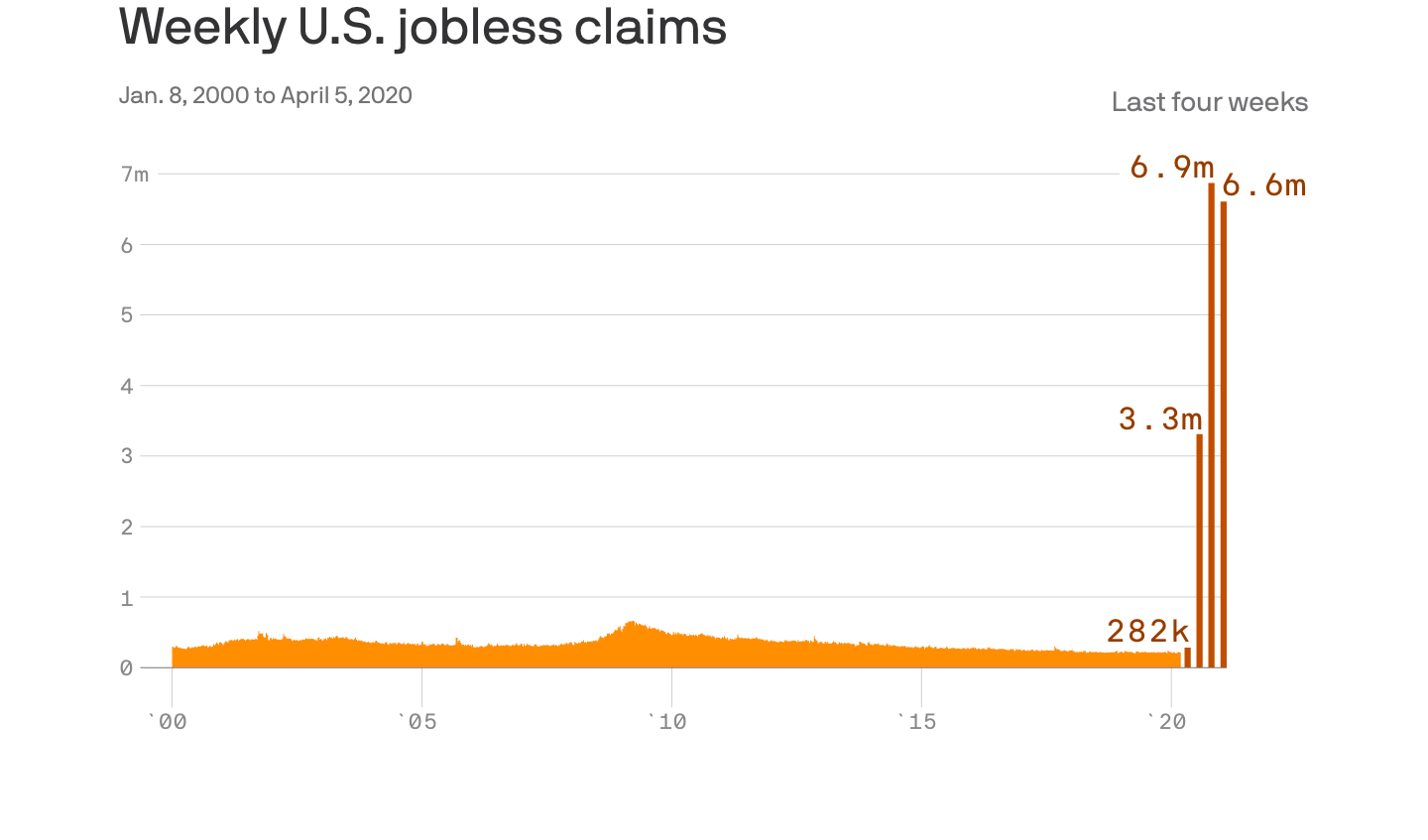
As a result, the statistics being released are completely surreal. Perhaps the best example of this is number for initial jobless claims in the U.S., which tops 22 million over the last four weeks.

Worst U.S. Job Losses on Record (Four Week Period)

Year Description Peak Jobless claims (4-wk total) % of U.S. Population
1975 Stagflation 2.24 million 1.0%
1980 Fed tightening (Volcker) 2.52 million 1.1%
1982 Double-dip recession 2.70 million 1.2%
1991 Early 1990s recession 2.00 million 0.8%
2001 Dotcom Bust 1.96 million 0.7%
2009 Great Recession 2.64 million 0.9%
2020 The Great Lockdown 22.03 million 6.7%

As you can see above, the number is 10x higher than many of the worst four-week job losses on record, so historical comparisons don’t come close.

In other words, if you were using recent recessions as a potential barometer of how bad things could get for jobless claims, the numbers coming from COVID-19 crisis just blew up your model.

The Recession Time Machine

To get further context on the numbers above, it’s worth jumping in a time machine to revisit what happened to job numbers in previous recessions:

  • Stagflation and Oil Shocks (1973-75)
    This recession put an end to the Post WWII global economic expansion, and was characterized by the 1973 oil embargo, the aftermath of the Nixon Shock, and the collapse of the Bretton Woods system of international finance. Unemployment and inflation were both high (stagflation), and the unemployment rate in the U.S. reached 9.0% in May 1975.
  • The Double-Dip Recession (1980, 1981-1982)
    This “W-shaped” recession saw economic contraction first in 1980, only to return again in 1981. This corresponded with the Iranian Revolution, as well as Fed chair Paul Volcker’s aggressive policy to rein in inflation with high interest rates. Unemployment peaked at 10.8% in 1982 — the highest rate seen since the Great Depression.
  • The Great Recession (2009)
    The most recent recession in memory peaked with 10.0% in unemployment in October 2009. It took until 2016 for unemployment to fall back to pre-recession levels.

Finally, it’s worth noting that during the Great Depression (1929-1933), unemployment reached a historic high of 24.9%. To get to a comparable equivalent in modern times, there would need to be 41 million Americans out of work permanently.

Room for Optimism

Although the initial jobless claims are staggering and clearly without modern precedent, there is a case to be made for cautious optimism.

Many of the aforementioned recessions took months or years to culminate, with peak job losses occurring at the tail end of each recession. The current crisis, now being called “The Great Lockdown”, caused many businesses to shut doors suddenly and against their will. It also corresponded with unexpected closures of national borders and the halting of regular trade activity around the world.

When and if normal economic activity resumes, it’ll be interesting to see how much of the damage is temporary.


Another 5.2 million jobless claims filed last week amid coronavirus crisis

https://www.axios.com/coronavirus-unemployment-filings-caded026-fce4-43cc-8dc0-5f0037747b69.html?stream=top&utm_source=alert&utm_medium=email&utm_campaign=alerts_all

Arrow

Another 5.2 million Americans filed for unemployment last week, the Labor Department announced Thursday.

Why it matters: With the more than 16 million jobless claims filed over the past three weeks, more jobs have now been lost in the last month than were gained since the Great Recession.

The big picture: The weekly unemployment filings report has become a must-watch for Wall Street and economists. It offers the timeliest glimpse into how efforts to contain the coronavirus outbreak are ravaging the job market.

  • And economists say that as bad as these weekly numbers look on the surface, they’re likely even higher. There are widespread complaints that state labor departments are having trouble processing the never-before-seen wave of jobless filings.

The bottom line: In just one month, the coronavirus economic shutdown has caused a staggering 22 million Americans to lose their jobs.


California governor unveils roadmap for relaxing coronavirus lockdowns

https://www.axios.com/california-newsom-coronavirus-restrictions-3195f1b4-cbf8-4205-aeda-500d1e965486.html

California governor unveils roadmap for relaxing coronavirus ...

California Gov. Gavin Newsom released a roadmap on Tuesday that will guide how he will make the decision to relax the stay-at-home policies his state implemented to combat the spread of the coronavirus.

The big picture: While there is no timeline for modifying the stay-at-home order, Newsom’s office said California would use a “gradual, science-based and data-driven framework” to determine when it would be safe to do so. Newsom indicated efforts to flatten the curve in California “have yielded positive results.”

  • California had 24,421 confirmed cases of COVID-19 as of Tuesday afternoon, per the LA Times.
  • On Monday, Newsom announced California would create a task force with Oregon and Washington to coordinate the reopening of the regional economy. Northeastern states have announced a similar plan.

Details: Newsom said California would use six indicators to determine when to relax social distancing measures:

  1. “The ability to monitor and protect our communities through testing, contact tracing, isolating, and supporting those who are positive or exposed.”
  2. “The ability to prevent infection in people who are at risk for more severe COVID-19.”
  3. “The ability of the hospital and health systems to handle surges.”
  4. “The ability to develop therapeutics to meet the demand.”
  5. “The ability for businesses, schools, and child care facilities to support physical distancing.”
  6. “The ability to determine when to reinstitute certain measures, such as the stay-at-home orders, if necessary.”

Newsom’s roadmap also notes that life will be different even after stay-at-home orders are eased. For example, restaurants will likely reopen with fewer tables and face coverings will be more common in public.

What he’s saying: “While Californians have stepped up in a big way to flatten the curve and buy us time to prepare to fight the virus, at some point in the future we will need to modify our stay-at-home order,” Newsom said.

  • “As we contemplate reopening parts of our state, we must be guided by science and data, and we must understand that things will look different than before.”
  • “There is no light switch here. Think of it as a dimmer. It will toggle between less restrictive and more restrictive.”


We can’t just flip the switch on the coronavirus

https://www.axios.com/coronavirus-slow-recovery-econony-deaths-27e8d258-754e-4883-bebe-a2e95564e3b6.html

The end of the coronavirus lockdown won't be like flipping a ...

It feels like some big, terrible switch got flipped when the coronavirus upended our lives — so it’s natural to want to simply flip it back. But that is not how the return to normalcy will go.

The big picture: Even as the number of illnesses and deaths in the U.S. start to fall, and we start to think about leaving the house again, the way forward will likely be slow and uneven. This may feel like it all happened suddenly, but it won’t end that way.

What’s next: Nationally, the number of coronavirus deaths in the U.S. is projected to hit its peak within the next few days. But many big cities will see their own peaks significantly later — for them, the worst is yet to come.

  • The White House is eyeing May 1 as the time to begin gradually reopening the economy. But that also will not be a single nationwide undertaking, and it will be a halting process even in the places where it can start to happen soon.
  • “In principle it sounds very nice, and everyone wants to return to normalcy. I think in reality it has to be incredibly carefully managed,” said Claire Standley, an infectious-disease expert at Georgetown University.

The future will come in waves — waves of recovery, waves of more bad news, and waves of returning to some semblance of normal life.

  • “It’s going to be a gradual evolution back to something that approximates our normal lives,” former Food and Drug Administration Commissioner Scott Gottlieb said.

What the post-lockdown world will look like:

  • Some types of businesses will likely be able to open before others, and only at partial capacity.
  • Stores may continue to only allow a certain number of customers through the door at once, or restaurants may be able to reopen but with far fewer tables available at once.
  • Some workplaces will likely bring employees back into the office only a few days a week and will stagger shifts to segregate groups of workers from each other, so that one new infection won’t get the whole company sick.
  • Large gatherings may need to stay on ice.

And there will be more waves of infection, even in areas that have passed their peaks.

  • “Everything doesn’t just go down to zero” once a city or region gets through its initial crush of cases, said Janet Baseman, a professor of epidemiology at the University of Washington.
  • This is happening now in Singapore, which controlled its initial outbreak more effectively than almost any other country in the world but is now seeing the daily number of new cases climb back up.

This is all but inevitable in the U.S., too, especially as travel begins to pick back up. Some places may need to shut down again, or at least tighten back up, if these new flare-ups are bad enough.

  • Part of the reason to lock down schools, businesses and workplaces is to prevent an outbreak from overwhelming the local health care system. If new cases start to pile up too quickly, leaders may need to pump the brakes.
  • “If you go back to normal too fast, then cases start to go up quickly, and then we end up back where we started,” Baseman said.
  • The good news, though, is that hospitals should have far more supplies by the fall, thanks to the coming surge in manufacturing for items like masks and ventilators.

What we’re watching: We’ll still need a lot more diagnostic testing to make this process work. Public health officials need to be able to identify people who might be spreading the virus before they begin to feel sick, and then identify the people they may have infected.

  • Most of the U.S. does not seem prepared for that undertaking, at least on any significant scale.
  • Another kind of test — serology tests, which identify people who have already had the virus and may be immune to it — will also help. We can’t test everyone, but identifying potential immunity could be important in knowing who can safely return to work in high-risk fields like health care.

The real turning point won’t come until there’s a proven, widely available treatment or, even better, a widely available vaccine.

  • A vaccine is still about a year away, even at a breakneck pace and if everything goes right. A treatment isn’t likely to be available until the fall, at the earliest.
  • In the meantime, all we can do is try to manage a slow recovery, using a less aggressive version of the same tools that are in place today.

The bottom line: “I’m not going back to Disneyland, I’m not going to take a cruise again, until we have a very aggressive testing system or we have very effective therapeutics or a vaccine,” Gottlieb said.


Bill Gates, in rebuke of Trump, calls WHO funding cut during pandemic ‘as dangerous as it sounds’

https://www.washingtonpost.com/nation/2020/04/15/who-bill-gates-coronavirus-trump/?fbclid=IwAR1AY1otbc2PccrdeOWGrWMyb7RznpZJMyGfMaOIe_09pw7WeS5kdvmHUvA&utm_campaign=wp_main&utm_medium=social&utm_source=facebook

Bill Gates: Trump halting funding to World Health Organization ...

Microsoft co-founder Bill Gates criticized President Trump’s decision to suspend funding to the World Health Organization as “dangerous,” saying the payments should continue particularly during the global coronavirus pandemic.

“Halting funding for the World Health Organization during a world health crisis is as dangerous as it sounds,” Gates tweeted early Wednesday. “Their work is slowing the spread of COVID-19 and if that work is stopped no other organization can replace them. The world needs @WHO now more than ever.”

The United States, the organization’s largest donor, has committed to provide the WHO with $893 million during its current two-year funding period, a State Department spokesperson told The Washington Post.

The Bill & Melinda Gates Foundation, the family’s giant philanthropy, is the next biggest donor to WHO after the U.S., accounting for close to 10 percent of the United Nations agency’s funding.

As The Washington Post’s Anne Gearan reported, the president said on Tuesday that the halt in U.S. funding would continue for a period of 60 to 90 days “while a review is conducted to assess the World Health Organization’s role and severely mismanaging and covering up the spread of the coronavirus.”

“We have not been treated properly,” Trump said at the Tuesday news briefing. He added, “The WHO pushed China’s misinformation about the virus.”

It remains unclear whether the United States will cut off money to the main international organization, or if Trump is setting conditions for a resumption of U.S. payments at a later date, The Post reported.

The announcement looms as a potentially devastating blow to the agency during the coronavirus pandemic, as the United States’ donations make up nearly 15 percent of all voluntary donations given worldwide.

The criticism from Gates, whose foundation has committed up to $100 million as part of the global response to the pandemic, comes as Trump has attempted to deflect blame for the administration’s failure to respond vigorously and early to the deadly novel coronavirus.

Also defending the WHO was U.N. Secretary General António Guterres, who, while not naming Trump, said it was “not the time to reduce the resources for the operations of the World Health Organization or any other humanitarian organization in the fight against the virus.”

“Now is the time for unity and for the international community to work together in solidarity to stop this virus and its shattering consequences,” he said.

Others, such as the American Medical Association, called Trump’s announcement to cut WHO funding “a dangerous step in the wrong direction.”

“Cutting funding to the WHO — rather than focusing on solutions — is a dangerous move at a precarious moment for the world,” the organization said in a statement. “The AMA is deeply concerned by this decision and its wide-ranging ramifications, and we strongly urge the President to reconsider.”

While some of Trump’s conservative allies are focusing on the WHO as complicit in a Chinese coverup of the outbreak, others have urged the president to hold off on moving forward on suspending funding.

“If the president wants to genuinely hold the WHO accountable, counter Chinese efforts to shift blame for COVID-19, and reform the WHO to better respond to the next pandemic, he should not cut funding — at least not yet,” wrote Brett D. Schaefer, an expert at the conservative Heritage Foundation and member of the U.N.’s Committee on Contributions.

It isn’t the first time that Gates has questioned the country’s response to the pandemic. In a TED interview last month, Gates, while not mentioning Trump by name, suggested the push to relax social distancing to reopen the country was reckless.

“There really is no middle ground, and it’s very tough to say to people: ‘Hey, keep going to restaurants, go buy new houses, ignore that pile of bodies over in the corner. We want you to keep spending because there’s maybe a politician who thinks GDP growth is all that counts,’” Gates said. “It’s very irresponsible for somebody to suggest that we can have the best of both worlds.”

In a March 31 op-ed for The Post, Gates emphasized that while the U.S. lost valuable time in getting out ahead of its response, there was still a path forward for recovery through decisions made by “science, data and the experience of medical professionals.”

“There’s no question the United States missed the opportunity to get ahead of the novel coronavirus. But the window for making important decisions hasn’t closed,” Gates wrote. “The choices we and our leaders make now will have an enormous impact on how soon case numbers start to go down, how long the economy remains shut down and how many Americans will have to bury a loved one because of covid-19.”


Hospitals will need a Bailout

https://www.beckershospitalreview.com/hospital-management-administration/kaleida-health-ceo-hospitals-will-need-a-bailout.html?utm_medium=email

We Tracked the Last Time the Government Bailed Out the… — ProPublica

The CEO of Kaleida Health in Buffalo, N.Y., said hospitals will likely need a bailout due to COVID-19, according to local news station WGRZ.

Kaleida Health President and CEO Jody Lomeo highlighted parallels between hospitals and U.S. automakers during the Great Recession. 

“I would think there’s gonna have to be some reimbursement on some level and we’ve seen some of that already with the [recent federal] stimulus bill. We’re gonna need support,” he told WGRZ. He added that his health system “can survive for a couple of months; after that I would be really nervous.”

While federal stimulus funds have begun flowing to hospitals nationwide, hospital CEOs are blasting HHS’ decision to distribute the first $30 billion in emergency funding based on Medicare fee-for-service revenue. HHS said April 10 it would allocate money to hospitals and providers based on their historical share of revenue from the Medicare program, rather than the burden caused by the coronavirus or number of uninsured patients treated.


Bill Gates says the world is entering ‘uncharted territory’ because it wasn’t prepared for a pandemic like COVID-19

https://www.businessinsider.com/bill-gates-warns-world-is-entering-uncharted-territory-coronavirus-2020-4

5 Books Bill Gates Wants You to Read This Summer | Time

  • Microsoft cofounder Bill Gates said the world was entering into “uncharted territory” because it was not prepared for a pandemic like COVID-19, the disease caused by the novel coronavirus.
  • Speaking to “BBC Breakfast” by video chat on Sunday, Gates said the world should’ve invested more in mitigating a global health crisis.
  • “There is the period where the virus shows up in those first few months,” he said. “Were the tests prepared? Did countries think through getting their ICU and ventilator capacity up?”
  • He added that once the crisis is over “very few countries are going to get an A grade” for their handling of the outbreak.

Microsoft cofounder Bill Gates said the world was entering into “uncharted territory” because it was not prepared for a pandemic like COVID-19, the disease caused by the novel coronavirus.

Gates, who has been warning about the risk of a pandemic disease for years and who has poured millions into fighting the new coronavirus outbreak, told “BBC Breakfast” on Sunday that the world should have invested more into mitigating a global health crisis.

“Well, there was a period when I and other health experts were saying that this was the greatest potential downfall the world faced,” he told the BBC in an interview on Sunday, highlighting his previous warnings against the possibility of a deadly pandemic.

“So we definitely will look back and wish we had invested more,” he said, “so that we could quickly have all the diagnostics, drugs, and vaccines. We underinvested,” he said.

The 67-year-old billionaire warned that in the period before COVID-19 became a public-health crisis, countries could have better prepared their testing capabilities and made sure hospitals were stocked with ventilators and other necessary health supplies.

“There is the period where the virus shows up in those first few months,” he said. “Were the tests prepared? Did countries think through getting their ICU and ventilator capacity up?”

He added that once the crisis is over “very few countries are going to get an A grade” for their handling of the outbreak.

“Now, here we are, we didn’t simulate this, we didn’t practice,” he said. “So both in health policies and economic policies, we find ourselves in uncharted territory.”

Gates has become an outspoken advocate for preparing for a global health crisis like COVID-19.

Speaking to the Financial Times earlier this month, Gates said that COVID-19 was the “biggest event that people will experience in their entire lives” and world leaders and global policymakers have “paid many trillions of dollars more than we might have had to if we’d been properly ready.”

He told FT he was confident that lessons learned from this outbreak would encourage people to better prepare for next time but lamented that the cost this time around was too high.

“It shouldn’t have required a many trillions of dollars loss to get there,” he said. “The science is there. Countries will step forward.”


Cartoon – Society Going Cashless

Today's cartoons: Getting used to a cashless society – Orange ...

When the coronavirus lockdowns end, we will live in a shrunken world

https://www.yahoo.com/news/coronavirus-lockdowns-end-live-shrunken-122800321.html

Flipboard: When the coronavirus lockdowns end, we will live in a ...

  • A projection from the Department of Homeland Security, published by the New York Times, shows coronavirus cases spiking again at the end of summer.
  • It’s a stark reminder that American life after lockdown will still be one of limited human interaction. And that means we’ll have to live with a smaller economy too. 
  • The economy will be packed with uncertainty given the possibility of another shelter-in-place order.
  • Until we can all hang out again with confidence, the US economy is going to be a shell of its former self.

When the US emerges from its various shades of shelter-in-place orders, it will emerge to a shrunken global economy. One that will not easily be inflated living within parameters the coronavirus demands.

Financial transactions are a form of human interaction, and even after strict orders to stay at home are lifted, Americans will need to limit human interaction to mitigate the spread of coronavirus. One projection from the Department of Homeland Security, first reported by the New York Times, imagines a world where schools remain closed, 25% of Americans work from home, and social distancing remains in place through the summer.

And people will still be scared. They will know that there is an deadly virus infecting people who interact with other people.

In this scenario, back to work doesn’t mean back to growth because people won’t be spending money the way they did before. Back to work simply means finding a more sane, stable way to maintain society until we get a vaccine. There will be no V-shaped recovery. This is a marathon, and if we’re lucky, we will limp across the finish line.

As incomplete as it is, China is the best picture we have for understanding what a life after lockdown looks like, and it doesn’t look like a booming economy. 460,000 businesses closed permanently in China during the first quarter.

One Chinese county has gone back into lockdown already. In Beijing — where state media says epidemic prevention and control will “probably” become “long-term normal” — restaurants have been ordered to maintain social distance by cutting seating in half and limiting tables to three people. Customers have been slow to come back anyway.

All of this is to say that even if we’re out of lockdown, this saga isn’t remotely over.

Deflation strikes back

What China’s economy is telling us is that once this weird supply funk brought on by everyone staying home is over, and some people are able to go back to work, we’ll still have a demand crisis. Even though the virus has been contained analysts at Oxford Economics told clients it expects to see “basically no growth” in China this year. With other global economies weakened it will sell fewer exports. 

Zhu Jun, director of the international department of the People’s Bank of China, said that there’s a small chance the world risks another Great Depression. Cheery, I know, but until there’s a vaccine, optimism will be in short supply.

Here in the US, just as in China, people will be broke and businesses will be broken. Money will be scarce. Demand will be depressed not just because of a lack of funds, but because people will have changed their behavior to avoid getting sick. 

Wall Street it seems, hasn’t processed this bad news yet. It’s taking this pandemic day-by-day, not looking at life after lockdown. This week the market rallied on news that all over the US, even New York City, the curve is flattening. It was a silly rally.

It’s silly for the market to declare victory before we’ve even seen how much damage has been done (that will take months at least). It’s silly to expect any kind of stability until we know what kind of demand a post-shelter-in-place, pre-vaccine American economy will have.

Finally, we don’t know how long Washington will be in a giving mood. So far the Federal Reserve has pulled out all the stops, and Congress has approved trillions in aid. But will Washington keep sending checks to unemployed Americans until we have a vaccine? 

US employment by industry who can work from home

We thought we knew uncertainty

I think back to all the times I’ve heard CEOs and Wall Street types talk about uncertainty around regulations, or elections, or literally anything else that has happened in my life time, and I have to laugh. All of it seems silly compared to the uncertainty before us right now.

It is quite possible that sometime this summer scientists will develop a treatment for COVID-19 that makes the symptoms much more mild — something more like a standard, week-long flu. That discovery could make things a lot easier, and really bolster confidence enough to bring the economy back until we have a vaccine. But government officials obviously can’t plan with that in mind. Neither can businesses.

And so, those charged with imagining the worst case scenario must imagine a world where Americans are again forced to shelter-in-place to flatten the curve. Homeland Security’s projections put a resurgence of the virus somewhere around the end of summer to the beginning of fall. It’s not unreasonable to think certain populations may have to go back into shelter-in-place then.

Singapore has a robust system of testing for and tracking the coronavirus and its citizens went back into shelter-in-place this week. Here in the US we don’t have such a system. Last week the White House ended federal funding for its drive-thru testing site program.

On Friday New York Governor Andrew Cuomo urged the President to invoke the Defense Production Act to ramp up production of antibody tests that can show who has been infected with the coronavirus and built up immunity. That would allow people to go back to work, but the federal government will only be able to produce 2,000 a day in the next two weeks. 

As a nation, we need to be doing everything we can to ensure that when this lockdown is over, those who can go out can do so with as much confidence as possible. We need to inject as much certainty into this situation as possible Without testing, that’s not happening.

In an interview with CNBC, Bill Gates — the Microsoft founder and billionaire philanthropist who has dedicated a significant chunk of his charitable efforts to studying pandemics — said the federal government simply doesn’t seem interested in a unified testing system. This is one of the few variables in this pandemic the government can control, and it’s blowing it.

Testing is one of the only things that will make our beleaguered, shrunken coronavirus economy a little bit bigger. It’s one of the only ways we can impact the ugly twist of this economic downturn, behavior.

Even then, though, the possibility of an outbreak in a workplace, city, or state will change the way our economy works in ways that will make money scarce. We need to be ready for that.


Another 6.6 million jobless claims filed last week amid coronavirus crisis

https://www.axios.com/coronavirus-unemployment-filings-6cb04d2d-9cc4-45b4-a473-9acbf4c99d43.html?stream=top&utm_source=alert&utm_medium=email&utm_campaign=alerts_all

Another 6.6 million jobless claims filed last week amid ...

Another 6.6 million Americans filed for unemployment last week, the Labor Department announced Thursday.

Why it matters: It adds to the staggering 10 million jobless claims in recent weeks — by far the sharpest spikes in American history — as the world economy has ground to a halt in an effort to contain the coronavirus outbreak.

  • The once-again colossal number of filings was worse than the 5 million that Wall Street had expected.
  • Last week’s unemployment claim numbers, which government data had pegged at 6.65 million, were revised upward to 6.87 million — the highest ever recorded.

The big picture: The data lags by a week, so while a large portion of the economic shutdown is now evident over the last three weeks, there may still be more huge numbers yet to come.

  • The $2.2 trillion coronavirus stimulus package opened the door to a surge of new unemployment filings, allowing the self-employed and independent contractors to claim benefits.