


Fighting the Coronavirus War
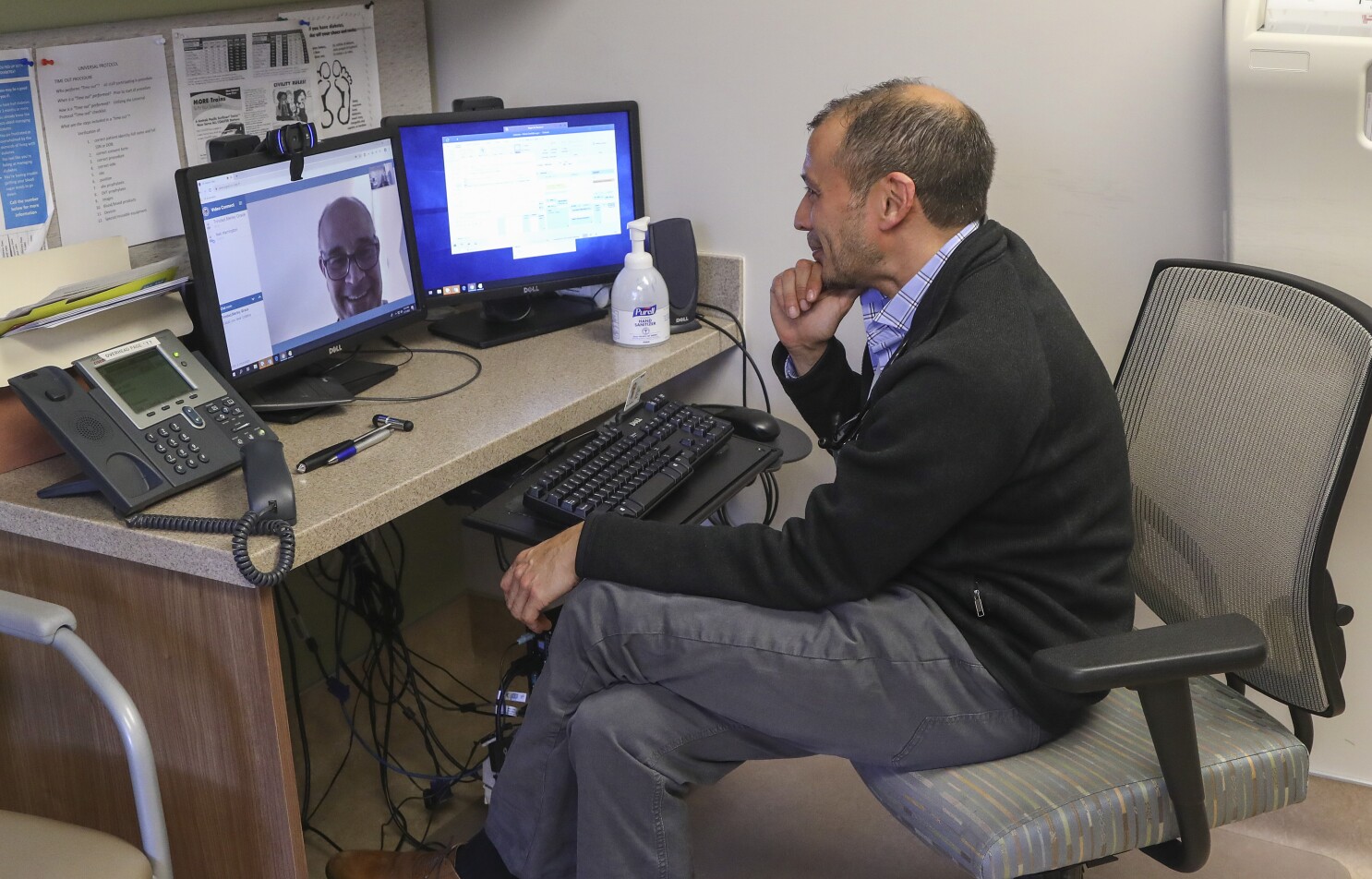
As a physician, waiting for the worst of coronavirus to hit, I see a lot to fear. It seems increasingly likely that this will be one of the most significant pandemics in modern human history, and that it will change our approach to healthcare going forward. But not all of its legacy will be negative. Here’s one thing I hope will come out of the crisis: an increased reliance on telemedicine, something that should have happened long ago.
A few months ago, when I was between jobs, I took a part-time job in a rural hospital serving a county of more than 150,000 people. On the verge of bankruptcy, the hospital was unable to attract many specialists to join its ranks, and in desperation, had turned to telemedicine to cover many services. So, for example, if a patient was rushed to the emergency room after a stroke, there was unlikely to be a neurologist in the room. Instead, a neurologist would assess the patient on a mobile screen from far away, with local nursing staff and doctors aiding him or her.
I had been skeptical of telemedicine going in. Physical exams are the bedrock of how doctors and nurses assess patients. We look patients and their loved ones in the eye, palpate sore spots with our fingers and offer comfort with a hand on a shoulder. Physical contact, I’d always thought, was at the heart of how doctors and patients communicate.
It was with this skepticism that I found myself next to a young man who been brought to the emergency room after attempting to take his own life. Again. This time, instead of seeing a psychiatrist in person, he saw one on a screen with wheels. The psychiatrist was in some distant location, but she had been in touch with the local doctors and had access to his medical records. Despite her physical remoteness, she connected with him, and he opened up. She knew of all the local resources to refer him to, and at the end of her conversation, she had developed a real rapport with him. After the visit ended and the nurse wheeled the monitor out of the room, I asked the young man what he thought, and to my surprise, he told me he was more comfortable with this than an in-person visit. He wasn’t the only one — many patients say they prefer a virtual doc to one sitting across from them.
Over the past few decades, medical care has been transformed by technology. Whenever a new drug becomes available, or a medical procedure is approved by the FDA, the medical community is quick to deploy it. Yet, when it comes to how we see patients, our current practices haven’t changed much since the time of Hippocrates. If a patient is sick they either have to come see us in clinic, urgent care, the emergency room or the hospital. Despite the internet transforming every aspect of our lives, from how we find love to how we order groceries, the way we deliver medical care has stagnated.
In the United States, not only are doctors often inaccessible for those living in rural areas, hospitals everywhere have huge economic challenges. One healthcare executive jokingly told me his hospital made more money from its parking lots than its clinics.
The response to COVID-19 might help change that.
One of the main reasons China has been able to slow coronavirus transmission has been because of a dramatic increase in virtual visits. In fact, China has moved half of all medical care online, allowing patients to consult with their doctors and get prescriptions from the comfort of their homes. Hospitals have been notorious petri dishes for deadly bugs since long before COVID-19, and this pandemic has brought that risk into crystal-clear focus. On Tuesday, Medicare announced that it will greatly expand coverage for telemedicine visits, previously sharply restricted. And at a White House briefing, the government announced it was urging states to similarly expand Medicaid coverage to include telemedicine visits by Skype, Facetime or other platforms. Some insurers have also said they will cover telehealth visits at parity with in-person visits.
These measures are commendable, but policies need to be put in place to ensure that the expansion of telemedicine is not temporary. Of course, in-person visits will still be necessary in many cases. But supporting telemedicine on a par with such visits has the potential to protect patients and healthcare personnel and allow for much more efficiency in the system. That said, physicians and nurses will need high-quality training to provide compassionate and thorough care to a patient from across a computer screen. Technology that allows patients to be “examined” remotely needs to be better studied and made more accessible. And since the backbone of telemedicine is reliable high-speed internet, Congress should consider Elizabeth Warren’s plan to bring broadband internet to the remotest parts of this country, to ensure broad access to these services.
This week my team converted most of our clinic visits from face to face to virtual visits. Some were over the phone, others were over video, often with a family member present as well. While there were some patients that still needed to be seen in person, we were able to minimize the risk of viral transmission not only for patients, but also for valuable members of our clinical team. Even before this crisis, as part of my job at the Veterans Affairs Health System in Boston, I often consulted with patients I had never seen as part of an “E Consult” system. While I was initially nervous when I first started doing this, it allowed me to expand my footprint far beyond what I could manage if I were seeing every patient in person.
At some point, I fervently hope the coronavirus will be a thing of the past. But I hope it leaves behind a legacy. I hope it changes how well we wash our hands, how well we fund public health and how well we protect the healthcare workers caring for our sickest patients. And, most of all, I hope it pushes us to embrace telemedicine.


“They were terrified. And that was the best-case scenario.”
Experts around the country have been churning out model after model — marshaling every tool from math, medicine, science and history — to try to predict the coming chaos unleashed by the new coronavirus and to make preparations.
At the heart of their algorithms is a scary but empowering truth: What happens next depends largely on us — our government, politicians, health institutions and, in particular, 327 million inhabitants of this country — all making tiny decisions on an daily basis with outsize consequences for our collective future.
In the worst-case scenario, America is on a trajectory toward 1.1 million deaths. That model envisions the sick pouring into hospitals, overwhelming even makeshift beds in parking lot tents. Doctors would have to make agonizing decisions about who gets scarce resources. Shortages of front-line clinicians would worsen as they get infected, some dying alongside their patients. Trust in government, already tenuous, would erode further.
That grim scenario is by no means a foregone conclusion — as demonstrated by countries like South Korea which has reduced its new cases a day from hundreds to dozens with aggressive steps to bolster their health system.
If Americans embrace drastic restrictions and school closures, for instance, we could see a death toll closer to thousands and a national sigh of relief as we prepare for a grueling but surmountable road ahead.
Doing that will require Americans to “flatten the curve” — slowing the spread of the contagion so it doesn’t overwhelm a health-care system with finite resources. That phrase has become ubiquitous in our national conversation. But what experts have not always made clear is that by applying all that downward pressure on the curve — by canceling public gatherings, closing schools, quarantining the sick and enforcing social distancing — you elongate the curve, stretching it out over a longer period of time.
Success means a longer — though less catastrophic — fight against the coronavirus. And it is unclear whether Americans — who built this country on ideals of independence and individual rights — would be willing to endure such harsh restrictions on their lives for months, let alone for a year or more.
This month began with U.S. officials recommending actions such as hand-washing and social distancing. By Sunday, the Centers for Disease Control and Prevention was warning against gatherings of 50-plus people. By Monday, President Trump had made an abrupt turn from encouraging Americans to go on with their lives, to urging them to work from home, not meet in groups of more than 10, and calling on local officials to close schools, bars and restaurants. (Getting the public to comply has been alarmingly difficult. Young revelers from Bourbon Street to Miami have ignored those pleas, as have some elderly, who are at highest risk.)
Trump’s sudden shift was driven by an alarming new scientific model, developed by British epidemiologists and shared with the White House. The scientists bluntly stated the coronavirus is the most serious respiratory virus threat since the Spanish Flu of 1918. If no action to limit the viral spread were taken, as many as 2.2 million people in the United States could die over the course of the pandemic, according to epidemiologist Neil Ferguson and others at the Imperial College Covid-19 Response Team.
Adopting some mitigation strategies to slow the pandemic — such as isolating those suspected of being infected and social distancing of the elderly — only cuts the death toll in half to 1.1 million, although it would reduce demand for health services by two-thirds.

Only by enacting an entire series of drastic, severe restrictions could America shrink its death toll further, the study found. That strategy would require, at minimum, the nationwide practice of social distancing, home isolation, and school and university closures. Such restrictions would have to be maintained, at least intermittently, until a working vaccine is developed, which could take 12 to 18 months at best.
The report’s conclusion: This is “the only viable strategy.”
Here is another thing that hasn’t been spelled out in our national conversation about flattening the curve: There will probably be more than one curve.
If we’re lucky, the coming months will probably look more like string of hilly bumps, say epidemiologists. If authorities ease some measures in coming months or if we start letting them slip ourselves, that hill could easily turn right back into the exponential curve that has cratered Italy’s health system and that U.S. officials are desperately trying to avoid replicating.
Climbing this first bump is in many ways the most challenging because it involves persuading people to change their individual behaviors for an abstract larger good — and because no one knows how far we actually are from the peak.
On Tuesday morning, New York Gov. Andrew M. Cuomo (D) said infections in his state are expected to peak in 45 days — at the start of May. The state has roughly 53,000 hospital beds, including 3,000 intensive-care beds — way short of the projected need for as many as twice that number of beds and as many as 11 times the number of ICU beds.
A day earlier, Northwell Health — whose 23 hospitals and 800 outpatient centers make up New York’s largest health system — canceled all elective surgeries in its hospitals to free up staff and space. It has 5,500 beds.
“We’re looking at Italy, which is currently 10 days ahead of us, and what they’ve had to do,” said Maria Carney, Northwell’s chief of geriatrics. Carney was health commissioner for New York’s Nassau County during the 2009 H1N1 outbreak and has worked furiously on Northwell’s plans to prepare for the coming tsunami.
One reason she and others are alarmed: In China, the fatality rate in Wuhan, the raging epicenter, was 5.8 percent. But in all other areas of the country it was 0.7 percent — a signal that most deaths were driven by an overwhelmed health system.
And U.S. hospitals are pinched as it is, with some already running at 95 percent capacity pre-coronavirus, Carney noted. As cases surge, Northwell plans to place multiple beds in single rooms. Its ambulances will also shuttle patients to less crowded satellite sites. Those suffering from ordinary emergencies — strokes, heart attacks, car accidents — may find themselves routed to other facilities away from ERs to avoid transmission.
But it’s unclear if it will be anywhere near enough.
Staffing shortages are already developing: As of Tuesday, 18 Northwell employees had already tested positive for the coronavirus. More than 200 were self-quarantined as a result of potential exposures, foreshadowing what is likely to come.
If the numbers next month get truly crazy, cities may look to convert stadiums into isolation wards, as in Wuhan. Cuomo has talked of turning the six-block-long Javits Convention Center on New York City’s west side into a medical surge facility. Others might take Italy’s approach and split hospitals into those treating coronavirus and those treating all other medical problems, to reduce transmission.
In San Francisco, we may see coronavirus patients put into RVs. In Takoma Park, Md., the old Washington Adventist Hospital site, which shuttered in 2019, could suddenly find its doors reopened.
As America enters this utterly unfamiliar territory, some experts have turned to history for glimpses of what to expect in the months ahead.
Initially leery of alarming the public, they have increasingly compared this pandemic to the 1918 Spanish flu, the deadliest in modern history. It infected roughly a third of the world’s population and killed at least 50 million people, including at least 675,000 in the United States.
Like the hilly bumps experts foresee in coming months, the 1918 pandemic hit America in three waves — a mild one that spring, the deadliest wave in fall and a final one that winter.
With each wave came a cycle of denial, devastation, community response finally kicking into overdrive — always followed by finger-pointing and blame among leaders and the public.
“Every outbreak is different,” said medical anthropologist Monica Schoch-Spana, who spent months digging through archives to study how Spanish flu played out in Baltimore.
Like coronavirus is likely to do, the 1918 flu overwhelmed hospitals. Unable to get help, desperate families waited outside to beg and try to bribe doctors for treatment. In a three-week period, 2,000 died in Baltimore alone. Mortuaries ran out of caskets. When the bodies finally reached cemeteries, the gravediggers were so ill, no one could bury the dead.
Economic pressure on business owners and workers caused public resistance to adopt — and stick with restrictions. The crisis brought out the best in Baltimoreans — with sewing circles churning out gauze masks and hospital bedding, and neighbors donating food and services.
But it also brought out the worst — xenophobic conspiracy theories that nurses of “German extraction” were deliberately infecting people. African American patients were kept out of most hospitals under Jim Crow-era segregation.
“Pandemics aren’t just physical,” said Schoch-Spana. “They bring with them an almost shadow pandemic of psychological and societal injuries as well.”
Stanford virologist Karla Kirkegaard said she has tried to stave off dread from the projected U.S. death toll with a case study she teaches in her classes:
Amid a cholera outbreak in mid-19th century London, as panicked residents fled one hard-hit neighborhood, a doctor named John Snow calmly entered the breach. He deduced that the source of hundreds of deaths was a single contaminated water pump and persuaded authorities to remove the pump’s handle — a strategy that ended the outbreak.
Controlling the covid-19 pandemic will take much more than a single water pump, Kirkegaard acknowledged as she sheltered in place at her Bay Area home.
But the story, she said, reminds her how powerful the simple act of one individual can be.

Rationing of care for novel coronavirus patients has been reported in China and Italy.
Medical utility based on scientific patient profiles should guide decisions to ration critical care resources such as ventilators, medical ethicist James Tabery says.
In a pandemic, public health considerations should drive decisions on prioritizing who is tested for disease, he says.
The novel coronavirus (COVID-19) pandemic is raising thorny medical ethics dilemmas.
In China and Italy, there have been reports of care rationing as the supply of key resources such as ventilators has been outstripped by the number of hospitalized COVID-19 patients. China, the epicenter of the pandemic, has the highest reported cases of COVID-19 at more than 80,800 as of March 17, according to worldometer. Italy has the second-highest number of COVID-19 cases at nearly 28,000 cases.
The severest form of COVID-19 includes pneumonia, which can require admission to an ICU and mechanical ventilation. “Those are not just things, there are expertly trained healthcare workers who man those domains. There just isn’t enough of these resources than what we anticipate needing,” says James Tabery, PhD, associate professor in the University of Utah Department of Philosophy and the University of Utah School of Medicine’s Program in Medical Ethics and Humanities.
He says the COVID-19 outbreak poses four primary ethical challenges in the healthcare sector.
In the United States, caring for the anticipated surge of seriously ill COVID-19 patients is likely to involve heart-wrenching decisions for healthcare professionals, Tabery says. “The question is how do you ration these resources fairly? With treatment—we are talking about ICUs, ventilators, and the staff—the purpose is you are trying to save the severely sick. You are trying to save as many of the severely sick as you can.”
The first step in managing critical care resources is screening out patients who are unlikely to need critical care and urging them to self-quarantine at home, he says.
“But eventually, you bump up to a place where you not only have screened out all of the folks who are at low risk of serious illness, but you have millions of people across the country who fall into high-risk groups. If they get infected, many are going to need access to ventilators, and the way you do that ethically is you screen patients based on medical utility,” Tabery says.
Medical utility is based on scientific assessments, he says. “You basically look at the cases and try to evaluate as quickly and efficiently as possible the likelihood that you can improve a patient’s condition quickly.”
Rationing of critical care resources would be jarring for U.S. clinical staff.
Under most standard scenarios, a patient who is admitted to an ICU and placed on mechanical ventilation stays on the machine as long as the doctors think the patient is going to get better, Tabery says.
However, the COVID-19 pandemic could drive U.S. caregivers into an agonizing emergency scenario.
“When there are 10 people in the emergency room waiting to get on a ventilator, it is entirely feasible that you would be removing people from ventilators knowing that they are going to die. But you remove people from ventilators when your evaluation of the medical situation suggests that patients are not improving. If a patient is not improving, and it doesn’t look like using this scarce resource is a wise investment, then you try it out on another patient who might have better luck,” he says.
There has been rationing of COVID-19 testing in the United States since the first novel coronavirus patient was diagnosed in January.
While there are clinical benefits to COVID-19 testing such as determining what actions should be taken for low- and high-risk patients, the primary purpose of testing during a pandemic is advancing public health, Tabery says.
“The primary purpose of the test is pure public health epidemiology. It’s about keeping track of who has COVID-19 in service of trying to limit the spread of the disease to other people. When that is the purpose, the prioritization isn’t so much about who is at greatest risk. It’s about who is more likely to interact with lots of people, or who is more likely to have interacted with more people.”
A classic example of rationing COVID-19 testing based on public health considerations is the first reported infection of an NBA player, he says.
“For the Utah Jazz player who had symptoms, it made sense to test him very quickly because it was clear that he had interacted with a lot of people. Once he tested positive, the testing of the other players was not because public health officials thought the players were more valuable than the average person on the street. It was because the players had come into contact with more people than the average person on the street.”
The COVID-19 pandemic involves competing obligations for healthcare workers, Tabery says. “On the one hand, they have a set of obligations that inclines them to go to work when they get the call. On the other hand, healthcare workers have their own interests—they don’t want to get sick, which can incline them not to work,” he says.
“The punchline is there is an ethical consensus that healthcare workers have a prima facie duty to work because of everything that has been invested in them, because of their unique position where not just anybody can replace them, because society looks to them to serve this function, and because they went into this profession and are expected to go into work,” he says.
However, the obligation of healthcare workers to show up for their jobs is not absolute, Tabery says. “If hospitals don’t have personal protective equipment, they are in no position to tell their staff to show up and work. If a hospital cannot provide even a basic level of safety for their employees to do their job, then they are turning their hospital not into a place to treat patients—they are turning it into a hub to exacerbate the problem.”
When a vaccine becomes available, policymakers, public health officials, and healthcare providers will face rationing decisions until there is sufficient supply to treat the entire U.S. population, Tabery says.
“When the vaccine comes out, the first group you are going to want to prioritize are healthcare workers, who are at risk of getting infected by doing their jobs and saving lives. You would also want to prioritize people who serve essential functions to keep society going—the people who keep the water running, the lights on, police, and firefighters. Then you want to start looking at the high-risk groups,” he says.

My country’s health care system may soon collapse.
MILAN — None of us have ever experienced a tragedy like it.
We know how to respond to road accidents, train derailments, even earthquakes. But a virus that has killed so many, which gets worse with each passing day and for which a cure — or even containment — seems distant? No.
We always think of calamity as something that will happen far from us, to others far away, in another part of the world. It’s a kind of superstition. But not this time. This time it happened here, to us — to our loved ones, our neighbors, our colleagues.
I’m an anesthesiologist at the Policlinico San Donato here in Milan, which is part of the Lombardy region, the heart of the Italian coronavirus outbreak. On Feb. 21, the day on which the first case was recorded, our hospital, which specializes in cardiac surgery, offered to help with the care of patients with Covid-19. Along with other hospitals, we created a task force of intensive care doctors to be sent to hospitals in the “red zone.”
All planned surgeries were postponed. Intensive care beds were given over to the treatment of coronavirus patients. Within 24 hours, the hospital created new intensive care places by converting operating theaters and anesthetic rooms. And 40 more beds were dedicated to patients suspected or proven to have the virus, though not in a serious condition.
But the increases in cases are astounding. As of Tuesday, nationwide, there were 31,506 cases, of which 2,941 recovered and 2,503 died. Lombardy, the region most affected, has 16,220 cases, with 1,640 dead, 879 in intensive care — 56 more than the day before — and 2,485 clinically cured. With these numbers, the country’s health care system may soon collapse.
The patients who arrive remain for many days, straining medical resources. Already across northern Italy — in Lombardy, Veneto, Emilia-Romagna and Marche — health care systems are under enormous stress. Medical workers are exhausted. As the virus spreads, other regions will soon find themselves in the same situation.
Fortunately, Lombardy and the national government adopted aggressive containment measures 10 days ago. By the end of this week — after 15 days, the incubation period of the infection — we will see whether such measures have been effective. Only then might we see a slowing down in the spread of the virus.
It cannot come too soon. There has been speculation that doctors may be forced to decide whom to treat, leaving some without immediate care. That’s not my experience: All patients at my hospital have received the treatment they require. But that may not last. If the number of patients infected does not start to drop, our resources won’t stretch to cover them. At that point, triaging patients — to give priority to those with more chances of survival — may become standard practice.
My colleagues, at the Policlinico and throughout the country, are showing a great spirit of sacrifice. We know how much we are needed right now; that gives us strength to withstand fatigue and stress. How long such resistance will last, I cannot say. Some colleagues have tested positive for the coronavirus, and a few have needed intensive care. For us all, the dangers are great.
As an anesthesiologist devoted to surgical emergencies, I haven’t had many direct dealings with coronavirus patients. But there was one. An elderly man in a fragile condition, he was set to have tumor removed. The surgery proceeded as normal: I put him to sleep, and he awoke four hours later, without pain.
That was in mid-February. A week later, the telltale symptoms began to show: a high fever, a cough. Before long, pneumonia. Now he’s in intensive care, intubated and in a critical condition. He is one of many who have become a number without a name, one of those that represent the worsening of the situation.
I hope the beginning of the end of this outbreak will be soon. But we will know that it’s coming only if and when the infections begin to decline.
The population’s calm response to the restrictive rules imposed by the government, the experience gained in the management of critically ill patients and the rumors of new treatments for the infection are grounds for hope. Perhaps the containment measures will work, and the news at the end of the week will be good.
But for now, we are in the thick of tragedy.

The Medicare Payment Advisory Commission released its March 2020 report on Medicare payment policy to Congress, which includes a chapter analyzing the effects of hospital and physician consolidation in the healthcare sector.
Here are seven takeaways:
1. Medicare’s Insurance Trust Fund is likely to run out without changes. Trustees from Medicare estimate that the program’s Hospital Insurance Trust Fund, mostly funded through a payroll tax, will be depleted by 2026. To keep the fund solvent for the next 25 years, Medicare trustees advise that the payroll tax immediately be raised from 2.9 percent to 3.7 percent, or Part A spending to be reduced by 18 percent.
2. MedPAC recommends boosting payment rate for three sectors:
3. MedPAC recommends unchanged payment rates for four sectors:
4. MedPAC recommends payment rate reductions for two sectors:
5. MedPAC builds on its recommendation to revamp quality programs. MedPAC is furthering its recommendation to replace Medicare’s four current hospital quality programs with a single hospital value incentive program. MedPAC said it believes that this recommendation would provide hospitals higher aggregate payments than they would get under current law.
6. MedPAC’s findings on hospital and physician consolidation. MedPAC said that consolidation gives providers greater market power, which has a statistically significant association with higher profit margins for treating non-Medicare patients. Higher non-Medicare margins also are associated with higher standardized costs per discharge. But the direct association between market power and standardized costs per discharge is statistically insignificant, the commission found.
“The effect of consolidation on hospitals’ costs is not clear in theory or from our current analysis. From a theoretical standpoint, the merger of two hospitals could initially create some efficiencies and bargaining power with suppliers. But over time, higher prices from commercial payers could loosen hospitals’ budget constraints and lead to higher cost growth, thus offsetting any efficiency gains,” MedPAC’s report states.
7. MedPAC’s findings on the 340B Drug Discount Program. MedPAC was asked to analyze whether the availability of 340B drug discounts creates incentives for hospitals to choose more expensive products than they would without the program. MedPAC studied the effect of 340B market share on higher drug spending on cancer treatments between 2009 and 2017. The commission found that for two of the five cancer types studied, 340B participation boosted prices by about $300 per patient per month. However, the boost in spending attributed to 340B was much smaller than the general increase in oncology spending, which includes rising prices and the launch of new products with high drug prices. For example, cancer drug spending grew by more than $2,000 per patient month for patients with breast cancer, lung cancer, and leukemia/lymphoma.
“The MedPAC report released today uses rigorous analysis and finds little evidence 340B participation influences cancer drug spending. Modest differences may be attributable to the types of patients treated in 340B facilities. The safety-net hospitals that participate in the 340B drug-pricing program are essential providers of cancer care in this nation, especially to patients who are living with low incomes, those living with disabilities, and patients requiring more complex oncology care,” said Maureen Testoni, president and CEO of 340B Health, an association that represents more than 1,400 hospitals participating in the 340B program.
Access MedPAC’s full report here.

Lawmakers should allocate at least another $1 billion in emergency funding for the coronavirus response, according to a letter from health care provider groups to congressional leaders.
The letter from the American Hospital Association, American Medical Association and American Nurses Association urged lawmakers to ensure that the next economic stimulus package includes funding to ensure that hospitals, health systems, physicians and nurses are “directly supported” for preparedness response.
The groups said the additional funding is needed for specific priorities, including ramping up infection controls, increasing the number of patient beds, building or retrofitting separate areas to screen and treat coronavirus patients and obtaining scarce protection supplies like masks and ventilators.
The groups also said hospitals and nurses need financial support because of the impact of canceling elective surgeries and procedures due to shortages of protective equipment, as well as patient fears.
“Such cancellations could have devastating financial implications for hospitals, physicians and nurses already at financial risk and may limit access to care,” the groups wrote.
The House early Saturday passed legislation aimed at mitigating the economic impact of the coronavirus epidemic, including provisions that would ensure that workers can take paid sick or family leave, bolster unemployment insurance and guarantee that all Americans can get free diagnostic testing for the coronavirus.
The Senate is expected to vote on the bill later this week, as the House still needs to pass “technical” corrections.

A patient can do everything right and still face substantial surprise medical bills.
In his recent Oval Office speech, President Trump pledged that Americans won’t receive surprise bills for their coronavirus testing.
The goal is good; we need people who are lightly symptomatic to be tested without fear of high personal costs. But it was an empty promise. Unless swift action is taken, surprise bills are coming. And they could exacerbate a public health crisis that is already threatening to spiral out of control.
As demand for coronavirus testing surges and beds start to fill with the sick, hospitals and clinics will roll out contingency plans that call on any available resources in their communities. Test samples will be sent to whichever private laboratories have capacity, patients will be transferred from overloaded hospitals to less-crowded locations and physicians and nurses will make greater use of telemedicine.
Emergency rooms will be slammed with visits from the worried well and the dangerously sick alike. College students are already being sent home and will seek treatment far from the universities that offer them health insurance.
All of this will be chaotic.
To their credit, health insurers recognize the need to eliminate out-of-pocket spending that might discourage people from seeking care. At a meeting earlier this week with Vice President Mike Pence, they publicly committed to eliminating deductibles and co-pays for coronavirus testing. The federal government is also taking some needed steps to eliminate or ease cost-sharing.
But insurance companies aren’t the ones sending surprise bills. They’re coming from private labs and emergency-room doctors and other providers of health care services — and they weren’t at Vice President Pence’s meeting.
A patient with insurance through work or the health-insurance exchanges can be surprise-billed when she seeks medical care at a hospital or clinic that’s in her insurance “network” — but then receives medical care from a person or an institution that’s outside the network.
That out-of-network provider will first send a bill to the patient’s insurer. But if the insurer doesn’t pay the full amount, the provider may bill the patient directly for the remaining balance. Because the provider is basically free to name its own price, these surprise bills can be wildly inflated.
In a coronavirus pandemic, a patient can do everything right and still face substantial surprise bills. Take someone who fears that she may have contracted Covid-19. After self-quarantining for a week, she develops severe shortness of breath. Her partner rushes her to the nearest in-network emergency room. But she’s actually seen by an out-of-network doctor — who may soon send her a hefty bill for the visit.
Matters get worse if the in-network hospital is approaching capacity and the patient is healthy enough to be sent to a hospital across town with spare beds. If the second hospital is outside her insurance network, she could potentially receive a second surprise bill. A third could come from the ambulance that transfers her — it too might not be in-network, and no one will think to check during a crisis. She could get a fourth surprise bill if her coronavirus tests are sent to an out-of-network lab. And so on.
Even in normal times, patients with private insurance receive roughly one surprise bill for every 10 inpatient hospital admissions.
These are not normal times.
Federal law currently provides little protection. The Affordable Care Act does cap an individual’s out-of-pocket spending — but the cap only applies to in-network care. For surprise bills, the sky is the limit.
Reputable providers will appreciate that now is not the time for price gouging. But many won’t and will seek to exploit people’s medical needs for financial gain, much as they did before the coronavirus began to spread. They may calculate that can collect enough money charging exorbitant fees for out-of-network services — and still make it to an airport ahead of a mob carrying pitchforks and torches.
We need more than gauzy commitments from the president. We need a law to ban bills incurred from out-of-network providers for medical care associated with the coronavirus outbreak. Unless that commitment is ironclad, people may not believe it. And if they don’t believe it, they won’t get tested.
To date, Congress — cowed by a furious public relations campaign led by private equity and specialty physicians — has been unable to pass a law banning routine surprise billing. Though Congress has moved closer to a watered-down deal in recent months, neither the House nor the Senate has actually passed a bill.
The coronavirus should refocus Congress’s attention. At a minimum, the legislature should quickly pass a temporary measure to limit out-of-network charges for coronavirus testing and treatment.
In the meantime, states can take action. About half have already passed surprise-billing laws, including California and New York, two of the hardest-hit states. But the laws in many states are patchy: Some cover only emergency room care, others don’t contain a legal mechanism for cutting back on excessive bills, and none are tailored for the current outbreak.
Already, reports of people who have received eye-popping bills for coronavirus testing or emergency room visits are circulating. As these stories proliferate, people will become even more reluctant to get tested or treated when they should. That will obscure the spread of the virus, complicate efforts to adopt measures for social distancing, and lead to unnecessary deaths.
It’s a national disgrace that the United States didn’t ban surprise bills in a time of relative prosperity and security. It could become a public health calamity if we do not end them in a world with coronavirus.


 HENRY KOTULA