Quick Visual Summary of Covid-19 in the United States

No photo description available.

340 organizations tell Congress to make telehealth permanent

https://www.healthcarefinancenews.com/news/340-organizations-tell-congress-make-telehealth-permanent?utm_source=SFMC&utm_medium=email&utm_campaign=NL-HFN-NewsDay-2020-07-01+-+20200629_101004+-+20200630_102918+-+20200630_181109+-+20200701_104543%e2%80%8b

Advocacy and Policy | Primary Care Collaborative

New report finds the growth of telemedicine visits has plateaued and accounts for a relatively small percentage of rebounding ambulatory care.

On Monday, 340 organizations signed a letter urging Congress to make telehealth flexibilities created during the COVID-19 pandemic, permanent. 

Those signing the letter include national and regional organizations representing a range of healthcare stakeholders in all 50 states, the District of Columbia and Puerto Rico.

Congress quickly waived statutory barriers to allow for expanded access to telehealth at the beginning of the COVID-19 pandemic, providing federal agencies with the flexibility to allow healthcare providers to deliver care virtually.

Stakeholders also want Congress to remove restrictions on the location of the patient to ensure that all patients can access care at home, and other appropriate locations; to maintain and enhance HHS authority to determine appropriate providers and services for telehealth; ensure federally qualified health centers and rural health clinics can furnish telehealth services after the public health emergency; and make permanent the Health and Human Services temporary waiver authority for future emergencies.

While federal agencies can address some of these policies going forward, the Centers for Medicare and Medicaid does not have the authority to make changes to Medicare reimbursement policy for telehealth under current law, stakeholders said.

In a statement separate from the letter to Congress, Lux Research Associate Danielle Bradnan said key concerns for legislators are broadband internet access, payer reimbursement and licensure barriers, since, currently, medical licenses are only valid for specific states.

WHY THIS MATTERS

If Congress does not act before the COVID-19 public health emergency expires, current flexibilities will disappear, according to stakeholders.

The PHE is scheduled to expire in July.

In a tweet late yesterday, Michael Caputo, the assistant secretary of the Department of Health and Human Services for public affairs, said HHS is expected to renew the PHE before it expires. It has already been renewed once.

THE LARGER TREND

The use of telehealth has skyrocketed under in-person restrictions under COVID-19.

Private health plans have followed suit, the letter said, resulting in a 4,300% year-over-year increase in claims for March 2020.

However, a new report from the Commonwealth Fund has found that the growth of telemedicine visits has plateaued and account for a relatively small percentage of rebounding ambulatory care services.

As states experiment with reopening – and re-closing – their economies in response to concerns around rising coronavirus cases, the report found that telemedicine visits have actually been declining since April.


The lessons of California

https://www.axios.com/newsletters/axios-vitals-e9aa531d-4ef5-46ec-aedb-56f2bc9a77c9.html?utm_source=newsletter&utm_medium=email&utm_campaign=newsletter_axiosvitals&stream=top

California Coronavirus Map and Case Count - The New York Times

Although California appeared to be on track in March to become a coronavirus disaster, the state managed to turn things around — only to find cases skyrocketing three months later.

Between the lines: It’s obvious what caused the problem in states like Arizona, Texas and Florida, where the warnings of public health officials were largely disregarded. But in California, there’s not just one clear-cut explanation, the MIT Technology Review reports.

What happened:

  1. There are large ethnic disparities, with infections concentrated within low-income communities.
  2. People became lax about safety measures like social distancing and mask-wearing.
  3. There’s a large number of prison cases.
  4. Some patients are coming from other places, including Mexico.

Yes, but: California avoided becoming a hotspot early on, but cases had been steadily rising long before they began rapidly spiking, as my colleagues Andrew Witherspoon and Sam Baker reported.


Oklahoma votes to expand Medicaid

https://www.beckershospitalreview.com/payer-issues/oklahoma-votes-to-expand-medicaid.html?utm_medium=email

Oklahoma voters narrowly approve Medicaid expansion | News Break

Oklahoma voters approved a state question to expand Medicaid to more low-income residents, according to The Oklahoman.

The June 30 vote makes Oklahoma the first state to amend its constitution to expand Medicaid. Adding Medicaid expansion to Oklahoma’s constitution effectively limits the state’s GOP-controlled legislature and Republican governor from rolling back the measure.

The vote narrowly passed, with most of Oklahoma’s counties opposing the expansion. Just seven of the state’s 77 counties, including more populated ones such as Oklahoma and Tulsa Counties, voted in favor.

Oklahoma has until July 1, 2021, to expand Medicaid under the ACA. The expansion is expected to affect about 200,000 Oklahomans and cost about $164 million annually. The cost was a sticking point for Gov. Kevin Stitt, as the state may face a $1 billion shortfall in 2022. The Oklahoma Hospital Association supports the expansion.


Six months in, coronavirus failures outweigh successes

Six months in, coronavirus failures outweigh successes

Covid-19 news: UK deaths fall below five-year average | New Scientist

In the six months since the World Health Organization (WHO) detected a cluster of atypical pneumonia cases at a hospital in Wuhan, China, the coronavirus pandemic has touched every corner of the globe, carving a trail of death and despair as humankind races to catch up.

At least 10.4 million confirmed cases have been diagnosed worldwide, and the true toll is likely multiples of that figure. In the United States, health officials believe more than 20 million people have likely been infected.

A staggering 500,000 people around the globe have died in just six months. More people have succumbed to the virus in the U.S. — 126,000 — than the number of American troops who died in World War I.

But even after months of painful lockdowns worldwide, the virus is no closer to containment in many countries. Public health officials say the pandemic is getting worse, fueled by new victims in both nations that have robust medical systems and poorer developing countries.

“We all want this to be over. We all want to get on with our lives. But the hard reality is this is not even close to being over,” WHO Director-General Tedros Adhanom Ghebreyesus said Monday. “Globally, the pandemic is actually speeding up.”

In the U.S., the fierce urgency of March and April has given way to the complacency of summer, as bars and restaurants teem with young people who appear largely convinced the virus poses no threat to them. New outbreaks, especially among younger Americans, have forced 16 states to pause or roll back their reopening plans.

“This is a really challenging point in time. It’s challenging because people are tired of the restrictions on their activity, people are tired of not being able to socialize, not being able to go to work,” said Richard Besser, a former acting director of the Centers for Disease Control and Prevention (CDC) who now heads the Robert Wood Johnson Foundation.

“You have people who have reached that point of pandemic fatigue where they just don’t want to hear it anymore, they just want to go back to their life,” he added.

The number of new U.S. cases has risen sharply in recent weeks, led disproportionately by states in the South, the Midwest and the Sun Belt. More than a quarter-million people tested positive for the coronavirus last week, and more than 40,000 tested positive on three consecutive days over the weekend.

“We are now having 40-plus thousand new cases a day. I would not be surprised if we go up to 100,000 a day if this does not turn around. And so I am very concerned,” Anthony Fauci, director of the National Institute for Allergy and Infectious Diseases, told a Senate panel on Tuesday.

Public health experts now worry that a rising tide of death is about to crest across the United States. Officials in Alabama, Arizona, California, Mississippi and Texas are reporting a surging number of COVID-19 hospitalizations, leading to fears that health systems could soon be overrun.

“If you’re over the hospital capacity, people will start dying faster,” said Eric Feigl-Ding, an epidemiologist and health economist at the Harvard T.H. Chan School of Public Health and a senior fellow at the Federation of American Scientists.

Already, Arizona has reported more coronavirus deaths per million residents in the last week, at 4.77, than any nation on Earth except Chile and Peru.

The response to the coronavirus pandemic has varied widely, and in some parts of the world, both wealthy and developing nations have brought it under control. In the U.S., some states hit hard early on have wrangled transmission under control.

But even in states that have achieved some measure of success, the spikes in cases stand in stark contrast to countries that have bent the epidemiological curves to manageable levels.

Mass screenings in South Korea crushed the spread, and quick action to identify and isolate contacts in more recent hot spots have meant new outbreaks are quickly contained. South Korea, with a population of 51 million, has reported just 316 new cases in the past week, fewer than the number of new cases reported in Rhode Island, a state with slightly more than 1 million residents.

Germany raced to protect its elderly population and rapidly expanded its hospital capacity. It deployed the world’s most successful diagnostics test, developed at a Berlin hospital, on a massive scale. With a population of 83 million, the country has reported 78 coronavirus deaths in the past week; Mississippi, population 3 million, reported 96 coronavirus-related deaths during the same period.

Vietnam imposed mandatory quarantines on contacts, including international travelers, in government-run centers to stop the spread. Among its 95 million residents, Vietnam has confirmed 355 total cases since the outbreak began. Alabama, population 4.9 million, reported 358 cases on Sunday alone.

Those countries have begun loosening restrictions on their populations and their economies, with few signs of major flare-ups.

The United States has begun to open up too but without bending the curve downward, and the results have been disastrous. The number of daily confirmed cases has more than doubled in nine states over the past two weeks and has increased by more than half in 17 more.

“I have really grave concerns that viral transmission is going to get out of control,” Besser said.

In interviews, public health experts and epidemiologists confess to feelings of depression and disgust over the state of the nation’s response. Some remain exasperated that there is still no coordinated national response from the White House or federal agencies.

President Trump has rarely mentioned the virus in recent weeks, aside from using racial epithets and suggesting his administration would slow testing to reduce the number of confirmed cases. He later said he was joking.

“There should be some sort of federal leadership,” Feigl-Ding said. “Every state’s on its own, for the most part.”

Left to their own devices, some states are trending in the right direction. Connecticut, Maryland, New Hampshire, New York, North Dakota, Rhode Island, South Dakota and the District of Columbia have seen their case counts decline for two consecutive weeks or more. New York reported 4,591 new cases in the last week — a startlingly high figure but only a fraction of the 65,000 cases infecting the state during its worst week, in early April.

States with their numbers on the decline have benefited from fast action and strict measures. They’re also viewed as role models for states that are now experiencing surges.

“States who are now on the rapid upslope need to act quickly, take the advice and example of states that have already been through this,” said Abraar Karan, an internist at Brigham and Women’s Hospital and Harvard Medical School. “We know what needs to be done to win this in the short run, and we are working on what needs to happen for the longer term.”

If there is a silver lining, it is that the number of tests American states are conducting on a daily basis has grown to about 600,000, on its way toward the millions the nation likely needs to fully control the spread.

But that silver lining frames a darkening cloud: As the virus spreads, even the higher testing capacity has been strained, and state and local governments are hitting their limits and running low on supplies.

The greater number of tests does not account for the speed of the spread, as Trump has suggested. The share of tests that come back positive has averaged almost 7 percent over the last week, according to The Hill’s analysis of national figures; in the first week of June, just 4.6 percent of tests were coming back positive.

If greater testing were responsible for more cases, the percentage coming back positive should decrease rather than increase. The higher positive rates are an indication the virus is spreading more rapidly.

As with so much else in American life, the coronavirus has become a political battleground. The new front is over face masks, which studies show dramatically reduce transmission. States that have mandated wearing masks in public saw the number of new cases decline by a quarter between the first and third weeks of June; states that do not require masks in any setting saw the number of cases rise by 84 percent over that same span.

“From a public health perspective, it’s demoralizing, it’s tragic … because our public health leaders know what to do to get this under control, but we’re in a situation where the CDC is not out front in a leadership role. We’re not hearing from them every day. They’re not explaining and capturing people’s hearts and minds,” said Besser, the former CDC chief. “If we have a vaccine, that will be terrific if it’s safe and effective. But until that point, these are the only tools we have, these tools of public health, and they’re very crude tools.”


In the Pandemic Era, Is It Safe to Go to Work?

In the Pandemic Era, Is It Safe to Go to Work?

Waiter serves meal to customers wearing PPE

A waiter wearing a face shield and mask to protect himself and others from the coronavirus serves diners at a restaurant in Santa Monica, California, on June 21, 2020. Photo: David Livingston / Getty Images

Stories that caught our attention.

It’s a scary thing to go back and know you have low immunity.

—Patti Hanks, Virginia furniture store worker

Twelve million adults who are not working live with those higher risks in households with at least one full-time worker, thereby exposing them indirectly to the infection risks of housemates doing customer-facing or other service jobs during a pandemic.

The ability to earn income from home is a privilege, and the “impossible choice between lives and livelihoods falls mainly to lower-wage workers in service industries,” KFF President and CEO Drew Altman wrote in Axios. Here’s what it’s like to work in four jobs that require face-to-face interaction during the worsening COVID-19 crisis.

Patti Hanks, Virginia

Soon after finishing chemotherapy for ovarian cancer, Patti Hanks had to go back to her job processing transactions at a furniture and appliance store in Virginia. She was nervous about returning to work during the pandemic, but she couldn’t afford to lose employer-sponsored health insurance.

“It’s a scary thing to go back and know you have low immunity,” Hanks, 62, told Sarah Kliff in the New York Times. “But when it all boils down to it, I don’t think COVID-19 is going away any time soon. I don’t think you can hide from it.”

Nearly 60% of Americans under 65 have employer health coverage, according to the Peterson-KFF Health System Tracker. For people like Hanks, that makes work and health interdependent. Even without her furniture store job, she likely makes too much income from other sources (rental properties and raising cattle) to qualify for Medicaid.

So Hanks continues reporting to work. She wears a mask in the store, maintains distance from customers, and sanitizes shared objects like chairs and pens frequently. Still, there’s only so much she can control. The store has been busy since Virginia began lifting stay-at-home restrictions in May, and Hanks has assisted at least one customer who appeared to be unwell.

“You can’t crawl into a hole,” she told Kliff. “I think we’ve done everything we can to protect ourselves. . . . So I’ll just keep going.”

David Smith, Michigan

In normal times, David Smith, co-owner of the European-style eatery Café Muse in the Detroit suburb of Royal Oak, has one of his younger employees seat customers for dine-in service. But times are certainly not normal — nor are interactions with customers.

“I’ve been trying to do most of the seating, because it’s just really difficult when you have like an 18- or 19-year-old [employee] at the front having to enforce mask wearing,” he told Brenna Houck for her article in Eater Detroit.

The restaurant has been open for dine-in service for a only few weeks, and Smith has already had to call the police on an irate customer who refused to wear a mask when picking up a to-go order. Smith’s business partner, Greg Reyner, stepped in to ask the customer to wait for his food outside, and when the man refused, Reyner asked him to leave. The customer later called the restaurant and allegedly threatened the staff, leading Smith and Reyner to call the police.

The state of Michigan allowed restaurants and bars to reopen for indoor and outdoor dine-in service on June 8. Governor Gretchen Whitmer mandated that each customer must “wear a face covering over his or her nose and mouth . . . when in any enclosed public space, unless the individual is unable medically to tolerate a face covering.” Additionally, businesses are permitted to deny entry or access to anyone who refuses to comply with the mask rule.

That doesn’t mean it’s easy or pleasant to enforce the rule for the safety of staff and customers. “It is very upsetting,” Smith told Houck. “You’re shaking after having these conversations with people, because you just don’t know. What if someone got killed because they told [a customer] to wear a mask? You worry about it all the time.”

Amanda, Missouri

Nursing homes and assisted living facilities are hot spots for COVID-19 cases. Amanda (who asked that her last name be withheld) is a receptionist at a nursing home in St. Louis, and the last few months have been extremely stressful as she and her colleagues work to keep the facility free of COVID-19.

“I can’t sleep nowadays because I dream about being the cause of people dying,” she told Vox’s Luke Winkie. “That’s a horrifying thought for me. I’ve written up my resignation several times. But I don’t have the heart to do it because they need me there.”

So far, the nursing home has not had any cases, and Amanda attributes this to the facility’s early adoption of safety precautions. In February, the administrators advised staff to use personal protective equipment at work, regularly disinfect surfaces, and shelter in place at home when they weren’t working. The facility stopped admitting visitors, and when families dropped off presents for Mother’s Day, staff put the presents on hold for 24 to 72 hours before giving them to the residents.

[My family and I] never even hugged one another when I went to the emergency department because I don’t want to infect them.

—Marcial Reyes, emergency room nurse

Amanda and her colleagues take precautions not only at work, but also at home. “I won’t let my kids see their friends,” she told Winkie. “A lot of people are letting their kids see other kids, but I nipped that in the bud right away. My colleagues have done the same.”

As states reopen, Amanda is increasingly worried about the health of senior citizens like the ones she cares for. “I believe that our government hasn’t done anything,” she said. “Why don’t we have rapid testing in our facility right now? They should be in every hospital, every nursing home, and they should continue to produce them until they’re in schools and courthouses.”

Marcial Reyes, California

Fourteen years ago, Marcial Reyes emigrated from the Philippines to the US on a work visa to become a nurse. He’s been a US citizen for eight years. He was working as an emergency room nurse in Fontana, California, when the COVID-19 crisis struck, Josie Huang reported in LAist.

Reyes knew he was at high risk of contracting the coronavirus. When he started experiencing shortness of breath, he quarantined himself on the first floor of his house, away from his wife Rowena, who is also a nurse, and their five-year-old son. But the symptoms kept getting worse, and eventually he drove himself to the hospital — to the same emergency room where he usually cares for patients.

His health deteriorated so rapidly over the next few days that his doctors put him in a medically induced coma and hooked him up to a ventilator for 10 days. “[My family and I] never even hugged one another when I went to the emergency department because I don’t want to infect them,” he told Huang.

In California, nearly one in five registered nurses is of Filipino descent, according to a 2016 survey (PDF) by the California Board of Registered Nursing. California hospitals have recruited heavily from the Philippines for more than a century. Filipino nurses have stepped up to work in underserved areas and work on the front lines of health crises like the AIDS epidemic and COVID-19.

“It’s not uncommon for many Filipino families to produce multiple health care workers,” Huang wrote. The Reyes family is just one such example. Rowena Reyes and their son both also tested positive for COVID-19, though they recovered without hospitalization.

Marcial Reyes’ recovery will be much slower and more complicated. He needs to regain strength in his legs, and he still struggles with writing, Huang reported. Still, he is looking forward to the day when he can return to the emergency room as a nurse.


Pre And Post Coronavirus Unemployment Rates By State, Industry, Age Group, And Race

https://www.forbes.com/sites/mikepatton/2020/06/28/pre-and-post-coronavirus-unemployment-rates-by-state-industry-age-group-and-race/#65c42c6555eb

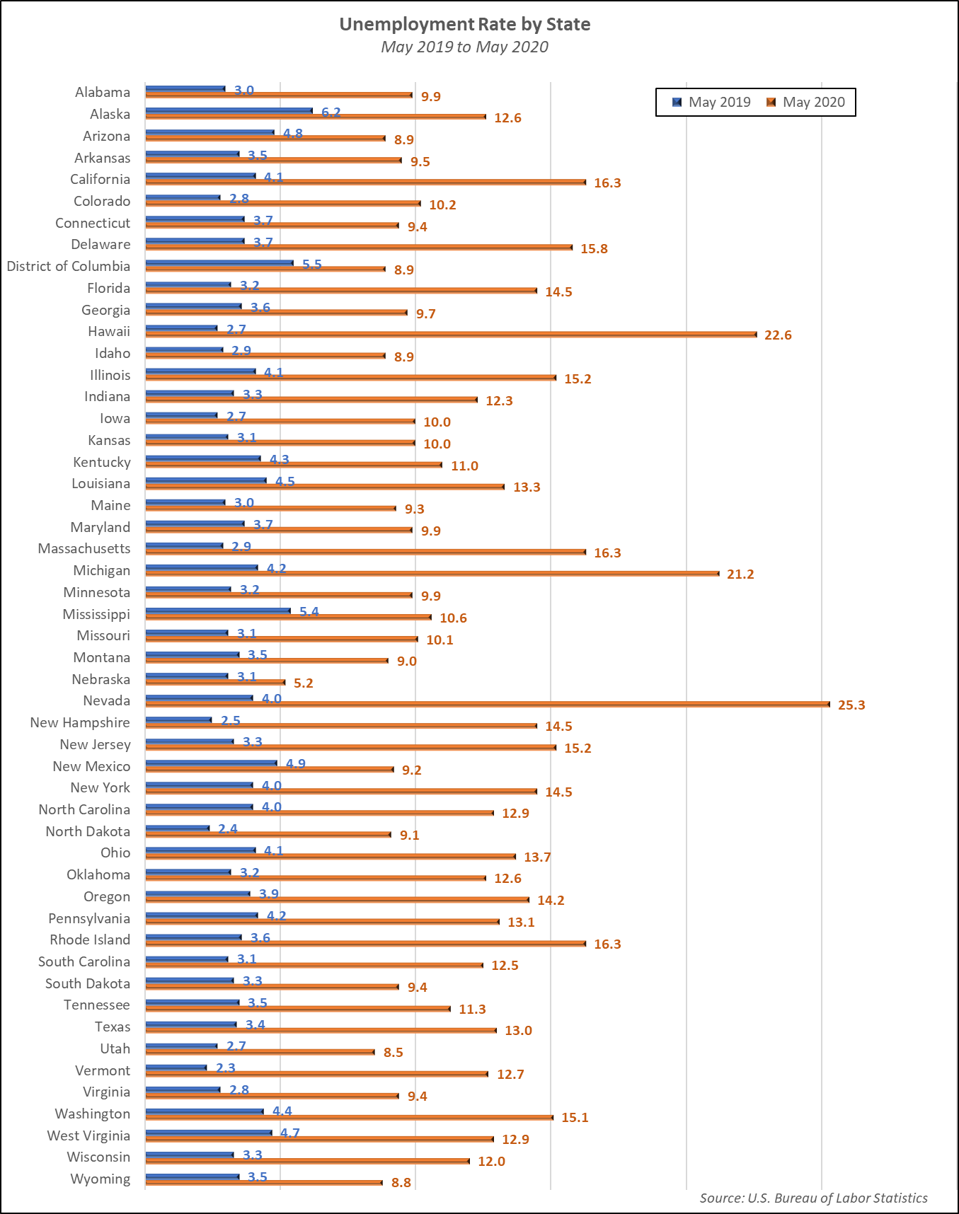
Unemployment by State-May 2019 to May 2020

The coronavirus has decimated the U.S. economy and benched nearly 40 million American workers. In the past several days, the U.S. has logged its highest number of new Covid-19 cases since the pandemic began. These combined with other factors, which we will discuss, is jeopardizing the future employment of millions of workers and the viability of thousands of businesses. Here’s how unemployment has increased for every state, industry, age group, and race, and why.

Unemployment by State

The coronavirus and subsequent stay at home orders hit the labor force especially hard. As states attempted to reopen, a resurgence in the virus is causing many businesses to close again, some by choice, others by government mandate.

Nevada has been hit the hardest as the unemployment rate in the Silver State rose from 4.0% in May 2019 to a whopping 25.3% in May 2020. Nevada’s economy is heavily reliant on leisure and hospitality, which had the brunt of the job losses. Hawaii, the second hardest hit state saw unemployment rise from 2.7% in May 2019 to 22.6% in May 2020. Which is the only other state with unemployment above 20% in May 2020? Michigan, where unemployment rose from 4.2% to 21.2% year over year. What state has fared best? Nebraska, which also has one of the most diverse economies of all states. Deriving nearly 50% of its total GDP from five different industries, unemployment in the Cornhusker State rose from 3.1% to a modest 5.2% from May 2019 to May 2020. Unemployment numbers for all states are shown in the following chart.

Unemployment by Industry

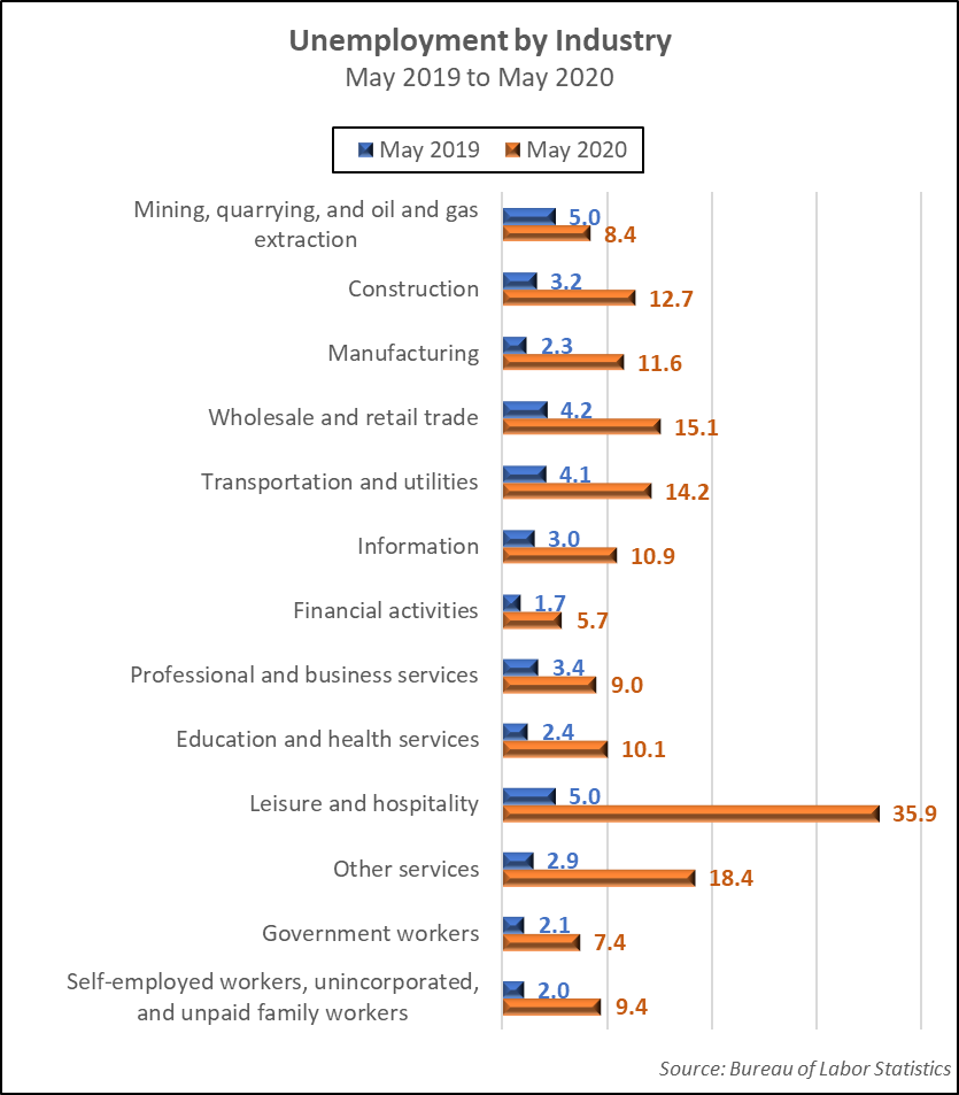
As mentioned in the previous section, the states that have fared best either have a more diverse economy or do not rely heavily on industries that have been hardest hit by the coronavirus. The most negatively affected is the leisure and hospitality industry where unemployment rose 618% from a low of 5.0% in May 2019 to a staggering 35.9% in May 2020. At a distant second, but still reeling, is the wholesale and retail trade industry, which saw unemployment rise from 4.2% to 15.1% during the same period. The rest of the industries are listed in the following chart.

Unemployment by Industry-May 2019 to May 2020

Unemployment by Age Group

Businesses need two things to exist: workers and customers. Without customers, there is no need for workers or the business for that matter. Some businesses require highly skilled workers while others operate well using unskilled labor. It is this unskilled labor group that has been hardest hit.

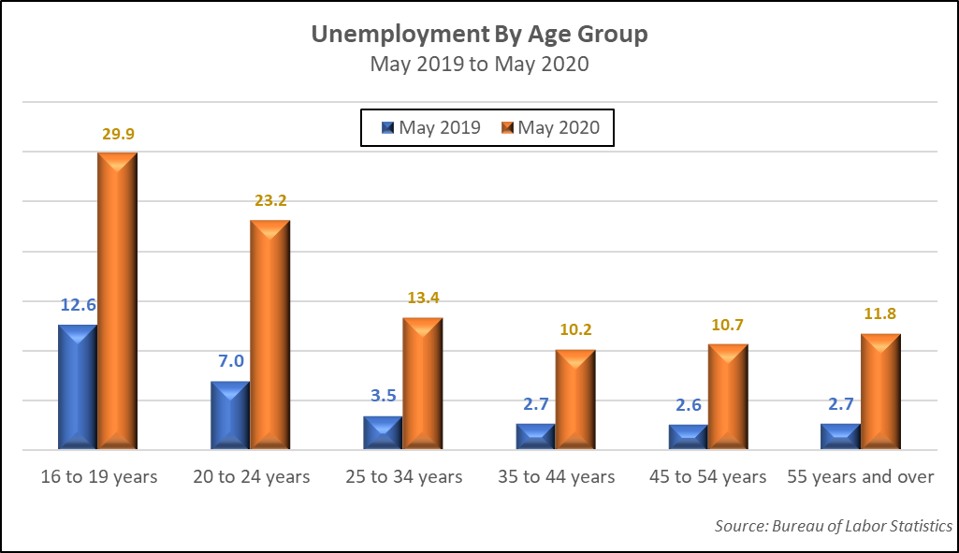
The greatest rise in unemployment is among workers under age 25. This is likely due to three factors. Younger workers typically have fewer marketable skills, less work experience, and less seniority. Many of these workers are in industries that have felt the greatest pain. Unemployment rates by age group are contained in the following chart.

Unemployment by Age Group-May 2019 to May 2020

Unemployment by Race/Ethnicity

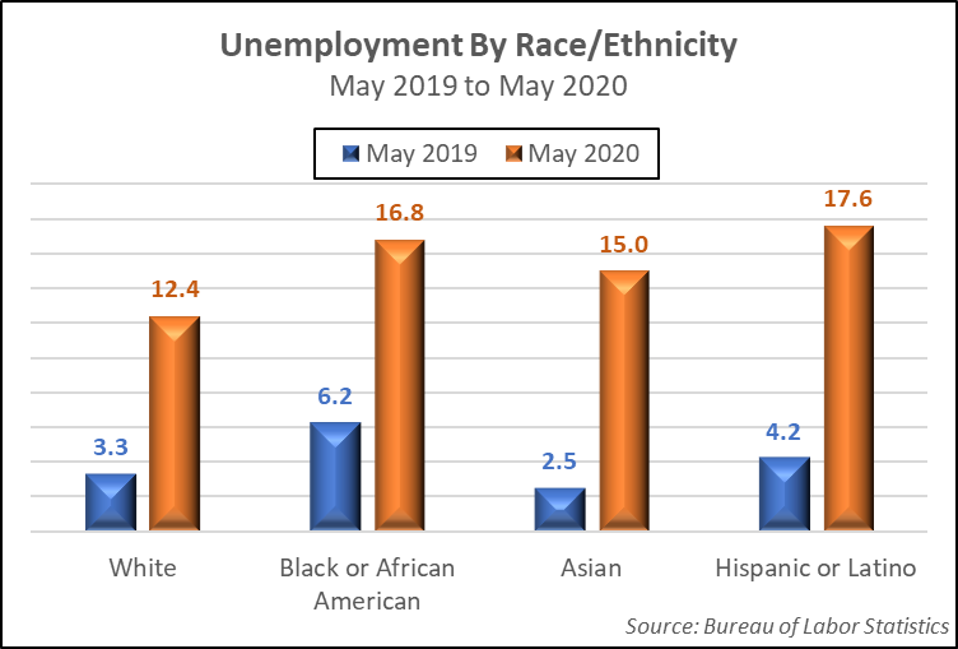
Question: Prior to Covid-19, was unemployment among blacks / African Americans at a record low as President Trump has claimed? Using the available data, which extends back to January 1972, the answer is yes. This new record low was achieved in October and November of 2019 when unemployment among black or African American workers fell to 5.1%. The previous record low was 5.2% in December 1973. The current rate is 16.8%, which is less than the highest rate of 20.7% logged in December 1982. The most recent high in unemployment for this group was 19.3% in March 2010. It has been steadily declining since then. Numbers for White, Asian, and Hispanic or Latino and black or African American workers are listed in the following chart.

Unemployment by Race or Ethnicity-May 2019 to May 2020

Businesses need workers, workers need businesses, and both depend on customers. Since the pandemic began, consumer demand has fallen sharply. With the probability that a vaccine will not be available until early 2021 at the soonest, plus a disregard for recommended safety protocols by many individuals, namely wearing masks and social distancing, it is highly unlikely that the economy will return to normal for several years.

Will the president continue to hold rallies? Will he set an example by wearing a mask? Will the protests and violence continue? Will other large gatherings continue? Unless Americans make a collective and conscious choice to mask up and social distance, we will be forced to live in a depressed economy for longer than necessary. The choice is up to us.


Short-term ‘junk’ plans widely discriminate against those with pre-existing conditions, House probe finds

https://www.healthcaredive.com/news/short-term-junk-plans-widely-discriminate-against-those-with-pre-existing/580556/

U.S. Rep. Castor's Statement Following a Federal Judge's Ruling on ...

Dive Brief:

  • A yearlong probe by the House Committee on Energy and Commerce into bare-bones insurance plans encouraged by the Trump administration found widespread discrimination against people with pre-existing conditions, even as a growing number are enrolled.
  • Top congressional Democrats investigated eight insurers selling short-term, limited duration plans, finding they all denied medical care claims if they found a consumer had a pre-existing condition. Some refused to pay for medical claims for no discernable reason, processing them only after consumers sued or complained to state regulators. Most rescinded coverage if they determined a member had a pre-existing condition or developed one later.
  • An HHS spokesperson defended the coverage as an affordable option to pricier Affordable Care Act plans, telling Healthcare Dive, “We’ve been abundantly clear that these plans aren’t for everyone.” America’s Health Insurance Plans made similar points, with spokesperson David Allen noting: “For Americans with pre-existing conditions, they may not be protected at all.”


Dive Insight:

The investigation looked at 14 companies that sell or market the plans, including eight insurers such as market giants Anthem and UnitedHealth Group, and six brokers.

It found insurers frequently turned down consumers with pre-existing conditions and discriminated against women, turning down applicants who were pregnant or planning to become pregnant and charging women more than men for the same coverage.

The plans had significant coverage limitations. Some excluded routine care like basic preventive visits and pelvic exams. Some plans had hard coverage cutoffs that left consumers with massive medical bills.

In one case, a consumer was billed a whopping $280,000 and lost coverage after being treated for an infection. The insurer said the patient previously had gotten an ultrasound that was “suspicious for deep venous thrombosis.”

AHIP spokesman Allen said it is not surprising given the plans are not intended to replace comprehensive coverage.

“They often do not cover the care and treatments that patients need throughout the year — preventive care, prescription drugs, mental health care or treatments for chronic health conditions — or if they do, they may limit or cap the benefits,” he acknowledged.

On average, short-term plans spend less than half of premium dollars collected from consumers on medical care: only 48%, the investigation found. That’s in stark contrast to plans in the ACA’s individual market, which are required to shell out at least 80% of all premium dollars on claims and benefits.

Short-term insurance represents a significant and growing share of the individual healthcare market. Roughly 3 million consumers bought the plans in 2019, a 27% growth from 2018, the investigation launched in March last year found.

The growth came after the Trump administration, in a controversial move, extended the maximum duration of the plans. The skimpy coverage, which isn’t required to cover the 10 essential benefits under the ACA, was originally designed as cheap safety net coverage for three months.

But in August 2018, HHS expanded the plans to 12 months, with a three year renewal period, and opened them up to all consumers, not just for those who can’t afford other coverage.

ACA supporters and patient advocates blasted the move, which sparked an ongoing legal challenge from safety net providers. Reports of consumers purchasing the coverage, believing it was comprehensive, then being shocked by balance bills prompted the House investigation.

The report also found brokers are paid up to 10 times more compensation for peddling short-term plans than ACA-compliant coverage. The average commission rate for short-term plans compared to ACA plans was 23% versus 2%, respectively.

Currently, 24 states ban or restrict the sale of short-term plans. Some states, including California, Massachusetts, New Jersey and New York, prohibit their sale entirely, while others like Colorado, Connecticut, New Mexico and Rhode Island have such strict regulations that no plans are sold.

Democratic leaders unveiled a bill on Wednesday to bolster the ACA and rescind the administration’s expansion of the plans and expand subsidies, allowing more people to qualify for coverage.

The effort has zero chance of moving this year with Republicans in control of the Senate, but both it and the probe are likely to play into the looming 2020 presidential and congressional elections.

“The heavy-handed tactics uncovered in this investigation demonstrate why Congress must reverse the Trump Administration’s expansion of these junk plans,” E&C Chairman Frank Pallone, D-N.J., Health Subcommittee Chairwoman Anna Eshoo, D-Calif., and Oversight and Investigations Subcommittee Chair Diana DeGette, D-Colo., wrote in a joint statement. “It also shows how dangerous a post-ACA world would be if Republican Attorneys General and the Trump Administration are successful in striking down the law and its protections.”

That lawsuit, led by 18 red states, argues the ACA, which expanded insurance to some 20 million people, is unconstitutional because a tax bill passed in 2017 zeroed out the penalty for its individual mandate. It’s currently pending before the U.S. Supreme Court.

President Donald Trump and his health officials have repeatedly promised people with pre-existing conditions will be protected if the ACA is struck down, but neither the administration nor Republicans in Congress have said specifically how.


As Americans lose job-based coverage, ACA marketplace sets record with near 500K signups

https://www.healthcaredive.com/news/as-americans-lose-job-based-coverage-aca-marketplace-sets-record-with-near/580623/

Dive Brief:

  • Millions of individuals have lost their jobs as a result of the pandemic, allowing them to enroll in Affordable Care Act marketplace coverage via Healthcare.gov due to their special circumstances. CMS said this week that this special enrollment coverage due to job loss specifically has reached a record, with about 487,000 consumers gaining coverage, a 46% increase compared with the same time last year.
  • April saw the biggest jump in enrollment following job loss, an increase of 139% compared to April of last year.
  • Due to a number of factors, CMS said it “remains unclear how many people will eventually look to Exchanges using HealthCare.gov to replace job-based coverage.”

Dive Insight:

The pandemic has battered the economy, causing historic levels of unemployment. For many Americans, healthcare coverage is tethered to their jobs. As such, the pandemic is not only a threat to Americans’ health but their ability to pay for the care they need, sick with COVID-19 or not.

As many as 27 million Americans may have lost job-based coverage between March and May of this year, according to a recent analysis from the Kaiser Family Foundation. 

Of the newly uninsured, about half (12.7 million) would be eligible for Medicaid coverage, according to Kaiser’s estimates. There are a few options for workers out of a job and insurance. They can opt to extend their coverage through COBRA, enroll in coverage through the exchanges, or check to see if they qualify for Medicaid.

This week, CMS attempted to quantify just how many out-of-work Americans were turning to the exchanges.

About 500,000 out-of-work consumers enrolled in coverage so far this year. However, there are other life events that qualify a consumer to shop for coverage during a special enrollment period. Overall, special enrollment period sign-ups garnered more than 890,000 enrollees, dwarfing other periods. 

If the trend continues, it may fuel a significant shift in health insurance. For years, a majority have received commercial coverage through work. Even health insurers recognize disruption is on the horizon.

Many of the nation’s largest insurers are bracing for a shift from their commercial book of business to covering more Medicaid enrollees through their contracts with states. Earlier this year, Molina, Centene and Anthem all said they expect upticks in their Medicaid membership and exchange products.

Molina executives said in April they already saw 30,000 more Medicaid members from the prior-year period.


Pandemic Graphic of the Day

Image may contain: text