Rick Bright, ousted director of vaccine agency, warns that administration lacks ‘centralized, coordinated plan’

https://www.cnn.com/2020/05/14/politics/coronavirus-whistleblower-testimony/index.html?fbclid=IwAR0KfVp-njw8vqKFdaLbBC4r4NAx3KeS4rFg2vmFbSneW7PcqOwVYult9rc

Virus whistleblower tells lawmakers US lacks vaccine plan | Where ...

Rick Bright, the ousted director of a crucial federal office charged with developing countermeasures to infectious diseases, testified before Congress on Thursday that the US will face an even worse crisis without additional preparations to curb the coronavirus pandemic.

“Our window of opportunity is closing,” Bright said. “Without better planning, 2020 could be the darkest winter in modern history.”
Bright criticized the Trump administration for failing to implement a “standard, centralized, coordinated plan” to combat the virus and questioned its timeline for a vaccine. His testimony came a week after filing a whistleblower complaint alleging he was fired from his job leading the Biomedical Advanced Research and Development Authority for opposing the use of a drug frequently touted by President Donald Trump as a potential coronavirus treatment.
About an hour before Bright’s hearing, Trump tweeted that he had “never met” or “even heard of” Bright, but considers the NIH senior adviser a “disgruntled employee, not liked or respected by people I spoke to and who, with his attitude, should no longer be working for our government!”
Before the House Committee on Energy and Commerce’s health subcommittee, Bright urged the Trump administration to consider a number of actions, including increasing production of essential equipment and establishing both a national test strategy and a national standard of procurement of supplies. He calls on top officials to “lead” through example and wear face coverings and social distance.
Bright claimed that the administration missed “early warning signals” to prevent the spread of the virus. He said that he would “never forget” an email from Mike Bowen, the hearing’s other witness and the vice president of the medical supply company Prestige Ameritech, indicating that the US supply of N95, the respirator masks used by health care professionals, was at a perilous level.
“He said, ‘We’re in deep shit,'” testified Bright. “‘The world is.'”
Bright said he “pushed” that warning “to the highest levels” he could at Health and Human Services but received “no response.”
“From that moment, I knew that we were going to have a crisis for health care workers because we were not taking action,” said Bright. “We were already behind the ball.”
In his written statement, Bright blamed the leadership of HHS for being “dismissive” of his “dire predictions.” Bright wrote that he knew the US had a “critical shortage of necessary supplies” and personal protective equipment during the first three months of the year and prodded HHS to boost production of masks, respirators, syringes and swabs to no avail. He alleged that he faced “hostility and marginalization” from HHS officials after he briefed White House trade adviser Peter Navarro and members of Congress “who better understood the urgency to act.”
And he charged that he was removed from his post at BARDA and transferred to “a more limited and less impactful position” at NIH after he “resisted efforts to promote” the “unproven” drug chloroquine.
A Department of Health and Human Services spokesperson responded that it was “a personnel matter that is currently under review” but said it “strongly disagrees with the allegations and characterizations.”
Bright is seeking to be reinstated to his position as the head of BARDA. The Office of Special Counsel, which is reviewing Bright’s complaint, has determined that was a “substantial likelihood of wrongdoing” in removing him from his post, according to Bright’s attorneys.
Rep. Anna Eshoo, a California Democrat and the panel’s chairwoman, said Bright “was the right person, with the right judgment, at the right time.”
“We can’t have a system where the government fires those who get it right and reward those who get it completely wrong,” added Eshoo.
In his testimony, Bright also cast doubt on the Trump administration’s goal of manufacturing a vaccine in 12 to 18 months as overly optimistic, calling it “an aggressive schedule” and noting that it usually takes up to 10 years to make a vaccine.
“My concern is if we rush too quickly, and consider cutting out critical steps, we may not have a full assessment of the safety of that vaccine,” Bright said. “So, it’s still going to take some time.”
Some Republicans on the subcommittee said that the hearing shouldn’t have been held at all.
Rep. Michael Burgess of Texas, the top Republican on the panel, said “every whistleblower needs to be heard,” but added the hearing was “premature” and a “disservice” to the Special Counsel’s investigation since Bright’s complaint was filed only a week ago.
And Republican Rep. Richard Hudson of North Carolina claimed that the hearing was not about the whistleblower complaint but “undermining the Administration during a national and global crisis.”
Thursday’s subcommittee meeting comes two days after a blockbuster hearing in the Senate that featured Dr. Anthony Fauci, who leads the National Institute of Allergy and Infectious Diseases. Fauci said that access to a vaccine in time for the fall school year would be “a bit of a bridge too far” and warning against some schools opening too soon, which Trump later called “not an acceptable answer.”
Fauci testified from his modified quarantine at home since he had made contact with a White House staffer who tested positive. But Bright appeared masked and in-person for his hearing on Capitol Hill, as did the lawmakers who questioned him. Many members of the House have steered clear of Capitol Hill since the onset of the outbreak, although they are expected to return on Friday to vote on a multi-trillion dollar Democratic bill responding to the crisis.


The pandemic broke America

https://www.axios.com/coronavirus-america-broken-2baa69e4-60e6-49a5-932a-5d118441ae20.html

The coronavirus pandemic broke America - Axios

Eight weeks into this nation’s greatest crisis since World War II, we seem no closer to a national strategy to reopen the nation, rebuild the economy and defeat the coronavirus.

Why it matters: America’s ongoing cultural wars over everything have weakened our ability to respond to this pandemic. We may be our worst enemy.

  • The response is being hobbled by the same trends that have impacted so much of our lives: growing income inequality, the rise of misinformation, lack of trust in institutions, the rural/urban divide and hyper-partisanship.
  • We’re not even seeing the same threat from the virus. Democrats are far more likely than Republicans to be worried about getting seriously ill, while Republicans — including the president — are more likely to think the death counts are too high.

Without even a basic agreement on the danger of the pandemic and its toll, here’s how we see the national response unfold:

  • The Centers for Disease Control and Prevention, the crown jewel of the globe’s public health infrastructure, has been sidelined, its recommendations dismissed by the White House.
  • President Trump declares the U.S. has “prevailed on testing” at a time when health experts say we still need far more daily tests before the country can reopen safely.
  • Distribution of the promising coronavirus drug remdesivir was initially botched because of miscommunication between government agencies.
  • More than two thirds of Americans say it’s unlikely they would use a cell phone-based contact tracing program established by the federal government, a key component of a testing regime to control the virus.
  • The second phase of a program to aid small businesses isn’t fully allocated because firms are either concerned about its changing rules, confused about how to access it, or find the structure won’t help them stay in business.
  • With the unemployment rate at a post-Depression record last month, and expected to go higher, there is no meaningful discussion between the parties in Congress on aid to the out-of-work.
  • States and local governments are facing billions in losses without a strategy for assistance.
  • The virus is literally inside the White House. Aides have tested positive for coronavirus, leading to quarantines for some of the nation’s top public health officials and a new daily testing regime for White House staff and reporters who enter the West Wing.
  • The No. 1 book on Amazon for a time was a book by an anti-vaxxer whose conspiracy-minded video about the pandemic spread widely across social media, leading to takedowns by platforms like YouTube and Facebook.

The other side: There’s better news at the state level. “Governors collectively have been winning widespread praise from the public for their handling of the coronavirus outbreak,” the Washington Post reports.

Between the lines: Nationwide, 71% of Americans approve of the job their governor is doing, according to the Post. For Trump, the figure is 43%.

  • And former presidents we often expect to help rally the nation in trying times are scarce.
  • George W. Bush released a video, in which his face barely appeared, calling for unity in the fight against the virus. Barack Obama was recorded in leaked remarks to former staffers calling Trump’s coronavirus response “an absolute chaotic disaster.” Trump attacked both of them on Twitter.

The bottom line: An existential threat — like war or natural disaster — usually brings people together to set a course of action in response. Somehow, we’ve let this one drive us apart.


Guns in Michigan Capitol: Defense of liberty or intimidation?

https://www.csmonitor.com/USA/Politics/2020/0504/Guns-in-Michigan-Capitol-Defense-of-liberty-or-intimidation

Guns in coronavirus protests: Defense of liberty or intimidation ...

WHY WE WROTE THIS

Bringing assault weapons to the Michigan Legislature for a protest against coronavirus restrictions? To one group, it’s why the Second Amendment exists. To many others, it’s unfathomable.

It was a first for Michigan state Sen. Sylvia Santana. Before heading to the statehouse in Lansing last Thursday, she slipped into a bulletproof vest.

Ms. Santana’s husband, a sheriff’s deputy, warned her about potential trouble at a rally to protest the decision to extend a coronavirus lockdown.

A group of armed white men entered the Capitol and shouted at lawmakers. To Ms. Santana, some were dressed like they were “going to war.” Several Confederate flags, a swastika, and a misogynistic sign aimed at Gov. Gretchen Whitmer could be seen outside.

“I thought that was very scary,” says Ms. Santana, an African American who represents parts of Detroit and all of neighboring Dearborn. “We’re there to do a job, and it’s not to dodge bullets as we try to do our jobs in a bipartisan fashion to make sure we’re keeping all Michiganders safe.”

Four days on from the protest, her concern lingers. The pandemic has intensified many societal fault lines – from health care inequities to political polarization – and gun control is no exception. Feeling that state officials are overreaching, a tiny minority of protesters are flexing their Second Amendment rights in Michigan and beyond.

But at a time of crisis, their crusade against the perceived tyranny of government is seen by many as tyrannical in its own right – recklessly using their liberties to intimidate others.

The core question is: Where should the line be drawn? For protesters, guns in statehouses is one of the purest expressions of the power the Second Amendment invests in citizens. But no constitutional right is absolute.

“Where do people who see no problem with guns downtown or near a hospital or in the legislature, where do they draw the line?” Sanford Levinson, co-author of “Fault Lines in the Constitution.” “That’s an interesting question both politically and legally, because courts are really receptive to line drawing. I don’t think you’d find any judge who says, ‘Yeah, I welcome guns in my courtroom.’”

In that way, the struggle over whether to allow firearms in legislatures “is part of the culture war,” he adds.

Are hard-line tactics effective?

Today, 21 state capitols allow guns in some form, according to a Wall Street Journal report. But only a few, including Michigan, allow citizens to openly carry under the rotunda. Many Republican-led states balk at open carry in the people’s hall for personal safety reasons, and courts have upheld bans in places like legislatures and polling places, holding that guns can chill other people’s rights.

Elements of race have long played a role. The modern gun control movement is linked to the signing of the Mulford Act in 1967, which banned open carry in California. The bill gained momentum after two dozen Black Panthers legally brought firearms to the state capitol to protest against it. The National Rifle Association backed the bill.

Incidents like the one in Michigan, however, could do more to damage gun rights than advance them. “It’s really now an open question to what extent hard-line pro-gun policies are politically advantageous,” says Mr. Levinson, also a visiting professor at Harvard Law School in Cambridge, Massachusetts.

Ms. Santana was certainly not persuaded. “I, as a state lawmaker, want to hear your concerns and your position on the issue. But I don’t feel that bringing assault weapons to the capitol and using symbols of hatred will make me understand your issue better.”

The scenes in Michigan, which has been hit hard by COVID-19, only make it harder to have already difficult conversations, others say. Part of self-defense is respecting the preferences other people have for their own security, which might mean leaving guns at home when overtones of intimidation are possible.

“When your eyes look at these pictures of groups of people … in a public building that is supposed to be a center of democratic exchange and debate, and you see a group of people carrying military weapons, that is not a vision of democracy,” says Hannah Friedman, a staff attorney at Giffords Law Center to Prevent Gun Violence in San Francisco. “That’s a vision of intimidation by a minority of people.”

Such concerns were heightened further this weekend, when employees at businesses in Stillwater, Oklahoma, faced a threat of violence with a gun while trying to force customers to wear masks, as mandated by the local government.

“I think we were heard”

But Ashley Phibbs has a different view.

Ms. Phibbs, a project manager and mother who helped organize the Michigan rally, acknowledged with regret that many in attendance didn’t abide by social distancing rules. She also confirmed the display of hate symbols. But she insisted those were agitators and not part of her group, Michigan United for Liberty, which has sprung up to oppose what members see as repressive COVID-19 restrictions.

“I know how it can seem to people who aren’t active in rallies and who are looking at it from the outside in, and I try to be very understanding of that,” says Ms. Phibbs. “But … I don’t think that anyone was there to really make anyone fearful. I didn’t see anything that would have really caused fear, aside from loud noises from the people yelling. But a lot of people are also sometimes afraid of guns in general.”

In the end, she says, “I think we were heard. I think overall [the rally] was positive.”

Knowing your audience

Other gun-rights advocates saw problems with the optics.

As he watched news from Michigan Thursday, Caleb Q. Dyer saw some familiar faces. The New Hampshire barista and former state legislator had been a keynote speaker at a Michigan Libertarian Party event last year.

But he worried that his friends in Michigan were sending “mixed messages” by failing to abide by public health rules.

In fact, he usually brings witty protest gear – such as a sign that says “arm the homeless” – to disarm fear. It’s a fine line, he says, between free speech and armed intimidation.

“People aren’t ready to have the discussion that a lot of these gun-carrying protesters want to have, which is that none of these laws are even remotely effective or just,” says Mr. Dyer. “But they’re not going to have that discussion if they cannot carry themselves in such a way that the opposition won’t think … that they’re murderous and violent.”


Window of Opportunity is Closing for Coronavirus Response

https://www.axios.com/rick-bright-testimony-opening-statement-6817ae7a-5196-4357-b83c-d3ff96990efd.html?stream=health-care&utm_source=alert&utm_medium=email&utm_campaign=alerts_healthcare

Window of opportunity – definition and meaning – Market Business News

A top vaccine doctor who was ousted from his position in April is expected to testify Thursday that the Trump administration was unprepared for the coronavirus, and that the U.S. could face the “darkest winter in modern history” if it doesn’t develop a national coordinated response, according to prepared testimony first obtained by CNN.

The big picture: Rick Bright, the former head of the Biomedical Advanced Research and Development Authority (BARDA), will tell Congress that leadership at the Department of Health and Human Services ignored his warnings in January, February and March about a potential shortage of medical supplies.

  • He will testify that HHS “missed early warning signals” and “forgot important pages from our pandemic playbook” early on — but that “for now, we need to focus on getting things right going forward.”
  • Bright’s testimony also reiterates claims from a whistleblower report he filed last week that alleges he was ousted over his attempts to limit the use of hydroxychloroquine — an unproven drug touted by President Trump — to treat the coronavirus.

What he’s saying: Bright will testify he urged HHS to ramp up production of
masks, respirators and medical supplies as far back as January. Those warnings were dismissed, Bright says, and he was “cut out of key high-level meetings to combat COVID-19.”

  • “I continue to believe that we must act urgently to effectively combat this deadly disease. Our window of opportunity is closing. If we fail to develop a national coordinated response, based in science, I fear the pandemic will get far worse and be prolonged, causing unprecedented illness and fatalities.”

Bright will call for a national strategy to combat the virus, including “tests that are accurate, rapid, easy to use, low cost, and available to everyone who needs them.”

  • “Without clear planning and implementation of the steps that I and other experts have outlined, 2020 will be darkest winter in modern history.”

Read Bright’s prepared statement.


COVID-19 by the numbers: 51 stats, dollar figures and dates for hospital leaders to know

https://www.beckershospitalreview.com/hospital-management-administration/covid-19-by-the-numbers-51-stats-dollar-figures-and-dates-for-hospital-leaders-to-know.html?utm_medium=email

Coronavirus death rate in US compared to countries like Italy ...

In recent months, hospitals and health systems across the U.S. have made dramatic changes to quickly respond to the COVID-19 pandemic. To help provide a more detailed picture of the COVID-19 pandemic and response efforts, Becker’s Hospital Review has compiled key stats, dollar figures and dates for hospital and health system leaders to know.

COVID-19 relief aid 

Congress has allocated $175 billion in relief aid to hospitals and other healthcare providers to cover expenses or lost revenues tied to the COVID-19 pandemic. 

The first $50 billion in funding from the Coronavirus Aid, Relief and Economic Security Act was delivered to hospitals in April. HHS distributed $30 billion based on Medicare fee-for-service reimbursements and another $20 billion based on hospitals’ share of net patient revenue.

In addition, HHS is sending $12 billion to 395 hospitals that provided inpatient care for 100 or more COVID-19 patients through April 10 and disbursing another $10 billion to hospitals, clinics and health centers in rural areas.

HHS recently provided a list of hospitals that received payments from the general distribution and rural targeted allocation of the provider relief fund as well as hospitals that received COVID-19 high-impact payments.

Below are the 10 health systems that received the most funding from the general distribution and rural targeted allocation of the provider relief fund based on data updated May 12. Each health system received payments and agreed to the terms and conditions for receiving relief aid as of May 6. 

1. Dignity Health: $180.3 million

2. NewYork-Presbyterian Hospital: $119 million

3. Cleveland Clinic: $103.3 million

4. Stanford Health Care: $102.4 million

5. Intermountain Healthcare: $97.9 million

6. Memorial Hermann Health System: $92.4 million

7. NYU Langone Hospitals: $92.1 million

8. Sutter Health: $82.7 million

9. County of Los Angeles: $80.8 million (County operates four hospitals)

10. Hackensack Meridian Health: $76.8 million


Below are the 10 hospitals that received the most funding from the $12 billion COVID-19 high-impact fund based on data updated May 8. 

1. Long Island Jewish Medical Center (New Hyde Park, N.Y.): $277.7 million

2. Holy Name Medical Center (Teaneck, N.J.): $213.4 million

3. Tisch Hospital (New York City): $203.2 million

4. Montefiore Hospital-Moses Campus (New York City): $156.7 million

5. Columbia University Irving Medical Center (New York City): $152.7 million

6. NewYork-Presbyterian Queens (New York City): $143.3 million

7. Mount Sinai Medical Center (New York City): $140.8 million

8. Sandra Atlas Bass Heart Hospital (Manhasset, N.Y.): $137.5 million

9. Maimonides Medical Center (New York City): $131.5 million

10. Weill Cornell Medical Center (New York City): $118.6 million


COVID-19 vulnerability 

Every state in the U.S. will be affected by COVID-19, but some are more vulnerable due to limited ability to mitigate and treat the virus, and to reduce its economic and social impacts, according to a COVID-19 vulnerability index created by the Surgo Foundation.

The Surgo Foundation, a privately funded think tank, created an index that combines indicators specific to COVID-19 with the CDC’s social vulnerability index, which measures the expected negative impact of disasters of any type. The Surgo Foundation’s index takes into account factors that fall into one of several categories, including socioeconomic status, minority status, housing type, epidemiologic factors and healthcare system factors. Each state and the District of Columbia received a score in each category and an overall score, with a higher score indicating that the state is more vulnerable. Read more about the methodology here.

Below are the 10 states with the highest composite scores based on the vulnerability index. 

1. Mississippi: 1

2. Louisiana: 0.98

3. Arkansas: 0.96

4. Oklahoma: 0.94

5. Alabama: 0.92

6. West Virginia: 0.9

7. New Mexico: 0.88

8. Nevada: 0.86

9. North Carolina: 0.84

10. South Carolina: 0.82


Where COVID-19 cases, deaths are decreasing most

An analysis from The New York Times based on county-level data shows some U.S. cities are seeing sustained decreases in COVID-19 cases and deaths.

Below are the top five metro areas where COVID-19 cases have decreased the most (relative to population) in the past week. The list reflects The New York Times‘ rankings as of May 13 at 6:30 a.m. CDT. 

1. Grand Island, Neb.
Change rate: -394 cases per 100,000 population

2. Waterloo-Cedar Falls, Iowa
Change rate: -265 cases per 100,000 population

3. Pine Bluff, Ark.
Change rate: -197 per 100,000 population

4. New York City area
Change rate: -184 cases per 100,000 population

5. Boston
Change rate: -139 cases per 100,000 population


Below are the top five metro areas where COVID-19 deaths have decreased the most in the past week. 

1. Grand Island, Neb.
Change rate: -11.8 deaths per 100,000 population

2. New York City area
Change rate: -11.1 deaths per 100,000 population

3. Fairfield County (Conn.)
Change rate: -9.7 deaths per 100,000 population

4. Hartford, Conn.
Change rate: -9.7 deaths per 100,000 population

5. Springfield, Mass.
Change rate: -9.5 deaths per 100,000 population


States resuming elective surgeries 

Below are the states that have allowed or announced plans to allow healthcare providers to resume elective surgeries as of May 13. There are different restrictions in each state, which are detailed in executive orders and other documents from the state. 

April 22
California
Texas
Utah

April 24
Oklahoma

April 26
Colorado

April 27
Arkansas
Indiana
Iowa
Kentucky
Louisiana
Mississippi
Pennsylvania

April 28
New York
West Virginia

April 30
Alabama
Tennessee

May 1
Arizona
Illinois
Ohio
Oregon
Virginia

May 4
Alaska
Florida
Nebraska

May 15
Vermont

May 18
Washington

May 31
South Dakota


The latest in the U.S.

https://www.axios.com/newsletters/axios-vitals-72173ec6-3383-4391-afbb-a5ed682e5d7a.html?utm_source=newsletter&utm_medium=email&utm_campaign=newsletter_axiosvitals&stream=top

COVID-19 in the U.S.

As of May 12, 2020, 11pm EDT

Deaths       Confirmed Cases

82,376           1,369,574

Trump and some top aides question accuracy of coronavirus death ...


The U.S. will “without a doubt” have more coronavirus infections and deaths in the fall and winter if effective testing, contact tracing and social distancing measures are not scaled up to adequate levels, NIAID director Anthony Fauci testified on Tuesday.

  • He also said that the “consequences could be really serious” for states and cities that reopen without meeting federal guidelines.

Sen. Mitt Romney (R-Utah) criticized the Trump administration’s coronavirus testing coordinator Adm. Brett Giroir at a Senate hearing Tuesday, accusing him of framing U.S. testing data in a politically positive light: “I find our testing record nothing to celebrate whatsoever.”

Millions of Americans are risking their lives to feed us and bring meals, toiletries and new clothes to our doorsteps — but their pay, benefits and working conditions do not reflect the dangers they face at work, Axios’ Erica Pandey reports.

House Democrats released Tuesday their phase 4 $3 trillion coronavirus relief proposal that would provide billions of additional aid to state and local governments, hospitals and other Democratic priorities.

The American Federation of Teachers launched several capstone lesson plans Tuesday to help K-12 teachers measure student progress during school closures and overcome the challenges of a remote learning setting.

Grocery staples in the U.S. cost more in the last month than in almost 50 years, according to new data out Tuesday from the U.S. Bureau of Labor Statistics.

A new study by economists at the University of Illinois, Harvard Business School, Harvard University and the University of Chicago projects that more than 100,000 small businesses have permanently closed since the coronavirus pandemic was declared in March, the Washington Post reports.


New urgency surrounding children and coronavirus

https://www.axios.com/newsletters/axios-vitals-72173ec6-3383-4391-afbb-a5ed682e5d7a.html?utm_source=newsletter&utm_medium=email&utm_campaign=newsletter_axiosvitals&stream=top

CDC adds 6 new possible coronavirus symptoms - Axios

Solving the mystery of how the coronavirus impacts children has gained sudden steam, as doctors try to determine if there’s a link between COVID-19 and kids with a severe inflammatory illness, and researchers try to pin down their contagiousness before schools reopen.

Driving the news: New York state’s health department is investigating 100 cases of the illness in children, Gov. Andrew Cuomo said at a Tuesday press briefing, Axios’ Orion Rummler reports.

  • Three children in the state have died: an 18-year-old girl, a 5-year-old boy, and a 7-year-old boy. The state’s hospitals had previously reported 85 cases on Sunday.

Doctors have described children “screaming from stomach pain” while hospitalized for shock, Jane Newburger of Boston Children’s Hospital told the Washington Post.

  • In some, arteries in their hearts swelled, similar to Kawasaki disease, a rare condition most often seen in infants and small children that causes blood vessel inflammation, she said.
  • Researchers remain uncertain if this is being caused by COVID-19, but most children appear to have a link. Some affected children have tested positive for coronavirus antibodies, suggesting that the inflammation is “delayed,” Nancy Fliesler of Boston Children’s Hospital wrote on Friday.

What’s next: The CDC is funding a $2.1 million study of 800 children who have been hospitalized after testing positive for the coronavirus through Boston Children’s Hospital. The study aims to understand why some children are more vulnerable to the disease.


Coronavirus likely forced 27 million off their insurance

https://www.axios.com/newsletters/axios-vitals-72173ec6-3383-4391-afbb-a5ed682e5d7a.html?utm_source=newsletter&utm_medium=email&utm_campaign=newsletter_axiosvitals&stream=top

The coronavirus pandemic is hitting Main Street and triggering ...

Roughly 27 million people have likely have lost job-based health coverage since the coronavirus shocked the economy, according to new estimates from the Kaiser Family Foundation.

Why it matters: Most of these people will be able sign up for other sources of coverage, but millions are still doomed to be uninsured in the midst of a pandemic, Axios’ Bob Herman reports.

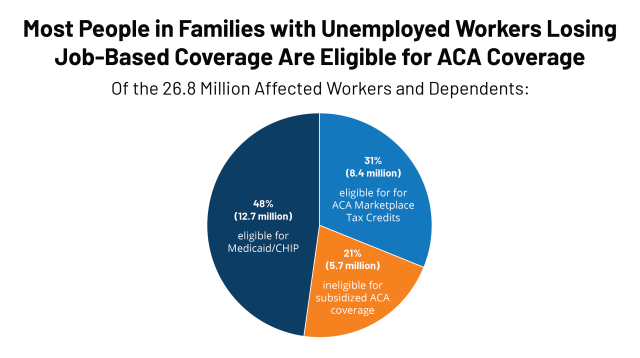
By the numbers: For the 27 million people who are losing their job-based coverage, about 80% have other options, said Rachel Garfield, a health policy expert at the Kaiser Family Foundation and lead author of the report.

  • Roughly half are eligible for Medicaid or the Children’s Health Insurance Program.
  • Another third are eligible for subsidized health plans on the Affordable Care Act’s marketplaces.
  • The remaining 20% are pretty much out of luck because they live in a state that didn’t expand Medicaid or are ineligible for other kinds of subsidized coverage.
  • House Speaker Nancy Pelosi’s latest coronavirus relief bill would fully subsidize the cost of maintaining an employer plan through COBRA — an option that would otherwise be prohibitively expensive for many people. But that’s a long way from becoming law.

The bottom line: The coronavirus is blowing up health insurance at a time when people need it most.


Eligibility for ACA Health Coverage Following Job Loss

Eligibility for ACA Health Coverage Following Job Loss
Eligibility for ACA Health Coverage Following Job Loss – Methods ...

The economic consequences of the coronavirus pandemic have led to historic level of job loss in the United States. Social distancing policies required to address the crisis have led many businesses to cut hours, cease operations, or close altogether. Between March 1st and May 2nd, 2020, more than 31 million people had filed for unemployment insurance. Actual loss of jobs and income are likely even higher, as some people may be only marginally employed or may not have filed for benefits. Some of these unemployed workers may go back to work as social distancing curbs are relaxed, though further job loss is also possible if the economic downturn continues or deepens.

In addition to loss of income, job loss carries the risk of loss of health insurance for people who were receiving health coverage as a benefit through their employer. People who lose employer-sponsored insurance (ESI) often can elect to continue it for a period by paying the full premium (called COBRA continuation) or may become eligible for Medicaid or subsidized coverage through the Affordable Care Act (ACA) marketplaces. Over time, as unemployment benefits end, some may fall into the “coverage gap” that exists in states that have not expanded Medicaid under the ACA.

In this analysis, we examine the potential loss of ESI among people in families where someone lost employment between March 1st, 2020 and May 2nd, 2020 and estimate their eligibility for ACA coverage, including Medicaid and marketplace subsidies, as well as private coverage as a dependent (see detailed Methods at the end of this brief). To illustrate eligibility as their state and federal unemployment insurance (UI) benefits cease, we show eligibility for this population as of May 2020 and January 2021, when most will have exhausted their UI benefits.

What are coverage options for people losing ESI?

Eligibility for health coverage for people who lose ESI depends on many factors, including income while working and family income while unemployed, state of residence, and family status. Some people may be ineligible for coverage options, and others may be eligible but opt not to enroll. Some employers may temporarily continue coverage after job loss (for example, through the end of the month), but such extensions of coverage are typically limited to short periods.

Medicaid: Some people who lose their jobs and health coverage—especially those who live in states that expanded Medicaid under the ACA— may become newly eligible1 for Medicaid if their income falls below state eligibility limits (138% of poverty in states that expanded under the ACA). For Medicaid eligibility, income is calculated based on other income in the family plus any state unemployment benefit received (though the $600 per week federal supplemental payment available through the end of July is excluded). Income is determined on a current basis, so prior wages for workers recently unemployed are not relevant. In states that have not expanded Medicaid under the ACA, eligibility is generally limited to parents with very low incomes (typically below 50% of poverty and in some states quite a bit less); thus many adults may fall into the “coverage gap” that exists for those with incomes above Medicaid limits but below poverty (which is the minimum eligibility threshold for marketplace subsidies under the ACA). Undocumented immigrants are ineligible for Medicaid, and recent immigrants (those here for fewer than five years) are ineligible in most cases.

Marketplace: ACA marketplace coverage is available to legal residents who are not eligible for Medicaid and do not have an affordable offer of ESI; subsidies for marketplace coverage are available to people with family income between 100% and 400% of poverty. Some people who lose ESI may be newly-eligible for income-based subsidies, based on other family income plus any state and new federal unemployment benefit received (including the $600 per week federal supplement, unlike for Medicaid).2 While current income is used for Medicaid eligibility, annual income for the calendar year is used for marketplace subsidy eligibility. Advance subsidies are available based on estimated annual income, but the subsidies are reconciled based on actual income on the tax return filed the following year. People who lose ESI due to job loss qualify for a special enrollment period (SEP) for marketplace coverage.3 As with Medicaid, undocumented immigrants are ineligible for marketplace coverage or subsidies. However, recent immigrants, including those whose income makes them otherwise eligible for Medicaid, can receive marketplace subsidies.

ESI Dependent Coverage: People who lose jobs may be eligible for ESI as a dependent under a spouse or parent’s job-based coverage. Some people may have been covered as a dependent prior to job loss, and some may switch from their own coverage to coverage as a dependent.

COBRA: Many people who lose their job-based insurance can continue that coverage through COBRA, although it is typically quite expensive since unemployed workers generally have to pay the entire premium – employer premiums average $7,188 for a single person and $20,576 for a family of four – plus an additional 2%. People who are eligible for subsidized coverage through Medicaid or the marketplaces are likely to opt for that coverage over COBRA, though COBRA may be the only option available to some people who are income-ineligible for ACA coverage.

Short-term plans: Short-term plans, which can be offered for up to a year and can sometimes be renewed under revised rules from the Trump administration, are also a potential option for people losing their employer-sponsored insurance. These plans generally carry lower premiums than COBRA or ACA-compliant coverage, as they often provider more limited benefits and usually deny coverage to people with pre-existing conditions. Even when coverage is issued, insurers generally may challenge benefit claims that they believe resulted from pre-existing medical problems; given the long latency between initial infection and sickness with COVID-19, these plans are riskier than usual during the current pandemic. People cannot use ACA subsidies toward short-term plan premiums.

Our analysis examines eligibility for Medicaid, marketplace subsidies, and dependent ESI coverage. We do not estimate enrollment in COBRA, short-term plans, or temporary continuation of ESI. See Methods for more details.

How does coverage and eligibility change following job loss?

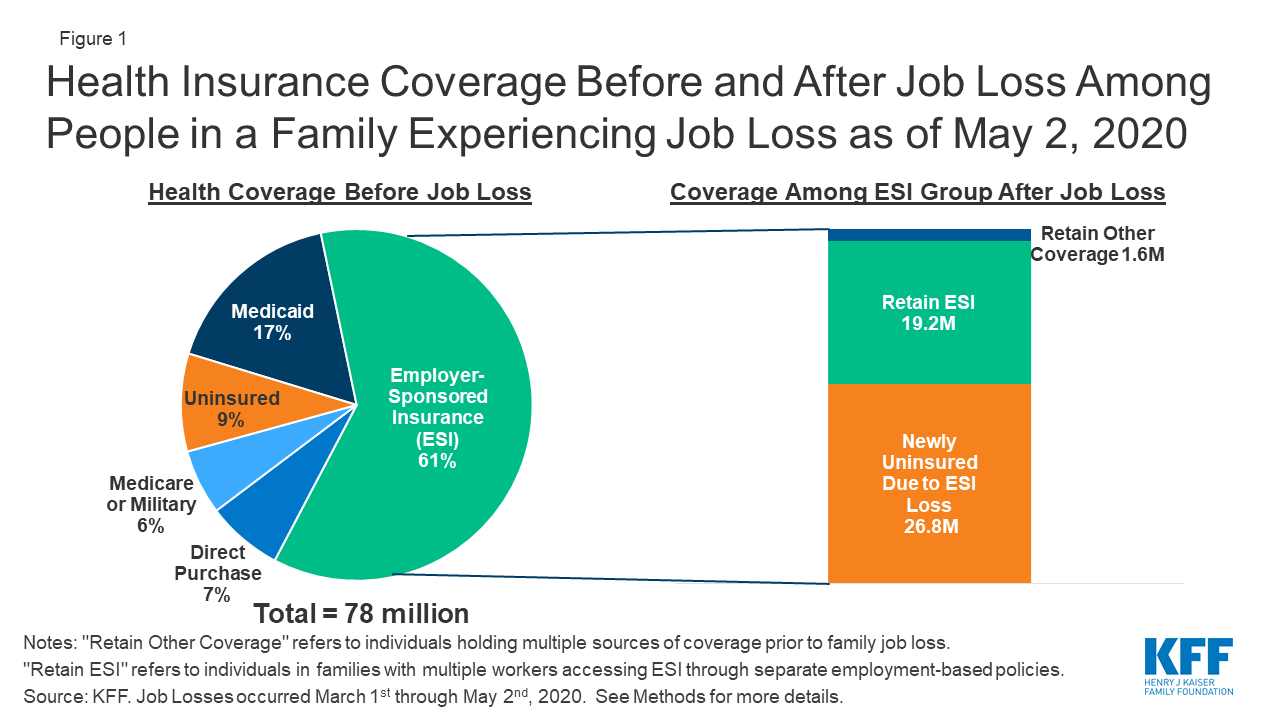
Between March 1st, 2020 and May 2nd, 2020, we estimate that nearly 78 million people lived in a family in which someone lost a job. Most people in these families (61%, or 47.5 million) were covered by ESI prior to job loss. Nearly one in five (17%) had Medicaid, and close to one in ten (9%) were uninsured. The remaining share either had direct purchase (marketplace) coverage (7%) or had other coverage such as Medicare or military coverage (6%) (Figure 1).
Eligibility for ACA Health Coverage Following Job Loss | The Henry ...

We estimate that, as of May 2nd, 2020, nearly 27 million people could potentially lose ESI and become uninsured following job loss (Figure 1). This total includes people who lost their own ESI and those who lost dependent coverage when a family member lost a job and ESI. Additionally, some people who otherwise would lose ESI are able to retain job-based coverage by switching to a plan offered to a family member: we estimate that 19 million people switch to coverage offered by the employer of a working spouse or parent. A very small number of people who lose ESI (1.6 million) also had another source of coverage at the same time (such as Medicare) and retain that other coverage. These coverage loss estimates are based on our assumptions about who likely filed for UI as of May 2nd, 2020 and the availability of other ESI options in their family (see Methods for more detail).

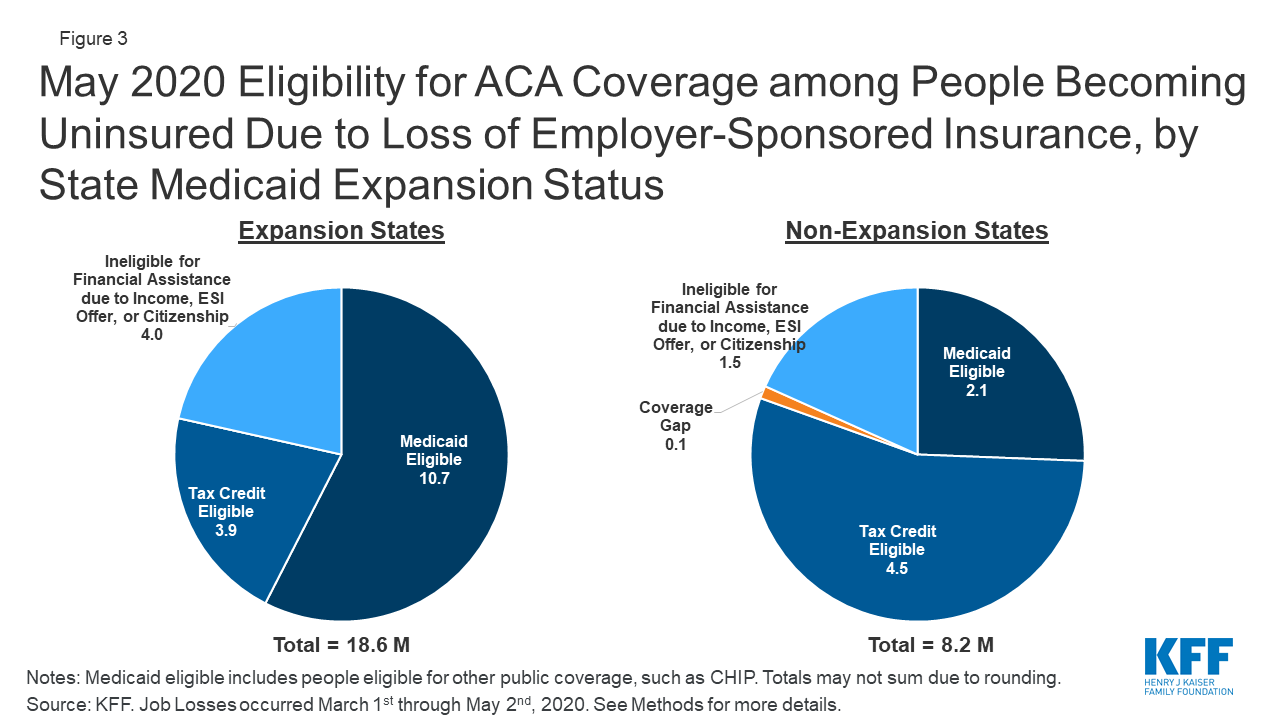
Among people who become uninsured after job loss, we estimate that nearly half (12.7 million) are eligible for Medicaid, and an additional 8.4 million are eligible for marketplace subsidies, as of May 2020 (Figure 2). In total, 79% of those losing ESI and becoming uninsured are eligible for publicly-subsidized coverage in May. Approximately 5.7 million people who lose ESI due to job loss are not eligible for subsidized coverage, including almost 150,000 people who fall into the coverage gap, 3.7 million people ineligible due to family income being above eligibility limits, 1.3 million people who we estimate have an affordable offer of ESI through another working family member, and about 530,000 people who do not meet citizenship or immigration requirements. We project that very few people fall into the coverage gap immediately after job loss (as of May 2020) because wages before job loss plus unemployment benefits (including the temporary $600 per week federal supplement added by Congress) push annual income for many unemployed workers in non-expansion states above the poverty level, making them eligibility for ACA marketplace subsidies for the rest of the calendar year.
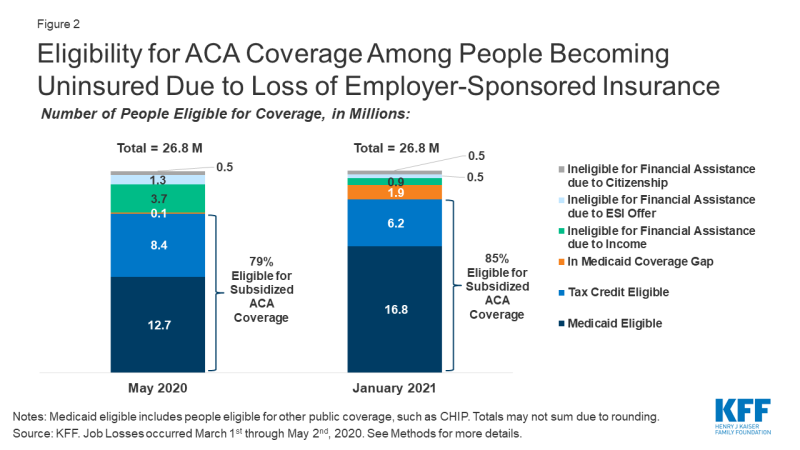
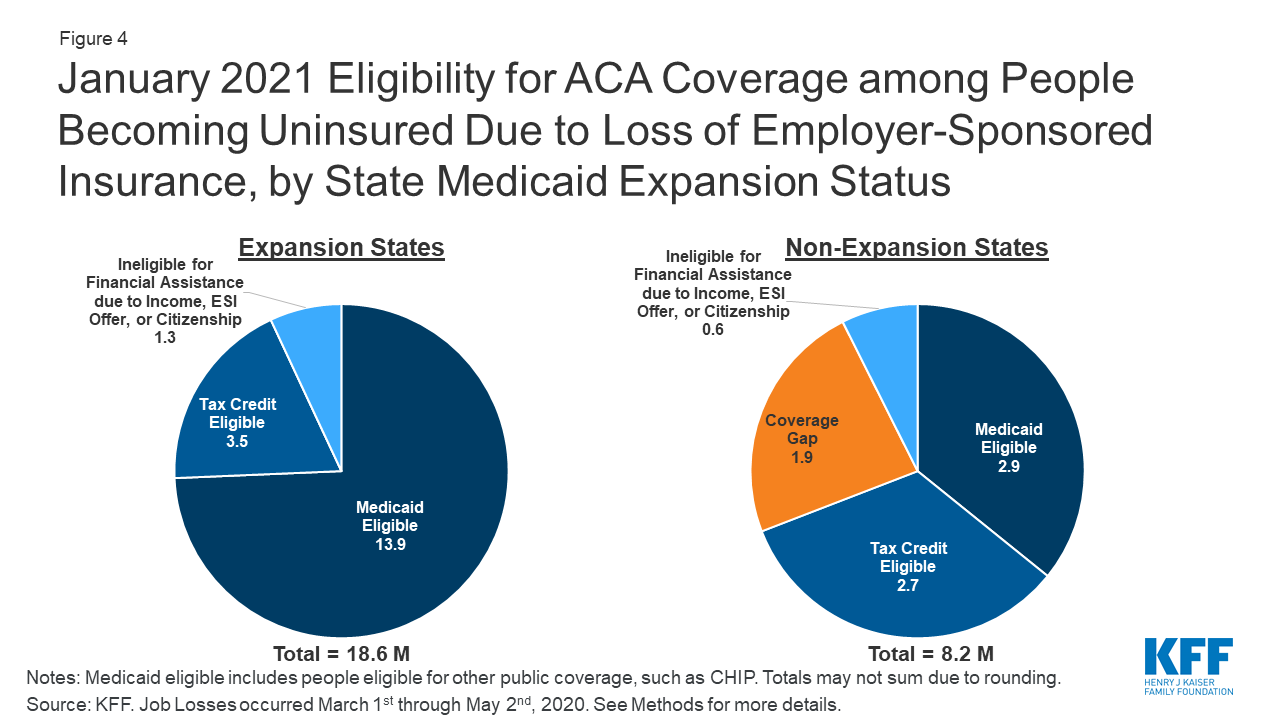
By January 2021, when UI benefits cease for most people, we estimate that eligibility shifts to nearly 17 million being eligible for Medicaid and about 6 million being eligible for marketplace subsidies (Figure 2), assuming those who are recently unemployed have not found work. Many unemployed workers who are eligible for ACA marketplace subsidies during 2020 would instead be eligible for Medicaid or fall into the coverage gap during 2021. The number in the coverage gap grows to 1.9 million (an increase of more than 80% of its previous size), and the number ineligible for coverage due to income shrinks to 0.9 million.

Estimates of coverage loss and eligibility vary by state, depending largely on underlying state employment by industry and Medicaid expansion status. Not surprisingly, states in which the largest number of people are estimated to lose ESI are large states with many people working in affected industries (Appendix Table 1). Eight states (California, Texas, Pennsylvania, New York, Georgia, Florida, Michigan, and Ohio) account for just under half (49%) of all people who lose ESI. Five of the top eight states have expanded Medicaid, and people eligible for Medicaid among the potentially newly uninsured as of May 2020 in these five states account for 40% of all people in that group nationally. Overall, patterns by state Medicaid expansion status show that people in expansion states are much more likely to be eligible for Medicaid, while those in non-expansion states are more likely to qualify for marketplace subsidies (Figure 3). However, the number of people qualifying for marketplace subsidies is similar across the two sets of states, as more people live in expansion states. Three states that have not expanded Medicaid, including Texas, Georgia, and Florida, account for 30% of people who become marketplace tax credit eligible nationally in May 2020. Assuming unemployment extends into 2021 when UI benefits would likely expire for most families, the proportion eligible for Medicaid would increase in expansion states while non-expansion states may see more nonelderly adults moving into the Medicaid coverage gap (Figure 4; Appendix Table 2).
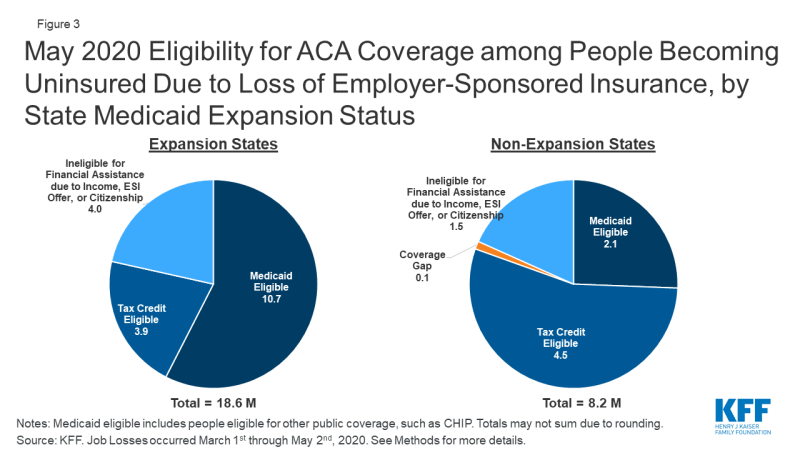
Figure 3: May 2020 Eligibility for ACA Coverage among People Becoming Uninsured Due to Loss of Employer-Sponsored Insurance, by State Medicaid Expansion Status
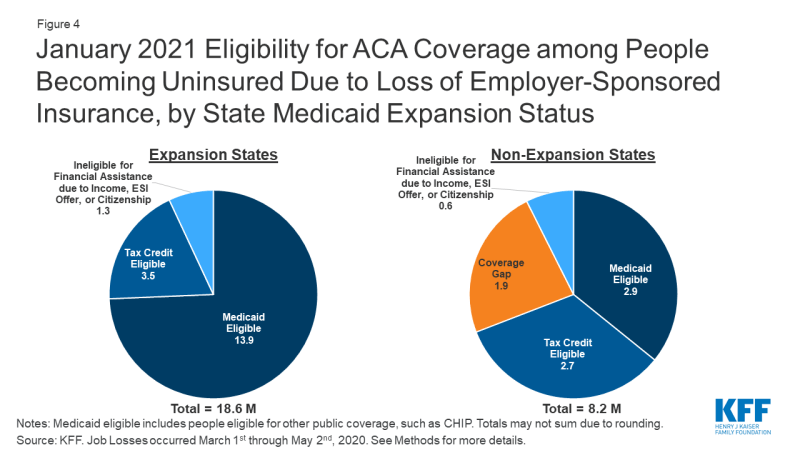
Figure 4: January 2021 Eligibility for ACA Coverage among People Becoming Uninsured Due to Loss of Employer-Sponsored Insurance, by State Medicaid Expansion Status

Nearly 7 million people losing ESI and becoming uninsured are children, and the vast majority of them are eligible for coverage through Medicaid or CHIP. Within the 26.8 million people losing ESI and becoming uninsured in May 2020, 6.1 million are children. Because Medicaid/CHIP income eligibility limits for children are generally higher than they are for adults, the vast majority of these children are eligible for Medicaid/CHIP in May 2020 (5.5 million, or 89%) or January 2021 (5.8 million, or 95%).

Discussion

Given the health risks facing all Americans right now, access to health coverage after loss of employment provides important protection against catastrophic health costs and facilitates access to needed care. Unemployment Insurance filings continue to climb each week, and it is likely that people will continue to lose employment and accompanying ESI for some time, though some of them will return to work as social distancing curbs are loosened. The ACA expanded coverage options available to people, and we estimate that the vast majority of people who lose ESI due to job loss will be eligible for ACA assistance either through Medicaid or subsidized marketplace coverage. However, some people will fall outside the reach of the ACA, particularly in January 2021 when UI benefits cease for many and some adults fall into the Medicaid coverage gap due to state decisions not to expand coverage under the ACA.

Both ACA marketplace subsidies and Medicaid are counter-cyclical programs, expanding during economic downturns as people’s incomes fall. In return for additional federal funding to help states finance their share of Medicaid cost during the public health crisis, states must maintain eligibility standards and procedures that were in effect on January 1, 2020 and must provide continuous eligibility through the end of the public health emergency, among other requirements. These provisions may help eligible individuals enroll in and maintain Medicaid, particularly in light of state and federal actions prior to the crisis to increase eligibility verification requirements or transition people off Medicaid.

Our estimates only examine eligibility among people who lost ESI due to job loss and potentially became uninsured. Additional uninsured individuals—including some of the 9% of the 78 million individuals in families where someone lost employment—may also be eligible for Medicaid or subsidized coverage. It is possible that contact with state UI systems may lead them to seek and enroll in coverage, even if they were eligible for financial assistance before job loss but uninsured.

It is unclear whether people losing ESI and becoming uninsured will enroll in new coverage. We did not estimate take-up or enrollment in coverage options but rather only looked at eligibility for coverage. Even before the coronavirus crisis, there were millions of people eligible for Medicaid or marketplace subsidies who were uninsured. Eligible people may not know about coverage options and may not seek coverage; others may apply for coverage but face challenges in navigating the application and enrollment process. Still others may find marketplace coverage, in particular, unaffordable even with subsidies. As policymakers consider additional efforts to aid people, expanding outreach and enrollment assistance, which have been reduced dramatically by the Trump Administration, could help people maintain coverage as they lose jobs.

This is the first economic downturn during which the ACA will be in place as a safety net for people losing their jobs and health insurance. The Trump Administration is arguing in case before the Supreme Court that the ACA should be overturned; a decision is expected by next Spring. The ACA has gaps, and for many the coverage may be unaffordable. However, without it, many more people would likely end up uninsured as the U.S. heads into a recession.


Now Is the Time to Address Surprise Billing

https://www.medpagetoday.com/blogs/marty-makary/86455?xid=fb_o&trw=no&fbclid=IwAR1boFFgBZuSqJ9-1728UdSFeIK790TTXNeoJJ9mky9jCKbGyQ_G4jqwrfk

Tips to avoid surprise medical bills

The doctor-patient relationship is being undermined.

Private equity companies have spent millions in dark money to stall and effectively kill all versions of surprise billing reform. But this week, the issue will come before Congress again. Legislation was introduced Tuesday in the House that, among other things, would further assist hospitals with more relief funds. With this potential third disbursement of federal dollars comes an opportunity to finally address the embarrassing problem of surprise billing that has eroded the public trust in our great medical profession.

Physicians across the country are now signing a letter urging leaders of Congress to address surprise billing once and for all. I have already signed this letter and encourage you to consider doing so as well.

One reason the medical profession is the greatest profession in the world is that patients put their faith and trust in us. But 64% of Americans now say they have avoided or delayed medical care for fear of the bill. As more and more patients lose faith in the system, the doctor-patient relationship is being undermined by surprise billing and the modern-day business practices of price gouging and predatory billing. In fact, these egregious practices have become part of the business model of some private equity groups, which seek to replace physician autonomy with corporate medicine.

Our system today is unnecessarily complicated and works against patients’ interests by putting them in the middle of a finger-pointing blame game, which leaves them holding the bag. It doesn’t make sense for us to accept people with open arms, treat their ailment, and then ruin their lives financially. Medical science is a bastion of scientific and intellectual genius. We can fix this problem. Already, some efforts are advancing price transparency by creating a transparent marketplace for patients.

I’ve spent many years looking at the systematic cost issues that face our health system and patients. Simply put, the lack of fairness and transparency in pricing and billing practices has created financial toxicity and increased the general mistrust of the medical system for millions of Americans. No one designed it to be this bad. In fact, we have good people working in a bad system. When I explain details of pricing, billing, and collections with doctors and hospital leaders, they are invariably shocked and furious to learn how out of control their billing offices have gotten in overcharging patients and shaking people down for more than a reasonable amount for a service.

The current COVID-19 crisis is a stark reminder of the gaps in our health system that exacerbate the pressures facing providers and patients. Many Americans are getting crushed right now. Despite many years of debate in Washington and bipartisan agreement that something must be done, there is still no federal protection in place to safeguard consumers from an egregious surprise medical bill if they need emergency care or have limited options. The reality is that special interests — including the very private equity firms that stand to benefit financially from these exploitative business practices — continue to spend millions to maintain the status quo.

It’s time for a bipartisan compromise to end the non-transparent game of surprise medical billing. It’s time that Congress takes meaningful action to protect patients during this COVID-19 crisis and finally address this issue. Congress has solutions on the table that would bring much greater fairness and transparency to the healthcare system, protect patients from these predatory charges, and ensure that physicians are paid fairly for our services, as we deserve. It’s time we put an end to the cycle of financial toxicity and rebuild the great public trust in the medical profession.