9 hospitals laying off workers

Unprecedented Layoffs among Nonprofits Threaten Deep Community Damage - Non  Profit News | Nonprofit Quarterly

The financial challenges caused by the COVID-19 pandemic forced hundreds of hospitals across the nation to furlough, lay off or reduce pay for workers, and others have had to scale back services or close.

Lower patient volume, canceled elective procedures and higher expenses tied to the pandemic have created a cash crunch for hospitals, and hospitals are taking a number of steps to offset financial damage. Executives, clinicians and other staff are taking pay cuts, capital projects are being put on hold, and some employees are losing their jobs. More than 260 hospitals and health systems furloughed workers in the last year, and dozens of others have implemented layoffs.

Below are nine hospitals and health systems that are laying off employees. Some of the layoffs were attributed to financial strain caused by the pandemic. 

1. Boca Raton, Fla.-based Cancer Treatment Centers of America is selling its hospital in Philadelphia and will lay off the facility’s 365 employees, according to a closure notice filed with the state. Cancer Treatment Centers of America said it anticipates the layoffs in Philadelphia will begin after May 30, according to the Philadelphia Business Journal

2. Providence Queen of the Valley Medical Center in Napa, Calif., will lay off 10 employees, The Napa Valley Register reported April 11. The layoffs will affect six emergency department technicians and four cooks. The COVID-19 pandemic had a “profound effect” on the hospital system, including volume and revenue reductions, a Providence spokesperson told The Napa Valley Register. As a result of volume declines in its ED, the health system is reducing staffing. 

3. Olympia Medical Center in Los Angeles closed March 31. The closure resulted in the layoffs of 451 employees.

4. The outgoing owners of Providence Behavioral Health Hospital in Holyoke, Mass., are laying off the hospital’s 151 employees, effective April 20, according to MassLive. Trinity Health of New England, part of Livonia, Mich.-based Trinity Health, is selling the hospital to Health Partners New England, which plans to take over the hospital April 20. 

5. Boca Raton, Fla.-based Cancer Treatment Centers of America plans to close its hospital in Tulsa, Okla., June. 1. About 400 employees will be affected by the closure. 

6. Plattsburgh, N.Y.-based Champlain Valley Physicians Hospital plans to cut 60 jobs. The hospital, which is facing a $6.5 million deficit in fiscal year 2021, said the cuts include 10 people who were laid off or had permanent hour reductions, 12 people who are planning retirement, and the rest are open positions that will not be filled, according to a March 9 NBC 5 report. 

7. Buffalo, N.Y.-based Catholic Health announced March 19 that it plans to end inpatient services and close the intensive care unit at its St. Joseph campus in Cheektowaga, N.Y. The changes will result in some positions being eliminated. Catholic Health said it will try to find affected employees comparable positions within the system. 

8. Upper Allegheny Health System, a two-hospital system based in Olean, N.Y., plans to reduce acute care and surgical services at Bradford (Pa.) Regional Medical Center. Under the plan, the acute care and surgical services will be moved to the health system’s other hospital, Olean General Hospital, effective May 1. There will be a minimal number of layoffs resulting from the consolidation of services, a spokesperson told WHYY. 

9. Philadelphia-based Tower Health laid off 15 workers at St. Christopher’s Hospital for Children, including four physicians, in March, according to The Philadelphia Inquirer. Tower Health ended the second half of last year with an operating loss of $31 million, according to the report.  

Hospital Volunteers Wanted

May be an image of text that says 'WANTED Volunteers who don '+ believe in COVID19. Activities include transfer of Patients, transfer of the dead, general cleaning on the COVID ward and personal care of COVID patients. OS: It won '+ be a problem that you won + get PPE as you don't believe they are necessary. Signed: Health care Workers'

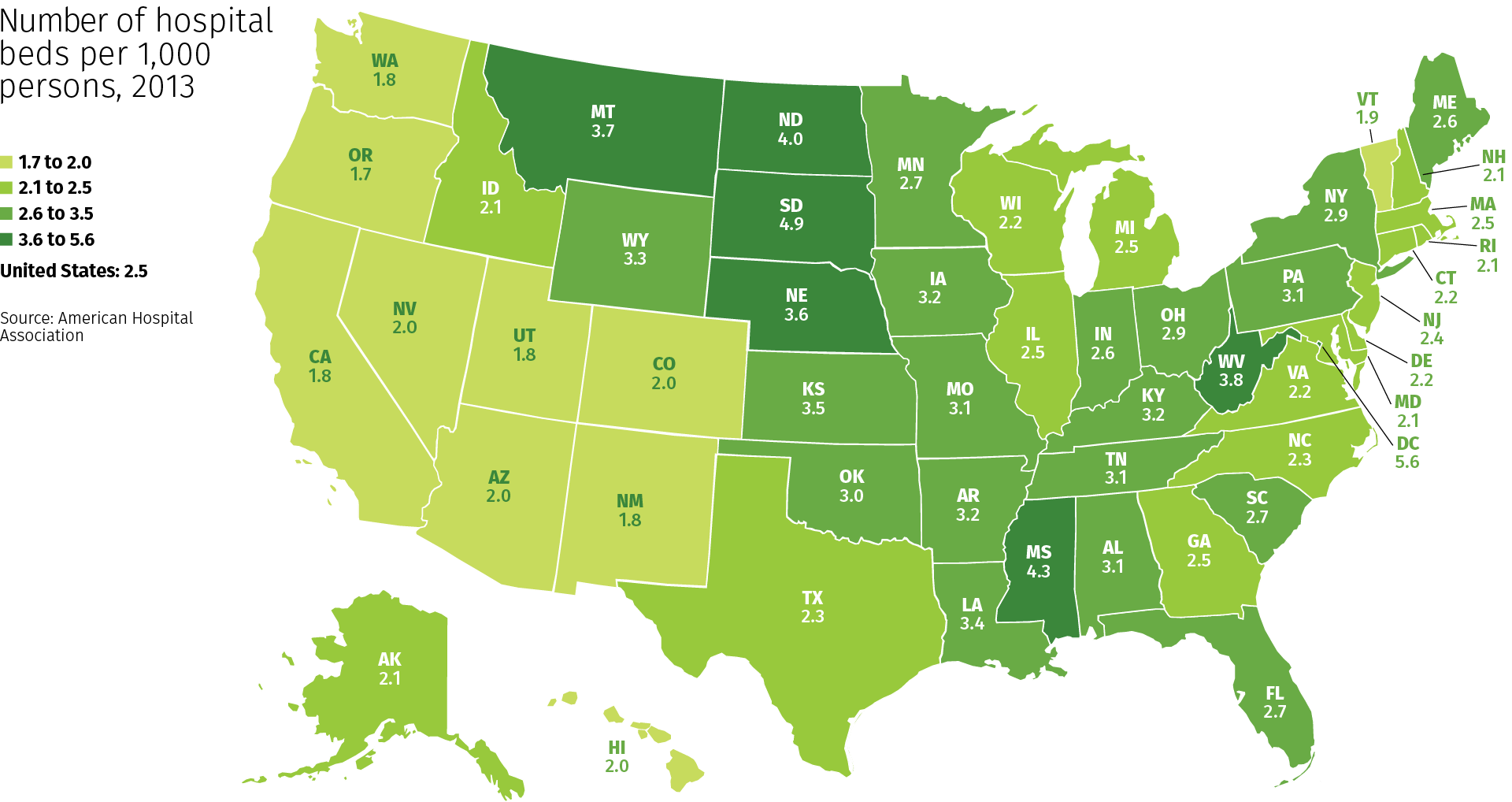
States ranked by hospital beds per 1,000 population

Map: Number of hospital beds per 1,000 persons, 2013

South Dakota has the highest number of hospital beds per 1,000 population in the U.S., while Oregon and Washington have the lowest, according to a ranking from the Kaiser Family Foundation.

The data is based on an analysis of the American Hospital Association’s annual survey from 2015 to 2019.

The national average per 1,000 U.S. residents was 2.4 hospital beds.

Here are the U.S. states ranked by number of staffed hospital beds per 1,000 population:

Note: The list includes ties and results in a numerical listing of 22.

1. South Dakota: 4.8 beds per 1,000 people 

2. District of Columbia: 4.2 

3. North Dakota: 4.4

4. Mississippi: 3.7

5. West Virginia: 3.6

6. Montana: 3.4

Wyoming: 3.4

7. Kansas: 3.3

    Louisiana: 3.3

8. Kentucky: 3.2

9. Alabama: 3.1

    Nebraska: 3.1

10. Arkansas: 3

     Iowa: 3

     Missouri: 3

11. Oklahoma: 2.9

12. Ohio: 2.8

      Pennsylvania: 2.8

13. Indiana: 2.7

      New York: 2.7

     Tennessee: 2.7

14. Florida: 2.6

     Maine: 2.6

     Michigan: 2.6

15. Illinois: 2.5

     Minnesota: 2.5

16. Georgia: 2.3

     Massachusetts: 2.3

     New Jersey: 2.3

    South Carolina: 2.3

17. Alaska: 2.2

     Delaware: 2.2

     Texas: 2.2

18. New Hampshire: 2.1

     North Carolina: 2.1

     Rhode Island: 2.1 

     Virginia: 2.1

19. Connecticut: 2

      Nevada: 2

     Vermont: 2

     Wisconsin: 2

20. Arizona: 1.9

      California: 1.9

      Colorado: 1.9

      Hawaii: 1.9

      Idaho: 1.9 

21. Maryland: 1.8

     New Mexico: 1.8

     Utah: 1.8

22. Oregon: 1.7

      Washington: 1.7

Pennsylvania cancer hospital to lay off 365 workers

Cancer Treatment Centers of America®, Philadelphia PA | CTCA

Cancer Treatment Centers of America is selling its hospital in Philadelphia and will lay off the facility’s 365 employees, according to a closure notice filed with the state.

Boca Raton, Fla.-based Cancer Treatment Centers of America signed an agreement in March to sell the hospital to Philadelphia-based Temple University Hospital. The deal requires approval from the Pennsylvania Department of Health. 

In the notice filed with the state, Cancer Treatment Centers of America said some displaced Philadelphia workers may be offered jobs at affiliated entities outside of Pennsylvania, according to the Philadelphia Business Journal. The company’s other hospitals are in Chicago, Atlanta, Phoenix and Tulsa, Okla. In March, the company announced it will close its hospital in Tulsa June 1. 

Cancer Treatment Centers of America said it anticipates the layoffs in Philadelphia will begin after May 30, according to the Philadelphia Business Journal

Temple Health CEO Michael Young told the Philadelphia Business Journal that the system wants to hire as many CTCA workers as possible if the deal is finalized. 

Houston Methodist implements mandatory COVID-19 vaccinations

Houston Methodist's new $700M tower sends a message in competitive market |  FierceHealthcare

Houston Methodist will make the COVID-19 vaccine mandatory for employees, with the first phase including managers and new hires, the health system said March 31. 

In an email, Marc Boom, MD, president and CEO, told managers new hires are already required to be vaccinated as a condition to joining Houston Methodist, and management is now also required to do the same.

“When we choose to be vaccinated against COVID-19, we are prioritizing safety by helping stop the spread of this deadly virus and keeping our patients, visitors and colleagues safe,” Dr. Boom wrote to managers. “As we move closer to announcing mandatory vaccinations for all employees, we need you to go first — to lead by example and show our employees how important getting vaccinated is.”

At Houston Methodist, 95 percent of management and all executives have already received at least one dose of a COVID-19 vaccine. Dr. Boom said managers who have not done this have until April 15 to receive at least one dose or get an approved exemption. Those who do not comply would first have a discussion with their supervisor, then could face suspension then termination. 

All 26,000 Houston Methodist employees and employed physicians soon will be required to receive at least one shot.

Overall, about 83 percent of the health system’s employees have been vaccinated. 

Non-operating income helps Providence claw back into black for 2020

https://www.healthcaredive.com/news/non-operating-income-helps-providence-claw-back-into-black-for-2020/596370/

Dive Brief:

  • Though the COVID-19 pandemic hampered Providence’s operational performance in 2020, the regional nonprofit powerhouse still ended the year in the black with net income of $1 billion, down about 9% from 2019.
  • Providence ended 2020 with an operating loss of $306 million, compared to an operating income of $214 million in 2019. However, healthy non-operating income recouped operating losses and offset reimbursement shortfalls from Medicaid and Medicare coverage, Providence said in full-year financial results released Monday.
  • The system, which operates 51 hospitals spanning seven states, posted drastic net losses in the first half of 2020 due to the pandemic, but seems to have closed out the year on more stable financial footing though volumes remain down.

Dive Insight:

Like other major systems, the pandemic railroaded Providence’s operational performance in 2020, as state and local lockdowns and orders to pause non-emergency procedures contributed to an unprecedented drop in patient volumes starting in March. As a result, the West Coast system reported a significant dip in patient revenue, along with skyrocketing expenses for personal protective equipment, pharmaceuticals and labor.

Volumes as measured by adjusted admissions were down 9% for the fiscal year ended Dec. 31, Providence said. Despite the lower volume, operating revenues were actually up 3% year over year to $25.7 billion, driven by growth in capitation, premium and diversified revenue streams — and supported by the recognition of $957 million in federal COVID-19 grants to providers from the Coronavirus Aid, Relief, and Economic Security Act passed a year ago.

However, operating expenses climbed 5% year over year to $26 billion, resulting in ​operating earnings before interest, depreciation and amortization of $1.1 billion, compared with $1.6 billion in 2019.

Overall, Providence’s financial results suggest the system was able to sidestep the worst of the pandemic’s financial effects, and mirrors 2020 reports from other major nonprofits.

Kaiser Permanente, which reported in early February, was also able to stay in the black despite COVID-19 deflating operating and net income, which fell about 19% and 15% respectively from 2019. Similarly, nonprofit Mayo Clinic reported a shrinking bottom line, with net income down almost 24% from 2019 though it remained profitable.

California-based nonprofit Sutter Health also squeaked to overall profitability in 2020 despite a operational loss of $321 million. The system, which said it expected to take several years to fully recover from COVID-19, launched a systemwide operational and financial review as a result of its weak operational performance.

For-profit operators weathered similar headwinds and were able to turn a profit in 2020, including Universal Health ServicesHCA HealthcareTenet and Community Health Systems.

A number of hospital executives have called out CARES grants and other federal aid as a key help in turning their finances around in 2020. However, despite the pandemic’s financial pressures, numerous major operators, including Kaiser Permanante, Mayo Clinic and HCA said they would return all or a portion of congressional aid, even as powerful hospital lobbies call on Washington for additional funds.

A recent Kaufman Hall report suggests providers could be overwhelmed by ongoing COVID-19 expenses following a surge in cases over the winter. Researchers estimate hospitals could lose anywhere from $53 billion to $122 billion in revenue in 2021 if pandemic pressures don’t abate, despite the glimmer of hope brought by ongoing vaccination efforts.

Despite increasing distribution of coronavirus vaccines, Moody’s Investors Service has placed a negative outlook on nonprofit hospitals in 2021.

Providence came together in 2016 with the merger of Washington-based Providence Health & Services and California-based St. Joseph Health to create the nation’s fourth-biggest Catholic hospital chain. Its full-year earnings come a week after California Attorney General and Biden nominee for HHS Secretary Xavier Becerra disclosed his office is investigating whether Providence violated legal commitments in applying religious restrictions to medical care at a hospital in Orange County.​

Sutter launches ‘sweeping review’ of finances after $321M operating loss

https://www.healthcaredive.com/news/sutter-launches-sweeping-review-of-finances-after-321m-operating-loss/596221/

Digital assistant uses AI to ease medical documentation at Sutter | Health  Data Management

Dive Brief:

  • Sutter Health is launching a “sweeping review” of its finances and operations due to the pandemic’s squeeze on the system in 2020, which led to a $321 million operational loss, the system said Thursday. 
  • The giant hospital provider in Northern California said it will take “several years to fully recover,” adding that it plans to restructure and even close some programs and services that attract fewer patients, and will reassign those employees to busier parts of its network. 
  • Sutter, which spent $431 million to modernize its facilities last year, is also reassessing its future capital investments due to its current financial situation. 

Dive Insight:

The pandemic “exacerbated” existing challenges for the provider, including labor costs, Sutter said. 

Expenses again outpaced revenue in 2020 and Sutter fears the trajectory is “unsustainable.” 

In 2020, Sutter generated revenue of $13.2 billion which was eclipsed by $13.5 billion in expenses, which was actually lower than its total expenses reported in 2019. 

Last year, the system invested heavily to prepare for the pandemic, buying up personal protective equipment and other supplies all while volumes declined. Sutter estimates it spent at least $121 million on COVID-19 supplies, which does not include outside staffing costs. 

Sutter said labor costs represented 60% of its total operating expenses, blaming high hospital wage indexes in Northern California, which it said are among the priciest in the country.

Still, Sutter was able to post net income of $134 million thanks in part to investment income, which was also deflated compared to the year prior. 

Volume has not rebounded to pre-pandemic levels, the system said. 

Admissions, emergency room visits and outpatient revenues all fell year over year, according to figures in Sutter’s audited financial statements. 

Other major health systems were pinched by the pandemic but were able to post a profit, including Kaiser Permanente.  

How hospital operators fared financially in 2020

“For the most part providers were dependent on that CARES funding. I think they would have been in the red or break even without it,” Suzie Desai, a senior director at S&P Global Ratings, said.

The pandemic weighed heavily on the financial performance of not-for-profit hospitals in 2020, but some of the larger health systems remained profitable despite the upheaval — in large part thanks to substantial federal funding earmarked to prop up providers during the global health crisis. 

Industry observers have been closely watching to see how health systems ultimately fared in 2020. Now, with the fiscal-year ended and accounted for, analysts say the $175 billion in federal funds was crucial for providers’ bottom lines.

Without the stimulus funding, it is very likely we would have seen more issuers [hospitals/health] systems experience either lower profitable margins, or outright losses from operations,” Kevin Holloran, senior director of U.S. public finance for Fitch Ratings, said.  

Still, the pandemic put a squeeze on nonprofit hospital margins last year, according to a recent Moody’s report that showed the median operating margin was 0.5% in 2020 compared to 2.4% in 2019.

The first half of the year hit providers especially hard as volumes fell drastically, seemingly overnight. Revenue plummeted alongside the volume declines as the nation paused lucrative elective procedures to preserve medical resources.

One estimate showed hospitals lost more than $20 billion as they halted surgeries in the early months of the outbreak in the U.S. 

But as the year wore on, the outlook improved as some volumes returned closer to pre-pandemic levels. At the same time, health systems worked to cut expenses to mitigate the financial strain.

Still, some health systems did post operational losses even with the federal funds meant to help them. Moody’s found that 42% of 130 hospitals surveyed posted an operating loss, an increase from 23% the year prior. Yet, the 2019 survey included more hospitals, a total of 282.

Sutter Health, the Northern California giant, reported an operating loss for 2020 and said it was launching a “sweeping review” of its finances as the pandemic exacerbated existing challenges for the provider. Washington-based Providence also reported an operating loss for 2020. However, both Sutter and Providence were able to post positive net income thanks in large part to investment gains.    

Investment income can aid nonprofit operators even when core operations are stunted like during 2020. Though, initially, the pandemic put stress on the stock market as uncertainty around the virus and its duration ballooned. The stock market took a dive and it was reflected in some six-month financials as both operations and investments took a hit. 

“COVID and the stimulus is (hopefully) a once in a lifetime disruption of operations,” Holloran said, who noted analysts have been trying to assess whether the top line losses can be placed squarely on COVID-19. If that’s the case, analysts are typically more apt to keep the provider’s existing rating. 

“For the most part providers were dependent on that CARES funding. I think they would have been in the red or break even without it,” Suzie Desai, a senior director at S&P Global Ratings, said.

For example, Arizona’s Banner Health would have posted an operating loss without federal relief, according to their financial reports. Banner Health was able to work its way back to black after it reported a loss through the first six months of the year. The same was true for Midwest behemoth Advocate Aurora. 

The providers that were able to weather the storm of the pandemic tended to be integrated systems that had a health plan under their umbrella. 

Kaiser Permanente ended the year with both positive operating and net income and returned relief funds it received.   

“The integrated providers, yeah, were one group that just had a natural hedge with the insurance premiums still coming in,” Desai said.  

Still, the hospital lobby is hoping to secure more funding for its members as the threat of the virus is still present even amid large scale efforts to vaccinate a majority of Americans to reach a blanket of protection from the novel coronavirus and its variants.

Shifting payer mix puts 340B hospitals at risk of losing eligibility

Dive Brief:

  • Hospitals enrolled in the 340B drug discount program may no longer be eligible after the pandemic shifted their payer mix, according to a Wednesday letter the American Hospital Association sent to HHS Secretary Xavier Becerra.
  • Depleted patient volumes and canceled elective surgeries lowered the proportion of hospital patients who are Medicaid and Medicare SSI patients in 2020, according to AHA. When hospitals file their Medicare cost reports reflecting those changes, they may no longer meet the criteria for the program and lose access.
  • AHA wants HHS to waive certain eligibility requirements for hospitals in the program to allow them continued access during the public health emergency, according to the letter.

Dive Insight:

Throughout the pandemic HHS has issued a number of regulatory flexibilities to help providers, and the hospital lobby is asking it to do so again by waiving the current eligibility requirements for the 340B drug discount program before providers experiencing a temporary shift in payer mix are kicked out.

The program requires drug companies to give discounts on outpatient drugs to providers serving a large share of low-income patients, particularly those in rural areas.

The discounts can range from 25% to 50% of the cost of the drugs, according to HRSA, which operates the program.

But many of those patients did not seek care last year, hampering hospitals’ finances and altering the mix of payers.

Hospitals currently qualify for the program based on their volume of inpatient Medicaid and Medicare SSI patients, reported through their most recently filed Medicare cost reports.

“Losing access to 340B discounted drugs and program savings could jeopardize the ability of these hospitals to provide critical services for their communities, which would be particularly catastrophic at a time when they remain on the front lines of the ongoing pandemic,” AHA said in its letter.

This latest issue comes after several years of clashes over the 340B program. 

Last year, a federal appeals court sided against the hospital lobby, ruling that HHS’ significant rate cut for some 340B drugs could remain in place. HHS made the reimbursement cut arguing that the hospitals already received steep discounts for the drugs and could be incentivized to overuse them.

At the time, AHA said it was weighing its options over whether to appeal to the Supreme Court. 

To head off other issues, HRSA finalized a rule late last year that created a dispute resolution process for when hospitals believed they were overcharged for 340B drugs. The drug manufacturers have a similar mechanism to raise concerns about whether hospitals received duplicate discounts. 

Another kind of surprise medical bills

Kaiser Health News’ latest edition of its “Bill of the Month” series features a patient who was charged a “facility fee,” which drove up what she owed to more than 10 times higher than what she’d previously paid for the same care.

Why it matters: Facility fees — which are essentially room rental fees, as KHN puts it — are becoming increasingly controversial, and patients often receive the bill without warning.

  • Hospitals aren’t required to inform patients ahead of time about facility fees.
  • Hospitals say they need the revenue to help cover the cost of providing 24/7 care.

What they’re saying: “Facility fees are designed by hospitals in particular to grab more revenue from the weakest party in health care: namely, the individual patient,” Alan Sager, a professor at the Boston University School of Public Health, told KHN.

  • The practice is becoming more popular as more private provider practices are bought by hospitals.
  • “It’s the same physician office it was,” said Trish Riley, executive director of the National Academy for State Health Policy. “Operating in exactly the same way, doing exactly the same services — but the hospital chooses to attach a facility fee to it.”