A contentious time for payer-provider negotiations

https://mailchi.mp/59374d8d7306/the-weekly-gist-january-13-2023?e=d1e747d2d8

In our decades of working in healthcare, we’ve never seen a time when payer-provider negotiations have been more tense. Emboldened insurers, having seen strong growth during the pandemic, are entering contract negotiations with an aggressive posture.

“They weren’t even willing to discuss a rate increase,” one CFO shared as he described his health system’s recent negotiations with a large national insurer. “The plan’s opening salvo was a fifteen percent rate cut!”

Health systems are feeling lucky to get even a two or three percent rate bump, well short of the historical average of seven percent—and far short of what would be needed to account for skyrocketing labor, supply, and drug costs. According to executives we work with, efforts to describe the current labor crisis and resulting cost impacts with payers are largely falling on deaf ears.  
 
This scenario is playing out in markets across the country, with more insurers and health systems announcing that they are “terming” their contract, publicly stating they will cut ties should the stalemate in negotiations persist.

Speaking off the record, a system executive shared how this played out for them. With negotiations at an impasse, a large insurer began the process of notifying beneficiaries that the system would soon be out-of-network, and patients would be reassigned to new primary care providers. The health plan assumed that the other systems in the market would see this as a growth opportunity—and was shocked when they discovered that other providers were already operating at capacity, unable to accommodate additional patients from the “terminated” system. 

Mounting concerns about access brought the plan back to the table. Even in the best of times, a major insurer cutting ties with a health system is extremely disruptive for consumers, who must shift their care to new providers or pay out-of-network rates. But given current capacity challenges in hospitals nationwide, major network disruptions can be even more dire for patients—and may force payers and providers to walk back from the brink of contract termination. 

XBB.1.5 variant becomes dominant COVID strain in US

https://mailchi.mp/ad2d38fe8ab3/the-weekly-gist-january-6-2023?e=d1e747d2d8

Surging from less than 5 percent of cases in the first week of December, XBB.1.5 now makes up over 40 percent of all COVID infections in the US. The new variant appears to demonstrate a high level of immune evasion, and is around 40 percent more contagious than the next most virulent strain, though illnesses caused by XBB.1.5 do not seem to be more severe. Weekly rates for new COVID-related hospital admissions are now higher than at any point since February 2022, despite case counts remaining lower than the peak of the summer wave in July 2022 (although it is likely that the vast majority of cases are now identified through home testing, and not reported, making the data unreliable). 

The Gist: While the new variant seems to be less likely to create a COVID spike of the magnitude we experienced last winter, hospitalizations rising faster than case counts bears watching. That’s especially true given the current staffing situation in most hospitals, which makes each COVID admission and each caregiver call-out for illness a cause for concern. 

Only 15 percent of eligible Americans have received the most recent bivalent booster, leaving the population more vulnerable to this and future variants. Plus, additional funding to support the fight against COVID does not seem to be forthcoming from the new Congress. Beset with surges of COVID, flu, and RSV admissions, hospitals must hope that the end of the holiday season brings some relief.

Why are fewer hospital admissions coming from the emergency department?

https://mailchi.mp/ad2d38fe8ab3/the-weekly-gist-january-6-2023?e=d1e747d2d8

At a recent health system retreat, the CFO shared data describing a trend we’ve observed at a number of systems: for the past few months, emergency department (ED) volumes have been up, but the percentage of patients admitted through the ED is precipitously down.

The CFO walked to through a run of data to diagnose possible causes of this “uncoupling” of ED visits and inpatient admissions. Overall, the severity of patients coming to the ED was higher compared to 2019, so it didn’t appear that the ED was being flooded with low-level cases that didn’t merit admission. Apart from the recent spike in respiratory illness brought on by the “tripledemic” of flu, COVID and RSV, there wasn’t a noteworthy change in case mix, or the types of patients and conditions being evaluated in the emergency room. (Fewer COVID patients were admitted compared to 2021, but that wasn’t enough to account for the decline.) The physicians staffing the ED hadn’t changed, so a shift in practice patterns was also unlikely. 
 
A physician leader attending the retreat spoke up from the audience: “I can diagnose this for you. I work in the ED, and the problem is we can’t move them. Patients are sitting in the ED, in hallways, in observation, sometimes for days, because we can’t get a bed on the floor. The whole time we are treating them, and many of them get better, and we’re able to discharge them before a bed frees up.”

With nursing shortages and other staffing challenges, many hospitals have been unable to run at full capacity even if the demand for beds is there. So total admissions may be down, even if the hospital feels like it’s bursting at the seams.

The current staffing crisis not only presents a business challenge, but also adversely impacts patient experience, and makes it more difficult to deliver the highest quality care. A good reminder of the complexity of hospital operations, where strain in one part of the system will quickly impact the performance of other parts of the care delivery continuum.

Vaccination shortfall making it harder to fully staff hospitals

https://mailchi.mp/ef14a7cfd8ed/the-weekly-gist-august-6-2021?e=d1e747d2d8

Your Messages of Support | Emerson Hospital

With vaccine mandates on the rise among healthcare organizations, including many of the health systems we work with, we’ve begun to hear a new argument in favor of getting staff vaccinated—one that weighs against the worry that mandates will drive scarce clinical workers away.

With staffing already stretched, some systems have been concerned that implementing mandates could worsen shortages and force an increase in the use of costly agency labor. But, some executives are now telling us, so could not vaccinating staff. As the highly contagious Delta variant continues to sweep through unvaccinated populations, clinical workers who haven’t gotten their shots are especially susceptible to contracting the virus.

That’s driven a sharp increase in unvaccinated nurses and other workers calling out sick with COVID symptoms, which has made a difficult staffing situation even worse.

Some of the high-profile reports of hospitals running out of beds in the face of the Delta variant are actually driven by running out of staff to keep those beds in use—making it even more critical to ensure that frontline workers are protected against the virus.

As a growing number of hospitals and other care facilities mandate that their workers get vaccinated, we’d hope this unwelcome pressure on an already stretched workforce begins to wane.

LA County Paramedics Told Not To Transport Some Patients With Low Chance Of Survival

https://www.npr.org/sections/coronavirus-live-updates/2021/01/05/953444637/l-a-paramedics-told-not-to-transport-some-patients-with-low-chance-of-survival?fbclid=IwAR1BM5NI_SDAuVmU4TqBUg1Hk0qmAWHroUN0b7jIzrbL053BZLgluBNeU1k

Paramedics in Southern California are being told to conserve oxygen and not to bring patients to the hospital who have little chance of survival as Los Angeles County grapples with a new wave of COVID-19 patients that is expected to get worse in the coming days.

The Los Angeles County Emergency Medical Services Agency issued a directive Monday that ambulance crews should administer supplemental oxygen only to patients whose oxygen saturation levels fall below 90%.

In a separate memo from the county’s EMS Agency, paramedic crews have been told not to transfer patients who experience cardiac arrest unless spontaneous circulation can be restored on the scene.

Both measures announced Monday, which were issued by the agency’s medical director, Dr. Marianne Gausche-Hill, were taken in an attempt to get ahead of an expected surge to come following the winter holidays.

Many hospitals in the region “have reached a point of crisis and are having to make very tough decisions about patient care,” Dr. Christina Ghaly, the LA County director of health services, said at a briefing Monday.

“The volume being seen in our hospitals still represents the cases that resulted from the Thanksgiving holiday,” she said.

“We do not believe that we are yet seeing the cases that stemmed from the Christmas holiday,” Ghaly added. “This, sadly, and the cases from the recent New Year’s holiday, is still before us, and hospitals across the region are doing everything they can to prepare.”

Speaking to the CBS affiliate in Los Angeles, Gausche-Hill said personnel would continue to do everything possible to save the lives of patients, both at the scene and in the hospital.

“We are not abandoning resuscitation,” she said. “We are absolutely doing best practice resuscitation and that is do it in the field, do it right away.”

“[We] are emphasizing the fact that transporting these patients arrested leads to very poor outcomes. We knew that already and we just don’t want to impact our hospitals,” she added.

Meanwhile, the state is looking for ways to increase its supply of oxygen for use in treating COVID-19 patients, Gov. Gavin Newsom said, according to the Los Angeles Times.

We’re just looking at the panoply of oxygen support … across the spectrum and looking how we can utilize more flexibility and broader distribution of these oxygen units all up and down the state, but particularly in these areas — San Joaquin Valley and Los Angeles, the larger Southern California region — that are in particular need and are under particular stress,” Newsom said.

Los Angeles County remains the worst-hit county in the U.S. for both confirmed COVID-19 cases and deaths from the disease. Johns Hopkins University listed more than 818,000 confirmed coronavirus cases and more than 10,700 deaths from complications from the virus in Los Angeles County by late Monday.

Last week, the new highly contagious coronavirus strain from the U.K. was discovered in Southern California. Experts have said it spreads faster than the common strain.

Banner Health halts elective surgeries

History

Banner Health will pause elective surgeries Jan. 1, the Phoenix-based system announced Dec. 30. 

The health system is suspending nonurgent elective surgeries that can reasonably be postponed for 30 to 60 days without a negative impact on the patient’s health, according to TV station CBS 5

Banner’s hospitals are facing a surge of COVID-19 patients. As of Dec. 29, the system was at 104 percent licensed bed capacity, Banner Chief Clinical Officer Marjorie Bessel, MD, said Dec. 30, according to TV station ABC 15. Some Banner hospitals have exceeded 120 percent licensed bed capacity.

Because of a backlog of patients, some Banner hospitals are diverting incoming ambulance transports. 

“This diversion activity is an early indication that triage may soon be necessary if volumes continue to increase like they did this past week,” Dr. Bessel said, according to CBS 5. “What triage would look like, would be that we might, if we got to that point, be unable to care for everybody.”

Scripps CEO: Care rationing near if Californians ignore COVID-19 mitigation efforts

Prepare for Health Emergencies Like War Says CEO - Scripps Health

Hospitals in Southern California will need to start rationing care if more action isn’t taken by the community to mitigate the spread of COVID-19, Chris Van Gorder, president and CEO of Scripps Health, wrote in a Dec. 28 op-ed for The San Diego Union-Tribune

As of Dec. 29, 20,642 California residents were hospitalized with COVID-19. The state’s hospital bed capacity is 72,511. In San Diego County, where Scripps is headquartered, 18 intensive care unit beds were available as of Dec. 28, “not even enough to handle a single mass casualty incident,” Mr. Van Gorder wrote. Out of Scripps’ 173 ICU beds, seven staffed beds were available as of Dec. 28.

“This past weekend, one of our community hospitals ran out of room in their morgue. We are nearing the point where we have to make the decision of who gets care and who does not,” Mr. Van Gorder wrote.

He pleaded with the San Diego and California community to adhere to mask-wearing and social distancing guidelines, especially as the New Year’s Day holiday approaches. He called on residents to stay home for New Year’s, wear a mask, wash their hands, and not eat or drink with people who aren’t in their immediate family household.

Mr. Van Gorder’s commentary comes as Kaiser Permanente hospitals in Northern California are suspending elective, non-urgent procedures through Jan. 4 as they continue to face a surge in COVID-19 hospitalizations. The Oakland, Calif.-based system announced the suspension Dec. 26, days after Chair and CEO Greg Adams said during a news conference, “We simply will not be able to keep up if the COVID surge continues to increase. We’re at or near capacity everywhere.”

Kaiser Permanente CEO: ‘We’re at or near capacity everywhere’

Kaiser Permanente's health system reaches carbon-neutral status |  FierceHealthcare

Hospital executives in California are sounding alarms on their inpatient capacity as COVID-19 hospitalizations surge in the state, according to ABC News.

As of Dec. 23, California is among the eight states where the virus is spreading quickest. On Dec. 22, the state saw one of its biggest jumps in one-day COVID-19 hospitalizations, with an additional 653 patients admitted to hospitals

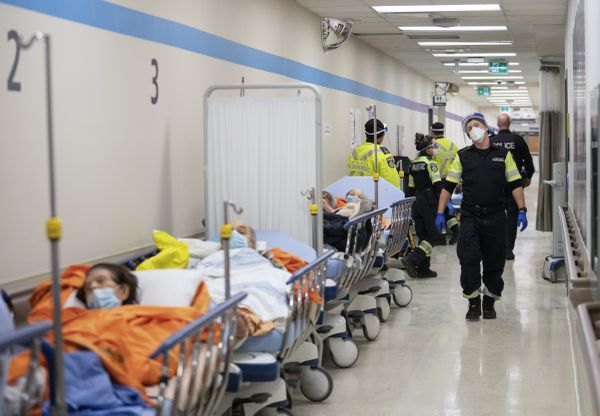
Officials from Oakland-based Kaiser Permanente, San Francisco-based Dignity Health and Sacramento-based Sutter Health said during a Dec. 22 news conference that they are facing capacity issues. In some cases, COVID-19 patients are being treated in hallways, gift shops and conference rooms.

Greg Adams, the chairman and CEO of Kaiser Permanente, said during the conference, “We simply will not be able to keep up if the COVID surge continues to increase. We’re at or near capacity everywhere.”

Many hospital officials said Thanksgiving gatherings contributed to the surge. The executives urged Californians to not gather for Christmas and New Year’s. 

U.S. Hits Highest 1-Day Toll From Coronavirus With 3,054 Deaths

https://www.npr.org/sections/coronavirus-live-updates/2020/12/09/944844088/u-s-hits-highest-one-day-death-toll-from-coronavirus-with-3-054?fbclid=IwAR0mP-0McBNWX43iXLzLWIJyQmI8dR73ChPEg98YtDAS6F1DI_36ZOpjnA4

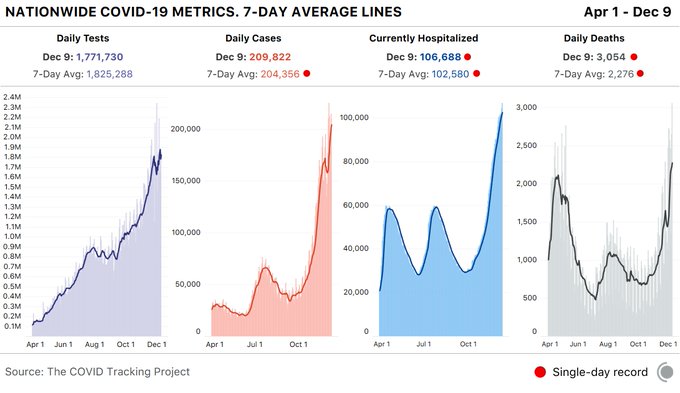
4 bar charts showing key COVID-19 metrics for the US over time. Today, states reported 1.8M tests, 210k cases, 106,668 currently hospitalized (record), and 3,054 deaths (record).

The coronavirus pandemic pushed the U.S. past another dire milestone Wednesday, the highest daily death toll to date, even while the mortality rate has decreased as health experts learn more about the disease.

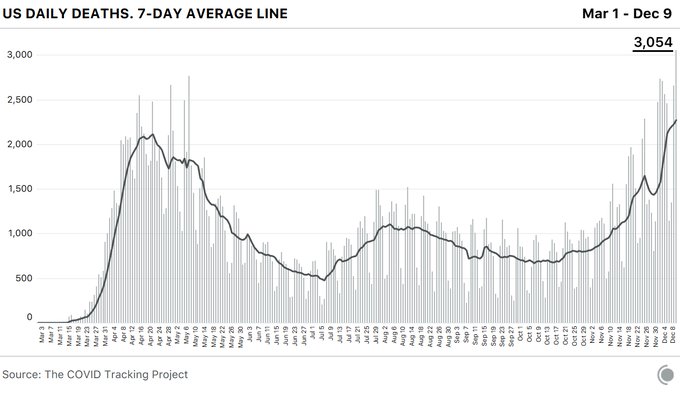
The Covid Tracking Project, which tracks state-level coronavirus data, reported 3,054 COVID-19 related deaths — a significant jump from the previous single-day record of 2,769 on May 7.

The spread of the disease has shattered another record with 106,688 COVID-19 patients in U.S. hospitals. And overall, states reported 1.8 million tests and 210,000 cases. According to the group, the spike represents more than a 10% increase in cases over the last 7 days.

Additionally, California nearly topped its single-day case record at 30,851. It is the second highest case count since December 6, the organization reported.

Chart showing COVID-19 deaths over time by day. Deaths hit a record high today (Dec 9) at 3,054.

The staggering spike in fatalities and infections has overwhelmed hospitals and intensive care units across the nation, an increase attributed by many experts to people relaxing their precautions at Thanksgiving.