Steward Health Care is abandoning its proposal to sell five Utah hospitals to HCA Healthcare, and New Jersey-based RWJBarnabas Health dropped its plan to purchase New Brunswick, NJ-based Saint Peter’s Healthcare System. These pivots come just weeks after the Federal Trade Commission (FTC) filed suits to block the transactions, saying they would reduce market competition. The FTC said in a statement that these deals “should never have been proposed in the first place,” and “…the FTC will not hesitate to take action in enforcing the antitrust laws to protect healthcare consumers who are faced with unlawful hospital consolidation.”
The Gist: These latest mergers follow the fate of the proposed Lifespan and Care New England merger in Rhode Island, and the New Jersey-based Hackensack Meridian Health and Englewood Health merger, which were both abandoned after FTC challenges earlier this year.
Antitrust observers find these recent challenges unsurprising, as all were horizontal, intra-market deals of the kind that commonly raise antitrust concerns. What will be more telling is whether antitrust regulators can successfully mount challenges of cross-market mergers, or vertical mergers between hospitals, physicians, and insurers.
A recent conversation with a health system CFO made us realize that a long-standing nugget of received healthcare wisdom might no longer be true. For as long as we can remember, economic observers have said that healthcare is “recession-proof”—one of those sectors of the economy that suffers least during a downturn. The idea was that people still get sick, and still need care, no matter how bad the economy gets. But this CFO shared that her system was beginning to see a slowdown in demand for non-emergent surgeries, and more sluggish outpatient volume generally.
Her hypothesis: rising inflation is putting increased pressure on household budgets, and is beginning to force consumers into tougher tradeoffs between paying for daily necessities and seeking care for health concerns. This is having a more pronounced effect than during past recessions, because we’ve shifted so much financial risk onto individuals via high deductibles and cost-sharing over the past decade.
There’s a double whammy for providers: because the current inflation problems are happening in the first half of year, most consumers are nowhere near hitting their deductibles, leading this CFO to forecast softer volumes for at least the next several months, until the usual “post-deductible spending spree” kicks in.
Combined with the tight labor market, which has increased operating costs between 15 and 20 percent, this inflation-driven drop in demand may have hospitals and health systems experiencing their own dose of recession—contrary to the old chestnut.
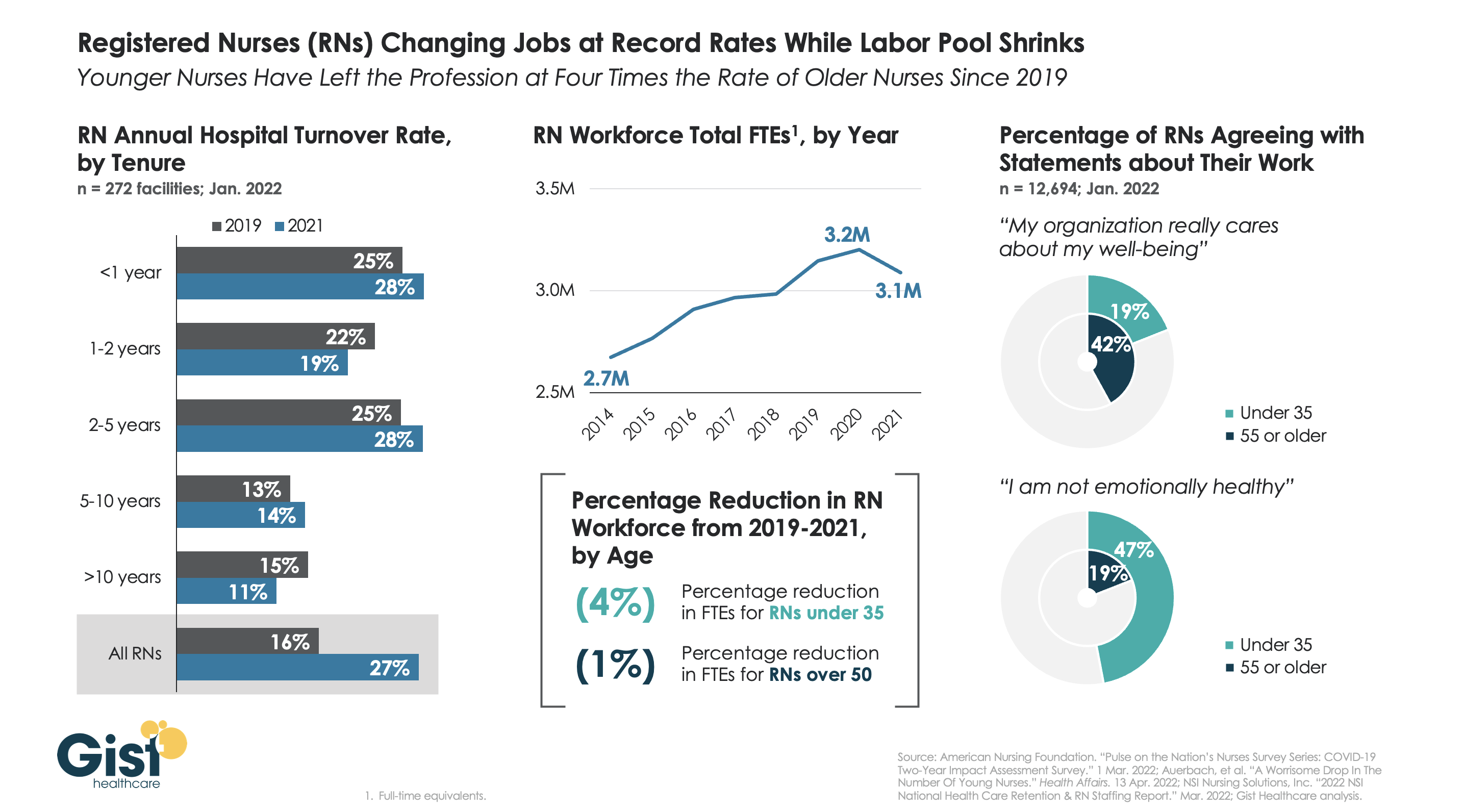
The prevailing opinion earlier this year was that the hospital registered nurse (RN) shortage was being driven by older nurses retiring early or leaving hospital employment for less-demanding care settings during the pandemic. However, recent data shown in the graphic below paint a different picture.
Hospital RNs with over ten years of tenure actually turned over at lower rates in 2021, compared to 2019. Meanwhile, the turnover rate for nurses with less tenure (who are typically younger) increased in 2021. While less-tenured nurses have always turned over at higher rates, we are seeing a new uptick in younger RNs leaving the profession.
The size of the total RN workforce decreased by 1.8 percent between 2019 and 2021—and the decline was twice as steep for hospital-employed RNs. Younger RNs disproportionately drove this decline: nurses under age 35 left the nursing workforce at four times the rate of those over age 50.
A recent survey suggestsyounger RNs are less likely to feel their well-being is supported by their organization, and more likely to define themselves as “emotionally unhealthy.” To keep younger nurses in the profession, hospitals must increase the support available to them. Investments might include expanding preceptorship and mentorship programs, many of which were cut during the pandemic, and increasing behavioral health support and job flexibility.
Citi, The American Hospital Association (AHA) and the Healthcare Financial Management Association (HFMA) recently hosted the 22nd annual Not-for-Profit Healthcare Investor Conference. The event was in person, after being virtual in 2021 and canceled in 2020 due to the pandemic. Leaders from over 25 diverse health systems, as well as private equity and fund managers, presented in panel discussions and traditional formats. The following summary attempts to synthesize key themes and particularly interesting work by leading health systems. The conference title was “Refining the Now, Reshaping What’s Next.”
Is Healthcare Headed for Best of Times or Worst of Times?
Clearly the pandemic showed how essential and adaptive the US healthcare industry is, and especially how incredible healthcare workers continue to be. It also exposed and accelerated many underlying dynamics, such as impact of disparities, clinical labor shortages and supply chain challenges. On balance, at this year’s conference presenters remained quite optimistic about the future, and felt that despite enormous pain, the pandemic has helped to accelerate positive transformation across healthcare.
At the same time, almost all presenters referenced future headwinds from labor and supply inflation, concerns about increasing payment pressures, and the continued need to address disparities and social justice. That being said, there was not much disclosure at the conference about just how bad things could get in the future given accelerated operational and financial risks.
As usual at such a conference, there was much passion, creativity, sharing and celebration. While each organization and market differ somewhat, the following are common themes discussed.
Key Themes
Enormous Workforce Challenges – Every speaker referenced workforce as being THE key issue they are facing, specifically retirement, recruitment, retention, well-being and cost. We have talked for years about a future caregiver shortage, but this reality was accelerated by the pandemic. The majority of health systems saw single-digit turnover rates grow to 20-30%, and the cost of temporary labor such as traveling nurses, decimate operating margins. The many strategies discussed at the conference went beyond simply paying more to attract and retain staff. A key question is whether organization-specific strategies will be enough, or whether we need a broader societal and industry-wide collaborative effort to dramatically increase training slots for nurses and other allied health professionals.
Pandemic Stressed Organizations and Accelerated Transformation – At the 2021 virtual Citi/AHA/HFMA conference, many posited that the country was past the worst of the pandemic. (In fact this author’s summary of last year’s conference was titled “Sunrise After the Storm”). That was before the Omicron wave hit hard in Q1 2022. First-quarter 2022 operating margins were negative for most but not all healthcare systems due to cumulative impact of Omicron, temporary labor and supply costs, especially since the governmental support that partially offset those costs in 2020 ended. Organizations and their teams remain resilient, but highly stressed. Risks and challenges associated with future waves continue, as well as high reliance on foreign drug and supply manufacturing. While highly distracting and painful, many organizations discussed how the pandemic actually accelerated the pace of transformation. Necessity drives required action, and at least temporarily overcomes political and cultural barriers to change.
Growing Pursuit of Scale, Including through M&A and Partnerships – All health systems continue to be highly complex with multiple competing “big-dot” priorities. Multiple systems described their current M&A and growth strategies, pursuit of scale, as well as how these strategies were impacted by the pandemic. While the provider community remains highly unconsolidated on a national basis, mergers are more frequent, including between non-contiguous markets. Systems said that larger size, coupled with disciplined management, can reduce cost structure and improve quality and patient experience. While some pursue scale through organic growth initiatives or M&A, others described success in creating scale by leveraging partnerships with “best-in-class” niche organizations and other outside expertise.
Health Equity, Diversity and ESG as Core to Mission – Consistent with last year, most speakers discussed their efforts to address health equity, social justice, diversity, and Social Determinants of Health. Many health systems have developed robust strategies quickly as the pandemic spotlighted the impact of existing disparities. There is increasing interest in Environment, Social and Governance (ESG) initiatives, including environmental stewardship to improve the health of their communities and the world by reducing their carbon footprint and medical waste.
Patient-Centric Care Transformation Continues as a Priority – The pandemic significantly accelerated the shift to telehealth and virtual care. Many health systems are increasing their efforts to design care around the patient instead of the traditional provider centric focus. While the need for inpatient care will always continue, more care is taking place in settings closer to or at home, with digital enablement. Expansion of personalized medicine, genetic testing and therapies, and drug discovery are transforming how healthcare is provided.
Affordability and Value-Based Care – US healthcare costs as a percentage of GDP increased from 18% in 2019 to almost 20% in 2020, mainly driven by the pandemic. There remains a dichotomy between reliance on fee-for-service payment and commitment to value-based care. Although only 11% of commercial payment is currently through two-sided risk arrangements, almost all presenting health systems discussed their strategies to continue moving to value-based care and to improve affordability. Some systems are leveraging their integrated health plans and/or expanding risk-based contracts. Many are trying to reduce unnecessary care through adoption of evidence-based models and to shift care to less costly settings.
Inflation and Accelerating Financial Pressures – Health systems are facing unprecedented increases in labor and supply costs, that are likely to continue into the foreseeable future. At the same time, commercial payment rate adjustments are “sticky low” as insurers and employers push back on rate increases. Governmental payment rate increases are less than cost inflation. In addition to current cuts like the re-implementation of sequestration, longer-term cuts to provider assessment programs, provider-based billing, disproportionate share and Medicaid expansion may severely impact many organizations over time. Benefits like 340b discounts are also experiencing pressure. Post-pandemic clinical-volume trends remain unclear, and additional governmental support associated with future pandemic waves is unlikely. Adding to these challenges, declines in stock and bond prices are negatively impacting currently strong balance sheets.
Conclusion: Best or Worst of Times in Healthcare?
Time will tell, in retrospect, if the next five years will be the best of times, worst of times, or both in healthcare. Optimists point to the resiliency of healthcare organizations; enormous opportunity to reduce unnecessary cost through adoption of evidence-based care and scale; pipeline of new cures and technology; and opportunities to address social and health equity. Pessimists point to likely unprecedented financial pressures and operational challenges due to endemic labor and supply shortages; high-cost inflation vs. constrained payment rates; and future uncertainty about the pandemic, the economy and investment markets.
The situation will undoubtedly vary by market and organization as reflected in conference presentations, but all systems will likely face substantial pressure. As one speaker noted “humans have a great ability to respond to pain,” so this may be the inflection point where more healthcare systems radically accelerate necessary change to improve health, make healthcare more equitable and affordable, with higher quality and better outcomes. Some health systems are clearly doing that, with pace, nimbleness and passion. Can the industry as a whole accomplish it successfully?
Credit rating downgrades for several hospitals and health systems were tied to cash flow issues in recent months.
The following seven hospital and health system credit rating downgrades occurred since February:
1. Jupiter (Fla.) Medical Center — lowered in June from “BBB+” to “BBB” (Fitch Ratings) “The ‘BBB’ rating reflects JMC’s increased leverage profile with the issuance of $150 million in additional debt to fund various campus expansion and improvement projects,” Fitch said. “While favorable population growth in the service area and demonstrated demand for services in an increasingly competitive market justify the overall strategic plan and project, the additional debt weakens JMC’s financial profile metrics and increases the overall risk profile.”
2. ProMedica (Toledo, Ohio) — lowered in May from “BBB-” to “BB+” (Fitch Ratings) “The long-term ‘BB+’ rating and the assigned outlook to negative on ProMedica Health System’s debt reflects the system’s significant financial challenges as result of continued pressure of the coronavirus pandemic and escalating expenses, with ProMedica reporting a $252 million operating loss that follows several years of weak performance,” Fitch said.
3. Providence (Renton, Wash.) — lowered in April from “Aa3” to to “A1” (Moody’s Investors Service); lowered from “AA-” to “A+” (Fitch Ratings) “The downgrade to ‘A1’ is driven by the disaffiliation with Hoag Hospital, and the expectation that weaker operating, balance sheet, and debt measures will continue for the time being,” Moody’s said.
4. San Gorgonio Memorial Healthcare District (Banning, Calif.) — lowered in May from “Ba1” to “Ba2” (Moody’s Investors Service) “The downgrade to Ba2 reflects the district’s tenuous cash position and weak finances that have contributed to difficulty in securing a bridge loan financing for liquidity needs pending the delayed receipt of approximately $8 million to $9 million in intergovernmental transfers beyond the end of the fiscal year,” Moody’s said.
5. Willis-Knighton Medical Center (Shreveport, La.) — lowered in March from “A1” to “A2” (Moody’s Investors Service) “The downgrade to A2 reflects expectations that Willis-Knighton will continue to face challenges in achieving budgeted operating cash flow margins due to heightened wage pressures and volume softness,” Moody’s said.
6. OU Health (Oklahoma City) — lowered in March from “Baa3” to “Ba2” (Moody’s Investors Service) “The magnitude of the downgrade to Ba2 reflects projected cashflow in fiscal 2022 that will be materially below prior expectations, from an escalation of labor costs, and reliance on a financing to avoid a further decline in already weak liquidity and potential covenant breach,” Moody’s said. “Also, the rating action reflects execution risk given a prolonged period of management turnover with several key positions unfilled or filled with interim leaders, a governance consideration under Moody’s ESG classification.”
7. Catholic Health System (Buffalo, N.Y.) — lowered in February from “Baa2” to “B1” (Moody’s Investors Service) “The downgrade to ‘B1’ anticipates minimal cashflow and a further significant decline in liquidity this year, following material losses in fiscal 2021 from a 40-day labor strike and the disproportionately severe impact of the pandemic, both social risks under Moody’s ESG classification,” the credit rating agency said.
The health systems listed below recently released financial results for the quarter ended March 31.
1. Pittsburgh-based Highmark Health — which includes the eight-hospital Allegheny Health Network — reported $6.4 billion in revenue for the first quarter of 2022. It posted an operating gain of $100 million for the three months ended March 31.
2. Pittsburgh-based UPMC had an operating revenue of $6.1 billion in the first quarter, increasing from $6.02 billion year over year, a 1.3 percent increase. Operating income in 2022 was $50 million, compared to $288 million during the same period in 2021, an 82.6 percent decrease.
3. Cleveland Clinic‘s revenue climbed to $3 billion in the first quarter of this year, which ended March 31, up from $2.8 billion in the same period of 2021. The hospital system ended the first quarter of 2022 with an operating loss of $104.5 million, compared to operating income of $61.7 million in the same period of 2021.
4. New York City-based Montefiore Health System had $1.7 billion in total operating revenue for the first quarter of this year, a 7.9 percent increase from the same period last year, at $1.6 billion. The health system had an operating loss of $8.4 million for the first quarter of this year, an improvement from an operating loss of $63.6 million for the same period last year.
5. Livonia, Mich.-based Trinity Health had $15.13 billion in revenue for the nine months ended March 31, up from $15.12 billion in the same period last year. It reported operating income of $139.7 million in the first nine months of fiscal year 2022, down 79 percent from operating income of $653.9 million in the same period a year earlier.
6. Rochester, Minn.-based Mayo Clinic recorded revenue of $3.9 billion for the three months ended March 31, representing about a 7 percent increase compared to the same period one year prior. Mayo Clinic ended the first quarter of this year with an operating gain of $142 million. In the same quarter last year, Mayo posted operating income of $243 million.
7. Advocate Aurora Health, which has dual headquarters in Milwaukee and Downers Grove, Ill., recorded operating revenue of $3.6 billion in the first quarter of 2022. This represents a 9 percent increase over the comparable period in 2021, in which Advocate Aurora had $3.3 billion in revenue. Advocate Aurora ended the period with an operating income of $2.5 million. In the same period in 2021, Advocate Aurora recorded an operating income of $51 million.
8. Chicago-based CommonSpirit Health saw revenues decline 6.6 percent year over year to $8.3 billion in the third quarter of fiscal year 2022, which ended March 31. CommonSpirit recorded an operating loss of $591 million in the three-month period ended March 31, compared to operating income of $539 million in the same period a year earlier.
9. Renton, Wash.-based Providence saw its operating revenue hit $6.3 billion for the three months ended March 31. In the same quarter one year prior, Providence recorded operating revenue of $6.4 billion. It recorded an operating loss of $510.2 million in the first quarter of 2022, compared to $221.9 million from the same quarter a year prior.
10. Boston-based Mass General Brigham recorded operating revenue of $4.04 billion in the second quarter of fiscal year 2022, up from the $4.02 billion recorded in the same period one year prior. Mass General Brigham posted an operating loss of $193.2 million. In the same period one year prior, Mass General Brigham recorded an operating gain of $250.2 million.
11. Johnson City, Tenn.-based Ballad Health‘s total revenue reached $564.8 million in the third quarter of fiscal year 2022, a slight increase from the same period last year at $558.9 million. It reported an operating loss of $37.3 million for the three months ended March 31, compared to an operating income of $16 million in the same period last year.
12. Altamonte Springs, Fla.-based AdventHealth saw its revenue increase to $3.7 billion for the three months ended March 31, up nearly 8 percent from the same period last year. AdventHealth ended the first quarter of 2022 with an operating loss of $46.8 million. In the same quarter of 2021, AdventHealth recorded an operating income of $179.1 million.
13. Oakland, Calif.-based Kaiser Permanente reported total operating revenue of $24.2 billion for the three months ended March 31, up from $23.2 billion the year prior. Kaiser recorded an operating loss of $72 million. In the same quarter last year, Kaiser recorded an operating income of $1 billion.
14. For the three months ended March 31, Sacramento, Calif.-based Sutter Health recorded revenue of $3.6 billion, up 3.7 percent from $3.4 billion recorded in the same period one year prior. Sutter Health ended the period with a $95 million operating gain. In the first quarter of 2021, Sutter had an operating loss of $49 million.
15. St. Louis-based Ascension reported operating revenue of $6.7 billion in the first three months of this year, up from $6.6 billion in the same period of 2021. Ascension ended the most recent quarter with an operating loss of $671.1 million, compared to an operating loss of $16.7 million in the same period last year.
16. Indianapolis-based Indiana University Health System had $1.93 billion in revenue for the three months ended March 31, a 2.9 percent increase year over year from $1.87 billion. IU Health posted an operating loss of $29.8 million for the first quarter of 2022, compared to an operating income of $192.7 million last year.
17. Franklin, Tenn.-based Community Health Systems had $3.1 billion in net operating revenue for the first quarter of 2022, a 3.3 percent increase from the $3 billion reported for the same period last year. The system posted a 17.2 percent decrease in its operating income, to $270 million for the three months ended March 31, compared to $326 million for the same period last year.
18. King of Prussia, Pa.-based Universal Health Services had a 9.3 percent increase in revenue year over year for the first quarter of 2022. Net revenue was $3.3 billion for the three months ended March 31, up from a little over $3 billion in the same period of 2021. UHS’ operating income fell by 21.2 percent year over year for the first quarter of 2022 to $232.9 million, compared to $295.7 million for the same period last year.
19. Nashville, Tenn.-based HCA Healthcare reported revenues of $15 billion in the first quarter of this year, up from $14 billion in the same period of 2021. HCA’s net income in the first quarter of 2022 totaled $1.3 billion, down from $1.4 billion in the same quarter a year earlier.
20. Dallas-based Tenet Healthcare posted net revenue of $4.8 billion in the quarter ended March 31, down 0.8 percent from the same period last year. Tenet recorded an operating income of $648 million in the first quarter of 2022. In the same period last year, Tenet’s operating income was $520 million.
In a unanimous decision, the Justices found that the Department of Health and Human Services (HHS) exceeded its legal authority when it cut Medicare reimbursement rates for outpatient drugs by 28.5 percent at 340B-eligible hospitals in 2018. The justices wrote that the Centers for Medicare and Medicaid Services (CMS) shouldn’t have cut payments to these hospitals without first surveying their average drug acquisition costs, as required by statute.
CMS must now figure out how to repay 340B hospitals the difference in reimbursement for 2018 and 2019, the two years the unlawful cuts were in effect, during which time it redistributed those savings to all hospitals in the form of higher reimbursement for outpatient services. (For an explainer on the mechanics of the 340B program, see our overview here, and for more details on this Supreme Court case, see our summary here.)
The Gist: This decision was a narrow ruling on administrative grounds, and did not touch on the larger policy debates concerning the 340B program. While 340B-eligible health systems can breathe a momentary sigh of relief, they are still facing significant, ongoing revenue disruptions as at least 17 pharmaceutical manufacturers are restricting discounted drug sales to contract pharmacies.
Scrutiny of the 340B program, which has grown to include over 40 percent of US hospitals, will continue to raise questions aboutwhether there are better ways to subsidize the operations of hospitals serving low-income patients, and to ensure that underserved patients have access to lifesaving treatments.
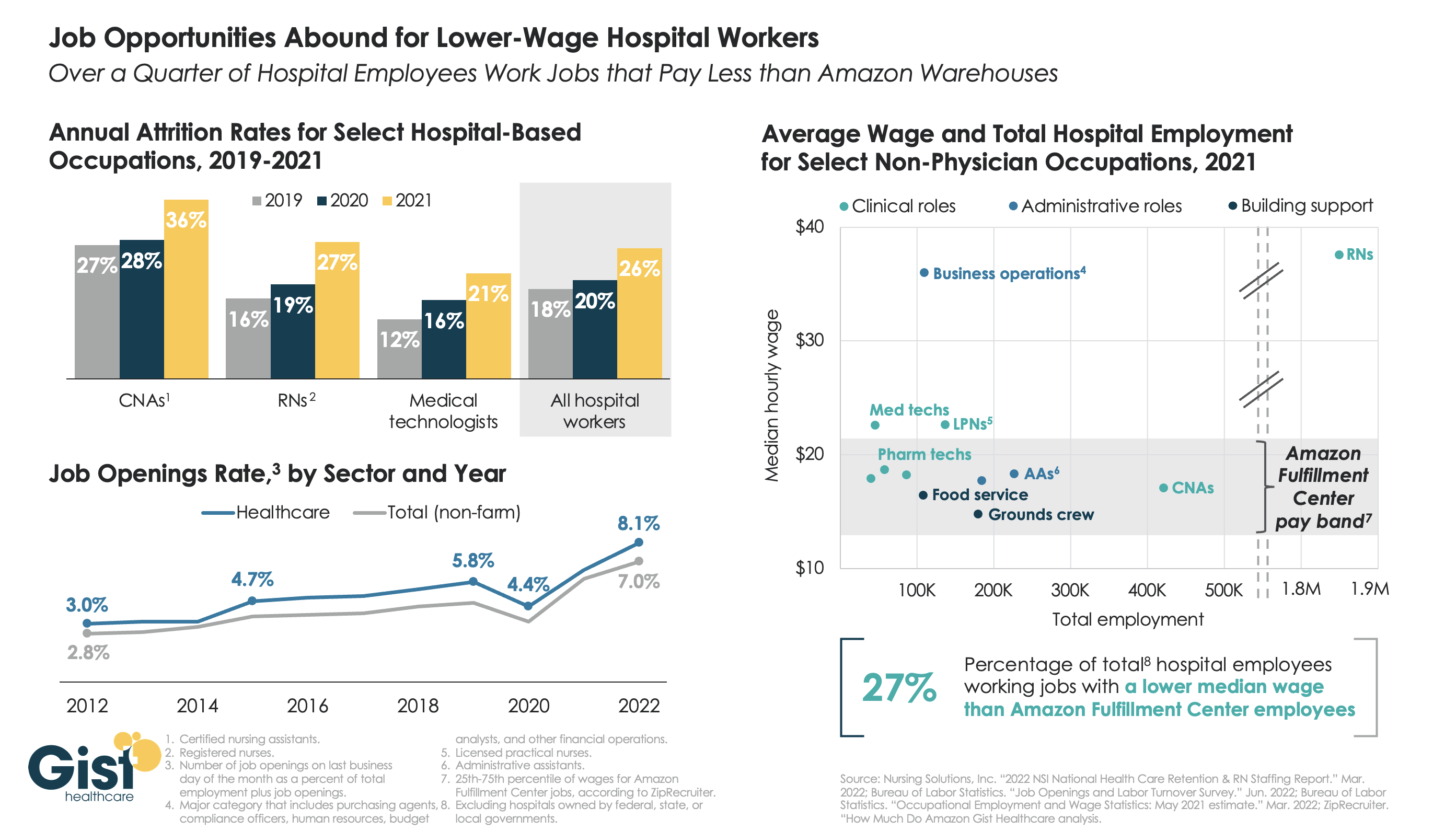
Although the nursing shortage has attracted much attention in recent months, the healthcare workforce crisis is hitting at all levels of the labor force. As the graphic above shows, the attrition rate for all hospital workers in 2021 was eight percentage points higher than in 2019.
Among clinicians and allied health professionals, certified nursing assistants (CNAs) have the highest turnover levels. Given the demands of the job and relatively low pay, CNA openings have been consistently difficult to fill. But it’s become even harder to hire for the role in today’s labor market as job openings near an all-time high.
Although labor force participation rates have rebounded to 2019 levels, pandemic-induced economic shifts have led to a boom in lower-wage jobs. In 2021 alone, Amazon opened over 250 new fulfillment centers and other delivery-related work sites. The company is competing directly with hospitals and nursing facilities for the same pool of workers at many of these new sites.
In fact, our analysis shows that more than a quarter of hospital employees currently work in jobs with a lower median wage than Amazon warehouses. Health systems have historically relied on rich benefits packages and strong career ladder opportunities to attract lower-wage employees, but that’s no longer enough—Amazon and other companies have ramped up their benefits, such that they now meet, or even surpass, what many hospitals are providing.
The time has come for health systems to reevaluate their position in local labor markets, and better define and promote their employee value proposition.
Consumers and employers recently filed lawsuits against Hartford HealthCare, HCA Healthcare, and Advocate Aurora Health, accusing the health systems of using their market power to increase prices through anticompetitive contracting practices. New reporting from the Wall Street Journal finds that all three suits are receiving funding from billionaire John Arnold, through his charitable foundation Arnold Ventures, which has sponsored several efforts to reduce healthcare spending. While the health systems say that the claims are baseless, the law firm leading the suits, Fairmark Partners, says that it’s attempting to enforce antitrust laws through the courts.
The Gist: Amid the Biden administration’s increased scrutiny of health system anticompetitive behavior, state governments and philanthropic groups are also taking a more active role in challenging hospital deals and contracting practices.
While these groups have targeted hospital prices because they’re a significant source of increased healthcare spending, these lawsuits do little to address the perverse underlying incentives that push hospitals to seek higher prices from commercial patients, to cross-subsidize what they view as insufficient pricing from public payers.
Wilmington, Del.-based ChristianaCare plans to buy a shuttered hospital from West Reading, Pa.-based Tower Health.
The deal includes Jennersville Hospital in West Grove, Pa., two office buildings and a 24-acre parcel of land, according to a June 15 ChristianaCare news release. It does not include any personnel or practices that are currently operating.
The hospital will have the new name of ChristianaCare West Grove Campus. The deal is expected to close in 30 to 60 days.
Jennersville Hospital closed Dec. 31. Tower Health was supposed to sell the hospital, along with Coatesville, Pa.-based Brandywine Hospital, to Texas turnaround firm Canyon Atlantic Partners Jan. 1, but pulled out of the deal, stating that Canyon Atlantic was unable to demonstrate it could effectively take ownership.
A judge later ordered Tower Health to restart the sale, but Canyon Atlantic eventually ended the bid, saying it ran out of time to save the hospitals.
ChristianaCare also signed a letter of intent in February to acquire Springfield, Pa.-based Crozer Health from Los Angeles-based Prospect Medical Holdings.







 HENRY KOTULA