Hospital labor expenses up 37% from pre-pandemic levels in March

Dive Brief:

  • Hospitals’ labor costs rose by more than a third from pre-pandemic levels by March 2022, according to a report out Wednesday from Kaufman Hall.
  • Heightened temporary and traveling labor costs were a main contributor, with contract labor accounting for 11% of hospitals’ total labor expenses in 2022 compared to 2% in 2019, the report found.
  • Contract nurses’ median hourly wages rose 106% over the period, from $64 an hour to $132 an hour, while employed nurse wages increased 11%, from $35 an hour to $39 an hour, the report found.

Dive Insight:

The new data from Kaufman Hall supports concerns hospital executives expressed while releasing first quarter earnings results, as higher-than expected labor costs spurred some operators, like HCA, to lower their financial full-year guidance.

The ongoing use of contract labor amid shortages driven by heightened turnover was a key factor executives cited for higher costs, and follows the findings from Kaufman Hall’s latest report.

More than a third of nurses surveyed by staffing firm Incredible Health said they plan to leave their current jobs by the end of this year, according to a March report. While burnout is driving them to leave, higher salaries are the top motivating factor for taking other positions, that report found.

Kaufman Hall’s report, which analyzes data from more than 900 hospitals across the country, found hospitals spent $5,494 in labor expenses per adjusted discharge in March compared to $4,009 roughly three years ago.

Costs rose for hospitals in every region, though the South and West experienced the largest increases from pre-pandemic levels as those expenses rose 43% and 42%, respectively.

The West and Northeast/Mid-Atlantic regions saw the highest expenses consistently from 2019 to 2022, according to the report.

“The pandemic made longstanding labor challenges in the healthcare sector much worse, making it far more expensive to care for hospitalized patients over the past two years,” said Erik Swanson, senior vice president of data and analytics at Kaufman Hall.

“Hospitals now face a number of pressures to attract and retain affordable clinical staff, maintain patient safety, deliver quality services and increase their efficiency,” Swanson said.

The report also notes that hospitals are competing with non-hospital employers also pursuing hourly staff, though those companies can pass along wage increases to consumers through higher prices “in a way healthcare organizations cannot,” the report said.

Some hospitals, like HCA Healthcare and Universal Health Services, are looking to raise prices for health plans amid rising nurse salaries, according to reporting from The Wall Street Journal.

Another recent report from group purchasing organization Premier found the CMS underestimated hospital labor spending when making payment adjustments for the 2022 fiscal year, resulting in hospitals receiving only a 2.4% rate increase compared to a 6.5% increase in hospital labor rates.

To match the rates hospitals are now paying staff, an adequate inpatient payment update for fiscal 2023 is needed, that report said.

The CMS proposed its IPPS rule for FY 2023 on April 18 that includes a 3.2% hike to inpatient hospital payments, which provider groups like the American Hospital Association rebuked as “simply unacceptable” considering inflation and rising hospital labor costs.

Ascension posts $884M quarterly loss

St. Louis-based Ascension reported higher expenses in the three months ended March 31 and ended the quarter with a loss, according to financial documents filed April 29. 

The 143-hospital system reported operating revenue of $6.69 billion in the first three months of this year, up from $6.56 billion in the same period of 2021. 

Ascension’s operating expenses climbed to $7.34 billion in the first three months of 2022, up from $6.59 billion in the same period a year earlier. The increase was attributed to several factors, including higher salaries, wages and supply expenses. 

Looking at the first nine months of the current fiscal year, Ascension’s operating expenses increased 8.7 percent year over year. Staffing challenges, increased use of contract labor and overtime spend pushed Ascension’s total salaries, wages and benefits up 10.1 percent year over year in the nine months ended March 31.

Ascension ended the most recent quarter with an operating loss of $671.14 million, compared to an operating loss of $16.71 million in the same period last year. 

After factoring in nonoperating items, Ascension reported a net loss of $884.74 million for the three months ended March 31. A year earlier, the health system posted net income of $957.32 million. For the first nine months ended March 31, Ascension reported net income of $145.21 million, compared to $4.77 billion in the same period a year earlier. 

As of March 31, Ascension had 295 days cash on hand, compared to 336 days as of June 30, 2021.

Kaiser posts net loss of $961M in Q1

https://about.kaiserpermanente.org/our-story/news/announcements/kaiser-foundation-health-plan-and-hospitals-q1-2022-financial-update

Q1 2022 and Q1 2021 financial summary

$ in millions, except %Q1 2022Q1 2021
Total operating revenues$24,197$23,185
Total operating expenses$24,269$22,155
Operating income (loss)($72)$1,030
Operating margin(0.3%)4.4%
Total other income and expense (loss)($889)$1,003
Net income (loss)($961)$2,033
Capital spending$872$906

For the quarter ending March 31, 2022, Kaiser Foundation Health Plan, Inc., Kaiser Foundation Hospitals, and their respective subsidiaries (KFHP/H) reported total operating revenues of $24.2 billion and total operating expenses of $24.3 billion compared to total operating revenues of $23.2 billion and total operating expenses of $22.2 billion in the same period of the prior year. There was an operating loss of $0.07 billion, or (0.3%) of total operating revenues, for the first quarter of the year compared to operating income of $1.0 billion, or 4.4%, in the first quarter of 2021.

During the first quarter of 2022, a surge in COVID-19 cases — the steepest since the start of the pandemic — led to a substantial increase in the demand for related care and testing. COVID-19 expenses drove an additional $1.4 billion in expenses. Those expenses, along with the costs of providing care to our members that was deferred earlier in the pandemic, were the primary drivers of additional expenses. In the first quarter of 2022, Kaiser Permanente cared for more than 688,000 patients with COVID-19, including more than 26,000 hospitalized patients, performed 2.5 million COVID-19 diagnostic tests, supplied 1.3 million COVID-19 home tests, and administered 1.4 million vaccine doses. In addition, like the rest of the industry, Kaiser Permanente experienced significant increases in labor costs during the first quarter of 2022, compared to the same period last year and when compared to year-end 2021.

“I am incredibly proud of the extraordinary people of Kaiser Permanente, who have stepped up time and time again to provide high-quality care and service to our members and communities during unparalleled challenges,” said chair and chief executive officer Greg A. Adams. “While in the first quarter, the ongoing effects of the pandemic strained our workforce, communities, and operations, our operating model, which provides both care and coverage, enabled us to continue providing that care even in the face of an unprecedented omicron surge and industrywide labor shortage. Our underlying operating performance remains solid and aligned with expectations.”

In the category of other income and expense, the quarterly loss totaled $889 million, driven largely by investment losses, compared to $1.0 billion in income in the same period of the prior year. For the quarter, there was a net loss of $961 million compared to net income of $2.0 billion in 2021.

Capital spending

Capital spending in the first quarter totaled $872 million compared to $906 million in the same period of the prior year. During the first 3 months of 2022, Kaiser Permanente opened a new, 220,000-square-foot medical facility in Timonium, Maryland, that features 24-hour advanced urgent care and a 24-hour pharmacy, along with an ambulatory surgery center.

“While the increase in pandemic-related expenses, overall rising costs, and investment market losses impacted our finances this quarter, Kaiser Permanente navigated this challenging time providing high-quality care and continued investing in our integrated model including ongoing capital investments to best serve our members. We controlled discretionary spending, optimized COVID-19 testing, addressed surgical backlogs, and managed outside medical expenses,” said executive vice president and chief financial officer Kathy Lancaster. “As we face the ongoing uncertainty and prolonged effects the pandemic is having on the health care industry, we are well positioned to continue delivering high-quality, affordable care and remain vigilant stewards of resources entrusted to us in this dynamic environment.”

Membership

Membership as of March 31, 2022, was 12.6 million, reflecting a growth of more than 88,000 members since December 31, 2021. Medicaid enrollees accounted for almost 33,000 of Kaiser Permanente’s new members.

Q1 2022 and Q1 2021 financial summary

$ in millions, except %Q1 2022Q1 2021
Total operating revenues$24,197$23,185
Total operating expenses$24,269$22,155
Operating income (loss)($72)$1,030
Operating margin(0.3%)4.4%
Total other income and expense (loss)($889)$1,003
Net income (loss)($961)$2,033
Capital spending$872$906

Investment gains masking health system operating margin difficulties 

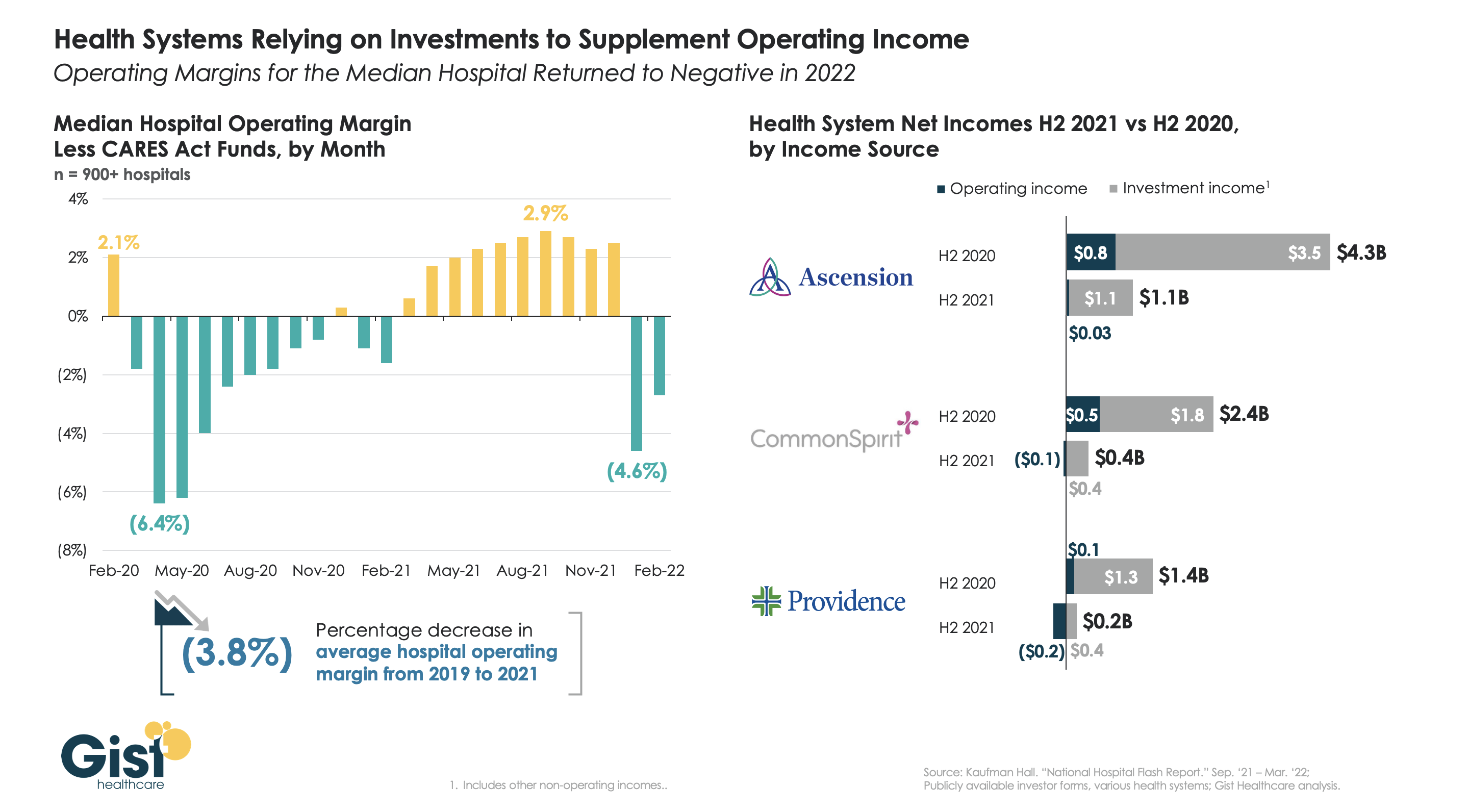
The combination of the Omicron surge, lackluster volume recovery, and rising expenses have contributed to a poor financial start of the year for most health systems. The graphic above shows that, after a healthier-than-expected 2021, the average hospital’s operating margin fell back into the red in early 2022, clocking in more than four percent lower than pre-pandemic levels. 

Despite operational challenges, however, many of the largest health systems continue to garner headlines for their sizable profits, thanks to significant returns on their investment portfolios in 2021.

While CommonSpirit and Providence each posted negative operating margins for the second half of 2021, and Ascension managed a small operating profit, all three were able to use investment income to cushion their performance.

A growing number of health systems are doubling down on investment strategies in an effort to diversify revenue streams, and capture the kind of returns from investments generated by venture capital firms. However, it is unlikely that revenue diversification will be a sustainable long-term strategy.

To succeed, health systems must look to reconfigure elements of the legacy business model that are proving financially unsustainable amid rising expenses, shifts of care to lower-cost settings, and an evolving, consumer-centric landscape.    

Saying farewell (for now) to a terrible financial quarter

Judging from our recent conversations with health system executives, we’d guess CEOs across the industry woke up this morning glad to see the first quarter in the rearview mirror.

Almost everyone we’ve spoken to has told us that the past three months have been miserable from an operating margin perspective—skyrocketing labor costs, rising drug and supply prices, and stubbornly long length of stay, particularly among Medicare patients.

In the words of one CFO, “I’ve never seen anything like this. For the first time, we budgeted for a negative margin, and still didn’t hit our target. I’m not sure how long our board will let us stay on this trajectory before things change.”

Yet few of the drivers of poor financial performance appear to be temporary. Perhaps the over-reliance on agency nursing staff will wane as COVID volumes bottom out (for how long remains unknown), but overall labor costs will remain high, there’s no immediate relief for supply chain issues, and COVID-related delays in care have left many patients sicker—and thus in need of more costly care. Plus, the lifeline of federal relief funds is rapidly dwindling, if not already gone.

Expect the next three quarters (and beyond) to bring a greater focus on cost cutting, especially as not-for-profit systems struggle to defend their bond ratings in the face of rising interest rates.

Buckle up, it’s going to be a bumpy landing.

Providence hit with credit downgrade after Hoag split

Moody’s Investors Service has downgraded the ratings on Providence’s revenue bond debt to “A1” from “Aa3.” 

“The downgrade to ‘A1’ is driven by the disaffiliation with Hoag Hospital, and the expectation that weaker operating, balance sheet, and debt measures will continue for the time being,” Moody’s said in an April 5 release. 

Renton, Wash.-based Providence and Newport Beach, Calif.-based Hoag ended their affiliation Jan. 31. The two organizations cut ties at a time when Providence is facing several challenges, including operating pressures, variable utilization and reliance on temporary labor, Moody’s said. 

The “A1” rating and stable outlook also reflect Providence’s strengths, including a large service area, a large revenue base of more than $25 billion and a leading market share in all of its markets. 

Moody’s said it expects Providence to continue to grow its operating platform and generate additional revenue growth. 

Hospital margins ‘well below sustainable levels’: Kaufman Hall

Hospitals across the U.S. saw their operating margins remain negative for the second consecutive month in February as they continued to feel the repercussions of the winter omicron surge, according to Kaufman Hall’s “National Hospital Flash Report: March 2022” posted March 28.

The median operating margin in February was -3.45 percent, up from -4.52 percent in January, but “still well below sustainable levels,” Kaufman Hall said. 

Kaufman Hall said the improvement in hospital margin was driven by disproportionate increases among several hospitals that saw margin gains, but most hospitals reported margin declines in February. Specifically, the median operating margin was down 11.8 percent month over month.

“The second month of 2022 brought further challenges for the nation’s hospitals and health systems,” Kaufman Hall said. “Overall, the year is off to a difficult start.”

Kaufman Hall noted that patient days were down 13.3 percent month over month, and fewer severely ill COVID-19 patients also contributed to shorter hospital stays as the average length of stay dropped 5.3 percent month over month. 

Hospitals’ gross operating revenue also decreased 7.4 percent compared to January 2022, with outpatient revenue falling 5 percent and inpatient revenue declining 19.3 percent.

Kaufman Hall noted that hospitals saw some improvement month over month in terms of expenses. Total expenses per adjusted discharge fell 4.5 percent compared to January, labor expense per adjusted discharge fell 6.1 percent and non-labor expenses per adjusted discharge was down 3.6 percent. However, Kaufman Hall noted that year over year, expenses are still up significantly, with total adjusted expense per adjusted discharge rising 10.4 percent compared to February 2021.

Even the largest health systems dwarfed by industry giants

https://mailchi.mp/f6328d2acfe2/the-weekly-gist-the-grizzly-bear-conflict-manager-edition?e=d1e747d2d8

Insurers, retailers, and other healthcare companies vastly exceed health system scale, dwarfing even the largest hospital systems. The graphic above illustrates how the largest “mega-systems” lag other healthcare industry giants, in terms of gross annual revenue. 

Amazon and Walmart, retail behemoths that continue to elbow into the healthcare space, posted 2021 revenue that more than quintuples that of the largest health system, Kaiser Permanente. The largest health systems reported increased year-over-year revenue in 2021, largely driven by higher volumes, as elective procedures recovered from the previous year’s dip.

However, according to a recent Kaufman Hall report, while health systems, on average, grew topline revenue by 15 percent year-over-year, they face rising expenses, and have yet to return to pre-pandemic operating margins. 

Meanwhile, the larger companies depicted above, including Walmart, Amazon, CVS Health, and UnitedHealth Group, are emerging from the pandemic in a position of financial strength, and continue to double down on vertical integration strategies, configuring an array of healthcare assets into platform businesses focused on delivering value directly to consumers.