Cartoon – Society Going Cashless

Today's cartoons: Getting used to a cashless society – Orange ...

Trump suggests doctors complain about lack of coronavirus equipment in order to get on TV

https://www.yahoo.com/news/trump-suggests-doctors-complain-lack-141500695.html

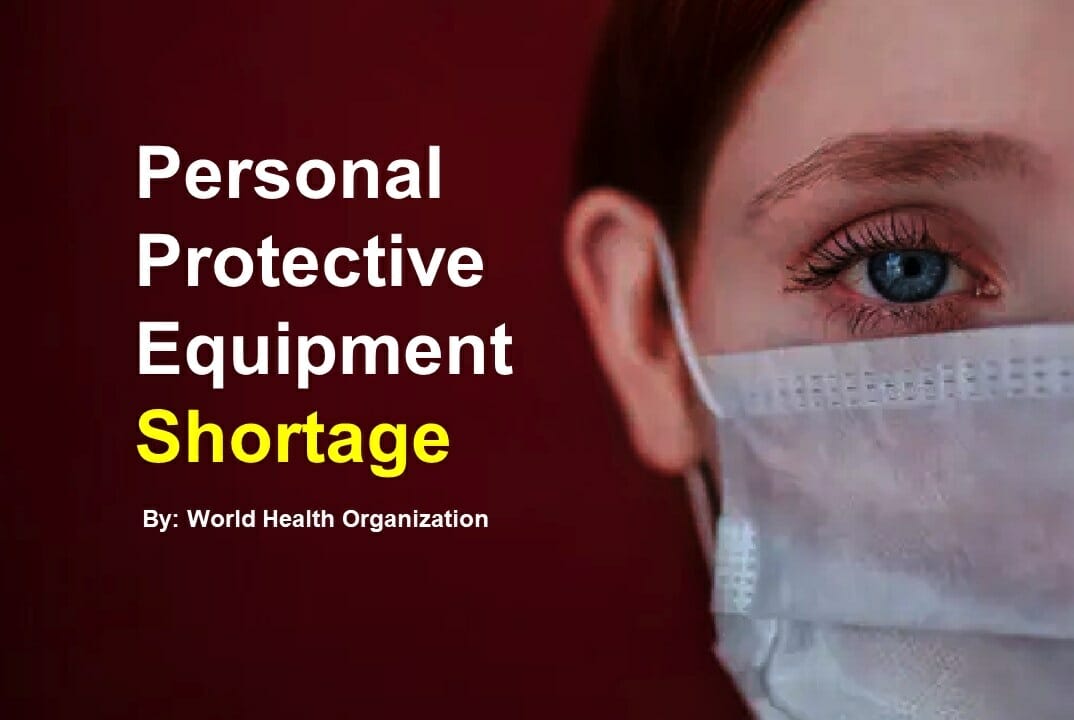
PPE Shortage Endangering Health Workers Worldwide - GineersNow

Donald Trump has implied doctors and elected officials say they do not have enough personal protective equipment (PPE) and other materials to get on television amid the coronavirus crisis.

The US president had a row with Jim Acosta, CNN’s chief White House correspondent, over the shortage of PPE, which includes essential gear such as hand sanitiser, gloves, aprons, and face masks, during his coronavirus press briefing.

Acosta said: “We hear from a lot of people who see these briefings as sort of ‘happy talk’ briefings. And some of the officials don’t paint as rosy a picture of what is happening around the country. If you look at some of these questions – do we have enough masks? No. Do we have enough tests? No. Do we have enough PPE? No.”

Mr Trump interjected: “Why would you say that? The answer is yes. I think the answer is yes.”

Acosta referred to doctors and other medical officials who have vented their frustrations about the dearth of essential equipment on CNN.

The president hit back: “A lot of it is fake news.”

Acosta said: “Doctors and medical officers come on our air and say ‘we don’t have enough tests, we don’t have enough masks’.”

Mr Trump chipped in: “Well yeah, depending on your air they are always going to say that because otherwise, you are not going to put them on.”

The spat comes as doctors and healthcare workers across America are battling against a shortage of face masks which safeguard them against coronavirus – sparking fears doctors will not be able to provide life-saving care if they fall ill.

America has become the first country in the world to record more than 2,000 people dying from coronavirus in one day alone, according to Johns Hopkins University figures.

People who contract coronavirus in the US are at greater risk than those in the UK or Canada due to America not having a national health service.

Americans are at risk of running up bills for coronavirus treatment which force them to fork out tens of thousands of dollars. The situation is exacerbated by the fact many have lost their healthcare insurance due to job losses linked to the pandemic.


When the coronavirus lockdowns end, we will live in a shrunken world

https://www.yahoo.com/news/coronavirus-lockdowns-end-live-shrunken-122800321.html

Flipboard: When the coronavirus lockdowns end, we will live in a ...

  • A projection from the Department of Homeland Security, published by the New York Times, shows coronavirus cases spiking again at the end of summer.
  • It’s a stark reminder that American life after lockdown will still be one of limited human interaction. And that means we’ll have to live with a smaller economy too. 
  • The economy will be packed with uncertainty given the possibility of another shelter-in-place order.
  • Until we can all hang out again with confidence, the US economy is going to be a shell of its former self.

When the US emerges from its various shades of shelter-in-place orders, it will emerge to a shrunken global economy. One that will not easily be inflated living within parameters the coronavirus demands.

Financial transactions are a form of human interaction, and even after strict orders to stay at home are lifted, Americans will need to limit human interaction to mitigate the spread of coronavirus. One projection from the Department of Homeland Security, first reported by the New York Times, imagines a world where schools remain closed, 25% of Americans work from home, and social distancing remains in place through the summer.

And people will still be scared. They will know that there is an deadly virus infecting people who interact with other people.

In this scenario, back to work doesn’t mean back to growth because people won’t be spending money the way they did before. Back to work simply means finding a more sane, stable way to maintain society until we get a vaccine. There will be no V-shaped recovery. This is a marathon, and if we’re lucky, we will limp across the finish line.

As incomplete as it is, China is the best picture we have for understanding what a life after lockdown looks like, and it doesn’t look like a booming economy. 460,000 businesses closed permanently in China during the first quarter.

One Chinese county has gone back into lockdown already. In Beijing — where state media says epidemic prevention and control will “probably” become “long-term normal” — restaurants have been ordered to maintain social distance by cutting seating in half and limiting tables to three people. Customers have been slow to come back anyway.

All of this is to say that even if we’re out of lockdown, this saga isn’t remotely over.

Deflation strikes back

What China’s economy is telling us is that once this weird supply funk brought on by everyone staying home is over, and some people are able to go back to work, we’ll still have a demand crisis. Even though the virus has been contained analysts at Oxford Economics told clients it expects to see “basically no growth” in China this year. With other global economies weakened it will sell fewer exports. 

Zhu Jun, director of the international department of the People’s Bank of China, said that there’s a small chance the world risks another Great Depression. Cheery, I know, but until there’s a vaccine, optimism will be in short supply.

Here in the US, just as in China, people will be broke and businesses will be broken. Money will be scarce. Demand will be depressed not just because of a lack of funds, but because people will have changed their behavior to avoid getting sick. 

Wall Street it seems, hasn’t processed this bad news yet. It’s taking this pandemic day-by-day, not looking at life after lockdown. This week the market rallied on news that all over the US, even New York City, the curve is flattening. It was a silly rally.

It’s silly for the market to declare victory before we’ve even seen how much damage has been done (that will take months at least). It’s silly to expect any kind of stability until we know what kind of demand a post-shelter-in-place, pre-vaccine American economy will have.

Finally, we don’t know how long Washington will be in a giving mood. So far the Federal Reserve has pulled out all the stops, and Congress has approved trillions in aid. But will Washington keep sending checks to unemployed Americans until we have a vaccine? 

US employment by industry who can work from home

We thought we knew uncertainty

I think back to all the times I’ve heard CEOs and Wall Street types talk about uncertainty around regulations, or elections, or literally anything else that has happened in my life time, and I have to laugh. All of it seems silly compared to the uncertainty before us right now.

It is quite possible that sometime this summer scientists will develop a treatment for COVID-19 that makes the symptoms much more mild — something more like a standard, week-long flu. That discovery could make things a lot easier, and really bolster confidence enough to bring the economy back until we have a vaccine. But government officials obviously can’t plan with that in mind. Neither can businesses.

And so, those charged with imagining the worst case scenario must imagine a world where Americans are again forced to shelter-in-place to flatten the curve. Homeland Security’s projections put a resurgence of the virus somewhere around the end of summer to the beginning of fall. It’s not unreasonable to think certain populations may have to go back into shelter-in-place then.

Singapore has a robust system of testing for and tracking the coronavirus and its citizens went back into shelter-in-place this week. Here in the US we don’t have such a system. Last week the White House ended federal funding for its drive-thru testing site program.

On Friday New York Governor Andrew Cuomo urged the President to invoke the Defense Production Act to ramp up production of antibody tests that can show who has been infected with the coronavirus and built up immunity. That would allow people to go back to work, but the federal government will only be able to produce 2,000 a day in the next two weeks. 

As a nation, we need to be doing everything we can to ensure that when this lockdown is over, those who can go out can do so with as much confidence as possible. We need to inject as much certainty into this situation as possible Without testing, that’s not happening.

In an interview with CNBC, Bill Gates — the Microsoft founder and billionaire philanthropist who has dedicated a significant chunk of his charitable efforts to studying pandemics — said the federal government simply doesn’t seem interested in a unified testing system. This is one of the few variables in this pandemic the government can control, and it’s blowing it.

Testing is one of the only things that will make our beleaguered, shrunken coronavirus economy a little bit bigger. It’s one of the only ways we can impact the ugly twist of this economic downturn, behavior.

Even then, though, the possibility of an outbreak in a workplace, city, or state will change the way our economy works in ways that will make money scarce. We need to be ready for that.


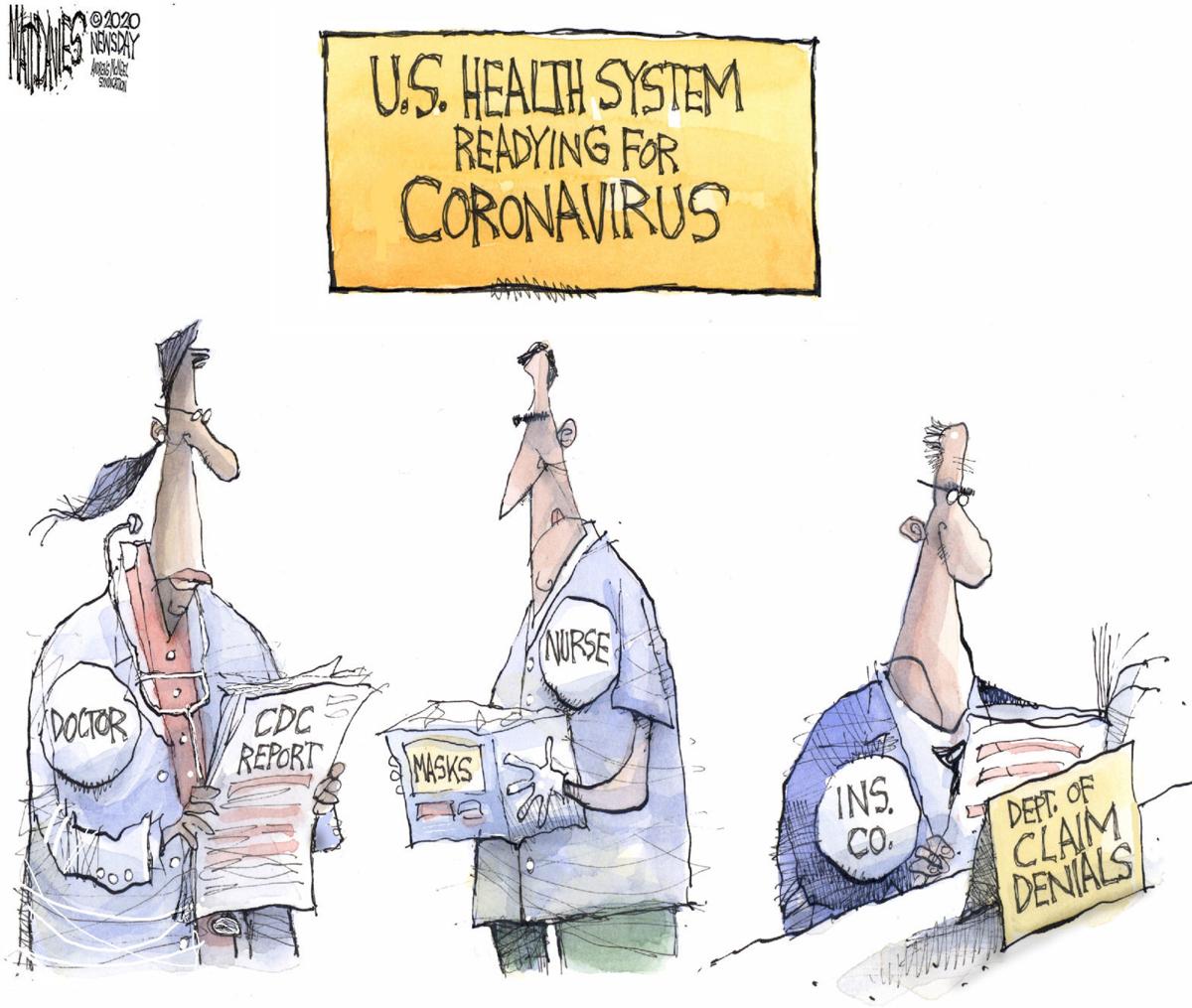
Cartoon – U.S Health System Readying for Coronavirus

Corona response | Cartoons | postregister.com

Timeline: How the U.S. fell behind on the coronavirus

https://www.axios.com/coronavirus-timeline-trump-administration-testing-c0858c03-5679-410b-baa4-dba048956bbf.html

Behind the Curve | Netflix

Early missteps allowed the new coronavirus to spread throughout the U.S for weeks before state and local officials implemented strict lockdowns designed to keep the pandemic from spinning further out of control.

Why it matters: The U.S. missed the boat on the kind of swift, early response that would have been most effective, and has been scrambling to catch up ever since. This timeline, compiled from official sources as well as media reports, shows how that all-important time was lost.

Dec. 31, 2019: China reports the novel coronavirus to the World Health Organization.

Jan. 6: The Centers for Disease Control and Prevention issued a travel notice for Wuhan, China.

Jan. 15: The first U.S. case is confirmed, in a man who traveled from Wuhan.

Jan. 17: The World Health Organization publishes a protocol for manufacturing coronavirus tests.

  • The Centers for Disease Control and Prevention opts to develop its own test instead of using the WHO’s.

Jan. 30: The WHO declares global health emergency.

Jan. 31: The Trump Administration suspended entry into the U.S. for most foreign nationals who had traveled to China in the past 14 days.

Feb. 5: The CDC begins shipping its diagnostic tests to state and local health agencies.

Feb. 8: Labs report problems with the CDC’s tests.

Feb. 24: President Trump tweets: “The Coronavirus is very much under control in the USA. We are in contact with everyone and all relevant countries. CDC & World Health have been working hard and very smart. Stock Market starting to look very good to me!”

Feb. 29: Washington state reports the first COVID-19 death in the U.S.

  • The Food and Drug Administration allows academic labs to develop and begin testing coronavirus testing kits while reviewing pending applications.
  • The WHO reports 86,604 coronavirus cases worldwide.

March 5: LabCorp and Quest Diagnostics launch coronavirus test for commercial use.

March 9: Trump tweets: “So last year 37,000 Americans died from the common Flu. It averages between 27,000 and 70,000 per year. Nothing is shut down, life & the economy go on. At this moment there are 546 confirmed cases of CoronaVirus, with 22 deaths. Think about that!”

  • The WHO reports 114,381 coronavirus cases worldwide.

March 13: Trump declares a national emergency, freeing up $50 billion in federal funds for states and territories.

March 15: 33 states and the District of Columbia closed public schools, according to Education Week. This included the New York City school system, the largest in the country.

March 16: Trump advises Americans to self-isolate for 15 days.

March 19: Trump signed into law an emergency coronavirus relief package for paid sick leave and free testing.

March 23: 9 states had stay-at-home orders.

  • Washington, Oregon, California, Louisiana, Illinois, Ohio, New York, Massachusetts and New Jersey.

March 26: The U.S. now leads world in coronavirus cases.

  • 12 more states issue stay-at-home orders, totaling 21: Idaho, Colorado, New Mexico, Michigan, Wisconsin, Kentucky, Indiana, West Virginia, Hawaii, Connecticut, Vermont and Delaware

March 29: Trump extends social distancing measures to April 30.

March 30: Nine more states issue stay-at-home orders, bringing the total to 30.

  • Governors say testing is still lacking in many states.

March 31: Trump warns of the potential for 100,000 to 240,000 deaths.

April 6: Twelve more states issue stay-at-home orders, bringing the total to 42.


What Will U.S. Labor Protections Look Like After Coronavirus?

https://hbr.org/2020/04/what-will-u-s-labor-protections-look-like-after-coronavirus?utm_medium=social&utm_source=facebook&utm_campaign=hbr&fbclid=IwAR1fNFaJM-Tz1jCoBQ3bTVJG5zdbuqcExQOujKz87J34csjOhRLm8C2Dxjo

As I was writing the draft of this article, I was checking my symptoms and awaiting the results of a test I underwent for Covid-19. This virus has upended my life, as it has for every last one of us, no matter where we fall on the socio-economic scale.

But the consequences fall more heavily on those at the bottom end of the wage distribution. That includes those risking their health as they sell us groceries, check our vitals, and sanitize our hospitals. Easily lost amid the chaos, however, is how this crisis may be an opportunity to improve employee protections — and not temporarily but permanently.

During bull markets, employers and policymakers often paint the hardships befalling low-wage workers as stemming from those workers’ personal failures. But when markets crash, we learn how these workers’ troubles were indicative of persistent, system-wide weaknesses.

As Warren Buffett wrote of the insurance failures exposed by 1993’s Hurricane Andrew, “It’s only when the tide goes out that you learn who’s been swimming naked.” Pundits cite Buffet to refer to firms that appear healthy during bull markets, only to get eaten alive during downturns. This month, however, the markets exposed a new group of skinny dippers: a government and an economic system that fail workers, and employers who haven’t or can’t fill this gap in public policy.

In response to the novel coronavirus, the stock market has been mostly in a free fall since late February. The low-wage service sector is facing widespread layoffs. And the tumbling markets have uncovered other deep inequalities among workers, who fall into two groups: those with access to employment protections like affordable healthcare, remote work accommodations, paid time off, and job security — and those without.

This second group, which includes the working class, often lack healthcare or face high out-of-pocket expenses. There are nearly 24 million uninsured working-age adults in the United States. Those with only a high school diploma or who did not complete high school are the least likely to be insured. Moreover, racial and ethnic minority groups face significant barriers to “good jobs.” They form 60% of the uninsured population but only 40% of the total population.

A quarter of all U.S. workers have no access to paid sick leave. Work-from-home options are slim, but many can’t afford not to work. Among workers at the bottom 10th of the earnings distribution, only 31% have paid sick leave. For comparison, 94% of the top 10% of earners have paid sick leave.

While many professionals enjoy protections that can help them ride out the pandemic with their livelihoods and family’s health intact, workers in the low-wage service sector have few options or resources to stay home to care for themselves, let alone their loved ones. And that burden to provide care largely falls on women. The workers lacking healthcare and paid sick leave are also the most vulnerable to layoffs and lost hours. The fate of service workers in travel and food services indicate what’s to come. Similarly, gig economy workers, migrant laborers, and those in the informal economy are particularly vulnerable.

How did we get here? Since the late 1970s, executives have prioritized boosting dividends for shareholders over protecting their employees, whose work has been outsourced, digitized, and downsized. In our book, Divested: Inequality in the Age of Finance, Ken-Hou Lin and I show how this shift in corporate governance undermined workers’ bargaining power. Although insurance coverage increased from the Affordable Care Act, overall working conditions, protections, and pay have diminished.

A more robust safety net would help to mitigate the consequences for workers today as it shores up the economy against future downturns. For years, U.S. policymakers have considered universal healthcare impractical because of its large scope and high startup costs. But as new unemployment claims surge to historical levels and Americans face the medical precarity of a pandemic, this crisis has laid bare the underlying problem of linking healthcare to employment.

Sick leave and universal healthcare would ease the stressors workers face and ensure the sick have time to recover, making them more productive when they return to work. Without the costs of insuring workers, employers could pay more. An income boost would generate more spending and stimulate the economy.

Broader protections would also support the self-employed, contract workers, and prospective entrepreneurs. The United States has lower rates of self-employment (6.3%) than countries with universal healthcare (e.g., Spain has 16%), and a lower share of employment at small businesses than any OECD country except Russia. Reducing the reliance on big businesses would free workers to find jobs that better fit their skills, creating a more nimble and innovative economy.

The current moment provides an opportunity to make lasting changes to the status quo and improve conditions for all workers. As sociologists have theorized, crises and crashes expose cracks in the systems upholding inequality. And history provides a clue for how crises can provide opportunities to transform society in ways that reduce inequality. After the Great Crash of 1929, unemployment spiked, reaching 25% by 1933. In less than three years, Franklin D. Roosevelt’s New Deal reduced unemployment to 9%.The New Deal achieved this feat through a vast and broad range of public works and conservation projects.

The New Deal transformed American society — from erecting iconic buildings and statues, to saving the whooping crane, to developing the rural United States, to planting a billion trees. New Deal workers built and renovated 2,500 hospitals, 45,000 schools, and 700,000 miles of roads. The New Deal hired 60% of the unemployed, including 50,000 teachers and 3,000 writers and artists, such as Jackson Pollock and Willem de Kooning. The New Deal modernized, preserved, and employed the country, while reducing inequality between the haves and have-nots.

Facing a similar economic threat in the wake of the pandemic, we have a comparable once-in-a-century opportunity to make lasting changes that address the pressing problems of today, from inequality to climate change.

In today’s crisis, we could double down on the “trickle-down” approach of the 2008 financial crisis: stimulus to the banks, corporations, and their investors combined with tax cuts and temporary wage support as a short-term Band-Aid for immiserated workers. But Lin and I find that this approach left many workers flailing and worsened inequality, because the banks deposited, rather than invested, the stimulus funding and corporations borrowed the money to buy back their stocks, enriching top executives and shareholders.

Last week, the president signed into law a sweeping $2 trillion plan that combines money for states, loans for distressed businesses, and tax relief, paid leave, unemployment benefits, and cash for most citizens. But this plan only gives workers temporary benefits. Although the bill has stricter oversight and restricts buybacks, it is unlikely to reduce inequality unless it addresses the structural conditions making some workers more vulnerable.

While a New Deal approach may be infeasible amid a contagious virus, we can and should enact permanent policies protecting all workers. Sick leave and healthcare should be universal rights. We could adopt a “flexicurity” labor policy modeled on the Danish one. The Danes provide both flexibility for employers to hire and fire workers as needed and security for workers through generous benefits and retraining opportunities during unemployment.

Meanwhile, in my household, after 2.5 weeks of symptoms—from a dry cough to a tight chest to a low fever—my test results came back negative. Thanks to the healthcare and insurance provided by my employer, I will continue to do the work I care about.

While I am on the mend, the workers who sell our groceries, serve us food, clean our workplaces, and drive us to the doctor also need to take care. In this pandemic, they are risking their health and lives. And they deserve the same level of care as the people they serve: access to both preventative medicine and comprehensive treatment, and time to take a break, recover, and care for their loved ones. The coronavirus is our chance to extend these protections during times of crisis and far into the future.


Medicaid nearing ‘eye of the storm’ as newly unemployed look for coverage

https://www.fiercehealthcare.com/payer/medicaid-nearing-eye-storm-as-newly-unemployed-look-for-coverage?mkt_tok=eyJpIjoiTXpaa1pEa3pOVGN5T1RnMiIsInQiOiJNbUdDbys5YmFjZDh2MjB2WTd6T0ZRTUg1cGlIYnAyTjNhdzBHdnpEblpZVGxjZEpQM0xPSEFvVG9RdGJQbzdcL21KcmxGV2Vkb1RzWTQ4TnlQQlcxU1BIMXkrZEFMRWwxUDZpTGdpQVlpMVJMR01CRWFDMk1OSGpRSDlLK3RNUTEifQ%3D%3D&mrkid=959610
Medicaid nearing 'eye of the storm' as newly unemployed look for ...

As the coronavirus roils the economy and throws millions of Americans out of work, Medicaid is emerging as a default insurance plan for many of the newly unemployed. That could produce unprecedented strains on the vital health insurance program, according to state officials and policy researchers.

Americans are being urged to stay home and practice “social distancing” to prevent the spread of the virus, causing businesses to shutter their doors and lay off workers.

The Labor Department reported Thursday that more than 6.6 million people signed up for unemployment insurance during the week that ended March 28. This number shattered the record set the previous week, with 3.3 million sign-ups. Many of these newly unemployed people may turn to Medicaid for their families.

Policymakers have often used Medicaid to help people gain health coverage and healthcare in response to disasters such as Hurricane Katrina, the water crisis in Flint, Michigan, and the 9/11 terrorist attacks. But never has it faced a public health crisis and economic emergency in which people nationwide need its help all in virtually the same month.

“Medicaid is absolutely going to be in the eye of the storm here,” said Joan Alker, executive director of the Georgetown University Center for Children and Families. “It is the backbone of our public health system, our public coverage system, and will see increased enrollment due to the economic conditions.”

Meeting those needs will require hefty investments―both in money and manpower.

Medicaid—which is run jointly by the states and federal government and covers about 70 million Americans―is already seeing early application spikes. Because insurance requests typically lag behind those for other benefits, the numbers are expected to grow in the coming months.

“We have been through recessions in the past, such as in 2009, and saw what that meant,” said Matt Salo, who heads the National Association of Medicaid Directors. “We are going to see that on steroids.”

The majority of states have expanded their Medicaid programs since 2014 to cover more low-income adults under a provision in the Affordable Care Act (ACA). That may help provide a cushion in those areas. In the 14 states that have chosen not to expand, many of the newly unemployed adults will not be eligible for coverage.

It’s possible the pandemic could change the decision-making calculus for non-expansion states, Salo said. “The pandemic is like a punch in the mouth.”

But even without expansion in those states, the Medicaid rolls could increase with more children coming into the system as their families’ finances deteriorate. Many states don’t have the resources or systems in place to meet the demand.

“It is going to hit faster and harder than we’ve ever experienced before,” Salo said.

The unique circumstances of social distancing impose new challenges for those whose jobs are to enroll people for coverage. In California, where more than a million people have filed for unemployment insurance since March 13, much of the workforce that would typically be signing people up and processing their paperwork is now working from home, which adds a layer of complexity in terms of accessing files and documents, and can inhibit communication.

“It’s going to be certainly more difficult than it was under the [2008] recession,” said Cathy Senderling-McDonald, deputy executive director for the County Welfare Directors Association of California. She said that although strides have been made in the past decade to set up better online forms and call centers, it will still be a heavy lift to get people enrolled without seeing them in person.

In some states, the challenges to the system are already noticeable.

Utah, for instance, has seen a 46% increase in applications for Medicaid. (These applications can be for individuals or families.) In March 2019, about 14,000 people applied. This March, it was more than 20,400.

“Our services are needed now more than ever,” said Muris Prses, assistant director of eligibility services for the Utah Department of Workforce Services, which processes Medicaid enrollment. The state typically takes 15 days to determine whether someone is eligible, he said, though that will increase by several days because of the surge in applicants and some staff working at home.

In Nevada, where the hotel- and casino-dominated economy has been hit particularly hard, applications for public benefits programs, including food stamps and Medicaid, skyrocketed from 200 a day in February to 2,000 in mid-March, according to the state Department of Health and Human Services. The volume of calls to a consumer hotline for Medicaid and health coverage questions is four times the regular amount.

In Ohio, the number of Medicaid applications has already exceeded what’s typical for this time of year. The state expects that figure to continue to climb.

States that haven’t yet seen the surge warned that it’s almost certainly coming. And as layoffs continue, some are already experiencing the strains on the system, including processing times that could leave people uninsured for months, while Medicaid applications process.

For 28-year-old Kristen Wolfe, of Salt Lake City, who lost her job and her employer-sponsored health insurance March 20, it’s a terrifying time.

Wolfe, who has lupus—an autoimmune disorder that requires regular doctor appointments and prescription medication―quickly applied for Medicaid. But after she filled in her details, including a zero-dollar income, she learned the decision on her eligibility could take as long as 90 days. She called the Utah Medicaid agency and, after being on hold for more than an hour, was told they did not know when she would hear back.

“With my health, it’s scary to leave things in limbo,” said Wolfe, who used her almost-expired insurance last week to order 90-day medication refills, just in case. “I am pretty confident I will qualify, but there is always the ‘What if I don’t?’”

Others have reported smoother sailing, though.

Jen Wittlin, 33—who, until recently, managed the now-closed bar in Providence, Rhode Island’s Dean Hotel―qualified for Medicaid coverage starting April 1. She was able to sign up online after waiting about half an hour on the phone to get help answering specific questions. Once she receives a check for unemployment insurance, the state will reassess her income—currently zero―to see if she still qualifies.

“It was all immediate,” she said.

In fact, she said, she is now working to help newly uninsured former colleagues also enroll in the program, using the advice the state gave her.

In California, officials are trying to reassign some employees—who are now working remotely―to help with the surge. But the system to determine Medicaid eligibility is complicated and requires time-intensive training, Senderling-McDonald said. She’s trying to rehire people who’ve retired and relying on overtime from staffers.

“It’s hard to expand this particular workforce very, very quickly by a lot,” she said. “We can’t just stick a new person in front of a computer and tell them to go. They’re going to screw everything up.”

The move away from in-office sign-ups is also a disadvantage for older people and those who speak English as a second language, two groups who frequently felt more comfortable enrolling in person, she added.

Meanwhile, increasing enrollment and the realities of the coronavirus will likely create a need for costly medical care across the population.

“What about when we start having many people who may be in the hospital, in ICUs or on ventilators?” said Maureen Corcoran, the director of Ohio’s Medicaid program. “We don’t have any specific answers yet.”

These factors will hit just as states―which will experience shrinking tax revenue because of the plunging economy—have less money to pay their share of the Medicaid tab.

“It’s all compounded,” said Lisa Watson, a deputy secretary at Pennsylvania’s Department of Human Services, which oversees Medicaid.

The federal government pays, on average, about 61% of the costs (PDF) for traditional Medicaid and about 90% of the costs for people who joined the program through the ACA expansion. The rest comes from state coffers. And, unlike the federal government, states are constitutionally required to balance their budgets. The financial squeeze could force cuts in other areas, like education, child welfare or law enforcement.

On March 18 (PDF), Congress agreed to bump up what Washington pays by 6.2 percentage points (PDF) as part of the second major stimulus bill aimed at the economic consequences of the pandemic. That will barely make a dent, Salo argued.

“The small bump is good, and we are glad it’s there, but in no way is that going to be sufficient,” he said.


Dying Patient’s Last Question

Image may contain: 1 person, text

Dr. Derrick Smit shares the final words from one of his COVID-19 patients as he struggled for his last breath, “Who’s going to pay for it?”

This doesn’t happen anywhere else in the world. Only in America.

How insurers are covering COVID-19

https://www.healthcaredive.com/news/how-insurers-are-covering-covid-19/575372/

Private Health Coverage of COVID-19: Key Facts and Issues | The ...

Insurers are weighing how best to respond to the outbreak of the novel coronavirus as cases swell in the U.S. Here is a tracker to follow the latest policy and coverage decisions from the nation’s largest insurers.

The nation’s health insurers are responding to the coronavirus pandemic with changes to coverage associated with COVID-19 as the number of cases continues to swell across the U.S.

The biggest payers have said they will waive patient cost-sharing — copays, coinsurance and deductibles — for testing. Although some, such as Cigna and Humana, have gone farther by eliminating cost-sharing for all COVID-19 treatment.

In addition to coverage decisions, insurers are weighing the ways they can reduce administrative barriers to promote quicker access to care for those infected with the novel coronavirus. All are cutting back on prior authorization in various ways to ease access to care.

Hospitals say that’s not enough, and are calling on the biggest payers to follow actions taken by Congress and CMS to help resolve cash flow issues, by accelerating payments or opting into releasing interim periodic payments. The American Hospital Association also is urging payers to eliminate administrative burdens such as prior authorizations.

“This crisis is challenging for all of us, and everyone has a role to play,” AHA said in its letter to the nation’s largest insurers. “You could make a significant difference in whether a hospital or health system keeps their doors open during this critical time.”

Despite the policy changes by payers, employers with self-funded plans can opt out of these policies. A majority of workers are covered by self-insured plans, which essentially allow employers to decide coverage decisions given they’re paying for the claims and having insurers simply perform administrative services.

Below is a tracker with the latest coverage decisions for the nation’s largest insurers.

Blue Cross Blue Shield Association

The BCBSA is eliminating cost-sharing for COVID-19 diagnostic testing. It will also waive cost-sharing for treatment at in-network or Medciare rates through May 31, including inpatient stays.

BCBSA will remove prior authorization requirements for testing and for services that are medically necessary to treat an infected patient. BCBSA also is waiving limits on early refills to make it easier to access medications and expanding access to telehealth services.

Molina

Molina is halting cost-sharing for testing and treatment. That policy applies to Medicare, Medicaid and marketplace members nationwide.

Aetna (CVS)

Aetna will waive cost-sharing for certain members admitted to an in-network hospital with COVID-19 or complications from the disease. The policy applies to all of Aetna’s commercial plans, though self-insured members can opt out. The policy will apply to admissions through June 1. Aetna also is waiving cost-sharing for testing and associated visits, including telehealth.

Aetna also is attempting to make access to hospitalization faster for those with COVID-19 by easing prior authorization requirements, particularly in areas hard hit by the outbreak like New York and Washington.

Anthem

The nation’s second largest commercial insurer will waive cost-sharing for COVID-19 treatment and will reimburse providers at either in-network or Medicare rates through May 31. The policy applies to Anthem’s fully insured, individual, Medicaid and Medicare Advantage members. Self-insured plans can opt out. Anthem also is waiving cost-sharing for COVID-19 testing and in-network visits associated with testing whether it’s conducted at a physician’s office, urgent care or ER.

Anthem also is easing its limits on early refills for 30-day prescriptions. Anthem said it would waive cost sharing for telehealth visits, including those for mental health for a period of 90 days starting March 17. Self-insured plans have the option to opt in the new virtual care policy.

Centene

Centene will waive cost-sharing for COVID-19 related screening, testing and treatment for its Medicaid, Medicare and Marketplace members through June 30.

Centene also will eliminate prior authorization requirements for care for all its Medicare, Medicaid and Marketplace members. The company is also working to supply federally qualified health centers with personal protective equipment and assistance in providing small business loans to behavioral health providers and long-term service support organizations.

Cigna

Cigna will waive cost-sharing for all COVID-19 treatment, including testing and telehealth screenings through May 31. The policy applies to Cigna’s fully-insured group plans, individual coverage and Medicare Advantage plans. Self-insured plans can opt out.

Cigna will reimburse providers either at in-network or Medicare rates depending on the member. Cigna also is easing access to maintenance medication by offering free shipping for a 90-day supply. Cigna is easing prior authorization requirements for patients being discharged from the hospital to post-acure stays.

Humana

Humana is waiving cost-sharing for testing and treatment, including hospital admissions for COVID-19 cases. The policy applies to its Medicare Advantage plans, fully-insured commercial plans, Medicare supplement and its Medicaid plans. The policy is indefinite with no current end date. Cost-sharing will be waived for all telehealth visits and members can opt to refill prescriptions early.

Humana also is easing administrative barriers to allow infected patients to easily move from a hospital to post-acute care settings. It’s suspending prior authorization and referral requirements and requesting notification within 24 hours. It’s also implementing an expedited claims process to reimburse providers faster, Humana said.

UnitedHealthcare

The nation’s largest commercial insurer, will waive cost-sharing for COVID-19 treatment through May 31. The policy applies to its fully-insured commercial, Medicare Advantage and Medicaid plans. United also is waiving cost-sharing for COVID-19 testing at approved locations in accordance with Centers for Disease Control guidelines. There will be no cost-sharing for visits related to testing including at physician offices, urgent care, ERs and telehealth visits. The policy applies to United’s commercial, Medicare Advantage and Medicaid members.

UnitedHealthcare is opening a special enrollment period for some of its commercial members who opted out of coverage during the traditional enrollment period with their employers. This enrollment period will end April 6. The insurer also is easing prior authorization requirements through May 31, suspending prior approval for post-acute care and switching to a new provider.


Jobless claims spike to another weekly record amid coronavirus crisis

https://www.axios.com/jobless-claims-unemployment-coronavirus-e54561c2-ed25-4f1e-8e32-7fbec81a9a24.html?stream=top&utm_source=alert&utm_medium=email&utm_campaign=alerts_all

Jobless claims spike to 6.6 million, another weekly record amid ...

6.6 million people filed for unemployment last week, a staggering number that eclipses the record set just days ago amid the coronavirus pandemic, according to government data released Thursday.

Why it matters: Efforts to contain the outbreak are continuing to create a jobs crisis, causing the sharpest spikes in unemployment filings in American history.

  • The colossal number of unemployment filings is worse than most Wall Street banks were expecting.

The big picture: Nearly 10 million Americans have filed for unemployment claims in recent weeks, as businesses around the country shut down in response to the pandemic.

  • But the data lags by a week, so it’s almost certain labor departments around the country are still processing claims and people are still applying.