In-Person, Mask-Free Classes: Some Schools About To Resume Despite Coronavirus Resurgence

https://www.forbes.com/sites/danielcassady/2020/07/28/in-person-mask-free-classes-some-schools-about-to-resume-despite-coronavirus-resurgence/#52f69637511d

In-Person, Mask-Free Classes: Some Schools About To Resume Despite ...

TOPLINE

As coronavirus infection rates continue to spike across the nation, some school districts—including Jefferson City Schools in Jefferson, Georgia—have decided to trudge forward with reopening plans and offer face-to-face classes without requiring face masks.


KEY FACTS

Jefferson City Schools plans to begin face-to-face classes on Friday, one of the earliest starting dates in the country, according to a report from the New York Times.

School officials in Jefferson said they would strongly encourage students or teachers to wear face masks, but wouldn’t require them to do so.

The debate over face masks has proven divisive among the town’s residents, 80% of whom voted for Trump in 2016, with high school students creating petitions both for and against mandatory face masks.

Jackson county, of which Jefferson is the county seat, has seen 162 new Covid-19 cases in the past 7 days while Georgia as a whole, a recent hotspot for the virus, has seen over 170,000 cases and more that 3,500 deaths.

At least 14 other school districts have chosen to open for full, in-person classes between July 27 and August 7, according to Ed Week, each with different rules regarding face masks.

At least 14 other school districts have chosen to open for full, in-person classes between July 27 and August 7, according to Ed Week, each with different rules regarding face masks.

KEY BACKGROUND

There has been a debate about when and how schools should reopen almost since the coronavirus pandemic began. Last week President Trump, who has been adamant that schools reopen in the fall, reversed course saying that schools in coronavirus hotspots should delay reopening, but that doing so would prevent them from receiving billions in federal aid. The CDC has also backed reopening schools as of last week, saying in a statement “Reopening schools creates opportunity to invest in the education, well-being, and future of one of America’s greatest assets — our children — while taking every precaution to protect students, teachers, staff and all their families.” Some school districts are operating more judiciously, halting reopenings until the coronavirus outbreaks subside, or relying on virtual lessons and hybrid classes.


GOP Rep. Gohmert—Who Shunned Masks—Reportedly Tests Positive For Coronavirus

https://www.forbes.com/sites/carlieporterfield/2020/07/29/gop-rep-gohmert-who-shunned-masks-reportedly-tests-positive-for-coronavirus/#2a9eaa2e393f

GOP Rep. Gohmert—Who Shunned Masks—Reportedly Tests Positive For ...

TOPLINE

A Republican congressman from Texas who said last month that he doesn’t wear a mask on the House floor because he doesn’t have Covid-19 tested positive for the virus Wednesday, according to a Politico report citing anonymous sources.


KEY FACTS

Rep. Louie Gohmert was reportedly diagnosed Wednesday morning during routine White House testing, required because he was slated to travel to Texas with President Donald Trump later in the day, Politico reported. 

Gohmert has been seen not wearing his mask on the floor, and told CNN in June it’s because he is tested often enough to be aware of his status.

“I keep being tested and I don’t have it,” he told CNN last month. “So I’m not afraid of you, but if I get it I’ll wear a mask.”

Gohmert was present at the House for Tuesday’s Attorney General Bill Barr hearings without a mask.


KEY BACKGROUND

According to media reports, Gohmert is at least the eighth member of Congress to have been infected with the virus that has also been detected in more than 4.3 million Americans. Gohmert’s state, Texas, has been one of the worst-hit in the union.


Florida Coronavirus Deaths Spike To Record High After Days Of Declines

https://www.forbes.com/sites/nicholasreimann/2020/07/28/florida-coronavirus-deaths-spike-to-record-high-after-days-of-declines/?utm_source=newsletter&utm_medium=email&utm_campaign=dailydozen&cdlcid=5d2c97df953109375e4d8b68#2d45f7d31d35

Florida Coronavirus Deaths Spike To Record High After Days Of Declines

TOPLINE

The coronavirus death toll Florida reported Tuesday set a new daily record high for the state, while new cases, hospitalizations and the number of ICUs at capacity once again rose, reversing what had been days of the state’s coronavirus crisis appearing to show signs of improvement.

KEY FACTS

Florida reported 186 new coronavirus deaths Tuesday, topping a record that had stood since July 22 and ending a streak of what had been a declining daily death toll every day since then.

Hospitals reporting 0% available ICU beds are also again on the rise, with 55 facilities reporting they were at capacity Tuesday, up from the 49 that reported 0% availability Monday.

Other major metrics that show worsening coronavirus spread, like hospitalizations and the rate of tests coming back positive, are also on the rise after declines during the past week.

Florida is the nation’s coronavirus epicenter, and has been for weeks—posting daily case increases that have been unmatched by any other state during the pandemic thus far.

Florida reported 9,243 new cases Tuesday, a rise from the 8,892 reported on Monday, which was the lowest increase the state had posted in three weeks, yet still more cases than most countries have reported throughout the entire pandemic so far.

The death toll in Florida is still far below what New York had during the worst of the pandemic there in March and April, when on its worst days the state would report around 1,000 deaths on its own.

KEY BACKGROUND

Florida was one of the fastest states to lift restrictions on its economy, and was eager to do so since the state largely avoided the dire impact the spring coronavirus surge brought to areas like New York. But a spike would come. Around Memorial Day, when large crowds packed popular vacation spots, the state was only reporting about 500 new cases a day. By mid-July, the state was regularly reporting over 10,000 new cases a day. A rise in hospitalizations would follow, and, more recently, a spike in deaths.

TANGENT

The southern part of the state has been the hardest-hit, including the city of Miami. Even its baseball team, the Miami Marlins, have not escaped the rampant coronavirus spread in Florida. At least 17 members of the organization, mostly players, have tested positive for coronavirus—thrusting plans for a 2020 Major League Baseball season into doubt.


What it’s like to be a nurse after 6 months of COVID-19 response

https://www.healthcaredive.com/news/what-its-like-to-be-a-nurse-6-months-coronavirus/581709/

Those on the front lines of the fight against the novel coronavirus worry about keeping themselves, their families and their patients safe.

That’s especially true for nurses seeking the reprieve of their hospitals returning to normal operations sometime this year. Many in the South and West are now treating ICUs full of COVID-19 patients they hoped would never arrive in their states, largely spared from spring’s first wave.

And like many other essential workers, those in healthcare are falling ill and dying from COVID-19. The total number of nurses stricken by the virus is still unclear, though the Centers for Disease Control and Prevention has reported 106,180 cases and 552 deaths among healthcare workers. That’s almost certainly an undercount.

National Nurses United, the country’s largest nurses union, told Healthcare Dive it has counted 165 nurse deaths from COVID-19 and an additional 1,060 healthcare worker deaths.

Safety concerns have ignited union activity among healthcare workers during the pandemic, and also given them an opportunity to punctuate labor issues that aren’t new, like nurse-patient ratios, adequate pay and racial equality.

At the same time, the hospitals they work for are facing some of their worst years yet financially, after months of delayed elective procedures and depleted volumes that analysts predict will continue through the year. Many have instituted furloughs and layoffs or other workforce reduction measures.

Healthcare Dive had in-depth conversations with three nurses to get a clearer picture of how they’re faring amid the once-in-a-century pandemic. Here’s what they said.

Elizabeth Lalasz, registered nurse, John H. Stroger Hospital in Chicago

Elizabeth Lalasz has worked at John H. Stroger Hospital in Chicago for the past 10 years. Her hospital is a safety net facility, catering to those who are “Black, Latinx, the homeless, inmates,” Lalasz told Healthcare Dive. “People who don’t actually receive the kind of healthcare they should in this country.”

Data from the CDC show racial and ethnic minority groups are at increased risk of getting COVID-19 or experiencing severe illness, regardless of age, due to long-standing systemic health and social inequities.

CDC data reveal that Black people are five times more likely to contract the virus than white people.

This spring Lalasz treated inmates from the Cook County Jail, an epicenter in the city and also the country. “That population gradually decreased, and then we just had COVID patients, many of them Latinx families,” she said.

Once Chicago’s curve began to flatten and the hospital could take non-COVID patients, those coming in for treatment were desperately sick. They’d been delaying care for non-COVID conditions, worried a trip to the hospital could risk infection.

A Kaiser Family Foundation poll conducted in May found that 48% of Americans said they or a family member had skipped or delayed medical care because of the pandemic. And 11% said the person’s condition worsened as a result of the delayed care.

When patients do come into Lalasz’s hospital, many have “chest pain, then they also have diabetes, asthma, hypertension and obesity, it just adds up,” she said.

“So now we’re also treating people who’ve been delaying care. But after the recent southern state surges, the hospital census started going down again,” she said.

Amy Arlund, registered nurse, Kaiser Permanente Medical Center in Fresno, California:

Amy Arlund works the night shift at Kaiser Fresno as an ICU nurse, which she’s done for the past two decades.

She’s also on the hospital’s infection control committee, where for years she’s fought to control the spread of clostridium difficile colitis, or C. diff., in her facility. The highly infectious disease can live on surfaces outside the body for months or sometimes years.

The measures Arlund developed to control C. diff served as her litmus test, as “the top, most stringent protocols we could adhere to,” when coronavirus patients arrived at her hospital, she told Healthcare Dive.

But when COVID-19 cases surged in northern states this spring, “it’s like all those really strict isolation protocols that prior to COVID showing up would be disciplinable offenses were gone,” Arlund said.

Widespread personal protective equipment shortages at the start of the pandemic led the CDC and the Occupational Safety and Health Administration to change their longstanding guidance on when to use N95 respirator masks, which have long been the industry standard when dealing with novel infectious diseases.

The CDC also issued guidance for N95 respirator reuse, an entirely new concept to nurses like Arlund who say those changes go against everything they learned in school.

“I think the biggest change is we always relied on science, and we have always relied heavily on infection control protocols to guide our practice,” Arlund said. “Now infection control is out of control, we can no longer rely on the information and resources we always have.”

The CDC says experts are still learning how the coronavirus spreads, though person-to-person transmission is most common, while the World Health Organization recently acknowledged that it wouldn’t rule out airborne transmission of the virus.

In Arlund’s ICU, she’s taken care of dozens of COVID positive patients and patients ruled out for coronavirus, she said. After a first wave in the beginning of April, cases dropped, but are now rising again.

Other changing guidance weighing heavily on nurses is how to effectively treat coronavirus patients.

“Are we doing remdesivir this week or are we going back to the hydroxychloroquine, or giving them convalescent plasma?”Arlund said. “Next week I’m going to be giving them some kind of lavender enema, who knows.”

Erik Andrews, registered nurse, Riverside Community Hospital in Riverside, California:

Erik Andrews, a rapid response nurse at Riverside Community Hospital in California, has treated coronavirus patients since the pandemic started earlier this year. He likens ventilating them to diffusing a bomb.

“These types of procedures generate a lot of aerosols, you have to do everything in perfectly stepwise fashion, otherwise you’re going to endanger yourself and endanger your colleagues,” Andrews, who’s been at Riverside for the past 13 years, told Healthcare Dive.

He and about 600 other nurses at the hospital went on strike for 10 days this summer after a staffing agreement between the hospital and its owner, HCA Healthcare, and SEIU Local 121RN, the union representing RCH nurses, ended without a renewal.

The nurses said it would lead to too few nurses treating too many patients during a pandemic. Insufficient PPE and recycling of single-use PPE were also putting nurses and patients at risk, the union said, and another reason for the strike.

But rapidly changing guidance around PPE use and generally inconsistent information from public officials are now making the nurses at his hospital feel apathetic.

“Unfortunately I feel like in the past few weeks it’s gotten to the point where you have to remind people about putting on their respirator instead of face mask, so people haven’t gotten lax, but definitely kind of become desensitized compared to when we first started,” Andrews said.

With two children at home, Andrews slept in a trailer in his driveway for 12 weeks when he first started treating coronavirus patients. The trailer is still there, just in case, but after testing negative twice he felt he couldn’t spend any more time away from his family.

He still worries though, especially about his coworkers’ families. Some coworkers he’s known for over a decade, including one staff member who died from COVID-19 related complications.

“It’s people you know and you know that their families worry about them every day,” he said. “So to know that they’ve had to deal with that loss is pretty horrifying, and to know that could happen to my family too.”


6 months in: Following the flow of CARES hospital funding

https://www.healthcaredive.com/news/6-months-cares-hospital-funding-covid/581506/

Congress has allocated $175 billion to help providers respond to the COVID-19 crisis, but HHS has been hit with multiple complaints about distribution as that money goes out the door.

The COVID-19 pandemic created massive upheaval for the nation’s healthcare system still evident six months after the U.S. declared it a national public health crisis.

The virus continues to surge, reaching new heights with more than 4 million confirmed cases and more than 143,000 deaths. No other country has experienced more deaths or cases than the U.S., data with Johns Hopkins Coronavirus Research Center show.

Parts of the country are facing the prospect of another lockdown as cases overwhelm healthcare facilities.

Forced into quickly responding to the pandemic, health systems have taken substantial financial hits. While the impact has been far from even, one estimate from the American Hospital Association estimates the nation’s health systems’ financial losses in the first four months of the outbreak reached nearly $203 billion.

To help staunch the free fall, Congress earmarked $175 billion in two pieces of legislation in an attempt to keep providers afloat as the virus wreaked havoc on the economy. The majority of that was from the Coronavirus Aid, Relief, and Economic Security Act passed in late March.

Yet, about 65% of the money has yet to go out to providers, with just $61 billion delivered and attested to by providers by mid-July, a senior HHS official told Healthcare Dive.

Still, with no end in sight for the pandemic, at least on U.S. shores, providers are ramping up lobbying in an effort to secure more funding as case counts soar. AHA is asking for another $100 billion in the next round of congressional relief now under discussion.

Many healthcare providers stopped profitable elective procedures as stay-at-home orders blanketed parts of the country to contain the spread of the disease. This also allowed providers to conserve much needed resources such as personal protective equipment that proved hard to procure amid the crisis.

But revenue quickly plummeted as providers delayed care in preparing for a surge of COVID-19 patients.

“The funding hospitals and health systems have received to date, while helpful, is just a small fraction of what we estimate they will lose this year,” Lisa Kidder Hrobsky, group vice president of federal relations for AHA, told Healthcare Dive in a statement.

Where did the money go?

So far, HHS has outlined a spending plan for $125 billion of the $175 billion in provider relief funds.

The program has been met with an array of criticism, including whether the distribution of funds went to those most in need and whether the fine print has deterred providers from taking a piece of the massive financial package.

https://www.datawrapper.de/_/7PvZ4/

In response to those critiques, HHS has sent out additional federal funding in more targeted waves since April.

The first tranche of money — $30 billion in April — was designed to get out the door quickly, as providers were struggling. From there, HHS has attempted to pinpoint the money to certain providers and geographic areas to appease the needs of various providers.

To even out distribution, HHS began sending targeted funding, such as to hospitals overrun with COVID-19 patients, mainly in New York and other hard hit areas. The agency also funneled money to rural providers and skilled-nursing facilities, among others.

After HHS was met with the argument that wealthier hospitals, or those that had larger shares of privately-insured patients, received more funding, it allocated money for those taking care of the neediest.

At the same time, as the agency doles out the rest of the $175 billion, it has promised to reimburse providers for uninsured COVID-19 patients. That has raised questions about whether HHS will have enough for uninsured care and additional tranches.  

However, a senior HHS official said it has only paid out $340 million to providers for uninsured COVID-19 patients, less than what they had expected. So low, that HHS has been trying to encourage providers to apply for such funding.

Timeline of HHS funding

  • AprilHHS​ released $30 billion from the first tranche of money based on a provider’s 2018 Medicare fee-for-service revenue. By the end of April, an additional $20 billion from general distribution was released, for a total of $50 billion.
  • MayMore than $26 billion was sent to rural, skilled-nursing facilities and those hit hard by the virus.
  • JuneHHS released an additional $25 billion earmarked for safety-net providers and those that cater to large populations of Medicaid patients.
  • JulyHHS​ said it would release another $4 billion for safety-net providers and certain specialty rural providers missed in earlier rounds, along with another $10 billion for those in hot spots.

Fears eased over fine print

Some providers declined or returned funding they had received, worried about the fine print or the terms and conditions, like how to appropriately spend the money.

However, HHS has relaxed some of those conditions, easing the fears of some.

For a lot of providers, it was a sigh of relief, causing many to say, “‘Great, we can feel comfortable participating in this program’,” Tim Fry, an attorney with McGuireWoods, told Healthcare Dive.

In particular, HHS recently said that if at the end of this pandemic, providers didn’t use all of the funding for lost revenue or healthcare related expenses, there will be a process to return the money. Initially, providers expressed concern that it was an all-or-nothing program.

Plus, HHS provided clarity on how the money can be used, stipulating that the funds go to healthcare-related expenses or lost revenue attributable to the coronavirus. HHS has provided more guidance and examples of appropriate uses, a relief to many, Fry said.

Earlier, health systems were overwhelmed by the administrative burden and fearful over how to appropriately spend the money without running afoul of new rules.

“We are not infinitely flexible around those requirements, but when we hear from providers of issues that they’re having — and we think we can be reasonably [accommodating], we try to be,” a senior HHS official said.


Cartoon – All Lives Matter

Cartoons: U.S. 'underestimated' COVID-19 spread; Disney reopens

Cartoon – The 2nd Wave

Editorial cartoon for April 23, 2020 - Winnipeg Free Press

COVID-19 Event Risk Assessment Planning Tool

https://covid19risk.biosci.gatech.edu/?fbclid=IwAR2w_OgIVr9Er81yZJaktKEz_ot6mz6HrdtRIzOYZPuigvIT4V2LuG59qm0

Georgia Tech map calculates COVID risk at events in each county ...

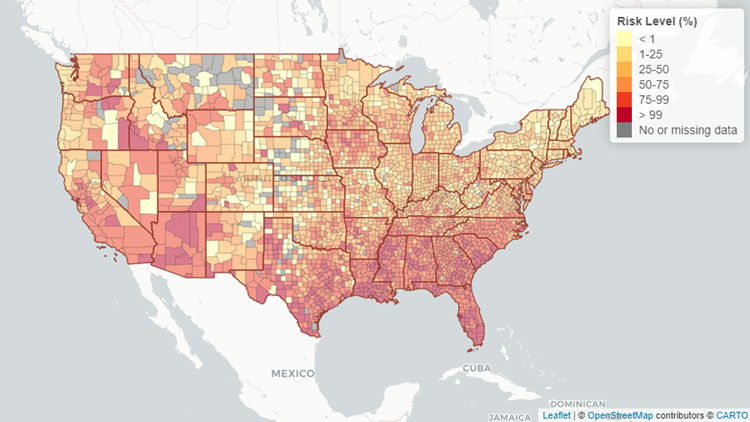
This map shows the risk level of attending an event, given the event size and location.

The risk level is the estimated chance (0-100%) that at least 1 COVID-19 positive individual will be present at an event in a county, given the size of the event.

Based on seroprevalence data, we assume there are ten times more cases than are being reported (10:1 ascertainment bias). In places with more testing availability, that rate may be lower.

Choose an event size and ascertainment bias below: