

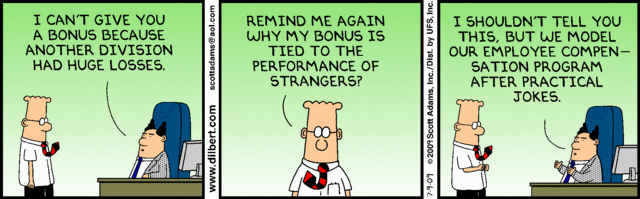
Cartoon – Performance Bonus

Months of inching performance gains were upended in July as the nation’s hospitals logged “some of the worst margins since the beginning of the COVID-19 pandemic,” Kaufman Hall wrote in its latest industry report.
Decreasing outpatient revenues paired with pricier inpatient stays were chief among the culprits and outpaced minor improvements in expenses, the group wrote in its monthly sector update for July.
What’s more, seven straight months of negative margins “reversed any gains hospitals saw this year” and has the advisory group forecasting a brutal year for the industry.
“July was a disappointing month for hospitals and put 2022 on pace to be the worst financial year hospitals have experienced in a long time,” Erik Swanson, senior vice president of data and analytics with Kaufman Hall, said in a statement. “Over the past few years, hospitals and health systems have been able to offset some financial hardship with federal support, but those funding sources have dried up, and hospitals’ bottom lines remain in the red.”
Kaufman Hall placed its median year-to-date operating margin index at -0.98% through July, compared to the -0.09% from January to June the group had reported during last month’s report. Hospitals’ median percent change in operating margin from June to July was -63.9%, according to the report, and -73.6% from July 2021.
The month’s volume trends hinted at the larger shift toward scheduling procedures for ambulatory settings, Kaufman Hall wrote. For instance, operating room minutes declined 10.3% from June to July and 7.7% year over year, according to the report.
Patients who did come into the hospital tended to be sicker, the firm continued. Average length of stay increased 2% from last month and 3.4% year over year. Patient days increased 2.8% from the previous month but were down 2.6% from the prior year, while adjusted discharges dipped 2.8% from June and 4.2% from July 2021.
These trends came together as a brake check on 2022’s to-date revenue gains. Gross operating revenue fell 3.6% from June but remains up 5.5% year to date. Outpatient revenue was down 4.8% from June and maintains a 7.1% year-to-date increase. Inpatient revenue declined 0.7% from June but is still up 3.6% year to date.
The silver lining in Kaufman Hall’s report were total expenses that, although up 7.6% from July 2021, saw a modest 0.4% decline since June. Those savings came squarely among supply and drug expenses as total labor costs and labor expense per adjusted discharge still grew 0.8% and 3.5%, respectively, since June. Increases in full-time employees per adjusted occupied bed “possibly” suggest increased hiring, the group wrote in the report.
Kaufman Hall acknowledged the “urgency of day-to-day pressures” driving the month’s sudden performance dips but urged hospital leaders to prioritize long-term operational improvements as they work to keep the organization afloat.
“2022 has been, and will likely continue to be, a challenging year for hospitals and health systems, but it would not be prudent to focus on short-term solutions at the expense of long-term planning,” Swanson said. “Hospitals and health systems must think strategically and make investments to strengthen performance toward long-term institutional goals despite the day-to-day financial challenges they experience.”
Kaufman Hall’s monthly reports are based on a sample of more than 900 nationally representative hospitals.
The group isn’t alone in its doom-and-gloom warnings for providers. Fitch Ratings recently wrote that high expenses, jilted volume gains and other challenges are unlikely to resolve before the end of the year. As such, the agency downgraded its outlook for the nonprofit hospital industry from “neutral” to “deteriorating.”
Read the full report here.

Cleveland Clinic’s revenue was down year over year in the second quarter of this year, and the health system ended the period with a loss, according to financial documents released Aug. 29.
The health system’s revenue totaled $3.1 billion in the three-month period ended June 30, down from $3.2 billion in the same quarter last year.
Cleveland Clinic reported expenses of $3.1 billion in the second quarter of this year, up from $2.7 billion in the same period last year. The system saw expenses rise across all categories, including supplies and salaries, wages and benefits.
“Nationwide labor shortages have created staffing challenges that have resulted in increased overtime costs and premium pay for employed caregivers as well as an increase in the utilization of agency nurses and other temporary personnel to meet the demand of patient activity,” Cleveland Clinic said in an earnings release. “Supplies, pharmaceuticals and other nonlabor expenses have also increased due to recent inflationary trends and supply chain challenges.”
The health system ended the second quarter with an operating loss of $183.5 million, compared to operating income of $339.5 million in the second quarter of 2021.
After factoring in nonoperating losses, Cleveland Clinic posted a net loss of $786.9 million in the second quarter of this year, compared to net income of $904.4 million in the same quarter a year earlier.
Looking at the first six months of this year, Cleveland Clinic reported a net loss of $1.1 billion on revenue of $6.2 billion. In the same period a year earlier, the health system reported net income of $1.3 billion on revenue of $6 billion, according to the financial documents.
Nonoperating losses for Cleveland Clinic were $781.4 million in the first six months of this year, compared to nonoperating gains of $853.5 million in the same period last year. The decrease was primarily due to lower investment returns in the first half of 2022.

The trend of “quiet quitting” has recently gained traction on social media, referring to a phenomenon in which workers to reduce their enthusiasm at work and stick to the minimum expectations of their role. Some professionals, including Generation Z workers, have embraced the concept as an increased form of work-life balance, and others see it as a lesser-version of actually quitting. Regardless of how an individual interprets the idea, the concept is not new among the U.S. workforce or in healthcare, according to Jeremy Sadlier, executive director of the American Society for Healthcare Human Resources Administration.
“Before the term quiet quitting was in vogue, we were talking about employees who would ‘quit and stay,'” said Mr. Sadlier, who previously served as a market director of human resources and provided operational support at Advocate Aurora Health, an organization with dual headquarters in Downers Grove, Ill., and Milwaukee. “In essence, it’s the same concept with a nearly identical motivation. No matter the term used, many disengaged employees will stick around long after they’re finding motivation and stimulation in their work.”
In healthcare, this phenomenon has only grown. An April Gallup poll found that 34 percent of U.S. employees were actively engaged at work in 2021, compared to only 32 percent this year. Healthcare professionals saw the largest dip in engagement, with their engagement scores dropping nine points year over year.
Mr. Sadlier noted that this trend can have significant effects in the industry.
“Any lack of engagement on the part of staff ultimately impacts patient care, teamwork, safety and throughput, all of which impact the financial health of an organization and the patient experience. It’s incredibly important for leaders to focus on engagement, growth opportunities, and to recognize and reward hard work. These are a few ways to focus on your employees to help them feel engaged with their work,” he said.
Still, quiet quitting doesn’t look significantly different in healthcare than it does in other industries, according to Mr. Sadlier. “Colleagues in other industries like hospitality and retail, for example, all talk about a lack of willingness among workers to pick up extra shifts, or work beyond the bare minimum requirements. That’s a sign of growing disengagement and may be quiet quitting,” he said. It is greatly concerning that, while the motivation may not be largely different than in other industries, the effects of quiet quitting in healthcare have a direct connection to patient care, quality and safety, according to Mr. Sadlier.
He also said lower patient experience scores may indicate that a hospital is experiencing decreased employee engagement, which can spread among all its staff.
“There’s an absolute hierarchy [in healthcare], and it doesn’t require somebody to work in healthcare to recognize that when physician engagement falters, that impacts nurses, and when nurses don’t feel engaged, that impacts the rest of the staff, whether it’s ancillary staff, support services,” he said. “There’s a trickledown effect to a lack of engagement at any part of the organization. Inevitably that impacts every position and is ultimately felt by those we serve.”
Additionally, he pointed to financial struggles at U.S. hospitals as a contributing factor for workloads increasing. On Aug. 29, Kaufman Hall released a new report that showed hospitals are experiencing some of the worst margins since the beginning of the COVID-19 pandemic. This means some organizations have had to implement layoffs and other cost-cutting measures.
“Cost-cutting measures are becoming harder to accomplish without having a direct effect on the care patients receive. When [full-time equivalents] are affected, in many cases the responsibilities are shifted to other members of the team. The additional responsibilities can lead to frustration and burnout and negatively impact employee engagement. These factors are what then lead to quiet quitting,” Mr. Sadlier said.
To avoid quiet quitting or disengagement, he recommends that hospitals provide open and honest communication, set and maintain realistic work expectations, closely monitor employee engagement, recognize and reward high performance through options that extend beyond pay, and provide opportunities for career growth.
At the same time, he acknowledged there’s no absolute formula to identify disengagement at the individual level.
“The more you round, the more that you spend time with your staff, the more likely you are to recognize changes in demeanor and perspective,” Mr. Sadlier said. “The sooner you recognize it, the sooner you’re able to have an influence on it. So that’s where the regular engagement for leaders and supervisors has the biggest benefit — recognizing [disengagement] early and trying to find a way to reenergize and reengage staff.”
During an interview with Fortune, Katarina Berg, Spotify’s chief human resources officer, said her company is working to avoid quiet quitting by encouraging a culture of trust where workers feel psychologically safe.
Her advice for leaders is to talk about “the part of quiet quitting that has to do with people not [being] trusted, and they also don’t trust their management team. Therefore, they don’t find any other resolution other than doing this type of very silent activism. So, I think with culture you always have to be proactive … and you have to be very deliberate and intentional.”


The AHA wants Congress to halt Medicare payment cuts and extend or make permanent certain waivers, among other requests.
The American Hospital Association has released a report on patient acuity that shows hospital patients are sicker and more medically complex than they were before the COVID-19 pandemic.
This is driving up hospital costs for labor, drugs and supplies, according to the AHA report.
Hospital patient acuity, as measured by average length of stay, rose almost 10% between 2019 and 2021, including a 6% increase for non-COVID-19 Medicare patients as the pandemic contributed to delayed and avoided care, the report said. For example, the average length of stay rose 89% for patients with rheumatoid arthritis and 65% for patients with neuroblastoma and adrenal cancer.
In 2022, patient acuity as reflected in the case mix index rose 11.1% for mastectomy patients, 15% for appendectomy patients and 7% for hysterectomy patients.
WHY THIS MATTERS
Mounting costs, combined with economy-wide inflation and reimbursement shortfalls, are threatening the financial stability of hospitals around the country, according to the AHA report.
The length of stay due to increasing acuity is occurring at a time of significant financial challenges for hospitals and health systems, which have still not received support to address the Delta and Omicron surges that have comprised the majority of all COVID-19 admissions, the AHA said.
The AHA is asking Congress to halt its Medicare payment cuts to hospitals and other providers; extend or make permanent certain waivers that improve efficiency and access to care; extend expiring health insurance subsidies for millions of patients; and hold commercial insurers accountable for improper and burdensome business practices.
THE LARGER TREND
Hospitals, through the AHA, have long been asking the federal government for relief beyond what’s been allocated in provider relief funds.
In January, the American Hospital Association sought at least $25 billion for hospitals to help combat workforce shortages and labor costs exacerbated by what the AHA called “exorbitant” rates on the part of some staffing agencies. The Department of Health and Human Services released $2 billion in additional funding for hospitals.
In March, the AHA asked Congress to allocate additional provider relief funds beyond the original $175 billion in the Coronavirus Aid, Relief and Economic Security Act.
Earlier this month, the Centers for Medicare and Medicaid Services increased what it originally proposed for payment in the Inpatient Prospective Payment system rule. The AHA said the increase was not enough to offset expenses and inflation.

Children, young adults will be impacted disproportionately, with 5.3 million children and 4.7 million adults ages 18-34 predicted to lose coverage.
Roughly 15 million people could lose Medicaid coverage when the COVID-19 public health emergency ends, and only a small percentage are likely to obtain coverage on the Affordable Care Act exchanges, according to a new report from the Department of Health and Human Services.
Using longitudinal survey data and 2021 enrollment information, HHS estimated that, based on historical patterns of coverage loss, this would translate to about 17.4% of Medicaid and Children’s Health Insurance Program (CHIP) enrollees leaving the program.
About 9.5% of Medicaid enrollees, or 8.2 million people, will leave Medicaid due to loss of eligibility and will need to transition to another source of coverage. Based on historical patterns, 7.9% (6.8 million) will lose Medicaid coverage despite still being eligible – a phenomenon known as “administrative churning” – although HHS said it’s taking steps to reduce this outcome.
Children and young adults will be impacted disproportionately, with 5.3 million children and 4.7 million adults ages 18-34 predicted to lose Medicaid/CHIP coverage. Nearly one-third of those predicted to lose coverage are Hispanic (4.6 million) and 15% (2.2 million) are Black.
Almost one-third (2.7 million) of those predicted to lose eligibility are expected to qualify for marketplace premium tax credits. Among these, more than 60% (1.7 million) are expected to be eligible for zero-premium marketplace plans under the provisions of the American Rescue Plan. Another 5 million would be expected to obtain other coverage, primarily employer-sponsored insurance.
An estimated 383,000 people projected to lose eligibility for Medicaid would fall in the coverage gap in the remaining 12 non-expansion states – with incomes too high for Medicaid, but too low to receive Marketplace tax credits. State adoption of Medicaid expansion in these states is a key tool to mitigate potential coverage loss at the end of the PHE, said HHS.
States are directly responsible for eligibility redeterminations, while the Centers for Medicare and Medicaid Services provides technical assistance and oversight of compliance with Medicaid regulations. Eligibility and renewal systems, staffing capacity, and investment in end-of-PHE preparedness vary across states.
HHS said it’s working with states to facilitate enrollment in alternative sources of health coverage and minimize administrative churning. These efforts could reduce the number of eligible people losing Medicaid, the agency said.
The Inflation Reduction Act of 2022 extends the ARP’s enhanced and expanded Marketplace premium tax credit provisions until 2025, providing a key source of alternative coverage for those losing Medicaid eligibility, said HHS.
WHAT’S THE IMPACT?
While the model projects that as many as 15 million people could leave Medicaid after the PHE, about 5 million are likely to obtain other coverage outside the marketplace and nearly 3 million would have a subsidized Marketplace option. And some who lose eligibility at the end of the PHE may regain it during the unwinding period, while some who lose coverage despite being eligible may re-enroll.
The findings highlight the importance of administrative and legislative actions to reduce the risk of coverage losses after the continuous enrollment provision ends, said HHS. Successful policy approaches should address the different reasons for coverage loss.
Broadly speaking, one set of strategies is needed to increase the likelihood that those losing Medicaid eligibility acquire other coverage, and a second set of strategies is needed to minimize administrative churning among those still eligible for coverage.
Importantly, some administrative churning is expected under all scenarios, though reducing the typical churning rate by half would result in the retention of 3.4 million additional enrollees.
THE LARGER TREND
CMS has released a roadmap to ending the COVID-19 public health emergency as health officials are expecting the Biden administration to extend the PHE for another 90 days after mid-October.
The end of the PHE, last continued on July 15, is not known, but HHS Secretary Xavier Becerra has promised to give providers 60 days’ notice before announcing the end of the public health emergency.
A public health emergency has existed since January 27, 2020.

The fact that poliovirus was detected in New York City wastewater samples as far back as April of this year shouldn’t be surprising, as the virus likely has been circulating for longer and more widely than previously believed, several experts told MedPage Today.
“I think you’re gonna see over the next weeks more and more reports of poliovirus in wastewater elsewhere,” said Vincent Racaniello, PhD, a virologist at Columbia University in New York City.
Poliovirus probably still circulated in the U.S. after 2000, when officials stopped giving the oral polio vaccine, he said. That version protects against paralysis and provides short-term protection against intestinal infection from poliovirus.
The transition to injectable polio vaccine, which is equally as effective against paralysis but not against intestinal infection, meant that the U.S. population was more susceptible to transmitting vaccine-associated poliovirus, he explained.
This circulation is likely occasional and sporadic, he said, but the threat to vulnerable populations is still high.
“Here’s the thing: polio is here in the U.S. It’s not gone,” Racaniello said. “It’s in the wastewater. It could contaminate you, so if you’re not vaccinated, that could be a problem.”
Calls for Nationwide Surveillance
Racaniello said there’s value in learning more about the circulation of the virus, especially for communities with low vaccination rates.
The first step to understanding how long and how broadly poliovirus is circulating, he said, is to start testing wastewater everywhere. The CDC used stored wastewater from April to confirm that the virus had been circulating then, but it is just as possible to conduct nationwide surveillance for poliovirus now, he noted.
In fact, Racaniello said, he has long believed that this kind of surveillance should be done routinely to provide an early detection system for poliovirus.
“Ten years ago, I said to the CDC, you should really be looking in the sewage for poliovirus because of this issue where it could come in from overseas and be in our sewage,” he said. “If someone is unvaccinated, that would be a threat to them, but [the CDC] never did it.”
Davida Smyth, PhD, of Texas A&M University-San Antonio, pointed out that the National Wastewater Surveillance System (NWSS) was established to detect COVID-19 in 2020, so the infrastructure to conduct a wide search for the spread of polio is available.
The primary issue, she said, is that the collaboration that academic researchers have enjoyed with the CDC in surveillance of COVID-19 is so far absent with poliovirus.
“I imagine the CDC is testing those samples for polio, even as we speak, given the nature of what has happened,” Smyth said.
Better coordination with academia and better surveillance, she said, is crucial for finding any potential pockets of poliovirus circulating in other communities around the U.S.
In fact, she said, she is “absolutely convinced” that more polio will be found in the coming weeks.
MedPage Today contacted the CDC to ask whether there are plans to use the NWSS to look for polio around the U.S., but as of press time had not received a response.
Smyth noted that most areas in the country have high rates of polio vaccination, but she is concerned about pockets of rural America where vaccination has dipped in recent years. Most states boast polio vaccination rates over 90%, but Smyth said in some regions, the percentages may be as low as the mid-30s.
“[In] the vast majority of the United States, the vaccination rates are quite high, but the COVID pandemic has led to a decrease in vaccination rates,” Smyth told MedPage Today. “The rates are going down. They’re dipping below 90%, which is shocking, frankly.”
Smyth said the decline is largely due to a lack of opportunity or access to healthcare in some areas, but vaccine hesitancy around the COVID-19 vaccine might be affecting polio vaccinations as well.
“There’s a variety of reasons why people don’t get vaccinated,” she said. “The problem is children are very vulnerable. So if you have a population where the vaccination rates drop, those are exactly the kinds of areas where we need to do this surveillance.”
Racaniello echoed the importance of polio vaccination in adults as well. If patients don’t have a record of their shot, “just vaccinate them,” he said, “because there’s no downside to getting vaccinated again.”
Re-evaluating the Polio Endgame
The recent case of paralytic polio infection and concerns over the wider circulation of poliovirus have also altered some of the thinking around the goal of polio eradication.
In fact, William Schaffner, MD, of Vanderbilt University Medical Center in Nashville, highlighted the unique difficulty of preventing the spread of poliovirus.
“As you can imagine, we’ve gotten into polio endgame,” he told MedPage Today. “I think the notion has now been modified. Eradication isn’t going to be as neat and clean and quick as we once thought. Once we get rid of all paralytic disease, we will have to keep vaccinating for a long time, because there will still be circulating vaccine-associated viruses — some of which will mutate back.”
Schaffner compared the final push to eradicate polio with the successful eradication of smallpox. When the last case of smallpox ended, he explained, public health officials were able to end smallpox vaccination campaigns. For polio, however, he said, it will likely not be that simple, and it will be necessary “to keep vaccinating for quite a long time.”
He said that as public health officials in the U.S. and globally continue to grapple with the nuances of eradicating poliovirus, healthcare providers and their patients will have to come to terms with the simple fact that polio is a real health concern.
“[It’s] the reverse of the old saying, ‘it’s gone, but not forgotten,'” Schaffner said. “Polio is forgotten, but it’s not gone.”

Radio Advisory’s Rachel Woods sat down with Advisory Board’s Sarah Hostetter and Vidal Seegobin to discuss the good and bad elements of private equity and what leaders can do to make it a valuable partner to their practices.
Private equity (PE) tends to get a bad rap when it comes to health care. Some see it as a disruptive force that prioritizes profits over the patient experience, and that it’s hurting the industry by creating a more consolidated marketplace. Others, however, see it as an opportunity for innovation, growth, and more movement towards value-based care.
Radio Advisory’s Rachel Woods sat down with Advisory Board‘s Sarah Hostetter and Vidal Seegobin to discuss the good and bad elements of PE and what leaders can do to make it be a valuable partner to their practices.
Read a lightly edited excerpt from the interview below and download the episode for the full conversation. https://player.fireside.fm/v2/HO0EUJAe+KzkqmeWH?theme=dark
Rachel Woods: Clearly there are a lot of feelings about private equity. I’m frankly not that surprised, because the more we see PE get involved in the health care space, we hear more negative feelings about what that means for health care.
Frankly, this bad guy persona is even seen in mainstream media. I can think of several cable medical dramas that have made private equity, or maybe it’s specific investors, as the literal enemy, right? The enemy of the docs that are the saviors of their hospital or ER or medical practice. Is that the right way we should be thinking about private equity? Are they the bad guy?
Sarah Hostetter: The short answer is no. I think private equity is a scapegoat for a lot of the other problems we’re seeing in the industry. So the influx of money and where it’s going and the influence that that has on health care. I think private equity is a prime example of that.
I also think the horror stories all get lumped together. So we don’t think about who the PE firm is or what is being invested in. We put together physician practices and health systems and SNPs, and we lump every story all together, as opposed to considering those on their individual merits.
Woods: And feeds to this bad guy kind of persona that’s out there.
Hostetter: Yeah. And like you said, the media doesn’t help, right? If the average consumer is watching and seeing different portrayals or lumped portrayals, it’s not helping.
Vidal Seegobin: Private equity, as all actors in our complex ecosystem, is not a monolith, and no one has the monopoly on great decisions in health care, nor do they have a monopoly on the bad decisions in health care. And so if you attribute a bad case to private equity, then you also have to attribute the positive returns done from a private equity investment as well.
Hostetter: Agree with what Vidal’s saying, but bottom line is that every stakeholder is not going to have the same outcomes or ripple effects from a private equity deal. It really depends on the deal itself, the market, and the vantage points that you take.
Woods: I want to actually play out a scenario with the two of you and I want you to talk about the positive and the potentially negative consequences for different sectors or different stakeholders.
So let’s take the newest manifestation that Sarah, you talked to us through. Let’s say that there is a PE packed multi-specialty practice heavily in value-based care. That practice starts to get bigger. They acquire other practices, including maybe even some big practices in a market and they start employing all of the unaffiliated or loosely affiliated practices in the market.
I am guessing that every health system leader listening to this episode is already starting to sweat. What does this mean for the incumbent health system?
Seegobin: So I think one thing that’s going to be pretty clear is that size does confer clear advantages and health care is part and parcel that kind of benefit. What I think is challenging is when we’re entering into a moment where access to capital is challenging for health systems in particular and we’re going to need to scale up investments, health systems could see themselves falling further and further behind as private equity makes smart investments into these practices to both capture and retain volume. And as a consequence of that, reduces the amount of inpatient demand or the demand to their bread and butter services.
Hostetter: And I think it’s really important that you phrase the question, Rae, as health system. Because we so often equate health system and hospital.
But a health system includes lots of hospitals, it includes ambulatory facilities, a range of services. And so I think for systems to equate health system and hospital, it’s really hard when any type of super practice or large backed practice comes into the market.
Whether we are talking about a plan backed practice, a PE backed practice, or just a really large independent group. There are pressures on health systems who think of their job or their primary service as the hospital. And there is a moment where the power dynamics can shift in markets away from the health system, if they aren’t able to pivot their strategy beyond just the hospital.
Woods: Which is exactly why health systems see this scenario as, let’s just say it, threatening. Sarah, then how do the physicians feel? Do they have the opposite feelings as the incumbent health systems?
Hostetter: There’s a huge range. Private equity is incredibly polarizing in the physician practice world, the same way that it is in other parts of the industry. So I think there is a hope from some practices that private equity is a type of investor that is aligned with them.
Physicians who go into private practice historically tend to be more entrepreneurial. They are shareholders in their own practice, so there are some natural synergies between private equity, business minded folks, and these physicians.
Also, even though I go into a small business, it takes a lot to run a small business, so there are potentially welcome synergies and help that you can get from a PE firm. On the flip side of that, there are groups who would never in a million years consider taking a private equity investment and are unwilling to have these conversations.
Woods: There is a tendency, especially in the conversation that we’re having, for folks to think about private equity as being something that primarily impacts the provider space, at least when it comes to health care. But I’m not sure that that’s actually true. So what consequences, good or bad, might the payers feel? Might the life sciences companies feel?
Seegobin: So one common refrain when talking about private equity and their acquisition or partnering with traditional health care businesses like physician practices is that they are immediately focused on cutting costs. So they are going to consolidate all of the purchasing contracts, they are going to make pretty aggressive decisions about real estate, all the types of cost components that run the business.
Now, if you are a kind of life sciences or a diagnostic business for whom you would depend on being an incumbent in those contracting decisions, you’re worried that the private equity is either going to direct you to a lower cost provider, or in many cases, another business that the private equity firm owns as well, right?
They would love to keep synergies within the portfolio of businesses that they’ve acquired and they partner. So if you were relying on incumbent or historical purchasing practices with these physician practices, it can be disrupted, depending on the arrangement.
Hostetter: And then I think there’s a range of potential implications for payers. So you have some payers who themselves are aggregating independent practices, and they’re targeting the same type of practices that the PE firms that are betting on value-based care are targeting. They are targeting primary care groups who are big in Medicare Advantage. So there’s some inherent competition potentially for the physician practice landscape there.
Woods: Well, and I think they’re trying to offer the same thing, right? They’re trying to offer capital. They’re trying to do that with the promise of autonomy. And they’re coming up against a competitive partner that is saying, “I can do both of those things and I can do it better and faster.”
Hostetter: Yeah. And both of them are saying we can do it better and faster than hospitals. That’s the other thing, right?
Woods: Which, that part is probably true.
Hostetter: Yeah. Their goals are aligned and they believe they can get there different ways. And I think autonomy is a big sticking point here for me or a big bellwether for me, because I think whoever can get to value-based care while preserving autonomy is going to win. You have to have some level of standardization to do value-based care well. You can’t just let everyone do whatever they want. You need high quality results for lower cost. That inherently requires standardization. So who can thread the needle of getting that standardization while preserving a degree of autonomy?
It’s fascinating, as we’ve had this call, it was suggested multiple times that payers actually might be the end of the line for some of these PE deals. That there’s a lot of alignment between what payers are trying to do with their aggregation and what PE firms who are investing in primary care do, and hey, payers have a lot of money too. So could we actually see some of these PE deals end with a payer acquisition? Because they’re trying to achieve similar things, just differently.
 HENRY KOTULA