

Dubai’s Super-Ambulance Is a Mini Hospital-on-Wheels with an Operating Room and X-Ray Unit

Dubai is proud to introduce its impressive fleet of the “world’s largest ambulances,” or “Mercedes-Benz large-capacity ambulances” which were created to give rapid medical assistance in the event of major emergencies with large numbers of causalities. These new emergency vehicles offer a fully-equipped, mobile clinic with an intensive-care unit and an operating room.
Equipped with an X-ray unit and ultrasonic equipment for further evaluation, each super ambulance bus carries 12,000 liters of oxygen, which ensures a dependable supply for up to three days. With the press of a button, oxygen masks fall from special holders, and the oxygen flow to each mask can be individually controlled.
They’re also equipped with an ECG and an InSpectra shock monitor, which monitors the oxygen saturation in tissue-matter and warns doctors of the onset of shock minutes before it occurs. This unit can also detect and monitor internal bleeding. If an emergency caesarian birth is needed, essential obstetrical instruments, including an incubator, are on board.
Cartoon – Recruiting Today

$5B offer to North Carolina hospital gives it ‘best of both worlds,’ Novant CEO says

Novant Health presented its proposal June 10 to partner with New Hanover Regional Medical Center, a county-owned hospital in Wilmington, N.C. The Winston-Salem, N.C.-based health system is one of three organizations interested in securing the deal.
During the public presentation, Novant Health President and CEO Carl Armato highlighted the system’s financial strength and its potential partnership with Chapel Hill, N.C.-based UNC Health, according to WilmingtonBiz.
In May, Novant, UNC Health and UNC School of Medicine signed a letter of intent to enhance clinical services and medical education at New Hanover Regional if the hospital chooses to form a joint venture with, affiliate with or sell to Novant.
“We are binging, I believe, the best of both worlds: one of the largest not-for-profit health care systems in the country, that’s financially strong, along with UNC Health Care and UNC medical school to really enhance and grow the economic development of Wilmington,” Mr. Armato said, according to WilmingtonBiz.
The 15-hospital system is offering up to $2 billion to New Hanover County, $50 million to the hospital’s foundation to fund unmet community needs and an investment of $3.1 billion in capital projects over the next decade, according to the report.
“We actually proposed a very significant financial commitment to New Hanover Regional Medical Center, that local board, that management team, that community — your community,” Mr. Armato said, according to the report. “And we want you to know that we have the resources to back that up.”
Novant made its proposal the day after Durham, N.C.-based Duke Health pitched its deal for New Hanover Regional. Charlotte, N.C.-based Atrium Health, the third health system trying to secure a deal with the hospital, will make its presentation June 11.
Trinity Health gets $2.2B in bailout funds, advance Medicare payments

Trinity Health saw revenue decline in the first nine months of fiscal year 2020, and the Livonia, Mich.-based health system ended the period with an operating loss, according to unaudited financial documents.
Trinity Health saw revenue decline less than 1 percent year over year to $14.2 billion in the first nine months of the fiscal year, which ended March 31. The health system attributed the drop in revenue to the COVID-19 pandemic and the divestiture of Camden, N.J.-based Lourdes Health System in June 2019.
The 92-hospital system’s expenses were also up 1.2 percent year over year. Trinity Health ended the first three quarters of fiscal 2020 with expenses of $14.3 billion. Same-hospital expense growth was driven by increases in labor and supply costs, purchased services and costs related to its conversion to the Epic EHR platform in the Michigan region. The health system said the pandemic added $14.1 million of costs in March.
Trinity Health has taken several steps to reduce operating and capital spending in response to the pandemic, including implementing furloughs and reducing salaries for executives. In early April, Trinity Health announced plans to furlough 2,500 employees, most of whom are in nonclinical roles.
Trinity Health reported an operating loss of $103.5 million for the first nine months of the current fiscal year, compared to operating income of $115.2 million in the same period a year earlier.
After factoring in investments and other nonoperating items, Trinity Health posted a net loss of $883.5 million in the first three quarters of fiscal 2020, down from net income of $457.9 million a year earlier. Nonoperating losses in the first nine months of fiscal 2020 were primarily driven by the pandemic’s effect on global investment market conditions in March, the health system said.
To help offset financial damage, Trinity Health received funds from the $175 billion in relief aid Congress has allocated to hospitals and other healthcare providers to cover expenses and lost revenue tied to the pandemic. The health system said it received a total of $600 million in federal grants in April and May.
Trinity Health also applied for and received $1.6 billion of Medicare advance payments, which must be repaid.
Though Trinity Health is unable to forecast the pandemic’s impact on its financial position, it said the ultimate effect of COVID-19 on its operating margins and financial results “is likely to be adverse and significant.”
“All policy is health policy”
The effects of racism are often inseparable from black Americans’ health and well-being, as “black communities bear the physical burdens of centuries of injustice, toxic exposures, racism, and white supremacist violence,” Rachel Hardeman, Eduardo Medina and Rhea Boyd write in the New England Journal of Medicine:
Any solution to racial health inequities must be rooted in the material conditions in which those inequities thrive. Therefore, we must insist that for the health of the black community and, in turn, the health of the nation, we address the social, economic, political, legal, educational, and health care systems that maintain structural racism. Because as the Covid-19 pandemic so expeditiously illustrated, all policy is health policy…
The response to the pandemic has made at least one thing clear: systemic change can in fact happen overnight.
Rich vs. poor hospitals

The inequalities in American health care extend right into the hospital: Cash-strapped safety-net hospitals treat more people of color, while wealthier facilities treat more white patients.
Why it matters: Safety-net hospitals lack the money, equipment and other resources of their more affluent counterparts, which makes providing critical care more difficult and exacerbates disparities in health outcomes.
The big picture: A majority of patients who go to safety-net hospitals are black or Hispanic; 40% are either on Medicaid or uninsured.
The other side: Wealthy hospitals, including many prominent academic medical centers, are “far less likely to serve or treat black and low-income patients even though those patients may live in their backyards,” said Arrianna Planey, an incoming health policy professor at the University of North Carolina.
- An investigation by the Boston Globe in 2017 found black people in Boston “are less likely to get care at several of the city’s elite hospitals than if you are white.”
- The Cleveland Clinic has expanded into a global icon for health care, but rarely cares for those in the black neighborhoods that surround its campus, Dan Diamond of Politico reported in 2017.
Between the lines: The way the federal government is bailing out hospitals for the revenues they’ve lost during coronavirus is exacerbating this inequality. More money is flowing to richer hospitals.
- For example, the main hospital within University of Colorado Health has gotten $79.3 million from the government’s main “provider relief” fund — about the same amount as Cook County Health, Chicago’s public hospital system, which predominantly treats low-income black and Hispanic people. It has gotten $77.6 million from that pot.
- The Colorado system, however, is sitting on billions of dollars in cash and investments that Chicago’s safety-net hospitals don’t have. Chicago has also seen a worse coronavirus outbreak.
The bottom line: Poor hospitals that treat minorities have had to rely on GoFundMe pages and beg for ventilators during the pandemic, while richer systems move ahead with new hospital construction plans.
Scientists caught between pandemic and protests
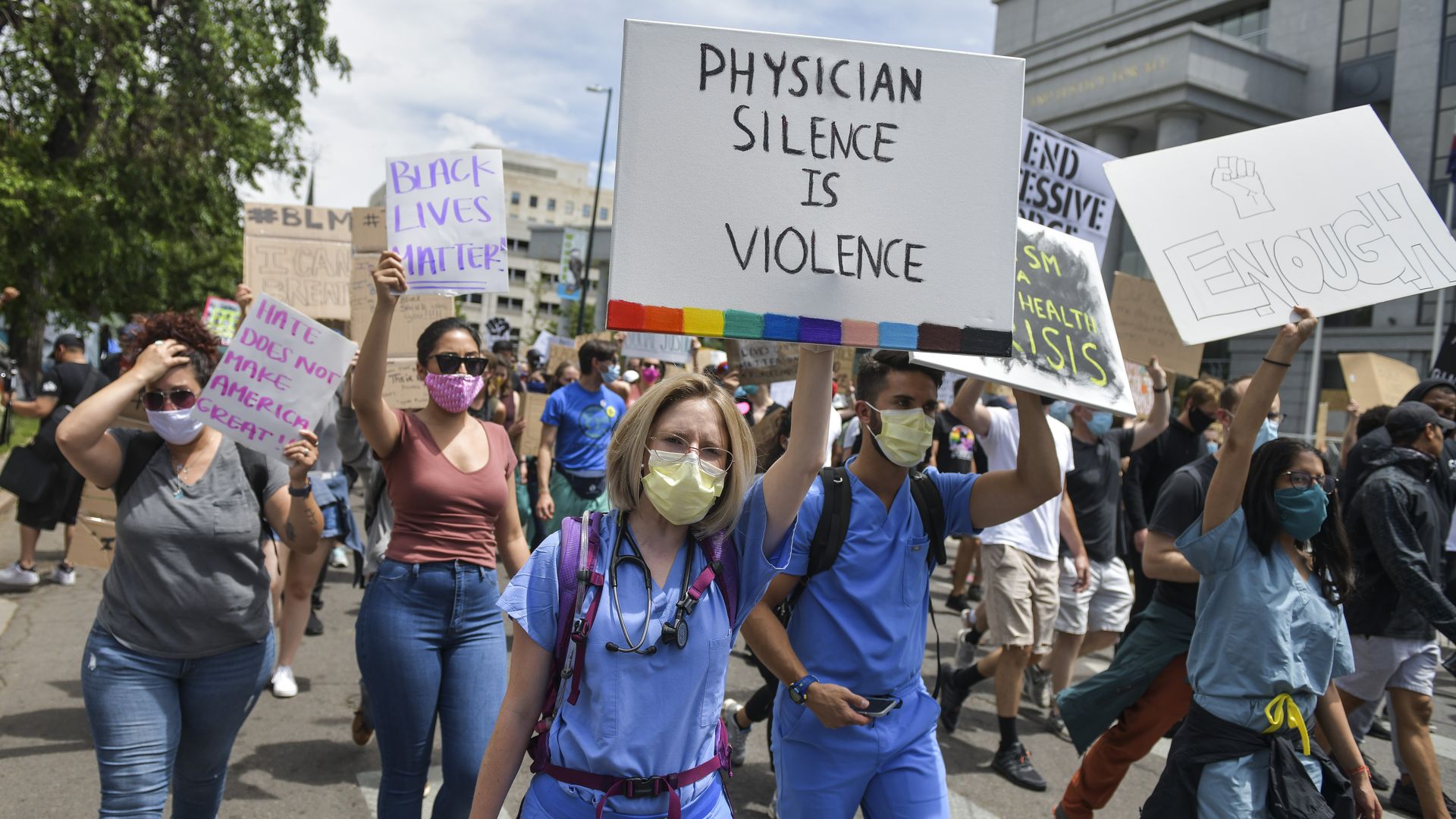
When protests broke out against the coronavirus lockdown, many public health experts were quick to warn about spreading the virus. When protests broke out after George Floyd’s death, some of the same experts embraced the protests. That’s led to charges of double standards among scientists.
Why it matters: Scientists who are seen as changing recommendations based on political and social priorities, however important, risk losing public trust. That could cause people to disregard their advice should the pandemic require stricter lockdown policies.
What’s happening: Many public health experts came out against public gatherings of almost any sort this spring — including protests over lockdown policies and large religious gatherings.
- But some of the same experts are supporting the Black Lives Matter protests, arguing that addressing racial inequality is key to tackling the coronavirus epidemic.
- The systemic racism that protesters are decrying contributes to massive health disparities that can be seen in this pandemic — black Americans comprise 13% of the U.S. population, but make up around a quarter of deaths from COVID-19. Floyd himself survived COVID-19 before he was killed by a now former police officer in Minneapolis.
- “While everyone is concerned about the risk of COVID, there are risks with just being black in this country that almost outweigh that sometimes,” Abby Hussein, an infectious disease fellow at the University of Washington, told CNN last week.
Yes, but: Spending time in a large group, even outdoors and wearing masks — as many of the protesters are — does raise the risk of coronavirus transmission, says Michael Osterholm, director of the Center for Infectious Disease Research and Policy at the University of Minnesota.
- In a Twitter thread over the weekend, coronavirus expert Trevor Bedford estimated that each day of protests would result in some 3,000 additional infections, which over time could lead to hundreds of additional deaths each day.
- Public health experts who work in the government have struck a cautionary note. Mass, in-person protests are a “perfect setup” for transmission of the virus, Anthony Fauci told radio station WTOP last week. “It’s a delicate balance because the reasons for demonstrating are valid, but the demonstration puts one at additional risk.”
The difference in tone between how some public health experts are viewing the current protests and earlier ones focused on the lockdowns themselves was seized upon by a number of critics, as well as the Trump campaign.
- “It will deepen the idea that the intellectual classes are picking winners and losers among political causes,” says Tom Nichols, author of the “The Death of Expertise.”
- Politico reported that the Trump campaign plans to restart campaign rallies in the next two weeks, with advisers arguing that “recent massive protests in metropolitan areas will make it harder for liberals to criticize him” despite the ongoing pandemic.
The current debate underscores a larger question: What role should scientists play in policymaking?
- “We should never try to harness the credibility of public health on behalf of our judgments as citizens,” writes Peter Sandman, a retired professor of environmental journalism. He tells Axios some scientists who supported one protest versus others “clearly damaged the credibility of public health as a scientific enterprise that struggles to be politically neutral.“
- But some are pushing back against the very idea of scientific neutrality. “Science is part of how we got to our racist system in the first place,” Susan Matthews wrote in Slate.
- Medical science has often betrayed the trust of black Americans, who receive less, and often worse, care than white Americans. That means — as Uché Blackstock, a physician and CEO of Advancing Health Equity, told NPR — that the pandemic presents “a crisis within a crisis.”
The big picture: The debate risks exacerbating a partisan divide among Americans in their reported trust in scientists.
- 53% of Democrats polled in late April — about a month before Floyd’s death — reported a “great deal of confidence in medical scientists to act in the public interests” versus 31% of Republicans.
- If science-driven policymaking continues to be seen as biased, it will have repercussions for public trust in issues beyond the pandemic, including climate change, AI and genetic engineering.
What to watch: If there is a rise in new cases in the coming weeks, there will be pressure to trace them — to protests, rallies and the reopening of states. How experts weigh in could affect how their recommendations will be viewed in the future — and whether the public, whatever their political leanings, will follow them again.
US showing signs of retreat in battle against COVID-19
When throngs of tourists and revelers left their homes over Memorial Day weekend, public health experts braced for a surge in coronavirus infections that could force a second round of painful shutdowns.
Two weeks later, that surge has hit places like Houston, Phoenix, South Carolina and Missouri. Week-over-week case counts are on the rise in half of all states. Only 16 states and the District of Columbia have seen their total case counts decline for two consecutive weeks.
But instead of new lockdowns to stop a second spike in cases, states are moving ahead with plans to allow most businesses to reopen, lifting stay-at-home orders and returning to something that resembles normal life.
“There is no — zero — discussion of re-tightening any measures to combat this trend. Instead, states are treating this as a one-way trip. That sets us up for a very dangerous fall, but potentially even for a dangerous summer,” said Jeremy Konyndyk, a senior fellow at the Center for Global Development who oversaw the U.S. Agency for International Development’s Office of Foreign Disaster Assistance during the Obama administration.
The moves suggest that many Americans — anxious to end two-plus months of lockdowns, smarting from the devastating economic toll they have already suffered and focused on the social justice protests that have roiled the nation — are ready to put the coronavirus behind them.
Even as case curves bend upward again, little action has been taken to counter the reversal.
“There are places that I suspect a lot of people are shrugging their shoulders and just rushing forward,” said David Rubin, who runs the PolicyLab at Children’s Hospital of Philadelphia. “I just worry that they might lose control of their epidemic, and that’s what you have to worry about these days.”
The statistics are startling. The average number of confirmed cases over a two-week period has doubled or more in Arizona, Arkansas, Oregon and Utah. Fewer than a quarter of intensive care unit beds in Alabama, Georgia and Rhode Island are available.
In Texas, the number of people admitted to the hospital has grown 42 percent since Memorial Day. Arizona’s top health official has urged hospitals to activate their emergency plans.
North Carolina, California, Mississippi and Arkansas are all reporting record levels of hospitalizations.
Some experts worry Americans have begun to accept the drumbeat of death, numbed by the nearly 2 million cases already confirmed across the country and the 112,000 who have died.
A virus once dismissed as not a serious threat to the nation and later acknowledged as a public health emergency is now becoming just another daily worry to be absorbed.
“One fear is that the U.S. will accept tens of thousands of deaths, as from gun violence, unlike other countries,” said Tom Frieden, director of the Centers for Disease Control and Prevention during the Obama administration.
“It’s not just lives. Unless we protect lives, we won’t get livelihoods back,” said Frieden, who now runs Resolve to Save Lives, a global health nonprofit.
The race to reopen comes even as new research shows the lockdowns were working. The dramatic steps Americans took to stop the virus saved an estimated 5 million infections through April 6, according to research by the Global Policy Lab at the University of California-Berkeley.
President Trump has been perhaps the loudest proponent of reopening, at times putting pressure on states to lift coronavirus restrictions even if the data is flashing warning signs.
World Health Organization (WHO) officials have practically begged nations to be slow and considerate as they move to reopen their economies.
“We need to focus on the now. This is far from over,” Maria Van Kerkhove, the WHO’s technical lead on the coronavirus, told reporters at a virtual press conference Monday. “I know many of us would like this to be over and I know many situations are seeing positive signs. But it is far from over.”
On Wednesday, WHO’s director of emergency programs acknowledged the challenges of lockdown life.
“We fully understand that governments are very reticent to go back into lockdowns that can be damaging to social and economic life,” said Mike Ryan.
“There has to be a balance between lives and livelihoods and the public health control of COVID-19,” Ryan added.
There are few signs that Americans are heeding the warnings.
“We’re just at the beginning of the Memorial Day story, not at the end,” Rubin said. “We are seeing the sea levels rise.”
U.S. tops 2 million confirmed coronavirus cases
https://www.cbsnews.com/news/coronavirus-united-states-cases-2-million/
The number of confirmed coronavirus cases in the United States topped 2 million late Wednesday night, according to Johns Hopkins University. The mark was passed with all 50 states in various stages of re-opening and with numerous states experiencing surges in cases and severe strain on their hospitals.
It’s been just five months since the coronavirus caused its first known U.S. fatality, in California, broke out in Washington state and quickly spread around the country.
The next closest nation to the U.S. in terms of number of cases is Brazil, with some 772,000.
The virus has killed almost 113,000 people in the U.S., Johns Hopkins said, and there were more than 7.3 million cases worldwide and 416,000 deaths.
And according to the Reuters News Service, the head of Harvard’s Global Health Institute, Ashish Jha, told CNN Wednesday that, “Even if we don’t have increasing cases, even if we keep things flat, it’s reasonable to expect that we’re going to hit 200,000 deaths sometime during the month of September. And that’s just through September. The pandemic won’t be over in September.”
Seventeen states have reported an increase in average daily new COVID-19 cases compared with two weeks ago, including Florida, California and Texas.
The ongoing pandemic has wreaked havoc on the U.S. economy. Tens of millions of people have filed for unemployment since states shut down to try to limit the virus’ spread. Several major companies, including J.C. Penney, J. Crew, Gold’s Gym and Hertz have filed for bankruptcy.
The Congressional Budget Office predicts the coronavirus could impact the nation until 2029 and cost the economy almost $16 trillion.
On Monday, White House Coronavirus Task Force officials said the police brutality protests around the country may spur a spike in virus cases. Many demonstrators haven’t been heeding public health guidelines for containing the virus, such as wearing masks and social distancing.

