Cartoon – Current State of the Union

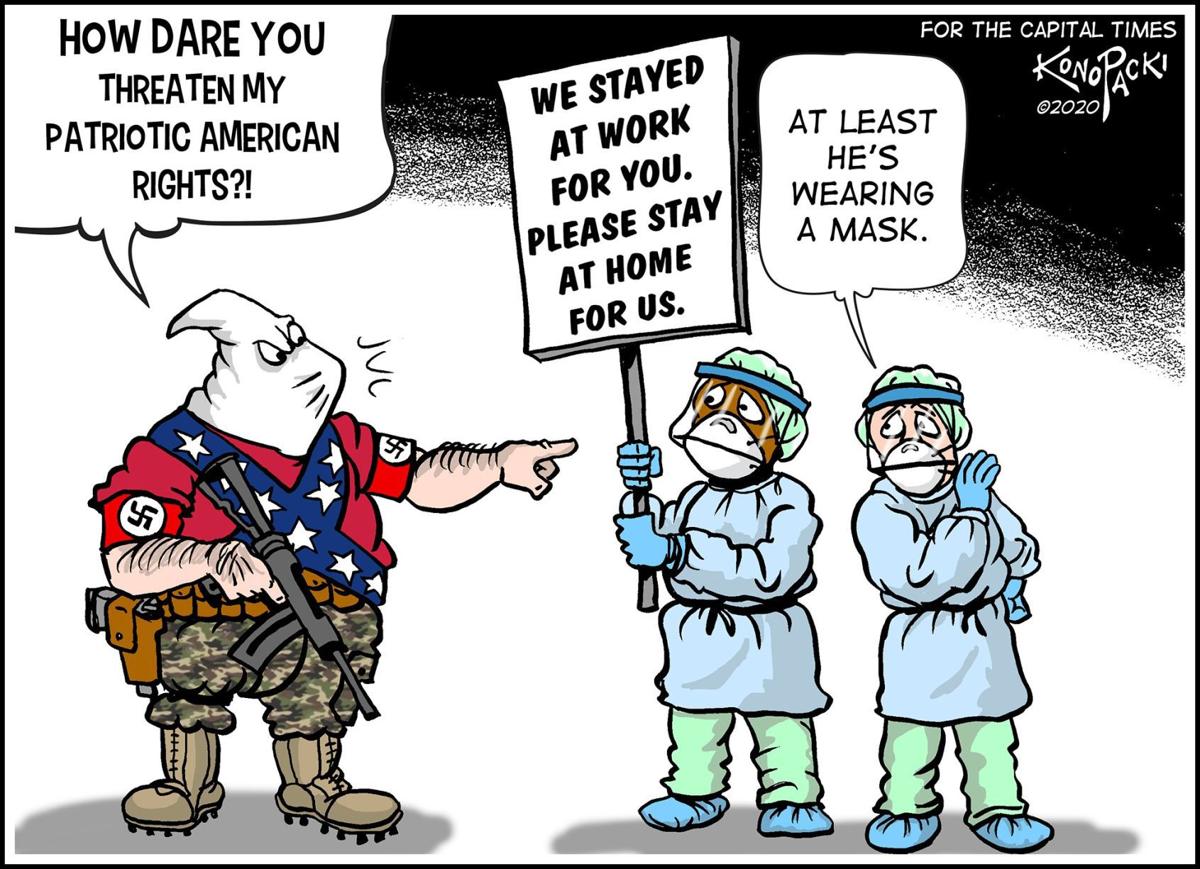
Plain Talk: Refusing to wear a mask isn't patriotic, it's just ...

Cartoon – Yes, We’re Open. Sort of

Today's editorial cartoon - CentralMaine.com

Cartoon – Where Liberty Ends

Coronavirus recovery, Joe Biden and binge-watching: Top columns

Cartoon – To Beach or not to Beach

Cartoons

Pre And Post Coronavirus Unemployment Rates By State, Industry, Age Group, And Race

https://www.forbes.com/sites/mikepatton/2020/06/28/pre-and-post-coronavirus-unemployment-rates-by-state-industry-age-group-and-race/#65c42c6555eb

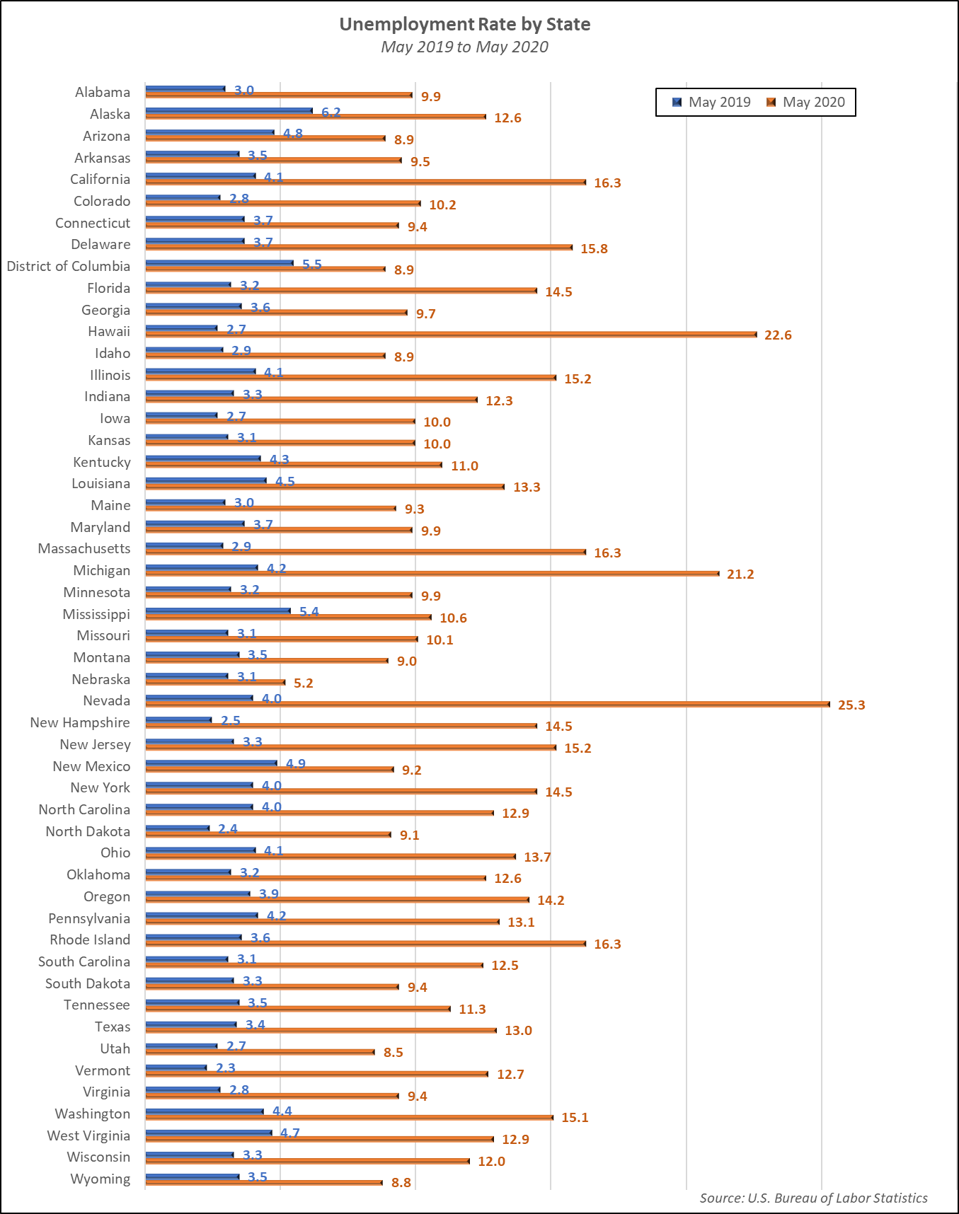
Unemployment by State-May 2019 to May 2020

The coronavirus has decimated the U.S. economy and benched nearly 40 million American workers. In the past several days, the U.S. has logged its highest number of new Covid-19 cases since the pandemic began. These combined with other factors, which we will discuss, is jeopardizing the future employment of millions of workers and the viability of thousands of businesses. Here’s how unemployment has increased for every state, industry, age group, and race, and why.

Unemployment by State

The coronavirus and subsequent stay at home orders hit the labor force especially hard. As states attempted to reopen, a resurgence in the virus is causing many businesses to close again, some by choice, others by government mandate.

Nevada has been hit the hardest as the unemployment rate in the Silver State rose from 4.0% in May 2019 to a whopping 25.3% in May 2020. Nevada’s economy is heavily reliant on leisure and hospitality, which had the brunt of the job losses. Hawaii, the second hardest hit state saw unemployment rise from 2.7% in May 2019 to 22.6% in May 2020. Which is the only other state with unemployment above 20% in May 2020? Michigan, where unemployment rose from 4.2% to 21.2% year over year. What state has fared best? Nebraska, which also has one of the most diverse economies of all states. Deriving nearly 50% of its total GDP from five different industries, unemployment in the Cornhusker State rose from 3.1% to a modest 5.2% from May 2019 to May 2020. Unemployment numbers for all states are shown in the following chart.

Unemployment by Industry

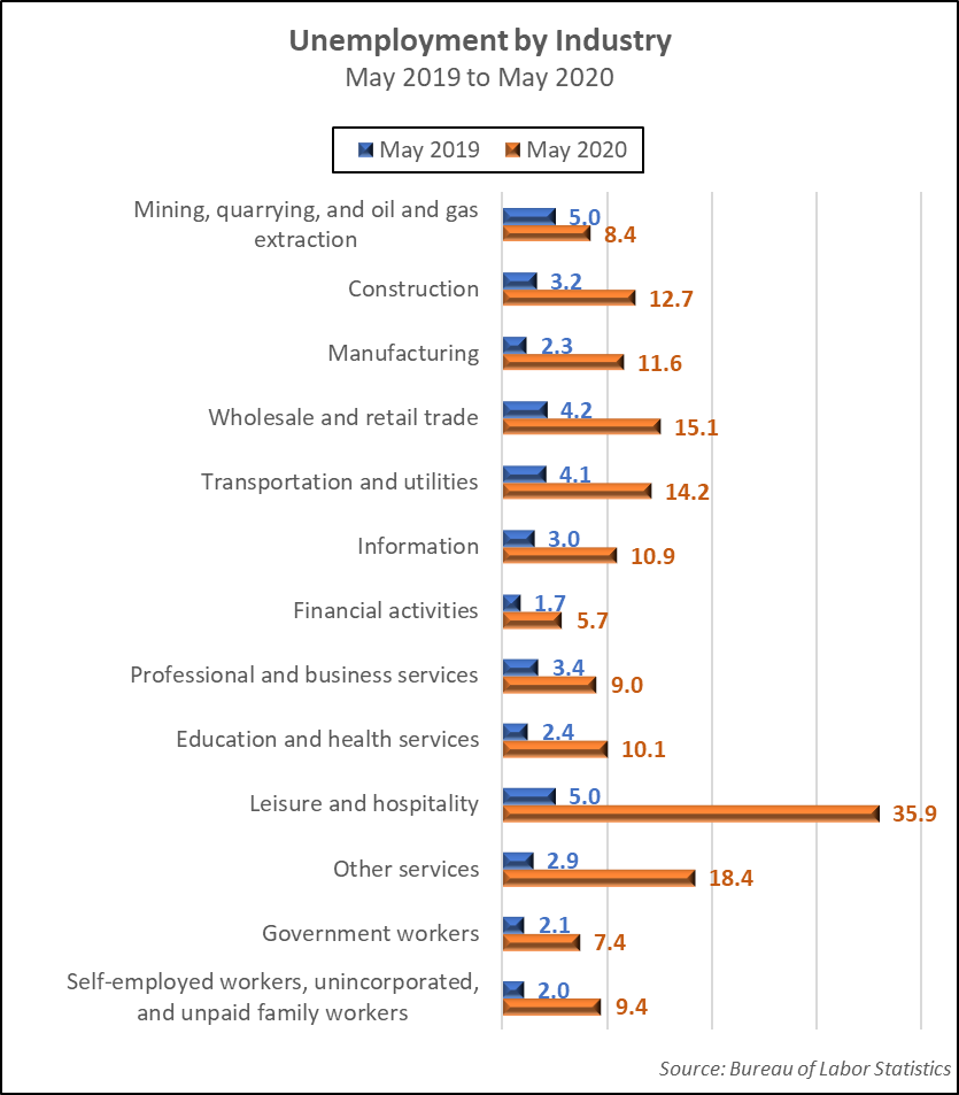
As mentioned in the previous section, the states that have fared best either have a more diverse economy or do not rely heavily on industries that have been hardest hit by the coronavirus. The most negatively affected is the leisure and hospitality industry where unemployment rose 618% from a low of 5.0% in May 2019 to a staggering 35.9% in May 2020. At a distant second, but still reeling, is the wholesale and retail trade industry, which saw unemployment rise from 4.2% to 15.1% during the same period. The rest of the industries are listed in the following chart.

Unemployment by Industry-May 2019 to May 2020

Unemployment by Age Group

Businesses need two things to exist: workers and customers. Without customers, there is no need for workers or the business for that matter. Some businesses require highly skilled workers while others operate well using unskilled labor. It is this unskilled labor group that has been hardest hit.

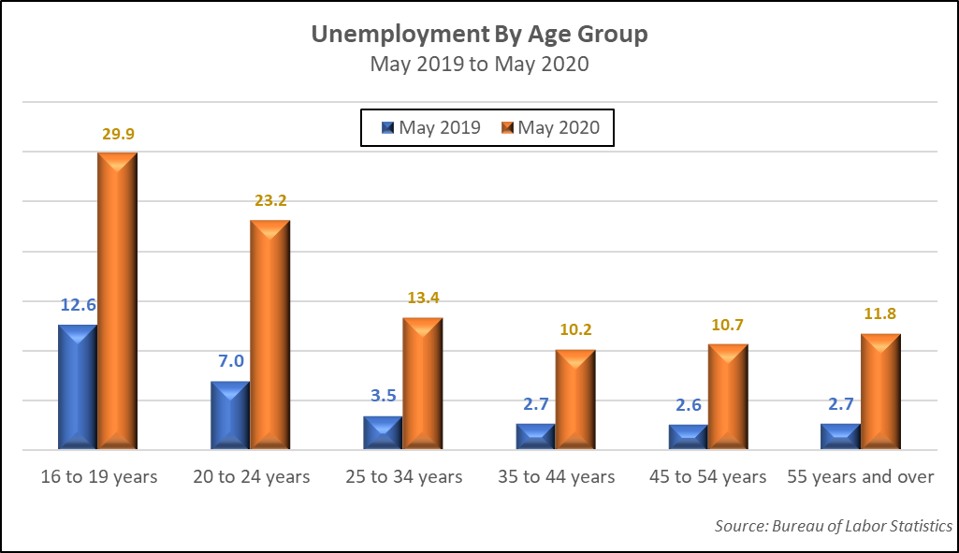
The greatest rise in unemployment is among workers under age 25. This is likely due to three factors. Younger workers typically have fewer marketable skills, less work experience, and less seniority. Many of these workers are in industries that have felt the greatest pain. Unemployment rates by age group are contained in the following chart.

Unemployment by Age Group-May 2019 to May 2020

Unemployment by Race/Ethnicity

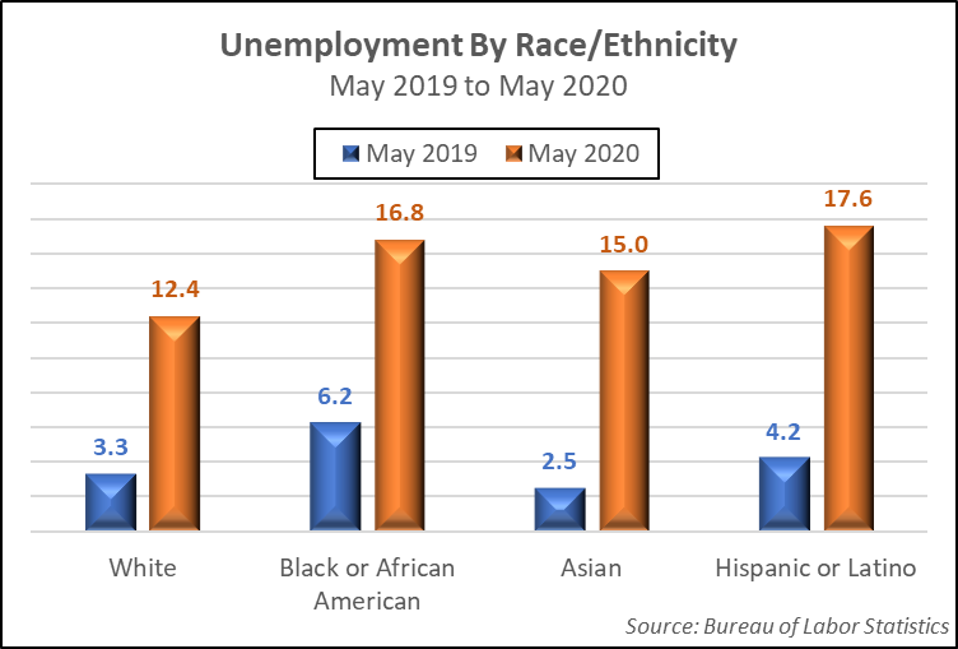
Question: Prior to Covid-19, was unemployment among blacks / African Americans at a record low as President Trump has claimed? Using the available data, which extends back to January 1972, the answer is yes. This new record low was achieved in October and November of 2019 when unemployment among black or African American workers fell to 5.1%. The previous record low was 5.2% in December 1973. The current rate is 16.8%, which is less than the highest rate of 20.7% logged in December 1982. The most recent high in unemployment for this group was 19.3% in March 2010. It has been steadily declining since then. Numbers for White, Asian, and Hispanic or Latino and black or African American workers are listed in the following chart.

Unemployment by Race or Ethnicity-May 2019 to May 2020

Businesses need workers, workers need businesses, and both depend on customers. Since the pandemic began, consumer demand has fallen sharply. With the probability that a vaccine will not be available until early 2021 at the soonest, plus a disregard for recommended safety protocols by many individuals, namely wearing masks and social distancing, it is highly unlikely that the economy will return to normal for several years.

Will the president continue to hold rallies? Will he set an example by wearing a mask? Will the protests and violence continue? Will other large gatherings continue? Unless Americans make a collective and conscious choice to mask up and social distance, we will be forced to live in a depressed economy for longer than necessary. The choice is up to us.


Fauci testifies new coronavirus cases could ‘go up to 100,000 a day if this does not turn around’

https://www.washingtonpost.com/nation/2020/06/30/coronavirus-live-updates-us/?utm_campaign=wp_post_most&utm_medium=email&utm_source=newsletter&wpisrc=nl_most

Coronavirus update: Fauci testifies new U.S. cases could 'go up to ...

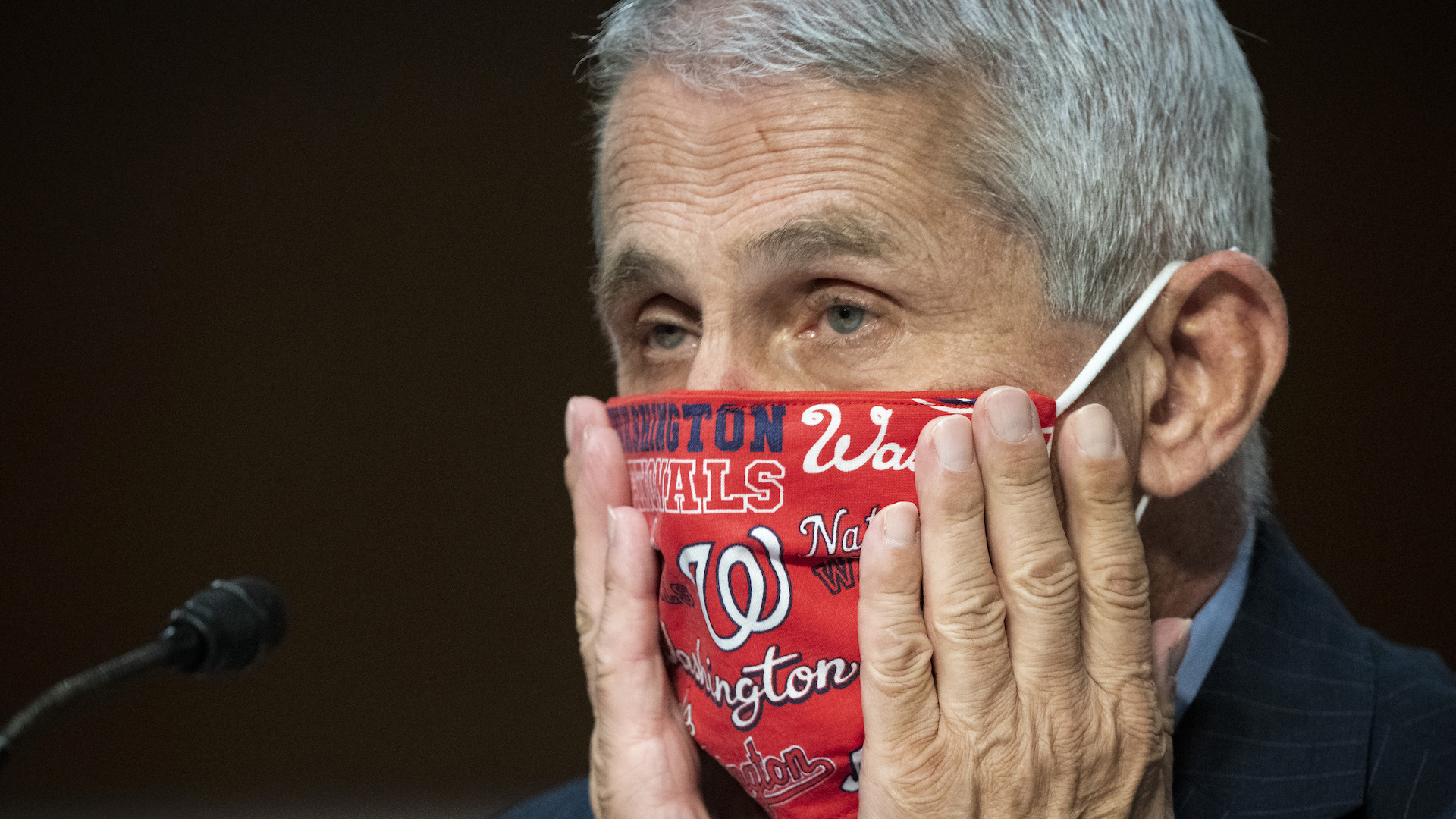
Anthony S. Fauci, the nation’s top infectious-diseases expert, gave a dire warning Tuesday in a Senate committee hearing held as coronavirus infections surge in many parts of the United States.

“We are now having 40-plus thousand new cases a day. I would not be surprised if we go up to 100,000 a day if this does not turn around. And so I am very concerned,” Fauci said in response to questioning from Sen. Elizabeth Warren (D-Mass.) on what the overall U.S. death toll is likely to be.

While the U.S. wrestles with safely reopening, the European Union confirmed Americans will not be allowed to travel to the bloc of 27 countries when it reopens to some foreign travel Wednesday. The United States is leading the world in both officially confirmed infections and fatalities as it continues to see surges in new cases, hospitalizations and deaths in many states.

Nearly 10.3 million coronavirus cases have been detected worldwide, with roughly 2.6 million infections reported in the United States. At least 124,000 people have died of covid-19 in the United States, and the global death count is hovering near 505,000.

Here are some significant developments:

  • Former vice president and presumptive Democratic presidential nominee Joe Biden said during a speech that President Trump ‘failed’ Americans in his response to the coronavirus pandemic. Biden also released a plan to combat the virus: beefed-up testing and contacting tracing, using the Defense Production Act and organizing a global, coordinated approach for treatment and vaccines.
  • More Republican leaders advocated for the use of face masks in public, including House Minority Leader Kevin McCarthy (Calif.) — who encouraged President Trump to don one — and Senate Majority Leader Mitch McConnell. In addition, Health and Human Services Secretary Alex Azar said the rise in cases can be stopped if Americans wear facial coverings in public, along with practicing social distancing and proper personal hygiene.
  • Social distancing will not be enforced July 3 at the Mount Rushmore fireworks display that Trump will attend, South Dakota Gov. Kristi L. Noem (R) said Monday. Noem also said masks will be provided to the 7,500 participants, but they will not be required to wear them.
  • The number of people hospitalized for covid-19 is surging in seven states, according to data tracked by The Washington Post. In Texas, Arizona, Nevada, South Carolina, Montana, Georgia and California, seven-day averages are up at least 25 percent from last week.
  • Chinese researchers announced the discovery of a new strain of swine flu among workers at a slaughterhouse and warned it should be monitored in case human-to-human transmission starts.


Short-term ‘junk’ plans widely discriminate against those with pre-existing conditions, House probe finds

https://www.healthcaredive.com/news/short-term-junk-plans-widely-discriminate-against-those-with-pre-existing/580556/

U.S. Rep. Castor's Statement Following a Federal Judge's Ruling on ...

Dive Brief:

  • A yearlong probe by the House Committee on Energy and Commerce into bare-bones insurance plans encouraged by the Trump administration found widespread discrimination against people with pre-existing conditions, even as a growing number are enrolled.
  • Top congressional Democrats investigated eight insurers selling short-term, limited duration plans, finding they all denied medical care claims if they found a consumer had a pre-existing condition. Some refused to pay for medical claims for no discernable reason, processing them only after consumers sued or complained to state regulators. Most rescinded coverage if they determined a member had a pre-existing condition or developed one later.
  • An HHS spokesperson defended the coverage as an affordable option to pricier Affordable Care Act plans, telling Healthcare Dive, “We’ve been abundantly clear that these plans aren’t for everyone.” America’s Health Insurance Plans made similar points, with spokesperson David Allen noting: “For Americans with pre-existing conditions, they may not be protected at all.”


Dive Insight:

The investigation looked at 14 companies that sell or market the plans, including eight insurers such as market giants Anthem and UnitedHealth Group, and six brokers.

It found insurers frequently turned down consumers with pre-existing conditions and discriminated against women, turning down applicants who were pregnant or planning to become pregnant and charging women more than men for the same coverage.

The plans had significant coverage limitations. Some excluded routine care like basic preventive visits and pelvic exams. Some plans had hard coverage cutoffs that left consumers with massive medical bills.

In one case, a consumer was billed a whopping $280,000 and lost coverage after being treated for an infection. The insurer said the patient previously had gotten an ultrasound that was “suspicious for deep venous thrombosis.”

AHIP spokesman Allen said it is not surprising given the plans are not intended to replace comprehensive coverage.

“They often do not cover the care and treatments that patients need throughout the year — preventive care, prescription drugs, mental health care or treatments for chronic health conditions — or if they do, they may limit or cap the benefits,” he acknowledged.

On average, short-term plans spend less than half of premium dollars collected from consumers on medical care: only 48%, the investigation found. That’s in stark contrast to plans in the ACA’s individual market, which are required to shell out at least 80% of all premium dollars on claims and benefits.

Short-term insurance represents a significant and growing share of the individual healthcare market. Roughly 3 million consumers bought the plans in 2019, a 27% growth from 2018, the investigation launched in March last year found.

The growth came after the Trump administration, in a controversial move, extended the maximum duration of the plans. The skimpy coverage, which isn’t required to cover the 10 essential benefits under the ACA, was originally designed as cheap safety net coverage for three months.

But in August 2018, HHS expanded the plans to 12 months, with a three year renewal period, and opened them up to all consumers, not just for those who can’t afford other coverage.

ACA supporters and patient advocates blasted the move, which sparked an ongoing legal challenge from safety net providers. Reports of consumers purchasing the coverage, believing it was comprehensive, then being shocked by balance bills prompted the House investigation.

The report also found brokers are paid up to 10 times more compensation for peddling short-term plans than ACA-compliant coverage. The average commission rate for short-term plans compared to ACA plans was 23% versus 2%, respectively.

Currently, 24 states ban or restrict the sale of short-term plans. Some states, including California, Massachusetts, New Jersey and New York, prohibit their sale entirely, while others like Colorado, Connecticut, New Mexico and Rhode Island have such strict regulations that no plans are sold.

Democratic leaders unveiled a bill on Wednesday to bolster the ACA and rescind the administration’s expansion of the plans and expand subsidies, allowing more people to qualify for coverage.

The effort has zero chance of moving this year with Republicans in control of the Senate, but both it and the probe are likely to play into the looming 2020 presidential and congressional elections.

“The heavy-handed tactics uncovered in this investigation demonstrate why Congress must reverse the Trump Administration’s expansion of these junk plans,” E&C Chairman Frank Pallone, D-N.J., Health Subcommittee Chairwoman Anna Eshoo, D-Calif., and Oversight and Investigations Subcommittee Chair Diana DeGette, D-Colo., wrote in a joint statement. “It also shows how dangerous a post-ACA world would be if Republican Attorneys General and the Trump Administration are successful in striking down the law and its protections.”

That lawsuit, led by 18 red states, argues the ACA, which expanded insurance to some 20 million people, is unconstitutional because a tax bill passed in 2017 zeroed out the penalty for its individual mandate. It’s currently pending before the U.S. Supreme Court.

President Donald Trump and his health officials have repeatedly promised people with pre-existing conditions will be protected if the ACA is struck down, but neither the administration nor Republicans in Congress have said specifically how.


Nonprofit health systems — despite huge cash reserves — get billions in CARES funding

https://www.healthcaredive.com/news/nonprofit-health-systems-despite-huge-cash-reserves-get-billions-in-car/580078/

CLICK ON LINK ABOVE FOR ACCESS TO GRAPHICS
Next Steps for Public Policy | Cato Institute

Healthcare Dive’s findings revive concerns that greater examination of hospital finances is needed before divvying up COVID-19 rescue funding allocated by Congress.
The nation’s largest nonprofit health systems, led by Kaiser Permanente, Ascension and Providence, have received more than $7.1 billion in bailout funds from the federal government so far, as the novel coronavirus forced them to all but shutter their most profitable business lines.

At the same time, some of these same behemoth systems sit on billions in cash, and even greater amounts when taking into account investments that can be liquidated over time. That raises questions about how much money these systems actually need from the federal government given they have hundreds of days worth of cash on hand. Indeed, some big systems, like Kaiser Permanente, are already returning some of the funds.

And it revives concerns that greater examination of hospital finances is needed before divvying up rescue packages.

Nonprofits with more cash and greater net income tend to have received less funding — but not always

This is the second story of a Healthcare Dive series examining the bailout funds health systems received amid the COVID-19 pandemic. In this report, we focus on the 20 largest nonprofits by revenue and the amount of Coronavirus Aid, Relief, and Economic Security (CARES) Act funding they have received compared to the amount of cash on hand and recent financial performance. Healthcare Dive used bond filings filed as of June 12 to compile the amount of CARES funding received by health systems. In some instances, we relied on data from Good Jobs First, which also tracks the money. In addition to bond filings, we relied on annual audited financial statements and analyst reports to compile financial performance and days cash on hand.

Cash reserves

The cash hospitals have on hand has become an important metric to watch over the past few months as many have seen reserves dwindle to pay everyday expenses as revenue has dried up. At the same time, hospital volumes have plunged due to the economy grinding to a halt.

“You can’t write a payroll check off of accounts receivables, you have to write it off your cash and cash equivalents.” Rick Gundling, senior vice president of healthcare financial practices for Healthcare Financial Management Association, told Healthcare Dive.

In the early days of the outbreak in the U.S., some hospital executives sounded the alarm over dire financial straits, particularly small, rural hospitals whose executives warned they were weeks away from not making payroll. These pleas helped push Congress to pass massive rescue packages, with providers earmarked for $175 billion thus far.

Nonprofit health systems tend to keep more cash on hand than publicly-traded hospital chains. That’s because investor-owned facilities can raise capital more quickly, mainly through the stock market, while nonprofits have to rely on the bond market and their own operations, Gundling said.

Another important avenue that can boost cash is investments. It’s common for large nonprofits to rake in more in net income than they do from their core operations of running hospitals and caring for patients, in large part due to their investments in the stock market.

For example, Chicago-based CommonSpirit posted an operating loss of $602 million during its fiscal year 2019 but net income far exceeded that, totaling $9 billion. It was buoyed by investments and its recent merger, bringing together Catholic Health Initiatives and Dignity Health, according to its audited financial statement for the year ended June 30, 2019.

Many nonprofit health systems rake in more in net income than they do from their core operations

Ascension, the second-largest nonprofit system, received about $492 million in CARES funding, according to Good Jobs First. Ascension reported having 231 days cash on hand. Its unrestricted cash and investments totaled a sum of $15.5 billion as of March 31.

Kaiser, the nation’s largest nonprofit system, has about 200 days of cash on hand as of its fiscal year end, Dec. 31, according to a recent report from Fitch Ratings.

Providence, the third-largest nonprofit and first U.S. health system to treat a COVID-19 patient, reported 182 days of cash on hand as of March 31, according to a May bond filing.

However, Cleveland Clinic has the most cash on hand when measured in days among the top 20 nonprofits.

Cleveland Clinic had 337 days of cash on hand at the end of March, according to an unaudited financial statement from May. That’s nearly an entire year’s worth of operating expenses. The system has received $199 million in CARES funding, according to that same filing.

Rochester, Minnesota-based Mayo Clinic had the second most days of cash on hand with 252. Mayo Clinic has received $220 million in grant money, according to a May financial filing.

“You would never see that much cash on an investor-owned hospital,” Gundling said. “Generally, they want to pour that cash back into the services,” he said.

NYC Health + Hospitals, also the nation’s largest municipal health system, had the fewest days of cash on hand and it received $745 million in CARES funding, the second-most compared to other systems.

How health systems’ funding and cash on hand compare

Samantha Liss (@samanthann) | Twitter

Risks of accepting bailout money

Sitting on a pile of money and accepting the bailout funds is already raising eyebrows.

“There is significant headline risk,” Michael Abrams, co-founder and partner at Numerof & Associates, told Healthcare Dive.

Worried about the optics, other institutions with considerable reserves or endowments have returned federal bailout funds, including Harvard University and major health insurers.

Providers are returning relief funds, too. Kaiser Permanente, the nation’s largest nonprofit by revenue, told the San Francisco Business Times it has returned more than $500 million in CARES funding. CEO Greg Adams the system “will do fine” despite the setback from the pandemic.

Mara McDermott, vice president of McDermott+Consulting, agrees there is a risk in accepting the grant money if systems possess such large reserves. Yet, she also cautioned that the healthcare ecosystem is so much more complicated.

“Regardless of the structure, it requires a deeper dive into need and that’s not what HHS did. They just wrote checks,” McDermott told Healthcare Dive.

Just because a parent company has a large cash reserve, it doesn’t mean that the money is readily available on a daily basis to a smaller practice it may own down the chain and one that hasn’t had any patients since March, she said.

“It’s easy to point the finger… but it’s much more complex than that,” she said.

The first tranche of money HHS sent to hospitals was based on Medicare fee-for-service business, and later on net patient service revenue. These formulas were criticized for putting some hospitals at an advantage compared to others, particularly those with larger shares of Medicaid patients. HHS has since released more targeted funding for providers in hot spots such as New York and plans to funnel funding to those serving a large share of Medicaid members in an attempt to address earlier concerns.

Still, without certainty of how long this public health crisis will last, no one knows how much cash on hand will ultimately be enough.

“A year’s cash on hand sounds like a lot of money but when you expend hundreds of millions of dollars a month, it won’t take you long to burn through that,” Scott Graham, CEO of Three Rivers Hospital, a 25-bed facility in rural Washington state, told Healthcare Dive.

Graham had feared in March that without quick intervention from the government, his hospital was near closure with just a few weeks cash on hand. The federal grant money has bought his hospital some time, about six months if volumes stay where they are, longer if they tick back up.

“I think what HHS did was right at the moment because we needed to ensure that the healthcare system survived this. It’s one thing for a small rural hospital to close, it’s another thing for the entire health system to collapse,” he said.


Primary care physicians could take $15 billion hit due to COVID-19 in 2020

https://www.healthcaredive.com/news/primary-care-physicians-could-take-15-billion-hit-due-to-covid-19-in-2020/580600/

Dive Brief:

  • The financial impact on primary care practices due to the COVID-19 pandemic has been profound and will likely continue in the months ahead, according to a new study published in Health Affairs.
  • Visits of all types to medical practices declined 58% in March and April compared to the baseline average, and in-person patient encounters declined by 69%, the study found. Although visits are expected to have rebounded by June, volumes are still below pre-COVID-19 levels.
  • The drop in fee-for-service revenue for the 2020 calendar year is nearly $68,000 per physician, contributing to an estimated revenue decline of 12.5%. That’s a steep enough loss to threaten the financial viability of many practices. Losses to primary care practices nationwide could top $15 billion over the year — a number that could grow if the federal government reverts increased telemedicine payment rates.

Dive Insight:

Medical practices across the United States have been hit hard by the COVID-19 outbreak.

The new study by researchers from Harvard Medical School and the American Board of Family Medicine attempts to put a price tag on that hit by running a microsimulation for projected 2020 revenues based on volume data for general practices, general internal medicine practices, general pediatric practices and family medicine practices.

As a result, they concluded that the average revenue loss per practice per physician will be $67,774, even taking into account revenue generated by telemedicine visits, which did not make up for the massive loss of patient volume during the spring.

That loss could be cut to as little as $28,265 per full-time physician if other staff is furloughed and salaries are cut to the 25th percentile of such cuts that took place during the peak of the stay-at-home orders.

Some practices are also projected to have steeper losses. Rural primary care practices are projected to lose $75,274 per physician. Other studies have suggested that pediatric practices have been hit harder than other primary care fields. Some organizations, such as the American Medical Group Association, say revenue won’t rebound fully even next year.

The study also conducted various alternate scenarios for the remainder of 2020, including a second wave of COVID-19 in the fall. The researchers estimated that would cut patient volumes by about half as much as what occurred during the spring. However, the financial hit would deepen even further, reaching $85,666 per physician.

Altogether, the study projects primary care practices will lose $15.1 billion in fee-for-service revenue this year, not even accounting for a second wave of the coronavirus. The study’s authors note that “this loss would balloon substantially if telemedicine payment rates revert back to pre-COVID-19 levels towards the end of the year.”

The study concluded that while primary care physicians as a whole have not been as hard hit as the hospital sector, the services they provide in managing chronic diseases such as diabetes and as the port of entry for many into the healthcare system makes them too valuable to suffer sustained levels of financial damage.


As Americans lose job-based coverage, ACA marketplace sets record with near 500K signups

https://www.healthcaredive.com/news/as-americans-lose-job-based-coverage-aca-marketplace-sets-record-with-near/580623/

Dive Brief:

  • Millions of individuals have lost their jobs as a result of the pandemic, allowing them to enroll in Affordable Care Act marketplace coverage via Healthcare.gov due to their special circumstances. CMS said this week that this special enrollment coverage due to job loss specifically has reached a record, with about 487,000 consumers gaining coverage, a 46% increase compared with the same time last year.
  • April saw the biggest jump in enrollment following job loss, an increase of 139% compared to April of last year.
  • Due to a number of factors, CMS said it “remains unclear how many people will eventually look to Exchanges using HealthCare.gov to replace job-based coverage.”

Dive Insight:

The pandemic has battered the economy, causing historic levels of unemployment. For many Americans, healthcare coverage is tethered to their jobs. As such, the pandemic is not only a threat to Americans’ health but their ability to pay for the care they need, sick with COVID-19 or not.

As many as 27 million Americans may have lost job-based coverage between March and May of this year, according to a recent analysis from the Kaiser Family Foundation. 

Of the newly uninsured, about half (12.7 million) would be eligible for Medicaid coverage, according to Kaiser’s estimates. There are a few options for workers out of a job and insurance. They can opt to extend their coverage through COBRA, enroll in coverage through the exchanges, or check to see if they qualify for Medicaid.

This week, CMS attempted to quantify just how many out-of-work Americans were turning to the exchanges.

About 500,000 out-of-work consumers enrolled in coverage so far this year. However, there are other life events that qualify a consumer to shop for coverage during a special enrollment period. Overall, special enrollment period sign-ups garnered more than 890,000 enrollees, dwarfing other periods. 

If the trend continues, it may fuel a significant shift in health insurance. For years, a majority have received commercial coverage through work. Even health insurers recognize disruption is on the horizon.

Many of the nation’s largest insurers are bracing for a shift from their commercial book of business to covering more Medicaid enrollees through their contracts with states. Earlier this year, Molina, Centene and Anthem all said they expect upticks in their Medicaid membership and exchange products.

Molina executives said in April they already saw 30,000 more Medicaid members from the prior-year period.