Retail wages are rising. Can hospital pay keep up?

While healthcare workers battle burnout, hospitals have been ramping up wages and other benefits to recruit and retain workers. It has created a culture of competition among health systems as well as travel agencies that offer considerably higher pay.

But other healthcare organizations are not hospitals’ only competitors. Some hospitals, particularly those in rural areas, are struggling to match rising employee pay among nonindustry employers such as Target and Walmart.

“We monitor and we’ve been looking and we ask around in the community and we can ask who’s paying what,” Troy Bruntz, CEO of Community Hospital in McCook, Neb., told Becker’s. “So we know where Walmart is on different things, and we’re OK. But if Walmart tried to match what Target’s doing, that would not be good.”

At Target, the hourly starting wage now ranges from $15-$24. The organization is making a $300 million investment total to boost wages and benefits, including health plans. Starting pay is dependent on the job, the market and local wage data, according to NPR.

Walmart raised the hourly wages for 565,000 workers in 2021 by at least $1 an hour, The New York Times reported. The company’s average hourly wage is $16.40, with the lowest being $12 and the highest being $17.

Meanwhile, Costco raised its minimum wage to $17 an hour, according to NPR. The federal minimum wage is $7.25.

Estimated employment for healthcare practitioners and technical occupations is 8.8 million, according to the latest data released March 31 by the U.S. Bureau of Labor Statistics. This includes nurse practitioners, physicians, registered nurses, physician assistants and respiratory therapists, among others. 

In sales and related occupations, estimated employment is 13.3 million, according to the bureau. This includes retail salespersons, cashiers and first-line supervisors of retail salespersons, among others.  

While retail companies up their wages, at least one hospital CEO is monitoring the issue.

Healthcare leaders weigh their options

Mr. Bruntz said rising wages among retailers is an issue his organization monitors. Although Target does not have a store in McCook, there is a Walmart, where pay is increasing.

“I was quoted a few months ago saying Walmart was approaching $15 an hour, and we can handle that,” Mr. Bruntz said. “But when it gets to $20 or $25, it’s going to be an issue.”

He also said he cannot solely increase the wages of the people making less than $15 or less than $25 because he has to be fair in terms of wages for different types of roles.

Specifically, he said he is concerned about what matching rising wages at retailers would mean for labor expenses, which make up about half of the hospital’s cost structure.

“I double that half, that’s 25 percent more expenses instantly,” Mr. Bruntz said. “And how is that going to ratchet to a bottom line anything less than a massive negative number? So it’s a huge problem.”

Clinical positions are not the only ones hospitals and health systems are struggling to fill; they are encountering similar difficulties with technicians and food service workers. Regarding these roles, competition from industries outside healthcare is particularly challenging.

This is an issue Patrice Weiss, MD, executive vice president and chief medical officer of Roanoke, Va.-based Carilion Clinic, addressed during a Becker’s panel discussion April 4. The organization saw workforce issues not just in its clinical staff, but among environmental services staff.

“When you look at what … even fast food restaurants were offering to pay per hour, well gosh, those hours are a whole lot better,” she said during the panel discussion. “There’s no exposure. You’re not walking into a building where there’s an infectious disease or patients with pandemics are being admitted.” 

Amid workforce challenges, Community Hospital is elevating its recruitment and retention efforts.

Mr. Bruntz touted the hospital as a hard place to leave because of the culture while acknowledging the monetary efforts his organization is making to keep staff.

He said the hospital has a retention program where full-time employees get a bonus amount if they are at the employer on Dec. 31 and have been there at least since April 15. Part-time workers are also eligible for a bonus, though a lesser amount.

“It also encourages staff [who work on an as-needed basis] to go part-time or full-time, and [those who are] part-time to go full-time,” Mr. Bruntz said. “That’s another thing we’re doing is higher amounts for higher status to encourage that trend.” 

Additionally, Community Hospital, which has 330 employees, offers a referral bonus to staff to encourage people they know to come work with them. 

“We want staff to bring people they like. [We are] encouraging staff to be their own ambassadors for filling positions,” Mr. Bruntz said.  

He said the hospital also will offer employees a sizable market wage adjustment not because of competition from Walmart but because of inflation.

Graham County Hospital in Hill City, Kan., is also affected by the tight labor market, although it has not experienced much competition with retail companies, CEO Melissa Atkins told Becker’s. However, the hospital is struggling with competition from other healthcare organizations, particularly when it comes to patient care departments and nursing. While many hospitals have struggled to retain employees from travel agencies, Graham County Hospital has mostly been able to avoid it.

“As the demand increases, so does the wage,” Ms. Atkins said. “In addition to other hospitals offering sign-on bonuses and increased wages, nurse agency companies are offering higher wages for traveling nurse aides and nurses. We are extremely fortunate in that we have not had to use agency nurses. Our current staff has stepped up and filled in the shortages [with additional incentive pay].”

To combat this trend, the hospital has increased hourly wages and shift differentials, as many healthcare organizations have done. It has also provided bonuses using COVID-19 relief funds.

Overall, Mr. Bruntz said he prefers “not to get into an arms race with wages” among nonindustry competitors. 

“It’s not going to end well for anybody. We prefer not to use that,” he said. “At the same time, we’re trying to do as much as possible without being in a full arms race. But if Walmart started paying $25 for a door greeter and cashier, we would have to reassess.”

Private equity-backed buyouts have physicians concerned

The Federal Trade Commission and the Justice Department are seeking comments on ways merger guidelines should be updated, and physicians are raising concerns about private equity-backed buyouts of provider practices. 

The FTC and the Justice Department announced in January that they’re seeking to revamp merger guidelines for businesses. Comments on how to “modernize the merger guidelines to better detect and prevent anticompetitive deals,” can be submitted to the agencies through April 21. 

Comments are pouring in from physicians. Many of the comments are anonymous, but the commenters self-identify as physicians. 

The physicians’ top concern are private equity-backed buyouts, according to an analysis by Law360. They’re also concerned by the profit-first attitude of healthcare and consolidation in the industry, according to the report. 

The commenters raised many concerns with private equity groups, saying theyput profits over patients” and “stifle the voices of physicians.”

The comments are coming in as private equity firms continue to buy up physician practices. 

Private equity firms acquired 59 physician practices in 2013, and that number increased to 136 practices by 2016, according to a research letter published in JAMA

Is it the beginning of the end of CON? 

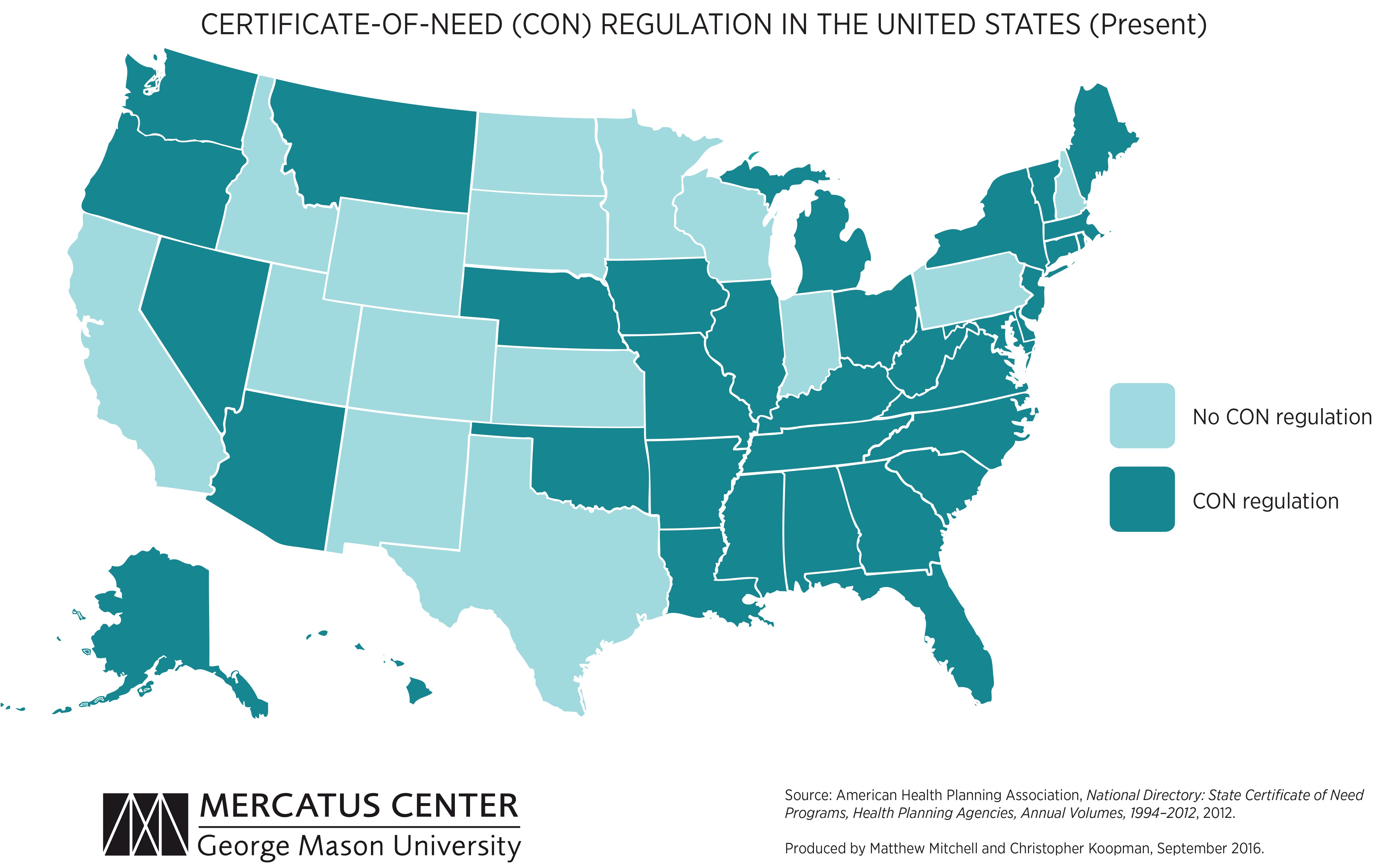
We’re picking up on a growing concern among health system leaders that many states with “certificate of need” (CON) laws in effect are on the cusp of repealing them. CON laws, currently in place in 35 states and the District of Columbia, require organizations that want to construct new or expand existing healthcare facilities to demonstrate community need for the additional capacity, and to obtain approval from state regulatory agencies. While the intent of these laws is to prevent duplicative capacity, reduce unnecessary utilization, and control cost growth, critics claim that CON requirements reduce competition—and free market-minded state legislators, particularly in the South and Midwest, have made them a target. 
 
One of our member systems located in a state where repeal is being debated asked us to facilitate a scenario planning session around CON repeal with system and physician leaders. Executives predicted that key specialty physician groups would quickly move to build their own ambulatory surgery centers, accelerating shift of surgical volume away from the hospital.

The opportunity to expand outpatient procedure and long-term care capacity would also fuel investment from private equity, which have already been picking up in the market. An out-of-market health system might look to build microhospitals, or even a full-service inpatient facility, which would be even more disruptive.

CON repeal wasn’t all downside, however; the team identified adjacent markets they would look to enter as well. The takeaway from our exercise: in addition to the traditional response of flexing lobbying influence to shape legislative change, the system must begin to deliver solutions to consumers that are comprehensive, convenient, and competitively priced—the kind of offerings that might flood the market if CON laws were lifted. 

Even the largest health systems dwarfed by industry giants

https://mailchi.mp/f6328d2acfe2/the-weekly-gist-the-grizzly-bear-conflict-manager-edition?e=d1e747d2d8

Insurers, retailers, and other healthcare companies vastly exceed health system scale, dwarfing even the largest hospital systems. The graphic above illustrates how the largest “mega-systems” lag other healthcare industry giants, in terms of gross annual revenue. 

Amazon and Walmart, retail behemoths that continue to elbow into the healthcare space, posted 2021 revenue that more than quintuples that of the largest health system, Kaiser Permanente. The largest health systems reported increased year-over-year revenue in 2021, largely driven by higher volumes, as elective procedures recovered from the previous year’s dip.

However, according to a recent Kaufman Hall report, while health systems, on average, grew topline revenue by 15 percent year-over-year, they face rising expenses, and have yet to return to pre-pandemic operating margins. 

Meanwhile, the larger companies depicted above, including Walmart, Amazon, CVS Health, and UnitedHealth Group, are emerging from the pandemic in a position of financial strength, and continue to double down on vertical integration strategies, configuring an array of healthcare assets into platform businesses focused on delivering value directly to consumers.

Higher prices correlated with lower mortality in competitive hospital markets

https://mailchi.mp/f6328d2acfe2/the-weekly-gist-the-grizzly-bear-conflict-manager-edition?e=d1e747d2d8

A National Bureau of Economic Research working paper found that higher-priced hospitals in competitive markets were associated with lower patient mortality—flying in the face of the common policy narrative that higher-priced care is not higher quality. However, in more concentrated, less-competitive healthcare markets (in which over two-thirds of the nation’s hospitals are located), the study found no correlation between price and quality. Authors of the study analyzed patient outcomes from more than 200K admissions among commercially insured patients, transported by ambulance to about 1,800 hospitals between 2007 and 2014.   

The Gist: As hospitals have consolidated, prices have risen by about 30 percent between 2015 to 2019, leading policy experts and regulators to search for ways to rein in price inflation. 

While there continues to be widespread consensus that industry consolidation has resulted in unsustainable cost growth, the new study’s findings bring a bit of welcome nuance around impact on quality and outcomes to an otherwise one-sided, price-centric policy narrative.

Can the F.T.C. Spur Healthcare Reform?

“Follow the money,” was the advice of Deep Throat to the Watergate journalists. But now, new Federal Trade Commission Chair Lina Khan says that’s not enough when analyzing monopolies in both healthcare and rest of the economy. Follow the algorithms and follow the power, too, not just the money.

We all know how monopolies harm consumers with higher prices. But monopolies and powerful corporations cause harm in other ways. Some examples:

Not all of these examples are linked directly to potentially illegal anticompetitive activities. But all are linked to the exercise of insufficiently checked corporate power. Commissioner Khan has signaled that she will consider such harms when analyzing mergers and other potentially anticompetitive activities.

This expanded view of anticompetitive harm is a departure from Robert Bork’s more narrow approach to antitrust enforcement taken by the F.T.C. since publication of Bork’s 1978 book The Antitrust Paradox. Bork noted that in many cases, mergers resulted in economies of scale that lowered prices for consumers. By his standard, such mergers were permissible as benefiting the consumer.

But now Commissioner Khan – and others like-minded theorists called neo-Brandeisians – point to the other harmful effects beyond the seeming benefit of lower prices. For example, the flip-side of a monopoly’s position as seller is its monopsony as a purchaser of labor. If there is only one big potential employer, workers do not have a competitive labor market, depressing their bargaining power and wages. In the digital economy there is also potential jeopardy to data privacy and security, and coercion to use certain digital products. Think the teenage girls on Instagram.

Employees of a single powerful employer are also inhibited from rocking the boat with innovations, critiques, or whistleblowing. This enervates a truly competitive marketplace.

Commissioner Khan views the antitrust issue not as being one of bigness but rather of power, power that reduces true competition. Beyond merely looking at prices, she seeks to identify and quantify the other elements of power and competition.

This blog has implicated healthcare monopolies as one direct cause of relentless increases in spending. It has also embraced the view of Steven Brill that “over the last five decades a new ‘best and brightest’ meritocracy rigged not only healthcare, but also the entire American financial, legal, and political system to build ‘moats’ of protection to perpetuate their wealth and power.

Commissioner Khan is now highlighting a key mechanism – anticompetitive political and financial power — by which healthcare corporations rig healthcare and by which other corporations have blocked reform in pursuit of short-sighted profits. She summarizes the remedy:

If you allow unfettered monopoly power to concentrate, its power can rival that of the state., right? And historically, the antitrust laws have a rich tradition and rich history, and a key goal was to ensure that our commercial sphere was characterized by the same types of checks and balances and protections against concentration of economic power that we had set up in our political and governance sphere. And so the desire to kind of check those types of concentrations of power, I think, is deep in the American tradition.

This blog thinks she is on the right track. Because healthcare reform is in the public interest and must be pursued even in the face of powerful special interests.

Take Action

Now, take action.

Department of Justice (DOJ) files suit to block UnitedHealth Group (UHG)’s $13B acquisition of Change Healthcare

https://mailchi.mp/7788648545f0/the-weekly-gist-february-25-2022?e=d1e747d2d8

DOJ alleges that allowing UHG’s Optum subsidiary to acquire Change, a direct competitor used by most large commercial insurers for healthcare claims solutions, would give UHG 75 percent of the healthcare claims processing and management market. This would significantly reduce competition, the DOJ claims, while simultaneously giving UHG access to its competitors’ sensitive plan design and pricing information. UHG called the DOJ’s position ‘deeply flawed’ and promised to fight the case. 

The Gist: This is the second big move by antitrust regulators in a week to put the brakes on consolidation in healthcare: shortly after the DOJ sued to block Rhode Island’s two largest health systems, Care New England and Lifespan, from merging, those systems abandoned plans to combine. 

We are seeing the first real signs that the Biden administration is following through on plans to more closely scrutinize healthcare deals, including payer-led vertical integration. For both payers and providers, increased scrutiny will place a premium on the consumer value proposition of any combination—and force merging companies to deliver on the benefits of scale. 

FTC sues to block Rhode Island’s largest health systems from merging

Dive Brief:

  • The Federal Trade Commission is suing to block Rhode Island’s two largest health systems from merging, alleging the tie-up between Lifespan and Care New England would increase prices and diminish the quality of care.
  • In the state’s own review, Rhode Island’s attorney general said the union would result in “extraordinary market power” and denied the merger application under state law that requires a review of such tie-ups. Rhode Island’s attorney general will join FTC’s federal lawsuit seeking to block the deal.
  • The FTC alleges that, together, Lifespan and Care New England would control at least 70% of Rhode Island’s market for inpatient hospital services and also reduce competition in several nearby Massachusetts communities.

Dive Insight:

The union between Lifespan, the state’s largest health system, and Care New England, the second largest, quickly raised alarms in Rhode Island.

A 25-page report from the state’s insurance department found that the merger would “significantly alter” the state’s healthcare market, which currently enjoys a “relatively competitive” market. State regulators were also concerned about the control the new system would have over physician services. Given these risks, the state insurance commissioner proposed a set of conditions on the deal including price caps. Health system executives were open to working under certain conditions.

However, executives seemed surprise by Thursday’s announcement that the deal to create an integrated academic medical system with Brown University at the forefront would be blocked.

“On four separate occasions in prior years, the FTC reviewed the same proposed merger and allowed it to proceed,” a joint statement released Thursday said. The management teams said they offered up 30 conditions to regulators to satisfy antitrust concerns about the merger, “but neither the FTC or the AG ever discussed these conditions or others with the two systems prior to today’s decisions,” according to the statement.

After flirting with the idea of combining the systems for years, Lifespan and Care New England inked a deal to merge last February after the coronavirus pandemic revived talks.

The two touted the deal as a way to create an integrated academic health system with Brown University’s medical school in a central role. Brown University committed $125 million to the creation of the new system.

However, FTC commissioners voted unanimously to block the union over concerns it would extinguish competition between the two.

And although regulators have long leaned on the argument that hospital mergers lead to higher prices, a joint letter from FTC Chair Lina Khan and Commissioner Rebecca Kelly Slaughter points to the harmful effects consolidation has on labor markets, an argument growing in importance within the agency

“Just as we want firms to compete with each other to sell goods and services to their customers, we want employers to compete with each other to attract and retain workers,” the letter states. “Indeed, there is a growing body of empirical research about the potential for competitive harm to labor markets from consolidation and concentration.”

The news follows reports that the Department of Justice is preparing to sue to stop UnitedHealth Group’s blockbuster acquisition of Change Healthcare, a healthcare technology firm. Concerned about the “massive consolidation” of healthcare data, the American Hospital Association urged antitrust regulators to thoroughly examine the proposed transaction in a letter sent to DOJ last spring.

After taking office, President Joe Biden has signaled his administration would take an aggressive antitrust stance, including getting tough on hospital mergers. Last summer, the president issued an executive order that called on antitrust regulators to “review and revise” merger guidelines to ensure patients are not harmed by proposed deals.

Biden specifically called out the healthcare industry, rife with consolidation and accompanying research that shows hospital unions lead to higher prices.

“Thanks to unchecked mergers, the ten largest healthcare systems now control a quarter of the market,” the release from the White House said.

Still, the FTC has become overwhelmed by the sheer number of proposed transactions. In August, the agency said it was hit by a “tidal wave” of merger filings and warned applicants it may not vet all submissions before the applicable deadlines. But in letters sent to merging companies, the FTC warned the delay should not be interpreted as a green light for any deal.

“Companies that choose to proceed with transactions that have not been fully investigated are doing so at their own risk,” the regulator said in a statement.

Amazon expands employer health solutions to 20+ new markets

Amazon Care Goes National With Hybrid Model | PYMNTS.com

Amazon Care, which contracts with employers, will now deliver its virtual care services nationwide. It also plans to expand its hybrid service offering—in which care is delivered by nurses dispatched to employees’ homes—to more than 20 new cities this year, including San Francisco, Miami, Chicago, and New York City. The company also announced it has secured new contracts with its subsidiary Whole Foods Market, as well as Hilton Hotels, semiconductor manufacturing company Silicon Labs, and staffing and recruiting firm TrueBlue.

The Gist: Amazon Care is looking to differentiate itself with a virtual-first, asset-light, hybrid service offering. But given the slow-moving and complex nature of employee health benefit contracting, Amazon’s recent moves could displace employer-facing point solutions, but present less of a threat to incumbent providers, instead offering a partnership opportunity for downstream care. 

Ultimately, Amazon could combine its care delivery offerings with its pharmacy and diagnostics businesses to launch a robust direct-to-consumer offering—should the company find healthcare a lucrative and manageable market. 

The Decentralization of Clinical Trials

Medable and CVS Health partner to expand clinical trial access - Drug  Discovery and Development

CVS Health announced it has struck a deal with Medable, a decentralized clinical trial software company, incorporating its offerings into MinuteClinics to help reach more patients for late-stage clinical trials. With over 40 percent of Americans living near a CVS pharmacy, CVS says it can help gather data and manage patients at MinuteClinic locations, and through its home infusion service, Coram. CVS has already cut its teeth in the clinical research space by conducting COVID-19 vaccine and treatment trials and testing home dialysis machines, and said it plans to engage 10M patients and open up to 150 community research sites this year.

The Gist: With this deal, CVS Health joins companies like Verily, Alphabet’s life sciences subsidiary, in taking advantage of patient appetite for clinical trials without regularly traveling to a research center, which became difficult during the pandemic.

Clinical research is a $50B market that has largely revolved around academic medical centers in large urban areas, which could see their dominance of the research business challenged. CVS’s entry into this space could lower the barriers to entry for community health systems to expand into clinical research. 

Ultimately, the decentralization of the clinical trials business is a win for patients, especially groups that have historically been under-represented in medical research, including rural and lower-income individuals. They may find participation through a local pharmacy—or even completely virtually from the comfort of their own home—much more accessible, affordable, and convenient.