Nonprofit health systems — despite huge cash reserves — get billions in CARES funding

https://www.healthcaredive.com/news/nonprofit-health-systems-despite-huge-cash-reserves-get-billions-in-car/580078/

CLICK ON LINK ABOVE FOR ACCESS TO GRAPHICS
Next Steps for Public Policy | Cato Institute

Healthcare Dive’s findings revive concerns that greater examination of hospital finances is needed before divvying up COVID-19 rescue funding allocated by Congress.
The nation’s largest nonprofit health systems, led by Kaiser Permanente, Ascension and Providence, have received more than $7.1 billion in bailout funds from the federal government so far, as the novel coronavirus forced them to all but shutter their most profitable business lines.

At the same time, some of these same behemoth systems sit on billions in cash, and even greater amounts when taking into account investments that can be liquidated over time. That raises questions about how much money these systems actually need from the federal government given they have hundreds of days worth of cash on hand. Indeed, some big systems, like Kaiser Permanente, are already returning some of the funds.

And it revives concerns that greater examination of hospital finances is needed before divvying up rescue packages.

Nonprofits with more cash and greater net income tend to have received less funding — but not always

This is the second story of a Healthcare Dive series examining the bailout funds health systems received amid the COVID-19 pandemic. In this report, we focus on the 20 largest nonprofits by revenue and the amount of Coronavirus Aid, Relief, and Economic Security (CARES) Act funding they have received compared to the amount of cash on hand and recent financial performance. Healthcare Dive used bond filings filed as of June 12 to compile the amount of CARES funding received by health systems. In some instances, we relied on data from Good Jobs First, which also tracks the money. In addition to bond filings, we relied on annual audited financial statements and analyst reports to compile financial performance and days cash on hand.

Cash reserves

The cash hospitals have on hand has become an important metric to watch over the past few months as many have seen reserves dwindle to pay everyday expenses as revenue has dried up. At the same time, hospital volumes have plunged due to the economy grinding to a halt.

“You can’t write a payroll check off of accounts receivables, you have to write it off your cash and cash equivalents.” Rick Gundling, senior vice president of healthcare financial practices for Healthcare Financial Management Association, told Healthcare Dive.

In the early days of the outbreak in the U.S., some hospital executives sounded the alarm over dire financial straits, particularly small, rural hospitals whose executives warned they were weeks away from not making payroll. These pleas helped push Congress to pass massive rescue packages, with providers earmarked for $175 billion thus far.

Nonprofit health systems tend to keep more cash on hand than publicly-traded hospital chains. That’s because investor-owned facilities can raise capital more quickly, mainly through the stock market, while nonprofits have to rely on the bond market and their own operations, Gundling said.

Another important avenue that can boost cash is investments. It’s common for large nonprofits to rake in more in net income than they do from their core operations of running hospitals and caring for patients, in large part due to their investments in the stock market.

For example, Chicago-based CommonSpirit posted an operating loss of $602 million during its fiscal year 2019 but net income far exceeded that, totaling $9 billion. It was buoyed by investments and its recent merger, bringing together Catholic Health Initiatives and Dignity Health, according to its audited financial statement for the year ended June 30, 2019.

Many nonprofit health systems rake in more in net income than they do from their core operations

Ascension, the second-largest nonprofit system, received about $492 million in CARES funding, according to Good Jobs First. Ascension reported having 231 days cash on hand. Its unrestricted cash and investments totaled a sum of $15.5 billion as of March 31.

Kaiser, the nation’s largest nonprofit system, has about 200 days of cash on hand as of its fiscal year end, Dec. 31, according to a recent report from Fitch Ratings.

Providence, the third-largest nonprofit and first U.S. health system to treat a COVID-19 patient, reported 182 days of cash on hand as of March 31, according to a May bond filing.

However, Cleveland Clinic has the most cash on hand when measured in days among the top 20 nonprofits.

Cleveland Clinic had 337 days of cash on hand at the end of March, according to an unaudited financial statement from May. That’s nearly an entire year’s worth of operating expenses. The system has received $199 million in CARES funding, according to that same filing.

Rochester, Minnesota-based Mayo Clinic had the second most days of cash on hand with 252. Mayo Clinic has received $220 million in grant money, according to a May financial filing.

“You would never see that much cash on an investor-owned hospital,” Gundling said. “Generally, they want to pour that cash back into the services,” he said.

NYC Health + Hospitals, also the nation’s largest municipal health system, had the fewest days of cash on hand and it received $745 million in CARES funding, the second-most compared to other systems.

How health systems’ funding and cash on hand compare

Samantha Liss (@samanthann) | Twitter

Risks of accepting bailout money

Sitting on a pile of money and accepting the bailout funds is already raising eyebrows.

“There is significant headline risk,” Michael Abrams, co-founder and partner at Numerof & Associates, told Healthcare Dive.

Worried about the optics, other institutions with considerable reserves or endowments have returned federal bailout funds, including Harvard University and major health insurers.

Providers are returning relief funds, too. Kaiser Permanente, the nation’s largest nonprofit by revenue, told the San Francisco Business Times it has returned more than $500 million in CARES funding. CEO Greg Adams the system “will do fine” despite the setback from the pandemic.

Mara McDermott, vice president of McDermott+Consulting, agrees there is a risk in accepting the grant money if systems possess such large reserves. Yet, she also cautioned that the healthcare ecosystem is so much more complicated.

“Regardless of the structure, it requires a deeper dive into need and that’s not what HHS did. They just wrote checks,” McDermott told Healthcare Dive.

Just because a parent company has a large cash reserve, it doesn’t mean that the money is readily available on a daily basis to a smaller practice it may own down the chain and one that hasn’t had any patients since March, she said.

“It’s easy to point the finger… but it’s much more complex than that,” she said.

The first tranche of money HHS sent to hospitals was based on Medicare fee-for-service business, and later on net patient service revenue. These formulas were criticized for putting some hospitals at an advantage compared to others, particularly those with larger shares of Medicaid patients. HHS has since released more targeted funding for providers in hot spots such as New York and plans to funnel funding to those serving a large share of Medicaid members in an attempt to address earlier concerns.

Still, without certainty of how long this public health crisis will last, no one knows how much cash on hand will ultimately be enough.

“A year’s cash on hand sounds like a lot of money but when you expend hundreds of millions of dollars a month, it won’t take you long to burn through that,” Scott Graham, CEO of Three Rivers Hospital, a 25-bed facility in rural Washington state, told Healthcare Dive.

Graham had feared in March that without quick intervention from the government, his hospital was near closure with just a few weeks cash on hand. The federal grant money has bought his hospital some time, about six months if volumes stay where they are, longer if they tick back up.

“I think what HHS did was right at the moment because we needed to ensure that the healthcare system survived this. It’s one thing for a small rural hospital to close, it’s another thing for the entire health system to collapse,” he said.


 

Primary care physicians could take $15 billion hit due to COVID-19 in 2020

https://www.healthcaredive.com/news/primary-care-physicians-could-take-15-billion-hit-due-to-covid-19-in-2020/580600/

Dive Brief:

  • The financial impact on primary care practices due to the COVID-19 pandemic has been profound and will likely continue in the months ahead, according to a new study published in Health Affairs.
  • Visits of all types to medical practices declined 58% in March and April compared to the baseline average, and in-person patient encounters declined by 69%, the study found. Although visits are expected to have rebounded by June, volumes are still below pre-COVID-19 levels.
  • The drop in fee-for-service revenue for the 2020 calendar year is nearly $68,000 per physician, contributing to an estimated revenue decline of 12.5%. That’s a steep enough loss to threaten the financial viability of many practices. Losses to primary care practices nationwide could top $15 billion over the year — a number that could grow if the federal government reverts increased telemedicine payment rates.

Dive Insight:

Medical practices across the United States have been hit hard by the COVID-19 outbreak.

The new study by researchers from Harvard Medical School and the American Board of Family Medicine attempts to put a price tag on that hit by running a microsimulation for projected 2020 revenues based on volume data for general practices, general internal medicine practices, general pediatric practices and family medicine practices.

As a result, they concluded that the average revenue loss per practice per physician will be $67,774, even taking into account revenue generated by telemedicine visits, which did not make up for the massive loss of patient volume during the spring.

That loss could be cut to as little as $28,265 per full-time physician if other staff is furloughed and salaries are cut to the 25th percentile of such cuts that took place during the peak of the stay-at-home orders.

Some practices are also projected to have steeper losses. Rural primary care practices are projected to lose $75,274 per physician. Other studies have suggested that pediatric practices have been hit harder than other primary care fields. Some organizations, such as the American Medical Group Association, say revenue won’t rebound fully even next year.

The study also conducted various alternate scenarios for the remainder of 2020, including a second wave of COVID-19 in the fall. The researchers estimated that would cut patient volumes by about half as much as what occurred during the spring. However, the financial hit would deepen even further, reaching $85,666 per physician.

Altogether, the study projects primary care practices will lose $15.1 billion in fee-for-service revenue this year, not even accounting for a second wave of the coronavirus. The study’s authors note that “this loss would balloon substantially if telemedicine payment rates revert back to pre-COVID-19 levels towards the end of the year.”

The study concluded that while primary care physicians as a whole have not been as hard hit as the hospital sector, the services they provide in managing chronic diseases such as diabetes and as the port of entry for many into the healthcare system makes them too valuable to suffer sustained levels of financial damage.


Trinity Health expects $2B revenue plunge as it cuts, furloughs more staff

https://www.healthcaredive.com/news/trinity-health-cutting-cost-cutting-2-billion-revenue-shortfall/580738/

The Dumbest Things You Can Do With Your Money | Work + Money

Dive Brief:

  • Trinity Health, one of the nation’s largest nonprofit health systems, said Monday it will take more measures to cut costs due to the downturn spurred by the novel coronavirus. The restructuring plan includes eliminating positions, extending furloughs, severances and reductions in schedules. The decisions are being “customized” across the system based on factors that include volume projections and the cost and revenue challenges in each market.
  • The Livonia, Michigan-based hospital operator said it continues to treat COVID-19 patients, however, it has “for now seen declining numbers of very sick patients with COVID-19.”
  • The system said it expects revenue to be depressed or “below historical levels” for the remainder of this fiscal year and much of the next. It projects revenue to drop by $2 billion to $17.3 billion for fiscal year 2021, which starts after its June 30 year end.

Dive Insight:

In May, Trinity said it planned to furlough nearly 12% of its workforce — or 15,000 employees out of the 125,000 nationally.  

Trinity, one of the nation’s largest hospital operators with 92 facilities and operations across 22 states, is now broadening that restructuring, extending and adding new furloughs.

In a Monday bond filing, Trinity said its operations were “significantly” impacted by the effects of the pandemic as many operators saw depressed volumes due to shelter-in-place orders, which started in most of Trinity’s markets during the last two weeks of March.

“The effect of COVID-19 on the operating margins and financial results of Trinity Health is adverse and significant and, at this point, the duration of the pandemic and the length of time until Trinity Health returns to normal operations is unknown,” according to Monday’s bond filing.

The system said relief funds provided by the federal government have not been enough to cover its operating losses. Trinity has received $600 million in relief funds that do not have to be repaid and more in loans through the advanced Medicare payment program, according to a previous analysis by Healthcare Dive.

Still, the system said it has drawn on credit facilities totaling $1 billion to provide adequate liquidity during the pandemic. Trinity reported having 178 days cash on hand as of March 30.

Some nonprofits are faring better than Trinity and pulling back on earlier staffing cuts.

Mayo Clinic said last week it will call back its furloughed workers by the end of August and restore pay that had been cut due to the pandemic.

Mayo has some of the most cash on hand in terms of days when comparing other major nonprofit systems. Mayo had 252 days of cash on hand as of March 30, more than the other 20 largest nonprofits except Cleveland Clinic and New York-Presbyterian.


Pandemic Graphic of the Day

Image may contain: text

Live updates: U.S. sets another single-day record for new coronavirus cases, surpassing 40,000 for first time

https://www.washingtonpost.com/nation/2020/06/26/coronavirus-live-updates-us/?fbclid=IwAR2rv7BC74tY4bLlGXlh70tcuv3V3vGz52MCFrCX2FYdMvhkOxd_XJoUsgM&utm_campaign=wp_main&utm_medium=social&utm_source=facebook

Coronavirus latest: Global coronavirus infections top 1 million ...

The United States has set a record for new covid-19 cases for the third time in three days, passing the 40,000 mark for the first time, according to tracking by The Washington Post.

Twelve states set their own records for the average number of new cases reported over the past seven days: Arizona, California, Florida, Georgia, Mississippi, Missouri, Oklahoma, South Carolina, Tennessee, Texas, Idaho and Utah.

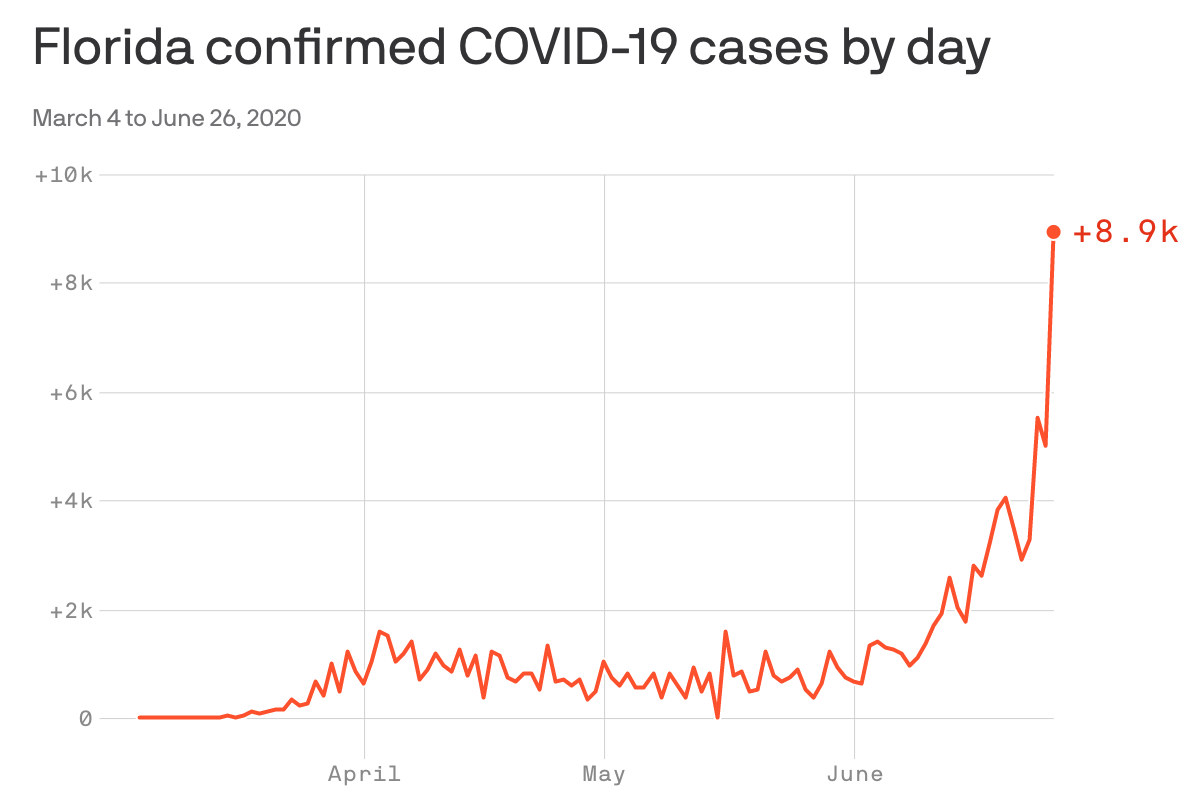
Six states set new single-day highs, led by Florida with 8,942 cases, more than 60 percent higher than its previous high set on Wednesday. Georgia, South Carolina, Tennessee, Idaho and Utah also set new single-day records.

Florida announced Friday morning that bars must close immediately, a move echoed by Texas, a state also dealing with a surge in cases and nearing its capacity to care for those suffering.

“The trajectory that we’re on right now has our hospitals being overwhelmed, probably about mid-July,” Austin Mayor Steve Adler (D) said during an appearance on CNN.

Texas Gov. Greg Abbott (R) issued an executive order that revives restrictions on bars, restaurants and certain types of outdoor recreation, one day after suggesting he would not.

Here are some significant developments:

  • The Dow Jones industrial average slid 730.05 points, about 2.8 percent, as rising coronavirus infections roiled investors Friday.
  • Vice President Pence said during a White House coronavirus task force news briefing that it is “very encouraging news” that half of the increasing cases in Florida and Texas are among Americans under 35, because younger people tend to have less-serious outcomes.
  • The Trump administration official coordinating tests for the novel coronavirus did a partial pivot Friday, announcing that the government would briefly extend its management of five testing sites in Texas, a state with a recent spike of cases and hospitalizations.
  • Anthony S. Fauci, the nation’s leading infectious-disease doctor, urged Americans to see their role in taking safety precautions as a “societal responsibility.” He begged them not to let their guards down even if the risk to their own health is considered minimal, because they can still transport it.
  • In another sign that hopes of a swift economic recovery may be losing steam, the number of homeowners delaying their mortgage payments shot up by 79,000.
  • Portugal is reinstating lockdown measures for about 700,000 people in 19 civil parishes around Lisbon next week after a worrying rise in cases in communities in the capital’s outskirts.

Six states set record number of new cases

As the United States logged a record number of infections Friday, six states announced their own new single-day high case totals: Georgia, Utah, South Carolina, Tennessee, Idaho and Florida.

Georgia reported four straight days of more than 1,700 new infections and two days in a row of records. The 1,900 cases reported by state health officials Friday surpassed the previous record, 1,714 cases, announced Thursday.

The seven-day average of new infections also hit a new high — 1,569 — and has been rising steadily since late May. That figure is up about 77 percent from a week ago and nearly 115 percent since Memorial Day.

In Utah, the single-day case total hit 676 and set a record for the fourth day in a row. The rolling average has also been on a steady upward swing for 10 days.

Current hospitalizations of Utah’s confirmed covid-19 patients are rising quickly, from 149 a week ago to 174 on Friday. Hospitalizations were at 102 when the month began.

South Carolina’s 1,301 new cases and 1,094 rolling average also set records. The state started the month with an average of 281 daily cases.

Tennessee announced 1,410 new infections, surpassing its previous record number of single-day cases by more than 200.

Current hospitalizations are also rising in South Carolina and Tennessee.

In addition to the states that set records, Louisiana has joined the states with rapidly increasing case numbers. Health officials announced 1,354 new cases Friday, compared with 523 two weeks ago and none two weeks before that.


Florida reports massive single-day increase of 9,000 coronavirus cases

https://www.axios.com/florida-single-day-increase-coronavirus-cases-a6d5578b-527c-4be4-88e6-eb7289a7be97.html?stream=health-care&utm_source=alert&utm_medium=email&utm_campaign=alerts_healthcare

Florida reports massive single-day increase of 9,000 coronavirus ...

Florida on Friday reported nearly 9,000 new coronavirus cases in 24 hours totaling 122,960 cases.

Why it matters: The state is one of many that are experiencing a fresh surge of infections.

Go deeper: The coronavirus surge is real, and it’s everywhere


3 moral virtues necessary for an ethical pandemic response and reopening

https://theconversation.com/3-moral-virtues-necessary-for-an-ethical-pandemic-response-and-reopening-140688?utm_medium=email&utm_campaign=Latest%20from%20The%20Conversation%20for%20June%2026%202020%20-%201662516009&utm_content=Latest%20from%20The%20Conversation%20for%20June%2026%202020%20-%201662516009+Version+A+CID_98447eb9cb25b06b85aed07c7fd721bd&utm_source=campaign_monitor_us&utm_term=3%20moral%20virtues%20necessary%20for%20an%20ethical%20pandemic%20response%20and%20reopening

3 moral virtues necessary for an ethical pandemic response and ...

The health and economic impacts of the coronavirus pandemic are not equally felt. From the United States to Brazil and the United Kingdomlow-wage workers are suffering more than others and communities of color are most vulnerable to the virus.

Despite the disparities, countries are reopening without a plan to redress these unequal harms and protect the broader community going forward. Our ethics research examines the potential for using virtues as a guide for a more moral coronavirus response.

Virtues are applied morals – actions that promote individual and collective well-being. Examples include generosity, compassion, honesty, solidarity, fortitude, justice and patience. While often embedded in religion, virtues are ultimately a secular concept. Because of their broad, longstanding relevance to human societies, these values tend to be held across cultures.

We propose three core virtues to guide policymakers in easing out of coronavirus crisis mode in ways that achieve a better new normalcompassion, solidarity and justice.

1. Compassion

Compassion is a core virtue of all the world’s major religions and a bedrock moral principle in professions like health care and social work. The distinguishing characteristic of compassion is “shared suffering:” Compassionate people and policies recognize suffering and take actions to alleviate it.

As the French philosopher André Comte-Sponville said, compassion “means that one refuses to regard any suffering as a matter of indifference or any living being as a thing.”

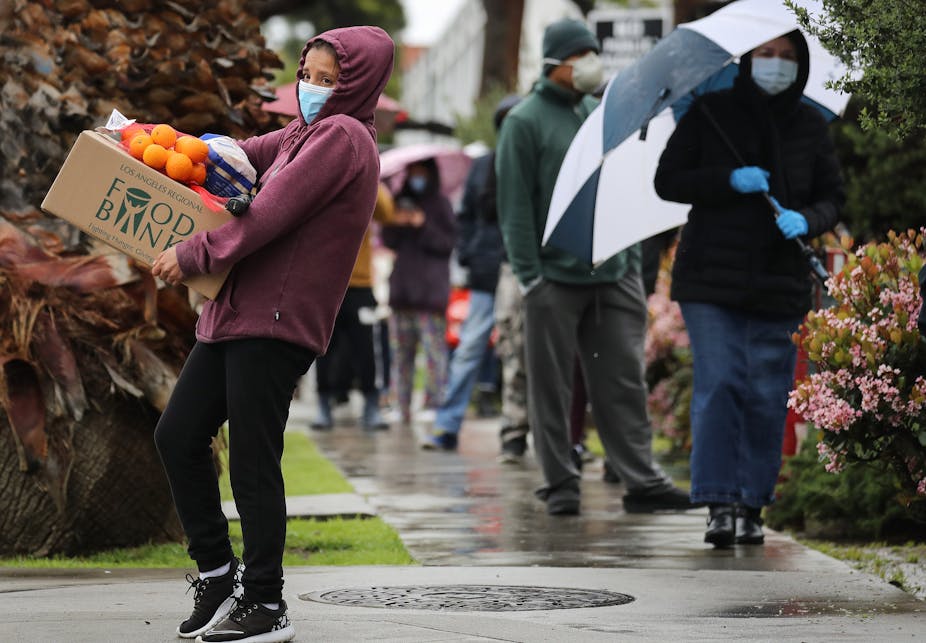
Individual acts of compassion abound in the coronavirus crisis, like frontline health care professionals and neighbors who deliver food, among other examples.

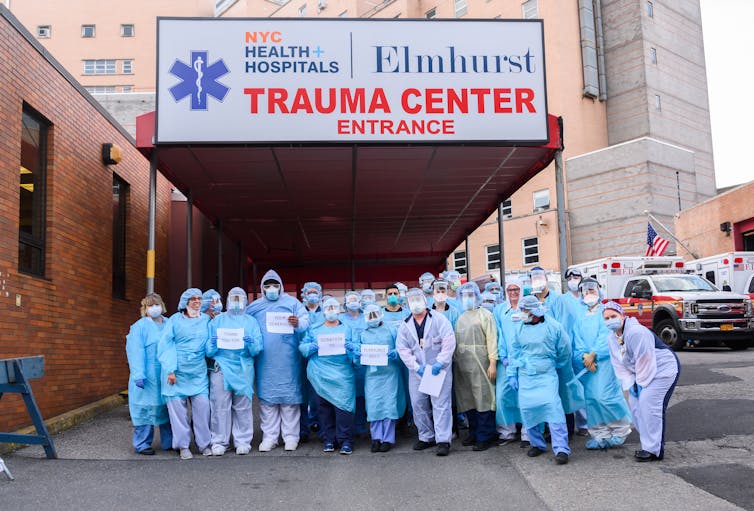
Compassion and solidarity on display at New York’s Elmhurst Hospital, during the April peak of the city’s coronavirus outbreak. Noam Galai/Getty Images

Some pandemic-era policies also reflect compassion, such as regulations preventing evictions and expanding unemployment benefits and giving food aid to poor familes.

A compassion-guided reopening aimed at preventing or reducing human suffering would require governments to continually monitor and alleviate the pain of their people. That includes addressing new forms of suffering that arise as circumstances change.

2. Solidarity

In a global pandemic, the actions people do or don’t take affect the health of others worldwide. Such shared emergencies require solidarity, which recognizes both the inherent dignity of each individual person and the interdependence of all people. As United Nations officials have emphasized, “we are all in this together.”

Public health measures like stay-at-home orders, social distancing and wearing masks reflect solidarity. While compliance in the United States has not been universal, data indicate broad approval for these measures. A new study found that 80% of Americans nationwide support staying home and social distancing and 74% support using face coverings in public.

To achieve these acts of solidarity, the leaders most praised in their countries and abroad – from U.S. National Institutes of Health director Dr. Anthony Fauci to New Zealand prime minister Jacinda Ardern – have relied primarily on moral persuasion, not threats of punishment.

By delivering clear information, giving simple and repeated behavioral guidance, and setting a good example, they’ve helped convince millions to take personal responsibility for protecting their community.

Face masks signal that wearers care about protecting others around them. Islam Dogru/Anadolu Agency via Getty Images

3. Justice

Justice focuses on the fair distribution of resources and the social structures that enable what the Dutch philosopher Patrick Loobuyck has called a “condition of equality.”

Justice-oriented policies are necessary for a moral reopening because of the pandemic’s disproportionate health and economic impacts. The evidence clearly shows that communities of colorlow-income populationspeople in nursing homes and those on the margins of society, such as homeless people and undocumented immigrants, are hardest hit.

Justice-oriented policies would aim for equitable balancing of necessary pandemic resources. That means directing testing and health equipment toward vulnerable communities – as identified by COVID-19 tracking data and risk factors like housing density and poverty – and ensuring free, widespread vaccine distribution when it becomes available.

In the U.S., economic justice will also require aggressively investing in minority-run businesses and poorer areas to guard against further harm to owners, employees and neighborhoods.

Similarly, all American school children have lost critical classroom hours, but lower-income children have been disproportionately damaged by remote learning in part due to the digital divide and loss of free lunch programs. Justice would demand channeling additional resources to the students and schools that need them most.

A moral reopening

Using virtues to guide social policies is an old idea. It dates back at least to the Greek thinker Aristotle.

Social distance stickers to prepare Nepal’s empty Tribhuwan International Airport for reopening. Narayan Maharjan/NurPhoto via Getty Images

New Zealand is a good example of virtuous pandemic policymaking, even considering its advantages in having wealth, low density and no land borders. Its coronavirus response included not only aggressive public health measures but also a well articulated message of being united in the COVID-19 fight and recurring government payments so workers did not have to risk their health for their job.

Note that it isn’t enough to apply just one virtue in a crisis of this magnitude. Policies built on compassion, solidarity and justice should be deployed in combination.

A compassionate post-pandemic response that does not address underlying inequalities, for example, ignores certain communities’ specific needs. Meanwhile, tackling specific injustices without engaging everyone in efforts like mask-wearing endangers the public health.

Bolstered by scientific evidence, virtue ethics can help nations reopen not just economically but morally, too.


Jobless claims: Another 1.48 million Americans file for unemployment benefits

https://finance.yahoo.com/news/coronavirus-covid-weekly-initial-jobless-claims-june-20-195644738.html

More than three months into the COVID-19 crisis in the U.S., countless Americans are still unemployed. According to the U.S. Labor Department, weekly initial jobless claims data showed yet another week of claims exceeding 1 million.

Another 1.48 million Americans filed for unemployment benefits in the week ending June 20, exceeding economists’ expectations for 1.32 million. The prior week’s figure was revised higher to 1.54 million from the previously reported 1.51 million claims. While this week’s report marked 12 consecutive weeks of deceleration, more than 47 million Americans have filed for unemployment insurance over the past 14 weeks.

“Jobless claims are not falling fast enough,” Renaissance Macro’s Neil Dutta said in an email Thursday. “Everything we have seen in the last week or two between rising case counts/hospitalizations, stalling economic progress in some important states, government job cuts, means one thing: the Phase 4 of fiscal stimulus must be bigger. Things should be better in 3-4 weeks, but the news will get worse before it gets better. Take some chips off the table and reload the chamber for August.”

Continuing claims, which lags initial jobless claims data by one week, totaled 19.52 million in the week ending June 13, down from 20.29 million in the week ending June 6. Consensus expectations were for 20 million continuing claims.

“Initial jobless claims continue to moderate only gradually,” Nomura economist Lewis Alexander wrote in a note Wednesday. “While the labor market remains exceptionally weak, signs of gradual improvement suggest another month of NFP gains during June.”

In the week ending June 20, California reported the highest number of jobless claims at an estimated 287,000 on an unadjusted basis, up from 241,000 in the previous week. Georgia had 124,000, down from 132,000, Florida reported 93,000, New York had roughly 90,000 and Texas reported 89,000 jobless claims.

Additionally, Pandemic Unemployment Assistance (PUA) program claims, which include those who were previously ineligible for unemployment insurance such as self-employed and contracted workers, was also closely monitored in Thursday’s report.

PUA claims totaled 728,120 on an unadjusted basis in the week ending June 20, down from the prior week’s 770,920.

As states reopen their economies, cases and hospitalization figures are back on the rise. As of Thursday morning, there were more than 9.4 million cases and 483,000 COVID-19 deaths around the world, according to Johns Hopkins University data. The U.S. had 2.3 million cases and 121,000 deaths.


Credit downgrades aren’t attributable to COVID-19 but cash flow will be a challenge

https://www.healthcarefinancenews.com/news/credit-downgrades-arent-attributable-covid-19-cash-flow-will-be-ongoing-challenge?mkt_tok=eyJpIjoiTUdSbVptVmhaR0ZpT0RJMyIsInQiOiJ2TVwvb3g5VWF4R05DeWFScVJ4U0lXeW9xWG1cL0pVMWo1RE1cL24rd21ySEErbk9kZWNIXC9hdmZYYmJBcGU1RDQ5MDVDNXVyZ2RZSWo2djRRSXhSOVFVQk1yNjFWOTVoVjlkTXVxXC95QXU1SU8yMEhJcEtHZXJ3ZDhDc2RMb2RcLzlMcSJ9

Just How Bad Is My Bad Credit Score? | Credit.com

The coronavirus is mainly affecting the credit outlook for the rest of the year and beyond as hospitals adapt to new financial realities.

While the COVID-19 coronavirus is likely to cause cash flow and liquidity issues for hospitals through the end of the year and into 2021, the credit outlook for the healthcare industry isn’t as dire as some had feared. While there have been some downgrades this year, most of those are attributable to healthcare financial performance at the end of 2019.

At a virtual session of the Healthcare Financial Management Association on Wednesday, Lisa Goldstein, associate managing director at Moody’s Investors Service, said the agency is taking a measured approach to issuing credit ratings and will “triage” these ratings based on factors such as liquidity and cash flow.

“Changes are happening daily, and sometimes hourly with funding coming from the federal government,” said Goldstein, “so we’re taking a very measured approach.”

Healthcare is among the most volatile industries being affected by the coronavirus due to the fact that it operates like a business, with a general lack of government support to pay off debt.

Credit downgrades are on the rise, but there’s historical precedent at play. Looking at data beginning with the 2008 financial crisis, there were consistently more downgrades than upgrades in the healthcare industry, owing to its inherent volatility. It was and has generally been subject to public policy and competitive forces. In any given year, downgrades exceed upgrades.

After passage of the Affordable Care Act, however, the number of uninsured Americans hit an all-time low. Hospitals grew in occupancy and revenues improved. The situation started to worsen once more when it became clear that there was a national nursing shortage, as well as top-line revenue pressure from government and commercial payers lowering their rates, but credit downgrades didn’t truly explode until this year. There have been 24 downgrades so far this year, already exceeding the 13 downgrades in all of 2019.

The rub is that it’s not the coronavirus’s fault.

“Most downgrades were in the first quarter of the year,” said Goldstein. “We did have a lot of downgrades in March, which is when the pandemic really started – when it became a pandemic – but even though there were 11 downgrades in March, it was based on what we’d seen through the end of 2019. There were problems that were appearing that had nothing to do with the pandemic.”

Basic fundamental operating challenges were becoming more pronounced during that time. A decline in inpatient cases, a rapid rise in observation stays, a decline in outpatient cases to competing clinics and health centers, and staffing and productivity challenges all contributed to material increases in debt.

COVID-19’s effects on hospital credit ratings are in the outlook for the rest of the year and beyond. Interestingly, in March, Moody’s changed its outlook from negative to stable.

“We haven’t seen anything like this,” said Goldstein. “The industry has been through shocks, but something this long in duration has been something we think will have an impact on financial performance going forward.”

Moody’s anticipates cash flow will remain low into 2021, mostly from the suspension of elective surgeries, rising staffing expenses and uncertainty around securing enough personal protective equipment. Liquidity is still a concern, but is more of a side issue due to Medicare funding providing a Band-Aid of sorts. The CARES act will help to fill some of that gap, but not all of it, said Goldstein.

She added that the $175 billion in stimulus funding is favorable, but modestly so, since it is estimated to cover only about two months’ worth of spending. The good news is that the opportunity to apply for grant money, which doesn’t have to be repaid, can help to fill some of the gap.

Some hospital leaders are concerned that if they violate covenants – also known as a technical default – their credit outlook will be downgraded. Goldstein sought to assuage those concerns.

“Debt service covenants are expected to rise, but an expected covenant breach or violation won’t have an impact on credit quality because it’s driven by an unusual event happening,” she said. “It doesn’t speak to your fundamental history as an operating entity.”


500 Delta Airline Staff Test Positive for Coronavirus, 10 Dead

https://www.newsweek.com/500-delta-airline-staff-test-positive-coronavirus-10-dead-1513016

Coronavirus Travel: What Happens to Planes Grounded by Covid-19 ...

Hundreds of staff at Delta Air Lines have tested positive for the novel coronavirus. Ten workers have died after contracting the virus, the company confirmed.

According to a transcript of the company’s latest shareholders meeting held on a phone conference June 18, Delta’s Chief Executive Officer Ed Bastian said: “We have had approximately 500 employees that have tested positive for COVID-19. The vast majority have recovered, thankfully. Unfortunately, we have lost 10 employees to the disease.”

Speaking to Newsweek, a spokesperson for Delta noted the latest tally of infected employees is “inclusive of all positive cases reported to us since March out of our 90,000 employees worldwide.

“Since initial reporting in March, Delta has seen a significant reduction in positive employee COVID-19 tests and is currently tracking at a rate five times lower than the national average.”

Bastian said: “We have recently announced that we are going to be testing all of our employees. In fact, we started this week in Minneapolis for both the blood serology, as to whether they have already been exposed to the disease and have antibodies, as well as the active test to see if they, indeed, are carrying the virus. And that test is being led by Mayo Clinic.”

“And we are also working very closely with Quest Diagnostics in that we will have all 90,000 of our employees available to be tested. And from getting a good baseline, we will be able to provide better protection for our people and then, eventually, certainly, our customers as we go forward,” Bastian confirmed on the call.

It is unknown whether the infected staff members are cabin crew or ground-level workers and which flights they may have been operating. The majority of Delta’s employees are reported to be flight attendants, pilots and airport agents, while less than 10,000 are administrative staff, most of whom are working from home, according to Bastian.

“Given that we are a frontline customer service business, the majority of our employees need to be at work to conduct business,” Bastian said.

On Monday, Delta announced it will resume flights between the U.S. and China. The carrier will operate a service between Seattle and China’s Shanghai Pudong International Airport via South Korea’s Incheon International Airport twice a week from June 25.

From July, the airline will operate weekly flights from Seattle and Detroit to Shanghai, also via Incheon International Airport. Delta is the first U.S. airline to resume services between the U.S. and China since the temporary suspension of flights in February following the outbreak.

Earlier this month, Delta announced it will be suspending flights to 11 U.S. airports from July 8 while “customer volume is significantly reduced,” the carrier confirmed in a statement.

These airports make up five percent of the airline’s domestic operations. “All of these airports will continue to receive service from at least one other carrier after Delta suspends its operations,” the statement added.

The 11 airport locations include Aspen in Colorado (ASE), Bangor in Maine (BGR), Erie, PA (ERI), Flint in Michigan (FNT), Fort Smith in Arkansas (FSM), Lincoln in Nebraska (LNK), New Bern/Morehead/Beaufort in North Carolina (EWN), Peoria in Illinois (PIA), Santa Barbara, California (SBA), Scranton/Wilkes-Barre, Pennsylvania (AVP) and Williston in North Dakota (XWA).

“Delta has announced an 85 percent reduction in our second-quarter schedule, which includes reductions of 80 percent in U.S. domestic capacity and 90 percent internationally,” including service to Canada’s Ottawa International Airport in the province of Ontario which was suspended indefinitely from June 21, the statement confirmed.

Last month, Delta also announced the temporary suspension of operations at airports in locations with “more than one Delta-served airport to allow more frontline employees to minimize COVID-19 exposure risk while customer traffic is low.”

“Delta will continue providing essential service to impacted communities via neighboring airports,” the statement said.

The 10 airports where operations were temporarily suspended include Chicago Midway International Airport (MDW) in Illinois, Oakland International Airport (OAK), Hollywood Burbank Airport (BUR) and Long Beach Airport (LGB) in California, T. F. Green International Airport (PVD) in Rhode Island, Westchester County Airport (HPN) and Stewart International Airport (SWF) in New York, Akron-Canton Airport (CAK) in Ohio, Manchester-Boston Regional Airport (MHT) in New Hampshire and Newport News/Williamsburg International Airport (PHF) in Virginia.

Services at Canada’s Saskatoon International Airport were also temporarily suspended last month.

Delta extended its waiving of change fees and the flexibility to travel through September 30, 2022, to customers with canceled flights through September 2020.

“Eligible customers include those who have upcoming travel already booked between now and September 30 as of April 17, 2020,” and those with “canceled travel on flights between March 2020 and September 2020,” the airline said.

From May 4, Delta has required all passengers to wear a face mask or other appropriate face covering on its flights. Other safety measures introduced include sanitizing all aircraft with electrostatic spraying before departure and disinfecting all high-touch points throughout the aircraft interior.

Aircraft are also equipped with “state-of-the-art air circulation systems with HEPA [high efficiency particulate absorbing] filters that extract more than 99.99 percent of particles, including viruses,” the company said in a statement Monday.

Last week, American Airlines flight crew asked a passenger to disembark a plane after the man refused to wear a mask on board a flight.

In the same week, a survey by the International Air Transport Association (IATA) found that 45 percent of travelers said they would fly within two months after the novel coronavirus is no longer seen as a threat, down from 60 percent in April.

The novel coronavirus, first reported in Wuhan, China, has infected more than 9.2 million people across the globe, including over 2.3 million in the U.S. More than 477,800 have died following infection, while over 4.6 million have reportedly recovered from infection, as of Wednesday, according to the latest figures from Johns Hopkins University.