Cartoon – Reality Check

Cartoon, April 9 | Cartoons | themountaineer.com

Timeline: How the U.S. fell behind on the coronavirus

https://www.axios.com/coronavirus-timeline-trump-administration-testing-c0858c03-5679-410b-baa4-dba048956bbf.html

Behind the Curve | Netflix

Early missteps allowed the new coronavirus to spread throughout the U.S for weeks before state and local officials implemented strict lockdowns designed to keep the pandemic from spinning further out of control.

Why it matters: The U.S. missed the boat on the kind of swift, early response that would have been most effective, and has been scrambling to catch up ever since. This timeline, compiled from official sources as well as media reports, shows how that all-important time was lost.

Dec. 31, 2019: China reports the novel coronavirus to the World Health Organization.

Jan. 6: The Centers for Disease Control and Prevention issued a travel notice for Wuhan, China.

Jan. 15: The first U.S. case is confirmed, in a man who traveled from Wuhan.

Jan. 17: The World Health Organization publishes a protocol for manufacturing coronavirus tests.

  • The Centers for Disease Control and Prevention opts to develop its own test instead of using the WHO’s.

Jan. 30: The WHO declares global health emergency.

Jan. 31: The Trump Administration suspended entry into the U.S. for most foreign nationals who had traveled to China in the past 14 days.

Feb. 5: The CDC begins shipping its diagnostic tests to state and local health agencies.

Feb. 8: Labs report problems with the CDC’s tests.

Feb. 24: President Trump tweets: “The Coronavirus is very much under control in the USA. We are in contact with everyone and all relevant countries. CDC & World Health have been working hard and very smart. Stock Market starting to look very good to me!”

Feb. 29: Washington state reports the first COVID-19 death in the U.S.

  • The Food and Drug Administration allows academic labs to develop and begin testing coronavirus testing kits while reviewing pending applications.
  • The WHO reports 86,604 coronavirus cases worldwide.

March 5: LabCorp and Quest Diagnostics launch coronavirus test for commercial use.

March 9: Trump tweets: “So last year 37,000 Americans died from the common Flu. It averages between 27,000 and 70,000 per year. Nothing is shut down, life & the economy go on. At this moment there are 546 confirmed cases of CoronaVirus, with 22 deaths. Think about that!”

  • The WHO reports 114,381 coronavirus cases worldwide.

March 13: Trump declares a national emergency, freeing up $50 billion in federal funds for states and territories.

March 15: 33 states and the District of Columbia closed public schools, according to Education Week. This included the New York City school system, the largest in the country.

March 16: Trump advises Americans to self-isolate for 15 days.

March 19: Trump signed into law an emergency coronavirus relief package for paid sick leave and free testing.

March 23: 9 states had stay-at-home orders.

  • Washington, Oregon, California, Louisiana, Illinois, Ohio, New York, Massachusetts and New Jersey.

March 26: The U.S. now leads world in coronavirus cases.

  • 12 more states issue stay-at-home orders, totaling 21: Idaho, Colorado, New Mexico, Michigan, Wisconsin, Kentucky, Indiana, West Virginia, Hawaii, Connecticut, Vermont and Delaware

March 29: Trump extends social distancing measures to April 30.

March 30: Nine more states issue stay-at-home orders, bringing the total to 30.

  • Governors say testing is still lacking in many states.

March 31: Trump warns of the potential for 100,000 to 240,000 deaths.

April 6: Twelve more states issue stay-at-home orders, bringing the total to 42.


Labor Secretary Eugene Scalia faces blowback as he curtails scope of worker relief in unemployment crisis

https://www.washingtonpost.com/business/2020/04/10/labor-secretary-eugene-scalia-faces-blowback-he-curtails-scope-worker-relief-unemployment-crisis/?fbclid=IwAR3mYk7W0Jvxu0lJ9vo7FXufkVsy1OVsg-VqmUztG1hi5PJAneL7PzcKDtI

Eugene Scalia, rising in Trump orbit, becomes key force in ...

Labor Department comes under fire over handling of worker protection, unemployment program.

The Labor Department is facing growing criticism over its response to the coronavirus pandemic as the agency plays a central role in ensuring that the tens of millions of workers affected by the crisis get assistance.

The criticism ranges from direct actions that the agency has taken to limit the scope of worker assistance programs to concerns that it has not been aggressive enough about protecting workers from health risks or supporting states scrambling to deliver billions in new aid.

In recent days, Labor Secretary Eugene Scalia, who has expressed concerns about unemployment insurance being too generous, has used his department’s authority over new laws enacted by Congress to limit who qualifies for joblessness assistance and to make it easier for small businesses not to pay family leave benefits. The new rules make it more difficult for gig workers such as Uber and Lyft drivers to get benefits, while making it easier for some companies to avoid paying their workers coronavirus-related sick and family leave.

“The Labor Department chose the narrowest possible definition of who qualifies for pandemic unemployment assistance,” said Andrew Stettner, a senior fellow at the Century Foundation who has spent two decades working on unemployment programs.

At the same time, frustrations have built among career staff at the Labor Department that the agency hasn’t ordered employers to follow safeguards, including the wearing of masks, recommended by the Centers for Disease Control and Prevention to protect workers. Two draft guidance documents written by officials at the Occupational Safety and Health Administration, part of the Labor Department, to strengthen protections for health-care workers have also not been advanced, according to two people with knowledge of the regulations granted anonymity to discuss the internal deliberations.

Scalia, a longtime corporate lawyer who is the son of the late Supreme Court justice Antonin Scalia, has emerged as a critical player in the government’s economic response to the pandemic. Nearly 17 million Americans have applied for unemployment insurance since President Trump declared a national emergency on March 13, and states are struggling to get their systems working to deliver $260 billion in new aid approved by Congress.

Democrats and some Republicans argue that the Labor Department needs to be more aggressive about disbursing money and technical assistance to states to shore up the unemployment insurance system. The department has released only half of $1 billion in administrative support for states that Congress approved almost a month ago.

Sen. Lindsay O. Graham (R-S.C.) said Thursday in an interview that he has talked to Scalia about the need to speed things up.

“You could have massive civil unrest if these systems cannot get checks out the door. We’re talking about 20 percent unemployment, maybe even more,” Graham said. “The application process is a nightmare. The state systems are failing.”

Graham said that Scalia has been responsive, but, “I don’t see any action being taken.”

Labor Department officials said Scalia is moving rapidly to help U.S. workers in an unprecedented time. They pointed to a poster and guidebook that OSHA released with steps companies “can take” to reduce worker risk of coronavirus exposure.

“Under Secretary Scalia’s leadership, in the last two weeks, the department has quickly released new rules and guidance for states, businesses, and individual Americans to help those in need of relief,” said Patrick Pizzella, deputy labor secretary. “The department has already distributed nearly $500 million in additional administrative funding to 39 states.”

Still, Scalia has made clear he is wary of taking an excessively lax approach to disbursing aid, an argument that he used to help win GOP support for recent legislation. Writing on Fox Business Network’s website on Monday, he warned that he does not want unemployed people to become addicted to government aid.

“We want workers to work, not to become dependent on the unemployment system,” Scalia wrote with Small Business Administration chief Jovita Carranza. “Unemployment is not the preferred outcome when government stay-at-home orders force temporary business shutdowns.”

On the day the $2 trillion package passed the Senate, Scalia spoke with Sens. Rob Portman (R-Ohio), Ben Sasse (R-Neb.) and Tim Scott (R-S.C.), who had raised concerns the law’s new unemployment benefits were too large and would deter workers from returning to jobs.

Scalia told conservative senators that once enacted, his agency would ensure the provisions his agency oversees would not hurt U.S. companies, according to three congressional officials aware of the conversations and granted anonymity to discuss the call.

Narrowing rules

Two recent laws passed by Congress expanded paid and sick leave policies as well as the size and scope of unemployment benefits for Americans. But worker advocates argue that as Scalia begins to implement these measures, his department is being much less generous toward workers than toward companies.

New Labor Department guidance says unemployment benefits apply to gig workers only if they are “forced to suspend operations,” which could dramatically limit options for those workers if their apps are still operating. Other workers also face a high hurdle to qualify for benefits.

The guidance says a worker “may be able to return to his or her place of employment within two weeks” of quarantining, and parents forced to stop work to care for kids after schools closed are not eligible for unemployment after the school year is over. Workers who stay home because they are older or in another high-risk group are also ineligible unless they can prove a medical professional advised them to stop working.

Some states are also having a difficult time figuring out how to verify how much money self-employed workers typically earn. It might require looking at tax documents, which unemployment offices don’t usually have access to.

“Some of the requirements, the standards that we’re being held to, are going to be incredibly difficult to adhere to,” Maine Labor Commissioner Laura Fortman said.

A Labor Department spokesperson said the agency is “providing as much technical assistance and IT support as possible” to states, some of which are using computer systems that are several decades old.

Scalia’s agency is also in charge of overseeing the new paid sick and family leave regulations, which apply to companies with fewer than 500 employees during the pandemic. The law gave the Labor Department authority to exempt businesses with under 50 employees from providing 12 weeks of paid family leave to care for a child out of school if the leave policy threatens to bankrupt the company.

Businesses that deny workers paid leave don’t have to send the government any paperwork justifying why. The Labor Department’s guidance asks companies to “retain such records for its own files,” a contrast with the heavy documentation required from gig workers who must prove they were affected by the coronavirus outbreak to get aid.

A Labor Department spokesperson said its rules on paid sick and family leave follow Congress’ direction.

“The department’s new rule balances allowing workers to take paid leave to care for their children with keeping small businesses open — as instructed by Congress,” a spokesperson said.

Tension at OSHA

Some Labor Department staffers and outside critics have also faulted Scalia for his handling of OSHA, which falls under his jurisdiction.

The CDC has issued recommendations for the public and businesses to follow practices such as social distancing and sanitizing workstations. OSHA could make those guidelines mandatory for all employers or for all essential employees but has not done so.

“Some of the OSHA staff is frustrated they can’t do more to protect workers. They want an emergency standard that would require employers to follow CDC guidelines,” said David Michaels, a George Washington University School of Public Health professor who served as assistant secretary of labor for occupational safety and health in the Obama administration.

Under Scalia, OSHA has also decided against issuing safety requirements to protect hospital and health-care workers, including rules that would mandate nurses and other providers be given masks and protective gear recommended by the CDC when at risk of exposure.

The union National Nurses United petitioned Scalia to increase the requirements during the pandemic, but a union spokeswoman said the Labor Department has not even acknowledged receipt of the letter.

Hospitals have resisted these rules for years. Tom Nickels, the chief lobbyist for the American Hospital Association, said that he hadn’t spoken to Scalia but that his group has opposed these actions in conversations with OSHA staff because widening the use of N95 respirator masks would be impractical. “The equipment is in short supply,” he said. “We can’t get it.”

OSHA also has not taken significant action to protect workers from retaliation when they speak out about dangerous conditions that expose them to coronavirus, Michaels said.

When workers at a manufacturing plant in northern Illinois tried alerting government officials about their concerns about working shoulder to shoulder, the regional OSHA official responded that “all OSHA can do is contact an employer and send an advisory letter outlining the recommended protective measures,” according to an email reviewed by The Washington Post. “This isn’t very helpful for you or your labor group, but it is the best I have to offer,” the email said.

On Wednesday, OSHA sent out a news release reminding companies that it is “illegal to retaliate against workers because they report unsafe and unhealthful working conditions during the coronavirus pandemic.”

“OSHA has completely abandoned their responsibility to protect workers on the job,” said Debbie Berkowitz, who worked at OSHA in the Obama administration and is now director of the worker safety and health program at the National Employment Law Project. “I have never felt this way, that every worker is at the mercy at their boss of whether they get protected. People are going to get sick and die, and they don’t have to.”

This week, Scalia said OSHA would take all worker safety concerns seriously.

“We are fielding calls from workers worried about their health and from workers who believe they have been illegally disciplined by their employer for expressing health concerns,” he said. “We will not tolerate retaliation.”


Another 6.6 million jobless claims filed last week amid coronavirus crisis

https://www.axios.com/coronavirus-unemployment-filings-6cb04d2d-9cc4-45b4-a473-9acbf4c99d43.html?stream=top&utm_source=alert&utm_medium=email&utm_campaign=alerts_all

Another 6.6 million jobless claims filed last week amid ...

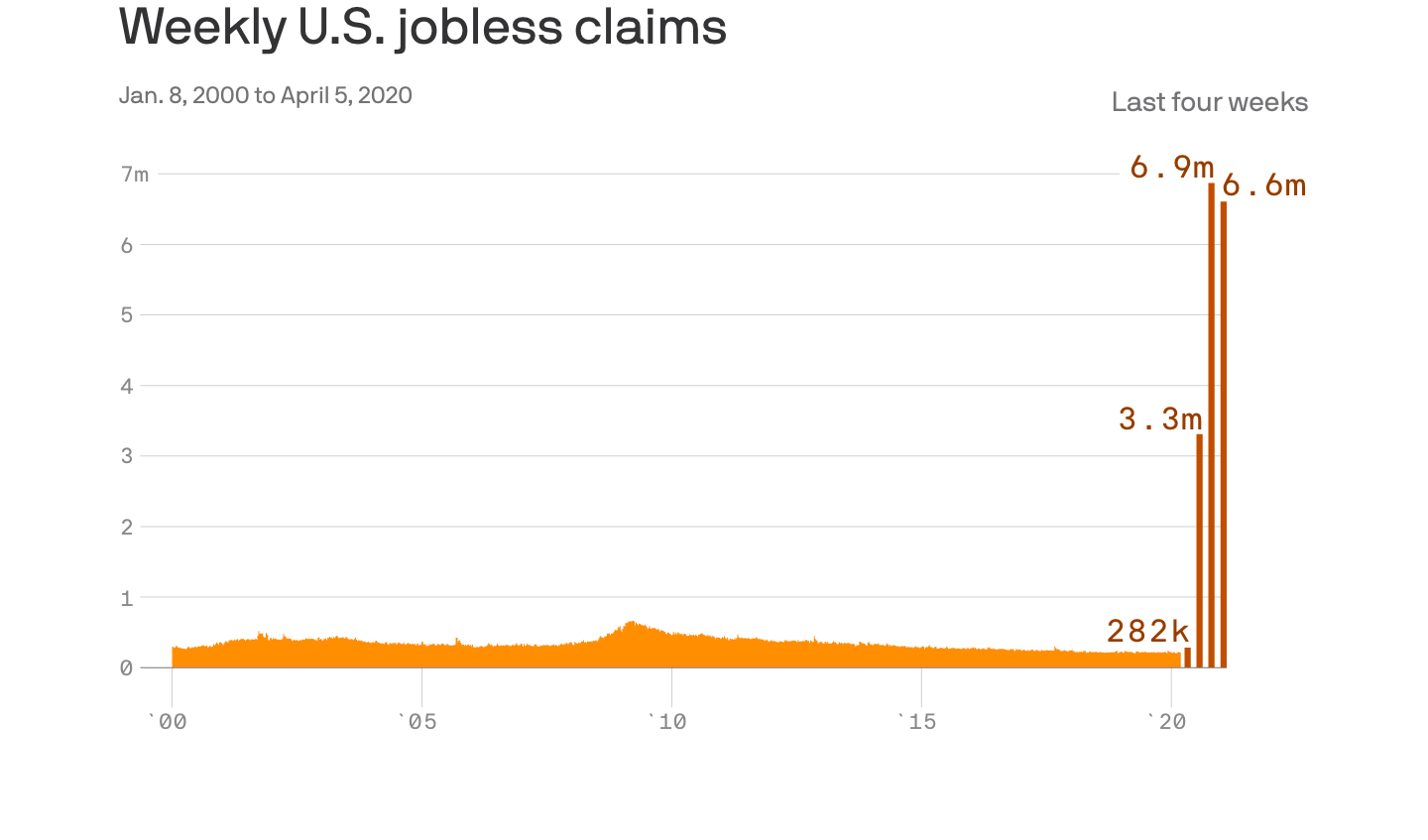
Another 6.6 million Americans filed for unemployment last week, the Labor Department announced Thursday.

Why it matters: It adds to the staggering 10 million jobless claims in recent weeks — by far the sharpest spikes in American history — as the world economy has ground to a halt in an effort to contain the coronavirus outbreak.

  • The once-again colossal number of filings was worse than the 5 million that Wall Street had expected.
  • Last week’s unemployment claim numbers, which government data had pegged at 6.65 million, were revised upward to 6.87 million — the highest ever recorded.

The big picture: The data lags by a week, so while a large portion of the economic shutdown is now evident over the last three weeks, there may still be more huge numbers yet to come.

  • The $2.2 trillion coronavirus stimulus package opened the door to a surge of new unemployment filings, allowing the self-employed and independent contractors to claim benefits.


$100B federal hospital aid won’t fully compensate lost revenue, Moody’s says

https://www.beckershospitalreview.com/finance/100b-federal-hospital-aid-won-t-fully-compensate-lost-revenue-moody-s-says.html?utm_medium=email

Moodys | HENRY KOTULA

The $2 trillion federal coronavirus aid package signed into law that includes $100 billion for nonprofit hospitals won’t completely cover the revenue hospitals will lose as a result of the pandemic, Moody’s Investors Service wrote in an April 3 note.

While the aid package includes several provisions like compensation for lost revenue, increased Medicare reimbursement and advances on future Medicare reimbursement, cash flow at nonprofit hospitals will still likely be materially lower for the next several months. Postponed services alone are likely to reduce hospital revenue by 25 percent to 40 percent a month on average, Moody’s said, a reduction that is affecting even hospitals that aren’t treating large COVID-19 case loads.

“The $100 billion aid package provides some relief to hospitals by supporting their operations and providing access to critical supplies,” Dan Steingart, vice president at Moody’s, said. “However, it is unlikely to fully compensate the sector for the two main financial challenges facing providers as a result of the coronavirus outbreak. The first is a material decline in revenue and cash flow as profitable elective surgeries, procedures and other services are postponed to preserve resources and avoid spreading the virus. The second is difficulty curbing expenses as surge preparation costs offset any expense reductions from postponed or canceled services.”

Moody’s maintained its negative outlook on nonprofit hospitals. 


The Memo: Scale of economic crisis sends shudders through nation

The Memo: Scale of economic crisis sends shudders through nation

Pandemic derails resilient US economy | TheHill

New data released Thursday revealed the scale of the economic devastation wrought by the coronavirus crisis — and experts say there is no end in sight.

More than 6.6 million new unemployment claims were filed during the week ending March 28, according to the Department of Labor. The figure was double that of the previous week, which had itself been by far the highest since records began.

The stark reality is that roughly 10 million people have been dumped from their jobs in two weeks. A previously robust economy has been scythed down by the virus. A nation that had been enjoying its lowest unemployment rate for decades is now virtually certain to see jobless totals surpass those of the Great Recession a decade ago.

“The present economic situation is awful,” said Jason Furman, a Harvard University professor who served as chairman of President Obama’s Council of Economic Advisers. “The data is just telling us what we can see with our own eyes — there is very little business happening.”

Economists who had already been deeply worried about the immediate outlook are now wondering if their earlier projections were in fact too rosy.

“In our earlier scenario, we had expected 6.5 million job losses by May,” said Beth Ann Bovino, the chief U.S. economist at Standard & Poor’s. That figure will be exceeded, she now believes, given that there were “more lockdowns, more business closures and more businesses just trying to keep themselves alive” by laying off workers.

Heidi Shierholz, senior economist and director of policy at the Economic Policy Institute, said that even the 10 million figure for new unemployment claims was “likely a massive undercount” of actual losses because, during that period, self-employed people and workers in the so-called “gig economy” were generally not eligible to apply. This is changing as a consequence of the package recently passed by Congress that extends eligibility for unemployment benefits, as well as providing other aid for businesses and individuals.

“Our estimate is that by the end of June, 20 million people will have lost their jobs — and I am wondering if even that is optimistic,” Shierholz said.

The political ramifications of such a huge economic shock are unknowable.

President Trump had been looking forward to using the economy as his strongest card as he seeks a second term in November. That card has been shredded.

Trump has promised repeatedly during his White House briefings on the crisis that the nation can bounce back very fast once the public health dangers have receded.

Trump’s approval ratings have also ticked up modestly since the crisis began in many polls. He may be benefitting from the traditional “rallying around the flag” effect that has occurred in previous moments of crisis.

President George W. Bush, for example, hit 90 percent approval in a Gallup poll — the highest result for any president in the polling organization’s history — right after the terrorist attacks of Sept. 11, 2001.

In a statement on Thursday, probable Democratic nominee Joe Biden hit Trump for “failing to prepare our nation” for the ramifications of the coronavirus crisis. Biden called on Trump to allow open enrollment in the Affordable Care Act and also jabbed at Treasury Secretary Steven Mnuchin for having referred to previous unemployment figures as “not relevant.”

In response, Trump campaign communications director Tim Murtaugh blasted back at Biden for “ineffectively sniping from the sidelines, stumbling through television interviews, and hoping for relevance and political gain.”

Economic experts caution that Trump’s promises of a v-shaped recovery, in which the nation jolts itself back into strong economic shape quickly, are almost certainly unrealistic. It will not be a matter of the nation simply rolling the shutters back up and returning to business as usual.

“The economy is not symmetrical,” said Furman. “It is easier to separate someone from a job than to connect someone to a job. In recessions, the unemployment rate can go up very quickly and it comes down very slowly. The worry is that this will be like that.”

Several economic experts who spoke with The Hill made similar points, unprompted, as to the ways the federal government could ease the crisis.

One refrain was that huge assistance needs to be made available to states. States are generally required to balance their budgets. In a situation like the current one, where their tax revenue is cratering, this means they are obligated to severely cut spending — something that most economists believe would deepen and prolong the recession.

Another theme was the need to tie together financial assistance for businesses and the retention of employees.

The recently passed stimulus package makes some effort to do that, particularly in the case of small businesses. The Paycheck Protection Program extends loans to small businesses based upon eight weeks of payroll costs plus an additional 25 percent of the total.

The payroll portion of the loans would be forgiven — rendering them in effect a grant, not a loan — so long as the workforce was maintained at existing levels.

Economic experts praise the principle but worry that the total amount of money in the pot for these loans — $349 billion — may not be enough. 

“The small business subsidies will be critical,” said Steven Hamilton, an assistant professor of economics at The George Washington University. “The government needs to get the word out on those, and Congress will likely need to pass an expansion both to adequately fund the existing scheme and to make the scheme more generous to businesses to keep them from laying off workers.”

The public seems to share the view that the aid package, which also includes checks of up to $1,200 for individuals, is a move in the right direction — but unlikely to suffice.

A CBS News poll released late Thursday afternoon indicated 81 percent of Americans support the recent legislation but 57 percent also say it likely won’t be enough.

The same trepidation is shared by the experts, given the unprecedented nature of the coronavirus and the economic crisis it has created.

“It’s like nothing we have ever seen before,” said Shierholz.


Trump rejects Obamacare special enrollment period amid pandemic

https://www.politico.com/news/2020/03/31/trump-obamacare-coronavirus-157788?fbclid=IwAR1nbCE7Uwvo2CNi6d6W5NG9zEIQulyh-noy1RXdk_0RJstMM0C5VYJ8mO4

Trump rejects opening ObamaCare special enrollment period amid ...

Before the coronavirus outbreak, nearly 30 million Americans were uninsured and as many as 44 million were under-insured, paying for bare-bones plans with soaring deductibles and copays. Today, millions more Americans will begin losing their employer-based health insurance because they’ve lost their jobs during this pandemic.

Meanwhile, the Trump administration is still actively trying to repeal the entirety of the Affordable Care Act in court, which would cause an additional 20 million people to lose insurance *in the middle of a pandemic*.

And today, Trump refused to reopen ACA enrollment to those millions of uninsured Americans for a special enrollment window, leaving them without any affordable options to get covered. People are going to die because they can’t afford to seek treatment or end up saddled with thousands of dollars of medical debt if they do. Remember this the next time someone tries to tell you Medicare for All is too radical.

What do you think?

The Trump administration has decided against reopening Obamacare enrollment to uninsured Americans during the coronavirus pandemic, defying calls from health insurers and Democrats to create a special sign-up window amid the health crisis.

President Donald Trump and administration officials recently said they were considering relaunching HealthCare.gov, the federal enrollment site, and insurers said they privately received assurances from health officials overseeing the law’s marketplace. However, a White House official on Tuesday evening told POLITICO the administration will not reopen the site for a special enrollment period, and that the administration is “exploring other options.”

The annual enrollment period for HealthCare.gov closed months ago, and a special enrollment period for the coronavirus could have extended the opportunity for millions of uninsured Americans to newly seek out coverage. Still, the law already allows a special enrollment for people who have lost their workplace health plans, so the health care law may still serve as a safety net after a record surge in unemployment stemming from the pandemic.

Numerous Democratic-leaning states that run their own insurance markets have already reopened enrollment in recent weeks as the coronavirus threat grew. The Trump administration oversees enrollment for about two-thirds of states.

Insurers said they had expected Trump to announce a special enrollment period last Friday based on conversations they had with officials at the Centers for Medicare and Medicaid Services, which runs HealthCare.gov enrollment. It wasn’t immediately clear why the Trump administration decided against the special enrollment period. CMS deferred comment to the White House.

Trump confirmed last week he was seriously considering a special enrollment period, but he also doubled down on his support of a lawsuit by Republican states that could destroy the entire Affordable Care Act, along with coverage for the 20 million people insured through the law.

People losing their workplace coverage have some insurance options outside of the law’s marketplaces. They can extend their employer plan for up to 18 months through COBRA, but that’s an especially pricey option. Medicaid is also an option for low-income adults in about two-thirds of states that have adopted Obamacare’s expansion of the program.

Short-term health insurance alternatives promoted by Trump, which allow enrollment year-round, is also an option for many who entered the crisis without coverage. Those plans offer skimpier coverage and typically exclude insurance protections for preexisting conditions, and some blue states like California and have banned them or severely restricted them. The quality of the plans vary significantly and, depending on the contract, insurers can change coverage terms on the fly and leave patients with exorbitant medical bills.

Major insurers selling Obamacare plans were initially reluctant to reopen the law’s marketplaces, fearing they would be crushed by a wave of costs from Covid-19, the disease caused by the novel coronavirus. But the main insurance lobby, America’s Health Insurance Plans, endorsed the special enrollment period roughly two weeks ago while also urging lawmakers to expand premium subsidies to make coverage more affordable for middle-income people.

Congress in last week’s $2 trillion stimulus passed on that request, as well as insurers’ petition for an open-ended government fund to help stem financial losses from an unexpected wave in coronavirus hospitalizations.

Democrats pushing for the special enrollment period are also grappling with the high costs facing many people with insurance despite new pledges from plans to waive cost-sharing. Obamacare plans and a growing number of those offered by employers impose hefty cost-sharing and high deductibles that could still burden infected Americans with thousands of dollar in medical bills.

House Energy and Commerce Chairman Frank Pallone (D-N.J.) on a press call Monday contended that “we also need to have free treatment” after Congress eliminated out-of-pocket costs for coronavirus tests.

“We did the testing, which is now free, and everybody, regardless of their insurance, gets it,” Pallone said. “But that has to be for the treatment as well.”


Small hospitals’ bailout concerns

https://www.axios.com/newsletters/axios-vitals-61745839-012e-4bd1-8843-24917a73b6e2.html?utm_source=newsletter&utm_medium=email&utm_campaign=newsletter_axiosvitals&stream=top

Country Closures: Rural Communities Adapt As More Hospitals Shut Down

Congress is about to provide $100 billion for hospitals and other health care providers to cope with the fallout from the coronavirus, but small hospitals have no idea how to access those funds — and many need the money immediately, Axios’ Bob Herman reports.

What they’re saying: “A lot of rural hospitals out there need a cash infusion today,” Alan Morgan, CEO of the National Rural Health Association, told Axios. “How is it going to happen? What is the process? There are way more questions than answers.”

Details: The stimulus bill says “the Secretary of Health and Human Services shall, on a rolling basis, review applications and make payments” to hospitals and other providers, out of a $100 billion fund.

  • HHS did not respond to questions about how that process would work.

Between the lines: Many hospitals are part of large, profitable systems that benefit from their area’s demographics. The coronavirus will cause them financial distress, but they are not in danger of going under.

  • Rural and safety net hospitals, which treat disproportionate amounts of older and low-income patients, have a lot less wiggle room to call off elective procedures as they wait for a coronavirus surge.
  • Many small hospitals can’t get new loans from banks and could miss payroll as soon as next week.

The bottom line: Bob asked Morgan how this process was supposed to work. “I don’t know,” he said, “and we are greatly concerned.”


What health care is getting out of the stimulus package

https://www.axios.com/health-care-hospitals-coronavirus-stimulus-package-c49bd0cc-05a0-479a-a83d-d4455bd0e7bd.html?utm_source=newsletter&utm_medium=email&utm_campaign=newsletter_axiosvitals&stream=top

Senate passes $2 Trillion coronavirus economic stimulus plan, it ...

Congress’ big stimulus package will provide more than $100 billion and several favorable payment policies to hospitals, doctors and others in the health care system as they grapple with the coronavirus outbreak.

The big picture: Hospitals, including those that treat a lot of rural and low-income patients, are getting the bailout they asked for — and then some.

The cornerstone provision is a no-strings-attached $100 billion fund for hospitals and other providers so they “continue to receive the support they need for COVID-19 related expenses and lost revenue,” according to a summary of the legislation.

  • It’s unclear how that money would be divvied up. One lobbyist speculated the funds would go to the “hardest-hit areas first and those areas that are next expected to get hit,” but that has not been clarified.

The bill provides many other incentives for the industry.

  • Hospitals that treat Medicare patients for COVID-19 will get a 20% payment increase for all services provided. That means Medicare’s payment for these types of hospital stays could go from $10,000 to $12,000, depending on the severity of the illness.
  • Employers and health insurers will be required to pay hospitals and labs whatever their charges are for COVID-19 tests if a contract is not in place. By comparison, Medicare pays $51.33 for a commercial coronavirus test.
  • Medicare’s “sequestration,” which cuts payments to providers by 2%, will be lifted until the end of this year.
  • Labs won’t face any scheduled Medicare cuts in 2021, and won delays in future payment cuts as well.

What’s missing: Patients who are hospitalized with COVID-19 could still be saddled with large, surprise bills for out-of-network care.

  • There also are no subsidies for COBRA coverage, which employers wanted for people who lost their jobs. However, people who are laid off are able to sign up for a health plan on the Affordable Care Act’s marketplaces or could qualify for Medicaid.