Unemployed struggle to cover basic expenses following CARES expiration: poll

Unemployed struggle to cover basic expenses following CARES expiration: poll

The number of jobless people saying that unemployment insurance does not cover basic expenses including food, clothing, housing and transportation nearly doubled after key benefits expired in July.

new survey from Morning Consult found that 50 percent of unemployed people said their benefits fell short of covering basic expenses, up from 27 percent in July.

The $600 in extra weekly benefits that Congress passed in March expired at the end of July, leaving many with significantly lower payments.

Republicans argued the $600 increase was too high and discouraged people from returning to work. Democrats countered that at a time of record high unemployment and limited job openings, the extra pay was unlikely to prevent jobs from getting filled.

A month later, negotiations between the White House and congressional Democrats remain stalled. Senate Republicans are setting a goal of voting on a more limited package of COVID-19 relief measures next week, though Speaker Nancy Pelosi (D-Calif.) has dismissed the idea of approving a limited bill.

An executive order by President Trump to provide $300 in additional benefits to a more limited pool of recipients has lagged in implementation, with only a handful of states able to start making new payments.

In the meantime, the pandemic continues to stifle the economy.

CNBC poll found that 14 percent of those surveyed had completely wiped out their emergency savings during the pandemic, and 39 percent were forced to take some sort of emergency measures to shore up their finances.

Among those who took emergency measures, 17 percent tapped into savings, 11 percent borrowed money, 6 percent stopped retirement contributions and 4 percent moved in with a family member.


Massachusetts health system lays off 118 furloughed workers, extends exec pay cuts

https://www.beckershospitalreview.com/finance/massachusetts-health-system-lays-off-118-furloughed-workers-extends-exec-pay-cuts.html?utm_medium=email

Cape Cod Hospital - Office of Student Affairs at UMass Medical School

Citing financial hardships due to the COVID-19 pandemic, Barnstable, Mass.-based Cape Cod Healthcare will lay off 118 employees and extend salary reductions for executives, according to The Cape Cod Times.

In May, Cape Cod Healthcare furloughed 595 employees due to low patient volume and revenue declines amid the pandemic. Of the workers furloughed, 477 have returned to work, and 118 will be laid off. 

Employees affected by the layoffs include eight vice presidents, a nurse, lab workers, environmental service workers and dietary employees.

In addition to the personnel reduction, Cape Cod Healthcare is extending a 10 percent salary cut for its senior executives, according to the report. 

Cape Cod Healthcare CEO Michael Lauf told the Times that the layoffs were “an extremely difficult decision to make, as Cape Cod Healthcare values each and every one of our employees.”

Read the full report here. 


New unemployment claims top 1 million. Again.

https://www.washingtonpost.com/business/2020/08/20/august-unemployment-claims/?wpmk=1&wpisrc=al_business__alert-economy&utm_source=alert&utm_medium=email&utm_campaign=wp_news_alert_revere&location=alert&pwapi_token=eyJ0eXAiOiJKV1QiLCJhbGciOiJIUzI1NiJ9.eyJjb29raWVuYW1lIjoid3BfY3J0aWQiLCJpc3MiOiJDYXJ0YSIsImNvb2tpZXZhbHVlIjoiNWI2M2EzNDJhZGU0ZTI3Nzk1NTBjYTFiIiwidGFnIjoid3BfbmV3c19hbGVydF9yZXZlcmUiLCJ1cmwiOiJodHRwczovL3d3dy53YXNoaW5ndG9ucG9zdC5jb20vYnVzaW5lc3MvMjAyMC8wOC8yMC9hdWd1c3QtdW5lbXBsb3ltZW50LWNsYWltcy8_d3Btaz0xJndwaXNyYz1hbF9idXNpbmVzc19fYWxlcnQtZWNvbm9teSZ1dG1fc291cmNlPWFsZXJ0JnV0bV9tZWRpdW09ZW1haWwmdXRtX2NhbXBhaWduPXdwX25ld3NfYWxlcnRfcmV2ZXJlJmxvY2F0aW9uPWFsZXJ0In0.ns8VggWJk95qb-c_2926acWIaHxyFIBXSRn76O7Lrf0

The number of people applying for the first time for unemployment insurance ticked up last week to 1.1 million, from 970,000 the week before, a sign that job losses continue to plague the labor market five months into the coronavirus pandemic.

The weekly jobless claims had sunk slowly in recent months but have remained well above historical highs, averaging about 1.18 million a week for the last four weeks. Economists had predicted last week’s figure to approach the numbers from the previous week, which had fallen below 1 million for the first time in about five months.

Instead, the initial claims and new claims for Pandemic Unemployment Assistance, the program available to gig and self-employed workers, both went up. About 543,000 new claims were filed for PUA for the week that ended on Aug. 15, up from 488,000 the week before.

“The fact that the claims are so high this far into the crisis is concerning,” said AnnElizabeth Konkel, an economist at the job site Indeed. “Yet the depths of the damage remain to be seen. I would definitely call it a canary raising alarms in the economic coal mine.”

Data shows the number of job postings slowly recovering in recent weeks, compared with postings from the year prior. However, last week, postings took a turn for the worse. They had been running about 18 percent below normal and fell to 20.3 percent below normal last week.

“The longer we go into this crisis, the longer people that have been temporarily laid off may not get called back,” Konkel said. “Businesses can only ride out this crisis for so long.”

More than 28 million people were receiving some form of unemployment benefits as of Aug. 1, the most recent week for that statistic, about equal to the previous week.

Job loss from the pandemic remains a singular crisis, without comparison in modern times. The country’s unemployment rate, last calculated in July, was 10.2 percent, and economists have warned that it could go up in August as the virus continues to alter life around the country.

The extra $600 in unemployment benefits that many workers credit with keeping them afloat expired at the end of July. And funds from the $660 billion PPP program, which gave grants and loans to companies to keep workers on payroll, have been running out for many recipients.

Companies announcing layoffs in recent days include Wieland Copper Products, in North Carolina, a Mohegan Sun casino in Wilkes-Barre, Pa., Amsterdam Printing & Litho, a printing company in Upstate, N.Y., and Ohio sales and marketing company Maritz. School districts and local governments are also beginning to experience deep cuts: New York Mayor Bill de Blasio (D) warned last week that as many as 22,000 city workers faced possible layoffs in the fall.


Executive Orders won’t cut it. Congress needs to make a deal.

https://www.washingtonpost.com/opinions/trumps-executive-orders-wont-cut-it-congress-needs-to-make-a-deal/2020/08/08/3ad733d4-d98e-11ea-9c3b-dfc394c03988_story.html

One $1,200 stimulus check won't cut it. Give Americans $2,000 a ...

AN INK-BLOT test of sorts on the U.S. economic situation, the July unemployment numbers can be seen optimistically or pessimistically. The jobless rate of 10.2 percent and the net total of new jobs created of 1.76 million were both slightly better than forecast. At the same time, the rate of recovery was slower than in June, when 4.8 million jobs came back.

The rational response for both Democrats and the White House is to stay focused on the big picture: however you look at last month, total employment is 13 million below what it was in February, the last full month before pandemic-related business shutdowns began. The economy remains too weak to recover its lost ground without another substantial injection of federal money.

Yet an impasse continues between congressional Democrats, who previously passed a $3.4 trillion package, and the White House, whose position is in flux but was at least partly defined in a $1.1 trillion bill unveiled by Senate Majority Leader Mitch McConnell (R-Ky.) last month. In hindsight, everyone would have been better off if Mr. McConnell had engaged earlier this year. Sensing the national political tide flowing their way, House Speaker Nancy Pelosi (D-Calif.) and Senate Minority Leader Charles E. Schumer (D-N.Y.) are driving a hard bargain, refusing, for now, to compromise on a key issue: how to renew the $600-per-week unemployment insurance (UI) supplement.

President Trump, desperate for negotiating leverage, and a political comeback, announced Saturday that he was resorting to executive action to impose a scaled-back version of UI, renewing the supplement at a reduced rate. The president also said he intends to suspend the payroll tax, beginning next month, which even Republicans in Congress regard as an ineffective trickle of relief. Even if Mr. Trump can be do these things lawfully — a doubtful proposition — they are likely to create more uncertainty at a time when the economy, and the country, need the opposite. Congress should continue working toward a permanent fix on UI and other pressing needs.

Those needs are clear and far from fully addressed by Mr. Trump’s unilateral action: a renewal of unemployment benefits at an elevated rate without disincentives to work; help to state and local governments ; support for small businesses; money for safe school reopenings where possible; funding for safe and fair elections in this unique public health environment; and an enhancement to housing and nutrition programs, targeted at the poorest Americans.

Though a faction of congressional Republicans oppose such spending, based on selective concern about the federal debt, others recognize the need — if only to aid the party’s dwindling chances of holding the White House and Senate. Democratic leaders on Friday indicated a willingness to reduce their bill’s cost by $1 trillion over 10 years, if Republicans would raise theirs by the same amount. That would mean a roughly $2 trillion deal. It’s a place to start when talks get serious, which they should have long ago.


Cartoon – Unemployment Insurance vs. Raising the Minimum Wage

If you make less than $600 week, you’re underpaid. Period.

No photo description available.

US economy added 1.8 million jobs in July but still down nearly 13 million jobs during the pandemic

https://edition.cnn.com/2020/08/07/economy/july-2020-jobs-report/index.html?fbclid=IwAR2ZKuCxrp3mzH_GizAoLlCe3ZRAleJbzjCSYYmxiJ6Efiq_qfbU9eq2N2o

July jobs report 2020: US economy added 1.8 million jobs in July ...

The US economy added another 1.8 million jobs in July, a sharp slowdown from June and a small step for an economy that’s still down 12.9 million jobs during the pandemic.

It was the third-straight month of improvement after the spring lockdown that decimated the labor market, and the July job gain exceeded economists’ expectations. Even so, it was far fewer than the 4.8 million jobs added in June.
The unemployment rate fell to 10.2%, the Bureau of Labor Statistics reported Friday, but remains above the Great Recession high of 10% that was reached in October 2009.
Friday’s report had good and bad parts, and economists are still trying to come to grips with how the labor market is behaving in this unparalleled situation.
For example, the number of people working part-time rose by 803,000 to 24 million in total in July. The government defines part-time work as anything under 35 hours per week.
“We added more jobs than most people expected, but the gains really were disproportionately part-time workers,” said Kate Bahn, economist and director of labor market policy at the Washington Center for Equitable Growth. “To me that means even if workers are coming back it’s to jobs that pay less, and families will be worse off.”
Meanwhile, the unemployment rate fell in all demographic groups. The rate remains by far the highest for Black workers at 14.6%, which is concerning, Bahn said.
“Research from previous downturns suggests that Black workers are the most likely to be displaced,” she added.
Then there are seasonal adjustments, which are based on historical trends in the job market — but because the pandemic is unlike any other moment in history, they’re distorting the data at the moment. Without seasonal adjustments, only 591,000 jobs were added in July.
That said, one positive sign in this jobs report is the number of permanent job losses: it was more or less flat from June at 2.9 million. This might not sound exciting, but it would have been very bad news for the recovery had the number gone up.
“Granted still more than double from before the crisis, but we’ll take the one-month reprieve,” said Daniel Zhao, senior economist at Glassdoor.
Since the pandemic hit, the government has struggled to count the enormous number of people who are out of work. That’s in part because it has been increasingly difficult for workers themselves to discern whether they have been temporarily laid off or employed but not at work.
The share of misclassified responses was smaller in June and July than in the months before, the BLS said. Including the misclassified workers, the July unemployment rate would have been about one percentage point higher than reported.
The reopening of the economy and a resurgence in Covid-19 infections in some states, paired with business and individuals running out of federal aid, has created a unique set of conditions for the jobs market.
survey from Cornell University showed that 31% of workers who were recently rehired have lost their jobs for a second time during the pandemic. Another 26% have been told that they might get laid off again.
Meanwhile, the Federal Reserve Bank of St. Louis said states with more Covid cases since June also registered the weakest employment recovery. This was most notably true for Arizona, Florida and Texas.

Head-butting in Washington

Friday’s jobs report comes during tense times in Washington, as Republicans and Democrats are butting heads over the next stimulus bill. One point of contention is the government’s boost of unemployment benefits. The CARES act provided a weekly boost of $600 to regular jobless aid. But this provision ran out on July 31.
Now Congress is arguing about how to proceed: Democrats want to keep the $600 weekly supplement for the rest of the year, while Republicans want to cut it to $400 a week.
For millions of Americans, the benefit expansion contributes a large portion of their income at the moment — so cutting it could hamper the recovery. At the same time, some economists believe that too much unemployment aid actually keeps people from returning to work. The question is what is too much aid during an economic crisis of unprecedented proportions.
“The primary reasoning behind the reducing those benefits it that it would push more Americans back into the labor force. But there doesn’t seem to be a lot of evidence for the need to push people back, because the jobs aren’t’ there,” said Zhao, the Glassdoor economist.
This could mean workers who are forced back to work by the lower benefits may have to take part-time or riskier jobs than they would otherwise choose.


Wave of evictions expected as moratoriums end in many states

https://apnews.com/833d91877e2f0fa913c5258978a9e83c
Wave of evictions expected as moratoriums end in many states

Kelyn Yanez used to clean homes during the day and wait tables at night in the Houston area before the coronavirus. But the mother of three lost both jobs in March because of the pandemic and now is facing eviction.

The Honduran immigrant got help from a local church to pay part of July’s rent but was still hundreds of dollars short and is now awaiting a three-day notice to vacate the apartment where she lives with her children. She has no idea how she will meet her August rent.

“Right now, I have nothing,” said Yanez, who briefly got her bar job back when the establishment reopened, but lost it again when she and her 4-year-old daughter contracted the virus in June and had to quarantine. The apartment owners “don’t care if you’re sick, if you’re not well. Nobody cares here. They told me that I had to have the money.”

Yanez, who lives in the U.S. illegally, is among some 23 million people nationwide at risk of being evicted, according to The Aspen Institute, as moratoriums enacted because of the coronavirus expire and courts reopen. Around 30 state moratoriums have expired since May, according to The Eviction Lab at Princeton University. On top of that, some tenants were already encountering illegal evictions even with the moratoriums.

Now, tenants are crowding courtrooms — or appearing virtually — to detail how the pandemic has upended their lives. Some are low-income families who have endured evictions before, but there are also plenty of wealthier families facing homelessness for the first time — and now being forced to navigate overcrowded and sometimes dangerous shelter systems amid the pandemic.

Experts predict the problem will only get worse in the coming weeks, with 30 million unemployed and uncertainty whether Congress will extend the extra $600 in weekly unemployment benefits that expired Friday. The federal eviction moratorium that protects more than 12 million renters living in federally subsidized apartments or units with federally backed mortgages expired July 25. If it’s not extended, landlords can initiate eviction proceedings in 30 days.

“It’s going to be a mess,” said Bill Faith, executive director of Coalition on Homelessness and Housing in Ohio, referring to the Census Bureau Household Pulse Survey, which found last week that more than 23% of Ohioans questioned said they weren’t able to make last month’s rent or mortgage payment or had little or no confidence they could pay next month’s.

Nationally, the figure was 26.5% among adults 18 years or older, with numbers in Louisiana, Oklahoma, Nevada, Alabama, Florida, Mississippi, New York, Tennessee and Texas reaching 30% or higher. The margins of error in the survey vary by state.

“I’ve never seen this many people poised to lose their housing in a such a short period of time,” Faith said. “This is a huge disaster that is beginning to unfold.”

Housing advocates fear parts of the country could soon look like Milwaukee, which saw a 21% spike in eviction filings in June, to nearly 1,500 after the moratorium was lifted in May. It’s more than 24% across the state.

“We are sort of a harbinger of what is to come in other places,” said Colleen Foley, the executive director of the Legal Aid Society of Milwaukee.

“We are getting calls to us from zip codes that we don’t typically serve, the part of the community that aren’t used to coming to us,” she added. “It’s a reflection of the massive job loss and a lot of people facing eviction who aren’t used to not paying their rent.”

In New Orleans, a legal aid organization saw its eviction-related caseload almost triple in the month since Louisiana’s moratorium ended in mid-June. Among those seeking help is Natasha Blunt, who could be evicted from her two-bedroom apartment where she lives with her two grandchildren.

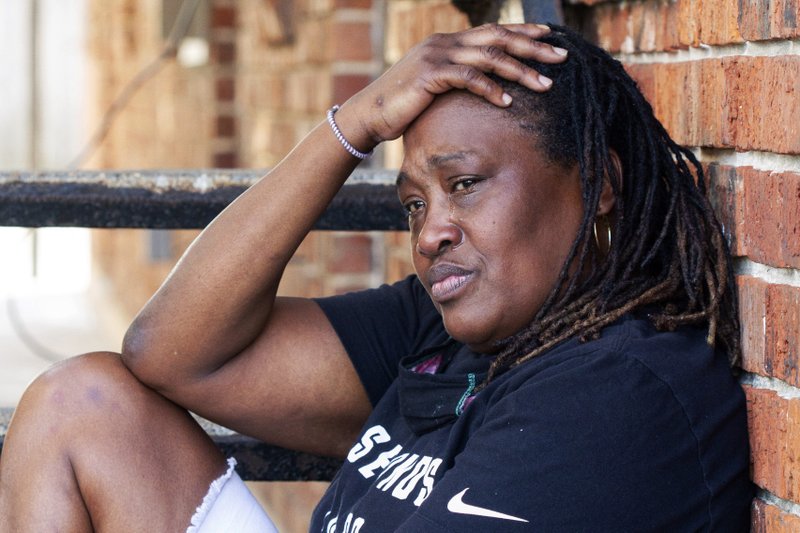
Blunt, a 50-year-old African American, owes thousands of dollars in back rent after she lost her banquet porter job. She has yet to receive her stimulus check and has not been approved for unemployment benefits. Her family is getting by with food stamps and the charity of neighbors.

“I can’t believe this happened to me because I work hard,” said Blunt, whose eviction is at the mercy of the federal moratorium. “I don’t have any money coming in. I don’t have nothing. I don’t know what to do. … My heart is so heavy.”

Along with exacerbating a housing crisis in many cities that have long been plagued by a shortage of affordable options, widespread discrimination and a lack of resources for families in need, the spike in filings is raising concerns that housing courts could spread the coronavirus.

Many cities are still running hearings virtually. But others, like New Orleans, have opened their housing courts. Masks and temperature checks are required, but maintaining social distance has been a challenge.

“The first couple of weeks, we were in at least two courts where we felt really quite unsafe,” said Hannah Adams, a staff attorney with Southeast Louisiana Legal Services.

In Columbus, Ohio, Amanda Wood was among some 60 people on the docket Friday for eviction hearings at a convention center converted into a courtroom.

Wood, 23, lost her job at a claims management company in early April. The following day, the mother of a 6-month-old found out she was pregnant again. Now, she is two months behind rent and can’t figure out a way to make ends meet.

Wood managed to find a part-time job at FedEx, loading vans at night. But her pregnancy and inability to find stable childcare has left her with inconsistent paychecks.

“The whole process has been really difficult and scary,” said Wood, who is hoping to set up a payment scheduled after meeting with a lawyer Friday. “Not knowing if you’re going to have somewhere to live, when you’re pregnant and have a baby, is hard.”

Though the numbers of eviction filings in Ohio and elsewhere are rising and, in some places reaching several hundred a week, they are still below those in past years for July. Higher numbers are expected in August and September.

Experts credit the slower pace to the federal eviction moratorium as well as states and municipalities that used tens of millions of dollars in federal stimulus funding for rental assistance. It also helped that several states, including Massachusetts and Arizona, have extended their eviction moratorium into the fall.

Still, experts argue more needs to be done at the state and federal level for tenants and landlords.

Negotiations between Congress and the White House over further assistance are ongoing. A $3 trillion coronavirus relief bill passed in May by Democrats in the House would provide about $175 billion to pay rents and mortgages, but the $1 trillion counter from Senate Republicans only has several billion in rental assistance. Advocacy groups are looking for over $100 billion.

“An eviction moratorium without rental assistance is still a recipe for disaster,” said Graham Bowman, staff attorney with the Ohio Poverty Law Center. “We need the basic economics of the housing market to continue to work. The way you do that is you need broad-based rental assistance available to families who have lost employment during this crisis.”

“The scale of this problem is enormous so it needs a federal response.”


Virus testing in the US is dropping, even as deaths mount

https://apnews.com/aebdc0978de958f20ab3f398cdf6f769

Virus testing in the US is dropping, even as deaths mount

U.S. testing for the coronavirus is dropping even as infections remain high and the death toll rises by more than 1,000 a day, a worrisome trend that officials attribute largely to Americans getting discouraged over having to wait hours to get a test and days or weeks to learn the results.

An Associated Press analysis found that the number of tests per day slid 3.6% over the past two weeks to 750,000, with the count falling in 22 states. That includes places like Alabama, Mississippi, Missouri and Iowa where the percentage of positive tests is high and continuing to climb, an indicator that the virus is still spreading uncontrolled.

Amid the crisis, some health experts are calling for the introduction of a different type of test that would yield results in a matter of minutes and would be cheap and simple enough for millions of Americans to test themselves — but would also be less accurate.

“There’s a sense of desperation that we need to do something else,” said Dr. Ashish Jha, director of Harvard’s Global Health Institute.

Widespread testing is considered essential to managing the outbreak as the U.S. approaches a mammoth 5 million confirmed infections and more than 157,000 deaths out of over 700,000 worldwide.

Testing demand is expected to surge again this fall, when schools reopen and flu season hits, most likely outstripping supplies and leading to new delays and bottlenecks.

Some of the decline in testing over the past few weeks was expected after backlogged commercial labs urged doctors to concentrate on their highest-risk patients. But some health and government officials are seeing growing public frustration and waning demand.

In Iowa, state officials are reporting less interest in testing, despite ample supplies. The state’s daily testing rate peaked in mid-July but has declined 20% in the last two weeks.

“We have the capacity. Iowans just need to test,” Gov. Kim Reynolds said last week.

Jessica Moore of rural Newberry, South Carolina, said that after a private lab lost her COVID-19 test results in mid-July, she had to get re-tested at a pop-up site organized by the state.

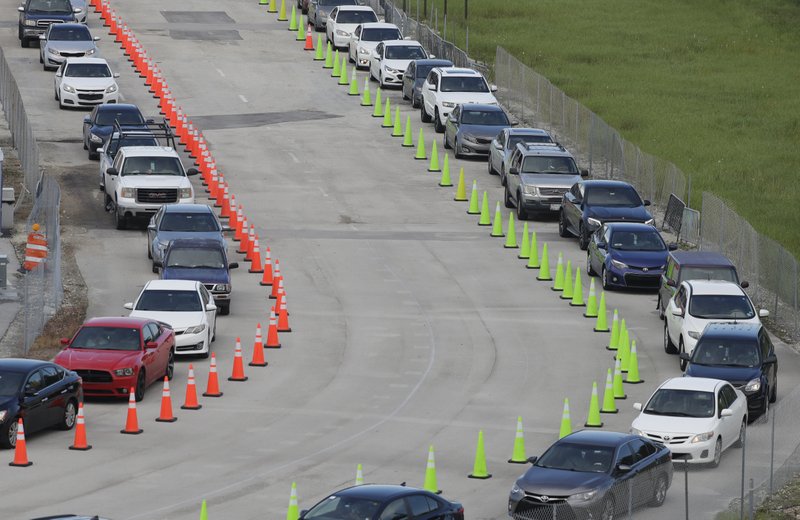
Moore and her husband arrived early on a Saturday morning at the site, a community center, where they waited for two hours for her test. Moore watched in the rear-view mirror as people drove up, saw the long line of cars, and then turned around and left.

“If people have something to do on a Saturday and they want to get tested, they’re not going to wait for two hours in the South Carolina heat for a test, especially if they’re not symptomatic,” Moore said.

Before traveling from Florida to Delaware last month, Laura DuBose Schumacher signed up to go to a drive-up testing site in Orlando with her husband. They were given a one-hour window in which to arrive.

They got there at the start of the window, but after 50 minutes it looked as if the wait would be another hour. Others who had gone through the line told them that they wouldn’t get their results until five days later, a Monday, at the earliest. They were planning to travel the next day, so they gave up.

“Monday would have been pointless, so we left the line,” Schumacher said.

The number of confirmed infections in the U.S. has topped 4.7 million, with new cases running at nearly 60,000 a day on average, down from more than 70,000 in the second half of July.

U.S. testing is built primarily on highly sensitive molecular tests that detect the genetic code of the coronavirus. Although the test is considered the gold standard for accuracy, experts increasingly say the country’s overburdened lab system is incapable of keeping pace with the outbreak and producing results within two or three days, the time frame crucial to isolating patients and containing the virus.

“They’re doing as good a job as they possibly can do, but the current system will not allow them to keep up with the demand,” said Mara Aspinall of Arizona State University’s College of Health Solutions.

Testing delays have led researchers at Harvard and elsewhere to propose a new approach using so-called antigen tests — rapid technology already used to screen for flu, strep throat and other common infections. Instead of detecting the virus itself, such tests look for viral proteins, or antigens, which are generally considered a less accurate measure of infection.

A number of companies are studying COVID-19 antigen tests in which you spit on a specially coated strip of paper, and if you are infected, it changes color. Experts say the speed and widespread availability of such tests would more than make up for their lower precision.

While no such tests for the coronavirus are on the U.S. market, experts say the technology is simple and the hurdles are more regulatory than technical. The Harvard researchers say production could quickly be scaled into the millions.

A proposal from the Harvard researchers calls for the federal government to distribute $1 saliva-based antigen tests to all Americans so that they can test themselves regularly, perhaps even daily.

Even with accuracy as low as 50%, researchers estimate the paper strip tests would uncover five times more COVID-19 cases than the current laboratory-based approach, which federal officials estimate catches just 1 in 10 infections.

But the approach faces resistance in Washington, where federal regulators have required at least 80% accuracy for new COVID-19 tests.

To date, the Food and Drug Administration has allowed only two COVID-19 antigen tests to enter the market. Those tests require a nasal swab supervised by a health professional and can only be run on specialized machines found at hospitals, doctor’s offices, nursing homes and clinics.

Also, because of the risk of false negatives, doctors may need to confirm a negative result with a genetic test when patients have possible symptoms of COVID-19.

On Tuesday, the governors of Maryland, Virginia, Louisiana and three other states announced an agreement with the Rockefeller Foundation to purchase more than 3 million of the FDA-cleared antigen tests, underscoring the growing interest in the technology.

When asked about introducing cheaper, paper-based tests, the government’s “testing czar,” Adm. Brett Giroir, warned that their accuracy could fall as low as 20% to 30%.

“I don’t think that would do a service to the American public of having something that is wrong seven out of 10 times,” Giroir said last week. “I think that could be catastrophic.”

___

This story has been corrected to show that Iowa’s daily testing rate has declined 20%, not 40%.


Pandemic relief funds pivotal in keeping hospitals afloat during Q2

https://www.fiercehealthcare.com/hospitals/hospital-earnings-highlight-pivotal-role-federal-relief-funds-staying-afloat-during?mkt_tok=eyJpIjoiTURoaU9HTTRZMkV3TlRReSIsInQiOiJwcCtIb3VSd1ppXC9XT21XZCtoVUd4ekVqSytvK1wvNXgyQk9tMVwvYXcyNkFHXC9BRko2c1NQRHdXK1Z5UXVGbVpsTG5TYml5Z1FlTVJuZERqSEtEcFhrd0hpV1Y2Y0sxZFNBMXJDRkVnU1hmbHpQT0pXckwzRVZ4SUVWMGZsQlpzVkcifQ%3D%3D&mrkid=959610

Hospital system earnings for the second quarter of the year painted a stark picture of how federal relief funding helped offset massive losses in patient volume sparked by the COVID-19 pandemic.

But a full financial recovery may not happen until next year, some analysts warn.

Major hospital systems such as HCA Health and Universal Health Services posted profits in the second quarter despite plummeting volumes sparked by the cancellation of elective procedures and patients avoiding care due to fears of exposure to the virus. A key boost, however, came from a $175 billion fund passed by Congress and loans under the Medicare Accelerated and Advance Payments Program.

“These companies survived the June quarter and exited the quarter with substantial amounts of liquidity,” said Jonathan Kanarek, vice president and senior credit officer for Moody’s Investors Services. “We think [liquidity] is probably the most critical factor for them as far as weathering the storm.”

Congress has approved $175 billion to help prop up providers, of which the Department of Health and Human Services has distributed more than $100 billion.

The Centers for Medicare & Medicaid Services also gave out $100 billion in advance Medicare payments before suspending the program in late April. But the payments are loans that hospitals have to start repaying as soon as this month, as opposed to the congressional funding that does not have to get paid back.

Hospital system earnings illustrated how pivotal the relief funds were to combat massive holes in patient volumes.

Tenet Healthcare, which operates 65 hospitals across the country, reported Monday that it earned in the second quarter adjusted earnings before interest, taxes, depreciation and amortization (EBITDA) of $732 million. But of that $732 million, more than 70% of it was aid from the relief fund.

Tenet wasn’t the only for-profit system where relief funding was a large part of their adjusted EBITDA.

Community Health Systems, which operates 95 facilities, reported an adjusted EBITDA of $454 million in the second quarter. But most of that figure was due to the $448 million that it got from the relief funds.

The provider funding made up a smaller portion of HCA Healthcare’s earnings. The system of 184 hospitals reported that the funding made up 31% of its adjusted EBITDA.

Hospital system volumes greatly declined in April as facilities were forced to cancel elective procedures and patients were scared of going to the hospital.

For example, Tenet’s hospital admissions in April were 33% of what it had in the same month in 2019. But volumes started to recover as shelter-in-place orders expired and some states got a better handle on the pandemic.

Tenet saw admissions grow in June to 90% of what they were in June 2019.

But it remains unclear what hospital finances will look like for the rest of the year. Major systems like Tenet and HCA have scrapped their 2020 financial outlook because of the pandemic.

“We don’t think the shape of this recovery or trajectory will be linear in nature,” Kanarek said. “We think there will be a lot of starts and stops.”

Those starts and stops will depend on the extent of the spread of the virus in an area.

Some states such as Florida, Texas and Arizona have seen massive spikes in the virus in recent weeks, which has put renewed strain on systems. Texas’ governor canceled elective procedures in eight counties back in June, some of which included major cities such as Houston and Dallas.

“I am a little skeptical that we are going to be back to normal before we ultimately have a vaccine,” Kanarek said.

It is also murky on whether hospitals will continue to get more financial help from Congress.

The House passed the HEROES Act more than a month ago that gives providers another $100 billion, but it has stalled in the Senate.

Congress and the White House have been in extensive talks for more than a week on a new relief package. Senate Majority Leader Mitch McConnell released a package last week that had $25 billion in relief funding and lawsuit liability protections for providers.

But even without the additional funding, for-profit hospitals have made some moves to prepare for more shutdowns such as accessing capital markets to add additional lawyers of bank liquidity, Kanarek said.

“We can only hope 2021 will look like a more normal year for hospitals, perhaps more like 2019, but there is still a lot of uncertainty out there,” he said.


For 20th straight week, more than 1 million Americans filed jobless claims even as enhanced benefits expired

https://www.washingtonpost.com/business/2020/08/06/20th-straight-week-more-than-1-million-americans-filed-jobless-claims-even-enhanced-benefits-expired/?utm_campaign=wp_main&utm_medium=social&utm_source=facebook&fbclid=IwAR2i4HqZnx_L6zRMf81cWUKPOQYNCp7iqWWvw0eMcwVzw1Q_3yUy5j7F0Ok

Stocks fall as weekly unemployment claims show a 'slowing' pace of ...

1.2 million Americans sought the benefits last week, down slightly from the week before.

The number of newly filed unemployed insurance claims dropped last week after two straight weeks of rising, but it remains well above historic pre-pandemic levels, according to Labor Department data.

It marked the 20th straight week that more than 1 million Americans filed jobless claims.

A total of 1.19 million people filed new claims last week, down from 1.43 million the week previously. The numbers of new claimants have come down from their peak in March of more than six million, but they are still well above the pre-pandemic record of 695,000 from 1982.

Another 656,000 new claims were filed for Pandemic Unemployment Assistance, the benefits offered to gig and self-employed workers.

The number of people continuing traditional unemployment claims, from the week ending July 25, was 16.1 million, down about 844,000 from the week prior. (The statistic lags by a week.) When including the PUA, more than 32.1 million Americans are currently receiving some form of unemployment benefits.

“It is promising that the initial unemployment numbers have ticked down,” said AnnElizabeth Konkel, an economist at Indeed Hiring Lab. “But we aren’t out of the woods yet. The claims are still much higher than the pre-covid era, so it’s still pointing to a lot of economic pain.”

The numbers come during what many economists say is an inflection point for the country’s economy.

Congress continues to wrangle over an extension to the extra $600 a week in unemployment benefits that many laid off workers say have helped stabilize their finances — and stave off a deeper crisis from an economy hollowed by evictions, mortgage and credit card defaults, and plunging consumer demand. Those benefits expired last week.

Funds from the Paycheck Protection Program, the $660 billion federal aid program that was meant to help small businesses keep workers on the payroll, are in the process of running out, as well. And the coronavirus’ frightening march since mid-June has added to uncertainty about when — or even if — the country can expect a return in the near future to what was considered a normal way of life and doing business not that long ago.

There are many indications that workers are getting laid off for a second time in just a few short months. In California, for example, which has one of the highest rates of workers on unemployment insurance, an analysis by the University of California, Los Angeles, and the California Employment Development Department found that more than half — 57 percent — of initial unemployment claims filed during the week ending July 25th were from workers re-opening older claims, a large majority of which had been filed early in the crisis.

The unemployment rate for July, as well as the number of jobs added or lost, will be released Friday by the Bureau of Labor Statistics, from a survey taken early in the month. Many economists expect the country’s unemployment rate to drop from the 11.1 percent it was at in June; but due to the survey’s lag, many caution that the release will not register more recent economic developments that have emerged in recent weeks as the the pandemic has caught up with the country’s economic rebound.

Companies announcing layoffs in the last week include: NBCUniversalJohn DeereFujitsu Network Communications, and hotel and tourism based businesses like retailer DFS Group and Wyndham Vacation Ownership.