How Many More Will Die From Fear of the Coronavirus?

Fear of contracting the coronavirus has resulted in many people missing necessary screenings for serious illnesses, like cancer and heart disease.

Seriously ill people avoided hospitals and doctors’ offices. Patients need to return. It’s safe now.

More than 100,000 Americans have died from Covid-19. Beyond those deaths are other casualties of the pandemic — Americans seriously ill with other ailments who avoided care because they feared contracting the coronavirus at hospitals and clinics.

The toll from their deaths may be close to the toll from Covid-19. The trends are clear and concerning. Government orders to shelter in place and health care leaders’ decisions to defer nonessential care successfully prevented the spread of the virus. But these policies — complicated by the loss of employer-provided health insurance as people lost their jobs — have had the unintended effect of delaying care for some of our sickest patients.

To prevent further harm, people with serious, complex and acute illnesses must now return to the doctor for care.

Across the country, we have seen sizable decreases in new cancer diagnoses (45 percent) and reports of heart attacks (38 percent) and strokes (30 percent). Visits to hospital emergency departments are down by as much as 40 percent, but measures of how sick emergency department patients are have risen by 20 percent, according to a Mayo Clinic study, suggesting how harmful the delay can be. Meanwhile, non-Covid-19 out-of-hospital deaths have increased, while in-hospital mortality has declined.

These statistics demonstrate that people with cancer are missing necessary screenings, and those with heart attack or stroke symptoms are staying home during the precious window of time when the damage is reversible. In fact, a recent poll by the American College of Emergency Physicians and Morning Consult found that 80 percent of Americans say they are concerned about contracting the coronavirus from visiting the emergency room.

Unfortunately, we’ve witnessed grievous outcomes as a result of these delays. Recently, a middle-aged patient with abdominal pain waited five days to come to a Mayo Clinic emergency department for help, before dying of a bowel obstruction. Similarly, a young woman delayed care for weeks out of a fear of Covid-19 before she was transferred to a Cleveland Clinic intensive care unit with undiagnosed leukemia. She died within weeks of her symptoms appearing. Both deaths were preventable.

The true cost of this epidemic will not be measured in dollars; it will be measured in human lives and human suffering. In the case of cancer alone, our calculations show we can expect a quarter of a million additional preventable deaths annually if normal care does not resume. Outcomes will be similar for those who forgo treatment for heart attacks and strokes.

Over the past 12 weeks, hospitals deferred nonessential care to prevent viral spread, conserve much-needed personal protective equipment and create capacity for an expected surge of Covid-19 patients. During that time, we also have adopted methods to care for all patients safely, including standard daily screenings for the staff and masking protocols for patients and the staff in the hospital and clinic. At this point, we are gradually returning to normal activities while also mitigating risk for both patients and staff members.

The Covid-19 crisis has changed the practice of medicine in fundamental ways in just a matter of months. Telemedicine, for instance, allowed us to pivot quickly from in-person care to virtual care. We have continued to provide necessary care to our patients while promoting social distancing, reducing the risk of viral spread and recognizing patients’ fears.

Both Cleveland Clinic and Mayo Clinic have gone from providing thousands of virtual visits per month before the pandemic to hundreds of thousands now across a broad range of demographics and conditions. At Cleveland Clinic, 94 percent of diabetes patients were cared for virtually in April.

While virtual visits are here to stay, there are obvious limitations. There is no substitute for in-person care for those who are severely ill or require early interventions for life-threatening conditions. Those are the ones who — even in the midst of this pandemic — must seek the care they need.

Patients who need care at a clinic or hospital or doctor’s office should know they have reduced the risk of Covid-19 through proven infection-control precautions under guidelines from the Centers for Disease Control and Prevention. We’re taking unprecedented actions, such as restricting visiting hours, screening patient and caregiver temperatures at entrances, encouraging employees to work from home whenever possible, providing spaces that allow for social distancing, and requiring proper hand hygiene, cough etiquette and masking.

All of these strategies are intended to significantly reduce risk while allowing for vital, high-quality care for our patients.

The novel coronavirus will not go away soon, but its systemic side effects of fear and deferred care must.

We will continue to give vigilant attention to Covid-19 while urgently addressing the other deadly diseases that haven’t taken a pause during the pandemic. For patients with medical conditions that require in-person care, please allow us to safely care for you — do not delay. Lives depend on it.


Hospitals Got Bailouts and Furloughed Thousands While Paying C.E.O.s Millions

Hospitals Got Bailouts and Furloughed Thousands While Paying ...

Dozens of top recipients of government aid have laid off, furloughed or cut the pay of tens of thousands of employees.

HCA Healthcare is one of the world’s wealthiest hospital chains. It earned more than $7 billion in profits over the past two years. It is worth $36 billion. It paid its chief executive $26 million in 2019.

But as the coronavirus swept the country, employees at HCA repeatedly complained that the company was not providing adequate protective gear to nurses, medical technicians and cleaning staff. Last month, HCA executives warned that they would lay off thousands of nurses if they didn’t agree to wage freezes and other concessions.

A few weeks earlier, HCA had received about $1 billion in bailout funds from the federal government, part of an effort to stabilize hospitals during the pandemic.

HCA is among a long list of deep-pocketed health care companies that have received billions of dollars in taxpayer funds but are laying off or cutting the pay of tens of thousands of doctors, nurses and lower-paid workers. Many have continued to pay their top executives millions, although some executives have taken modest pay cuts.

The New York Times analyzed tax and securities filings by 60 of the country’s largest hospital chains, which have received a total of more than $15 billion in emergency funds through the economic stimulus package in the federal CARES Act.

The hospitals — including publicly traded juggernauts like HCA and Tenet Healthcare, elite nonprofits like the Mayo Clinic, and regional chains with thousands of beds and billions in cash — are collectively sitting on tens of billions of dollars of cash reserves that are supposed to help them weather an unanticipated storm. And together, they awarded the five highest-paid officials at each chain about $874 million in the most recent year for which they have disclosed their finances.

At least 36 of those hospital chains have laid off, furloughed or reduced the pay of employees as they try to save money during the pandemic.

Industry officials argue that furloughs and pay reductions allow hospitals to keep providing essential services at a time when the pandemic has gutted their revenue.

But more than a dozen workers at the wealthy hospitals said in interviews that their employers had put the heaviest financial burdens on front-line staff, including low-paid cafeteria workers, janitors and nursing assistants. They said pay cuts and furloughs made it even harder for members of the medical staff to do their jobs, forcing them to treat more patients in less time.

Even before the coronavirus swept America, forcing hospitals to stop providing lucrative nonessential surgery and other services, many smaller hospitals were on the financial brink. In March, lawmakers sought to address that with a vast federal economic stimulus package that included $175 billion for the Department of Health and Human Services to hand out in grants to hospitals.

But the formulas to determine how much money hospitals receive were based largely on their revenue, not their financial needs. As a result, hospitals serving wealthier patients have received far more funding than those that treat low-income patients, according to a study by the Kaiser Family Foundation.

One of the bailout’s goals was to avoid job losses in health care, said Zack Cooper, an associate professor of health policy and economics at Yale University who is a critic of the formulas used to determine the payouts. “However, when you see hospitals laying off or furloughing staff, it’s pretty good evidence the way they designed the policy is not optimal,” he added.

The Mayo Clinic, with more than eight months of cash in reserve, received about $170 million in bailout funds, according to data compiled by Good Jobs First, which researches government subsidies of companies. The Mayo Clinic is furloughing or reducing the working hours of about 23,000 employees, according to a spokeswoman, who was among those who went on furlough. A second spokeswoman said that Mayo Clinic executives have had their pay cut.

Seven chains that together received more than $1.5 billion in bailout funds — Trinity Health, Beaumont Health and the Henry Ford Health System in Michigan; SSM Health and Mercy in St. Louis; Fairview Health in Minneapolis; and Prisma Health in South Carolina — have furloughed or laid off more than 30,000 workers, according to company officials and local news reports.

The bailout money, which hospitals received from the Health and Human Services Department without having to apply for it, came with few strings attached.

Katherine McKeogh, a department spokeswoman, said it “encourages providers to use these funds to maintain delivery capacity by paying and protecting doctors, nurses and other health care workers.” The legislation restricts hospitals’ ability to use the bailout funds to pay top executives, although it doesn’t stop recipients from continuing to award large bonuses.

The hospitals generally declined to comment on how much they are paying their top executives this year, although they have reported previous years’ compensation in public filings. But some hospitals furloughing front-line staff or cutting their salaries have trumpeted their top executives’ decisions to take voluntary pay cuts or to contribute portions of their salary to help their employees.

The for-profit hospital giant Tenet Healthcare, which has received $345 million in taxpayer assistance since April, has furloughed roughly 11,000 workers, citing the financial pressures from the pandemic. The company’s chief executive, Ron Rittenmeyer, told analysts in May that he would donate half of his salary for six months to a fund set up to assist those furloughed workers.

But Mr. Rittenmeyer’s salary last year was a small fraction of his $24 million pay package, which consists largely of stock options and bonuses, securities filings show. In total, he will wind up donating roughly $375,000 to the fund — equivalent to about 1.5 percent of his total pay last year.

A Tenet spokeswoman declined to comment on the precise figures.

The chief executive at HCA, Samuel Hazen, has donated two months of his salary to a fund to help HCA’s workers. Based on his pay last year, that donation would amount to about $237,000 — or less than 1 percent — of his $26 million compensation.

“The leadership cadre of these organizations are going to need to make sacrifices that are commensurate with the sacrifices of their work force, not token sacrifices,” said Jeff Goldsmith, the president of Health Futures, an industry consulting firm.

Many large nonprofit hospital chains also pay their senior executives well into the millions of dollars a year.

Dr. Rod Hochman, the chief executive of the Providence Health System, for instance, was paid more than $10 million in 2018, the most recent year for which records are available. Providence received at least $509 million in federal bailout funds.

A spokeswoman, Melissa Tizon, said Dr. Hochman would take a voluntary pay cut of 50 percent for the rest of 2020. But that applies only to his base salary, which in 2018 was less than 20 percent of his total compensation.

Some of Providence’s physicians and nurses have been told to prepare for pay cuts of at least 10 percent beginning in July. That includes employees treating coronavirus patients.

Stanford University’s health system collected more than $100 million in federal bailout grants, adding to its pile of $2.4 billion of cash that it can use for any purpose.

Stanford is temporarily cutting the hours of nursing staff, nursing assistants, janitorial workers and others at its two hospitals. Julie Greicius, a spokeswoman for Stanford, said the reduction in hours was intended “to keep everyone employed and our staff at full wages with benefits intact.”

Ms. Greicius said David Entwistle, the chief executive of Stanford’s health system, had the choice of reducing his pay by 20 percent or taking time off, and chose to reduce his working hours but “is maintaining his earning level by using paid time off.” In 2018, the latest year for which Stanford has disclosed his compensation, Mr. Entwistle earned about $2.8 million. Ms. Greicius said the majority of employees made the same choice as Mr. Entwistle.

HCA’s $1 billion in federal grants appears to make it the largest beneficiary of health care bailout funds. But its medical workers have a long list of complaints about what they see as penny-pinching practices.

Since the pandemic began, medical workers at 19 HCA hospitals have filed complaints with the Occupational Safety and Health Administration about the lack of respirator masks and being forced to reuse medical gowns, according to copies of the complaints reviewed by The Times.

Ed Fishbough, an HCA spokesman, said that despite a global shortage of masks and other protective gear, the company had “provided appropriate P.P.E., including a universal masking policy implemented in March requiring all staff in all areas to wear masks, including N95s, in line with C.D.C. guidance.”

Celia Yap-Banago, a nurse at an HCA hospital in Kansas City, Mo., died from the virus in April, a month after her colleagues complained to OSHA that she had to treat a patient without wearing protective gear. The next month, Rosa Luna, who cleaned patient rooms at HCA’s hospital in Riverside, Calif., also died of the virus; her colleagues had warned executives in emails that workers, especially those cleaning hospital rooms, weren’t provided proper masks.

Around the time of Ms. Luna’s death, HCA executives delivered a warning to officials at the Service Employees International Union and National Nurses United, which represent many HCA employees. The company would lay off up to 10 percent of their members, unless the unionized workers amended their contracts to incorporate wage freezes and the elimination of company contributions to workers’ retirement plans, among other concessions.

Nurses responded by staging protests in front of more than a dozen HCA hospitals.

“We don’t work in a jelly bean factory, where it’s OK if we make a blue jelly bean instead of a red one,” said Kathy Montanino, a nurse treating Covid-19 patients at HCA’s Riverside hospital. “We are dealing with people’s lives, and this company puts their profits over patients and their staff.”

Mr. Fishbough, the spokesman, said HCA “has not laid off or furloughed a single caregiver due to the pandemic.” He said the company had been paying medical workers 70 percent of their base pay, even if they were not working. Mr. Fishbough said that executives had taken pay cuts, but that the unions had refused to take similar steps.

“While we hope to continue to avoid layoffs, the unions’ decisions have made that more difficult for our facilities that are unionized,” he said. The dispute continues.

Apparently anticipating a strike, a unit of HCA recently created “a new line of business focused on staffing strike-related labor shortages,” according to an email that an HCA recruiter sent to nurses.

The email, reviewed by The Times, said nurses who joined the venture would earn more than they did in their current jobs: up to $980 per shift, plus a $150 “Show Up” bonus and a continental breakfast.


The patients stayed away—will they come back?

https://mailchi.mp/9f24c0f1da9a/the-weekly-gist-june-5-2020?e=d1e747d2d8

Emergency Department Patient Resources

new analysis from the CDC this week confirmed what we have been hearing anecdotally from health systems for several weeks—as the coronavirus lockdown took hold, there was a precipitous drop in visits to hospital emergency departments. According to the study, visits were down by 42 percent in the month of April compared to the previous year, and despite a rebound in May, were still 26 percent lower than a year ago. Visits in the Northeast dropped the most, as did those among women, and children under 14.

Although visits for minor ailments and symptoms declined the most, even more disconcerting was the drop in visits for chest pain, echoing the concern we’ve heard in many parts of the country that many patients may have suffered minor heart attacks without being treated, or may have waited to be seen until significant damage had been done.

As non-emergent visits have begun to return to many facilities, we continue to hear that emergency department and urgent care volume remains relatively low.

Survey data indicate that patients are fearful of becoming infected with coronavirus if they visit healthcare facilities—especially, it seems, ones where they’ll be forced to wait.

While many providers are investing in messaging campaigns to assure patients it’s safe to return, this nightmarish first-person account by one healthcare insider provides a useful cautionary tale.

Visiting a surgeon for a pre-op consult, she found the experience of visiting a COVID-era hospital downright dystopian. Simply touting safety precautions by itself won’t make patients more comfortable—they’ll need to see and feel that measures are in place to make time spent in a care setting as efficient and reassuring as possible. Otherwise, like the insider in question, they’ll take their business elsewhere. There’s work to be done.


A Third of Unemployment Benefits Haven’t Been Paid Out: Report

https://www.thefiscaltimes.com/2020/06/02/Third-Unemployment-Benefits-Haven-t-Been-Paid-Out-Report

A Third of Unemployment Benefits Haven't Been Paid Out: Report

The U.S. Treasury paid out $146 billion in jobless benefits in the three months ending in May as tens of millions of Americans lost their jobs due to the coronavirus pandemic. Although the number is massive – larger than all of the unemployment benefits provided during the depths of the Great Recession in 2009 – it’s smaller than it should have been, according to a new analysis by Bloomberg News. Crunching the numbers on weekly unemployment filings and average claim size, Bloomberg found that total jobless benefits should have come to roughly $214 billion during that time.

“The estimated gap of some $67 billion shows how emergency efforts to boost payments, and deliver them via creaking state-level systems, are lagging the needs of a jobs crisis that’s seen more than 40 million people file for unemployment as the economy shut down,” Bloomberg’s Shawn Donnan and Catarina Saraiva wrote Tuesday.

A tough calculation: Although it’s hard to put a precise number on the shortfall – the Labor Department pushed back against the method used by Bloomberg to develop its estimate – there is general agreement that there are many people who still haven’t received the unemployment assistance they are entitled to. “There’s a lot more money that should have gone out that has not gone out,” said Jay Shambaugh, an economist at the Brookings Institution who has been studying the issue.

And Bloomberg says its analysis likely provides a conservative estimate of the shortfall. Some states are still working through backlogs of unemployment claims – Texas alone is waiting to verify nearly 650,000 cases – and more than 7 million people are still owed retroactive benefits under the Pandemic Unemployment Assistance program for independent contractors.

Why it matters: In addition to the unnecessary suffering the delays are causing, the shortfall is reducing the positive economic effect that unemployment benefits are intended to provide. “On paper the U.S. strategy is very generous,” Ernie Tedeschi, a former U.S. Treasury economist now at Evercore ISI, told Bloomberg. “But that generosity on paper is meaningless if it doesn’t translate into actual money in people’s pockets when they need it.”

Diane Swonk, chief economist at the accounting firm Grant Thornton, said she is worried that lawmakers are experiencing “fiscal fatigue” as the crisis wears on, risking a falloff in aid that could prolong the recession. “We’re really talking about an economy that is going to be operating at a fraction of its capacity for a long period of time,” she told Bloomberg.


Unemployment Claims Top 42 Million

https://www.thefiscaltimes.com/2020/06/04/Unemployment-Claims-Top-42-Million

Unemployment Claims Top 42 Million

About 1.9 million people filed for unemployment benefits last week, the Department of Labor announced Thursday, bringing the total for initial claims over the last 11 weeks to 42.6 million.

Continuing claims rose by 649,000 over the previous week, for a total of 21.5 million. Adding independent contractors, the number of people receiving unemployment benefits comes to roughly 30 million.

The good news: Initial jobless claims for state benefits continue to fall. Torsten Slok, chief economist at Deutsche Bank Securities, said the job market appears to have bottomed out and is “crawling out of the hole now,” adding that we “have the worst behind us.”
Earlier this week, Mark Zandi, chief economist at Moody’s Analytics, said he thinks the coronavirus recession is technically over, with growth resuming this month. “This Covid recession will go down as the shortest and arguably the most severe in history,” Zandi told The Washington Post.

The bad news: The unemployment numbers are still shockingly high, and the economy is in bad shape by any measure. “Even as states reopen, claims in the millions are an indicator that the economic pain of the Covid-19 crisis is still acute,” Daniel Zhao, senior economist at Glassdoor, told CNBC.

Recovery is expected to be slow and painful. Economist Ed Yardeni said Thursday in a note to clients that he expects it to take more than two years to recover all of the lost jobs, with a return to the February 2020 employment peak not coming until October 2022.

The even worse news: The official unemployment numbers are almost certainly underestimating the damage.

In addition to the state unemployment filings, there were about 623,000 newly reported claims from independent contractors, who are eligible to receive federal aid temporarily under the Pandemic Unemployment Assistance program. But at least half a million filings for pandemic relief payments have yet to show up in the official data, Bloomberg reported Thursday, due to lags in the system. And the weekly unemployment reports tell us nothing about the people who may still be working but are earning far less than they were just a few months ago.

Up next: On Friday the Labor Department will release its employment numbers for May. Economists surveyed by Dow Jones project 8.3 million job losses and an unemployment rate of 20.5%.


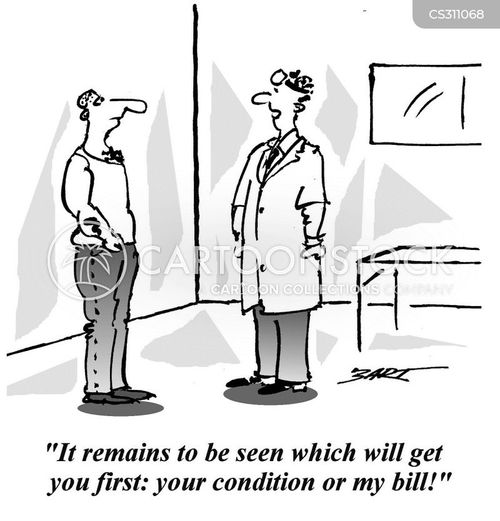
Cartoon – It remains to be seen which will get you first

Cartoon – It remains to be seen which will get you first | HENRY ...

Cartoon – Out of Pocket Experience

Cartoon – Out of Body Feeling vs Out of Pocket Experience | HENRY ...

Americans’ deepening financial stress will make the coronavirus a lot harder to contain

https://theconversation.com/americans-deepening-financial-stress-will-make-the-coronavirus-a-lot-harder-to-contain-139741

Americans' deepening financial stress will make the coronavirus a ...

Preventing deaths from COVID-19 depends on people who get it seeking treatment – which also allows authorities to track down whom they came in contact with to reduce spread.

But, as the economic pain and joblessness caused by the statewide lockdowns continue to grow, more Americans are experiencing severe strains on their personal finances. This threatens our ability to contain the pandemic because those feeling the most financial stress are much less likely to seek medical care if they experience coronavirus symptoms, according to my analysis of a recent Federal Reserve survey.

As an economist who studies how individuals make health care choices, I worry that in the coming months even more people will consider forgoing vital treatment to pay rent or some other bill – especially as the extended unemployment benefits, rent moratoriums and other relief are set to expire soon.

‘Just getting by’

The Fed conducts a survey of the economic health of U.S. households every quarter, most recently near the end of 2019. In April, it conducted a supplementary but similar survey to quickly gauge how people were handling the coronavirus crisis. Results of both surveys were released on May 14.

The Fed tries to measure financial stress in three key ways. Its surveys ask respondents if they are unable to pay all their monthly bills, couldn’t cover a US$400 emergency expense, or are “just getting by” or worse.

Even before the pandemic hit, the picture wasn’t pretty. In October, when the fourth-quarter survey was conducted, 42% of employed respondents reported fitting at least one of these descriptions, while over 8% said they fit all three. Those figures jumped to 72% and 20% for low-income workers.

But by April, tens of millions of people who had jobs in October lost them as most nonessential businesses across the U.S. either closed or reduced their services. The unemployment rate shot up to 14.7% that month – the highest since the Great Depression – and is expected to climb further when the May data are released on June 5.

The Fed’s April survey, however, paints an even broader picture of the economic impact of the pandemic. In that survey, about 28% of the previously employed respondents said they either lost their job, were being furloughed, had their hours cut or were taking unpaid leave. This has been financially devastating to many, with 68% of this group reporting one of the stresses listed above and 28% saying they were experiencing all three, regardless of income level.

Forgoing medical care

Separate questions in the surveys demonstrate just how strong the link is between financial and physical health.

The October survey also asks those respondents if they had skipped a doctor’s visit during the previous 12 months because of the cost. More than 20% of those who reported one of these financial stresses said they had, while almost 46% of those with all three said so.

In April, the Fed asked a more timely question: “If you got sick with symptoms of the coronavirus, would you try to contact a doctor?”

A third of those respondents who also said they’re experiencing all three financial stresses said “no.” This is especially significant because, unlike the October question, it describes a current, known threat, rather than referring to a previous medical issue of unknown severity. And the widely reported urgency and seriousness of the coronavirus suggests someone wouldn’t treat the decision to seek a doctor’s care or advice lightly.

Relieving the stress

That was back in April, less than a month into the coronavirus lockdowns. If the same questions were asked today, I believe the numbers would look a lot worse.

In the middle of a serious pandemic, we don’t want sick people avoiding treatment because they’re worried they won’t be able to put food on the table. This would likely worsen the spread of the coronavirus and make it a whole lot harder to contain.

As Congress debates additional measures to mitigate the economic and financial effects of the pandemic, it would be wise to keep in mind the connection between financial stress and individual decisions to seek medical care.


The Essence of Big Pharma


Few U.S. adults say they’ve been diagnosed with coronavirus, but more than a quarter know someone who has

https://www.pewresearch.org/fact-tank/2020/05/26/few-u-s-adults-say-theyve-been-diagnosed-with-coronavirus-but-more-than-a-quarter-know-someone-who-has/?utm_source=Pew+Research+Center&utm_campaign=ef5ba73bf3-EMAIL_CAMPAIGN_2020_05_29_05_11&utm_medium=email&utm_term=0_3e953b9b70-ef5ba73bf3-400197657

28% of U.S. adults say they know someone diagnosed with COVID-19 ...

Relatively few Americans say they have been diagnosed with COVID-19 or tested positive for coronavirus antibodies, but many more believe they may have been infected or say they personally know someone who has been diagnosed.

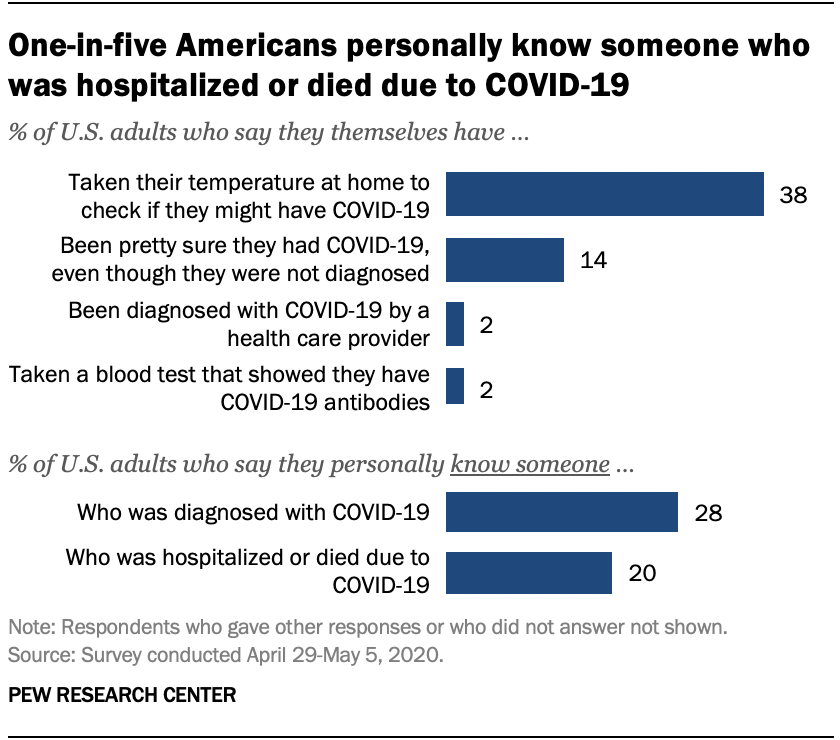
Only 2% of U.S. adults say they have been officially diagnosed with COVID-19 by a health care provider, according to a new Pew Research Center survey. And 2% say they have taken a blood test that showed they have COVID-19 antibodies, an indication that they previously had the coronavirus. But many more Americans (14%) say they are “pretty sure” they had COVID-19, despite not getting an official diagnosis. And nearly four-in-ten (38%) say they’ve taken their temperature to check if they might have the disease.

Although few Americans have been diagnosed with COVID-19 themselves, many more say they know someone with a positive diagnosis. More than one-in-four U.S. adults (28%) say they personally know someone who has been diagnosed by a health care provider as having COVID-19. A smaller share of Americans (20%) say they know someone who has been hospitalized or who has died as a result of having the coronavirus.

Some groups are more likely than others to report personal experiences with COVID-19. For instance, black adults are the most likely to personally know someone who has been hospitalized or died as a result of the disease. One-third of black Americans (34%) know someone who has been hospitalized or died, compared with 19% of Hispanics and 18% of white adults. Black Americans (32%) are also slightly more likely than Hispanic adults (26%) to know someone diagnosed with COVID-19. Public health studies have found black Americans are disproportionately dying or requiring hospitalization as a result of the coronavirus.

28% of U.S. adults say they know someone diagnosed with COVID-19 ...

Areas in the northeastern United States have recorded some of the highest rates of coronavirus cases and fatalities, and this is reflected in the Center’s survey. About four-in-ten adults living in the Northeast (42%) say they personally know someone diagnosed with COVID-19, significantly more than among adults living in any other region. People living in the Northeast (31%) are also the most likely to know someone who has been hospitalized or died as a result of the disease.

One aspect of personal risk for exposure to the coronavirus is whether someone is employed in a setting where they must have frequent contact with other people, such as at a grocery store, hospital or construction site. Given the potential for the spread of the coronavirus within households, risk to individuals is also higher if other members of the household are employed in similar settings. Among people who are currently employed full-time, 35% are working in a job with frequent public contact. Among those working part-time, almost half work (48%) in such a setting. For those living in a household with other adults, 35% report that at least one of those individuals is working in a job that requires frequent contact with other people.

Taken together, nearly four-in-ten Americans (38%) have this type of exposure – either currently working in a job that requires contact with others, living in a household with others whose jobs require contact, or both.

Hispanics (at 48%) are more likely than either blacks (38%) or whites (35%) to have this type of personal or household exposure. An earlier Center analysis of government data found Hispanic adults were slightly more likely to work in service-sector jobs that require customer interaction, and that are at higher risk of layoffs as a result of the virus. In fact, the current Center survey found Hispanics were among the most likely to have experienced pay cuts or job losses due to the coronavirus outbreak.

28% of U.S. adults say they know someone diagnosed with COVID-19 ...

Interpersonal exposure in the workplace is also more widespread among younger adults. And there is a 10 percentage point difference between upper- and lower-income Americans in exposure, with lower-income adults more likely to work in situations where they have to interact with the public, or to live with people who do.

Health experts warn that COVID-19 is particularly dangerous to people who have underlying medical conditions. In the survey, one-third of adults say they have such a condition. Among this group, nearly six-in-ten (58%) say that the coronavirus outbreak is a major threat to their personal health. Among those who do not report having an underlying medical condition, just 28% see the outbreak as a major threat to their health. Americans who have an underlying health condition are also more likely than those who do not to say they’ve taken their temperature to check if they might have COVID-19 (47% vs. 33% of those without a health condition).

Self-reports of an underlying health condition vary greatly by age. Among those ages 18 to 29, just 16% say they have a condition; this rises steadily with age to 56% among those 65 and older. Whites are a little more likely than blacks and Hispanics to report having a health condition, but both blacks (at 54%) and Hispanics (52%) are far more likely than whites (32%) to say that the coronavirus outbreak is “a major threat” to their health.