Missouri’s Medicaid expansion is back on

https://mailchi.mp/b5daf4456328/the-weekly-gist-july-23-2021?e=d1e747d2d8

Missouri Supreme Court reverses Medicaid expansion decision

On Thursday, the Missouri Supreme Court unanimously reversed a lower court ruling that held that the state’s $1.9B Medicaid expansion, approved by voters in a 2020 ballot initiative, was unconstitutional.

The ruling clears the way for the state’s Department of Social Services to begin implementation of the expansion, which is expected to cover 275,000 low-income Missouri residents. Under the Affordable Care Act (ACA), the federal government will pay 90 percent of the cost to cover the newly eligible Medicaid beneficiaries, along with an additional bump in federal funding for Missouri’s Medicaid program, thanks to a provision in the American Rescue Plan Act passed earlier this year. 

Missouri voters approved the expansion by a 53-47 margin last year, but the ballot initiative was held to be unconstitutional because it did not include a source of funding for the portion of coverage costs to be paid for by the state (and the state legislature refused to allocate money for the expansion, despite currently running a surplus). Five other states have turned to ballot initiatives to expand Medicaid under the ACA, seeking to work around state legislatures that have resisted the change. In all, a dozen states, mostly in the Southeast, have  chosen not to expand their Medicaid programs, even despite the additional incentives Congress voted into law this year. 

Democrats on Capitol Hill are considering legislative alternatives to provide new coverage to low-income residents in those states, as part of the $3.5T reconciliation package currently being negotiated. Numerous studies have shown the positive impact of expanding Medicaid on health and financial well-being, but state-level politics have proven to be a challenge, especially in deep-red states. Meanwhile, tax dollars continue to flow from those states to fund Medicaid expansion elsewhere—now, including Missouri.

New CMS payment rule is good news, bad news for hospitals

https://mailchi.mp/b5daf4456328/the-weekly-gist-july-23-2021?e=d1e747d2d8

Centers for Medicare & Medicaid Services - Wikipedia

Two major policy developments emerged from this week’s release by the Centers for Medicare & Medicaid Services (CMS) of the FY22 proposed rule governing payment for hospital outpatient services and ambulatory surgical centers.

First, CMS proposes to dramatically increase the financial penalties assessed to hospitals that fail to adequately reveal prices for their services, a requirement first put in place by the Trump administration. According to a report by the consumer group Patient Rights Advocate, only 5.6 percent of a random sample of 500 hospitals were in full compliance with the transparency requirement six months after the regulation came into effect, with many instead choosing to pay the $300 per hospital per day penalty associated with noncompliance. The new CMS regulation proposes to scale the assessed penalties in accordance with hospital size, with larger hospitals liable for up to $2M in annual penalties, a substantial increase from the earlier $109,500 maximum annual fine. In a press release, the agency said it “takes seriously concerns it has heard from consumers that hospitals are not making clear, accessible pricing information available online, as they have been required to do since January 1, 2021.” In a statement, the AHA stated that it was “deeply concerned” about the proposal, “particularly in light of substantial uncertainty in the interpretation of the rules.” The penalty hike is a clear signal that the Biden administration plans to put teeth behind its new push for more competition in healthcare, which was a major focus of the President’s recent executive order. We’d expect to see most hospitals and health systems quickly move to comply with the transparency rule, given the size of potential penalties.
 
More heartening to hospitals was CMS’ proposal to roll back changes the Trump administration made, aimed at shifting certain surgical procedures into lower cost, ambulatory settings. The agency proposed halting the elimination of the Inpatient Only (IPO) list, which specifies surgeries CMS will only pay for if they are performed in an inpatient hospital. Citing patient safety concerns, CMS noted that the phased elimination of the IPO list, which began this year, was undertaken without evaluating whether individual procedures could be safely moved to an outpatient setting. Nearly 300 musculoskeletal procedures have already been eliminated from the list, and will now be added back to the list for 2022, keeping the rest of the list intact while CMS undertakes a formal process to review each procedure. Longer term, we’d anticipate that CMS will look to continue the elimination of inpatient-only restrictions on surgeries, as well as pursuing other policies (such as site-neutral payment) that level the playing field between hospitals and lower-cost outpatient providers. 

For now, hospitals will enjoy a little more breathing room to plan for the financial consequences of that inevitable shift.

Florida, Missouri and Texas now account for 40% of new coronavirus cases in U.S.

https://www.yahoo.com/news/florida-missouri-and-texas-now-account-for-40-percent-of-new-us-coronavirus-cases-172032337.html

NEW COVID-19 HOT SPOTS EMERGE AS DELTA VARIANT CIRCULATES

Just three states are now driving the pandemic in the United States, as the divide between vaccinated and unvaccinated regions of the country becomes ever more stark, as the more transmissible Delta variant of the coronavirus spreads.

Forty percent of all new cases this week have been recorded in Florida, Texas and Missouri, White House pandemic response coordinator Jeff Zients revealed at a press briefing Thursday.

Florida alone accounts for 20 percent of all new cases nationally, Zients pointed out, a trend that has stretched into its second week.

Zients added that “virtually all” hospitalizations and deaths — a full 97 percent — are among unvaccinated people. “The threat is now predominantly only to the unvaccinated,” he said. A few vaccinated people do experience so-called breakthrough infections, but they tend to experience only mild COVID-19 illness, or no illness at all.

Encouragingly, Zients said the five states that have experienced the most significant rise in infections — Arkansas, Louisiana, Florida, Nevada and Missouri — all also saw vaccination rates beat the national average for a second week in a row. But because immunity takes two weeks to develop, and the Delta variant spreads so rapidly, the benefits of the increased uptake of vaccinations may not be evident right away.

Singling out the three states where infections are now spiking could have the effect of putting pressure on elected officials there to do more to encourage vaccinations.

Florida’s governor, Ron DeSantis, is a Donald Trump loyalist who is widely expected to seek the presidency in 2024. His handling of the pandemic is coming under new scrutiny with the recent rise in cases.

Gov. Greg Abbott of Texas, also a GOP presidential aspirant, has recently said he will not impose new mask mandates. Both he and DeSantis have also signed measures striking down requirements that people produce proof of vaccination.

As the pandemic has surged back in parts of the country, other Republicans have deviated from that approach. The governor of Arkansas, Asa Hutchinson — a Republican who, like DeSantis and Abbott, is rumored to have presidential ambitions of his own — has recently pushed for more vaccinations in his state.

Rep. Steve Scalise, a member of Republican leadership in the House of Representatives and a close Trump ally, rolled up his sleeve last Sunday and was vaccinated. Scalise represents a district in Louisiana, another state with a low rate of vaccination that is experiencing a surge in new cases.

There were 46,318 new cases of the coronavirus reported nationwide on Tuesday, Centers for Disease Control and Prevention Director Rochelle Walensky said at Thursday’s briefing. That is a marked increase from the lows of late May and early June. Hospitalizations and deaths are also rising, after plummeting earlier this summer.

“If you are not vaccinated,” Walensky said, “please take the Delta variant seriously.”

Healthcare and the Proposed Infrastructure Legislation

Senate Democrats Agree on $3.5 Trillion Infrastructure Bill | Barron's

One of the most important initiatives for President Biden since
taking office in 2021 has been to pass a sweeping infrastructure
bill to improve roads, bridges, water systems, and to make
affordable housing more available to Americans in need
, to name a few key
components. While a bill has not yet been passed, initial estimates range from $2.5 –
3.5 Trillion in total spending across all sectors. How will the proposed infrastructure bill
affect healthcare for Americans?
Healthcare remains the largest component of
household spending in the U.S. In 2019, Americans spent approximately $3.8 Trillion on
healthcare, or about 18% of the Gross Domestic Product. More importantly, we learned
from the pandemic that healthcare service providers are a critical infrastructure support
network to our nation. What does the infrastructure bill provide to assist with this going
forward?

The largest healthcare components in the infrastructure bill are estimated to be:

  • $400 Billion for Home and Community Based care for the disabled and elderly.
    According to census, an estimated 20% of the U.S. population will be over 65 by
  1. Caring for elderly relatives or living independently will become a top concern
    for most Americans. Home care is projected to grow by 22.6% in the next decade.
  • Lowering the Medicare eligibility age from 65 to 60. If it passes, this will increase the
    participants in the Medicare program by an estimated 20 million.
  • $18 Billion for needed upgrades to VA hospitals. The average age of a VA hospital is
    58 years. The private-sector hospitals median age is 11 years old. There are 1,700
    VA hospitals and clinics with 69% are more than 50 years old. Additionally, nearly
    100 VA sites, mostly in the western part of the country, need seismic correction.
    Other President Biden Healthcare Priorities
    There are several other healthcare topics that President Biden has added to his Agenda.
    Expand coverage to Medicaid at the state level to provide access to almost 5
    million additional individuals
    Lowering drug costs for consumers by requiring drug companies to negotiate
    with Medicare, limiting drug price increases and import drugs to save costs
    • Ending surprise billing
  • Expand funding for mental health care through the ACA and bring parity between mental health and other healthcare services
  • Tax credits for eligible families who enroll in coverage through the Marketplace
  • Unfortunately, while these estimates may continue to change between now and when a final bill is passed, healthcare is not a meaningful part of the infrastructure bill. Given our recent experience during the pandemic with hospital capacity being overloaded, one would have thought that the infrastructure bill would have addressed this critical shortfall.

Americans’ medical debt tops $140B, study finds

What Are The Best Ways to Clear Medical Debt?

Collection agencies held $140 billion in unpaid medical debt in 2020, according to a study published July 20 in JAMA.

Researchers examined a nationally representative panel of consumer credit reports between January 2009 and June 2020. Below are four other notable findings from their report.

  1. An estimated 17.8 percent of Americans owed medical debt in June 2020. The average amount owed was $429.
  2. Over the time period studied, the amount of medical debt became progressively more concentrated in states that don’t participate in the Affordable Care Act’s Medicaid expansion program.
  3. Between 2013 and 2020, states that expanded Medicaid in 2014 experienced a decline in the average flow of medical debt that was 34 percentage points greater than the average medical debt flow in states that didn’t expand Medicaid.
  4. In the states that expanded Medicaid, the gap in the average medical debt flow between the lowest and highest ZIP code income levels decreased by $145, while the gap increased by $218 in states that did not expand Medicaid.

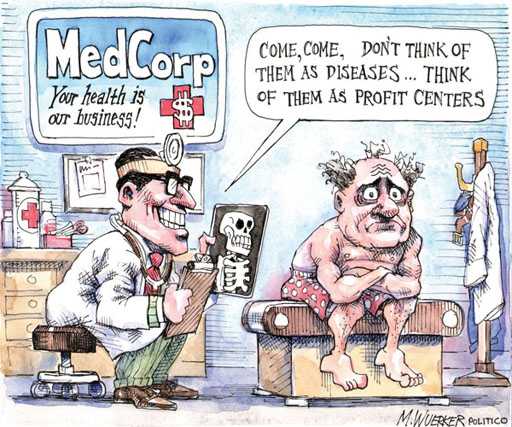
Cartoon – Centers of Profit

MedCorp” by Matt Wuerker, Politico | Kaiser Health News

Senate Democrats strike a $3.5T spending deal

https://mailchi.mp/26f8e4c5cc02/the-weekly-gist-july-16-2021?e=d1e747d2d8

Senate Democrats aim to include Medicare drug price negotiation authority  in $3.5T infrastructure deal | FierceHealthcare

Senate Democrats announced a compromise budget framework to fund President Biden’s social spending plans to the tune of $3.5T, including substantial money for some of the administration’s key healthcare priorities. The framework sends instructions to several Senate committees, including the Budget and Finance panels, to craft legislative language around the central components of the deal, with the goal of passing a spending package before next month’s recess.

Many specifics remain to be ironed out in negotiations among the party’s progressive and moderate camps, but some of the main elements of the deal became clear this week. The plan includes extending the enhanced subsidies for purchasing individual coverage on the healthcare marketplaces, which were implemented earlier this year as part of the American Rescue Plan Act. It would also seek to close the so-called “Medicaid coverage gap”, by providing new coverage options for low-income adults in states that did not expand Medicaid under the Affordable Care Act (ACA).

New investments would be made in home- and community-based services for long-term care, along the lines of the $400B proposed in President Biden’s American Families Plan. And the budget deal envisions expanding benefits in the Medicare program to include dental, vision, and hearing services. Given the budgetary concerns of moderate Democratic lawmakers like Sen. Joe Manchin (WV), one critical question will be how the $3.5T deal will be paid for. One likely source of funding for the deal will be reforming the way Medicare purchases prescription drugs, making that long-time Democratic policy objective a probable part of any final package.
 
Notably absent from the healthcare spending proposals: lowering the eligibility age for Medicare from 65 to 60. No final decision has been reached on whether to incorporate such a move; rather, the question will be sent to the Senate Finance Committee for consideration. Given the urgency of passing as much of the Biden administration’s legislative agenda as possible before the midterm campaign season begins in earnest, we think it’s unlikely that Democrats will be willing to cross the Rubicon of Medicare expansion at this point.

The prospect of having to gain support from all 50 Democratic senators—as zero Republicans are expected to support the package—will likely temper any appetite for picking a fight with the influential hospital and physician industries, which have strongly opposed Medicare expansion.

One longer-term implication of the apparent decision to favor expansion of Medicare benefits over lowering the Medicare eligibility age now: a richer package of services in traditional Medicare might make Medicare Advantage (MA) a less attractive alternative for potential enrollees and could undermine any future efforts to create an “MA buy-in” for coverage expansion.

Expect lobbying and negotiations to reach a furious pace over the next several weeks, as lawmakers work out the final details of the $3.5T spending plan.