Coronavirus cases could reach 150,000 a day this fall, widely followed Morgan Stanley analyst says

https://www.cnbc.com/2020/07/23/coronavirus-cases-could-reach-150000-a-day-this-fall-morgan-stanley-analyst-says.html

KEY POINTS
  • Morgan Stanley’s biotechnology analyst, Matthew Harrison, said 150,000 daily new U.S. coronavirus cases are possible in the fall without better control of the virus.
  • The analyst has gained a wide following on Wall Street for his success in predicting the course of the pandemic and government responses.
  • Harrison previously projected a “second wave” in the fall with daily new cases between 40,000 and 50,000 nationwide.
  • However, the recent hot spots — Arizona, Texas, Florida and California — have shown a high rate of infection, which led the analyst to adjust to a more pessimistic view on the pandemic.

The spread of the coronavirus could be elevated this fall with as many as 150,000 daily cases in the U.S., according to Morgan Stanley’s biotechnology analyst, Matthew Harrison.

“We update our scenarios to account for the higher sustained infection rate,” Harrison said in a note Thursday. “Our bull [most optimistic] case reflects similar virus control to Europe while our base [most likely] case assumes a near-term plateau followed by increased spread in the fall. [About] 150,000 daily new cases are possible without better control of the virus.”

Harrison previously projected a “second wave” in the autumn with daily new cases totaling between 40,000 and 50,000 nationwide. However, the recent emergence of hot spots — Arizona, Texas, Florida and California — has reflected a high rate of infection, which led the analyst to adjust to a more pessimistic view on the pandemic.

The analyst has gained a wide following on Wall Street for his success in predicting the course of the pandemic and government responses. For example, in April, Harrison warned that the reopening of the U.S. economy would be a slow and tedious process.

“Our assumption of a growing reproduction number, and consequently increasing daily cases, throughout the rest of the year is based on the fact that traditionally the spread of viruses is elevated in the fall compared to the summer primarily due to more people in enclosed spaces,” Harrison said.

A recent resurgence in new cases has forced a number of states to roll back their reopening plans, which weighed on the stock market that rallied massively in the second quarter on hopes for a fast economic recovery. 

Texas and Florida hit grim records earlier this week for daily coronavirus deaths based on a seven-day moving average.The virus has infected an average of 66,805 people per day in the U.S. over the past seven days, up more than 7% compared with a week ago, according to a CNBC analysis of data compiled by Johns Hopkins University.

On Wednesday, California reported a record spike in daily infections and passed New York as the U.S. state with the most confirmed infections since the pandemic began. 

To be sure, Harrison said his projection doesn’t take into account any pharmacological intervention such as vaccines or strict lockdown measures that could potentially dampen the infection rate.

There has been a slew of positive news on the vaccine front this week. The U.S. agreed to pay drugmaker Pfizer and German partner BioNTech nearly $2 billion for 100 million coronavirus vaccines if their candidate proves both safe and effective.

Meanwhile, another vaccine candidate from Oxford University and AstraZeneca showed a positive immune response in an early trial. Earlier this week, British pharmaceutical company Synairgen claimed that its new respiratory coronavirus treatment has reduced the number of hospitalized Covid-19 patients needing intensive care in a clinical trial.

Goldman Sachs biotech analyst Salveen Richter said the Covid-19 vaccine market will be similar to the flu vaccine market, which requires an annual or periodic vaccination. The analyst also cited data showing the global vaccine market will grow to at least $40 billion in 2023 from $35 billion in 2018.


Fauci on coronavirus: ‘I don’t really see us eradicating it’

https://thehill.com/policy/healthcare/public-global-health/508530-fauci-on-coronavirus-i-dont-really-see-us-eradicating?utm_source=Sailthru&utm_medium=email&utm_campaign=Issue:%202020-07-23%20Healthcare%20Dive%20%5Bissue:28659%5D&utm_term=Healthcare%20Dive

Anthony Fauci, the nation’s top infectious diseases expert, said Wednesday he doesn’t think COVID-19 will ever be fully eradicated but noted it can be controlled.

“I don’t see this disappearing the way SARS 1 did,” Fauci said during a livestreamed event hosted by the TB Alliance, a nonprofit focused on finding better tuberculosis treatments.

The SARS outbreak that started in 2003 lasted several months and mostly affected Asian countries before eventually vanishing. But in the process the disease sickened more than 8,000 people in 29 countries and claimed 774 lives.

Because COVID-19 is more contagious, it has had a far greater impact, with more than 15 million cases worldwide, including 618,000 deaths.

“It is so efficient in its ability to transmit from human to human that I think we ultimately will get control of it. I don’t really see us eradicating it,” Fauci said.

President Trump has repeatedly said the virus will eventually disappear, even though that is rare for most infectious diseases.

Fauci, who is a member of the White House coronavirus task force, recently responded to Trump’s characterization of him as “a little bit of an alarmist” on the pandemic by saying he prefers to think of himself as “a realist.”

During Wednesday’s interview, Fauci described ways that the U.S. can get the coronavirus under control.

“I think with a good combination of good public health measures, a degree of global herd immunity and a good vaccine, which I do hope and feel cautiously optimistic we will get, I think when you put all three of those together we will get very good control of this. Whether it’s this year or next year, I’m not certain,” he added.

“We’ll bring it down to such a low level that we will not be in the position we are right now for an extended period of time.”


Why COVID-19’s biggest impact on healthcare may not be until 2022

https://www.healthcaredive.com/news/why-covid-19s-biggest-impact-on-healthcare-may-not-be-until-2022/582129/

This perfect storm of a shift in payer mix, the impending insolvency of Medicare and the inability of states to absorb the growing costs of Medicaid represent a tsunami of challenges.

With COVID-19 there has been unprecedented stress placed upon the healthcare system. The human and financial toll of the current crisis has been extraordinary. Yet, little attention has been focused on the impact of this virus on the viability of our healthcare financing system.

Three significant shifts in healthcare financing are occurring as a result of the pandemic’s economic impact. First, as a result of job losses, there will be a shift in commercial insurance to government-funded insurance programs. Second, revenue for funding Medicare, based on payroll taxes, will be significantly decreased. Finally, states will have less tax revenue to pay for Medicaid, threatening the viability of this program as well.

More than 30 million Americans have filed for unemployment since the start of the COVID-19 pandemic. According to a recent report, about 27 million people may lose their employer-sponsored insurance. 

This will result in millions of people seeking coverage through Medicaid programs, the individual marketplace or simply becoming uninsured. Healthcare providers have relied upon margins from commercial insurance to offset costs from poorer reimbursing government funded programs and uncompensated care.

With more than 156 million Americans receiving employer sponsored insurance at the start of this year, and given recent projected job losses, providers may see a 17% shift in payer mix. The reliance on commercial insurance and cost shifting has become a necessary way for providers to financially sustain operations. 

With a 35% margin with commercial insurance compared to Medicare, a 17% shift in payer mix on a trillion dollar spend would result in a substantial reduction in financial resources available to hospitals.

Almost half of healthcare expenditures already come from government programs. Medicare, the largest of these programs, is principally supported by taxes on payroll and social security benefits. With COVID-related job losses there will be a corresponding reduction in payroll tax revenues to the Medicare system. Reports from the Congressional Research Service submitted to Congress in May, with data used prior to COVID-19, projected that Medicare would become insolvent in 2026.

Analyses performed show that there will be a gap in Medicare revenues during the next three years (from the pre-COVID projections) of close to $150 billion. The result is that Medicare will become insolvent as early as 2022. Even by applying more conservative projections, such as recovering all job losses by the end of 2020 and payroll tax revenue holding steady at pre-COVID levels, Medicare still becomes insolvent in 2023.

State revenues, too, will be under real pressure with reduced tax revenues resulting from the current economic downturn. Medicaid programs are supported in part by federal funds, but also from general funds from the state. 
On average, states are projecting about a 10% reduction in revenues in 2020, rising to almost a 25% reduction in 2021. Even without considering the growth in Medicaid enrollment hitting states, this reduced tax revenue will make sustaining current Medicaid program funding increasingly difficult.

This perfect storm of a shift in payer mix, the impending insolvency of Medicare by 2022 and the inability of states to absorb the growing costs of Medicaid represent a tsunami of challenges for the health system. Looking at this new reality, it is clear that our system for financing healthcare is severely broken and we must identify solutions to sustain access to medical care for our citizens.

This will be a challenge of a generation and we will need strength, courage and bold ideas to get through this. Pandemics have a way of changing a society’s political, economic and sociologic outlooks, and COVID-19 will be no different. 


New unemployment insurance claims rise for the first time since March

https://www.washingtonpost.com/business/2020/07/23/another-14-million-workers-filed-unemployment-benefits-last-week-pandemic-continues-weigh-labor-market/


Some 1.4 million workers filed for unemployment last week, the first increase in months, as the pandemic continues to weigh on the labor market

The number of new unemployment claims rose for the first time in months last week, to 1.4 million — a troubling sign for the labor market that’s weathering a new round of closures as the pandemic spreads.

For the week ending July 18, about 109,000 more jobless claims were filed compared to the week prior, according to the Department of Labor.

“What you’re seeing is that, as the economy slows, the pace of claims picks back up — which really puts at risk the monthly jobs report over the next few months,” said Joseph Brusuelas, the chief economist at RSM. “The July numbers are going to be tenuous, but it’s August that I’m worried about.”

The number of workers continually claiming unemployment insurance went down, however, a statistic that lags by a week, to 16.1 million workers for the week ending July 11, from 17.4 million for the week ending July 4.

In addition to the 1.4 million seeking unemployment nationwide last week, another 980,000 new Pandemic Unemployment Assistance claims were filed, the benefits offered to self-employed and gig workers.

The numbers come as millions of unemployed workers are about to exhaust stimulus payments from two federal benefits programs whose expiration economists have warned could have dire effects on the economy.

Brusuelas said the numbers are a sign that the burst of economic activity that marked the country’s reopening has waned, and that shrinking consumer demand remained a significant risk for businesses and the workers they employ across the country.

“We are going to see a much slower pace of growth the reset of the year,” he said. “While we still are retaining our call for a swoosh-shaped recovery, one has to acknowledge a w-shaped recovery is possible.”

The extra $600 a week in unemployment benefits that the federal government has offered to supplement more modest state unemployment benefits will end this week, as lawmakers wrangle over legislation that could extend it.

Including the new benefits available to gig workers and the self-employed, more than 53 million applications have been filed for some form of unemployment insurance during the pandemic.


Coronavirus’s painful side effect is deep budget cuts for state and local government services

https://theconversation.com/coronaviruss-painful-side-effect-is-deep-budget-cuts-for-state-and-local-government-services-141105

Coronavirus's painful side effect is deep budget cuts for state ...

Nationwide, state and local government leaders are warning of major budget cuts as a result of the pandemic. One state – New York – even referred to the magnitude of its cuts as having “no precedent in modern times.”

Declining revenue combined with unexpected expenditures and requirements to balance budgets means state and local governments need to cut spending and possibly raise taxes or dip into reserve funds to cover the hundreds of billions of dollars lost by state and local government over the next two to three years because of the pandemic.

Without more federal aid or access to other sources of money (like reserve funds or borrowing), government officials have made it clear: Budget cuts will be happening in the coming years.

And while specifics are not yet available in all cases, those cuts have already included reducing the number of state and local jobs – from firefighters to garbage collectors to librarians – and slashing spending for education, social services and roads and bridges.

In some states, agencies have been directed to cut their budget as much as 15% or 20% – a tough challenge as most states prepared budgets for a new fiscal year that began July 1.

As a scholar of public administration who researches how governments spend money, here are the ways state and local governments have reduced spending to close the budget gap.

Cutting jobs

State and local governments laid off or furloughed 1.5 million workers in April and May.

They are also reducing spending on employees. According to surveys, government workers are feeling personal financial strain as many state and local governments have cut merit raises and regular salary increases, frozen hiring, reduced salaries and cut seasonal employees.

Washington state, for example, cut both merit raises and instituted furloughs.

survey from the National League of Cities shows 32% of cities will have to furlough or lay off employees and 41% have hiring freezes in place or planned as a result of the pandemic.

Employment reductions have met some resistance. In Nevada, for example, a state worker union filed a complaint against the governor to the state’s labor relations board for violating a collective bargaining statute by not negotiating on furloughs and salary freezes.

Most of the employee cuts have been made in education. Teachers, classroom aids, administrators, staff, maintenance crews, bus drivers and other school employees have seen salary cuts and layoffs.

The job loss has hurt public employees beyond education, too: librarians, garbage collectors, counselors, social workers, police officers, firefighters, doctors, nurses, health aides, park rangers, maintenance crews, administrative assistants and others have been affected.

Residents also face the consequences of these cuts: They can’t get ahold of staff in the city’s water and sewer departments to talk about their bill; they can’t use the internet at the library to look for jobs; their children can’t get needed services in school.

Most of these cuts have been labeled temporary, but with the extensions to stay-at-home orders and a mostly closed economy, it will be some time before these employees are back to work.

Suspending road, bridges, building and water system projects

As another way to reduce costs quickly, a National League of Cities survey shows 65% of the municipalities surveyed are stopping temporarily, or completely, capital expenditure and infrastructure projects like roads, bridges, buildings, water systems or parking garages.

In New York City, there is a US$2.3 billion proposed cut to the capital budget, a fund that supports large, multiyear investments from sidewalk and road maintenance, school buildings, senior centers, fire trucks, sewers, playgrounds, to park upkeep. There are potentially serious consequences for residents. For example, New York housing advocates are concerned that these cuts will hurt plans for 21,000 affordable homes.

Suspending these big money projects will save the government money in the short term. But it will potentially harm the struggling economy, since both public and private sectors benefit from better roads, bridges, schools and water systems and the jobs these projects create.

Delaying maintenance also has consequences for the deteriorating infrastructure in the U.S. The costs of unaddressed repairs could increase future costs. It can cost more to replace a crumbling building than it does to fix one in better repair.

Cities and towns hit

In many states, the new budgets severely cut their aid to local governments, which will lead to large local cuts in education – both K-12 and higher education – as well as social programs, transportation, health care and other areas.

New York state’s budget proposes that part of its fiscal year 2021 budget shortfall will be balanced by $8.2 billion in reductions in aid to localities. This is the state where the cuts were referred to in the budget as “not seen in modern times.” This money is normally spent on many important services that residents need everyday –mass transit, adult and elderly care, mental health support, substance abuse programs, school programs like special education, children’s health insurance and more. Lacking any of these support services can be devastating to a person, especially in this difficult time.

Fewer workers, less money

As teachers and administrators figure out how to teach both online and in person, they and their schools will need more money – not less – to meet students’ needs.

Libraries, which provide services to many communities, from free computer use to after-school programs for children, will have to cut back. They may have fewer workers, be open for fewer hours and not offer as many programs to the public.

Parks may not be maintained, broken playground equipment may stay that way, and workers may not repave paths and mow lawns. Completely separate from activists’ calls to shift police funding to other priorities, police departments’ budgets may be slashed just for lack of cash to pay the officers. Similar cuts to firefighters and ambulance workers may mean poorly equipped responders take longer to arrive on a scene and have less training to deal with the emergency.

To keep with developing public safety standards, more maintenance staff and materials will be needed to clean and sanitize schools, courtrooms, auditoriums, correctional facilitiesmetro stations, buses and other public spaces. Strained budgets and employees will make it harder to complete these new essential tasks throughout the day.

To avoid deeper cuts, state and local government officials are trying a host of strategies including borrowing money, using rainy day funds, increasing revenue by raising tax rates or creating new taxes or fees, ending tax exemptions and using federal aid as legally allowed.

Colorado was able to hold its budget to only a 3% reduction, relying largely on one-time emergency reserve funds. Delaware managed to maintain its budget and avoided layoffs largely through using money set aside in a reserve account.

Nobody knows how long the pandemic, or its economic effects, will last.

In the worst-case scenario, budget officials are prepared to make steeper cuts in the coming months if more assistance does not come from the federal government or the economy does not recover quickly enough to restore the flow of money that governments need to operate.


Hospital margins could sink to a negative 7% this year: 5 things to know

https://www.beckershospitalreview.com/finance/hospital-margins-could-sink-to-a-negative-7-this-year-5-things-to-know.html?utm_medium=email

New Kaufman Hall Report: Hospital Finances Crashed in April ...

The COVID-19 pandemic has created financial challenges for hospitals and health systems, and, without additional federal aid, half of US hospitals could be operating in the red in the second half of this year, according to an analysis released by the American Hospital Association on July 21.

Five takeaways from the analysis: 

1. Before the COVID-19 pandemic, the median hospital margin was 3.5 percent. COVID-19 is expected to drive the median hospital margin from positive to negative. 

2. Without funding from the Coronavirus Aid, Relief and Economic Security Act, hospital margins would have been a negative 15 percent in the second quarter of 2020. Margins are still expected to drop to a negative 3 percent in the second quarter.

3. Without additional aid from the federal government, hospital margins could sink to a negative 7 percent in the second half of this year. 

4. In the second quarter of this year, nearly half of U.S. hospitals had negative margins. Those hospitals will remain with negative margins without further financial support.  

5. “Heading into the COVID-19 crisis, the financial health of many hospitals and health systems were challenged, with many operating in the red,” said hospital association President and CEO Rick Pollack in a news release. “As today’s analysis shows, this pandemic is the greatest financial threat in history for hospitals and health systems and is a serious obstacle to keeping the doors open for many.” 

The full report, prepared by Kaufman, Hall & Associates and released by the AHA, is available here


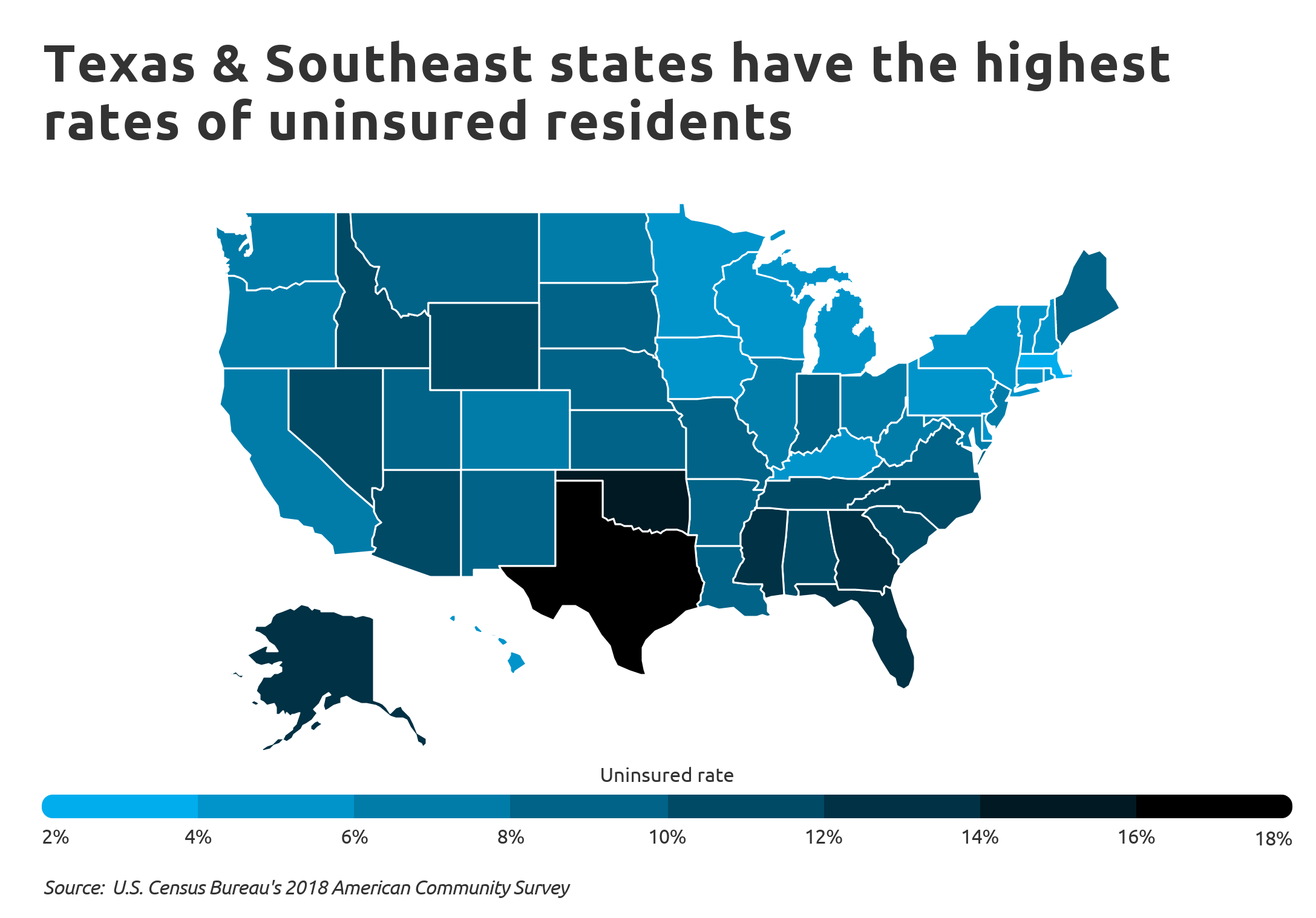
Texas has the highest uninsured rate in the U.S., with 29 percent of adults uninsured as of May

https://www.beckershospitalreview.com/rankings-and-ratings/states-ranked-by-uninsured-rates.html?utm_medium=email

COVID-19 Health: Rate of Uninsured Americans by City - Self

Texas has the highest uninsured rate in the U.S., with 29 percent of adults uninsured as of May, according to a report from Families USA. 

The report compared uninsured rates in 2018 to rates in May 2020 using data from the U.S. Bureau of Labor Statistics and the Urban Institute. Every state saw an increase in the number of uninsured, and the total number of uninsured in the U.S. climbed 21 percent.

The increase was due in part to layoffs tied to the COVID-19 pandemic in recent months. Nearly 5.4 million Americans lost health insurance coverage from February to May of this year due to job losses, according to the report.

Below is the total percentage of all uninsured adults in each state and the District of Columbia as of May. 

Texas: 29 percent

Florida: 25 percent

Oklahoma: 24 percent

Georgia: 23 percent

Mississippi: 22 percent

Nevada: 21 percent

North Carolina: 20 percent

South Carolina: 20 percent

Alabama: 19 percent

Tennessee: 19 percent

Idaho: 18 percent

Alaska: 17 percent

Arizona: 17 percent

Missouri: 17 percent

Wyoming: 17 percent

New Mexico: 16 percent

South Dakota: 16 percent

Arkansas: 15 percent

Kansas: 15 percent

Louisiana: 14 percent

Virginia: 14 percent

California: 13 percent

Colorado: 13 percent

Illinois: 13 percent

Indiana: 13 percent

Maine: 13 percent

Montana: 13 percent

New Jersey: 13 percent

Oregon: 13 percent

Utah: 13 percent

Michigan: 12 percent

Nebraska: 12 percent

Washington: 12 percent

West Virginia: 12 percent

Delaware: 11 percent

Maryland: 11 percent

New Hampshire: 11 percent

North Dakota: 11 percent

Ohio: 11 percent

Connecticut: 10 percent

Hawaii: 10 percent

Kentucky: 10 percent

New York: 10 percent

Pennsylvania: 10 percent

Wisconsin: 10 percent

Iowa: 9 percent

Rhode Island: 9 percent

Massachusetts: 8 percent

Minnesota: 8 percent

Vermont: 7 percent

District of Columbia: 6 percent


What happens if Covid-19 symptoms don’t go away? Doctors are trying to figure it out.

https://www.vox.com/2020/7/14/21324201/covid-19-long-term-effects-symptoms-treatment

Covid-19 long-term effects: People with persistent symptoms ...

People with long-term Covid-19 complications are meanwhile struggling to get care.

In late March, when Covid-19 was first surging, Jake Suett, a doctor of anesthesiology and intensive care medicine with the National Health Service in Norfolk, England, had seen plenty of patients with the disease — and intubated a few of them.

Then one day, he started to feel unwell, tired, with a sore throat. He pushed through it, continuing to work for five days until he developed a dry cough and fever. “Eventually, I got to the point where I was gasping for air literally doing nothing, lying on my bed.”

At the hospital, his chest X-rays and oxygen levels were normal — except he was gasping for air. After he was sent home, he continued to experience trouble breathing and developed severe cardiac-type chest pain.

Because of a shortage of Covid-19 tests, Suett wasn’t immediately tested; when he was able to get a test, 24 days after he got sick, it came back negative. PCR tests, which are most commonly used, can only detect acute infections, and because of testing shortages, not everyone has been able to get a test when they need one.

It’s now been 14 weeks since Suett’s presumed infection and he still has symptoms, including trouble concentrating, known as brain fog. (One recent study in Spain found that a majority of 841 hospitalized Covid-19 patients had neurological symptoms, including headaches and seizures.) “I don’t know what my future holds anymore,” Suett says.

Some doctors have dismissed some of his ongoing symptoms. One doctor suggested his intense breathing difficulties might be related to anxiety. “I found that really surprising,” Suett says. “As a doctor, I wanted to tell people, ‘Maybe we’re missing something here.’” He’s concerned not just for himself, but that many Covid-19 survivors with long-term symptoms aren’t being acknowledged or treated.

Suett says that even if the proportion of people who don’t eventually fully recover is small, there’s still a significant population who will need long-term care — and they’re having trouble getting it. “It’s a huge, unreported problem, and it’s crazy no one is shouting this from rooftops.”

In the US, a number of specialized centers are popping up at hospitals to help treat — and study — ongoing Covid-19 symptoms. The most successful draw on existing post-ICU protocols and a wide range of experts, from pulmonologists to psychiatrists. Yet even as care improves, patients are also running into familiar challenges in finding treatment: accessing and being able to pay for it.

What’s causing these long-term symptoms?

Scientists are still learning about the many ways the virus that causes Covid-19 impacts the body — both during initial infection and as symptoms persist.

One of the researchers studying them is Michael Peluso, a clinical fellow in infectious diseases at the University of California San Francisco, who is currently enrolling Covid-19 patients in San Francisco in a two-year study to study the disease’s long-term effects. The goal is to better understand what symptoms people are developing, how long they last, and eventually, the mechanisms that cause them. This could help scientists answer questions like how antibodies and immune cells called T-cells respond to the virus, and how different individuals might have different immune responses, leading to longer or shorter recovery times.

At the beginning of the Covid-19 pandemic, “the assumption was that people would get better, and then it was over,” Peluso says. “But we know from lots of other viral infections that there is almost always a subset of people who experience longer-term consequences.” He explains these can be due to damage to the body during the initial illness, the result of lingering viral infection, or because of complex immunological responses that occur after the initial disease.

“People sick enough to be hospitalized are likely to experience prolonged recovery, but with Covid-19, we’re seeing tremendous variability,” he says. It’s not necessarily just the sickest patients who experience long-term symptoms, but often people who weren’t even initially hospitalized.

That’s why long-term studies of large numbers of Covid-19 patients are so important, Peluso says. Once researchers can find what might be causing long-term symptoms, they can start targeting treatments to help people feel better. “I hope that a few months from now, we’ll have a sense if there is a biological target for managing some of these long-term symptoms.”

Lekshmi Santhosh, a physician lead and founder of the new post-Covid OPTIMAL Clinic at UCSF, says many of her patients are reporting the same kinds of problems. “The majority of patients have either persistent shortness of breath and/or fatigue for weeks to months,” she says.

Additionally, Timothy Henrich, a virologist and viral immunologist at UCSF who is also a principal investigator in the study, says that getting better at managing the initial illness may also help. “More effective acute treatments may also help reduce severity and duration of post-infectious symptoms.”

In the meantime, doctors can already help patients by treating some of their lingering symptoms. But the first step, Peluso explains, is not dismissing them. “It is important that patients know — and that doctors send the message — that they can help manage these symptoms, even if they are incompletely understood,” he says. “It sounds like many people may not be being told that.”

Long-term symptoms, long-term consequences

Even though we have a lot to learn about the specific damage Covid-19 can cause, doctors already know quite a bit about recovery from other viruses: namely, how complex and challenging a task long-term recovery from any serious infection can be for many patients.

Generally, it’s common for patients who have been hospitalized, intubated, or ventilated — as is common with severe Covid-19 — to have a long recovery. Being bed-bound can cause muscle weakness, known as deconditioning, which can result in prolonged shortness of breath. After a severe illness, many people also experience anxiety, depression, and PTSD.

A stay in the ICU not uncommonly leads to delirium, a serious mental disorder sometimes resulting in confused thinking, hallucinations, and reduced awareness of surroundings. But Covid-19 has created a “delirium factory,” says Santhosh at UCSF. This is because the illness has meant long hospital stays, interactions only with staff in full PPE, and the absence of family or other visitors.

Theodore Iwashyna, an ICU physician-scientist at the University of Michigan and VA Ann Arbor, is involved with the CAIRO Network, a group of 40 post-intensive care clinics on four continents. In general, after patients are discharged from ICUs, he says, “about half of people have some substantial new disability, and half will never get back to work. Maybe a third of people will have some degree of cognitive impairment. And a third have emotional problems.” And it’s common for them to have difficulty getting care for their ongoing symptoms after being discharged.

In working with Covid-19 patients, says Santhosh, she tells patients, “We believe you … and we are going to work on the mind and body together.”

Yet it’s currently impossible to predict who will have long-lasting symptoms from Covid-19. “People who are older and frailer with more comorbidities are more likely to have longer physical recovery. However, I’ve seen a lot of young people be really, really sick,” Santhosh says. “They will have a long tail of recovery too.”

Who can access care?

At the new OPTIMAL Clinic at UCSF, doctors are seeing patients who were hospitalized for Covid-19 at the UCSF health system, as well as taking referrals of other patients with persistent pulmonary symptoms. For ongoing cough and chest tightness, the clinic is providing inhalers, as well as pulmonary rehabilitation, including gradual aerobic exercise with oxygen monitoring. They’re also connecting patients with mental health resources.

“Normalizing those symptoms, as well as plugging people into mental health care, is really critical,” says Santhosh, who is also the physician lead and founder of the clinic. “I want people to know this is real. It’s not ‘in their heads.’”

Neeta Thakur, a pulmonary specialist at Zuckerberg San Francisco General Hospital and Trauma Center who has been providing care for Covid-19 patients in the ICU, just opened a similar outpatient clinic for post-Covid care. Thakur has also arranged a multidisciplinary approach, including occupational and physical therapy, as well as expedited referrals to neurology colleagues for rehabilitation for the muscles and nerves that can often be compressed when patients are prone for long periods in the ICU. But she’s most concerned by the cognitive impairments she’s seeing, especially as she’s dealing with a lot of younger patients.

These California centers join new post-Covid-19 clinics in major cities across the country, including Mount Sinai in New York and National Jewish Health Hospital in Denver. As more and more hospitals begin to focus on post-Covid care, Iwashyna suggests patients try to seek treatment where they were hospitalized, if possible, because of the difficulty in transferring sufficient medical records.

Santosh recommends that patients with persistent symptoms call their closest hospital, or nearest academic medical center’s pulmonary division, and ask if they can participate in any clinical trials. Many of the new clinics are enrolling patients in studies to try to better understand the long-term consequences of the disease. Fortunately, treatment associated with research is often free, and sometimes also offers financial incentives to participants.

But otherwise, one of the biggest challenges in post-Covid-19 treatment is — like so much of American health care — being able to pay for it.

Outside of clinical trials, cost can be a barrier to treatment. It can be tricky to get insurance to cover long-term care, Iwashyna notes. After being discharged from an ICU, he says, “Recovery depends on [patients’] social support, and how broke they are afterward.” Many struggle to cover the costs of treatment. “Our patient population is all underinsured,” says Thakur, noting that her hospital works with patients to try to help cover costs.

Lasting health impacts can also affect a person’s ability to go back to work. In Iwashyna’s experience, many patients quickly run through their guaranteed 12 weeks of leave under the Family Medical and Leave Act, which isn’t required to be paid. Eve Leckie, a 39-year-old ICU nurse in New Hampshire, came down with Covid-19 on March 15. Since then, Leckie has experienced symptom relapses and still can’t even get a drink of water without help.

“I’m typing this to you from my bed, because I’m too short of breath today to get out,” they say. “This could disable me for the rest of my life, and I have no idea how much that would cost, or at what point I will lose my insurance, since it’s dependent on my employment, and I’m incapable of working.” Leckie was the sole wage earner for their five children, and was facing eviction when their partner “essentially rescued us,” allowing them to move in.

These long-term burdens are not being felt equally. At Thakur’s hospital in San Francisco, “The population [admitted] here is younger and Latinx, a disparity which reflects who gets exposed,” she says. She worries that during the pandemic, “social and structural determinants of health will just widen disparities across the board.” People of color have been disproportionately affected by the virus, in part because they are less likely to be able to work from home.

Black people are also more likely to be hospitalized if they get Covid-19, both because of higher rates of preexisting conditions — which are the result of structural inequality — and because of lack of access to health care.

“If you are more likely to be exposed because of your job, and likely to seek care later because of fear of cost, or needing to work, you’re more likely to have severe disease,” Thakur says. “As a result, you’re more likely to have long-term consequences. Depending on what that looks like, your ability to work and economic opportunities will be hindered. It’s a very striking example of how social determinants of health can really impact someone over their lifetime.”

If policies don’t support people with persistent symptoms in getting the care they need, ongoing Covid-19 challenges will deepen what’s already a clear crisis of inequality.

Iwashyna explains that a lot of extended treatment for Covid-19 patients is “going to be about interactions with health care systems that are not well-designed. The correctable problems often involve helping people navigate a horribly fragmented health care system.

“We can fix that, but we’re not going to fix that tomorrow. These patients need help now.”


Administration’s war on the public health experts

https://www.axios.com/trump-public-health-experts-cdc-fauci-e1509d14-0cf1-4b1c-b107-7753bf95395d.html

Trump's war on the public health experts - Axios

A pandemic would normally be a time when public health expertise and data are in urgent demand — yet President Trump and his administration have been going all out to undermine them.

Why it matters: There’s a new example almost every day of this administration trying to marginalize the experts and data that most administrations lean on and defer to in the middle of a global crisis.

Here’s how it has been happening just in the past few weeks:

  • The administration has repeatedly undermined the Centers for Disease Control and Prevention. Most recently, Trump has criticized the CDC’s school reopening guidelines, Education Secretary Betsy DeVos declared that “kids need to be in school,” and the administration has reportedly ordered hospitals to bypass the CDC in reporting coronavirus patient information.
  • It has repeatedly undermined Anthony Fauci. Trump distanced himself on Wednesday from an op-ed attack by White House trade adviser Peter Navarro, but longtime Trump aide Dan Scavino also called the infectious diseases specialist “Dr. Faucet” in a Facebook post accusing him of leaking his disagreements. And the White House gave a opposition research-style list of the times Fauci “has been wrong” to the Washington Post and other media outlets.
  • Trump himself undermined public health experts generally with his retweet of former game show host Chuck Woolery’s “everyone is lying” tweet — which blamed “The CDC, Media, Democrats, our Doctors, not all but most, that we are told to trust.”
  • Trump has made numerous statements suggesting, over and over again, that we wouldn’t have as many COVID cases if we just tested less. (From his Tuesday press conference at the White House: “If we did half the testing we would have half the cases.”)

The impact: The result is that the CDC — which is supposed to be the go-to agency in a public health crisis — is distracted by constant public critiques from the highest levels. And Fauci, “America’s Doctor,” is the subject of yet another round of stories about whether Trump is freezing him out.

  • “The way to make Americans safer is to build on, not bypass, our public health system,” Tom Frieden, a former CDC director under Barack Obama, said in a statement to Axios about the efforts to sideline the agency.
  • “Unfortunately, as with mask-up recommendations and schools reopening guidance, the administration has chosen to sideline and undermine our nation’s premier disease fighting agency in the middle of the worst pandemic in 100 years,” Frieden said.
  • And Fauci, in an interview with The Atlantic, said of the efforts to discredit him: “Ultimately, it hurts the president to do that … It doesn’t do anything but reflect poorly on them.”

The other side: The White House insists there’s no problem. “President Trump has always acted on the science and valued the input of public health experts throughout this crisis,” said White House deputy press secretary Sarah Matthews.

  • Trump campaign communications director Tim Murtaugh closed ranks with the experts as well. “President Trump has said repeatedly that he has a strong relationship with Dr. Fauci, and Dr. Fauci has always said that the President listens to his advice,” he said.
  • And Department of Health and Human Services spokesman Michael Caputo declared that “the scientists and doctors speak openly, they are listened to closely, and their advice and counsel helps guide the response.”
  • “Frankly, when it comes to this tempest in a teapot over Dr. Fauci, I blame the media and their unending search for a ‘Resistance’ hero, for turning half a century of a brilliant scientist’s hard work into a clickbait headline that helps reporters undermine the president’s coronavirus response,” Caputo said.

Between the lines: Murtaugh deflected several times when asked whether there was a deliberate strategy to marginalize the CDC and the experts: “The President and the White House have consistently advised Americans to follow CDC guidelines. The President also believes we can open schools safely on time and that we must do so.”

  • However, one administration official said there were parts of the CDC school reopening guidelines that were impractical, and noted that kids can also suffer long-term harm by staying out of school too long.

Our thought bubble, by Axios White House reporter Alayna Treene: The responses make it clear that the White House and the Trump campaign don’t want to advance the narrative that they’re deliberately battling with America’s health experts, or that there’s any kind of strategy behind it.

The bottom line: When the history of this pandemic is written, it will show that the public health experts who were trying to fight it also had to deal with political fights that made their jobs harder.