

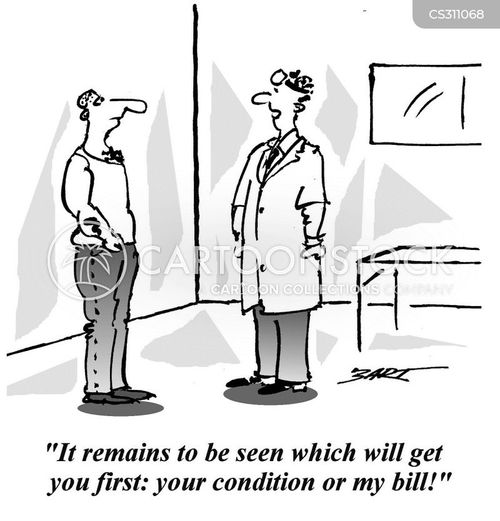
Cartoon – It remains to be seen which will get you first

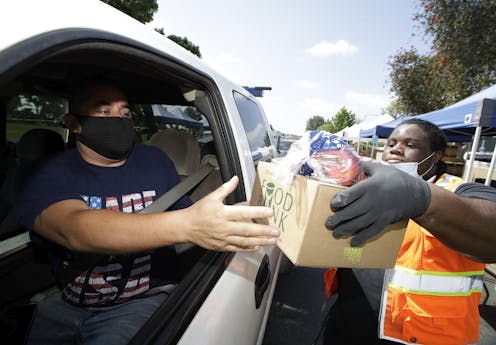
Preventing deaths from COVID-19 depends on people who get it seeking treatment – which also allows authorities to track down whom they came in contact with to reduce spread.
But, as the economic pain and joblessness caused by the statewide lockdowns continue to grow, more Americans are experiencing severe strains on their personal finances. This threatens our ability to contain the pandemic because those feeling the most financial stress are much less likely to seek medical care if they experience coronavirus symptoms, according to my analysis of a recent Federal Reserve survey.
As an economist who studies how individuals make health care choices, I worry that in the coming months even more people will consider forgoing vital treatment to pay rent or some other bill – especially as the extended unemployment benefits, rent moratoriums and other relief are set to expire soon.
The Fed conducts a survey of the economic health of U.S. households every quarter, most recently near the end of 2019. In April, it conducted a supplementary but similar survey to quickly gauge how people were handling the coronavirus crisis. Results of both surveys were released on May 14.
The Fed tries to measure financial stress in three key ways. Its surveys ask respondents if they are unable to pay all their monthly bills, couldn’t cover a US$400 emergency expense, or are “just getting by” or worse.
Even before the pandemic hit, the picture wasn’t pretty. In October, when the fourth-quarter survey was conducted, 42% of employed respondents reported fitting at least one of these descriptions, while over 8% said they fit all three. Those figures jumped to 72% and 20% for low-income workers.
But by April, tens of millions of people who had jobs in October lost them as most nonessential businesses across the U.S. either closed or reduced their services. The unemployment rate shot up to 14.7% that month – the highest since the Great Depression – and is expected to climb further when the May data are released on June 5.
The Fed’s April survey, however, paints an even broader picture of the economic impact of the pandemic. In that survey, about 28% of the previously employed respondents said they either lost their job, were being furloughed, had their hours cut or were taking unpaid leave. This has been financially devastating to many, with 68% of this group reporting one of the stresses listed above and 28% saying they were experiencing all three, regardless of income level.
Separate questions in the surveys demonstrate just how strong the link is between financial and physical health.
The October survey also asks those respondents if they had skipped a doctor’s visit during the previous 12 months because of the cost. More than 20% of those who reported one of these financial stresses said they had, while almost 46% of those with all three said so.
In April, the Fed asked a more timely question: “If you got sick with symptoms of the coronavirus, would you try to contact a doctor?”
A third of those respondents who also said they’re experiencing all three financial stresses said “no.” This is especially significant because, unlike the October question, it describes a current, known threat, rather than referring to a previous medical issue of unknown severity. And the widely reported urgency and seriousness of the coronavirus suggests someone wouldn’t treat the decision to seek a doctor’s care or advice lightly.
That was back in April, less than a month into the coronavirus lockdowns. If the same questions were asked today, I believe the numbers would look a lot worse.
In the middle of a serious pandemic, we don’t want sick people avoiding treatment because they’re worried they won’t be able to put food on the table. This would likely worsen the spread of the coronavirus and make it a whole lot harder to contain.
As Congress debates additional measures to mitigate the economic and financial effects of the pandemic, it would be wise to keep in mind the connection between financial stress and individual decisions to seek medical care.

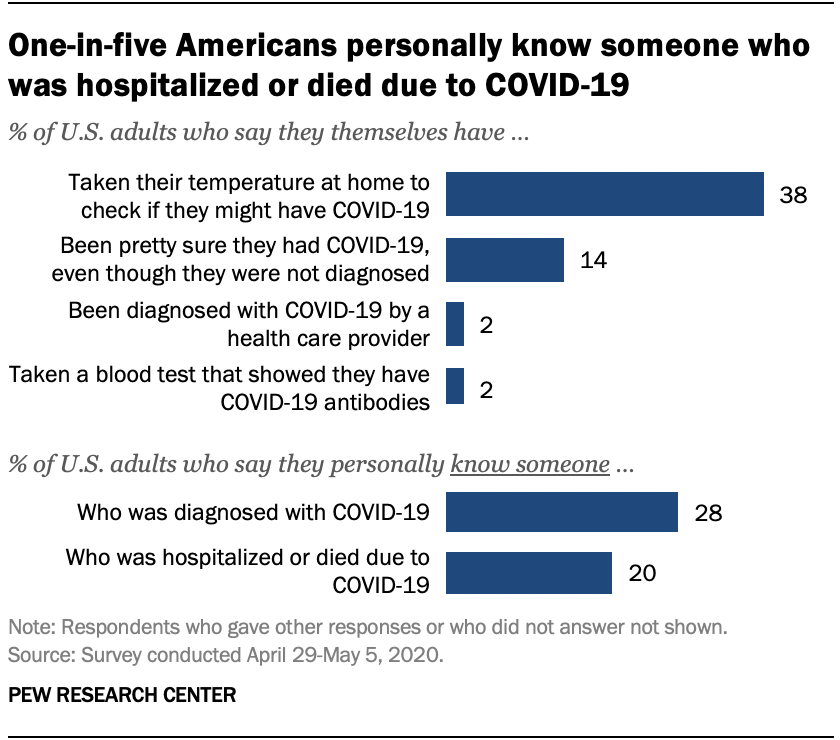
Relatively few Americans say they have been diagnosed with COVID-19 or tested positive for coronavirus antibodies, but many more believe they may have been infected or say they personally know someone who has been diagnosed.
Only 2% of U.S. adults say they have been officially diagnosed with COVID-19 by a health care provider, according to a new Pew Research Center survey. And 2% say they have taken a blood test that showed they have COVID-19 antibodies, an indication that they previously had the coronavirus. But many more Americans (14%) say they are “pretty sure” they had COVID-19, despite not getting an official diagnosis. And nearly four-in-ten (38%) say they’ve taken their temperature to check if they might have the disease.
Although few Americans have been diagnosed with COVID-19 themselves, many more say they know someone with a positive diagnosis. More than one-in-four U.S. adults (28%) say they personally know someone who has been diagnosed by a health care provider as having COVID-19. A smaller share of Americans (20%) say they know someone who has been hospitalized or who has died as a result of having the coronavirus.
Some groups are more likely than others to report personal experiences with COVID-19. For instance, black adults are the most likely to personally know someone who has been hospitalized or died as a result of the disease. One-third of black Americans (34%) know someone who has been hospitalized or died, compared with 19% of Hispanics and 18% of white adults. Black Americans (32%) are also slightly more likely than Hispanic adults (26%) to know someone diagnosed with COVID-19. Public health studies have found black Americans are disproportionately dying or requiring hospitalization as a result of the coronavirus.

Areas in the northeastern United States have recorded some of the highest rates of coronavirus cases and fatalities, and this is reflected in the Center’s survey. About four-in-ten adults living in the Northeast (42%) say they personally know someone diagnosed with COVID-19, significantly more than among adults living in any other region. People living in the Northeast (31%) are also the most likely to know someone who has been hospitalized or died as a result of the disease.
One aspect of personal risk for exposure to the coronavirus is whether someone is employed in a setting where they must have frequent contact with other people, such as at a grocery store, hospital or construction site. Given the potential for the spread of the coronavirus within households, risk to individuals is also higher if other members of the household are employed in similar settings. Among people who are currently employed full-time, 35% are working in a job with frequent public contact. Among those working part-time, almost half work (48%) in such a setting. For those living in a household with other adults, 35% report that at least one of those individuals is working in a job that requires frequent contact with other people.
Taken together, nearly four-in-ten Americans (38%) have this type of exposure – either currently working in a job that requires contact with others, living in a household with others whose jobs require contact, or both.
Hispanics (at 48%) are more likely than either blacks (38%) or whites (35%) to have this type of personal or household exposure. An earlier Center analysis of government data found Hispanic adults were slightly more likely to work in service-sector jobs that require customer interaction, and that are at higher risk of layoffs as a result of the virus. In fact, the current Center survey found Hispanics were among the most likely to have experienced pay cuts or job losses due to the coronavirus outbreak.

Interpersonal exposure in the workplace is also more widespread among younger adults. And there is a 10 percentage point difference between upper- and lower-income Americans in exposure, with lower-income adults more likely to work in situations where they have to interact with the public, or to live with people who do.
Health experts warn that COVID-19 is particularly dangerous to people who have underlying medical conditions. In the survey, one-third of adults say they have such a condition. Among this group, nearly six-in-ten (58%) say that the coronavirus outbreak is a major threat to their personal health. Among those who do not report having an underlying medical condition, just 28% see the outbreak as a major threat to their health. Americans who have an underlying health condition are also more likely than those who do not to say they’ve taken their temperature to check if they might have COVID-19 (47% vs. 33% of those without a health condition).
Self-reports of an underlying health condition vary greatly by age. Among those ages 18 to 29, just 16% say they have a condition; this rises steadily with age to 56% among those 65 and older. Whites are a little more likely than blacks and Hispanics to report having a health condition, but both blacks (at 54%) and Hispanics (52%) are far more likely than whites (32%) to say that the coronavirus outbreak is “a major threat” to their health.


Here are some significant developments:
https://www.healthcaredive.com/news/fitch-analysts-hospital-worries-FY-2020/577875/

From the Mayo Clinic to Kaiser Permanente, nonprofit hospitals are posting massive losses as the coronavirus pandemic upends their traditional way of doing business.
Fitch Ratings analysts predict a grimmer second quarter: “the worst on record for most,” Kevin Holloran, senior director for Fitch, said during a Tuesday webinar.
Over the past month, Fitch has revised its nonprofit hospital sector outlook from stable to negative. It has yet to change its ratings outlook to negative, though the possibility wasn’t ruled out.
Some have already seen the effects. Mayo estimates up to $3 billion in revenue losses from the onset of the pandemic until late April — given the system is operating “well below” normal capacity. It also announced employee furloughs and pay cuts, as several other hospitals have done.
Data released Tuesday from health cost nonprofit FAIR Health show how steep declines have been for larger hospitals in particular. The report looked at process claims for private insurance plans submitted by more than 60 payers for both nonprofit and for-profit hospitals.
Facilities with more than 250 beds saw average per-facility revenues based on estimated in-network amounts decline from $4.5 million in the first quarter of 2019 to $4.2 million in the first quarter of 2020. The gap was less pronounced in hospitals with 101 to 250 beds and not evident at all in those with 100 beds or fewer.
Funding from federal relief packages has helped offset losses at those larger hospitals to some degree.
Analysts from the ratings agency said those grants could help fill in around 30% to 50% of lost revenues, but won’t solve the issue on their own.
They also warned another surge of COVID-19 cases could happen as hospitals attempt to recover from the steep losses they felt during the first half of the year.
Anthony Fauci, the nation’s top infectious disease expert, warned lawmakers this week that the U.S. doesn’t have the necessary testing and surveillance infrastructure in place to prep for a fall resurgence of the coronavirus, a second wave that’s “entirely conceivable and possible.”
“If some areas, cities, states or what have you, jump over these various checkpoints and prematurely open up … we will start to see little spikes that may turn into outbreaks,” he told a Senate panel.
That could again overwhelm the healthcare system and financially devastate some on the way to recovery.
“Another extended time period without elective procedures would be very difficult for the sector to absorb,” Holloran said, suggesting if another wave occurs, such procedures should be evaluated on a case-by-case basis, not a state-by-state basis.
Hospitals in certain states and markets are better positioned to return to somewhat normal volumes later this year, analysts said, such as those with high growth and other wealth or income indicators. College towns and state capitols will fare best, they said.
Early reports of patients rescheduling postponed elective procedures provide some hope for returning to normal volumes.
“Initial expectations in reopened states have been a bit more positive than expected due to pent up demand,” Holloran said. But he cautioned there’s still a “real, honest fear about returning to a hospital.”
Moody’s Investors Service said this week nonprofit hospitals should expect the see the financial effects of the pandemic into next year and assistance from the federal government is unlikely to fully compensate them.
How quickly facilities are able to ramp up elective procedures will depend on geography, access to rapid testing, supply chains and patient fears about returning to a hospital, among other factors, the ratings agency said.
“There is considerable uncertainty regarding the willingness of patients — especially older patients and those considered high risk — to return to the health system for elective services,” according to the report. “Testing could also play an important role in establishing trust that it is safe to seek medical care, especially for nonemergency and elective services, before a vaccine is widely available.”
Hospitals have avoided major cash flow difficulties thanks to financial aid from the federal government, but will begin to face those issues as they repay Medicare advances. And the overall U.S. economy will be a key factor for hospitals as well, as job losses weaken the payer mix and drive down patient volumes and increase bad debt, Moody’s said.
Like other businesses, hospitals will have to adapt new safety protocols that will further strain resources and slow productivity, according to the report.
Another trend brought by the pandemic is a drop in ER volumes. Patients are still going to emergency rooms, FAIR Health data show, but most often for respiratory illnesses. Admissions for pelvic pain and head injuries, among others declined in March.
“Hospitals may also be losing revenue from a widespread decrease in the number of patients visiting emergency rooms for non-COVID-19 care,” according to the report. “Many patients who would have otherwise gone to the ER have stayed away, presumably out of fear of catching COVID-19.”
https://mailchi.mp/f4f55b3dcfb3/the-weekly-gist-may-15-2020?e=d1e747d2d8

Even after hearing dozens of reports from health systems about how steep their COVID-related volume losses have been, we were still floored by this analysis from healthcare analytics firm Strata Decision Technology, documenting a 55 percent drop in patients seeking hospital care across the country.
The report, which analyzed data from 228 hospitals in 51 health systems across 40 states, found that no clinical service line was immune from steep volume losses. The graphic below shows volume loss by service line in March-April 2020 compared to the same period in 2019.
Unsurprisingly, ophthalmology, gynecology, ortho/spine and ENT—all specialties with a high portion of elective cases, and heavily dependent on procedures—saw volume declines of greater than 70 percent. But even obstetrics and neonatology (which we expected to be “pandemic proof”) and infectious disease (which we thought might be busier in the throes of COVID-19) saw losses of 20-30 percent.
Looking at specific procedures, complex elective surgeries like spinal fusion and hip and knee replacements were almost completely obliterated. Precipitous declines in encounters for chronic diseases like coronary heart disease and diabetes (down 75 and 67 percent, respectively) and cancer screenings (a 55 percent decline in breast health and a 37 percent decline in cancer care overall) point to the likelihood of worrisome disease exacerbations, and a future full of more complex patients.
The volume losses, plus a 114 percent rise in uninsured patients, led to average two-week losses of $26.5M per health system across the study’s cohort. Strata will continue to track and publish volume changes, but this early snapshot paints a bleak picture of staggering financial hits, and “lost” patient care that will carry lasting ramifications for the health of communities nationwide.

Data: U.S. Employment and Training Administration via FRED; Chart: Andrew Witherspoon/Axios
Another 2.98 million Americans filed for unemployment last week, the Labor Department said on Thursday.
Why it matters: The coronavirus is still forcing a historically high number of Americans out of work. In two months alone, more than 36 million people have filed jobless claims.
Between the lines: The pace of new applications has slowed from its peak in March, but the weekly numbers are still way higher than before businesses shuttered to contain the outbreak.
By the numbers: The total number of people continuing to receive unemployment benefits — after initially applying — rose, bringing the total to a record 22.8 million.
The bottom line: Goldman Sachs estimates the unemployment rate will hit 25%, matching the peak level of joblessness during the Great Depression.
 HENRY KOTULA