Amazon Is Hiring an Intelligence Analyst to Track ‘Labor Organizing Threats’

https://www.vice.com/en_us/article/qj4aqw/amazon-hiring-intelligence-analyst-to-track-labor-organizing-threats?fbclid=IwAR2HPsGNDFctpmNzBb_6Su9yof5SN_ke-E9cG0vHwgseLJw8UaQmarmGoPk

Amazon is looking to hire two people who can focus on keeping tabs on labor activists within the company.

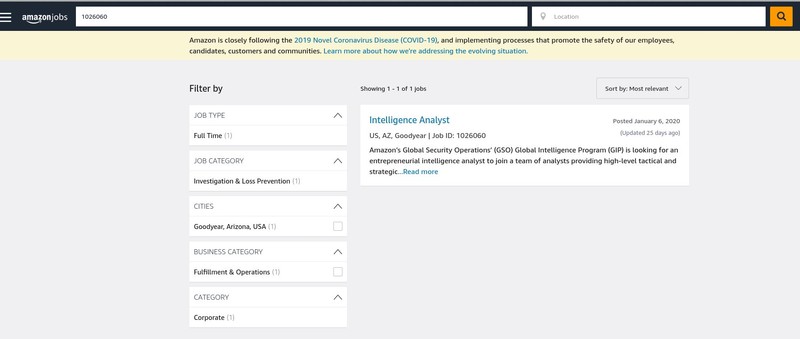
Amazon is looking to hire two intelligence analysts to track “labor organizing threats” within the company.

The company recently posted two job listings for analysts that can keep an eye on sensitive and confidential topics “including labor organizing threats against the company.” Amazon is looking to hire an “Intelligence Analyst” and a “Sr Intelligence Analyst” for its Global Security Operations’ (GSO) Global Intelligence Program (GIP), the team that’s responsible for physical and corporate security operations such as insider threats and industrial espionage. 

The job ads list several kinds of threats, such as “protests, geopolitical crises, conflicts impacting operations,” but focuses on “organized labor” in particular, mentioning it three times in one of the listings. 

Amazon has historically been hostile to workers attempting to form a union or organize any kind of collective action. Last year, an Amazon spokesperson accused unions of exploiting Prime Day “to raise awareness to their cause” and increase membership dues. Earlier this year, the company fired Christian Smalls, a Black employee who led a protest at a fulfillment center in New York over Amazon’s inadequate safety measures in the early days of the COVID-19 pandemic. During a meeting with Amazon CEO Jeff Bezos, company executives discussed plans to smear Smalls calling him “not smart, or articulate.”  

These job listings show Amazon sees labor organizing as one of the biggest threats to its existence.

Do you work at Amazon, did you used to, or do you know anything else about the company? We’d love to hear from you. Using a non-work phone or computer, you can contact Lorenzo Franceschi-Bicchierai securely on Signal at +1 917 257 1382, on Wickr at lorenzofb, OTR chat at lorenzofb@jabber.ccc.de, or email lorenzofb@vice.com.

After this story was published, Amazon deleted the job listings and company spokesperson Maria Boschetti said in an email that “the job post was not an accurate description of the role— it was made in error and has since been corrected.” The spokesperson did not respond to follow-up questions about the alleged mistake. The job listing, according to Amazon’s own job portal, had been up since January 6, 2020.

Dania Rajendra, the Director of the Athena Coalition, an alliance of dozens of grassroots labor groups that organize amazon workers, criticized the listing.

“Workers, especially Black workers, have been telling us all for months that Amazon is targeting them for speaking out. This job description is proof that Amazon intends to continue on this course,” Rajendra told Motherboard in a statement. “The public deserves to know whether Amazon will continue to fill these positions, even if they’re no longer publicly posted.”

On Monday, the Open Markets Institute, a nonprofit that studies monopolies, published a report on Amazon’s employee surveillance efforts, claiming that these practices “create a harsh and dehumanizing working environment that produces a constant state of fear, as well as physical and mental anguish.” 

After a week of the jobs being posted online, 71 people have applied to the Intelligence Analyst position, and 24 people to the Sr Intelligence Analyst job, according to Linkedin. The first job was posted in the Amazon Jobs portal in January, the second job on July 21, according to the company’s site.

UPDATE Sept. 1, 12:04 p.m. ET: Shortly after this story was published, Amazon removed the listings from its job portal.


Battle over COVID-19 school openings goes to the courts

Battle over COVID-19 school openings goes to the courts

Nearly 800 COVID-19 lawsuits have been filed, according to law firm's  tracker

Teachers unions are waging court fights across the country aimed at unwinding what they say are unsafe and politically motivated timetables for reopening schools that risk exposing personnel to the coronavirus pandemic.

State officials eager to ramp up brick-and-mortar operations are facing lawsuits from Florida to Texas to Iowa over reopening plans as well as access to the COVID-19 infection data needed to monitor the rate of spread within school communities. 

At the same time, lawsuits are flying from the opposition direction: Parents in several states, including New York, Massachusetts and Oregon, dissatisfied with web-based teaching alternatives, are suing to force state officials to reopen physical schools sooner as courts are increasingly called upon to referee the fight over education in the age of coronavirus.

“A legal storm is brewing as safety and social distancing requirements for a physical return to school begin to take shape around the country,” Maria Ferguson, executive director of the Center on Education Policy at George Washington University, wrote on the education website The 74.

As millions of students prepare for the first day of school — whether in-person, remote or a hybrid of the two — the fight over the reopening physical school buildings is likely to intensify.

The debate over in-person K-12 instruction planning is inseparably tied to the issues of child care needs and parents’ ability to return to the workforce to help revive the struggling economy, all of which is playing out against the backdrop of a fast-approaching November election in a country that has seen nearly 6 million cases and more than 181,000 deaths from COVID-19.

Perhaps the highest-profile legal battle is taking place in the courts of Florida, where Republican Gov. Ron DeSantis signed off last month on an emergency order over school reopenings.

Under the order, most Florida school districts would be required to hold in-person classes five days a week by the end of August or risk losing funding. President Trump, who counts DeSantis as a close ally, has also threatened to cut off federal funding for schools if they do not resume in-person learning this fall.

The Florida policy prompted a lawsuit from the Florida Education Association (FEA), a statewide teachers union, and several other plaintiffs in favor of a more cautious return to in-person teaching.

“Public schools are not designed for COVID safety, and indeed, the government has recognized that they are high-contact environments,” said Kendall Coffey, the lead plaintiff’s attorney in the Florida case, who likened prematurely opened schools to “disease factories” and called the Florida policy “financial bullying.”

There are any number of issues, in terms of hallway sizes, the flow of students in and out of classrooms, ventilation, even how many students go into the bathroom,” he told The Hill. “There are many elements that are virtually impossible to guarantee when you’re dealing with children in large amounts.”

On Aug. 24, a Florida judge ruled in favor of the union and temporarily halted the statewide order. In his decision, Judge Charles Dodson struck down the order’s unconstitutional provisions and blasted DeSantis for having “essentially ignored” the state’s constitutional requirement that schools be operated safely.

“The districts have no meaningful alternative,” wrote Dodson, of Leon County. “If an individual school district chooses safety, that is, delaying the start of schools until it individually determines it is safe to do so for its county, it risks losing state funding, even though every student is being taught.”

A Florida appeals court agreed to temporarily halt Judge Dodson’s order from taking effect while DeSantis appeals.

The state contends that the benefit of in-person instruction outweighs the health risks associated with reopening brick-and-mortar schools. Some Florida school officials have also declined to disclose incidents of positive COVID-19 cases to school communities, citing the need for patient privacy. 

Attorneys for Florida have also argued in hearings that courts should not substitute their judgment for that of policymakers who have balanced all the equities and decided a prompt in-person reopening is the best policy.

Randi Weingarten, president of the American Federation of Teachers (AFT), one of the largest teachers unions in the country, said Florida has its priorities backward.

“What their arguments show is that they don’t care about human life,” Weingarten told The Hill.

According to Weingarten, internal AFT polling in June showed that about 3 in 4 teachers said they would be comfortable returning to the classroom if guidelines from the Centers for Disease Control and Prevention (CDC) were implemented in schools.

But she predicts that attitudes among teachers have shifted dramatically in past months as the Trump administration has failed to adequately manage the virus to ensure schools can be reopened safely.

“We’re polling right now,” she said. “And my hunch is that just like the public polls, it’s totally flipped.”

The AFT is backing lawsuits in Florida, New Mexico and Texas. Before schools can reopen safely — for what Weingarten calls “the biggest move indoors that the nation has done since March” — the group says local positivity rates should be below 3 percent and schools should have visibility into daily transmission rates. 

The union is also pushing for protocols that involve testing, contact tracing and isolation and implement best practices from the CDC for things such as ventilation, cleaning, physical distancing, mask-wearing and other safeguards.

As teachers unions make their case in court, parents in at least five states have filed lawsuits of their own to accelerate school reopenings.

A nonprofit litigation group called the Center for American Liberty, co-founded by lawyer and GOP official Harmeet Dhillon, is backing one such suit in California. Democratic Gov. Gavin Newsom’s restrictions on in-person school openings in the Golden State will affect an estimated 80 percent of K-12 students.

“The effects of this ham-handed policy are as predictable as they are tragic,” the lawsuit filed in a federal court in California states. “Hundreds of thousands of students will essentially drop out of school, whether because they lack the technological resources to engage with ‘online learning’ or because their parents cannot assist them.”

The litigation raises concerns about everything from school closures exacerbating the achievement gap and disproportionately harming special needs students and those without convenient internet access to challenges over the constitutional validity of government health orders.

Weingarten, of AFT, said it’s important to remember that despite seemingly irreconcilable differences over the policy details, all parties want to see schools reopen as soon as it’s safe to do so.

“None of us believes that remote is a substitute,” she said. “It’s a supplement.”


Many workers don’t get new paid sick leave, because of ‘broad’ exemption for providers, report finds

https://www.washingtonpost.com/business/2020/08/11/paid-sick-leave/?utm_source=Sailthru&utm_medium=email&utm_campaign=Issue:%202020-08-12%20Healthcare%20Dive%20%5Bissue:29035%5D

Many health-care workers don't get new paid sick leave, because of ...

The New York attorney general sued the Labor Department in April over the agency’s interpretation of ‘health care provider’.

A government watchdog said in a report out Tuesday that the Labor Department “significantly broadened” an exemption allowing millions of health-care workers to be denied paid sick leave as part of the law Congress passed in March to help workers during the coronavirus pandemic.

Congress passed the Families First Coronavirus Response Act in March to ensure workers at small- and medium-size companies were able to take paid leave if they or a family member became sick with the coronavirus. The law exempts health-care providers as well as companies with more than 500 employees.

But an Office of the Inspector General report noted that a move by the Labor Department to more broadly expand how they categorize health-care providers ended up leaving far more workers without a guarantee of paid sick leave than the agency’s estimate of 9 million.

While existing federal statutes define health-care workers as doctors, someone practicing medicine or providing health-care services, the Labor Department’s exemption from paid sick leave included anyone employed at a doctor’s office, clinic, testing facility or hospital, including temporary sites. The report also found the agency also exempted companies that contract with clinics and hospitals, such as those that produce medical equipment or tests related to the coronavirus, the OIG found.

The report also suggested the Labor Department is not doing enough to enforce the paid-sick-leave provisions, as well as its existing laws on pay and overtime issues.

In an effort to be socially distant, the federal agency acknowledged it has been forgoing fact-finding, on-site investigations, where an investigator examines all aspects of whether an employer is complying with federal labor laws. Instead, the agency has been using conciliations, which are telephone-only reviews limited to looking into a single issue affecting one or a few employees, with no fact-finding.

Critics of the Labor Department’s more hands-off approach to the pandemic have seized on the report as another indication of the ways in which the Trump administration has abandoned its commitments to worker safety.

“The Inspector General’s report makes clear that the Department of Labor went out of its way to limit the number of workers who could take emergency paid leave,” Rep. Robert C. “Bobby” Scott (D-Va.), the chairman of the House Education Committee, said in a statement. “This absence of meaningful enforcement of our nation’s basic workplace laws creates a major risk to workers who are already vulnerable to exploitation amid record unemployment.”

Before the pandemic, limited or full on-site investigations, a more robust way the agency looked into pay and overtime issues, made up about 53 percent of its inquiries. But since March 18, only 19 percent of those inquiries have been on-site investigations.

Actions taken to enforce the sick-leave provisions in the Families First Coronavirus Response Act have skewed even further away from investigations: 85 percent have been resolved through conciliations.

The agency’s Wage and Hour Division responded to the OIG’s findings, noting that they were “developing and sharing models for conducting virtual investigations,” and that they also pledged to maintain a backlog of delayed on-site investigations to be tackled when it was safer to conduct those reviews.

But critics suggest the pandemic alone is not a sufficient excuse for the drop-off in investigations, some aspects of which could be done remotely.

“These numbers just look so different than the numbers that I’m used to seeing in terms of conciliations versus investigations,” said Sharon Block, a senior Obama administration labor department official. “It really does jump out. That 85 percent is just a really big number.”

The issue about expanding who gets to opt out of offering paid sick leave has been the subject of complaints, according to the OIG report, as well as a federal lawsuit filed by New York Attorney General Letitia James. That lawsuit argued that the Labor Department overstepped its authority by defining health-care providers in such broad terms, saying it could be skewed to include workers such as teaching assistants or librarians at universities, employees who work in food services or tech support at medical schools, and cashiers at hospital gift shops and cafeterias.

Judge J. Paul Oetken, of New York’s Southern District, struck down the Labor Department’s definition, as well as three other provisions last week — but confusion remains about whether his ruling applies only to employers in New York.

In an internal response to the OIG report, which predates the New York ruling, the Labor Department said that it agreed with many of the OIG’s recommendations and that it would continue to use its definition of health-care providers until the resolution of the federal lawsuit.

The Labor Department did not reply to requests for comment about whether it planned to contest the judge’s ruling, or the other findings in the report.

The inspector general pointed to other ways the department is not doing enough to adjust to the challenges of the post-outbreak world.

The OIG report said that while the agency’s Wage and Hour Division referenced the coronavirus in an operating plan in late May, it pointed out that the division “focuses more on what the agency has already accomplished rather than thinking proactively and describing how it will continue to ensure FFCRA compliance while still maintaining enforcement coverage,” the report noted.

The department did not provide any goals about the enforcement or provide any requirements for tracking and reporting the new violations created by the FFCRA.

“With the predicted surge of covid-19 cases nationwide in upcoming months as more Americans return to work and as a consequence, an anticipated increase in complaint call volume to WHD, it would be expedient of the agency to devise a detailed plan as to how it intends to address this issue,” the OIG noted.

The report is the latest to spotlight the Trump administration’s employer-friendly approach to worker safety and protections.

The Occupational Safety and Health Administration, the part of the Labor Department that investigates and is charged with upholding worker safety, has been criticized by workers and advocates for failing to issue citations for worker safety issues during the pandemic in significant numbers. It had only issued four citations out of more than 7,900 coronavirus-related complaints, according to figures from July 21.


What it’s like to be a nurse after 6 months of COVID-19 response

https://www.healthcaredive.com/news/what-its-like-to-be-a-nurse-6-months-coronavirus/581709/

Those on the front lines of the fight against the novel coronavirus worry about keeping themselves, their families and their patients safe.

That’s especially true for nurses seeking the reprieve of their hospitals returning to normal operations sometime this year. Many in the South and West are now treating ICUs full of COVID-19 patients they hoped would never arrive in their states, largely spared from spring’s first wave.

And like many other essential workers, those in healthcare are falling ill and dying from COVID-19. The total number of nurses stricken by the virus is still unclear, though the Centers for Disease Control and Prevention has reported 106,180 cases and 552 deaths among healthcare workers. That’s almost certainly an undercount.

National Nurses United, the country’s largest nurses union, told Healthcare Dive it has counted 165 nurse deaths from COVID-19 and an additional 1,060 healthcare worker deaths.

Safety concerns have ignited union activity among healthcare workers during the pandemic, and also given them an opportunity to punctuate labor issues that aren’t new, like nurse-patient ratios, adequate pay and racial equality.

At the same time, the hospitals they work for are facing some of their worst years yet financially, after months of delayed elective procedures and depleted volumes that analysts predict will continue through the year. Many have instituted furloughs and layoffs or other workforce reduction measures.

Healthcare Dive had in-depth conversations with three nurses to get a clearer picture of how they’re faring amid the once-in-a-century pandemic. Here’s what they said.

Elizabeth Lalasz, registered nurse, John H. Stroger Hospital in Chicago

Elizabeth Lalasz has worked at John H. Stroger Hospital in Chicago for the past 10 years. Her hospital is a safety net facility, catering to those who are “Black, Latinx, the homeless, inmates,” Lalasz told Healthcare Dive. “People who don’t actually receive the kind of healthcare they should in this country.”

Data from the CDC show racial and ethnic minority groups are at increased risk of getting COVID-19 or experiencing severe illness, regardless of age, due to long-standing systemic health and social inequities.

CDC data reveal that Black people are five times more likely to contract the virus than white people.

This spring Lalasz treated inmates from the Cook County Jail, an epicenter in the city and also the country. “That population gradually decreased, and then we just had COVID patients, many of them Latinx families,” she said.

Once Chicago’s curve began to flatten and the hospital could take non-COVID patients, those coming in for treatment were desperately sick. They’d been delaying care for non-COVID conditions, worried a trip to the hospital could risk infection.

A Kaiser Family Foundation poll conducted in May found that 48% of Americans said they or a family member had skipped or delayed medical care because of the pandemic. And 11% said the person’s condition worsened as a result of the delayed care.

When patients do come into Lalasz’s hospital, many have “chest pain, then they also have diabetes, asthma, hypertension and obesity, it just adds up,” she said.

“So now we’re also treating people who’ve been delaying care. But after the recent southern state surges, the hospital census started going down again,” she said.

Amy Arlund, registered nurse, Kaiser Permanente Medical Center in Fresno, California:

Amy Arlund works the night shift at Kaiser Fresno as an ICU nurse, which she’s done for the past two decades.

She’s also on the hospital’s infection control committee, where for years she’s fought to control the spread of clostridium difficile colitis, or C. diff., in her facility. The highly infectious disease can live on surfaces outside the body for months or sometimes years.

The measures Arlund developed to control C. diff served as her litmus test, as “the top, most stringent protocols we could adhere to,” when coronavirus patients arrived at her hospital, she told Healthcare Dive.

But when COVID-19 cases surged in northern states this spring, “it’s like all those really strict isolation protocols that prior to COVID showing up would be disciplinable offenses were gone,” Arlund said.

Widespread personal protective equipment shortages at the start of the pandemic led the CDC and the Occupational Safety and Health Administration to change their longstanding guidance on when to use N95 respirator masks, which have long been the industry standard when dealing with novel infectious diseases.

The CDC also issued guidance for N95 respirator reuse, an entirely new concept to nurses like Arlund who say those changes go against everything they learned in school.

“I think the biggest change is we always relied on science, and we have always relied heavily on infection control protocols to guide our practice,” Arlund said. “Now infection control is out of control, we can no longer rely on the information and resources we always have.”

The CDC says experts are still learning how the coronavirus spreads, though person-to-person transmission is most common, while the World Health Organization recently acknowledged that it wouldn’t rule out airborne transmission of the virus.

In Arlund’s ICU, she’s taken care of dozens of COVID positive patients and patients ruled out for coronavirus, she said. After a first wave in the beginning of April, cases dropped, but are now rising again.

Other changing guidance weighing heavily on nurses is how to effectively treat coronavirus patients.

“Are we doing remdesivir this week or are we going back to the hydroxychloroquine, or giving them convalescent plasma?”Arlund said. “Next week I’m going to be giving them some kind of lavender enema, who knows.”

Erik Andrews, registered nurse, Riverside Community Hospital in Riverside, California:

Erik Andrews, a rapid response nurse at Riverside Community Hospital in California, has treated coronavirus patients since the pandemic started earlier this year. He likens ventilating them to diffusing a bomb.

“These types of procedures generate a lot of aerosols, you have to do everything in perfectly stepwise fashion, otherwise you’re going to endanger yourself and endanger your colleagues,” Andrews, who’s been at Riverside for the past 13 years, told Healthcare Dive.

He and about 600 other nurses at the hospital went on strike for 10 days this summer after a staffing agreement between the hospital and its owner, HCA Healthcare, and SEIU Local 121RN, the union representing RCH nurses, ended without a renewal.

The nurses said it would lead to too few nurses treating too many patients during a pandemic. Insufficient PPE and recycling of single-use PPE were also putting nurses and patients at risk, the union said, and another reason for the strike.

But rapidly changing guidance around PPE use and generally inconsistent information from public officials are now making the nurses at his hospital feel apathetic.

“Unfortunately I feel like in the past few weeks it’s gotten to the point where you have to remind people about putting on their respirator instead of face mask, so people haven’t gotten lax, but definitely kind of become desensitized compared to when we first started,” Andrews said.

With two children at home, Andrews slept in a trailer in his driveway for 12 weeks when he first started treating coronavirus patients. The trailer is still there, just in case, but after testing negative twice he felt he couldn’t spend any more time away from his family.

He still worries though, especially about his coworkers’ families. Some coworkers he’s known for over a decade, including one staff member who died from COVID-19 related complications.

“It’s people you know and you know that their families worry about them every day,” he said. “So to know that they’ve had to deal with that loss is pretty horrifying, and to know that could happen to my family too.”


6 months in: What will the new normal look like for hospitals?

https://www.healthcaredive.com/news/6-months-in-new-normal-hospitals-covid/581524/

Experts say a sustained state of emergency is likely until there is a cure or vaccine for COVID-19.

The first U.S. hospital to knowingly treat a COVID-19 patient was Providence Regional Medical Center in Everett, Washington, on Jan. 20. Since then, every aspect of healthcare has been upended, and it’s becoming increasingly clear all parts of society will have to adapt to a new baseline for the foreseeable future.

For hospitals and doctors’ offices, that means building on a major shift to telemedicine, new workflows to allow for more infection control and revamping the supply chain for pharmaceuticals, personal protective equipment and other supplies. That’s on top of ongoing challenges of burned out workers and staff shortages further exacerbated by the pandemic.

Looking out even further, the industry will have to figure out how to treat potential chronic conditions in COVID-19 survivors and, until an effective vaccine is developed, how to manage new outbreaks of the disease.

Experts say U.S. hospitals are generally in a much better position for dealing with COVID-19 now than they were in March, and providers are learning more every week about the best treatments and care practices.

June survey of healthcare executives conducted by consultancy firm Advis found that 65% of respondents said the industry is prepared for a fall or winter surge, about the inverse of what an earlier survey with that question showed.

“We’ve evolved. We’re in a much better state now than we were in the beginning of the pandemic,” Michael Calderwood, associate chief quality officer at Dartmouth-Hitchcock Medical Center, told Healthcare Dive. “There’s been a lot of learning.”

But the number of positively identified cases has now topped 4 million, and little political will exists to reinstitute widespread shutdowns even in areas where surges have filled ICUs to capacity. No treatment or vaccine for the disease exists or appears imminent. Testing and contract tracing efforts are too few and remain scattered and uncoordinated.

Whether there is a clear nationwide second wave or smaller surges in various parts of the country at different times, hospitals will need to remain in an effective state of emergency that requires constant vigilance until there is a cure or vaccine.

“Until we’re armed with that, we’re always going to have to be working like this. I don’t see any other way,” Diane Alonso, director of Intermountain Healthcare’s abdominal transplant program, told Healthcare Dive.

The fall will bring additional challenges. Flu season usually begins to ramp up in October, and if the strains in wide circulation this year are severe, that will further stress the health system. While some schools have announced they will be virtual-only for the rest of 2020, others are committed to in-person classes. That could mean increased community spread, especially in college towns. Colder weather that forces people indoors — where the novel coronavirus is far more likely to spread — will also be a complicating factor.

So far, hospitals have been reluctant to once again halt elective procedures, though some have had to, arguing that the care is still necessary and can be done safely when the proper protections are in place. But that doesn’t mean volume will rebound to pre-pandemic levels.

“While we think demand will come back, we’ve seen some flattening on demand in certain aspects that may be the new indicator of the new norm in terms of how people seek care,” Dion Sheidy, a partner and healthcare advisory leader at advisory firm KPMG, told Healthcare Dive.

Accelerating trends to provide care outside hospitals

When the number of COVID-19 cases first surged in the U.S. and stay-at-home orders were implemented nationwide, telehealth became a necessary way for urgent care to continue.

Virtual visits skyrocketed in March and April as CMS and private payers relaxed regulations and expanded coverage. Some of that will be rolled back, but much may persist as patients and providers grow more used to using telehealth and platforms become smoother.

Virtual care can’t replace in-person care, of course, and some patients and doctors will prefer face-to-face visits. The middle- to long-term result is likely to be that telehealth thrives for some specialties like psychiatry, but drops substantially from the highest levels during shutdowns throughout the country.

Other care settings outside of the hospital may see upticks as well, including at-home and retail-based primary and urgent care.

Renee Dua, the CMO of home healthcare and telemedicine startup Heal, said the company has seen virtual visits increase eight fold since the pandemic began in the U.S. and a 33% increase in home visits as people seek to continue care while reducing their risk of exposure to the coronavirus.

“The idea that you do not use an office building to get care — that’s why we started Heal — we bet on the fact that the best doctors come to you,” Dua told Healthcare Dive.

And care does need to continue, particularly vital services like vaccinations and pediatric checkups.

“You cannot ignore preventive screenings and primary care because you can get sick with cancer or with infectious diseases that are treatable and preventable,” Dua said.

Movements toward non-traditional settings existed before anyone had heard of COVID-19, but the realities of the pandemic have shifted resources and spurred investment that will have lasting effects, Ross Nelson, healthcare strategy leader at KPMG, told Healthcare Dive.

“What we’re going to see is there going to be an acceleration of the underlying trends toward home and away from the hospital,” he said.

Some of this was already underway. Multiple large health systems have established programs to provide hospital-level care at home and major employers have inked contracts to have primary care delivered to employees at on-site clinics.

PPE, staff shortages lingering

A key problem for hospitals in the first COVID-19 hotspots, such as Washington state and New York City, was a lack of necessary personal protective equipment, including N95 masks, gowns, face shields and gloves.

Also running low were supplies like ventilators and some drugs necessary for putting people on those machines.

While advances have certainly been made, the country did not have enough time to build up those supply stores before new surges in the South and West. The result has been renewed worries that not enough PPE is available to keep healthcare workers safe.

Chaun Powell, group vice president of strategic supplier engagement at group purchasing organization Premier, said “conservation practices continue to be the key to this” as COVID-19 surges roll through the country. The longer those dire situations continue, the more stress is put on the supply chain before it has a chance to recover.

Premier’s most recent hospital survey found that more than half of respondents said N95s were heavily backordered. Almost half reported the same for isolation gowns and shoe covers.

Calderwood said there has been improvement, however. “We have a much longer days-on-hand PPE supply at this point and the other thing is, we’ve begun to manufacture some of our own PPE,” he said. “That’s something a number of hospitals have done in working with local companies.”

But the ability to manufacture new PPE in the U.S. also depends on the availability of raw materials, which are limited. That means significant advancements in domestic production are likely several months away, Powell said.

Health systems have stepped up the ability to coordinate and attempt to get equipment where it’s needed most, especially for big-ticket items like ventilators. Providers are more hesitant, however, to let go of PPE without the virus being better contained.

The backstop supposed to help hospitals during a crisis is the national stockpile, which the federal government is attempting to resupply. It doesn’t appear to be enough, though, at least not yet, Calderwood said.

“One thing that concerns me is we did have a national stockpile of PPE, and I get the sense that we’ve kind of burned through that supply,” he said. “And now we’re relying on private industry to meet the need.”

Another problem hospitals face as the pandemic drags on is maintaining adequate staffing levels. Doctors, nurses and other front-line employees are in incredibly stressful work environments. The great potential for burnout will exacerbate existing shortages, just as medical schools are still trying to figure out how to continue with training and education.

“Those areas are concerning to our hospitals because our hospitals depend on a whole myriad of medical staff,” Advis CEO Lyndean Brick said. “Whether it’s physicians, nurses, technicians, housekeepers — that whole staff complement is what’s at the core of healthcare. You can have all the technology in the world but if you don’t have somebody to run it that whole system falls apart.”

On top of that is the increase in labor strife as working conditions have deteriorated in some cases. Nurses have reported fearing for their safety among PPE shortages and alleged lapses in protocol. Brick said she expects strike threats and other actions to continue.

Changing workflows

When COVID-19 cases started ramping up for the first time in the U.S., hospitals throughout the country, acting on CMS advice, shut down elective procedures to prepare their facilities for a potential influx of critical patients with the disease. In some areas, hospitals did have to activate surge plans at that time. Others have done so more recently as the result of increases in the South and West.

But few have resorted to once again halting electives. Brick told Healthcare Dive she doesn’t expect that to change, mostly because hospitals have by and large figured out how to properly continue that care.

She trusts any that can’t do so safely, won’t try.

For the majority of our providers, except in the occasional state where they’re having a real problem right now, I think that we’re going to see elective surgeries still continue,” Brick said. “Because most of our hospitals have capacity right now. They’re able to do this successfully and securely, and it’s really detrimental to patients to not get the care that they need.”

Hospitals rely on elective procedures to drive their revenue, an added motivation to find ways to keep them running even when COVID-19 is detected at greater levels in the community.

Intermountain, based in Salt Lake City, recently performed its 100th organ transplant of the year, ahead of last year’s pace despite the disruption of the COVID-19 crisis.

Alonso, the program director for abdominal transplants, said that while transplants are considered essential services, staff did pause some procedures when electives were halted and have re-evaluated workflow to be as safe as possible to patients, who are at higher risk after surgery because they are immunocompromised.

The hospital developed a triage system to help evaluate what services are necessary based on what level of COVID-19 spread is present in the community and how many beds and staffers are available to treat them.

The system’s main hospital has certain floors and employees designated for COVID-19 treatment. Staff have been reallocated for certain needs like testing and there are plans available if doctors and surgeons need to be deployed to the ICU.

As many outpatient visits as possible are being changed to virtual, but in the building, patients are screened for symptoms and required to wear masks and follow distancing protocols.

At the transplant center, doctors were at one point divided into teams in case someone got sick and coworkers had to self-isolate.

“We went through a dry run where, at the beginning, we shut down incredibly hard to see how we could do it operationally,” Alonso said. Intermountain hasn’t had to do that again, but is ready if such measures become necessary, she said.

Brick and others said that despite the genuinely frightening circumstance brought by the pandemic, hospitals’ responses have been admirable and providers have been quick to adapt. Slow or nonexistent leadership at the federal level, especially in sourcing and obtaining PPE, has been the bigger roadblock.

“Across the board, the whole healthcare industry has responded beautifully to this,” Brick said. “Where our country has fallen down is we don’t have a master plan to deal with this. Our federal leadership is reactionary, and we are not coordinating a master plan to deal with this in the long term. That’s where my concerns are at. My concerns are not at our local hospitals. They have their acts together.”


MLB faces its first coronavirus crisis with Marlins outbreak less than a week into season

https://www.washingtonpost.com/sports/2020/07/26/marlins-delay-return-miami-after-apparent-coronavirus-outbreak-among-players/?utm_campaign=wp_main&utm_medium=social&utm_source=facebook&fbclid=IwAR1u7AypEX5AoBbLoaKIZ9tSyJqE-khQkODR5GviFpI3LJk8cV6T89CoYcw

Less than a week in, the 2020 Major League Baseball season has already reached its first crisis point, with the Miami Marlins reportedly stuck in Philadelphia and forced to cancel their home opener in Miami on Monday night after as many as a dozen players and coaches tested positive for the coronavirus.

The outbreak potentially has far-reaching consequences, affecting not only the Marlins, but the Philadelphia Phillies, who hosted the Marlins this weekend; the Baltimore Orioles, who were scheduled to open a series in Miami on Monday night; and the New York Yankees, who start a series in Philadelphia on Monday, in which they would occupy the same visitors’ clubhouse the Marlins just departed.

Major League Baseball has made no formal indication of what it would take to halt the 2020 season, with the ultimate decision resting with Commissioner Rob Manfred. An MLB spokesperson did not immediately return a message seeking comment Monday.

On Sunday, following their game against the Phillies, the Marlins decided to remain overnight at their Philadelphia hotel rather than travel home as scheduled, after three players tested positive. A fourth had tested positive on Friday. The plan, at that point, was to fly home Monday in time for their 7:10 p.m. game at Marlins Park against the Orioles.

In the meantime, the rest of the team’s traveling party was awaiting test results, which according to ESPN, resulted in an additional eight players and two coaches testing positive. Under MLB’s 2020 operations manual, players or coaches who test positive on the road are required to remain in that city and quarantine for 14 days, and must test negative twice at least 24 hours apart to return to the roster.

Unlike most other major sports leagues, MLB decided against the “bubble” model of bringing teams together, under strict quarantine rules, to one or two hub cities to stage its season — an option the players’ union rejected this spring. Instead, the 30 MLB teams are playing in 30 different stadiums and traveling between cities, a step that experts believe increases the degree of difficulty for pulling off a season.

Teams have been granted expanded, 30-man rosters at the start of the season, plus up to an additional 30 reserves who train at an alternative site — which means the Marlins, theoretically, could field a team for its upcoming games, made up of a combination of unaffected players from their big league roster and reserves from their alternative site in nearby Jupiter, Fla.

However, the larger questions are how the Marlins’ outbreak occurred and whether such a crisis, coming within days of teams beginning to travel for games, is cause enough for MLB to take stronger action. Although Florida has among the highest caseload of coronavirus of any state in the United States, the Marlins have been out of the state for nearly a week, having played exhibition games in Atlanta last week before opening their season in Philadelphia.


California AG conditionally approves $350M sale of nonprofit to Prime Healthcare

https://www.healthcarefinancenews.com/news/california-ag-conditionally-approves-350m-sale-st-francis-medical-center-prime-healthcare

Prime Healthcare, CEO Prem Reddy settle false-claims suit for $65M

Prime will acquire St. Francis for a net of $350 million, with a $200 million base cash price and $60 million for accounts receivable.

California Attorney General Xavier Becerra has conditionally approved Verity Health’s application to transfer ownership of St. Francis Medical Center to Prime Healthcare. The Attorney General’s decision follows an earlier decision by the U.S. Bankruptcy Court of the Central District of California granting Verity’s request to reject the existing collective bargaining agreements which impose legacy cost structures that it said contributed to bankruptcy.

Becerra noted that his approval of the sale of St. Francis to Prime Healthcare “protect(s) access to care for the Los Angeles communities served” by St. Francis.

“The COVID-19 public health crisis has brought home the importance of having access to lifesaving hospital care nearby in our communities,” he said. “St. Francis Medical Center is not just an asset, it is an indispensable neighbor, it is the workers who serve the patients, and the doctors who save lives. We conditionally approve this sale to keep it that way.”

Prime Healthcare has built a reputation for saving financially distressed hospitals across the U.S., touting improved clinical quality. Healthgrades said Prime had hospitals named among the nation’s 100 best 53 times, and has been the recipient of several Patient Safety Excellence Awards.

The Attorney General’s office conducted an exhaustive review of the transaction for the past several months and carefully considered public input on the proposed transaction. The Attorney General’s approval includes conditions for the sale which Prime is currently reviewing. Pending a final ruling by the Bankruptcy Court, the transaction is expected to be completed this summer.

THE LARGER TREND

In early April, the U.S. Bankruptcy Court approved the Asset Purchase Agreement for the sale of St. Francis Medical Center to Prime. Under the agreement, Prime will acquire St. Francis for a net consideration of over $350 million, including a $200 million base cash price and $60 million for accounts receivable. In addition, Prime has committed to invest $47 million in capital improvements and extend offers of employment to nearly all staff.

The court also recently granted Verity’s request to reject the existing collective bargaining agreements with two unions that represent associates at St. Francis Medical Center, SEIU and UNAC. The court noted that Prime Healthcare was the only party to submit a qualifying bid for St. Francis and that without rejecting the existing CBAs, “St. Francis would not continue to operate as a going concern, and all of the UNAC (and SEIU) represented employees would lose their jobs.”

The court also noted that Prime and Verity had made multiple efforts to negotiate in good faith with the unions, and the parties devoted “hundreds of hours to negotiations,” but ultimately were unable to agree on new CBAs. Further, the court determined that one of the reasons for the hospital’s bankruptcy was the “legacy cost structure imposed by the existing CBAs.”

It then staid that the proposals were rejected “without good cause” by the unions. Prime said it negotiated in good faith and proposed increasingly generous offers to UNAC and SEIU with wages far above its existing agreements at its Los Angeles-area hospitals. Prime’s latest offer to SEIU maintained existing wages for roughly 90% of SEIU members, and increased wages for some of them. Prime said these wages would be substantially higher than those recently voted by SEIU members at three of Prime’s Los Angeles hospitals.

ON THE RECORD

“Receiving conditional approval is an important step in ensuring Prime is able to preserve the St. Francis mission for the benefit of associates, members of the medical staff and most importantly the patients and Southeast Los Angeles community that has relied on St. Francis for 75 years,” said Rich Adcock, CEO of Verity Health.

“We are honored to be selected to continue the St. Francis legacy and are working to review the conditions and finalize the sale as quickly as possible,” said Dr. Sunny Bhatia, CEO, Region I and chief medical officer of Prime Healthcare. “St. Francis’ mission is especially critical during this pandemic and we honor the service of all caregivers. Prime has already started investments at St. Francis that will enhance patient care as we commit to continue every service line, community benefit program, charity care and expand new services to the community.”


700+ Chicago nurses reach labor deal after 2-week strike

https://www.beckershospitalreview.com/hr/700-chicago-nurses-reach-labor-deal-after-2-week-strike.html?utm_medium=email

How Have Health Workers Won Improvements to Patient Care? Strikes.

More than 700 nurses who walked off the job for two weeks approved a new contract July 20 with Amita Health Saint Joseph Medical Center Joliet (Ill.), hospital and union officials confirmed to Becker’s.

The nurses are represented by the Illinois Nurses Association, and both sides had been negotiating a new contract since early spring. Nurses had worked without a contract since May 9 and went on strike July 4.

Pay and benefits have been key sticking points at the bargaining table. Additionally, the Illinois Nurses Association had claimed the hospital was not adequately addressing staffing issues.

The new contract includes agreements by the hospital to improve the staffing guidelines on certain units before Dec. 31 and to meet and confer with the union by that date to improve staffing throughout the facility, the union said in a news release. Health insurance premium contributions were also capped at 25 percent for full-time nurses and 35 percent for part-time nurses, the union said.

“While a majority of nurses voted for this contract, there are still many nurses who want to see more progress on safe staffing,” said Pat Meade, RN, one of the lead union negotiators. “We will continue the fight for safe staffing through enforcement of our contract and in Springfield.”

In an emailed statement to Becker’s, hospital spokesperson Tim Nelson said Amita Health is pleased with the agreement and called it “fair and just for all involved.”

The hospital hired temporary nurses from an outside agency to fill in during the strike.

Mr. Nelson said the hospital’s nurses will return to work July 22 for their regularly scheduled shifts.


The burden on teachers

https://www.axios.com/teachers-worry-school-reopening-coronavirus-4f173e1b-f48f-49ad-a319-0b053ddd7295.html

The burden on teachers in reopening the schools - Axios

The debate over whether and how much to re-open schools in the fall has put teachers in the precarious position of choosing between their own safety and the pressures from some parents and local officials.

Why it matters: Teachers are the core of K-12 education. The people we depend on to educate our society’s children may end up bearing the brunt of both the risk and the workload.

What’s happening: With coronavirus cases spiking in many parts of the U.S., districts are weighing the feasibility of keeping classes all virtual, as Los Angeles and San Diego are doing, or conducting a rotation of in-person and remote lessons.

While all back-to-school options have pros and cons, there are specific worries for teachers.

1. Exposure: Despite a child’s overall low health risk if they contract COVID-19, scientists still do not conclusively know if schools could become hotspots for more vulnerable populations.

  • Schools are on a time and money crunch for better ventilation, more disinfectant and masks and proper social distancing techniques. If a cluster of cases do occur, teachers and parents are short on answers about how to isolate students and contact trace.
  • Districts were already facing staffing shortages before the pandemic. And nearly 1.5 million teachers have a condition that puts them at increased risk of serious illness from coronavirus, per a Kaiser Family Foundation study. A separate KFF study out today found that 3.3 million adults age 65 or older live in a household with school-age children.
  • A study in Germany found that infections in schools had not led to outbreaks in the community. But an analysis of a surge of cases in Israel found that nearly half the reported cases in June were traced back to illness in schools.

“We as teachers prepare for active shooters, tornadoes, fires and I’m fully prepared to take a bullet or shield a child from falling debris during a tornado. But if I somehow get it and I’m asymptomatic and I get a student sick and something happens to them or one of their family members, that’s a guilt I would carry with me forever.”

— Michelle Albright, a second grade teacher from northwest Indiana

2. Difficulty of a hybrid approach: Many school districts like New York City are opting to split school between in-person and online to minimize exposure. That’s an effective but more burdensome approach for teachers, top teachers union chief Randi Weingarten told Axios’ Dan Primack Monday.

  • In-person contact with a teacher can make a big difference for students struggling with a concept or who need one-on-one time.
  • But many teachers will have to prepare virtual and in-person lessons and ensure the same learning outcomes for students in both settings — a tall order.

3. Child care availability: Teachers with children of their own are concerned about how to care for them when they are teaching.

  • States could choose to provide child care services for educators as essential employees, but it’s unclear what non-school child care options will be available in areas with high infection rates or where day care centers have struggled to stay in business.

4. Concerns of other school staff: Bus drivers, custodians, classroom aides, administrative staff, cafeteria workers, school nurses and substitute teachers may come in contact with more children throughout the day because they are less likely than teachers to be confined to a single classroom.

What to watch: School districts ought to be finding other roles for teachers who are not comfortable returning to the classroom, such as reassigning them to virtual-only roles or providing one-on-one online tutoring sessions with students, said John Bailey, visiting fellow at the American Enterprise Institute and former domestic policy adviser during the George W. Bush administration.

  • But there’s not much time to sort that out on top of getting teachers the professional development they need for effective remote learning.
  • “What I worry about is that we squandered the few months we had to make sure we can think through these challenges,” Bailey said. “This was one of the most obvious challenges facing schools with reopening and we should have been thinking about that for the last several months. Instead it’s creeping up on districts.”

The bottom line: Due to the unprecedented nature of this pandemic, teachers are worried about the uncertainties and, in some cases, lack of clear planning should conditions worsen. That may drive some to quit teaching altogether.

  • “You’ve got 25% of teachers who may be in either a high-risk situation because of pre-existing conditions or because of age, and a lot of them, if they can, they may just check out and say ‘nobody’s taking care of me. I can’t go back,'” Weingarten said.


Pandemic spurs national union activity among hospital workers

https://www.healthcaredive.com/news/coronavirus-spurs-healthcare-union-activity/581397/

Pandemic spurs national union activity among hospital workers ...

When COVID-19 cases swelled in New York and other northern states this spring, Erik Andrews, a rapid response nurse at Riverside Community Hospital in southern California, thought his hospital should have enough time to prepare for the worst.

Instead, he said his hospital faced staffing cuts and a lack of adequate personal protective equipment that led around 600 of its nurses to strike for 10 days starting in late June, just before negotiating a new contract with the hospital and its owner, Nashville-based HCA Healthcare.

“To feel like you were just put out there on the front lines with as minimal support necessary was incredibly disheartening,” Andrews said. Two employees at RCH have died from COVID-19, according to SEIU Local 121RN, the union representing them.

A spokesperson for HCA told Healthcare Dive the “strike has very little to do with the best interest of their members and everything to do with contract negotiations.”

Across the country, the pandemic is exacerbating labor tensions with nurses and other healthcare workers, leading to a string of disputes around what health systems are doing to keep front-line staff safe. The workers’ main concerns are adequate staffing and PPE. Ongoing or upcoming contract negotiations could boost their leverage.

But many of the systems that employ these workers are themselves stressed in a number of ways, above all financially, after months of delayed elective procedures and depleted volumes. Many have instituted furloughs and layoffs or other workforce reduction measures.

Striking a balance between doing union action at hospitals and continuing care for patients could be an ongoing challenge, Patricia Campos-Medina, co-director of New York State AFL-CIO/Cornell Union Leadership Institute.

“The nurses association has been very active since the beginning of the crisis, demanding PPE and doing internal activities in their hospitals demanding proper procedures,” Campos-Medina said. “They are front-line workers, so they have to be thoughtful in how they continue to provide care but also protect themselves and their patients.”

At Prime Healthcare’s Encino Hospital Medical Center, just outside Los Angeles, medical staff voted to unionize July 5, a week after the hospital laid off about half of its staff, including its entire clinical lab team, according to SEIU Local 121RN, which now represents those workers.

One of the first things the newly formed union will fight is “the unjust layoffs of their colleagues,” it said in a statement.

A Prime Healthcare spokesperson told Healthcare Dive 25 positions were cut. “These Encino positions were not part of front-line care and involved departments such as HR, food services, and lab services,” the system said.

Hospital service workers elsewhere who already have bargaining rights are also bringing attention to what they deem as staffing and safety issues.

In Chicago, workers at Loretto Hospital voted to authorize a strike Thursday. Those workers include patient care technicians, emergency room technicians, mental health staff and dietary and housekeeping staff, according to SEIU Healthcare Illinois, the union that represents them. They’ve been bargaining with hospital management for a new contract since December and plan to go on strike July 20.

Loretto Hospital is a safety-net facility, catering primarily to “Black and Brown West Side communities plagued with disproportionate numbers of COVID illnesses and deaths in recent months,” the union said.

The “Strike For Black Lives” is in response to “management’s failure to bargain in good faith on critical issues impacting the safety and well-being of both workers and patients — including poverty level wages and short staffing,” according to the union.

A Loretto spokesperson told Healthcare Dive the system is hopeful that continuing negotiations will bring an agreement, though it’s “planning as if a strike is eminent and considering the best options to continue to provide healthcare services to our community.”

Meanwhile in Joliet, Illinois, more than 700 nurses at Amita St. Joseph Medical Center went on strike July 4.

The Illinois Nurses Association which represents Amita nurses, cited ongoing concerns about staff and patient safety during the pandemic, namely adequate PPE, nurse-to-patient ratios and sick pay, they want addressed in the next contract. They are currently bargaining for a new one, and said negotiations stalled. The duration of the strike is still unclear.

However, a hospital spokesperson told Healthcare Dive, “Negotiations have been ongoing with proposals and counter proposals exchanged.”

The hospital’s most recent proposal “was not accepted, but negotiations will continue,” the system said.

INA is also upset with Amita’s recruitment of out-of-state nurses to replace striking ones during the COVID-19 pandemic.

It sent a letter to the Illinois Department of Financial and Professional Regulation, asserting the hospital used “emergency permits that are intended only for responding to the pandemic for purposes of aiding the hospital in a labor dispute.”