Ruth Bader Ginsburg on a Meaningful Life

Administration’s Record on Health Care

President Trump’s Record on Health Care

President Trump's Record on Health Care | KFF

A review of Trump’s health care record so far. Avoiding the problematic issue of Trump’s alleged plan, analysts at the nonpartisan Kaiser Family Foundation released a report this week that examines President Trump’s record on health care over the last three and half years. Some highlights from the overview and the full analysis:

  • On the Affordable Care Act: “From the start of his presidential term, President Trump took aim at the Affordable Care Act, consistent with his campaign pledge leading up to the 2016 election. He supported many efforts in Congress to repeal the law and replace it with an alternative that would have weakened protections for people with pre-existing conditions, eliminated the Medicaid expansion, and reduced premium assistance for people seeking marketplace coverage. While the ACA remains in force, President Trump’s Administration is supporting the case pending before the U.S. Supreme Court to overturn the ACA in its entirety that is scheduled for oral arguments one week after the election.”


  • On Medicare and Medicaid: “The Administration has proposed spending reductions for both Medicaid and Medicare, along with proposals that would promote flexibility for states but limit eligibility for coverage under Medicaid (e.g., work requirements).”


  • On drug prices: “The President has made prescription drug prices a top health policy priority and has issued several executive orders and other proposals that aim to lower drug prices; most of these proposals, however, have not been implemented, other than one change that would lower the cost of insulin for some Medicare beneficiaries with diabetes, and another that allows pharmacists to tell consumers if they could save money on their prescriptions. The Trump Administration has also moved forward with an initiative to improve price transparency in an effort to lower costs, though it is held up in the courts.”


  • On the response to the coronavirus: “The Trump administration has not established a coordinated, national plan to scale-up and implement public health measures to control the spread of coronavirus, instead choosing to have states assume primary responsibility for the COVID-19 response, with the federal government acting as back-up and ‘supplier of last resort.’ The President has downplayed the threat of COVID-19, given conflicting messages and misinformation, and often been at odds with public health officials and scientific evidence.”


President Trump’s Record on Health Care – Issue Brief


Trump Unveils Healthcare Agenda

https://www.medpagetoday.com/washington-watch/electioncoverage/88250?xid=nl_mpt_DHE_2020-08-26&eun=g885344d0r&utm_source=Sailthru&utm_medium=email&utm_campaign=Daily%20Headlines%20Top%20Cat%20HeC%20%202020-08-26&utm_term=NL_Daily_DHE_dual-gmail-definition
What's in, and out, of Biden's health care plan

List of bullet points prompts debate over lack of detail, potential for actual achievement.

Health policy scholars critiqued the Trump campaign’s broad strokes healthcare agenda for his potential second term. While some found it overly vague, even dishonest, one suggested it was precisely what voters want.

Released Sunday night as a list of bullet points, the “Fighting for You” agenda will apparently serve as the Republican platform for the 2020 election. The GOP’s platform committee voted over the weekend to dispense with the customary detailed policy document for this cycle, in favor of simply backing President Trump’s agenda.

That agenda, which the Trump campaign promised would be fleshed out in future speeches and statements, included the following points relevant to healthcare:

Eradicate COVID-19

  • Develop a vaccine by the end of 2020
  • Return to normal in 2021
  • Make all critical medicines and supplies for healthcare workers
  • Refill stockpiles and prepare for future pandemics

Healthcare

  • Cut prescription drug prices
  • Put patients and doctors back in charge of our healthcare system
  • Lower healthcare insurance premiums
  • End surprise billing
  • Cover all pre-existing conditions
  • Protect Social Security and Medicare
  • Protect our veterans and provide world-class healthcare and services

Reliance on China

  • Allow 100% expensing deductions for essential industries like pharmaceuticals and robotics who bring back their manufacturing to the U.S.
  • No federal contracts for companies who outsource to China
  • Hold China fully accountable for allowing the virus to spread around the world

Joseph Antos, PhD, a resident scholar in healthcare and retirement policy at the American Enterprise Institute, characterized Trump’s strategy as “Don’t explain it. Just say what your goals are.”

He applauded the brevity of the document, 6 pages in total, covering 10 different policy areas from jobs to healthcare to immigration, as a “smart strategy.”

Voters don’t want to read lengthy policy briefs and gave the “Biden-Sanders Unity Task Force Recommendations” which were over 100 pages long and “unbelievably complicated stuff” as an example of how not to reach voters.

“I think [Trump] got it right. He’s not running a think tank…. He’s running for office. He does have a keen eye for what the average voter could stand to listen to.”

Gail Wilensky, PhD, an economist and senior fellow at Project Hope in Bethesda, Maryland, and CMS administrator under President George H.W. Bush, agreed that a platform packed with policy details doesn’t sway many voters.

This election, she said, is about one thing only: “Trump or not Trump.”

Whither the ACA?

Nevertheless, the Trump campaign’s goals merit attention, often for what they don’t include as well as what they do.

As for the substance of the agenda, the key difference between the Trump administration’s proposed agenda and that of the Democratic nominee, former Vice President Joe Biden, is that the latter aims to expand access to health insurance using the Affordable Care Act’s (ACA) framework, said Wilensky.

While Trump’s 2016 healthcare agenda centered around repealing the ACA, his second-term agenda doesn’t mention the law by name.

Wilensky said she’s glad that Trump did not include ACA repeal among his goals, given that “there’s no historical precedence” for eliminating the core benefits of such far-reaching legislation, now on the books for 10 years and fully implemented for 6.

Kavita Patel, MD, a primary care physician and Brookings Institution scholar in Washington, D.C., who was an advisor on the Democrats’ platform, said, “This is all just posturing and politics and almost a continuation of things [Trump’s] been saying without any real details behind it.”

Many of these items — such as ending surprise billing, lowering health insurance premiums, and cutting prescription drug prices — would have Democrats’ support “but they would get there in a different way,” Patel said.

One thing she was surprised not to see in the agenda were references to abortion or other reproductive health issues, she noted.

Insurance Coverage Neglected

Rosemarie Day, founder and CEO of Day Health Strategies and author of Marching Toward Coverage: How Women can Lead the Fight for Universal Healthcare, was dumbfounded by the overall lack of substance in the agenda, and particularly by the absence of a plan to deal with rising rates of uninsurance related to the pandemic.

Day thought the Trump campaign could have at least included a plan for returning to the “baseline” on the number of uninsured. Another administration might have chosen to promote Medicaid coverage or encourage unemployed workers to enroll on the health insurance exchanges, but not this administration, she said.

“So, they’re really just leaving people out in the cold,” Day said.

Wilensky, too, suggested it would have been “useful” for the Trump campaign to have “talked about how they envision getting more people covered.”

Paul Ginsburg, PhD, director of the USC-Brookings Schaeffer Initiative for Health Policy, said much of the agenda is “just aspirations.”

“‘Put patients and doctors in charge of our healthcare system’? … I don’t know what the policy is, [but] who’s going to quarrel with that?”

Lowering healthcare premiums also sounds “nice” but how that would be achieved is unclear, he said.

One agenda item in the document that really really irked Day was the Trump administration’s pledge to protect people who have pre-existing conditions.

“I consider the ‘covering all pre-existing conditions’ an outright lie,” she said. “I find it incredibly upsetting that [Trump] continues to say that” because he spent his first term attacking the ACA, which does protect pre-existing condition coverage.

Day also noted that the administration has repeatedly promised an ACA replacement without ever delivering an actual proposal.

Responding to the Pandemic

The Trump campaign agenda lists “eradicate COVID-19” on its bullet list, but Patel said it’s “probably not an achievable goal.” A more realistic target is to control it better.

“We have deaths every year and hospitalizations from influenza, but we have a vaccine and we have … strategies to protect people like seniors and young children,” Patel said. “That’s exactly the kind of attitude we have to take” with regard to COVID-19.

For both Patel and Ginsburg, “return to normal” is another aspiration that’s beyond the government’s power to deliver.

“So much depends on a vaccine and its acceptance and how quickly it can be produced,” Ginsburg said.

As for making all critical medicines and supplies for healthcare workers in the United States, Ginsburg acknowledged that it’s theoretically doable, but still unrealistic because it would be “way too expensive.”

“Brand name drugs are routinely produced in other countries as well as the U.S.; I wouldn’t want to upset that supply chain, especially for drugs that are in shortage,” he said.


The future of the ACA takes center stage yet again

https://mailchi.mp/0e13b5a09ec5/the-weekly-gist-august-21-2020?e=d1e747d2d8

The 2020 ACA Reporting & Regulation Landscape for US Employers ...

Across four nights of a national convention that was anything but conventional, with the nominating process, acceptance speeches, and traditional pomp and circumstance forced into a virtual format due to the coronavirus pandemic, Democrats returned to the healthcare playbook widely viewed as successful in the 2018 midterm elections.

In addition to promising a more robust and concerted response to the COVID crisis gripping the nation, party leaders vowed to protect and expand the Affordable Care Act (ACA), rather than aiming to replace it with the more aggressive “Medicare for All” (M4A) approach that dominated much of the discussion during the primary campaign.

In his acceptance speech on Thursday, Democratic nominee Joseph R. Biden, Jr. promised “a healthcare system that lowers premiums, deductibles, and drug prices by building on the Affordable Care Act he’s trying to rip away,” referring to President Trump’s continued support for the full repeal of the 2010 healthcare reform law.

Earlier, progressive runner-up and vocal M4A advocate Sen. Bernie Sanders signaled a closing of the party’s ranks around Biden’s more moderate approach: “While Joe and I disagree on the best path to get to universal coverage, he has a plan that will greatly expand healthcare and cut the cost of prescription drugs. Further, he will lower the eligibility age of Medicare from 65 to 60.”

Several other speakers highlighted the need to protect the ACA’s guarantee of affordable insurance to those with preexisting conditions, most powerfully the prominent M4A crusader Ady Barkan, who suffers from amyotrophic lateral sclerosis (ALS).

“Even during this terrible crisis,” Barkan said, “Donald Trump and Republican politicians are trying to take away millions of people’s health insurance.”


Supreme Court to hear ACA arguments after November election

https://www.healthcaredive.com/news/supreme-court-will-hear-aca-case-after-november-election/583804/?utm_source=Sailthru&utm_medium=email&utm_campaign=Issue:%202020-08-20%20Healthcare%20Dive%20%5Bissue:29204%5D&utm_term=Healthcare%20Dive

Dive Brief:

  • The Supreme Court will hear oral arguments in the Republican-led case seeking to overturn the Affordable Care Act on November 10, exactly one week after the presidential election, according to the court’s online docket on Wednesday.
  • A hearing post-election was the likeliest choice from the outset. The justices’ October schedule did not include the highly anticipated case, leaving just one day for arguments to potentially be heard before the election.
  • Still, Wednesday’s news does not mean the Supreme Court will make a ruling on the case in 2020. Legal experts say a final ruling is still expected next year.


Dive Insight:

The ACA court case has loomed large as the nation has been ravaged by the novel coronavirus pandemic that has sickened millions, killed thousands and severed millions of people from their employer-sponsored health insurance coverage. 

Alternative coverage options introduced or strengthened by the ACA, such as expanded Medicaid coverage or marketplace plans, have served as an important safety net for those who have lost coverage as a result of the pandemic. 

Onlookers have long been waiting for the court to set a date for final arguments in the case against the ACA. Wednesday’s updated docket means the country is one step closer to knowing whether the ACA and its popular provisions, such as protections for pre-existing conditions, will remain the law of the land. 

Waiting to schedule oral arguments until after the election may have been intentional, legal experts say.

The highly unusual decision by the Trump administration’s DOJ to refuse to defend the law is likely to change with the election result, if former Vice President Joe Biden, the Democratic presidential nominee and a staunch ACA backer, wins the White House.

Republicans for years have been trying to dismantle President Barack Obama’s landmark health law, including by eliminating the financial penalty for not holding insurance.

The central argument in the case, brought primarily by a group of red states, is whether the entire law is invalid because it no longer contains the so-called individual mandate. The red states have argued that because Congress lowered the penalty to zero that the individual mandate can no longer be considered a tax and therefore renders the entire law unconstitutional.

Lower courts have ruled in favor of the red state plaintiffs, though the appeals court did not weigh in on whether the rest of the law could be severed from the mandate.


Payers win again, court rules Admininistration violated law in axing ACA cost-sharing payments

https://www.healthcaredive.com/news/payers-win-again-court-rules-trump-admin-violated-law-in-axing-aca-cost-sh/583565/?utm_source=Sailthru&utm_medium=email&utm_campaign=Issue:%202020-08-17%20Healthcare%20Dive%20%5Bissue:29123%5D&utm_term=Healthcare%20Dive

Payers win again, court rules Trump admin violated law in axing ...

Dive Brief:

  • A federal court ruled Friday that insurers are owed subsidies mandated by the Affordable Care Act to help them cover people with low incomes in the exchanges and the Trump administration violated the law when it halted the payments in 2017.
  • In a separate but related ruling, the same court found that payers that were able to raise premiums to offset the loss of those payments in 2018, however, should not receive the entire unpaid amount.
  • The judges with the U.S. Court of Appeals for the Federal District in their decision relied on a recent ruling in favor of insurers from the U.S. Supreme Court on a separate cost-sharing program in the ACA. “We see no sufficient basis for reaching a different conclusion,” they wrote.

Dive Insight:

The Affordable Care Act took into account that payers participating in the exchanges it created would be somewhat flying blind when setting premium rates for a new population. To safeguard them, multiple programs were established to help manage the inherent risk.

One of them was the risk corridors program, which was supposed to redistribute some of the profits insurers received in the exchanges to other companies seeing losses. But far more companies reported losses than profits, and the program quickly ran out of funds to pay out.

The Trump administration argued the ACA does not properly appropriate the funding anyway. 

The high court, however, ruled in April those insurers are owed about $12 billion from the program and that the language indeed creates what is called a money-mandating provision.

The decisions released Friday use that precedent for one of the other risk programs, which provided the subsidies for coverage of people with low-incomes, called cost-sharing reduction payments.

HHS abruptly stopped making the payments in October 2017, making the argument that the money had not been appropriated. But litigation of the issue goes back farther. Republicans in Congress sued HHS in 2014 making the same claim.

In 2018, with the payments still halted, payers increased their premium rates to help account for the lack of cost-sharing reduction payments, and thus received additional premium tax credits (a practice known as silver loading). The judges Friday said that although they agreed with a February 2019 decision from the U.S. Court of Federal Claims that the payers were owed the payments, they disagreed that insurers should be reimbursed in full despite the 2018 premium adjustments.

“The complexity of the process cannot obscure the underlying economic reality that the government is paying at least some of the increased costs that the insurers incurred as a result of the government’s failure to make cost-sharing reduction payments,” they wrote.

The judges remanded the case back to the Court of Federal Claims to determine the amount Maine Community Health Options is owed, and instructed them to take into account what amount of silver loading can be attributed to the loss of the payments.

Montana Co-op is owed $1.23 million for missed 2017 payments and Sanford Health Plan is owed $360,254.


Administration keeps promising an overhaul of the nation’s health-care system that never arrives

https://www.washingtonpost.com/politics/trump-obamacare-promise/2020/08/01/856ce250-d348-11ea-8d32-1ebf4e9d8e0d_story.html

Conversations About Health Reform - Dr. Susan Mazer Blog

It was a bold claim when President Trump said that he was about to produce an overhaul of the nation’s health-care system, at last doing away with the Affordable Care Act, which he has long promised to abolish.

“We’re signing a health-care plan within two weeks, a full and complete health-care plan,” Trump pledged in a July 19 interview with “Fox News Sunday” anchor Chris Wallace.

Now, with the two weeks expiring Sunday, there is no evidence that the administration has designed a replacement for the 2010 health-care law. Instead, there is a sense of familiarity.

Repeatedly and starting before he took office, Trump has vowed that he is on the cusp of delivering a full-fledged plan to reshape the health-care system along conservative lines and replace the central domestic achievement of Barack Obama’s presidency.

No total revamp has ever emerged.

Trump’s latest promise comes amid the outbreak of the novel coronavirus, which has infected millions, caused more than 150,000 deaths and cost Americans their work and the health benefits that often come with jobs. His vow comes three months before the presidential election and at a time when Trump’s Republican allies in Congress may least want to revisit an issue that was a political loser for the party in the 2018 midterm elections.

Yet Trump has returned to the theme in recent days.

“We’re going to be doing a health-care plan. We’re going to be doing a very inclusive health-care plan. I’ll be signing it sometime very soon,” Trump said during an exchange with reporters at an event in Belleair, Fla., on Friday. When a reporter noted that he told Fox’s Wallace that he would sign it in two weeks, Trump added: “Might be Sunday. But it’s going to be very soon.”

Trump’s decision to revive a health-care promise that he has failed to deliver on — this time with less than 100 days before Election Day — carries political risks. Although it may appeal to voters who don’t like the ACA, it also highlights his party’s inability to come up with an alternative, despite spending almost a decade promising one.

It also raises questions about what exactly his plan would look like and whether it would cover fewer Americans than the current system as the pandemic ravages the country.

Nonetheless, some of Trump’s allies said floating health-care ideas is a smart move by the president.

Sen. Lindsey O. Graham (R-S.C.), who regularly meets and golfs with the president, said the health-care plan that Trump has referred to would come in the form of an executive order that Graham called “fairly comprehensive.” However broad, an executive order would fall short of a full legislative overhaul.

Graham said what Trump has in mind now would ensure that consumers do not risk losing their health plans if they get sick, but he did not give details.

“He’s pretty excited about it,” Graham said of the president. The ACA’s consumer protections for people with preexisting medical conditions is one its most popular facets with the public, and it is the one part of the law Trump consistently says he would preserve if he could get rid of the rest. How he could do that while containing costs after he and congressional Republicans remove the law’s requirement that everyone has to purchase health insurance remains the question.

Graham said it is politically astute for the White House to present an alternative to Democratic proposals close to the election, including the idea of Joe Biden, the party’s presumptive nominee, to build on the ACA so that more people could get coverage.

Still, senior Republican aides on Capitol Hill who are steeped in health care said they had little knowledge of any White House planning for a comprehensive replacement of the ACA.

The White House did not offer details or parse the president’s terminology, which has included saying that the forthcoming plan would be a bill. That implied legislation rather than an executive order.

“President Trump continues to act in delivering better and cheaper health care, protecting Americans with preexisting conditions, lowering prescription drug costs, and defending the right of Americans to keep their doctors and plans of their choice,” White House press secretary Kayleigh McEnany said in a statement to The Washington Post.

McEnany pointed out that Trump issued four executive orders in late July intended to lower prescription drug prices. “There will be more action to come in the coming weeks,” she said without identifying any.

On Capitol Hill, the president’s promises of health plans and legal efforts by the administration to scrap the ACA have created dilemmas for some Republicans. Of the GOP senators facing competitive races this fall, only Susan Collins (Maine) has said that she opposes the Justice Department’s decision to back an effort to gut the law in the courts. Other Republicans have struggled to answer directly, walking a tightrope between embracing a position that would go against popular provisions in the health-care law and risking the wrath of conservatives who want Obamacare repealed.

And the pandemic has also only sharpened the relevance of health care in the eyes of voters — increasing Republican anxiety about doing anything that could limit coverage ahead of the election. Republican Sens. John Cornyn (Tex.), Dan Sullivan (Alaska), Steve Daines (Mont.) and Martha McSally (Ariz.) — all on the ballot this November — this past week drafted legislation that would provide assistance through COBRA for people who lose their employer-sponsored health care as jobs continue to vanish during the pandemic.

“I think there’s definitely things we need to do,” Cornyn said. “But I think our focus ought to be on giving people more choices.”

The ACA — politically polarizing throughout the decade it has existed — is favored by a slim majority of Americans. A Kaiser Family Foundation survey in July found that 51 percent support the law while 36 percent oppose it. A Fox News survey in June showed 56 percent support and 38 percent opposition.

For Trump, saying that he is about to produce a health-care plan to replace the ACA has become a recurrent mantra of his presidency.

During his 2016 campaign, condemning the law was central to Trump’s candidacy. During that campaign’s final days, Trump said he was so eager to repeal and replace the 2010 law that he might ask Congress to convene a special session to do it.

“It will be such an honor for me, for you and for everybody in this country,” the then-Republican nominee said, “because Obamacare has to be replaced. And we will do it, and we will do it very, very quickly.”

The ACA was a significant theme of the president’s joint address to Congress just over a month into his tenure. “Tonight I am calling on this Congress to repeal and replace Obamacare,” he said, calling for measures that would “expand choice, increase access, lower costs and, at the same time, provide better health care.”

With GOP majorities in both the House and the Senate, Congress devoted much of 2017 to trying to get rid of substantial parts of the law. But a succession of repeal bills ultimately faltered in the Senate. When the last one did, Trump said nothing.

Near the end of the year, Congress took one big whack at the health law. As part of a major change in tax law, it eliminated the penalty the ACA levied on most Americans if they failed to carry health insurance. The penalty’s end neutralized the law’s insurance mandate.

With little appetite after that among Senate Republicans to continue trying to gut the law, and a Democratic House majority a year later, the momentum for replacing the ACA fell back to the Trump administration. Cabinet departments have, by turns, undercut specific parts of the law and tried to have it invalidated in the courts, while emphasizing that their concern for the nation’s health-care system and America’s patients reaches beyond the ACA.

And the president? He has continued to periodically vow that he would come up with a better health plan.

In the fall of 2017, Trump took a major swipe at the law by ending payments to insurance companies that had helped them afford to offer lower-income customers discounts on their deductibles and other out-of-pocket costs, as the ACA requires.

During 2018, health officials sought to shrink the law in several other ways. They wrote rules that gave states greater latitude in defining a set of 10 “essential health benefits” that the ACA requires many health plans to cover. They widened the availability of short-term health plans — originally intended as bridge coverage when someone was, say, between jobs — that do not meet consumer protections or benefits that the law otherwise requires.

The administration has joined with a group of Republican attorneys general who are pursuing a lawsuit, now before the Supreme Court, that contends the entire ACA is unconstitutional. At first, the Justice Department argued that only part of the law is invalid, but the administration hardened its position to argue that the entire law should be thrown out.

As these and other administration health-care actions have played out, the drumbeat has continued that the president was about to reveal an ACA replacement plan.

In June 2019, Trump said in an interview with ABC News that he would announce a “phenomenal” new health-care plan “in about two months, maybe less.”

Two months later, White House counselor Kellyanne Conway told reporters that the president was preparing to introduce an elaborate plan to redesign the nation’s health-care system in a speech the following month. “We’re working every single day here,” Conway said last August. “I’ve already been in meetings this morning on the president’s health-care plan. It’s pretty impressive.”

No speech or plan came.

In June, Health and Human Services Secretary Alex Azar suggested that the administration would develop a health-care plan only if the nation’s highest court, which has upheld the law in two earlier cases over the past eight years, overturns it this time. “We’ll work with Congress on a plan if the ACA is struck down,” Azar said on NBC’s “Meet the Press.” “We’ll see what the Supreme Court rules.”

That was three weeks before the president told Fox that he was about to issue a plan.

The administration’s antipathy toward the law has not produced much real-world change for the approximately 20 million people who have coverage through the insurance marketplaces the ACA created for those who cannot get affordable health benefits through a job and those insured through Medicaid expansions.

Early on, HHS slashed federal funding for advertising and other outreach efforts to encourage people to buy ACA health plans during the annual enrollment period. Critics of the administration predicted that sign-ups would ebb. They have not.

The most recent enrollment figures document the number of people choosing an ACA health plan who had followed up by paying insurance premiums last winter so their coverage was in place as of February. The figures, released last week, show that 10.7 million consumers have such plans, slightly more than the 10.6 million a year earlier.

Despite the administration’s steps to undercut parts of the law, and the elimination of the penalty for not having insurance, some of the ACA’s main features remain in place. They include federal subsidies for more than 8 in 10 people who buy health plans in the marketplaces created under the law, the expansion of Medicaid in most states, many consumer insurance protections, and a rule that young adults can stay on their parents’ insurance until they turn 26.

Against existing evidence, Trump says that will soon change.

“We’re getting rid of it because we’re going to replace it with something much better,” Trump told Wallace two weeks ago.


The Constitution doesn’t have a problem with mask mandates

https://theconversation.com/the-constitution-doesnt-have-a-problem-with-mask-mandates-142335?utm_medium=email&utm_campaign=Latest%20from%20The%20Conversation%20for%20July%2022%202020%20-%201684316250&utm_content=Latest%20from%20The%20Conversation%20for%20July%2022%202020%20-%201684316250+Version+A+CID_3a4842bdc1542ab5ad1725fad090f099&utm_source=campaign_monitor_us&utm_term=The%20Constitution%20doesnt%20have%20a%20problem%20with%20mask%20mandates

The Constitution doesn't have a problem with mask mandates

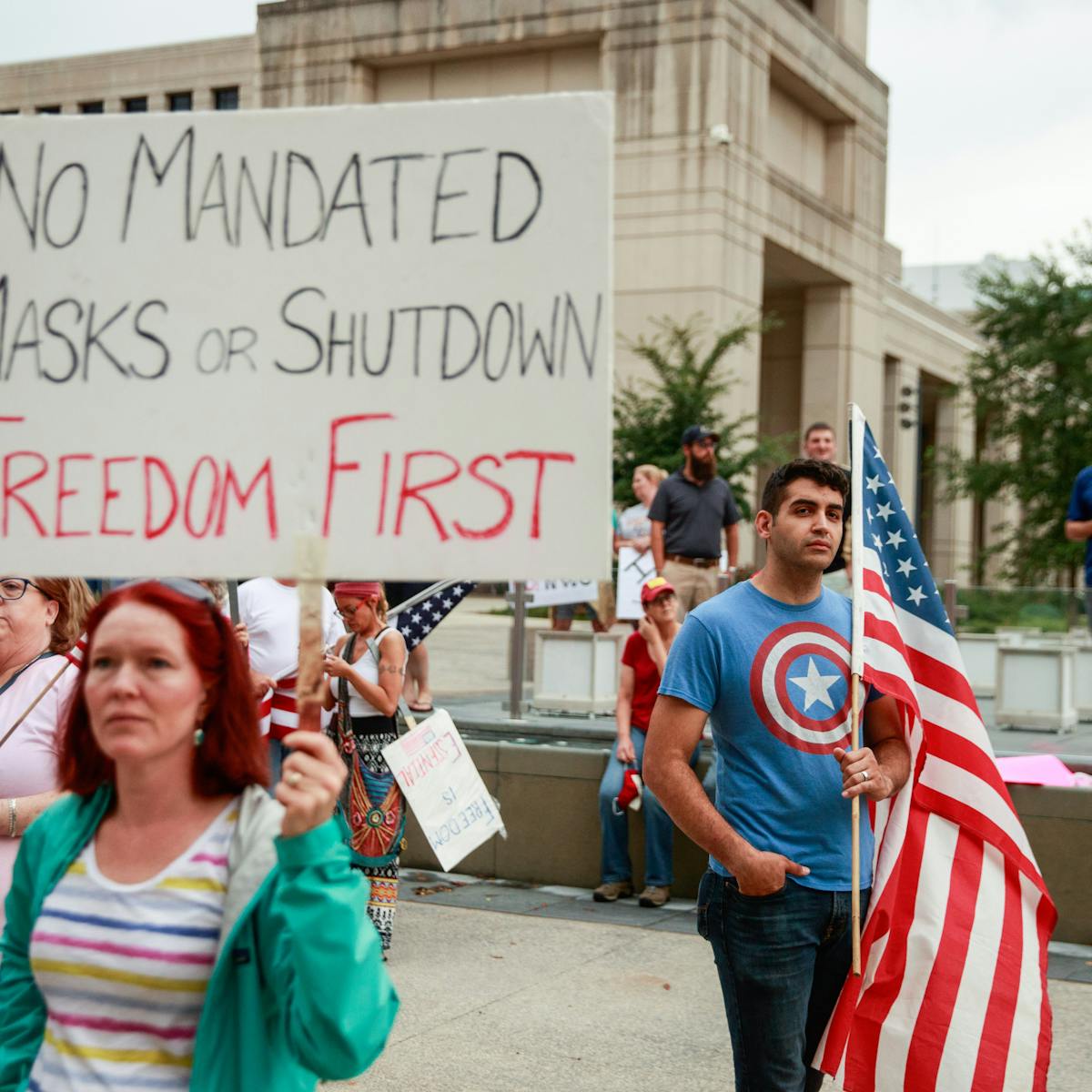
Many public health professionals and politicians are urging or requiring citizens to wear face masks to help slow the spread of the COVID-19 virus.

Some Americans have refused, wrongly claiming mask decrees violate the Constitution. An internet search turns up dozens of examples.

“Costco Karen,” for instance, staged a sit-in in a Costco entrance in Hillsboro, Oregon after she refused to wear a mask, yelling “I am an American … I have rights.”

A group called Health Freedom Idaho organized a protest against a Boise, Idaho, mask mandate. One protester said, “I’m afraid where this country is headed if we just all roll over and abide by control that goes against our constitutional rights.”

As one protester said, “The coronavirus doesn’t override the Constitution.”

Speaking as a constitutional law scholar, these objections are nonsense.

The objections

It is not always clear why anti-maskers think government orders requiring face coverings in public spaces or those put in place by private businesses violate their constitutional rights, much less what they think those rights are. But most of the mistaken objections fall into two categories:

Mandatory masks violate the First Amendment right to speech, assembly, and especially association and mandatory masks violate a person’s constitutional right to liberty and to make decisions about how to their own health and bodily integrity.

They’re not mutually exclusive claims:lawsuit filed by four Florida residents against Palm Beach County, for example, argues that mask mandates “interfere with … personal liberty and constitutional rights,” such as freedom of speech, right to privacy, due process, and the “constitutionally protected right to enjoy and defend life and liberty.” The lawsuit asks the court to issue a permanent injunction against the county’s mask mandate.

Responding to a reporter who asked why President Donald Trump appeared unconcerned about the absence of masks and social distancing at a campaign rally in Tulsa, Vice President Mike Pence said: “I want to remind you again freedom of speech and the right to peaceably assemble is in the Constitution of the U.S. Even in a health crisis, the American people don’t forfeit our constitutional rights.”

What the First Amendment does – and doesn’t – do

The First Amendment protects freedom of speech, press, petition, assembly and religion.

There are two reasons why mask mandates don’t violate the First Amendment.

First, a mask doesn’t keep you from expressing yourself. At most, it limits where and how you can speak. Constitutional law scholars and judges call these “time, place, and manner” restrictions. If they do not discriminate on the basis of the content of the speech, such restrictions do not violate the First Amendment. An example of a valid time, place and manner restriction would be a law that limits political campaigning within a certain distance of a voting booth.

Additionally, the First Amendment, like all liberties ensured by the Constitution, is not absolute.

All constitutional rights are subject to the goverment’s authority to protect the health, safety and welfare of the community. This authority is called the “police power.” The Supreme Court has long held that protecting public health is sufficient reason to institute measures that might otherwise violate the First Amendment or other provisions in the Bill of Rights. In 1944, in the case of Prince v. Massachusetts, for example, the Supreme Court upheld a law that prohibited parents from using their children to distribute religious pamphlets on public streets.

The right to liberty

Some anti-maskers object that masks violate the right to liberty.

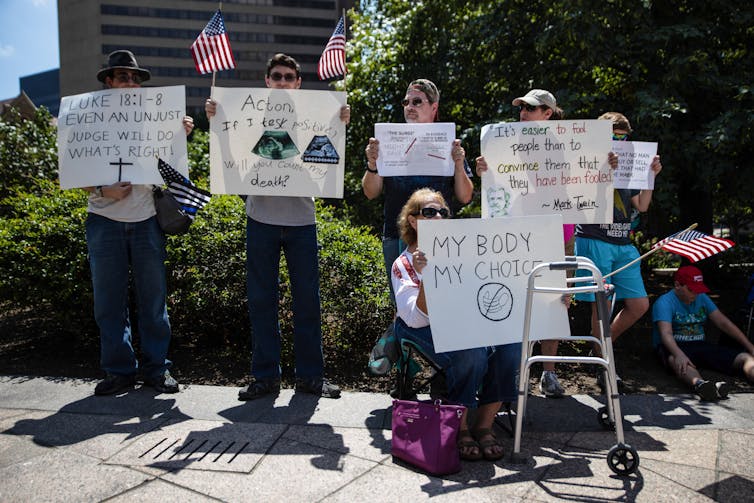
The right to liberty, including the right to make choices about one’s health and body, is essentially a constitutional principle of individual autonomy, neatly summarized as “My body, my choice.”

The 1905 case of Jacobsen v. Massachusetts shows why mask mandates don’t violate any constitutional right to privacy or health or bodily integrity. In that case, the Supreme Court upheld a smallpox vaccination requirement in Cambridge, Massachusetts.

The court said that the vaccination requirement did not violate Jacobsen’s right to liberty or “the inherent right of every freeman to care for his own body and health in such way as to him seems best.”

As the court wrote, “There are manifold restraints to which every person is necessarily subject for the common good. On any other basis, organized society could not exist with safety to its members.” In a 1995 New York case, a state court held that an individual with active tuberculosis could be forcibly detained in a hospital for appropriate medical treatment.

Even if you assume that mask mandates infringe upon what the Supreme Court calls “fundamental rights,” or rights that the court has called the “very essence of a scheme of ordered liberty,” it has consistently ruled states can act if the restrictions advance a compelling state interest and do so in the least restrictive manner.

Rights are conditional

As the Jacobsen ruling and the doctrine of time, place and manner make clear, the protection of all constitutional liberties rides upon certain necessary – but rarely examined – assumptions about communal and public life.

One is that is constitutional rights – whether to liberty, speech, assembly, freedom of movement or autonomy – are held on several conditions. The most basic and important of these conditions is that our exercise of rights must not endanger others (and in so doing violate their rights) or the public welfare. This is simply another version of the police power doctrine.

Unfortunately, a global pandemic in which a serious and deadly communicable disease can be transmitted by asymptomatic carriers upsets that background and justifies a wide range of reasonable restrictions on our liberties. Believing otherwise makes the Constitution a suicide pact – and not just metaphorically.


GOP senators in close races mislead on preexisting conditions

https://www.washingtonpost.com/politics/2020/07/15/gop-senators-close-races-mislead-preexisting-conditions/?utm_campaign=wp_main&utm_medium=social&utm_source=facebook&fbclid=IwAR3XOi91b1jsLf-grP_iIXALJiIvlZNItPE1ZDO0_ql4Wlw8m3GicyoHIH8

2018 midterms: Republicans mislead voters about preexisting ...

“Steve Daines will protect Montanans with preexisting conditions.”

“Of course I will always protect those with preexisting conditions. Always.”

“What I look forward to working on is a plan that protects people with preexisting conditions.”

— Sen. Cory Gardner (R-Colo.), in an interview with Colorado Public Radio, July 1, 2020


Sound familiar? Just like President Trump, these Republican senators say they support coverage guarantees for patients with preexisting health conditions. And just like Trump, their records show the opposite.

The president’s doublespeak — voicing support for these protections while asking the Supreme Court to strike them down — is spreading into some battleground Senate races this year.


It’s a classic case of buyer beware: Look under the hood of what Daines, Gardner and McSally are selling, and you’ll find a car without an engine.

THE FACTS

Republicans for a decade have tried to repeal the Affordable Care Act, President Barack Obama’s signature health-care legislation. The Supreme Court has upheld the law twice in the face of challenges from conservative groups. As coronavirus cases reached a new high in the United States, the Trump administration filed a legal brief on June 25 asking the Supreme Court to strike down the entire law, joining with a group of GOP state attorneys general who argue that the ACA is unconstitutional.

Before the ACA, insurance companies could factor in a person’s health status while setting premiums, a practice that sometimes made coverage unaffordable or unavailable for those in need of expensive treatment or facing a serious illness such as cancer.


The ACA PROHIBITED THIS PRACTICE through two provisions: “guaranteed issue,” which means insurance companies must sell insurance to anyone who wants it, and “community rating,” which means people in the same age group and geographic area who buy similar insurance pay similar prices. The changes made insurance affordable for people with serious diseases or even those with minor health problems, who also could have been denied coverage before the law’s passage.

Now, about 20 million people covered through the ACA could lose their health insurance if the Supreme Court strikes down the law, among many other consequences bearing directly on the U.S. response to the coronavirus pandemic.

In addition to the coverage guarantee, the ACA established online health insurance marketplaces and subsidies for participating buyers. The law also directs billions of dollars a year in federal funding to states that have chosen to expand their Medicaid programs under the Obamacare law. Millions of Americans have gained coverage through those provisions.

We asked the Daines, Gardner and McSally campaigns whether the senators support or oppose the GOP lawsuit at the Supreme Court and how they would address affordability issues for patients with preexisting conditions if the ACA falls. None of their campaigns responded to our questions.


“Steve Daines will protect Montanans with preexisting conditions.”

Daines voted to repeal the ACA in 2013 and has supported efforts to repeal and replace the law more recently during the Trump administration.

Regarding the GOP lawsuit, a Daines spokesperson was quoted in the Billings Gazette saying the senator “supports whatever mechanism will protect Montanans from this failed law, lower health care costs, protect those with preexisting conditions and expand access to health care for Montanans.”


“What I look forward to working on is a plan that protects people with preexisting conditions.” (Gardner)

Gardner has been voting to repeal, defund or replace the ACA since 2011, the year after its passage. This year, his campaign website says nothing about the law, but his official Senate website says, “Fixing our healthcare system will require repealing the Affordable Care Act and replacing it with patient-centered solutions, which empower Americans and their doctors.”

Asked by the Hill whether he supported the GOP lawsuit, Gardner said: “That’s the court’s decision. If the Democrats want to stand for an unconstitutional law, I guess that’s their choice.” In an interview with Colorado Public Radio, Gardner evaded the question six times in a row.

“Of course I will always protect those with preexisting conditions. Always.” (McSally)

In 2015, McSally voted to repeal the ACA when she served in the House. In 2017, she voted to replace the ACA with the American Health Care Act, which would have allowed insurers to charge higher premiums to patients with complicated medical histories.

McSally, now in the Senate, has declined to comment on the GOP lawsuit pending before the Supreme Court. When asked by PolitiFact, “the campaign didn’t specifically answer, but pointed to her general disapproval of the ACA.”

WHAT HAPPENS IF  THE GOP LAWSUIT SUCCEEDS?

Trump told The Washington Post days before his inauguration in 2017 that he was nearly done with his plan to replace the ACA. Three and a half years later, no replacement plan has emerged from the administration and Republicans in Congress hardly agree on what it would look like — or how to preserve the protections for preexisting health conditions.

Sen. Thom Tillis (R-N.C.), who is also running for reelection this year, has introduced a 24-page bill called the Protect Act that includes language guaranteeing coverage for preexisting conditions. Daines signed on as a co-sponsor on June 24, the day before the Justice Department filed its brief in the Supreme Court. McSally signed on in April 2019. Gardner is not listed as a co-sponsor.

Experts say the Tillis proposal does not offer the same level of protection for preexisting conditions as the ACA, and they warn that millions of Americans could lose their health coverage if the ACA falls and the Protect Act is the only replacement.

“Insurers before the Affordable Care Act had multiple and redundant ways that they could avoid people who had preexisting conditions,” said Karen Pollitz, a senior fellow at the Kaiser Family Foundation. The Protect Act prevents some of those practices, but it “leaves enough other loopholes that it would make it very possible and likely for insurers to be able to avoid paying benefits for the conditions they most worry about,” she said.


Before the ACA, an insurance company could reject an application outright, say, after reviewing a patient’s medical history. The Protect Act has language barring that practice.

“The second thing they could do is, they could sell you coverage, but they could exclude your preexisting condition. ‘Oh, you have diabetes? I’m not going to pay for any of those benefits,’” Pollitz said. “The Tillis bill says you can’t do that, so that’s good.”

In the days before the ACA, insurers were allowed to charge higher premiums based on a patient’s health status. To prevent this, the Protect Act takes language from the Health Insurance Portability and Accountability Act (HIPAA), rather than the newer ACA.

“The Protect Act inserts old HIPAA nondiscrimination language that prevents employers from varying worker premium contributions based on health status,” Pollitz said. “But the Protect Act also includes the old rule of construction that says nothing limits what the insurance company can charge the employer or individual.”

Pollitz said the “community rating” language in the ACA provides clearer protections in this area. The Protect Act says “nothing … shall be construed to restrict the amount that an employer or individual may be charged for coverage under a group health plan.”

“The bill would reinstate three protections at risk in the Texas case — prohibiting insurers from denying applicants based on pre-existing conditions, charging higher premiums due to a person’s health status, and excluding pre-existing conditions from coverage,” Sarah Lueck, a senior policy analyst at the left-leaning Center on Budget and Policy Priorities, wrote in an analysis.

“But it would leave many others on the cutting room floor,” she wrote, because insurers would be able to exclude coverage of benefits such as maternity care, mental health and substance-use treatment; set annual and lifetime limits on insurance payouts; and charge older patients more than younger patients at greater levels than the ACA allows, among other changes.

It’s important to keep in mind that the Protect Act would not replace other parts of Obamacare, such as the online marketplaces and subsidies. Neither would it continue the ACA’s Medicaid expansion, which 37 states and D.C. have now adopted. That includes Arizona, Colorado and Montana.


The Pinocchio Test

Voters deserve straight answers when their health care is on the line, especially in the middle of a deadly pandemic.

Daines, Gardner and McSally have voted to end the Affordable Care Act. People with preexisting conditions would have been left exposed because of those votes; insurers could have denied coverage or jacked up prices for sick patients.

The three senators’ comments about the GOP lawsuit are woefully vague, but they can all be interpreted as tacit support. Asked about the case, a Daines spokesperson said “whatever mechanism” to get rid of the ACA would do. McSally’s campaign “didn’t specifically answer, but pointed to her general disapproval of the ACA.” Gardner avoided the question six times in one interview, but in another, he said: “That’s the court’s decision. If the Democrats want to stand for an unconstitutional law, I guess that’s their choice.”

Four Pinocchios all around.


Supreme Court says employers may opt out of Affordable Care Act’s birth control mandate over religious, moral objections

https://www.washingtonpost.com/politics/courts_law/supreme-court-obamacare-birth-control-mandate/2020/07/08/0b38a352-c123-11ea-b4f6-cb39cd8940fb_story.html?location=alert&pwapi_token=eyJ0eXAiOiJKV1QiLCJhbGciOiJIUzI1NiJ9.eyJjb29raWVuYW1lIjoid3BfY3J0aWQiLCJpc3MiOiJDYXJ0YSIsImNvb2tpZXZhbHVlIjoiNWI2M2EzNDJhZGU0ZTI3Nzk1NTBjYTFiIiwidGFnIjoid3BfbmV3c19hbGVydF9yZXZlcmUiLCJ1cmwiOiJodHRwczovL3d3dy53YXNoaW5ndG9ucG9zdC5jb20vcG9saXRpY3MvY291cnRzX2xhdy9zdXByZW1lLWNvdXJ0LW9iYW1hY2FyZS1iaXJ0aC1jb250cm9sLW1hbmRhdGUvMjAyMC8wNy8wOC8wYjM4YTM1Mi1jMTIzLTExZWEtYjRmNi1jYjM5Y2Q4OTQwZmJfc3RvcnkuaHRtbD93cG1rPTEmd3Bpc3JjPWFsX25ld3NfX2FsZXJ0LXBvbGl0aWNzLS1hbGVydC1uYXRpb25hbCZ1dG1fc291cmNlPWFsZXJ0JnV0bV9tZWRpdW09ZW1haWwmdXRtX2NhbXBhaWduPXdwX25ld3NfYWxlcnRfcmV2ZXJlJmxvY2F0aW9uPWFsZXJ0In0.huz885amIR-ZrDl72t5E8qtHEI-itG-wa4GE-H-Z1UE&utm_campaign=wp_news_alert_revere&utm_medium=email&utm_source=alert&wpisrc=al_news__alert-politics–alert-national&wpmk=1

Supreme Court appears divided on Trump plan to limit contraception ...

The Supreme Court ruled Wednesday that the Trump administration may allow employers and universities to opt out of the Affordable Care Act requirement to provide contraceptive care because of religious or moral objections.

The decision seems to greatly expand an exception approved by the Obama administration, and the government estimates that it could mean that 70,000 to 126,000 women could lose access to cost-free birth control.

“We hold that the [administration] had the authority to provide exemptions from the regulatory contraceptive requirements for employers with religious and conscientious objections,” wrote Justice Clarence Thomas, who was joined by Chief Justice John G. Roberts Jr., and Justices Samuel A. Alito Jr., Neil M. Gorsuch and Brett M. Kavanaugh.

The decision sent the case back to a lower court and instructed it to dissolve a nationwide injunction that had kept the exception from being implemented.

Liberal Justices Elena Kagan and Stephen G. Breyer agreed with the court conservatives’ decision to send the case back to lower courts, but they did not join the majority opinion. Justices Ruth Bader Ginsburg and Sonia Sotomayor dissented.

At issue is the Trump administration’s decision in 2018 to expand the types of organizations that could opt out of providing cost-free access to birth control and the extent to which the government should create exemptions to the law for religious groups and nonreligious employers with moral and religious objections.

The Obama administration had narrower exceptions for churches and other houses of worship, and it created a system of “accommodations,” or workarounds, for religiously affiliated organizations such as hospitals and universities. Those accommodations would provide the contraceptive care but avoid having the objecting organizations directly cover the cost.

Under the Trump administration rules, the employers able to opt out include essentially all nongovernmental workplaces, from small businesses to Fortune 500 companies. And the employer has the choice of whether to permit the workaround.

The states of Pennsylvania and New Jersey initially challenged the rules, noting that when women lose coverage from their employers, they seek state-funded programs and services. Last summer, a unanimous panel of the U.S. Court of Appeals for the 3rd Circuit blocked the rules from taking effect nationwide. The court said the administration probably lacked authority to issue such broad exemptions and did not comply with requirements to provide notice and allow public comment on the rules.

In addition to the Trump administration, a charity called Little Sisters of the Poor defended the rules. The order of nuns, which runs homes for the elderly and employs about 2,700 people, points out that the government provided exemptions from the beginning for religious organizations such as churches. They say the accommodation provision violates the 1993 Religious Freedom Restoration Act, the law that says the government must have a compelling reason for programs that substantially burden religious beliefs.

In 2014, the Supreme Court in Burwell v. Hobby Lobby Stores ruled that certain closely held businesses do not have to offer birth control coverage that conflicts with the owners’ religious beliefs. But the court did not take a position on the accommodation provision, which requires objecting organizations to notify the government.

Two years later, a shorthanded court of eight justices declined to rule on the merits of another challenge to the contraceptive-coverage requirement and sent the case back to the lower courts. The unusual, unsigned decision was viewed as a punt by a court then equally divided along ideological lines.