Canada’s “national shame”: Covid-19 in nursing homes

https://www.vox.com/future-perfect/2020/7/7/21300521/canada-covid-19-nursing-homes-long-term-care

Why Canada's coronavirus cases are concentrated in nursing homes - Vox

Nursing homes account for 81 percent of Covid-19 deaths in the country. How did this happen?

Canada’s response to the coronavirus pandemic has generally been viewed as a success, with experts pointing to its political leadership and universal health care system as factors.

But there has been one glaring failure in Canada’s fight against the pandemic: its inability to protect the health of its senior citizens in nursing homes and long-term care facilities.

The situation for these seniors is so dire that the police — and even the military — have been called in to investigate why so many are dying.

In Quebec, some residents have been left for days in soiled diapers, going hungry and thirsty, and 31 residents were found dead at one home in less than a month, leading to accusations of gross negligence. In Ontario, the military found shocking conditions in five homes: cockroaches and rotten food, blatant disregard for infection control measures, and treatment of residents that was deemed “borderline abusive, if not abusive.”

“It’s a national shame,” said Nathan Stall, a geriatrician at Toronto’s Sinai Health System. “I don’t think we’ve done a good job at all in Canada.”

A whopping 81 percent of the country’s coronavirus deaths are linked to nursing homes and long-term care facilities. That means roughly 7,050 out of 8,700 deaths to date have been among residents and workers in these facilities.

In terms of raw numbers, that may not seem like very much. (For comparison, more than 40,000 US coronavirus deaths have been linked to nursing homes.) And, to be clear, Canada is hardly alone in watching tragedy unfold in these facilities. The US and Europe have seen startling numbers of fatalities among nursing home staffers and residents.

But 81 percent is a staggering statistic, especially for Canada, a country that prides itself on its progressive health policies. And it’s higher than the rate in any other country for which we have good data. In European countries, roughly 50 percent of coronavirus deaths are linked to these facilities. In the US, it’s 40 percent.

Experts say a number of factors are probably involved in Canada’s collapse on the nursing home front, like the fact that Canada has done well at controlling community spread outside these facilities (making nursing home deaths account for a greater share of overall deaths) and that residents in Canadian homes tend to be older and frailer than those in US homes (and thus more vulnerable to severe cases of Covid-19). But they say the high death rate in the homes is due, in large part, to egregious problems with the homes themselves.

“I think we have serious issues with long-term care,” said Vivian Stamatopoulos, a professor at Ontario Tech University who specializes in family caregiving. Experts have been warning political leaders about this for years, but, she said, “they’ve all been playing the game of pass the long-term care hot potato.”

Furious over how their elders are being treated, some Canadians have started petitions, protests, lawsuits, and even hunger strikes outside the homes. They say the government’s failure to respond reveals a deeper failure to care about seniors and people with disabilities, and to make that care concrete by sending facilities what they urgently need: more tests, more personal protective equipment (PPE), and more funding to pay staff members so they don’t have to work multiple jobs at different facilities.

Prime Minister Justin Trudeau has acknowledged that the situation in the facilities is “deeply disturbing.” He’s sent hundreds of military troops to help feed and care for the seniors in certain homes, where burnout and fear have prompted some staff members to flee their charges. But to some extent, Trudeau’s hands are tied because the facilities fall under provincial jurisdiction.

That leaves families terrified for their loved ones. They’re asking: Why have things gone so terribly wrong? How could this happen in Canada?


Canada’s crisis was a long time in the making

The first thing to understand is that Canada’s universal health care system does not cover nursing homes and long-term care facilities. That means these institutions are not insured by the federal system. Different provinces offer different levels of cost coverage, and even within a given province, you’ll find that some homes are publicly run, others are run by nonprofits, and still others are run by for-profit entities.

“This is the main problem — they don’t fall under the Canada Health Act,” said Stamatopoulos, adding that the same is not true of hospitals. “That’s why you see that the hospitals did so well. They had the resources.”

From the standpoint of someone in the US, where more than 132,000 people have died of Covid-19, Canada may seem to be doing well overall: The death toll there is around 8,700. Per capita, Canada’s coronavirus death rate is roughly half that of America’s. It’s clear that the northern neighbor has been doing better at keeping case numbers down, partly because it’s giving safer advice on easing social distancing.

Which makes the dire situation in nursing homes stand out even more. Longstanding problems with Canada’s nursing homes have clearly fueled the tragic situation unfolding there.

These homes are chronically understaffed. They tend to hire part-time workers, underpay them, and not offer them sick leave benefits. That means the workers have to take multiple jobs at different facilities, potentially spreading the virus between them. Many are immigrants or asylum seekers, and they fear putting their precarious employment at risk by, say, taking a sick day when they need it. (These problems aren’t unique to Canada, but as in other countries, they’ve been thrown into stark relief by the pandemic.)

A lot of Canadian homes also have poor infrastructure, built to the outdated design standards of the 1970s. Residents often live four to a room, share a bathroom, and congregate in crowded common spaces. That makes it very difficult to isolate those who get sick.

These problems are even worse in Canada’s for-profit nursing homes. Research shows that these private facilities provide inferior care for seniors compared to the public facilities, in large part because they hire fewer staff members and put fewer resources into upgrading or redesigning their buildings. The for-profit model incentivizes cost-cutting. (Similarly problematic profit motives and poor living conditions persist in US nursing homes, too.)

Canadian experts have been raising the alarm about these issues for more than a decade. So why haven’t they been addressed?

“Frankly, overall, it really reflects ageism in society. We choose not to invest in frail older adults,” Stall said. He added that early on in the pandemic, the public imagination latched onto stories of relatively young people on ventilators in hospitals. The hospitals and their staff got resources, free food, nightly applause. Homes for older people didn’t get the same attention.

“Nursing homes are not something we’re proud of societally. There’s a lot of shame around even having someone in a nursing home,” Stall said.

Stamatopoulos noted there are other forces at play, too. “I’d say it’s a trifecta of ageism, racism, and sexism,” she said. “When you look at this industry, it’s majority female older residents being cared for by majority racialized women.”

Ronnie Cahana, a 66-year-old rabbi who lives with paralysis at the Maimonides Geriatric Centre in Montreal, recently wrote a letter to Quebec’s premier. “I am not a statistic. I am a fully sentient, confident human being, who needs to have my humanity honored,” he wrote, adding that the premier should help the workers who take care of people like him. “Many of them are immigrants, newly beginning their lives in Quebec. … Please give them all the resources they require. Listen to their voices.”


How to make nursing homes safer — in Canada and beyond

If you want to keep nursing homes from becoming coronavirus hot spots, look to the strategies that have proven effective elsewhere. For months now, Canadian public health experts and advocates have been begging leaders to do just that.

All residents and workers in nursing homes should be tested regularly, whether they show symptoms or not. Anyone who gets sick should be isolated in a separate part of the building or taken to the hospital. Workers should be given adequate PPE, and universal masking among them should be mandatory. Working at multiple homes during the pandemic should be disallowed.

“Look at South Korea. They’ve had no deaths in long-term care because they treated it like SARS right from the get-go,” Stamatopoulos said. “They did aggressive testing. They were strict in terms of quarantining any infected residents and were quick to move them to hospitals. We’ve done the opposite.” Earlier in the pandemic, some Canadian hospitals sent recovering Covid-19 patients back to their nursing homes too soon; they inadvertently infected others.

“And look at New York state,” Stamatopoulos continued. “Gov. Cuomo signed an executive order on May 10 requiring all staff and residents to be tested twice a week. That aggressive testing helped halt the outbreaks in the homes.” Quebec and Ontario have yet to do this.

British Columbia, a Canadian standout at preventing deaths in nursing homes, adopted several wise measures early on. Way back on March 27, the western province made it illegal to work in more than one home — and topped up workers’ wages so they wouldn’t have to. It gave them full-time jobs and sick leave benefits.

It’s clear that so long as long-term care falls under provincial jurisdiction, nursing home residents will be better off in some provinces than in others. So some Canadian experts, including Stamatopoulos, are arguing that these facilities should be nationalized under the Canada Health Act. Others are not sure that’s the answer; Stall thinks it may make sense to target only for-profit homes, compelling them to improve their poor infrastructure. In the long term, any homes that do not meet modern standards should be redesigned.

Another lesson for the long term comes from Hong Kong, which has managed to totally avoid deaths in its nursing homes. Even before the coronavirus came along, all homes had a trained infection controller who put precautions in place to prevent the spread of infections. (US homes saw a similar system enacted under President Obama, but President Trump has proposed that it be rolled back.) Four times a year, Hong Kong’s homes underwent pandemic preparedness drills so that if an outbreak occurred, they’d be ready with best practices. It did, and they were.

Preparedness clearly saves lives. Hopefully, Canada and other countries will learn that lesson going forward so that no more lives are needlessly lost.

As Cahana, the resident in the Montreal home, said, “Each of us is crying to be heard. We say: More life! Please! We are not afraid of the future. We are afraid that society is forgetting us.”


Covid-19 cases are rising, but deaths are falling. What’s going on?

https://www.vox.com/2020/7/6/21314472/covid-19-coronavirus-us-cases-deaths-trends-wtf

Coronavirus cases are rising, but Covid-19 deaths are falling ...

By the time coronavirus deaths start rising again, it’s already too late.

There is something confounding about the US’s new coronavirus spikes: Cases are rising, but the country is seeing its lowest death counts since the pandemic first exploded.

The numbers are genuinely strange to the naked eye: On July 3, the US reported 56,567 new Covid-19 cases, a record high. On the same day, 589 new deaths were reported, continuing a long and gradual decline. We haven’t seen numbers that low since the end of March.

When laypeople observe those contradictory trends, they might naturally have a follow-up question: If deaths are not increasing along with cases, then why can’t we keep reopening? The lockdowns took an extraordinary toll of their own, after all, in money and mental health and some lives. If we could reopen the economy without the loss of life we saw in April and May, then why shouldn’t we?

I posed that very question to more than a dozen public health experts. All of them cautioned against complacency: This many cases mean many more deaths are probably in our future. And even if deaths don’t increase to the same levels seen in April and May, there are still some very serious possible health consequences if you contract Covid-19.

The novel coronavirus, SARS-Cov-2, is a maddeningly slow-moving pathogen — until it’s not. The sinking death rates reflect the state of the pandemic a month or more ago, experts say, when the original hot spots had been contained and other states had only just begun to open up restaurants and other businesses.

That means it could still be another few weeks before we really start to see the consequences, in lives lost, of the recent spikes in cases. And in the meantime, the virus is continuing to spread. By the time the death numbers show the crisis is here, it will already be too late. Difficult weeks will lie ahead.

Even if death rates stay low in the near term, that doesn’t mean the risk of Covid-19 has evaporated. Thousands of Americans being hospitalized in the past few weeks with a disease that makes it hard to breathe is not a time to declare victory. Young people, who account for a bigger share of the recent cases, aren’t at nearly as high a risk of dying from the virus, but some small number of them will still die and a larger number will end up in the hospital. Early research also suggests that people infected with the coronavirus experience lung damage and other long-term complications that could lead to health problems down the road, even if they don’t experience particularly bad symptoms during their illness.

And as long as the virus is spreading in the community, there is an increased risk that it will find its way to the more vulnerable populations.

“More infected people means faster spread throughout society,” Kumi Smith, who studies infectious diseases at the University of Minnesota, told me. “And the more this virus spreads the more likely it is to eventually reach and infect someone who may die or be severely harmed by it.”

This presents a communications challenge. Sadly, as Smith put it, “please abstain from things you like to benefit others in ways that you may not be able to see or feel” is not an easy message for people to accept after three-plus months in relative isolation.

But perhaps the bigger problem is the reluctance of our government to take the steps necessary to control the disease. Experts warned months ago that if states were too quick to relax their social distancing policies, without the necessary capacity for more testing or contact tracing, new outbreaks would flare up and be difficult to contain.

That’s exactly what happened — and now states are scrambling to reimpose some restrictions. Unless the US gets smarter about its coronavirus response, the country seems doomed to repeat this cycle over and over again.


Why Covid-19 deaths aren’t rising along with cases — yet

The contradiction between these two curves — case numbers sloping upward, death counts downward — is the primary reason some people are agitating to accelerate, not slow down, reopening in the face of these new coronavirus spikes.

The most important thing to understand is that this is actually to be expected. There is a long lag — as long as six weeks, experts told me — between when a person gets infected and when their death would be reported in the official tally.

“Why aren’t today’s deaths trending in the same way today’s cases are trending? That’s completely not the way to think about it,” Eleanor Murray, an epidemiologist at Boston University, told me. “Today’s cases represent infections that probably happened a week or two ago. Today’s deaths represent cases that were diagnosed possibly up to a month ago, so infections that were up to six weeks ago or more.”

“Some people do get infected and die quickly, but the majority of people who die, it takes a while,” Murray continued. “It’s not a matter of a one-week lag between cases and deaths. We expect something more on the order of a four-, five-, six-week lag.”

As Whet Moser wrote for the Covid Tracking Project last week, the recent spikes in case counts really took off around June 18 and 19. So we would not expect them to show up in the death data yet.

“Hospitalizations and deaths are both lagging indicators, because it takes time to progress through the course of illness,” Caitlin Rivers at the Johns Hopkins Center for Health Security told me late last week. “The recent surge started around two weeks ago, so it’s too soon to be confident that we won’t see an uptick in hospitalizations and deaths.”

The national numbers can also obscure local trends. According to the Covid Tracking Project, hospitalizations are spiking in the South and West, but, at the same time, they are dropping precipitously in the Northeast, the initial epicenter of the US outbreak.

And a similar regional shift in deaths may be underway, though it will take longer to reveal itself because the death numbers lag behind both cases and hospitalizations. But even now, Alabama, Arizona, Florida, Nevada, South Carolina, Tennessee, Texas, and Virginia have seen an uptick in their average daily deaths, according to Covid Exit Strategy, while Connecticut, Massachusetts, and New York have experienced a notable decline.

There are some reasons to be optimistic we will not see deaths accelerate to the same extent that cases are. For one, clinicians have identified treatments like remdesivir and dexamethasone that, respectively, appear to reduce people’s time in the hospital and their risk of dying if they are put on a ventilator.

The new infections are also, for now, skewing more toward younger people, who are at a much lower risk of dying of Covid-19 compared to older people. But that is not the case for complacency that it might superficially appear to be.


Younger people are less at risk from Covid-19 — but their risk isn’t zero

For starters, younger people can die of Covid-19. About 3,000 people under the age of 45 have died from the coronavirus, according to the CDC’s statistics (which notably have a lower overall death count than other independent sources that rely on state data). That is a small percentage of the 130,000 and counting overall Covid-19 deaths in the US. But it does happen.

Moreover, younger people can also develop serious enough symptoms that they end up having to be hospitalized with the disease. Again, their risk is meaningfully lower than that of older people, but that doesn’t mean it’s zero.

There can also be adverse outcomes that are not hospitalization or death. Illness is not a zero-sum game. A recent study published in Nature found that even asymptomatic Covid-19 patients showed abnormal lung scans. As Lois Parshley has documented for Vox, some people who recover from Covid-19 still report health problems for weeks after their initial sickness. Potential long-term issues include lung scarring, blood clotting and stroke, heart damage, and cognitive challenges.

In short, surviving Covid-19, even with relatively mild symptoms, does not mean a person simply reverts to normal. This is a new disease, and we are still learning the full extent of its effects on the human body.

But even if we recognize that young people face less of a threat directly from the coronavirus, there is still a big reason to worry if the virus is spreading in that population: It could very easily make the leap from less vulnerable people to those who are much more at risk of serious complications or death.


The coronavirus could easily jump from younger people to the more vulnerable

One response to the above set of facts might be: “Well, we should just isolate the old and the sick, while the rest of us go on with our lives.” That might sound good in theory (if you’re not older or immunocompromised yourself), but it is much more difficult in practice.

“The fact is that we live in communities that are all mixed up with each other. That’s the concern,” Natalie Dean, a biostatistics professor at the University of Florida, says. “It’s not like there’s some nice neat demarcation: you’re at high risk, you’re at low risk.”

The numbers in Florida are telling. At first, in late May and into early June, new infections accelerated among the under-45 cohort. But after a lag of a week or so, new cases also started to pick up among the over-45 (i.e., more at-risk) population.

“The rise in older adults is trailing behind, but it is starting to go up,” Dean said.

Anecdotally, nursing homes in Arizona and Texas — the two states with the most worrisome coronavirus trends right now — have seen outbreaks in recent weeks as community spread increases. The people who work in nursing homes, after all, are living out in the community where Covid-19 is spreading. And, because they are younger, they may not show symptoms while they are going to work and potentially exposing those patients.

As one expert pointed out to me, both Massachusetts and Norway have seen about 60 percent of their deaths come in long-term care facilities, even though the former has a much higher total fatality count than the latter. That would suggest we have yet to find a good strategy for keeping the coronavirus away from those specific populations.

“There is so far not much evidence that we know how to shield the most vulnerable when there is widespread community transmission,” Marc Lipsitch, a Harvard epidemiologist, told me.

That means the best recourse is trying to contain community spread, which keeps the overall case and death counts lower (as in Norway) and prevents the health care system from being overwhelmed.


Health systems haven’t been overwhelmed — but some hospitals in new hot spots are getting close

Arizona, Florida, and Texas still have 20 to 30 percent of their ICU and hospital beds available statewide, according to Covid Exit Strategy, even as case counts continue to rise. While some people use those numbers to argue that the health systems can handle an influx of Covid patients, the experts I spoke to warned that capacity can quickly evaporate.

“Let’s keep it that way, shall we?” William Hanage at Harvard said. “Hospitals are getting close to overwhelmed in some places, and that will be more places in future if action isn’t taken now. Also ‘not overwhelmed’ is a pretty low bar.”

Hospital capacity is another example of how the lags created by Covid-19 can lull us into a false sense of security until a crisis presents itself and suddenly it’s too late. Because it can take up to two weeks between infection and hospitalization, we are only now beginning to see the impact of these recent spikes.

And, to be clear, hospitalizations are on the rise across the new hot spots. The number of people currently hospitalized with Covid-19 in Texas is up from less than 1,800 on June 1 to nearly 8,000 on July 4. Hospitalizations in Arizona have nearly tripled since the beginning of June, up to more than 3,100 today.

And the state-level data doesn’t show local trends, which are what really matter when it comes to hospital capacity. Some of the hardest-hit cities in these states are feeling the strain, as Hanage pointed out. Hospitals in Houston have started transferring their Covid-19 patients to other cities, and they are implementing their surge capacity plans, anticipating a growing need because of the trendlines in the state.

Once a hospital’s capacity is reached, it’s already too late. They will have to endure several rough weeks after that breach, because the virus has continued to infect more people in the interim, some of whom will get very sick and require hospitalization when there isn’t any room available for them.

“We’re seeing some drastic measures being implemented right now in Texas and Arizona along those lines: using children’s hospitals for adults, going into crisis mode, etc.,” Tara Smith, who studies infectious diseases at Kent State University, told me. “So it shows how quickly all of that can turn around.”

And, on top of Covid-19, these health systems will continue to have the usual flow of emergencies from heart attacks, strokes, accidents, etc. That’s when experts start to worry people will die who wouldn’t otherwise have. That is what social distancing, by slowing the spread of the coronavirus, is supposed to prevent.


We don’t have to lock down forever — but we have to be smart and vigilant

Lockdowns are extraordinarily burdensome. Tens of millions of Americans have lost their jobs. Drug overdoses have spiked. There has been a worrying increase in heart-related deaths, which indicates people who otherwise would have sought medical treatment did not do so during the worst of the outbreak this spring.

But we cannot will the coronavirus out of existence. Experts warned months ago that if states reopened too early, cases would spike, which would strain health systems and put us at risk of losing more people to this virus. That appears to be what’s starting to happen. And it may get worse; if the summer heat has suppressed the virus to any degree, we could see another rebound in the fall and winter.

So we must strike a balance, between the needs of a human society and the reality that most of us are still susceptible to an entirely novel pathogen that is much deadlier and more contagious than the flu.

That means, for starters, being smarter about how we reopen than we have been so far. There is strong evidence that states were too cavalier about ending stay-at-home orders and reopening businesses, with just a handful meeting the metrics for reopening laid out by experts, as Vox’s German Lopez explained.

“What I’ve seen is that reopening is getting interpreted by many as reverting back to a Covid-free time where we could attend larger group gatherings, socialize regularly with many different people, or congregate without masks,” Kumi Smith in Minnesota said. “The virus hasn’t changed since March, so there’s no reasons why our precautions should either.”

To date, most states have opened up bars again and kept schools closed. Lopez made a persuasive case last week that we’ve got that backward. One of the most thorough studies so far on how lockdowns affected Covid-19’s spread found that closing restaurants and bars had a meaningful effect on the virus but closing schools did not.

That study also found that shelter-in-place orders had a sizable impact. While those measures may not be politically feasible anymore, individuals can still be cautious about going out — and when they do, they can stick to outdoor activities with a small number of people.

Masks are not a panacea either, but the evidence is convincingly piling up that they also help reduce the coronavirus’s spread. Whether a given state has a mandate to wear one or not, that is one small inconvenience to accept in order to get this outbreak back under control.

And, really, that is the point. While the current divergence between case and death counts can be confusing, the experts agree that Covid-19 still poses a significant risk to Americans — and it is a risk that goes beyond literal life and death. We know some of the steps that we, as individuals, can take to help slow the spread. And we need our governments, from Washington to the state capitals, to get smarter about reopening.

It will require collective action to stave off the coronavirus for good. Other countries have done it. But we have to act now, before we find out it’s already too late.


U.S. coronavirus cases rise by nearly 50,000 in biggest one-day spike of pandemic

https://www.yahoo.com/news/u-coronavirus-cases-rise-nearly-013221004.html

Dr Fauci warns US could see 100,000 new coronavirus cases PER DAY ...

New U.S. COVID-19 cases rose by nearly 50,000 on Wednesday, according to a Reuters tally, marking the biggest one-day spike since the start of the pandemic.

The record follows a warning by the government’s top infectious diseases expert that the number could soon double to 100,000 cases a day if Americans do not come together to take steps necessary to halt the virus’ resurgent spread, such as wearing masks when unable to practice social distancing.

In the first week of June, the United States added about 22,000 new coronavirus cases each day. But as the month progressed, hotspots began to emerge across the Sun Belt. In the last seven days of June, daily new infections almost doubled to 42,000 nationally.

Brazil is the only other country to report more than 50,000 new cases in one day. The United States reported at least 49,286 cases on Tuesday.

More than half of new U.S. cases each day come from Arizona, California, Florida and Texas, home to 30% of the country’s population. All four states plus 10 others saw new cases more than double in June.

The daily increase in new cases could reach 100,000 unless a nationwide push was made to tamp down the fast-spreading virus, Dr. Anthony Fauci, head of the National Institute of Allergy and Infectious Diseases, told a U.S. Senate committee on Tuesday.

“We can’t just focus on those areas that are having the surge. It puts the entire country at risk,” Fauci said.

The rise in cases is not just the result of more testing. Hospitalizations are also skyrocketing.

Nationally, 7% of coronavirus diagnostic tests came back positive last week, up from 5% the prior week, according to a Reuters analysis. Arizona’s positivity test rate was 24% last week, Florida’s was 16%. Nevada, South Carolina and Texas were all 15%, according to the analysis.

(Open https://tmsnrt.rs/2WTOZDR in an external browser for a Reuters interactive)

Some of the recent increase traces back to Memorial Day holiday celebrations in late May. Health experts are worried about Independence Day celebrations this weekend, when Americans traditionally flock to beaches and campgrounds to watch fireworks displays.


Cases skyrocketing among communities of color

https://www.axios.com/newsletters/axios-vitals-e9aa531d-4ef5-46ec-aedb-56f2bc9a77c9.html?utm_source=newsletter&utm_medium=email&utm_campaign=newsletter_axiosvitals&stream=top

Coronavirus cases skyrocketing among communities of color - Axios

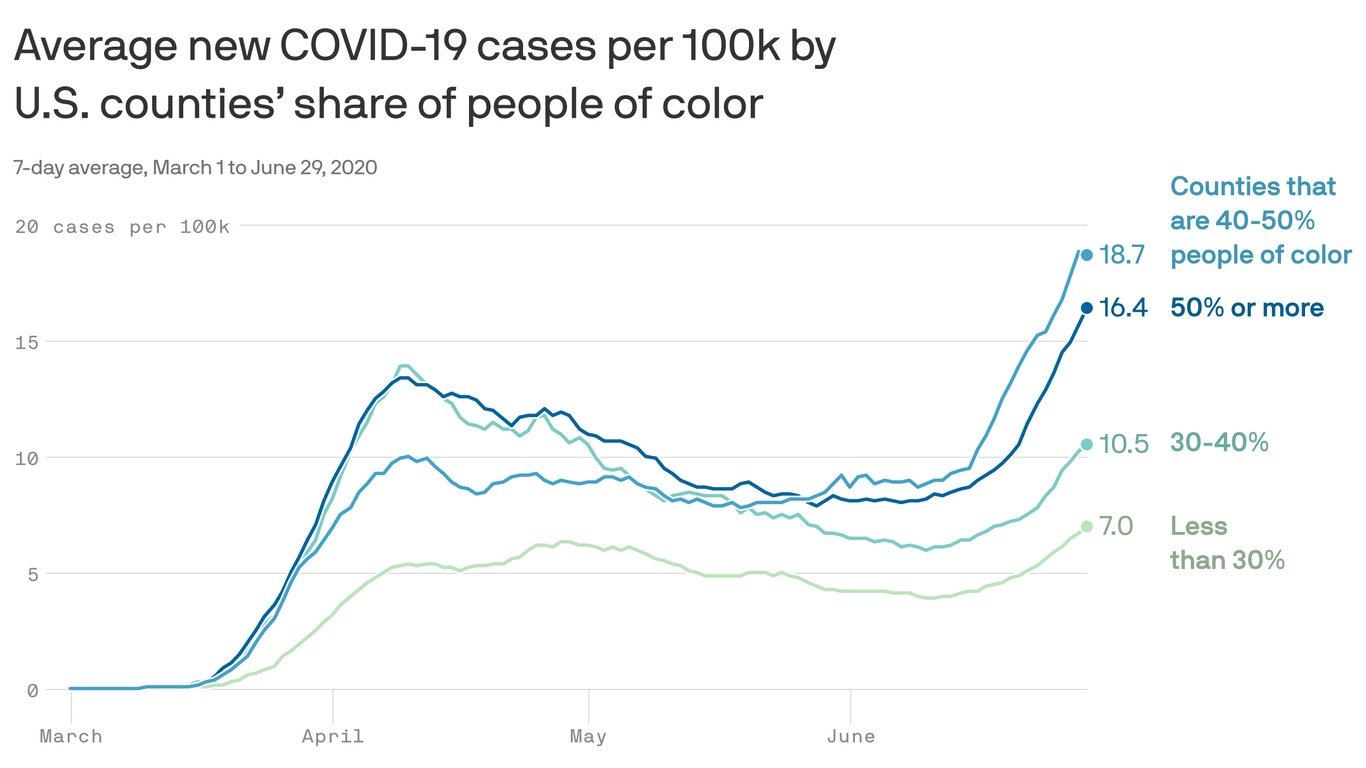
Counties populated by larger numbers of people of color tend to have more coronavirus cases than those with higher shares of white people.

What we’re watching: As the outbreak worsens throughout the South and the West, caseloads are growing fastest in counties with large communities of color.

The big picture: The southern and southwestern parts of the U.S. — the new epicenters of the outbreak — have higher Black and Latino or Hispanic populations to begin with.

  • People of color have seen disproportionate rates of infection, hospitalization and death throughout the pandemic.

Between the lines: These inequities stem from pre-existing racial disparities throughout society, and have been exacerbated by the U.S. coronavirus response.

  • Black and Hispanic or Latino communities have had less access to diagnostic testing, and people of color are also more likely to be essential workers. That means the virus is able to enter and spread throughout a community without adequate detection, often with disastrous results.

The bottom line: Until we plug the huge holes in the American coronavirus response — like inadequate testing and contact tracing and a lack of protection for essential workers — people of color will continue to bear the brunt of the pandemic.

Go deeper: People of color have less access to coronavirus testing


DOJ charges execs, others with elaborate $1.4B billing scheme using rural hospitals

https://www.healthcaredive.com/news/doj-charges-execs-others-with-elaborate-14b-billing-scheme-using-rural-h/580785/

Office of Attorney Recruitment & Management | Department of Justice

Dive Brief:

  • The U.S. Department of Justice is charging 10 defendants for an “elaborate” pass-through billing scheme that used small rural hospitals across three states as shells to submit fraudulent claims for laboratory testing to commercial insurers, jacking up reimbursement.
  • The defendants, including hospital executives, lab owners and recruiters, billed private payers roughly $1.4 billion from November 2015 to February 2018 for pricey lab testing, reaping $400 million.
  • The four rural hospitals used in the scheme are: Cambellton-Graceville Hospital, a 25-bed rural facility in Florida; Regional General Hospital of Williston, a 40-bed hospital in Florida; Chestatee Regional Hospital, a 49-bed facility in Georgia; and Putnam County Memorial Hospital, a 25-bed hospital in Missouri. Only Putnam emerged from the scheme relatively unscathed: Chestatee was sold to a health system that plans to replace it with a newer facility, Cambellton-Graceville closed in 2017 and RGH of Williston was sold for $100 to an accounting firm earlier this month.

Dive Insight:

The indictment, filed in the Middle District of Florida and unsealed Monday, alleges the 10 defendants, using management companies they owned, would take over rural hospitals often struggling financially. They would then bill commercial payers for millions of dollars for pricey urine analysis drug tests and blood tests through the rural hospitals, though the tests were normally conducted at outside labs, and launder the money to hide their trail and distribute proceeds.

The rural hospitals had negotiated rates with commercial insurers for higher reimbursement for tests than if they’d been run at an outside labs, so the facilities were used as a shell for fraudulent billing for often medically unnecessary tests, the indictment alleges.

The defendants, aged 34 to 60, would get urine and other samples by paying kickbacks to recruiters and healthcare providers, like sober homes and substance abuse treatment centers.

Screening urine tests, to determine the presence or absence of a substance in a patient’s system, is generally inexpensive and simple — it can be done at a substance abuse facility, a doctor’s office or a lab. But confirmatory tests, to identify concentration of a drug, are more precise and sensitive and have to be done at a sophisticated lab.

As such they’re more expensive and are typically reimbursed at higher rates than screening urine tests. None of the rural hospitals had the capacity to conduct confirmatory tests, or blood tests, on a large scale, but frequently billed in-network insurers, including CVS Health-owned Aetna, Florida Blue and Blue Cross Blue Shield of Georgia, for the service from 2015 to 2018, the indictment says.

Rural hospitals are facing unprecedented financial stress amid the pandemic, but have been fighting to keep their doors open for years against shrinking reimbursement and lowering patient volume. That can give bad actors an opportunity to come in and assume control.

One of the defendants, Jorge Perez, 60, owns a Miami-based hospital operator called Empower, which has seen many of its facilities fail after insurers refused to pay for suspect billing. Half of rural hospital bankruptcies last year were affiliated with Empower, which controlled 18 hospitals across eight states at the height of the operation. Over the past two years, 12 of the hospitals have declared bankruptcy. Eight have closed, leaving their rural communities without healthcare and a source of jobs.

“Schemes that exploit rural hospitals are particularly egregious as they can undermine access to care in underserved communities,” Thomas South, a deputy assistant inspector general in the Office of Personnel Management Office of Inspector General, said in a statement.


U.S. Healthcare System vs. Socialized Medicine during the Pandemic

https://www.commondreams.org/news/2020/06/25/why-socialized-system-medicare-all-beats-profit-healthcare-one-chart-covid-19?fbclid=IwAR1qT_AI5KFreoEKOqQfvdWUHPyW80fa2Iefxb5Ul5wJQtf8rSvZXkL8RHM


“All countries successfully combatting this virus have robust public health systems, which provide for coordination of effort.”

A recent rise in cases of Covid-19 and the overt failure of the for-profit healthcare system throughout the pandemic in the U.S. are making the case for Medicare for All, advocacy groups and activists say, as countries with socialized systems see their infection rates decline.

“All countries successfully combatting this virus have robust public health systems, which provide for coordination of effort,” remarked a popular healthcare advocate who uses the @AllOnMedicare handle on Twitter.

Calls for the U.S. to adopt a single-payer heathcare system have increased as the pandemic has raged around the country. Cases and deaths in the U.S are now the highest in the world, a result critics blame on both the private healthcare system and the mismanagement of the crisis by President Donald Trump.

Public Citizen’s health care policy advocate Eagan Kemp told Common Dreams that the current for-profit healthcare system that has driven millions of Americans in to bankruptcy and leaves millions more without care will only continue to exacerbate the pain of the outbreak. 

“While no health care system can completely protect a country from Covid-19, the U.S. has failed to respond for a number of reasons, not least of which is a for-profit health care system where Americans are too afraid to go to the doctors for fear of the cost,” said Kemp. “Far too many Americans will face medical debt and even bankruptcy if they are lucky enough to survive getting Covid-19, something unheard of in all other comparably wealth countries.”

As University of Massachusetts professor Dean E. Robinson wrote in a piece that appeared at Common Dreams earlier this month, the coronavirus is impacting people of color at a disproportionate rate in cities and communities nationwide—a dynamic that bolsters the call for a universal Medicare for All program to help close those gaps.

“The obvious and immediate need of Black and other working class populations caught in the teeth of the pandemic is the right to health care treatment without the burden of cost,” wrote Robinson. “Even before the pandemic, lower-income, Latino, and younger workers were more likely to be uninsured. Undocumented workers had the highest rates of uninsurance.”

On June 18, Ralph Nader in an opinion piece for Common Dreams expressed his hope that the ongoing pandemic would make essential workers in the health field “the force that can overcome decades of commercial obstruction to full Medicare for All.”


Coronavirus Cases may be 10x higher than official count says CDC

https://www.axios.com/newsletters/axios-vitals-59e9ac1a-ab86-4f8a-917a-8c9d52f5835f.html?utm_source=newsletter&utm_medium=email&utm_campaign=newsletter_axiosvitals&stream=top

NC coronavirus update June 25: North Carolina's mask mandate goes ...

The real number of U.S. coronavirus cases could be as high as 23 million — 10 times the 2.3 million currently confirmed cases — the Centers for Disease Control and Prevention told reporters yesterday, Axios’ Marisa Fernandez reports.

Between the lines: The new estimate is based on antibody testing, which indicates whether someone has previously been infected by the virus regardless of whether they had symptoms.

  • “This virus causes so much asymptomatic infection. The traditional approach of looking for symptomatic illness and diagnosing it obviously underestimates the total amount of infections,” CDC director Robert Redfield said.

The agency also expanded its warnings of which demographic groups are at risk, which now include younger people who are obese and who have underlying health problems.

  • The shift reflects what states and hospitals have been seeing since the pandemic began, which is that young people can get seriously ill from COVID-19.

The new guidance also categorizes medical conditions that can affect the severity of illness:

  • Conditions that increase risk: Chronic kidney disease; chronic obstructive pulmonary disease; obesity; weakened immune system from solid organ transplant; serious heart conditions, such as heart failure, coronary artery disease or cardiomyopathies; sickle cell disease; Type 2 diabetes.
  • Conditions that may increase risk: Chronic lung diseases, including moderate to severe asthma and cystic fibrosis; high blood pressure; a weakened immune system; neurologic conditions, such as dementia or history of stroke; liver disease; pregnancy.


America’s workers still aren’t protected from the coronavirus

https://www.axios.com/americas-workers-vulnerable-coronavirus-944e3451-4458-4f1d-83d2-c86a1beb1117.html

America's workers still aren't protected from the coronavirus - Axios

Essential workers have borne the brunt of the coronavirus pandemic for months, but the U.S. is still doing relatively little to protect them.

Why it matters: With no end to the pandemic in sight, America’s frontline workers still must choose between risking their health and losing their source of income.

Driving the news: The Trump administration said this week that health insurers aren’t required to cover coronavirus diagnostic tests performed as part of workplace safety or public health surveillance efforts.

  • It didn’t say who is supposed to pay for these tests. If employers are stuck footing the bill, that makes the testing less likely to happen.

The big picture: There’s been no national effort or initiative to protect essential workers, and America is still failing to implement basic public health measures as new cases skyrocket.

  • Masks have become a political flashpoint and aren’t required in many of the states that are emerging coronavirus hotspots.
  • That means essential workers go to work each day without any guarantee that the people they’re interacting with will take one of the most basic and effective steps to prevent transmission of the virus.
  • No one is even talking about mass distribution of personal protective equipment beyond health care workers. And even some health care workers — particularly those who work in nursing homes — don’t have the protective gear that they need.

More broadly, the financial incentives for frontline workers, particularly those who are low-income, to keep working make it nearly impossible for them to avoid health risks.

  • At least 69 million American workers are potentially ineligible for the emergency paid sick leave benefits that Congress passed earlier this year, per the Kaiser Family Foundation.
  • An estimated 25-30 million people — particularly lower-wage workers in service industries — are unable to work from home but also face a high risk of severe infection, KFF’s Drew Altman wrote earlier this week.

What we’re watching: The line between essential workers and those who are required to return to the office by their employer has become blurry, and millions more Americans are facing dilemmas similar to those faced by grocers and bus drivers.

  • The sickest — and thus most vulnerable — Americans may feel the most pressure to return to work, as that’s often where they get their health insurance, the NYT points out.
  • Nearly a quarter of adult workers are vulnerable to severe coronavirus infections, per KFF.

The bottom line: Essential workers and their families will continue to feel the impact of America’s coronavirus failures most acutely.

Go deeper: “Disposable workers” doing essential jobs


750 Million Struggling to Meet Basic Needs With No Safety Net

https://news.gallup.com/poll/312401/750-million-struggling-meet-basic-needs-no-safety-net.aspx?utm_source=newsbrief-newsletter&utm_medium=email&utm_campaign=NewsBriefNewsletter-NewsAlerts_June_06232020&utm_content=readarticle-textlink-6&elqTrackId=4006f0c4b7d144559ddd21458f847dda&elq=855f025f02c444dcb59fe9492ea16815&elqaid=4326&elqat=1&elqCampaignId=925

750 Million Struggling to Meet Basic Needs With No Safety Net

STORY HIGHLIGHTS

  • One in seven adults worldwide struggle to afford food, shelter with no help
  • At least some percentage in every country is “highly vulnerable”
  • Highly vulnerable in developed, developing world as likely to have health problems

This article is the first in series based on results from Gallup’s new Basic Needs Vulnerability Index.

Imagine being unable to afford food or to put a roof over your head, or maybe you are struggling to do both. On top of this, you don’t have family or friends who can help you.

Now, imagine this is all happening and a pandemic hits.

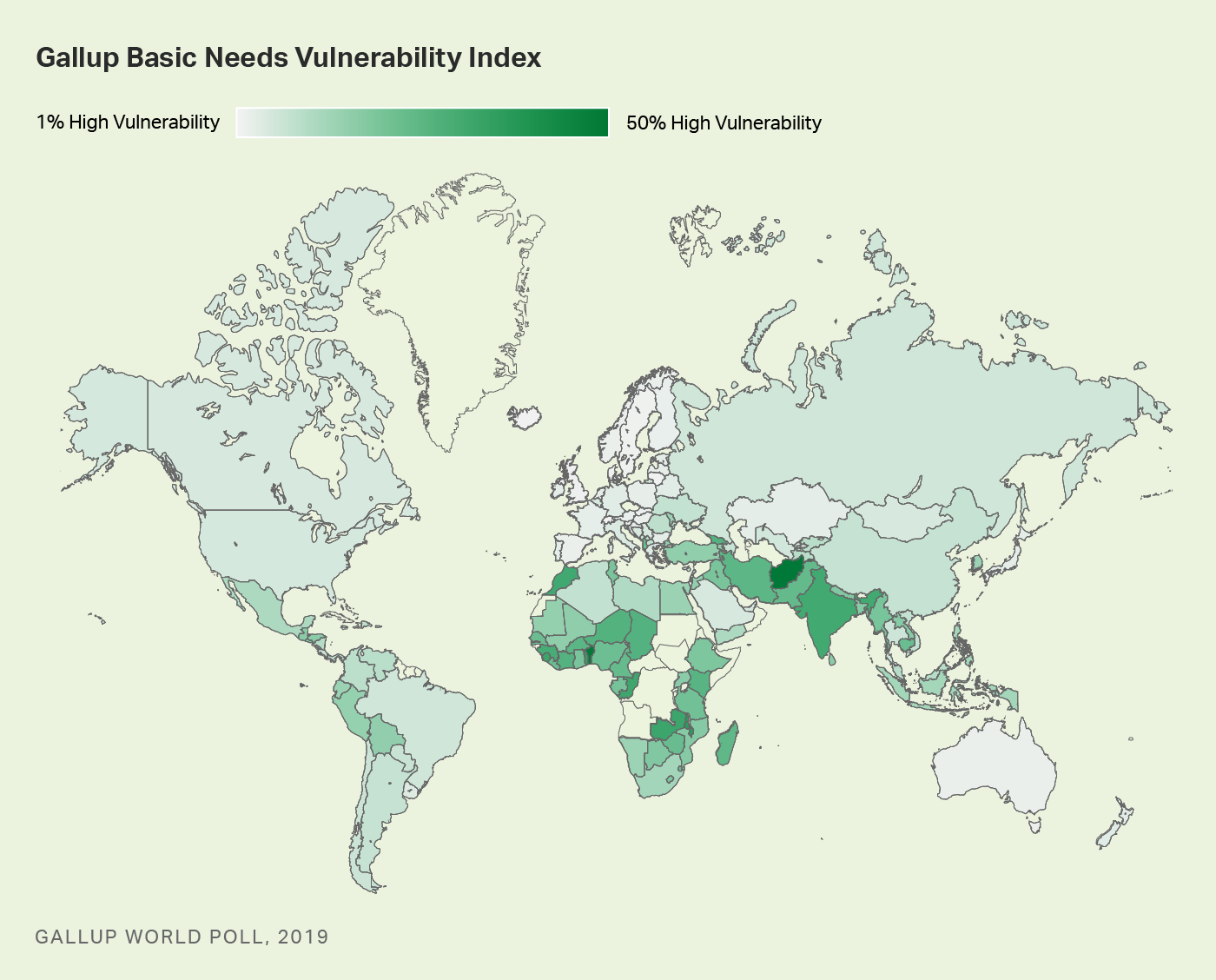
Gallup’s new Basic Needs Vulnerability Index, based on surveys in 142 countries in 2019, suggests this was the reality for hundreds of millions worldwide just as COVID-19 arrived.

About one in seven of the world’s adults — or about 750 million people — fall into this index’s “High Vulnerability” group, which means they are struggling to afford either food or shelter, or struggling to afford both, and don’t have friends or family to count on if they were in trouble.

Globally, at least some adults in every country fall into the High Vulnerability group, which is important because Gallup finds people in this group are potentially more at risk in almost every area of their lives. Worldwide, these percentages range from 1% in wealthy countries such as Denmark and Singapore to roughly 50% in places such as Benin and Afghanistan.

20200602_vulnerability@2x

Gallup’s Basic Needs Vulnerability Index gauges people’s potential exposure to risk from economic and other types of shocks like a pandemic. Beyond measuring people’s ability to afford food and shelter, this index also folds in whether people have personal safety nets — people who can help them when they are in trouble.

People worldwide fall into one of three groups:

High Vulnerability: People in this group say there were times in the past year when they were unable to afford food or shelter or say they struggled to afford both and say they do not have family or friends who could help them in times of trouble.

Moderate Vulnerability: People in this group say there were times in the past year when they were unable to afford food or shelter or say they struggled to afford both, and they do have family or friends to help them in times of trouble.

Low Vulnerability: People in this group say there were not times in the past year when they struggled to afford food or shelter and say they do have family or friends to help them if they were in trouble.

Before the pandemic, most of the world was at least moderately vulnerable, falling into either the High Vulnerability group (14%) or the Moderate Vulnerability group (39%). The rest, 47%, fell into the Low Vulnerability group.

The life experiences in these three groups illustrate the difference that not having family and friends to count on in times of trouble can make in people’s lives.

Highly Vulnerable Most Likely to Experience Health Problems, Experience Pain

While people in the High Vulnerability group are potentially more at risk in almost every area of their lives than those in the other two groups, they are particularly at risk when it comes to their health.

More than four in 10 (41%) of the highly vulnerable say they have health problems that keep them from doing activities that people their age normally do. This percentage drops to 29% among those who are moderately vulnerable and to 14% among those with low vulnerability.

The same is true for experiences of physical pain. The highly vulnerable are also far more likely to say they experienced physical pain the day before the interview (53% have) compared with 37% in the moderately vulnerable and 20% in the lowest vulnerability group.

Looking at who the highly vulnerable are within the global population reinforces why the greater risks to their health are so important. Globally, people in the high vulnerability group are just as likely to be male or female (14% of each fall into this group), and percentages are similar in the 15 to 29 age group (12%) and 60 and older group (14%).

However, the highly vulnerable are more likely to live in rural (16%) rather than urban areas (10%) and be in the poorest 20% of the population (21%) than the richest 20% of the population (7%).

Highly Vulnerable in Developed and Developing Countries Poor Health in Common

As might be expected, most of the countries with the highest percentage in the High Vulnerability group are a mix of developing economies and notably one emerging economy — India — and the countries with the lowest percentage are developed, high-income economies.

However, regardless of where they are located or their level of development, the highly vulnerable populations look a lot alike. In fact, when it comes to health problems, among the highly vulnerable populations, almost the exact same percentage in developing economies (41%) and high-income economies (42%) report having them.

The highly vulnerable in developing countries are only slightly more likely to report experiencing physical pain (53%) than this group in developed, high-income economies (47%).

Implications

As massive as the highly vulnerable group was before the pandemic, it could have been even larger, taking children and other household members into account.

As such, this new layer of vulnerability among populations will be important to monitor as the pandemic threatens to push tens of millions more people into extreme poverty and hunger this year and beyond.


Industry Voices—Healthcare has a plus-size problem from consolidation. Here are 9 ways to respond

https://www.fiercehealthcare.com/hospitals/industry-voices-healthcare-has-a-plus-size-problem-from-consolidation-here-are-9-ways-to?mkt_tok=eyJpIjoiWlRJMk9UYzVZVFl4Tm1VMSIsInQiOiJ0aElzSllzTkpISWNIcU13ZXErNVdPSzU3K05cLzRVY2FEWFMycDNHZTZcLzlTYUo3UVNNQXd3ZjlwZXlFbVA3c3NQTHI0NFhqcjhFNk1VUXc4aVlnYW9aSnFVOVIydEFqWG5weWdEc2Viall1elwvK0RIRWtEajhPWGw3TEFTNDlkUCJ9&mrkid=959610

Industry Voices—Healthcare has a plus-size problem from ...

For two decades, healthcare consolidation has been a strong industry trend. But in the COVID-19 era, big healthcare is proving to be a big problem.

Once the community spread of COVID-19 became apparent, large systems turned off the spigot of specialty and nonessential services almost immediately. Now, as these organizations try to entice patients back into services, they face consumers who have good reason to fear the large, populated spaces these systems are built on.

As patients return for care and treatments, large hospitals and health providers need targeted approaches to overcome risk and obstacles. Here are nine strategies to consider for restarting patients:

1. Identify patients and instances with care disruption and high risks associated with care deferral. Knowing which patients are at high risk due to missed appointments plus other risk and time-based analytics will be useful in targeting efforts to bring patients back. Use various technologies to identify prior scheduled procedures and diagnostics.

2. Create a clinical flow for patients in each treatment or appointment category so communication to patients is clear as they are recruited back into the system. The clinical flows should determine which patients will receive telehealth services and who will need physical exams, along with how imaging or laboratory services will be handled to safely address patient time and access to services.

3. Use population health technology to target patients by risk level for services and deferral reasons. Patients who were infected with COVID-19 should be indicated and targeted for services, since this calls for additional surveillance of new risk factors associated with the disease.

4. Contact patients for pre-appointment discussions prior to actual telehealth or personal visits and services. Identify data to collect from patients on symptoms, social determinants and concerns about healthcare or COVID-19 infection so patients can vet their concerns and upcoming discussions with physicians can be more informative.

5. Reimagine the role and functions of some specialists. Because specialty practices are often located in close proximity to many diagnostic services, primary care physicians, who tend to be off campus, can provide initial services in a low-density setting and leave the procedures to specialists.

6. Consider aligning with smaller or more localized services for diagnostics, or provide wearable devices that capture needed clinical data.

7. If feasible, consider whether physical access to some care locations should be redetermined in the short or midterm for patient ease of access.

8. For physical visits or treatments, adjust scheduling to accommodate patient and staff density in clinical or waiting areas.

9. Involve specialists in care and space redesign as well as designing risk criteria. Every specialty will have unique issues that should be accommodated in the design of restarting services.

Planning to improve and strengthen connections to patients in larger healthcare operations will go far toward helping them gain confidence to return during this phase of the pandemic. Now more than ever, we can’t afford a systemwide hit or miss.