More than six out of 10 Americans are hopeful about what 2021 has in store for the world, according to a new Axios/SurveyMonkey poll.
The big picture:After a year dominated by the pandemic and a seemingly endless presidential election, Americans are overwhelmingly hopeful that things will get better with the pandemic — and more narrowly hopeful about Joe Biden’s presidency.
By the numbers:63% of poll respondents said they’re more hopeful than fearful about what 2021 holds in store for the world, while 36% said they’re more fearful.
That’s a jump in optimism compared to the same poll heading into 2019, when just 51% said they were hopeful and 48% said they were fearful.
The only group that wasn’t optimistic about 2021 was Republicans: 41% said they were more hopeful, while 58% said they were more fearful.
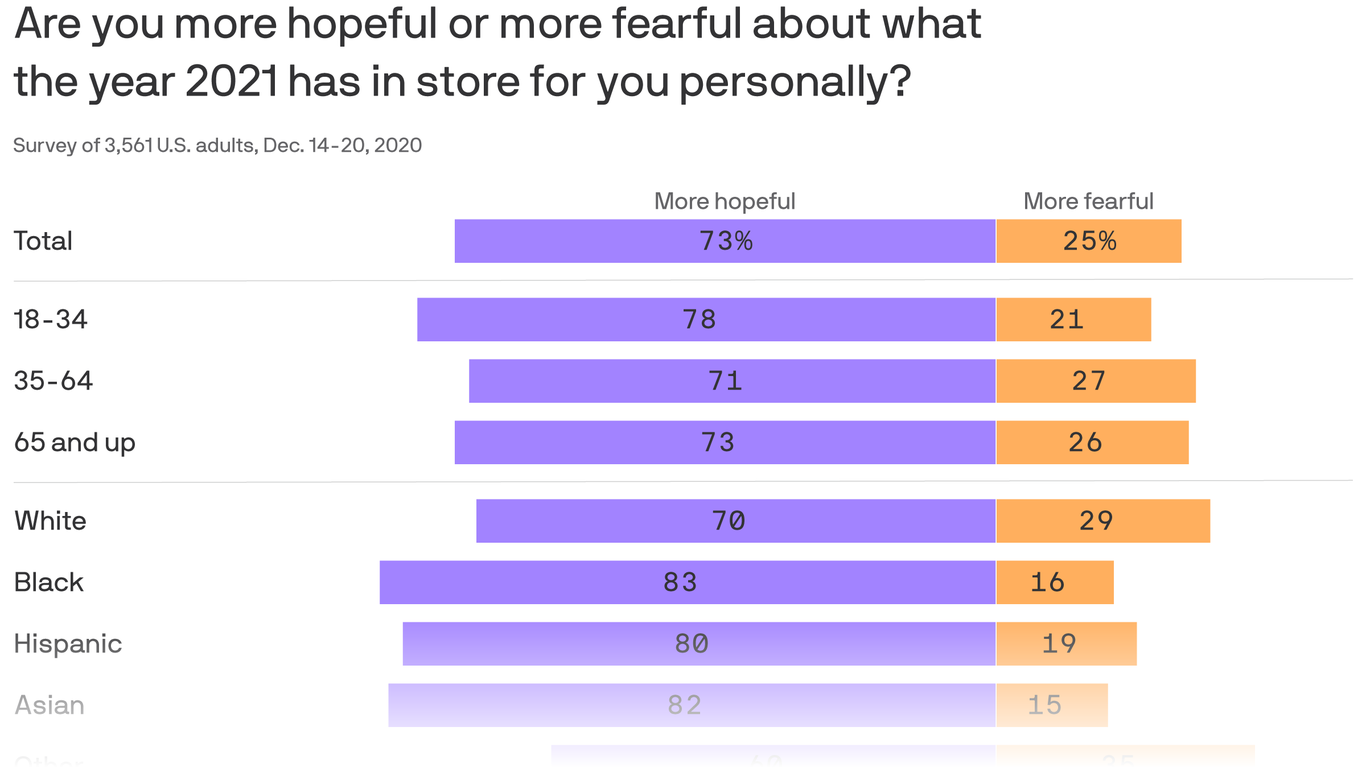
Between the lines:Americans were even more optimistic about the year ahead for them personally — mostly driven by the hopes of young adults, people of color and Democrats.
The coronavirus was the one issue that united most people in optimism. Overall, 76% were more hopeful than fearful about the pandemic next year — a view that held across most age groups, racial and ethnic groups, and parties.
82% of Democrats, 72% of Republicans, and 73% of independents said they were more hopeful than fearful.
The Biden presidency was more divisive. Overall, 56% were more hopeful about his presidency, while 42% were more fearful.
Not surprisingly, Republicans are the most pessimistic: 82% said they’re more fearful than hopeful about his presidency.
By contrast, 59% of independents said they’re more hopeful about it — and 92% of Democrats said the same.
And while Republicans are ready for President Trump to take on a big leadership role in the Republican Party after his presidency ends, that’s not true of everyone else.
75% of Republicans said they’re more concerned that Trump will play too small a role in the future of the GOP rather than too big a role — while 51% of all respondents said they’re more concerned that he’ll play too big a role.
And more than half of Republicans (52%) said they believe Trump will have a major role in the Republican Party, while 30% said they think he’ll have a minor role.
By contrast, just 34% of all respondents expect him to play a major role, while 32% think he’ll have a minor role and 31% think he’ll have no role at all.
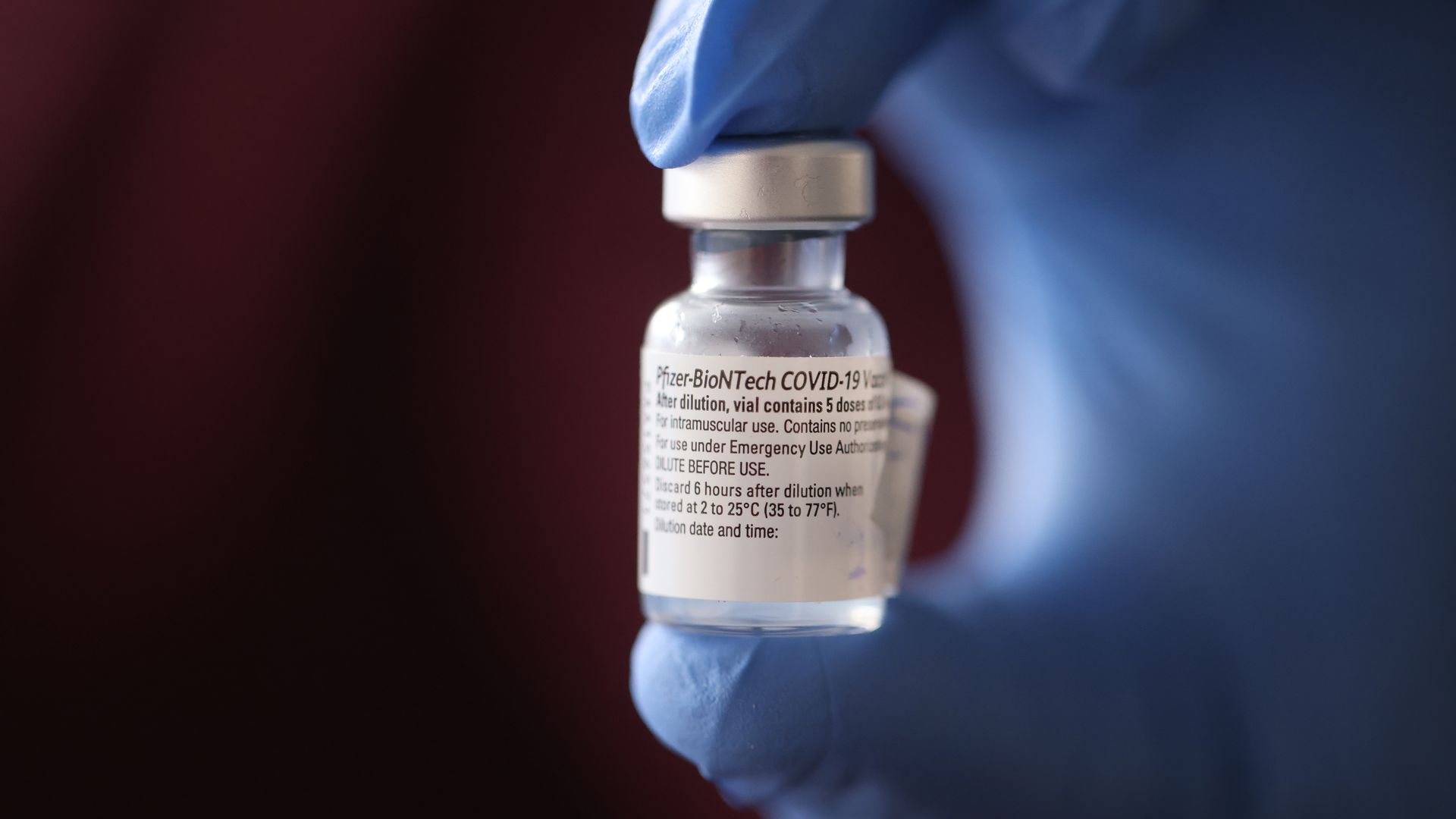
Pfizer said in a statement that there are “no data” to demonstrate that a single dose of its coronavirus vaccine will provide protection from infection after 21 days.
Why it matters: The U.K. announced on Wednesday that it would shift its vaccination strategy “to give as many people in at-risk groups their first dose, rather than providing the required two doses in as short a time as possible.” Some provinces in Canada are doing the same.
Pfizer confirmed in response that although some protection appears to begin as early as 12 days after the first dose, two doses of the vaccine — separated by three weeks — is the only regimen that proved to be 95% effective in Phase 3 trials.
“Everyone will still receive their second dose and this will be within 12 weeks of their first,” the U.K. government added in a statement. “The second dose completes the course and is important for longer term protection.”
The big picture: Pfizer’s warning comes as many countries, including the U.S., debate how to rapidly deploy the vaccines in the most effective way possible. The U.S. is on pace to fall far below its target of vaccinating 20 million people by the end of 2020, with only 3 million single-doses administered as of Wednesday night.
Travelers boarding a flight during the pandemic might consider it unlikely that anyone sick with the coronavirus would make it onboard. But the reality is that travelers are boarding planes with covid-19, putting their fellow passengers at risk of contracting the illness.
Beyond the danger those infected passengers are creating to the people around them, they also pose a sizable risk to themselves when they board their planes. Doctors say that flying is a high-risk activity for coronavirus-positive individuals because of low air pressure in the cabin and that multiple passengers have now died because of it.
When a man infected with the coronavirus died of acute respiratory failure on a United Airlines flight from Orlando to Los Angeles on Dec. 14, he was not the first individual to die of covid-19 on a plane. In July, a Texas woman died of the disease on a Spirit Airlines flight that was diverted when she was found to be unresponsive and not breathing. In both cases, the passengers were given CPR on the plane but could not be revived.
The likely medical problem in both these instances, doctors say, is that low air pressure — which is standard in plane cabins — creates dangerously low blood-oxygen levels in people with respiratory conditions. Covid-19, the illness caused by the coronavirus, is a respiratory disease that often attacks the lungs and heart.
Nicholas Hill, pulmonary chief at Tufts Medical Center in Boston, says there is “no question” that the air condition in plane cabins poses a risk to passengers with covid-19 and that flying was probably factor in the deaths of the passengers infected with the virus.
“If you get on a plane with covid, or anything else respiratory-related, you are going to be at a considerably higher risk when you go to altitude,” Hill says. “This is not something unique to covid; it’s true of anybody that’s got an acute or respiratory condition. This change in oxygen from sea level can provoke crises in the air.”
Plane cabins are pressurized so passengers are able to breathe at altitudes over 30,000 feet, but the air pressure is still about 25 percent lower in a plane cabin than it is at sea level. Flying has long given respiratory-troubled patients medical crises in the air. Covid-19 is no different. Flying with it can impact blood oxygen levels to a degree that requires immediate medical attention.
David Freedman, an epidemiologist at the University of Alabama at Birmingham, says covid-infected patients are at the same risk as people with non-coronavirus lung and heart conditions that impact their breathing. Airlines are prepared for those kinds of respiratory emergencies with supplemental oxygen onboard.
“The oxygen concentration [on planes] is much lower than on the ground, and all patients with severe lung or heart disease know this and know that they will need supplemental oxygen on board even if they don’t require it normally,” Freedman says. “All planes do carry an oxygen tank on board for emergencies like this.”
Delta Air Lines says that respiratory emergencies make up about 10 percent of in-flight medical events and that all aircraft are equipped with supplemental oxygen.
All airline flight attendants receive annual training in CPR, Taylor Garland, a spokesperson for the Association of Flight Attendants labor union, told The Washington Post in an email. Flight crew are also in close contact with medical services on the ground that can meet the aircraft in the event of an emergency landing.
But those efforts all fell short in the July and December deaths. Hill says passengers do not necessarily need to be experiencing shortness of breath before takeoff to become breathing-impaired in-flight. Blood oxygen levels can be low in covid-19 patients who are not experiencing trouble breathing, making getting on a plane with the virus — even if you’re pre-symptomatic or asymptomatic — a high-risk endeavor.
“Early on in the pandemic there were descriptions of ‘happy hypoxia’ patients, covid patients who come in with pretty low oxygen levels but wouldn’t be short of breath,” Hill says. “Most people who have low oxygen levels are also complaining of shortness of breath, but it is possible initially to not have those symptoms.”
On the July Spirit Airlines flight, a crew member who administered CPR to the unresponsive woman passed out from exhaustion, according to reporting by The Post. Contact tracers reportedly never notified passengers on the plane of the positive coronavirus case onboard.
Tony Aldapa, an off-duty medical worker on the Dec. 14 United flight who gave chest compressions to the unresponsive man, said last week that he was experiencing coronavirus symptoms after helping the flight crew with CPR. He was not notified about his exposure to the virus by contact tracers until 10 days after the flight.
“I knew we were pretty far from where we needed to land at, and CPR is exhausting with one person or two people. Even with three or four people, it’s not an easy thing to do,” Aldapa, 31, told the Los Angeles Times of the incident. “Regardless of COVID … he needed CPR to save his life.”