AMA report: U.S. has “highly concentrated” payer markets that stifle competition  

https://medcitynews.com/2021/10/ama-report-u-s-has-highly-concentrated-payer-markets-that-stifle-competition/?utm_campaign=MCN%20Daily%20Top%20Stories&utm_medium=email&hsmi=166812730&_hsenc=p2ANqtz–Z_7y9-ZOPkhC7HI4RXSwuM5xDzd2B0uZi9sApeW1J89hQBktG-rqujxpBFiXmxEEnaK77vlq-7vHhr-qK8mxRgBmwA&utm_content=166812730&utm_source=hs_email

About 73% of health insurance markets are highly concentrated, and in 46% of markets, one insurer had a share of 50% or more, a new report from the American Medical Association shows. The report comes a few months after President Joe Biden directed federal agencies to ramp up oversight of healthcare consolidation.

The majority of health insurance markets in the U.S. are highly concentrated, curbing competition, according to a report released by the American Medical Association.

For the report, researchers reviewed market share and market concentration data for the 50 states and District of Columbia, and each of the 384 metropolitan statistical areas in the country.

They found that 73% of the metropolitan statistical area-level payer markets were highly concentrated in 2020. In 91% of markets, at least one insurer had a market share of 30%, and in 46% of markets, one insurer had a share of 50% or more.

Further, the share of markets that are highly concentrated rose from 71% in 2014 to 73% last year. Of those markets that were not highly concentrated in 2014, 26% experienced an increase large enough to enter the category by 2020.

In terms of national-level market shares of the 10 largest U.S. health insurers, UnitedHealth Group comes out on top with the largest market share in both 2014 and 2020, reporting 16% and 15% market share, respectively. Anthem comes in second with shares of 13% in 2014 and 12% in 2020.

But the picture looks different when it comes to the market share of health insurers participating in the Affordable Care Act individual exchanges. In 2014, Anthem held the largest market share among the top 10 insurers on the exchanges, with a share of 14%. By 2020, Centene had taken the top spot, with a share of 18%, while Anthem had slipped to fifth place, with a share of just 4%.

Another key entrant into the top 10 list in 2020 was insurance technology company Oscar Health, with 3% of the market share in the exchanges at the national level.

“These [concentrated] markets are ripe for the exercise of health insurer market power, which harms consumers and providers of care,” the report authors wrote. “Our findings should prompt federal and state antitrust authorities to vigorously examine the competitive effects of proposed mergers involving health insurers.”

The payer industry hit back. In a statement provided to MedCity News, America’s Health Insurance Plans, a national payer association, said that Americans have many affordable choices for their coverage, pointing to the fact that CMS announced average premiums for Medicare Advantage plans will drop to $19 per month in 2022 from $21.22 this year.

“Health insurance providers are an advocate for Americans, fighting for lower prices and more choices for them,” said Kristine Grow, senior vice president of communications at America’s Health Insurance Plans, in an email. “We negotiate lower prices with doctors, hospitals and drug companies, and consumers benefit from lower premiums as a result.”

Further, the report does not mention the provider consolidation that also contributes to higher healthcare prices. Mergers and acquisitions among hospitals and health systems have continued steadily over the past decade, remaining relatively impervious to even the Covid-19 pandemic.

Scrutiny around consolidation in the healthcare industry may grow. In July, President Joe Biden issued an executive order urging federal agencies to review and revise their merger guidelines through the lens of preventing patient harm.

The Federal Trade Commission has already said that healthcare businesses will be one of its priority targets for antitrust enforcement actions.

Will choosing a “white coat CEO” advance physician alignment?

https://mailchi.mp/a2cd96a48c9b/the-weekly-gist-october-1-2021?e=d1e747d2d8

Physician Advocates Docs Ditch The White Coat - Too Germy | WUKY

We recently got a call from a health system board chair seeking our perspective on the system’s ongoing search for a new CEO. At the top of his list: trying to understand how important it will be for the next CEO to be a physician. “We’ve never had a doctor in the role,” he mused. “But now we employ hundreds of doctors. And you’d have to imagine that having a physician as CEO would help with physician alignment.” 

While choosing a physician CEO brings great signal value to the medical staff, we cautioned that it’s far from a panacea. 

Of course, there are advantages in having walked in a frontline clinician’s shoes, being able to personally identify with their challenges and speak their language. But over the years, working with hundreds of health system CEOs, we’ve found that the most important characteristic of a CEO who will advance physician strategy is the desire to form strong personal relationships with doctors and draw on their counsel.

Does the CEO build a “kitchen cabinet” of physician leaders whom he can consult? Are physicians viewed as something to be managed, a problem to solve, or seen as true partners in strategy? Even more simply, does she like spending time with physicians, or groan every time a meeting with doctors pops up on the calendar? We’ve seen many non-physician CEOs excel at building strong, strategic ties with doctors, and some physician executives, who become jaded by never-ending physician alignment struggles, fail to advance partnerships with their colleagues.

One retiring physician CEO, reflecting on his replacement by a nonclinical executive, summed it up well: “I have a feeling he’ll do well with our doctors. He counts several physicians among his closest friends, which is a great sign.”

An unsettling start to the school year

https://mailchi.mp/a2cd96a48c9b/the-weekly-gist-october-1-2021?e=d1e747d2d8

As a long hoped-for sign of the “return to normal”, most children went back to in-person learning this fall. And with the patchwork of COVID safety protocols and masking policies across school districts, classrooms became a learning lab for scientists studying the efficacy of masking and other precautions.

Unsurprisingly, getting a bunch of unvaccinated kids back together caused a surge in pediatric COVID cases. But recent Centers for Disease Control and Prevention (CDC) data from 500 counties demonstrate just how effective mask mandates have been at mitigating outbreaks.

The graphic above shows that cases in counties without school mask mandates increased at nearly three times the rate of those with mask mandates. In the five-week period spanning the start of the school year, cases in counties without a mask mandate rose by 62.6 cases per 100K children, while cases in counties with a mask mandate rose by only 23.8 per 100K. COVID outbreaks are incredibly disruptive to learning; according to a recent KFF survey, nearly a quarter of parents report their child has already had to quarantine at home this school year following a possible COVID exposure.

Even once vaccines are approved for children under 12, recent data suggest that a majority of parents will be hesitant to vaccinate their child. Just over half of 12- to 17-year-olds have received at least one dose of the vaccine so far, and only a third of parents of 5- to 11-year-olds plan to vaccinate their child right away, once the shot is approved.

Many want more information, or are worried about side effects—concerns that will best be assuaged by their pediatricians and other trusted sources of unbiased information.

Walmart partners with Epic for its health technology platform

https://mailchi.mp/a2cd96a48c9b/the-weekly-gist-october-1-2021?e=d1e747d2d8

Walmart to Deploy Epic EHR Platform in 4 New Health Centers

This week, retail giant Walmart announced a partnership with Epic, the country’s most widely-used electronic health record (EHR) system, as the technology platform to support its health and wellness businesses. Epic will first be installed in four Walmart Health Center clinics slated to open in Florida early next year.

The company currently operates 20 health centers in Georgia, Arkansas and the Chicago area, offering an expanded range of services including comprehensive primary care, behavioral health, dental, hearing and vision care, as well as labs and other diagnostics. Skeptics have noted that Walmart has fallen behind in its ambitious plans to broadly roll out the expanded clinics, the first of which opened in an Atlanta exurb in 2019.

The partnership with Epic, which is used by more than 2,000 hospitals nationwide, signals that Walmart is serious about expanding its role as a healthcare provider—and sees opportunity in being able to share information and connect with health systems and doctors’ offices.

However, the vision of a “unified health record across care settings, geographies and multiple sources of health data” outlined by Walmart’s EVP of health and wellness may be more difficult to achieve than expected, if the experience of health systems, who have been stymied by upgrades and version mismatches in their quest for a unified EHR, is any indication.

Welcome, Walmart, to the wonderful world of EHRs—if you thought healthcare was complicated, just wait until you begin your first Epic install!

Setting the rules for settling “surprise bills”

https://mailchi.mp/a2cd96a48c9b/the-weekly-gist-october-1-2021?e=d1e747d2d8

Surprise Medical Bills: New Protections for Consumers Take Effect in 2022 |  KFF

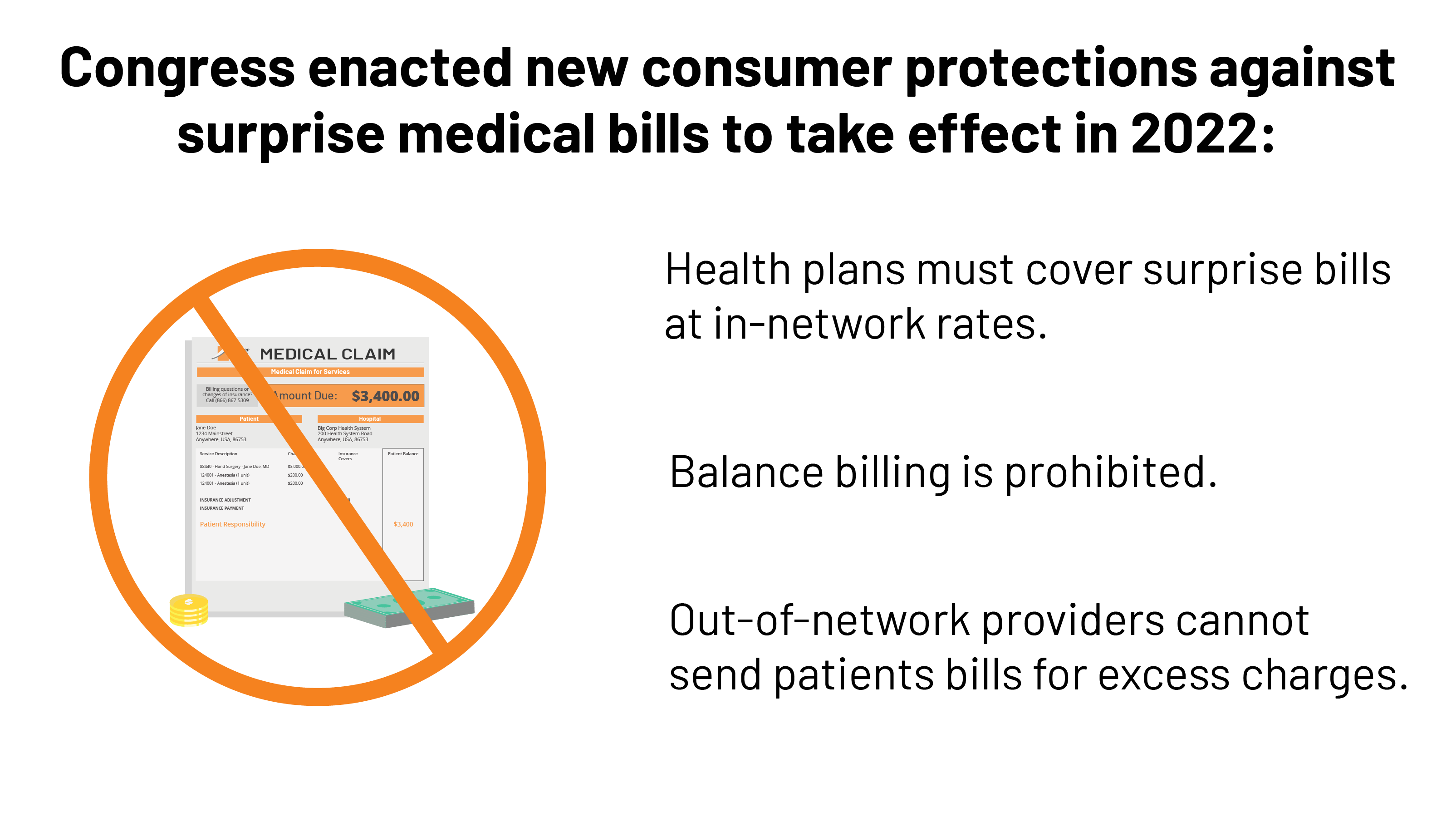
On Thursday the Department of Health and Human Services (HHS), along with other federal agencies, released the long-awaited second half of its proposed regulations implementing the No Surprises Act, passed by Congress at the end of last year, which bans “surprise billing” of patients who unsuspectingly receive care from out-of-network providers.

The interim final rule, which will take effect on January 1st after a comment and review period, lays out a process for addressing disputed patient bills, first through a 30-day “open negotiation” between the patient’s insurer and the out-of-network provider, and then through a federally-managed arbitration process.

Of most interest to insurers and providers who have lobbied fiercely for months to ensure a favorable interpretation of the law, the new regulation specifies that the outsider arbitrator, to be agreed upon by both parties, must begin with the presumption that the median in-network rate for services in the local market is the correct one. The arbitrator can then modify that price based on the specific circumstances of the case.

That method was broadly favored by insurers, and AHIP strongly endorsed the proposed approach, saying in a press release that “this is the right approach to encourage hospitals, healthcare providers, and health insurance providers to work together and negotiate in good faith.” Predictably, the hospital lobby felt otherwise; the American Hospital Association reacted by calling the rule “a windfall for insurers”, saying that it “unfairly favors insurers to the detriment of hospitals and physicians who actually care for patients.” 

The ultimate winners here are patients, who will gain important new protections against the potentially crippling financial implications of surprise billing. We’d agree with HHS Secretary Xavier Becerra, who told the New York Times that the new rule would “[take] patients out of the middle of the food fight,” and provide “a clear road map on how you can resolve that food fight between the provider and the insurer.” It’s about time. 

Still unresolved: the high cost of out-of-network ambulance services, left out of the No Surprises Act altogether. Let’s hope Congress circles back to address that issue soon.