The hospital finance misconception plaguing C-suites

Health systems have a big challenge: rising costs and reimbursement that doesn’t keep up with inflation. The amount spent on healthcare annually continues to rise while outcomes aren’t meaningfully better.

Some people outside of the industry wonder: Why doesn’t healthcare just act more like other businesses?

“There seems to be a widely held belief that healthcare providers respond the same as all other businesses that face rising costs,” said Cliff Megerian, MD, CEO of University Hospitals in Cleveland. “That is absolutely not true. Unlike other businesses, hospitals and health systems cannot simply adjust prices in response to inflation due to pre-negotiated rates and government mandated pay structures. Instead, we are continually innovating approaches to population health, efficiency and cost management, ensuring that we maintain delivery of high quality care to our patients.”

Nonprofit hospitals are also responsible for serving all patients regardless of ability to pay, and University Hospitals is among the health systems distinguished as a best regional hospital for equitable access to care by U.S. News & World Report.

“This commitment necessitates additional efforts to ensure equitable access to healthcare services, which inherently also changes our payer mix by design,” said Dr. Megerian. “Serving an under-resourced patient base, including a significant number of Medicaid, underinsured and uninsured individuals, requires us to balance financial constraints with our ethical obligations to provide the highest quality care to everyone.”

Hospitals need adequate reimbursement to continue providing services while also staffing the hospital appropriately. Many hospitals and health systems have been in tense negotiations with insurers in the last 24 months for increased pay rates to cover rising costs.

“Without appropriate adjustments, nonprofit healthcare providers may struggle to maintain the high standards of care that patients deserve, especially when serving vulnerable populations,” said Dr. Megerian. “Ensuring fair reimbursement rates supports our nonprofit industry’s aim to deliver equitable, high quality healthcare to all while preserving the integrity of our health systems.”

Industry outsiders often seek free market dynamics in healthcare as the “fix” for an expensive and complicated system. But leaving healthcare up to the normal ebbs and flows of businesses would exclude a large portion of the population from services. Competition may lead to service cuts and hospital closures as well, which devastates communities.

“A misconception is that the marketplace and utilization of competitive business model will fix all that ails the American healthcare system,”

said Scot Nygaard, MD, COO of Lee Health in Ft. Myers and Cape Coral, Fla.

“Is healthcare really a marketplace, in which the forces of competition will solve for many of the complex problems we face, such as healthcare disparities, cost effective care, more uniform and predictive quality and safety outcomes, mental health access, professional caregiver workforce supply?”

Without comprehensive reform at the state or federal level, many health systems have been left to make small changes hoping to yield different results. But, Dr. Nygaard said, the “evidence year after year suggests that this approach is not successful and yet we fear major reform despite the outcomes.”

The dearth of outside companies trying to enter the healthcare space hasn’t helped. People now expect healthcare providers to function like Amazon or Walmart without understanding the unique complexities of the industry.

“Unlike retail, healthcare involves navigating intricate regulations, providing deeply personal patient interactions and building sustained trust,” said Andreia de Lima, MD, chief medical officer of Cayuga Health System in Ithaca, N.Y. “Even giants like Walmart found it challenging to make primary care profitable due to high operating costs and complex reimbursement systems. Success in healthcare requires more than efficiency; it demands a deep understanding of patient care, ethical standards and the unpredictable nature of human health.”

So what can be done?

Tracea Saraliev, a board member for Dominican Hospital Santa Cruz (Calif.) and PIH Health said leaders need to increase efforts to simplify and improve healthcare economics.

“Despite increased ownership of healthcare by consumers, the economics of healthcare remain largely misunderstood,” said Ms. Saraliev. “For example, consumers erroneously believe that they always pay less for care with health insurance. However, a patient can pay more for healthcare with insurance than without as a result of the negotiated arrangements hospitals have with insurance companies and the deductibles of their policy.”

There is also a variation in cost based on the provider, and even with financial transparency it’s a challenge to provide an accurate assessment for the cost of care before services. Global pricing and other value-based care methods streamline the price, but healthcare providers need great data to benefit from the arrangements.

Based on payer mix, geographic location and contracted reimbursement rates, some health systems are able to thrive while others struggle to stay afloat. The variation mystifies some people outside of the industry.

“Healthcare economics very much remains paradoxical to even the most savvy of consumers,” said Ms. Saraliev.

Insurers and Private Equity Look to Join Forces to Further Consolidate Control of Americans’ Access to Health Care

With both Republicans and Democrats taking on these Goliaths individually, this could be a watershed moment for bi-partisan action.

The push and pull between providers and insurance companies is as old as our health payment system. Doctors have long argued insurers pay too little and that they too often interfere in patient care.

Dramatic increases in prior authorization, aggressive payment negotiations and less-generous reimbursement to doctors by Medicare Advantage plans show there’s little question the balance of power in this equation has swung toward payers.

These practices have led some doctors to look for outside investment, namely private equity, to keep their cash flow healthy and their operations functional. The trend of private equity acquisitions of physician practices is worthy of the federal scrutiny it has attracted. Insurers have noticed this trend, too, and appear ready to propose a profitable partnership.

Bloomberg recently reported that CVS/Aetna is looking for a private equity partner to invest in Oak Street Health, the primary care business CVS acquired for $9.5 billion last year. Oak Street is a significant player in primary care delivery, particularly for Americans on Medicare, with more than 100 clinics nationwide. CVS is said to be exploring a joint venture with a private equity firm to significantly expand Oak Street’s footprint and therefore also expand the parent corporation’s direct control over care for millions of seniors and disabled Americans across hundreds of communities.

Republicans have led scrutiny of pharmacy benefit managers on Capitol Hill. And Democratic attacks on private equity in health care have recently intensified. I hope, then, that both parties would find common ground in being watchful of a joint venture between private equity and one of the country’s largest PBMs, Caremark, also owned by CVS/Aetna.

The combination of health insurers and PBMs over the last decade – United Healthcare and Optum; CVS/Aetna and Caremark, and Cigna and Express Scripts – has increasingly handed a few large corporations the ability to approve or deny claims, set payment rates for care, choose what prescriptions to dispense, what prescriptions should cost, and how much patients must pay out-of-pocket for their medications before their coverage kicks in.

As enrollment in Medicare Advantage plans has grown to include a majority of the nation’s elderly and disabled people, we have seen insurers source record profits off the backs of the taxpayer-funded program. But in recent months, insurers have told investors they have had higher than expected Medicare Advantage claims – in particular CVS/Aetna, which took a hammering on Wall Street recently because its Medicare Advantage enrollees were using more health care services than company executives had expected.

It is natural, then, that one of the largest insurer-owned PBMs is looking to expand its hold on primary care for older Americans. Primary care is often the gateway to our health care system, driving referrals to specialists and procedures that lead to the largest claims insurers and their employer customers have to pay. By employing a growing number of primary care providers, CVS/Aetna can increasingly influence referrals to specialists and therefore the care or pharmacy benefit costs those patients may incur.

Control of primary care doctors holds another benefit for insurers: determination of what primary care doctor a patient sees.

People enrolled in an Aetna Medicare Advantage or employer-sponsored plan may find that care is easier to access at Oak Street clinics. Unfortunately, while that feels monopolistic and ethically alarming, this vertical integration has received relatively little scrutiny by lawmakers and regulators.

No law prevents an insurance company or PBM from kicking doctors it does not own out of network while creating preferential treatment for doctors directly employed by or closely affiliated with the corporate mothership.

In fact, the system largely incentivizes this. And shareholders expect insurers to keep up with their peers. As UnitedHealth Group has become increasingly aggressive in its acquisitions of physician practices – now employing or affiliated with about one in ten of the nation’s doctors – it has also become increasingly aggressive in its contract negotiations with physicians it does not control, particularly the specialists who depend on the referrals that come from primary care physicians.

That’s another area where looking to expand Oak Street Health makes smart business sense for CVS/Aetna. Specialist physicians are historically accustomed to higher compensation than primary care doctors and are used to striking hard-fought deals with insurers to stay in-network.

By controlling the flow of primary care referrals to specialists, CVS/Aetna can control what insurers have long-desired greater influence over: patient utilization. As a key driver of referrals to specialists in a specific market, CVS/Aetna will have even more power in contract negotiations with specialists.

As Oak Street’s clinics grow market share in the communities they serve, specialists in that market will feel even more pressured to stay in-network with Aetna and to refer prescriptions to CVS pharmacies. That has the dual benefit for CVS/Aetna of helping to predict what patients will be treated for once they go to a specialist and control over what the insurer will have to pay that specialist.

With different corporate owners, this sort of model could easily run afoul of the federal Anti-Kickback Statute and Stark Law.

No doctor or physician practice is allowed to receive anything of value for the referral of a patient. But that law only applies when there is separate ownership between the referring doctor and the specialist.

CVS/Aetna would clearly be securing value – in the form of lower patient utilization and effective reimbursement rates – under this model. But with Oak Street owned by CVS/Aetna and specialists forced to agree to lower reimbursement rates through negotiations with an insurer that appears separate from Oak Street, there’s no basis for a claim under the Stark Law. There may be antitrust implications, but those are more difficult and take longer to prove – and the fact the federal government cleared CVS/Aetna to acquire Oak Street Health last year wouldn’t help that argument.

This model is already of concern, which is why I continue to urge examination of increasing insurer control of physicians across the country. Their embrace of private equity to accelerate this model is truly alarming. And given Democrats’ recent focus on private equity in health care, they should work with their Republican colleagues who are rightly alarmed about the increasingly anti-competitive, monopolistic health insurance industry.

Dollar General piloting mobile clinics at three locations

https://mailchi.mp/8f3f698b8612/the-weekly-gist-january-27-2023?e=d1e747d2d8

Budget retailer Dollar General announced this week that it’s partnering with mobile medical service provider DocGo to deliver routine primary care in mobile clinics outside three stores near its Goodlettsville, TN headquarters

The mobile clinics will accept public and select commercial insurance plans, as well as offer services for a flat fee. It’s the latest step in Dollar General’s tentative exploration of healthcare, which includes a partnership with Babylon Health to offer telehealth visits in several Missouri stores, and the DG Wellbeing initiative, which has placed basic health and wellness products in roughly 3,200 of its 19,000 stores nationwide. 

The Gist: With an unmatched footprint in rural areas (an estimated 75 percent of the US population lives within five miles of one of its stores) Dollar General has the capacity to transform rural healthcare access. 

Rather going head-to-head with other national retailers who are quickly expanding into healthcare delivery, Dollar General has so far taken a measured approach, aiming to develop workable services that improve rural healthcare access at the margins. 

Since it hired a chief medical officer in 2021, it has dabbled in small care delivery pilots like this one, but one of these pilots will need to succeed at scale for Dollar General to enter the ranks of serious retail disruptors.

Hospital margins see eleventh-hour improvement

Hospitals experienced a slight boost to operating margins in November, but not enough to restore the median negative margins that persisted for 2022 to date.

Kaufman Hall’s December “National Flash Hospital Report — based on data from more than 900 hospitals — found hospitals’ median operating margin was -0.2 percent through November, a slight improvement from the median of -0.3 percent recorded a month prior. 

A 1 percent decline in expenses from October to November drove the eleventh-hour improvement to margins and tipped the scales on hospitals’ relatively flat revenue. Additionally, hospitals saw labor expenses decrease 2 percent in November, potentially driven by less reliance on contract labor. 

The median -0.2 percent margin recorded in November 2022 marks a 44 percent decline for margins in 22 year-to-date compared to 2021 year-to-date. Kaufman Hall’s index shows hospitals’ median monthly margins have been in the red throughout 2022, starting with the -3.4 percent recorded in January, driven by the omicron surge. November is tied with September as hospitals’ best month of the year, with both sharing a median margin of -0.2 percent. 

Outpatient care marks one of the brighter spots for hospitals’ finances, with outpatient revenue up 10 percent year-over-year while inpatient revenue was flat over the same time period. 

“The November data, while mildly improved compared to October, solidifies what has been a difficult year for hospitals amidst labor shortages, supply chain issues and rising interest rates,” Erik Swanson, senior vice president of data and analytics with Kaufman Hall, said. “Hospital leaders should continue to develop their outpatient care capabilities amid ongoing industry uncertainty and transformation.”

Podcast: All Healthcare Is Politics?

Does Your Vote Affect Your Healthcare?

What role should the federal government play in addressing major healthcare issues? And does the way you vote affect your prospects for a long and healthy life? We talked about it on today’s episode of the 4sight Friday Roundup podcast.

  • David Johnson is CEO of 4sight Health.
  • Julie Vaughan Murchinson is Partner of Transformation Capital and former CEO of Health Evolution.
  • David Burda is News Editor and Columnist of 4sight Health.

Subscribe on Apple PodcastsSpotify, and other services.

Digging Into the Growth in 340B Contract Pharmacies

This week’s contributor is Paula Chatterjee, a physician and assistant professor at the Perelman School of Medicine at the University of Pennsylvania. Her research focuses on improving the health of low-income patients and evaluating policies related to safety-net health care delivery and financing.

Low-income patients face many barriers to care, one of which is the high cost of prescription medications. The 340B program lets certain hospitals and clinics (like federally qualified health centers) receive discounts on outpatient medications. They can then use those savings to provide medication and additional care for little to no charge to low-income patients. However, policymakers and other stakeholders have raised concerns that the 340B program might not be reaching the patients it was designed to support.

A recent paper in the American Journal of Managed Care by Sayeh Nikpay*, Gabriela Garcia, Hannah Geressu and Rena Conti sheds light on one of the latest examples of 340B mistargeting: so-called contract pharmacies. These are retail pharmacies that fill 340B prescriptions and split the savings with the hospital or clinic. These relationships have been on the rise, with hospitals and clinics arguing they make it more convenient for patients to get their prescriptions. Given their growth, the authors looked at whether contract pharmacies were more likely to open up in areas where low-income and uninsured people live.

They found the pattern was different for pharmacies contracting with 340B clinics vs. 340B hospitals:

  • The number of counties with a pharmacy contracted with a 340B clinic grew from 20.8% to 64.8% over the past decade. Counties with higher poverty rates were more likely to gain a clinic-contracted pharmacy.
  • The number of counties with hospital-contracted pharmacies grew much more (from 3.2% to 76.3%), but those counties had fewer uninsured residents and were less likely to be medically underserved.

The researchers acknowledge that counties may be an imperfect geographical area to represent a pharmacy’s market and that they were unable to collect information on how many (if any) 340B prescriptions a pharmacy actually filled.

Nonetheless, their results reveal a mismatch between where the 340B program is growing and where low-income patients live, especially for pharmacies contracting with 340B hospitals. The authors argue that any 340B policy changes should take these differences between hospitals and clinics into account.

Despite decades of policies designed to bolster the safety-net, it remains perennially reliant on a patchwork of subsidies that are often mistargeted.

This study adds to a growing body of work highlighting the opportunity to improve the 340B program so that it achieves its intended goal of improving access for low-income patients.

How other industry players are expanding their healthcare platforms  

https://mailchi.mp/31b9e4f5100d/the-weekly-gist-june-03-2022?e=d1e747d2d8


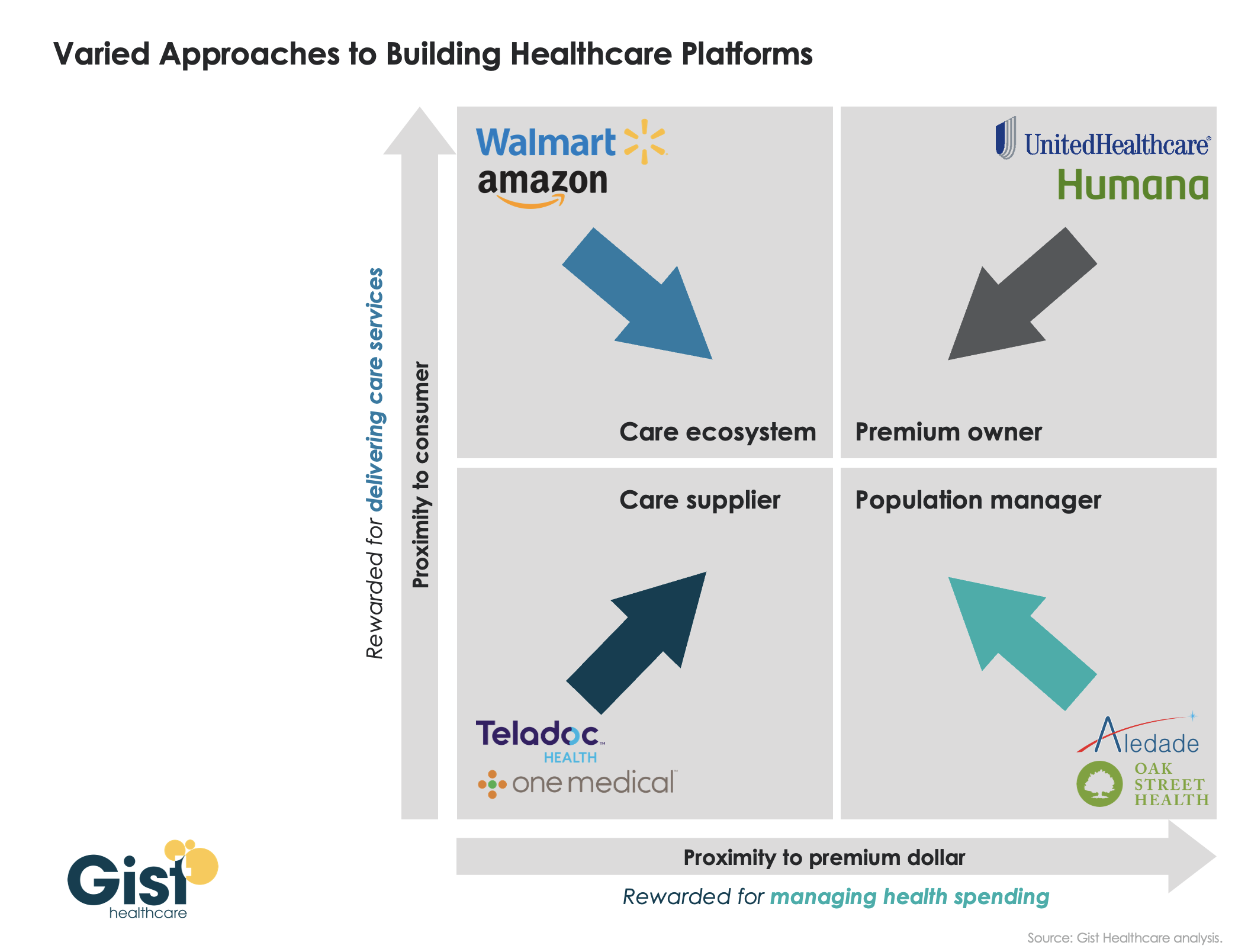
Last week, we introduced our framework for value delivery as a “healthcare platform”, in which an organization’s proximity to both the consumer and to the premium dollar determines how it competes as a “care supplier,” a “care ecosystem,” a “premium owner,” or a “population manager.” Traditionally, different healthcare companies have operated primarily in one of these four domains. However, as shown in the graphic below, we’ve recently seen many shift their business into one or more additional quadrants, as they seek to expand their value propositions. UnitedHealth Group is an obvious example: it has moved well beyond the traditional insurance business, via numerous provider and care delivery acquisitions across the continuum.

Other players have shifted from their own “pure play” positions toward more comprehensive “platform” strategies as well: One Medical adding Iora Health to enhance population health capabilities; Walmart moving beyond retail and pharmacy services, partnering with Oak Street Health to expand its ability to manage Medicare patients; Amazon getting into the employer health business. 

There’s a clear pattern emerging—value propositions are converging on a “strategic high ground” that encompasses all four dimensions of platform value, creating a comprehensive set of solutions to deliver accessible care, promote health, and grow consumer loyalty, with an aligned financial model centered on managing the total cost of care. Health systems looking to build platform strategies will find many of these competitors also vying for pride of place as the “platform of choice” for healthcare consumers and purchasers.

When a Medicaid Card Isn’t Enough

tradeoffs.org/2022/05/17/medicaid-physician-access/

A certain segment of the health policy world spends a lot of time trying to get more states to expand Medicaid and reduce underinsurance.

But are we doing enough to make sure care is accessible once people enroll? One issue is access to physicians, who are less likely to treat patients on Medicaid than Medicare or private insurance because Medicaid payment rates are lower.

A new paper in Health Affairs by Avital Ludomirsky and colleagues looked at how well the networks of physicians supposedly participating in Medicaid reflect access to care. The researchers used claims data and provider directories from Medicaid managed care plans (the private insurers that most states contract with to run their Medicaid programs) in Kansas, Louisiana, Michigan and Tennessee from 2015 and 2017 to assess how the delivery of care to Medicaid patients was distributed among participating doctors. Their results were striking:

  • One-quarter of primary care physicians provided 86% of the care; one-quarter of specialists provided 75%.
  • One-third of both types of physicians saw fewer than 10 Medicaid patients per year, hardly contributing any “access” at all.
  • There was only one psychiatrist for every 8,834 Medicaid enrollees after excluding those seeing fewer than 10 Medicaid patients per year. This is especially concerning given that the COVID-19 pandemic has worsened mental health in the U.S., particularly among children

The authors note that their study only covers primary care and mental health providers in four states, so it is not necessarily generalizable to other states or specialties. But these results are still concerning.   

States have so-called network adequacy standards for their Medicaid managed care plans that are supposed to make sure there are enough providers. These standards typically rely on either a radius (a certain number of providers for a geographic area) or ratio (number of providers per enrollee), but the authors’ findings show these methods fall short if they are based on directories alone.

The authors specifically recommend states use claims-based assessments like the ones in the study and “secret shopper” programs — like this recently published one from Maryland by Abigail Burman and Simon Haeder — to better evaluate whether plans are offering adequate access to physicians. We absolutely need people to have coverage, but it needs to be more than just a card in their wallet.

Credit monitoring companies are removing most medical debt from consumer credit reports

Spurred by the Consumer Financial Protection Bureau’s investigation into how credit companies report medical debt, TransUnion, Equifax, and Experian—the country’s three largest credit bureaus, who keep records on 200M Americans—are revising how they report medical debt.

As a result, the companies could eliminate up to 70 percent of medical debt from consumers’ credit reports. Starting in July, medical debts paid after going to collections will no longer appear on credit reports, and unpaid debts won’t be added until a year after being sent to collections (instead of six months, per current policy). And beginning in 2023, medical debts of less than $500 will also be excluded from credit reports altogether.

The Gist:The poorest and sickest patients have been disproportionately saddled with the highest levels of medical debt. In 2017, 19 percent of US households carried medical debt, including many with private insurance. 

While these changes will help mitigate the impact of medical debt for some, they aren’t a fix to the larger underlying problem of rising healthcare costs and access to adequate health insurance coverage.