Big Shifts: CVS Is Pulling the Plug on ACA Coverage — And 1 Million Americans Will Pay the Price

In what’s becoming an all-too-familiar pattern, CVS Health announced it will pull Aetna out of the Affordable Care Act (ACA) marketplace in 2026, leaving about a million people across 17 states searching for new health coverage — and in some cases, fighting to afford any at all.

This marks yet another retreat by a major for-profit insurer from a program designed to provide affordable health coverage to Americans who don’t get it through work. CVS made the announcement while simultaneously celebrating a 60% increase in quarterly profit and revealing a new deal to boost sales of the pricey weight-loss drug Wegovy through its pharmacy and pharmacy benefit manager (PBM) arms.

Let me repeat that: Aetna is exiting the ACA because it claims it can’t make enough money on people enrolled in those plans, on the same day its parent company posted nearly $1.8 billion in profits in just the first three months of this year. 

This is the same company, by the way, that dumped hundreds of thousands of seniors and disabled people at the end of 2024 because some of them were using more medical care than Wall Street found acceptable. If this doesn’t tell you everything you need to know about who the health insurance industry is really working for, I don’t know what will.

From “Commitment” to Abandonment

Aetna first bailed on the ACA exchanges in 2018, then re-entered in 2022 when insurers could see more clearly how they could make significant profits on that book of business. Now, after just a few years of moderate participation, it’s heading for the exits again. CVS Health executives blamed “regulatory uncertainty” and “highly variable economic factors,” according to a statement to The Columbus Dispatch.

But make no mistake—this was a cold business calculation. Uncertainties and economic variabilities are constants in the insurance game.

CVS’ CEO David Joyner told investors:

“We are disappointed by the continued underperformance from our individual exchange products … this is not a decision we made lightly.”

That’s corporate-speak for “our Wall Street friends weren’t impressed.”

Aetna’s ACA exchange business, covering roughly 1 million people, is just a sliver of CVS’ overall medical membership of 27.1 million. But even though the profits weren’t massive, the people depending on this coverage — many of them self-employed, working multiple part-time jobs, or recently uninsured — will now be thrown into chaos.

And it’s happening at a time when health insurance for many Americans hangs by a thread. Unless Congress acts in the coming months, the ACA’s enhanced tax subsidies—first implemented under the American Rescue Plan—are set to expire at the end of this year. Without them, premiums could spike by 50% to 100% depending on income and geography.

The Congressional Budget Office projects that the lapse in subsidies could leave 3.8 million more Americans uninsured — and now, 1 million more will be forced to find new plans as CVS/Aetna walks away.

Same Song: Prioritizing Profit, Not Patients

Let’s be clear about what CVS is doing here: It’s ditching an essential safety net for millions in order to chase higher profits elsewhere—most notably, in the exploding market for GLP-1 drugs like Wegovy. On the same day it abandoned the ACA, CVS announced a new deal to give Wegovy preferred placement on its PBM formulary, displacing Eli Lilly’s Zepbound. This will help CVS dominate the obesity drug market—and rake in profits through its Caremark PBM and nearly 9,000 retail pharmacies.

It’s a powerful example of vertical integration in action.

CVS owns the insurer (Aetna), the PBM (Caremark), and the pharmacy (CVS retail stores). When it walks away from lower-margin business like ACA plans and doubles down on high-dollar drug deals, we see its true priorities: selling expensive drugs, saddling individuals, families and employers with the costs, and keeping Wall Street happy.

Even worse, the decision is taking place against a troubling political backdrop. The Trump administration has already taken steps to undermine ACA infrastructure and expressed skepticism toward core public health programs. Cuts to navigator funding, changes to vaccine guidelines, and looming uncertainty around tax credits are all part of a slow-motion sabotage of the ACA. This is not to say that the ACA doesn’t have its flaws that need to be addressed.

But instead of penalizing hard-working Americans and their families, lawmakers and the Trump administration should focus instead on lowering the ridiculously high out-of-pocket maximum that the ACA established (and that keeps going up every year) and fixing the medical loss ratio provision that has fueled the vertical integration in the insurance industry.

Millions could lose coverage under potential GOP Medicaid policies: CBO

https://www.healthcaredive.com/news/medicaid-coverage-losses-gop-policies-cbo/747615/

Dive Brief:

  • Millions of people could lose coverage under potential policy changes to Medicaid under consideration by Republicans in Congress, according to a letter sent to lawmakers this week from the Congressional Budget Office. 
  • One option, reducing the federal government’s share of costs for enrollees covered under Medicaid expansion, would reduce the federal deficit by $710 billion over the next decade. But in 2034, 5.5 million people would be removed from the safety-net program, with 2.4 million of these enrollees becoming uninsured, according to the CBO.
  • Another potential policy, placing a per-enrollee cap on federal spending, would remove 5.8 million people from Medicaid. Nearly 3 million of those people would lose coverage entirely. The policy would reduce the deficit by $682 billion, the analysis found.

Dive Insight: 

Debates surrounding potential cuts to Medicaid — and their implications for patients and providers — have been heating up in Congress for weeks. 

Last month, lawmakers approved a budget resolution that called for the House Energy and Commerce Committee, which oversees Medicare and Medicaid, to find $880 billion in savings. That budget goal is likely impossible to hit without targeting major healthcare programs under the committee’s purview, according to an earlier analysis published in March by the CBO.

The committee is expected to meet next week to mark up its portion of the reconciliation package and hash out legislation.

However, cutting Medicaid is a politically contentious move for Republican lawmakers. Some legislators have pushed back on potential cuts, and others have argued they’ll preserve Medicaid for the most vulnerable by targeting fraud, waste and abuse in the safety-net insurance program. 

But Rep. Frank Pallone Jr., D-N.J., and Sen. Ron Wyden, D-Ore., who requested the latest CBO analysis, said the policies will ultimately limit benefits and result in coverage losses.

“This analysis from the non-partisan, independent CBO is straightforward: the Republican plan for health care means benefit cuts and terminated health insurance for millions of Americans who count on Medicaid,” Wyden said in a statement. “Republicans continue to use smoke and mirrors to try to trick Americans into thinking they aren’t going to hurt anybody when they proceed with this reckless plan, but fighting reality is an uphill battle.”

The letter from the CBO analyzes five potential policy options for Medicaid: setting the federal matching rate for the expansion population at the same rate as other enrollees; limiting state taxes on providers; setting federal caps on spending for the entire Medicaid population or just the expansion group; and repealing two regulations linked to eligibility and enrollment. 

Most of the options reduce the funds available to states, according to the CBO. The agency expects states will replace about half of the reduced support with their own resources, and then reduce spending by cutting provider payment rates, reducing optional benefits and cutting enrollment. 

For example, if Congress decides to limit provider taxes, where states levy taxes that finance a portion of their Medicaid spending, that would result in 8.6 million fewer people enrolled in Medicaid in 2034, including nearly 4 million becoming uninsured. The move would ultimately lessen the federal deficit by $668 billion, as the government would offer reimbursement for lower state spending, the analysis found.

Another option, placing a cap on federal spending for the expansion population, would save $225 billion — but 3.3 million people would lose Medicaid coverage. Repealing regulations that aim to reduce barriers to enrollment and simplify the renewal process would reduce the federal deficit by $162 billion over the next decade, but 2.3 million fewer people would be enrolled in Medicaid, the CBO found.

What Trump and the GOP have planned for healthcare

Health systems are rightly concerned about Republican plans to cut Medicaid spending, end ACA subsidies and enact site neutral payments, says consultant Michael Abrams, managing partner of Numerof, a consulting firm.

“Health systems have reason to worry,” Abrams said shortly after President Donald Trump was inaugurated on Monday. 

While Trump mentioned little about healthcare in his inauguration speech, the GOP trifecta means spending cuts outlined in a one-page document released by Politico and another 50-pager could get a majority vote for passage.

Of the insurers, pharmaceutical manufacturers and health systems that Abrams consults with, healthcare systems are the ones that are most concerned, Abrams said.

At the top of the Republican list targeting $4 trillion in healthcare spending is eliminating an estimated $2.5 billion from Medicaid. 

“There’s no question Republicans will find savings in Medicaid,” Abrams said.

Medicaid has doubled its enrollment in the last couple of years due to extended benefits made possible by the Affordable Care Act, despite disenrolling 25 million people during the redetermination process at the end of the public health emergency, according to Abrams.

Upward of 44 million people, or 16.4% of the non-elderly U.S. population are covered by an Affordable Care Act initiative, including a record high of 24 million people in ACA health plans and another 21.3 million in Medicaid expansion enrollment, according to a KFF report. Medicaid expansion enrollment is 41% higher than in 2020.

The enhanced subsidies that expanded eligibility for Medicaid and doubled the number of enrollees are set to expire at the end of 2025 and Republicans are likely to let that happen, Abrams said. Eliminating enhanced federal payments to states that expanded Medicaid under the ACA are estimated to cut the program by $561 billion.

If enhanced subsidies end, the Congressional Budget Office has estimated that the number of people who will become uninsured will increase by 3.8 million each year between 2026 and 2034. 

The enhanced tax subsidies for the ACA are set to expire at the end of 2025. This could result in another 2.2 million people losing coverage in 2026, and 3.7 million in 2027, according to the CBO.

WHY THIS MATTERS

For hospitals, loss of health insurance coverage means an increase in sicker, uninsured patients visiting the emergency department and more uncompensated care.

“Health systems are nervous about people coming to them who are uninsured,” Abrams said. “There will be people disenrolled.”

The federal government allowed more people to be added to the Medicaid rolls during the public health emergency to help those who lost their jobs during the COVID-19 pandemic, Numerof said. Medicaid became an open-ended liability which the government wants to end now that the unemployment rate is around 4.2% and jobs are available.

An idea floating around Congress is the idea of converting Medicaid to a per capita cap and providing these funds to the states as a block grant, Abrams said. The cost of those programs would be borne 70% by the federal government and 30% by states.

This fixed amount based on a per person amount would save money over the current system of letting states report what they spent.

Another potential change under the new administration includes site neutral Medicare payments to hospitals for outpatient services.

The HFMA reported the site neutral policy as a concern in a list it published Monday of preliminary federal program cuts totaling more than $5 trillion over 10 years. The 50-page federal list is essentially a menu of options, the HFMA said, not an indication that programs will actually be targeted leading up to the March 14 deadline to pass legislation before federal funding expires.

Other financial concerns for hospitals based on that list include: the elimination of the tax exemption for nonprofit hospitals, bringing in up to $260 billion in estimated 10-year savings; and phasing out Medicare payments for bad debt, resulting in savings of up to $42 billion over a decade.

Healthcare systems are the ones most concerned over GOP spending cuts, according to Abrams. Pharmacy benefit managers and pharmaceutical manufacturers also remain on edge as to what might be coming at them next.

THE LARGER TREND

President Donald Trump mentioned little about healthcare during his inauguration speech on Monday.

Trump said the public health system does not deliver in times of disaster, referring to the hurricanes in North Carolina and other areas and to the fires in Los Angeles.

Trump also mentioned giving back pay to service members who objected to getting the COVID-19 vaccine.

He also talked about ending the chronic disease epidemic, without giving specifics.

“He didn’t really talk about healthcare even in the campaign,” Abrams said.

However, in his consulting work, Abrams said, “The common thread is the environment is changing quickly,” and that healthcare organizations need to do the same “in order to survive.”

The CBO Health Insurance Status Report: Four Reasons it’s Overly Optimistic

In the Congressional Budget Office’ latest report on the status of health insurance coverage from the 2023 National Health Interview Survey released last week, a cautiously optimistic picture of coverage is presented:

  • In 2023, 25.0 million people of all ages (7.6%) were uninsured at the time of interview. This was lower than, but not significantly different from 2022, when 27.6 million people of all ages (8.4%) were uninsured. Among adults ages 18 64, 10.9% were uninsured at the time of interview, 23.0% had public coverage, and 68.1% had private health insurance coverage.
  • The percentage of adults ages 18-64 who were uninsured in 2023 (10.9%) was lower than the percentage who were uninsured in 2022 (12.2%).
  • Among children ages 0–17 years, 3.9% were uninsured, 44.2% had public coverage, and 54.0% had private health insurance coverage.
  • The percentage of people younger than age 65 with exchange-based coverage increased from 3.7% in 2019 to 4.8% in 2023.”

That represents the highest level of coverage in modern history. Later, it adds important context: The percentage of adults ages 18–64 who were uninsured decreased between 2019 and 2023 for all family income groups shown except for adults in families with incomes greater than 400% FPL. Notably, a period in which the Covid-19 pandemic prompted federal government’s emergency funding so households and businesses could maintain their coverage.

  • “Among adults with incomes below 100% FPL, the percentage who were uninsured in 2023 (20.2%) was lower than, but not significantly different from, the percentage who were uninsured in 2022 (22.7%).
  • Among adults with incomes 100% to less than 200% FPL, the percentage who were uninsured decreased from 22.3% in 2022 to 19.1% in 2023.
  • Among adults with incomes 200% to 400% FPL, the percentage who were uninsured decreased from 14.2% in 2022 to 11.5% in 2023.
  • No significant difference was observed in the percentage of adults with incomes above 400% FPL who were uninsured between 2022 (4.1%) and 2023 (4.3%).”
  • In 2023, among adults ages 18–64, the percentage who were uninsured was highest among health insurance coverage of any type was higher for those with higher household income but decreased coverage in 2023 correlated to ethnicity, non-expansion of state Medicaid programs: From 2019 to 2023.”
  • And decreases in the ranks of the uninsured were noted across all ethnic groups:
    • Among Hispanic adults, from 29.7% to 24.8%
    • Among Black non-Hispanic adults, from 14.7% to 10.4% in 2023
    • Among White non-Hispanic adults, decreased from 10.5% to 6.8%
    • Among Asian non-Hispanic adults, from 8.8% to 4.4% in 2023.

The New York Times noted “The drops cut significantly into gaps between ethnic groups. The uninsured rate among Black Americans, for example, was almost 8% higher than for white Americans in 2010, and was only 4%higher in 2022. The data points to the broad effects of the Affordable Care Act, the landmark law President Barack Obama signed in 2010 that created new state and federal insurance marketplaces and expanded Medicaid to millions of adults. National uninsured rates have continued to drop in recent years, hitting a record low in early 2023.”

But the report also flags a reversal of the trend: “The uninsured share of the population will rise over the course of the next decade, before settling at 8.9% in 2034, largely as a result of the end of COVID-19 pandemic–related Medicaid policies, the expiration of enhanced subsidies available through the Affordable Care Act health insurance Marketplaces, and a surge in immigration that began in 2022. The largest increase in the uninsured population will be among adults ages 19–44. Employment-based coverage will be the predominant source of health insurance, and as the population ages, Medicare enrollment will grow significantly. After greater-than-expected enrollment in 2023, Marketplace enrollment is projected to reach an all-time high of twenty-three million people in 2025.”

My take:

A close reading of this report suggests its forecast might be overly optimistic. it paints a best-case picture of health insurance coverage that under-estimates the realities of household economics and marketplace trends and over-estimates the value proposition promoted by health insurers to their customers. My conclusion is based on four trends that suggest coverage might slip more than the report suggests:

  1. The affordability of healthcare insurance is increasingly problematic to lower- and middle-income households who face inflationary prices for housing, food, energy and transportation. The CBO report verifies that household income is key to coverage and working age populations are most-at risk of losing its protections. Subsidies to fund premiums for those eligible, employer plans that expose workers to high deductibles and increased non-covered services are likely to push fewer to enroll as premiums become unaffordable to working age adults and unattractive to their employers. As outlined in a sobering KFF analysis, half of the adult population is worried about the affordability of their healthcare—and that includes 48% who have health insurance. And wages in the working age population are not keeping pace with prices for food, shelter and energy, leaving healthcare expenses including their insurance premiums and out-of-pocket obligations at greater risk.
  2. The value proposition for health insurance coverage is eroding among employers, consumers and lawmakers. To large employers that provide employee insurance, medical costs are forcing benefits reduction or cessation altogether. Insurance has not negated their medical costs. To small employers, it’s an expensive bet to recruit and keep their workforce. To government sponsors (i.e. Medicare, Medicaid, VHA, et al), insurance is a necessary but increasingly expensive obligation with growing dependence on private insurers to administer their programs. State and federal regulators are keen to limit public spending and address disparities in their public insurance programs. All recognize that private insurers play a necessary role in the system and all recognize that confidence in health insurance protections is suspect. Thus, increased regulation of private insurers is likely though unwelcome by its members.
  3. Public funding for government payers will be increasingly limited increasing insurer dependence on private capital for sustainability and growth. Funding for Medicare, Medicaid, Veterans and Military Health, Public Health et al are dependent on appropriations and tax collections. All are structured to invite private insurer participation: all are seeing corporate insurers seize market share from their weaker competitors. The issues are complex and controversial as evidenced by the ongoing debates about fairness in Medicare Advantage and administration of Medicaid expansion among others. And polls indicate widespread dissatisfaction with the system and lack of confidence in its insurers, hospitals, physicians or the government to fix it.
  4. Access to private capital for private health insurers is shrinking enabling corporate insurers to play bigger roles in financing and delivering services. Private investments in healthcare services (i.e. hospitals, physicians, clinics) has slowed and momentum has shifted from sellers to buyers seeking less risk and higher returns. Capital deployment by corporate insurers i.e. UHG, HUM et al has resulted in vertically-integrated systems of health inclusive of physician services, drug distribution, ASCs and more. And funding for AI-investments that lower their admin costs and increase their contracting leverage with providers is a strategic advantage for corporate insurer that operate nationally at scale. Unless the federal government bridles their growth (which is unlikely), corporate insurers will control national coverage while others fail.

Thus, no one knows for sure what coverage will be in 2034 as presented in the CBO report. Its analysis appropriately considers medical inflation, population growth and an incremental shift to value-based purchasing in healthcare, but it fails to accommodate highly relevant changes in the capital markets, corporate insurer shareholder interests and voter sentiment.

P.S. This is an important week for healthcare: Today marks the two-year anniversary of the Supreme Court’s Dobbs decision that overturned Roe v. Wade, ending the constitutional right to an abortion that pushed reproductive rights to states.

And Thursday in Atlanta, President Joe Biden and former President Donald Trump will make history in the first presidential debate between an incumbent and a former president.

Reproductive rights will be a prominent theme along with immigration and border security as wedge issues for voters.

The economy and inflation are the issues of most consequence to most voters, so unless the campaigns directly link healthcare spending and out of pocket costs to voter angst about their household finances, not much will be said.

Notably, half of the U.S. population have unpaid medical bills and medical debt is directly related to their financial insecurity. Worth watching.

The Healthcare Economy: Three Key Takeaways that Frame Public and Private Sector Response

Last week, 2 important economic reports were released that provide a retrospective and prospective assessment of the U.S. health economy:

The CBO National Health Expenditure Forecast to 2032: 

“Health care spending growth is expected to outpace that of the gross domestic product (GDP) during the coming decade, resulting in a health share of GDP that reaches 19.7% by 2032 (up from 17.3% in 2022). National health expenditures are projected to have grown 7.5% in 2023, when the COVID-19 public health emergency ended. This reflects broad increases in the use of health care, which is associated with an estimated 93.1% of the population being insured that year… During 2027–32, personal health care price inflation and growth in the use of health care services and goods contribute to projected health spending that grows at a faster rate than the rest of the economy.”

The Congressional Budget Office forecast that from 2024 to 2032:

  • National Health Expenditures will increase 52.6%: $5.048 trillion (17.6% of GDP) to $7,705 trillion (19.7% of GDP) based on average annual growth of: +5.2% in 2024 increasing to +5.6% in 2032
  • NHE/Capita will increase 45.6%: from $15,054 in 2024 to $21,927 in 2032
  • Physician services spending will increase 51.2%: from $1006.5 trillion (19.9% of NHE) to $1522.1 trillion (19.7% of total NHE)
  • Hospital spending will increase 51.6%: from $1559.6 trillion (30.9% of total NHE) in 2024 to $2366.3 trillion (30.7% of total NHE) in 2032.
  • Prescription drug spending will increase 57.1%: from 463.6 billion (9.2% of total NHE) to 728.5 billion (9.4% of total NHE)
  • The net cost of insurance will increase 62.9%: from 328.2 billion (6.5% of total NHE) to 534.7 billion (6.9% of total NHE).
  • The U.S. Population will increase 4.9%: from 334.9 million in 2024 to 351.4 million in 2032.

The Bureau of Labor Statistics CPI Report for May 2024 and Last 12 Months (May 2023-May2024): 

“The Consumer Price Index for All Urban Consumers (CPI-U) was unchanged in May on a seasonally adjusted basis, after rising 0.3% in April… Over the last 12 months, the all-items index increased 3.3% before seasonal adjustment. More than offsetting a decline in gasoline, the index for shelter rose in May, up 0.4% for the fourth consecutive month. The index for food increased 0.1% in May. … The index for all items less food and energy rose 0.2% in May, after rising 0.3 % the preceding month… The all-items index rose 3.3% for the 12 months ending May, a smaller increase than the 3.4% increase for the 12 months ending April. The all items less food and energy index rose 3.4 % over the last 12 months. The energy index increased 3.7%for the 12 months ending May. The food index increased 2.1%over the last year.

Medical care services, which represents 6.5% of the overall CPI, increased 3.1%–lower than the overall CPI. Key elements included in this category reflect wide variance: hospital and OTC prices exceeded the overall CPI while insurance, prescription drugs and physician services were lower.

  • Physicians’ services CPI (1.8% of total impact): LTM: +1.4%
  • Hospital services CPI (1.0% of total impact): LTM: +7.3%
  • Prescription drugs (.9% of total impact) LTM +2.4%
  • Over the Counter Products (.4% of total impact) LTM 5.9%
  • Health insurance (.6% of total) LTM -7.7%

Other categories of greater impact on the overall CPI than medical services are Shelter (36.1%), Commodities (18.6%), Food (13.4%), Energy (7.0%) and Transportation (6.5%).

Three key takeaways from these reports:

  • The health economy is big and getting bigger. But it’s less obvious to consumers in the prices they experience than to employers, state and federal government who fund the majority of its spending. Notably, OTC products are an exception: they’re a direct OOP expense for most consumers. To consumers, especially renters and young adults hoping to purchase homes, the escalating costs of housing have considerably more impact than health prices today but directly impact on their ability to afford coverage and services. Per Redfin, mortgage rates will hover at 6-7% through next year and rents will increase 10% or more.
  • Proportionate to National Health Expenditure growth, spending for hospitals and physician services will remain at current levels while spending for prescription drugs and health insurance will increase. That’s certain to increase attention to price controls and heighten tension between insurers and providers.
  • There’s scant evidence the value agenda aka value-based purchases, alternative payment models et al has lowered spending nor considered significant in forecasts.

The health economy is expanding above the overall rates of population growth, overall inflation and the U.S. economy. GDP.  Its long-term sustainability is in question unless monetary policies enable other industries to grow proportionately and/or taxpayers agree to pay more for its services. These data confirm its unit costs and prices are problematic.

As Campaign 2024 heats up with the economy as its key issue, promises to contain health spending, impose price controls, limit consolidation and increase competition will be prominent.

Public sector actions

will likely feature state initiatives to lower cost and spend taxpayer money more effectively.

Private sector actions

will center on employer and insurer initiatives to increase out of pocket payments for enrollees and reduce their choices of providers.

Thus, these reports paint a cautionary picture for the health economy going forward. Each sector will feel cost-containment pressure and each will claim it is responding appropriately. Some actually will.

PS: The issue of tax exemptions for not-for-profit hospitals reared itself again last week.

The Committee for a Responsible Federal Budget—a conservative leaning think tank—issued a report arguing the exemption needs to be ended or cut.  In response,

the American Hospital Association issued a testy reply claiming the report’s math misleading and motivation ill-conceived.

This issue is not going away: it requires objective analysis, fresh thinking and new voices.  For a recap, see the Hospital Section below.

Medicare Can Cover Anti-Obesity Drugs for Heart Disease — But at What Cost?

On March 8, 2024, FDA approved Wegovy (semaglutide)opens in a new tab or window to treat cardiovascular disease risks — heart attack, stroke, and death — for obese or overweight adults with a history of cardiovascular disease, making it the first anti-obesity medication (AOM) to obtain such approval. Studies showopens in a new tab or window that semaglutide reduces heart disease risks when accompanied by blood pressure and cholesterol management and healthy lifestyle counseling. FDA noted that this approval is “a major advance in public health.”

Less than 2 weeks after FDA approved the new indication (semaglutide is also approved for chronic weight management and type 2 diabetes), CMS issued a memorandumopens in a new tab or window stating that Medicare Part D plans may cover AOMs if they are FDA approved for an additional medically accepted indication beyond only weight management. CMS’ guidance is prospective and is not limited to semaglutide. The guidance applies to all AOMs that may be approved in the future to treat other conditions. To ensure that AOMs are used for medically accepted indications, CMS clarified that Part D sponsors may employ common utilization management tools like step therapy and prior authorization.

Notably, FDA’s approval of semaglutide for cardiovascular disease is likely a harbinger of similar approvals in the near future — along with their coverage by Medicare. While the benefits are substantial, so too may be the costs as more and more drugs and patients receive coverage.

Obesity and Public Health

Obesity is a pressing public health crisis that requires robust, multidimensional solutions, including medical interventionsopens in a new tab or window. The CDC considers obesity an epidemicopens in a new tab or window, and in 2013, the American Medical Association recognized obesity as a diseaseopens in a new tab or window. Although there isn’t consensus in the scientific community as to whether obesity is a disease, one thing is clear: medical interventions (including AOMs) are key to addressing obesity, along with other public health measures.

Obesity prevalence in the U.S. is 41.9%opens in a new tab or window, with rates higher for Black and Hispanic adults — the very populations that face the greatest socioeconomic barriersopens in a new tab or window to accessing healthcare and medications. While AOMs offer a significant public health benefit, ensuring equitable and affordable access is vital.

Economic Implications

Analyses have foundopens in a new tab or window extraordinarily high prices for Wegovy , with a list price up to $1,349 and a net price (received by the manufacturer) of $701 for a 4-week supply. It is estimated that 6.6 million Americans opens in a new tab or window would benefit from medications like semaglutide for cardiovascular event reduction. Because AOMs are so costly, increasing their coverage and use could result in substantial Medicare spending, as well as higher premiums and cost-sharing for enrollees.

In 2022, Medicare gross total spending on semaglutide and tirzepatide for diabetes reached $5.7 billionopens in a new tab or window, up from $57 million in 2018. With FDA’s approval of these drugs as AOMs, Medicare spending for new indications can be expected to increase dramatically in the next few years.

In March 2024, the Congressional Budget Office (CBO) found that Medicare coverage of AOMs would result in considerable demand for and use of AOMsopens in a new tab or window by enrollees. CBO expects that generic competition, which could moderate prices and lead to higher rebates, would start in earnest only in the second decade of a policy allowing Medicare Part D to cover AOMs. However, even that assumption is not certain as pharmaceutical companies seek to “evergreen”opens in a new tab or window patent protection and market exclusives. CBO also acknowledges the possibility of new drugs that are more effective, have fewer side effects, or can be taken less often, which could translate to higher prices. Furthermore, if AOMs are stopped, weight then increases, meaning that these medications may have to be taken lifelong.

Arguably, reducing obesity rates could reduce the incidence of many chronic diseases such as diabetes and heart disease, potentially creating a net benefit in the long term. And even in the near-term, the Inflation Reduction Act (IRA) may help curb costs.

CBO and other reportsopens in a new tab or window suggest that semaglutide is likely to be selected by CMS for drug price negotiation opens in a new tab or window under the IRA within the next few years. If chosen in 2025, a negotiated Medicare price would be available by 2027. Successful CMS price negotiation is likely to address some of the cost concerns.

The IRA also has other mechanisms that may help address the high costs. The IRA’s rebate program, for example, ensures cost containment by requiring manufacturers of drugs that don’t have competitors to pay rebates to HHS if the prices of those drugs increase faster than the inflation rate. The IRA also caps out-of-pocket spending for prescription drugs at $2,000 starting in 2025opens in a new tab or window. (Although a $2,000 cap helps limit costs, spending that amount of money is still burdensome, especially for people of low socioeconomic status who are disproportionately impacted by obesity.)

In short, the IRA may alleviate, but not eliminate, Medicare spending concerns. The IRA’s ability to address the cost concerns of AOM coverage depends on various factors, and it is likely that those cost containment measures will take many years to materialize. As AOMs continue to be approved for new uses, the intense demand for these drugs coupled with their high costs are likely to place pressures on Medicare spending for years to come.

Takeaways

CMS has made clear that Medicare should cover semaglutide or other AOMs only when needed to avert cardiovascular or other serious diseases. This rule will have to be rigorously enforced and monitored.

Savvy Medicare enrollees could try to game the system, using medications primarily for weight loss purposes — which would be inconsistent with CMS’s approval. Some physicians might also engage in dishonest prescribing. Also, given the racial and ethnic disparities in access to obesity treatment, marginalized groups are unlikely to reap equal benefit from AOMs. For those reasons, robust and thoughtful strategies are needed to ensure that coverage for such drugs is not exploited. Without clear limits on the use of AOMs, Medicare could be overwhelmed with costs.

Beyond Medicare spending, there are wider equity concerns about access to drugs that treat medical conditions associated with obesity. Even if marginalized individuals can gain access to the medication, obtaining optimal health benefits of AOMs is likely to remain a challenge. FDA notes that semaglutide is most effective when it is taken together with other lifestyle or behavioral changesopens in a new tab or window, such as diet and exercise. Because healthy lifestyles and behaviors are mostly influenced by broader social and commercial determinants, the full health benefits of AOMs may elude those most at risk. To harness the public health benefits, AOMs must be seen as part of a broader approach to address health risks associated with obesity; they should not detract from the interventions targeted at socio-structural determinants of health that shape individual and population health outcomes.

To some, semaglutide and other AOMs are a miracle of modern science. Yet, we should entertain some skepticism about miracle solutions to deeply complex health threats. Medicare should extend coverage for AOMs under criteria that meaningfully considers the competing concerns and tradeoffs. Meanwhile, public health professionals and clinicians should continue to use all the tools at our disposal to reduce the burdens of disease caused by overweight and obesity, while also fighting against the stigma, shaming, and discrimination that are widely prevalent in our society.

CMMI increased Medicare spending in its first decade

https://mailchi.mp/f12ce6f07b28/the-weekly-gist-november-10-2023?e=d1e747d2d8

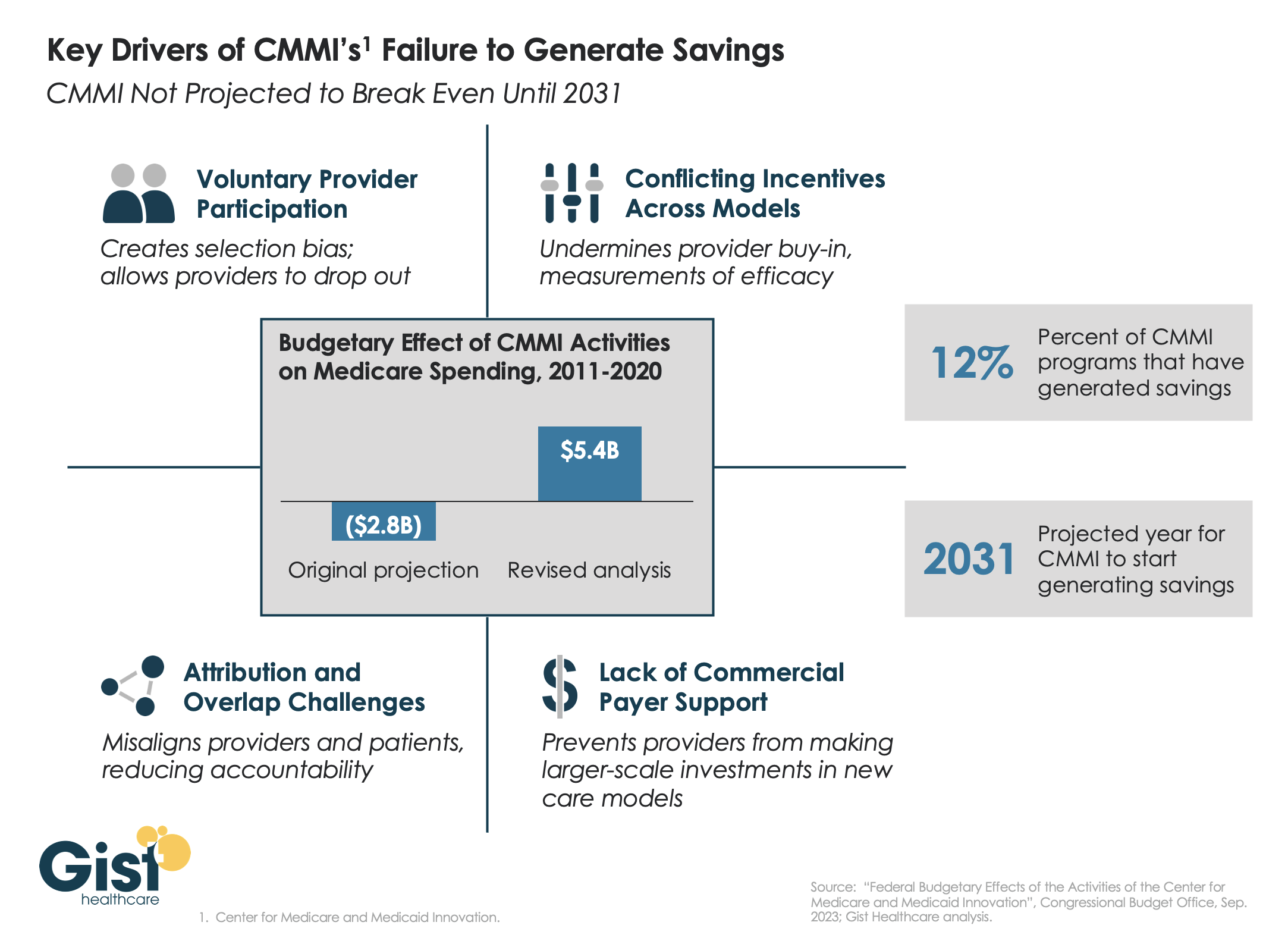
In this week’s graphic, we highlight the recent Congressional Budget Office (CBO) analysis of the budgetary impact of the Center for Medicare and Medicaid Innovation (CMMI), which has gotten off to a disappointing start. 

CMMI was created by the Affordable Care Act in 2010 to test new payment models and other initiatives for reducing the federal government’s healthcare costs, but of the nearly 50 models it has run, only four have become permanent programs. 

Originally projected to generate $2.8B in savings between 2011 and 2020, CMMI was responsible for a net spending increase of $5.4B, having achieved only one quarter of its projected Medicare savings. 

Moreover, the CBO predicts that CMMI won’t produce net annual savings until 2031. 

There are several factors to blame for CMMI’s initial shortcomings, including the lack of mandatory participation for providers, conflicting incentives across care models, patient attribution challenges between providers, and insufficient commercial payer support to scale new care models. 

CMMI intends to simplify its approach, according to its 2021 “strategy refresh”, which should address some of these issues, though requiring commercial payers to participate in new models seems unlikely.

However, despite the discouraging results so far, CMMI’s mission is still laudable and important, and the transition to value remains a key priority for federal regulators.

CBO Report finds CMMI hasn’t saved Medicare any money

https://mailchi.mp/9fd97f114e7a/the-weekly-gist-october-6-2023?e=d1e747d2d8

Late last week, the Congressional Budget Office (CBO) released its analysis of the Center for Medicare and Medicaid Innovation (CMMI)’s spending outlays, revealing that in its first decade of operations it produced a $5.4B net increase in federal spending instead of a projected $2.8B reduction. 

Moreover, CBO revised its CMMI projection for 2021-2030 from a $77.5B net spending reduction to a $1.3B increase, predicting CMMI may only begin to generate annual savings in 2031. CBO says its updated projections largely reflect revised expectations on CMMI’s ability to identify and scale models that actually reduce Medicare spending.

CMMI was created by the Affordable Care Act (ACA) in 2010 to test new payment models and other initiatives for reducing the federal government’s healthcare costs, but of the nearly 50 models it has run, only four have become permanent programs.

The Gist: This critical report confirms what many in the healthcare world already believed: the ACA’s value-based care initiatives have largely struggled to reduce Medicare spending. 

There are plenty of policy factors to blame, including the lack of mandatory participation for providers and conflicting incentives across care models, but one factor left out of the CBO report is CMMI’s disproportionate emphasis on accountable care organizations (ACOs) to produce meaningful cost savings, even as years of data proved otherwise. 

ACOs are designed to reduce spending primarily through utilization management, but research has shown that prices, not utilization, are responsible for the US’s high medical spend relative to other countries.

While CMMI’s mission is still laudable and important, the center must make good on its 2021 “strategic refresh” if it hopes to continue receiving Congressional support.

$1.7 trillion U.S. spending bill would not stoke inflation: Moody’s

Dive Brief:

  • The $1.7 trillion “social infrastructure” legislation passed by the House and now before the Senate would spur growth, expand employment and boost productivity with limited inflationary impact, according to Moody’s Investors Service.
  • The spending “would occur over 10 years, include significant revenue-raising offsets and would likely only start to flow into the economy later in 2022 at a time when inflationary pressures from disruptions to global supply chains and U.S. labor supply will likely have diminished,” Moody’s Vice President-Senior Analyst Rebecca Karnovitz said
  • “Investments in childcare, education and workforce development have the potential to boost labor force participation and increase productivity over the medium and longer term,” she said. While the Senate will likely insist on amendments, the Build Back Better (BBB) bill currently would invest $555 billion in clean energy and “climate resilience” and $585 billion in childcare, universal prekindergarten and paid family leave.

Dive Insight:

CFOs concerned about rising prices and the risk of a wage-price spiral have found sympathy from some lawmakers who warn that the $5.7 trillion in spending Congress has already approved during the pandemic will further stoke inflation.

“Inflation is hammering working families across America,” Senate Minority Leader Mitch McConnell told the chamber last week. The Kentucky Republican called BBB a “socialist wish list” and an inflationary “taxing and spending spree.”

Some Democrats — including Sens. Kyrsten Sinema of Arizona and Joe Manchin of West Virginia — have cautioned that excessive spending could push up prices and worsen the fiscal outlook.

Sinema and Manchin have said that they want less costly legislation. With Democrats holding the smallest possible Senate majority, support from the two senators is essential for final passage of the bill.

“I have been concerned about high levels of spending that are not targeted or are not efficient and effective,” Sinema told the Washington Post on Nov. 18 while noting rising inflation.

“The threat posed by record inflation to the American people is not ‘transitory’ and is instead getting worse,” Manchin said on Twitter this month after the Labor Department reported that consumer prices rose 6.2% in October on an annual basis.

CFOs face even higher price gains for wholesale goods. The producer price index for final demand, a measure of what suppliers charge, soared 8.6% in October from the prior year, according to the Labor Department. That was a record jump in a series of data first published in 2010.

The Moody’s analysis suggests that concerns about the impact of BBB on inflation and the U.S. fiscal outlook may be overblown.

“We expect the spending package to have a limited impact on inflation,” Moody’s said.

Referring to the U.S. credit outlook, Moody’s said, “we expect the legislation to have only a small effect on the sovereign’s fiscal position, given that the spending would be spread over a decade and the revenue-raising measures would help offset the impact on federal budget deficits.”

The Congressional Budget Office estimates that the House version of BBB would push up fiscal deficits by $367 billion over a 10-year period.

Yet the estimate excludes about $200 billion in revenue that would come from a provision in the bill funding tougher tax enforcement and collection, Moody’s said.

“Estimates of the bill’s impact on the deficit are likely to shift in accordance with provisions that may be stripped from the Senate’s final version of the legislation,” according to Moody’s.

Administration’s Handling of Coronavirus Threatens a Long Unemployment Crisis

https://www.americanprogress.org/issues/economy/news/2020/05/07/484795/trump-administrations-handling-coronavirus-threatens-long-unemployment-crisis/
The Trump Administration's Handling of Coronavirus Threatens a ...

On Friday, the Bureau of Labor Statistics will release employment numbers for April that are expected to show a tragic and historic increase in unemployment. Consensus estimates anticipate more than 20 million jobs lost and an unemployment rate of 16 percent—a figure that may well be an underestimate given that millions of people may not be looking for jobs, effectively exiting the labor force and reducing the labor force participation rate. Moreover, state-level unemployment claims data show that this economic pain is being felt across the country, with sharp rises in joblessness in every state. And Thursday’s jobless claims release suggests that job losses have continued at high levels since the April unemployment survey was taken.

While the immediate cause of this spike in joblessness is, of course, the necessary stay-at-home orders and social distancing measures taken to respond to the crisis, the rise in unemployment—and how long it lasts—cannot be separated from choices made by the Trump administration. In understanding the state of the economy, as well as what comes next, the following three elements of this crisis must be understood:

  1. The economic crisis we are facing—and the economic pain we expect in the months ahead—is the result of a failed public health response. The Trump administration ignored early warnings, misled the public, and made the coronavirus crisis worse. The fact that the administration bungled the testing regime early on in the crisis meant that the United States could never contain the virus, as other countries such as South Korea, New Zealand, and Taiwan have done. As a consequence of that failure, the United States has had to engage in social distancing that has meant economic shock in order to avoid significantly greater levels of infections and deaths. The depth and scope of the economic pain being felt is a consequence of the administration’s delayed response and complete failure take leadership during this crisis.
  2. The administration’s inability to put in place appropriate public health measures going forward—combined with its insistence that efforts to contain the virus should be lifted in the absence of those measures—is likely to not only prolong the public health crisis but also extend the economic pain. Rather than provide workers, businesses, and families the confidence that they can return to activity safely, the administration is taking steps that try to ignore the risk of infection, such as absolving employers of responsibility for worker safety through a liability shield or forcing workers to return to work even when they have concerns about their health. In this environment, we are likely to see decreased demand for some time to come because people will have little confidence in individual state reopening strategies disconnected from science—as we are already seeing across the country.
  3. By rejecting efforts that would support families, workers, and communities during this crisis, the administration and its allies in Congress are putting us on a path for continued double-digit unemployment even after the pandemic finally ends. Indeed, the Congressional Budget Office (CBO) projects that the unemployment rate—absent additional action—will be near 10 percent at the end of 2021, several months after they project social distancing as a result of the health crisis abates. By opposing efforts to provide sufficient aid to states and localities; relief to families and unemployed workers; and assistance to those struggling the most, President Donald Trump, Majority Leader Mitch McConnell (R-KY), and their allies are insisting on making this extended period of double-digit unemployment a reality.

There is an alternative path, however: Taking the necessary steps to address the public health crisis and ensure that people can go back to work safely and doing what is needed to address the immediate economic pain and avoid prolonged unemployment. As Congress and the administration consider an additional stimulus package, they should put in place necessary public health protections while providing robust aid to families, workers, and communities for as long as the crisis lasts. This will allow us to avoid double-digit unemployment from being a devastating reality for American families for the next year and a half or more.

Public health failures has driven unemployment up

The rise in unemployment over the past two months is a direct consequence of the public health crisis—one that could have taken a far less severe toll under an administration that had been better prepared for it and that had approached it more wisely. The Trump administration has failed to develop an evidence-based plan to end the coronavirus crisis. Instead, its mismanagement has resulted in widespread fear and uncertainty as to when it might be appropriate to reopen parts of the economy. President Trump did not take the pandemic seriously when cases first emerged in the United States; his administration failed to use the month of April—when the nation was largely shut down—to ramp up the testing, contact tracing, and other pieces necessary for the public health response. And now, Trump is pushing states to reopen too soon. Before people feel comfortable enough to once again venture out of their homes and reengage in work and other economic activities, we need to ensure the country has developed the necessary health infrastructure to allow us to gradually reopen our economy without sparking a second wave of infections.

The economic crisis cannot end until public health crisis is solved

The Trump administration and its allies are arguing that the way to solve the economic crisis is to open up the country, ending stay-at-home orders and engaging in aggressive efforts to force business to return to normal. But in the absence of public health measures that actually allow activity to return safely, the administration’s strategy appears to be one of “ignore and press on,” with potentially devastating results for workers and communities. This strategy includes:

  • Pushing communities to lift stay-at-home orders and other public health measures before sufficient testing, tracing, isolation and ongoing surveillance is in place
  • Forcing workers back on the job, even without sufficient personal protective equipment or workplace safety protections—whether by removing unemployment insurance for those who are recalled to unsafe situations or through executive actions such as those taken for the meatpacking industry
  • Proposing to absolve employers of the responsibility to keep workers and communities safe through blanket immunity from liability—a measure that would do nothing to keep workers safe or build confidence in economic reopening

These steps reflect an acceptance of elevated risks of transmission, and ultimately, death. And despite the president’s rhetoric, it will make it less likely that the economy can return faster.

First, it is clear that the public isn’t going to feel safe to return to normal economic activity absent additional public health measures. A recent Washington Post-University of Maryland poll found that “67 percent say they would be uncomfortable shopping at a retail clothing store, and 78 percent would be uncomfortable eating at a sit-down restaurant.” These results were similar both in states that had loosened restrictions and those that had not and is consistent with other data. As long as people are anxious that returning to normal activities could put them at risk of contracting the virus, the economy will be unable to recover.

Second, a strategy that fails to put in place the necessary protections against spreading the virus will increase transmission among the public, and especially workers, in ways that may force additional shutdowns and prolong the period of public health crisis. In sum, prolonged public health crisis equals a prolonged state of economic distress—extending the number of months with a job market like April’s. The best approach—an approach adopted by other countries who are faring better both with their health outcomes and their economic impacts—is a national plan to fight the virus that is based on testing, tracing, and isolation.

After the pandemic ends, double-digit unemployment will persist under the current course

The CARES act provided large, necessary relief to most Americans, including assistance for workers, families, and small businesses. But this assistance will run out before the economic emergency is behind us, forcing the economy into unnecessarily prolonged hardship.

Indeed, the measures in the CARES Act both leave important gaps and will expire long before the economy is expected to return to normal. States and localities are facing extreme budget shortfalls. If action is not taken before state budget deadlines on July 1, states are likely to begin implementing layoffs of teachers and first responders and service cuts in the coming months that will cause additional job loss. Expanded unemployment insurance benefits expire at the end of July, removing an important lifeline for those out of work. While the direct payments in the CARES Act provided important assistance to families, the $1,200 per person payment will not be enough to sustain households through a prolonged crisis. The initial Paycheck Protection Program (PPP) support for small businesses has run out, and a second round of funding may soon run out too. And in important areas such as housingfood assistancechild care, and health coverage, among others, the CARES Act failed to do enough to address the hardship being felt today, let alone over a prolonged crisis—even as it provided generous aid to corporations.

As a result, under baseline projections—those that assume no further action on the part of the government—double-digit unemployment is expected to be a feature of the economy for at least the next year and a half. As noted above, the CBO estimates that the unemployment rate will remain near 10 percent at the end of 2021—many months after they predict that social distancing due to the pandemic itself ends.

Yet the Trump administration and congressional Republicans have indicated that they are prepared to accept this reality, or at best, offer solutions that do nothing to shift it. White House economic adviser Kevin Hassett said that another round of coronavirus relief legislation might not be necessary, and chief economic adviser Larry Kudlow said on Sunday that nothing has been decided yet and that “there’s kind of a pause period right now” and that “we will wait and see.” Senator McConnell has dismissed state and local aid as a “blue state bailout,” despite pain being felt in all states.

To the extent the administration or its allies have signaled a desire to act, they have focused on measures that would be woefully insufficient to address the economic challenges we face. Aside from the liability shield, Trump has signaled a push for poorly targeted corporate tax cuts or a payroll tax cut that would fail to benefit those who are out of work. An illustrative example of Trump’s approach is his call for removing limits on corporate deductions for meals and entertainment—effectively allowing companies to deduct expenses for sports tickets, golf trips, or visits to casinos—which would provide a benefit to corporations and their wealthiest executives but do little to help put money in the hands of those who need it.

A better path: a response that meets the public health and economic challenge

As it considers another package to address this crisis, Congress has the opportunity to take a path that rejects double-digit unemployment as a lasting feature of this crisis. The approach Congress should take would allow economic activity to restart safely and ensure that, as the economy restarts, we are actually getting people back to work rather than accepting a recession that keeps millions unemployed.

First, that requires a sufficient public health response. The purpose of stay-at-home orders in the first place was to suppress transmission to low levels and buy time to put in place extensive testing and contact tracing programs, but we have yet to meet those goals. Nationally, we still need to increase our testing capacity and reach at least 500,000 tests a day; scale up contact tracing—both manually and by apps that meet privacy standards—in order to isolate people who test positive as well as their contacts; and have in place a far more robust disease surveillance system.

And second, it requires an economic response that offers relief that both addresses immediate pain that families, small businesses, and communities are facing and is sufficient to build back to a stronger economy.

In particular, the package must be:

  1. At a scale necessary to address the crisis. We need to pursue a fiscal response that is proportional to both the public health and economic threat posed by COVID-19. The economic consequences of this crisis are staggering. Children are going hungry; households are piling massive debts; millions of homeowners are delaying their mortgage payments; small businesses in hard hit states received fewer loans than others; minority small business owners are struggling to stay open; and state and local governments are preparing for significant layoffs of teachers and first responders in the absence of federal aid. Action needs to be sufficiently large to both address the immediate hardship that families are facing and get the economy back to work. This big push for aid has to be coordinated at the national, state, and local levels. An important lesson form the Great Recession was that austerity at the level of states and localities was a key factor in delaying economic recovery for years, since states were in austerity mode from 2008 until 2012, contributing to lower GDP growth. And, in contrast to concerns raised by some congressional Republicans—concerns that were absent during the passage of nearly $2 trillion in tax cuts in 2017—we have the fiscal capacity to respond robustly, especially with interest rates near zero. Indeed, evidence suggests that increased fiscal stimulus may increase fiscal sustainability.
  2. Sustained for the duration of the crisis. Relief must be sustained, automatic, and available with certainty for as long as it is needed. We should learn from the Great Recession, when stimulus was insufficient and removed too soon. During that crisis, unemployment insurance expired for many workers long before the crisis had passed; fiscal aid ended long before state and fiscal budget cuts ceased being a drag on the recovery. Key measures to support the economy, such as unemployment insurance, state and local aid, and direct relief to families, should automatically extend for the duration of the economic crisis—ensuring that we are providing sufficient relief and necessary stimulus as long as is needed to support a robust recovery.
  3. Targeted to all the areas where Americans are feeling economic hardship. There is no silver bullet that will bring the economy back. We need a multilayered attack that addresses the root cause of the problem—the spread of the virus—and ameliorates its symptoms in the form of hardship for families, workers, small businesses, and communities. Building off the CARES Act, additional aid needs to make sure it is reaching those who have been excluded. That requires ensuring that aid is more completely available—for example, ensuring that immigrant families can access needed relief or closing loopholes that prevent workers from having access to paid leave. It also means providing much needed assistance in areas such as food assistance, child care, housing, and for people with disabilities—areas that would both address concentrated harm and support the economy going forward. Finally, the package should be designed so that—rather than exacerbating structural problems in our economy that benefited corporations over workers—it puts us on a path for a stronger economy once the crisis ends.

The administration and its allies appear content to accept a prolonged period of public health and economic harm that is a result of the mismanagement of the COVID-19 crisis to date—essentially condemning the nation to a greater toll from the virus itself and a much longer period of economic distress. It must be clear that the harsh reality of the April jobs report—and the much broader pain that has been felt over recent weeks—was the result of both failed policy decisions and mismanagement. By the same token, we have the choice going forward as to whether we accept further pain or take steps that would both keep people healthy and get Americans back to work.